


Data handling for Class 1 teaches children how to collect, organize, and interpret simple information using tools like tally marks, tables, and picture graphs.
- What is Data Handling? A Simple Explanation for Young Learners
- Why is Data Handling Important for Class 1?
- The 4 Steps of Data Handling for Class 1
- Fun Data Handling Activities for Class 1
- How to Teach Tally Marks to Class 1 Students
- How to Introduce Pictographs to Young Learners
- Simple Data Handling Questions for Class 1 Practice
- Tips for Teachers and Parents
- Final Thoughts
It helps them answer questions such as “Which item appears the most?” or “How many more apples than bananas?”
The challenge most teachers and parents run into is knowing where to start.
In this guide, you’ll learn the basics of data handling, how tally marks and pictographs work, common mistakes children make, fun activities and worksheets to build confidence with real-world data.
What is Data Handling? A Simple Explanation for Young Learners
Data is just information. It’s the answer to any question.
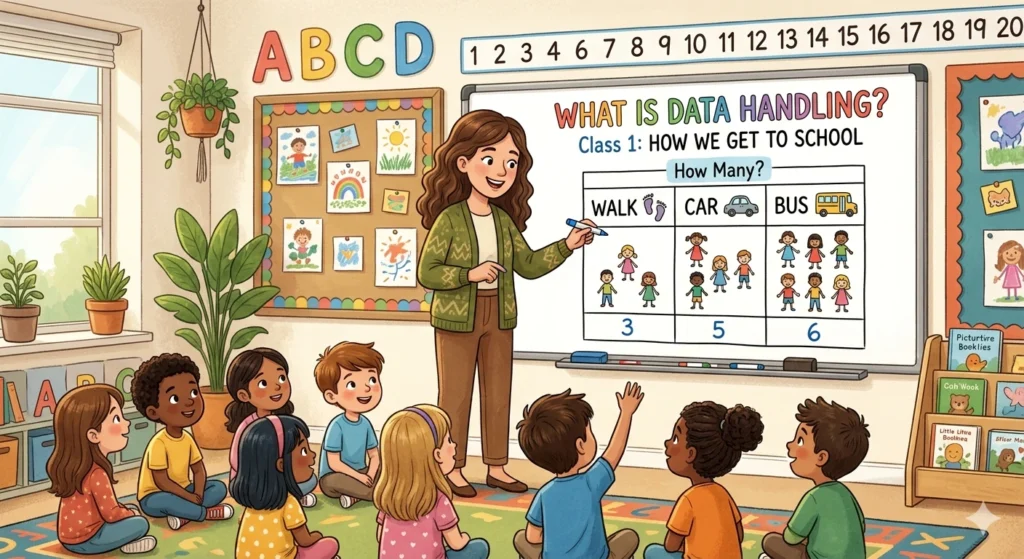
How many children are in class today? What fruit did everyone bring for lunch? Which color is the most popular? When we collect those answers and make sense of them, we’re handling data.
Here’s a quick story to make it real. Imagine you’re a Class 1 teacher on a Monday morning.
You ask your 20 students: “How did you get to school today?” Some walked. Some came by car. A few took a bus. You write it all down.
Then you count each group. Then you show it maybe with little drawings or a simple chart on the board.
By the end, every child can see that walking is the most common way. That whole process — collecting, sorting, counting, and showing is data handling.
It doesn’t need to involve computers, spreadsheets, or anything digital. At this level, data handling is about asking questions, gathering accurate answers, organizing what you find, and interpreting the results.
These are skills that connect directly to critical thinking activities for Grade 1 and form the logical foundation young children need across every area of math.
Why is Data Handling Important for Class 1?
Data handling builds logical thinking. When a child sorts objects by shape or size, they’re learning to notice what things have in common and what makes them different.
That’s the foundation of every kind of reasoning they’ll use for the rest of their lives.
It also connects math to the real world in an immediately obvious way. When children collect data about their own lives, their favorite fruits, their pets, how they travel to school the math isn’t abstract.
It’s about them. That personal connection makes it memorable.
From a cognitive development standpoint, children aged 5–7 can classify objects by one or two attributes and begin to use simple symbols to represent real things.
Tally marks and pictographs are perfectly matched to where their minds are at this stage.
The same visual-spatial thinking that helps children understand geometrical shapes in Grade 1 also helps them read and build simple charts.
Data handling also quietly teaches children to ask good questions which is one of the most important thinking skills there is.
The 4 Steps of Data Handling for Class 1
The best way to teach data handling is to follow a clear, logical sequence.
Don’t jump straight to charts. Build up from the very beginning every step prepares the child for the next one.
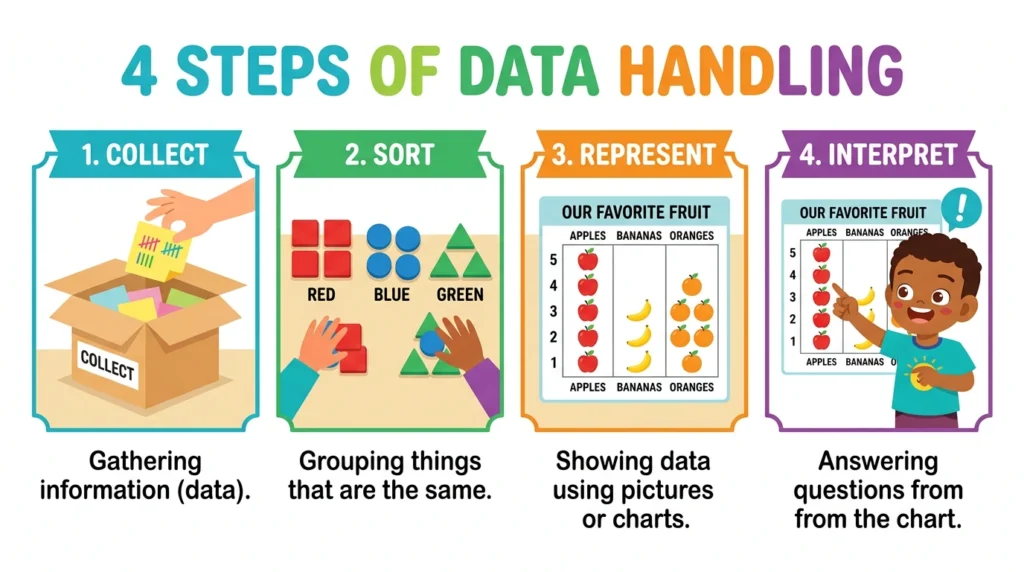
Step 1 — Collecting Data
Collecting data means gathering answers to a question. In Class 1, the question should be simple, concrete, and personally relevant to the children.
Good classroom example: ask the class, “How do you come to school?” Give each child a sticky note.
They write or draw their answers on walks, cars, buses, and bicycles. You collect all the notes. That’s your raw data.
Activity: The Morning Survey
- Objective: practice collecting answers from a group
- Materials: sticky notes, a large chart paper on the wall
- Instructions: ask one simple yes/no question “Do you have a pet?” Children place their sticky note under YES or NO on the chart. Count together as a class.
Keep the question to one clear choice between two or three options. More than three options is too complex for this age group.
Step 2 — Organizing Data
Once you’ve collected data, you need to sort it. This is where physical, hands-on work is especially powerful for young children.
Sorting means putting things into groups that belong together. Before you even introduce numbers, let children physically handle and move objects into categories.
This kind of classification thinking also shows up in sorting and odd one out activities if your students have done those, they already have the sorting instinct and data handling needs.
Activity: The Fruit Basket Sort
- Objective: sort real or plastic fruits by type
- Materials: a basket of mixed plastic fruits (or pictures of fruits), three labeled trays or circles on the floor
- Instructions: each child picks one fruit and places it in the correct group. Count each group together at the end.
You can extend this to sorting crayons by color, buttons by size, or toys by type. The key is that children are physically moving objects, not just watching.
Step 3 — Representing Data
Now comes the part where children show what they found visually. At Class 1 level, you’ll use three gentle tools: tally marks, pictographs, and a very simple bar chart.
Tally marks are a simple way of counting one line for each thing, with the fifth line drawn diagonally across the previous four. Children find them easy and satisfying to draw.
Pictographs use pictures or drawings to represent data. One picture equals one object. If four children like mangoes, you draw four mango pictures in a row.
A simple bar chart is just a column of colored blocks, stickers, or drawn squares one for each item in a category. No numbers on axes yet. Just visual height comparison.
Step 4 — Interpreting Data
Interpreting data means reading the result and drawing a simple conclusion. At this age, the questions should be very direct:
- Which group has the most?
- Which group has the least?
- How many are in this group?
- Are there more cats or more dogs?
Don’t ask children to calculate differences yet (“How many more?”) unless they’re ready. The goal at this stage is for them to read a chart or pictograph and tell you something true about it.
This kind of simple reasoning also builds the thinking children need for word problems for Grade 1 later in the year.
Fun Data Handling Activities for Class 1
Worksheets have their place, but the best way to introduce data handling is through doing. Here are five classroom-tested activities that children genuinely enjoy.
Activity 1: The Favourite Color Tally
Objective: practice collecting data and using tally marks
Materials: a large sheet of paper with four or five colors listed, a marker
Instructions:
- Ask each child: “What’s your favourite color?”
- Make a tally mark next to that color as they answer
- When everyone has answered, count the tallies together
- Ask: “Which color do most children like?”
Activity 2: The Weather Chart
Objective: build a data habit over a week by recording daily weather
Materials: a wall chart with days of the week and weather symbols (sun, cloud, rain)
Instructions:
- Each morning, one child marks what the weather looks like today
- At the end of the week, count how many sunny days, cloudy days, and rainy days there were
- Discuss: “What kind of weather did we have the most?”
Activity 3: The Sock Sort Game
Objective: practice sorting by attribute color or pattern
Materials: a bag of mixed socks cut from colored paper
Instructions:
- Tip the bag out on the floor
- Children sort the paper socks into groups (red, blue, striped)
- Count each group and record on the board
- Make a simple pictograph together one sock picture per item
Activity 4: The Story-Based Survey
Objective: use a story to introduce the idea of collecting information
Read a short story about a zookeeper who needs to find out which animal the children love most. Then pause and say: “Let’s help the zookeeper! We’ll collect data.” Children vote for their favourite zoo animal.
You tally the votes on the board together. This story-first approach gives data handling a purpose that children understand immediately when someone needs this information to make a decision.
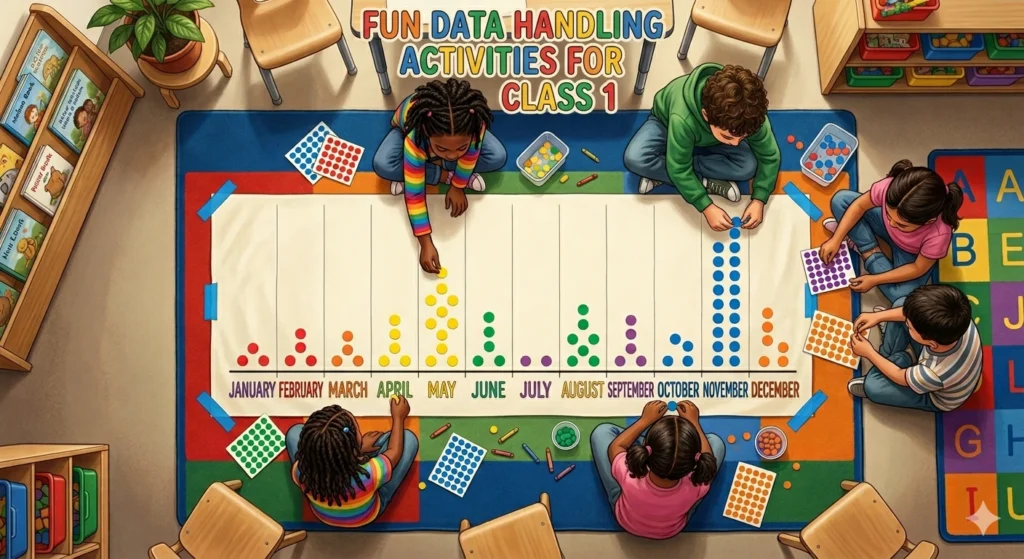
Activity 5: The Class Birthday Month Chart
Objective: build a simple bar chart using stickers
Materials: a chart with months across the bottom, sticker dots
Instructions:
- Each child places a sticker dot above their birthday month
- The sticker columns become a visual bar chart
- Discuss: “Which month has the most birthdays?”
How to Teach Tally Marks to Class 1 Students
Tally marks are one of those beautiful tools that look simple but teach children something important: we can represent counting with symbols.
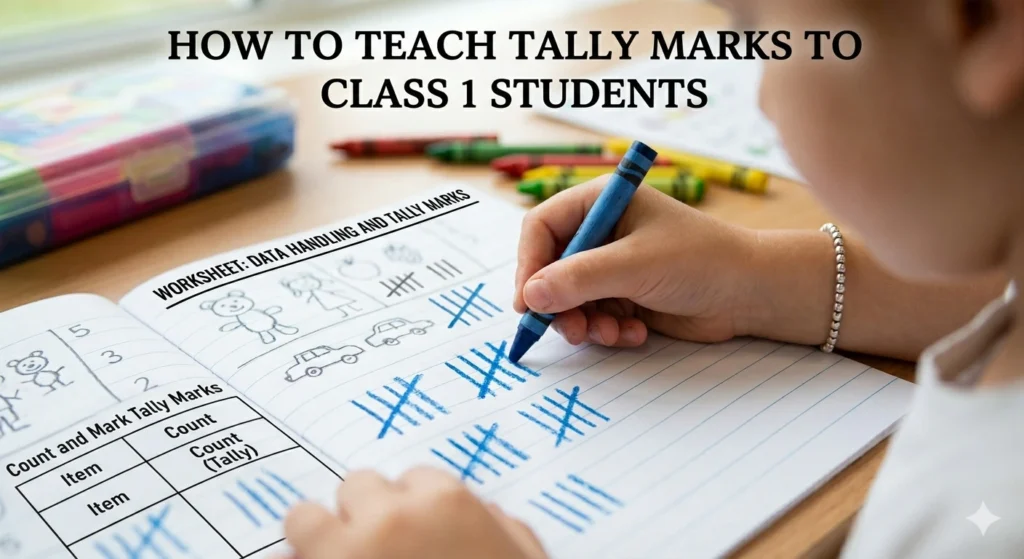
Here’s how to introduce them without overwhelming young learners.
Step 1: Start with fingers. Hold up one finger for each answer a child gives. Count aloud. Then say: “Let’s draw a line for each finger.” Draw one vertical line per answer on the board.
Step 2: Introduce the bundle of five. When you reach five, draw the diagonal line crossing the four. Say: “Five makes a bunch! It’s easier to count in fives.” Show how you count five tallies as one bundle.
Step 3: Practice together. Ask children to count how many classmates have short hair vs long hair. Let them take turns drawing a tally mark for each response.
Common mistakes children make and how to fix them:
- Drawing the crossing line too early (at 3 or 4) correct by counting together before drawing
- Making tallies too close together and losing track encourage spacing them out
- Forgetting to count the crossing line as a fifth mark
The fix for all of these is simply more physical practice. Let children use small whiteboards where they can erase and redo. Repetition without pressure builds the habit naturally.
How to Introduce Pictographs to Young Learners
A pictograph is a chart that uses pictures or symbols to represent data. One picture means one item.
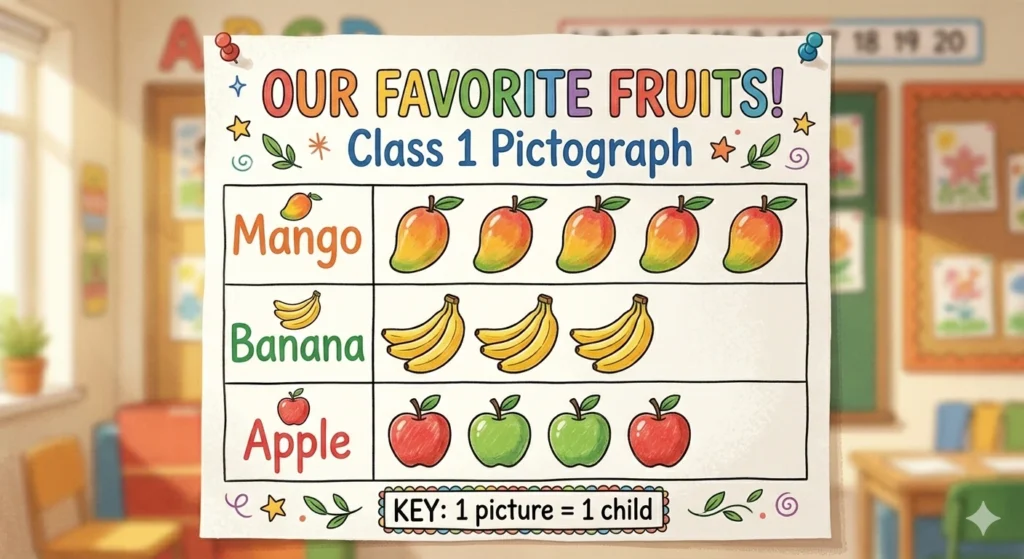
It’s the most visual form of data representation which makes it perfect for children who are just learning to read numbers.
How to introduce it step by step:
- Start with a real question: “How many children brought an apple for snack, and how many brought a banana?”
- Have children with apples stand in one line; children with bananas in another. Say: “Each of you is one picture in our chart.”
- On the board, draw one apple for each child who raised their hand. Draw one banana for each banana child.
- Point to the chart and ask: “Which row is longer? Which fruit is more popular?”
Sample pictograph Favourite Fruit Survey, Class 1A:
| Fruit | Votes |
| Mango | 🥭 🥭 🥭 🥭 🥭 (5 children) |
| Banana | 🍌 🍌 🍌 (3 children) |
| Apple | 🍎 🍎 🍎 🍎 (4 children) |
(Each picture = 1 child)
After making the chart, ask: “Which fruit got the most votes?” (mango) “How many children voted altogether?” (12) “Which fruit is least popular?” (banana)
One thing that confuses children at first is that one picture stands for one child, not one fruit in the world. Spend time on this.
Hold up one picture and say clearly: “This apple means one child chose an apple.”
Simple Data Handling Questions for Class 1 Practice
These questions work best verbally, with physical objects, or as guided classroom activities.
They increase slightly in complexity starting from the top if you’re working with very young beginners.
Q1 (Very easy sorting) “Here are 8 buttons: 3 red, 3 blue, 2 yellow. Can you put all the red ones together? All the blue ones? Now count each group.”
Q2 (Collecting) “Ask 5 friends: do you prefer drawing or playing outside? Write a tally mark for each answer. Which did more friends choose?”
Q3 (Reading a tally) “The teacher asked children about their pets. Cats: IIII I (6 tallies). Dogs: IIII (5 tallies). Fish: II (2 tallies). Which pet do most children have?”
Q4 (Reading a pictograph) “Row 1 has 4 star pictures. Row 2 has 2 star pictures. Row 3 has 6 star pictures. Which row has the most? Which has the least?”
Q5 (Comparing groups) “In a class survey: 7 children like football, 4 like cricket, 5 like running. Which sport is most popular? Which is least popular?”
Q6 (Building a pictograph) “Mango got 5 votes, Orange got 3, Grapes got 4. Draw one fruit picture for each vote. Label each row. Which fruit won?”
Q7 (Weather data) “The class recorded weather for 5 days. Sunny: 3 days, Rainy: 1 day, Cloudy: 1 day. Draw tally marks for each. Which weather happened most?”
Q8 (Simple interpretation) “10 children chose cats or dogs. Cats: 6 tally marks. Dogs: 4 tally marks. Which is more popular? How many children were asked altogether?”
Tips for Teachers and Parents
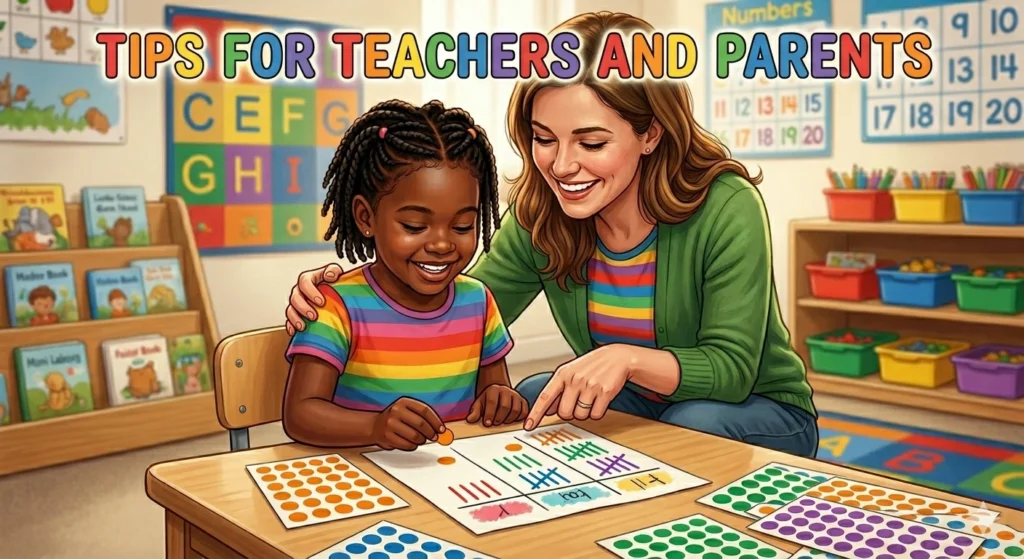
Keeping children engaged
Young children lose interest the moment something feels abstract. Keep data connected to things they care about: their names, their favorite things, their classroom.
The moment a child sees their own sticker on a chart, they’re invested.
Use movement wherever you can. Instead of filling in a worksheet, let them physically move to a side of the room (“Stand here if you like cats; stand there if you like dogs”).
Then count each group. The whole-body experience helps the concept stick.
Supporting very young or struggling learners (ages 5–6)
For children who aren’t yet confident with numbers, start with just two categories and very small counts no more than 5 in each group.
Spend longer at the sorting and grouping stage before moving to representation.
Use physical objects they can hold and move. A child who struggles with drawing a tally mark on paper might be perfectly capable of placing a block in a tower to represent data.
The concept is the same; the medium is more forgiving.
Pair struggling learners with a more confident peer for data collection activities. Peer teaching is surprisingly effective at this age explaining something to a friend cements understanding on both sides.
Assessing without written tests
You don’t need a test to know whether a child understands data handling. Observation during activities is your best assessment tool.
Watch whether the child can sort objects correctly, count each group accurately, and answer a simple “which has more” question by looking at a chart.
Ask individual children questions during the activity itself: “Can you show me the group with the most?” “How many tally marks are here?”
Their verbal responses tell you far more than a written worksheet at this age.
Common pitfalls to avoid
- Moving to pictographs before children are secure in sorting and grouping the representation means nothing if the underlying concept isn’t there
- Using too many categories at once two or three is enough for Class 1
- Skipping the physical, hands-on stage and going straight to drawn charts
- Asking “how many more” before children can reliably count each group
- Treating data handling as a one-day lesson it’s much better absorbed across several short sessions spread over two or three weeks
What is data handling for Class 1?
Data handling for Class 1 is the process of collecting simple information, sorting it into groups, counting each group, and showing the result using pictures, tally marks, or a basic chart. At this level, children learn to answer questions like “which group has the most?” using real-life examples such as favourite fruits, classroom surveys, or daily weather records.
What are examples of data handling for kids?
Simple examples include asking classmates about their favourite color and recording tally marks for each answer; sorting a basket of plastic fruits into groups and drawing one picture per fruit to make a pictograph; recording the weather every morning for a week and counting sunny, cloudy, and rainy days; or placing sticker dots above birthday months to build a simple bar chart.
How do you introduce data handling to young children?
The best starting point is a question: children care about something personal to their own lives. Ask something simple like “How did you get to school today?” Collect answers physically (sticky notes, raised hands, moving to different sides of the room). Sort and count together as a class, then show the result on the board using a simple pictograph or tally chart. Building from concrete experience to visual representation is the key.
What is a pictograph for Class 1?
A pictograph is a type of chart that uses pictures or drawings to represent data. In Class 1, one picture stands for one item. If five children like mangoes, you draw five mango pictures in a row. The chart lets children compare groups visually without needing to work with large numbers. It’s usually the first type of data display children learn after tally marks.
What are tally marks in data handling?
Tally marks are a simple counting symbol system. Each item is one vertical line. When you reach four lines, the fifth is drawn diagonally across making a bundle of five that’s easy to count at a glance. In Class 1, tally marks are used to record data as it’s collected, and counting the bundles gives the total quickly.
Make Preparing for Math Olympiad Simple!



Final Thoughts
Data handling for Class 1 doesn’t have to be intimidating for you or for your students.
Start with one question, one survey, and one tally chart on the board, and you’ll see young children engage immediately because the data is about their own lives.
The full progression collect, sort, represent, interpret follows naturally from there.
If you want to build on these foundational skills with structured, curriculum-aligned practice, explore what the Math Olympiad for Class 1.

Mikha Piregu is a Content Writer with experience spanning educational content, including math and math olympiad topics, as well as advocacy writing, research-based articles, and SEO-driven web content. He creates high-quality blog content, web copy, and feature articles that support brand visibility, audience engagement, and long-term organic growth through data-informed storytelling. Skilled in WordPress, WooCommerce, and modern digital tools, Mikha adapts content across various platforms, including blogs, websites, campaigns, and advocacy initiatives, with clarity and purpose. You can reach out to him at [email protected].

There are no comments posted here yet.
Sign in to leave a comment