


IOQM stands for Indian Olympiad Qualifier in Mathematics.
- What is the Full Form of IOQM?
- What is the IOQM Exam?
- From PRMO to IOQM — What Changed?
- The Indian Mathematics Olympiad Pathway
- IOQM Eligibility Criteria (Class 8–12)
- IOQM Syllabus Overview
- IOQM Exam Pattern and Marking Scheme
- How Difficult Is the IOQM?
- Registration, Fees, and IOQM 2026 Dates
- IOQM Cutoff Trends
- How to Prepare for IOQM — Beginner's Guide
- Best Books and Resources
- Common Mistakes to Avoid
- Benefits of Qualifying IOQM
- Conclusion
It’s the first-stage national exam in India’s Mathematical Olympiad programme and the starting point for students who dream of competing at the International Mathematical Olympiad (IMO).
This guide covers the IOQM full form, eligibility, syllabus, exam pattern, preparation strategy, recommended books, and common mistakes all in one place, explained simply.
What is the Full Form of IOQM?
IOQM stands for Indian Olympiad Qualifier in Mathematics.
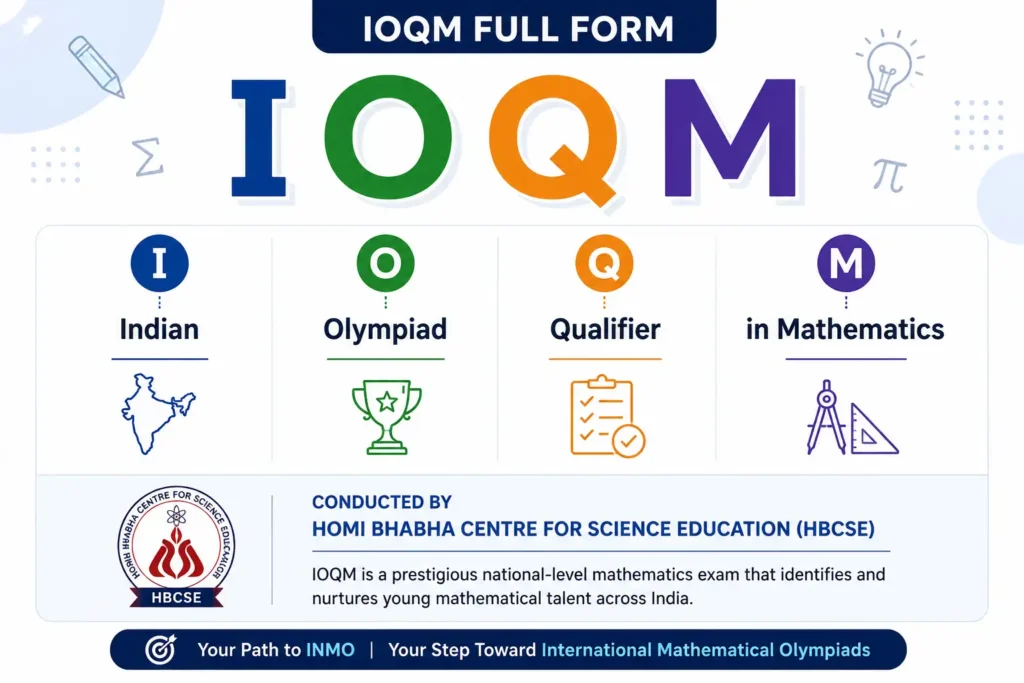
Breaking it down: “Indian” marks it as a national-level exam.
“Olympiad Qualifier” means it’s the gateway to higher Olympiad stages, and “in Mathematics” specifies its focus on mathematical reasoning and problem-solving not textbook calculations.
IOQM is jointly conducted by the Homi Bhabha Centre for Science Education (HBCSE) and the Mathematics Teachers’ Association of India (MTA(I)).
HBCSE operates under the Tata Institute of Fundamental Research and is India’s nodal centre for all Science and Maths Olympiad programmes.
What is the IOQM Exam?
IOQM is the entry-level exam in India’s Mathematical Olympiad programme.
It replaced the earlier Pre-Regional Mathematical Olympiad (PRMO) starting from the 2021 cycle.

Unlike school exams that test formula application, IOQM tests creative problem-solving in number theory, algebra, geometry, and combinatorics.
It’s open to school students across India typically Classes 8 to 12 and is conducted once a year.
Qualifying IOQM advances you to the Regional Mathematical Olympiad (RMO), which is the next step toward representing India at the International Mathematical Olympiad.
From PRMO to IOQM — What Changed?
Before 2021, the Olympiad pathway began with PRMO.
HBCSE restructured it into IOQM to streamline the selection process.

The core purpose is the same qualifying for RMO but the registration, format, and organisation were updated.
| Feature | PRMO (Old) | IOQM (Current) |
| Full Form | Pre-Regional Mathematical Olympiad | Indian Olympiad Qualifier in Mathematics |
| Conducting Body | MTA(I) under HBCSE guidance | HBCSE in association with MTA(I) |
| Year Introduced | 2017 | 2021 |
| Duration | 3 hours | 3 hours |
| Questions | 30 (integer-answer) | ~30 (integer-answer) |
| Total Marks | 102 | 100 |
| Registration | Through schools/MTA(I) | Online via HBCSE/MTA(I) portal |
If you see older resources mentioning PRMO, just know that IOQM is its current replacement.
The rest of the pathway (RMO → INMO → IMO) remains unchanged.
The Indian Mathematics Olympiad Pathway

Here’s how IOQM fits into the bigger picture:
Stage 1 → IOQM: National qualifying exam. Open to all eligible students. Score above the regional cutoff to advance.
Stage 2 → RMO (Regional Mathematical Olympiad): Region-wise exam with proof-based questions a significant step up.
You’ll need to write complete mathematical proofs, not just find answers.
Stage 3 → INMO (Indian National Mathematical Olympiad): National-level exam. Only a few hundred students across India reach this stage.
Stage 4 → IMOTC (International Mathematical Olympiad Training Camp): Intensive training by HBCSE. A final selection test picks the 6-member Indian team.
Stage 5 → IMO (International Mathematical Olympiad): India’s team competes against the best young mathematicians from 100+ countries.
Representing India at IMO is one of the highest academic honours a school student can achieve.
The key point: You can’t reach any of these stages without clearing IOQM first.
IOQM Eligibility Criteria (Class 8–12)
Eligibility is mainly age-based.
To apply, you must be an Indian citizen, study in a recognised Indian school, and be born on or after August 1 of the relevant eligibility year.
For the 2026 cycle, this is typically August 1, 2008, but it should be verified with the official HBCSE notification.

| Class | Eligible? | Readiness |
| Class 8 | Yes (if age criteria met) | Challenging but possible for strong students |
| Class 9 | Yes | Good starting point to build Olympiad skills |
| Class 10 | Yes | Ideal first serious attempt |
| Class 11 | Yes | Greater mathematical maturity helps |
| Class 12 | Yes (if age criteria met) | Last opportunity; strong maths background is an advantage |
For parents: Your child doesn’t need to be a math prodigy. If they enjoy solving tricky problems and show curiosity beyond the textbook, IOQM is worth exploring.
IOQM Syllabus Overview
IOQM covers four broad areas none of which require calculus:

Number Theory: Divisibility, primes, GCD/LCM, modular arithmetic, Euler’s theorem, Diophantine equations.
Algebra: Inequalities (AM-GM, Cauchy-Schwarz), polynomials, functional equations, sequences, algebraic identities.
Geometry: Triangles, circles, angle chasing, similarity, congruence, properties of special points (circumcentre, incentre, orthocentre). Emphasis on Euclidean geometry, not coordinate geometry.
Combinatorics: Counting principles, permutations, combinations, Pigeonhole Principle, basic graph theory.
Good news for younger students: you don’t need Class 11–12 school maths to start preparing.
IOQM Exam Pattern and Marking Scheme
| Feature | Details |
| Mode | Offline (pen and paper) |
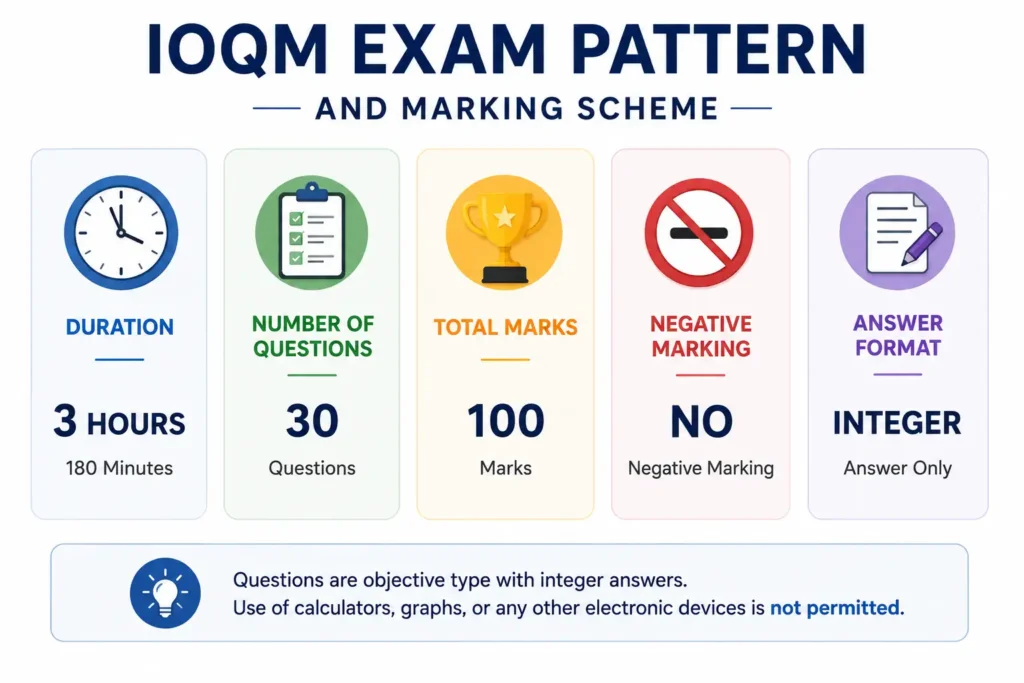
| Duration | 3 hours |
| Questions | ~30 |
| Question Type | Integer-answer (not multiple choice) |
| Total Marks | 100 |
| Marking | Different sections carry 2, 3, and 5 marks |
| Negative Marking | None |
| Calculator | Not allowed |
Since there’s no negative marking, attempting every question, even an educated guess costs you nothing.
With 30 questions in 180 minutes, budget roughly 2–3 minutes for easier problems and save extra time for the tougher ones.
How Difficult Is the IOQM?
IOQM is significantly harder than school maths and school-level Olympiads like SOF IMO.
School exams test whether you can apply formulas. SOF IMO adds logical reasoning but stays within the school curriculum.
IOQM requires creative mathematical thinking problems where no single formula works and you need to construct clever arguments or spot hidden patterns.
But it’s not impossible. Thousands of students qualify every year. With 6–12 months of focused preparation and the right resources, the difficulty becomes very manageable.
You need consistency, not genius.
Registration, Fees, and IOQM 2026 Dates

How to register: Watch for the official HBCSE notification on olympiads.hbcse.tifr.res.in → register online through the portal → pay the fee (~₹250–₹300) → download your admit card.
Some schools handle bulk registration, so check with your maths department.
IOQM 2026 expected timeline (based on previous years official dates pending):
- Registration window: June–August 2026
- Exam date: September 2026
- Results: 6–8 weeks after the exam
- RMO: October–November 2026
Bookmark the HBCSE Olympiad page and check from June 2026 onwards.
Don’t wait for dates to start preparing.
IOQM Cutoff Trends
Cutoffs are region-wise the qualifying score varies by region.
Based on past years, IOQM cutoffs for RMO qualification have generally fallen between 40 and 55 marks out of 100, depending on region and paper difficulty.
Aim for 50+ to be safe across most regions.
These figures are approximate and change yearly; always check official HBCSE results for confirmed cutoffs.
How to Prepare for IOQM — Beginner’s Guide

Step 1 — Build your foundation. Get comfortable with algebraic manipulation, integer properties, basic geometry, and counting techniques.
Your school maths is the starting point, but go deeper.
Step 2 — Learn Olympiad-specific topics. Study modular arithmetic, inequalities, the Pigeonhole Principle, Euclidean geometry techniques, and functional equations.
Work through recommended books chapter by chapter.
Step 3 — Solve previous year papers. There’s no substitute for actual IOQM and PRMO papers (2017–2025).
Start untimed, then simulate full exam conditions (3 hours, no calculator).
Step 4 — Take mock tests weekly. Mock tests reveal weak spots and build exam stamina.
Review every wrong answer, that’s where real learning happens.
Class-wise tips: Classes 8–9 should focus on foundations and start with number theory and combinatorics.
Class 10 is ideal for a first serious attempt. Classes 11–12 can leverage mathematical maturity but should set aside dedicated daily practice time.
Best Books and Resources

Number Theory: Challenge and Thrill of Pre-College Mathematics (Krishnamurthy et al.); Elementary Number Theory (David Burton).
Algebra: Inequalities: An Approach Through Problems (B.J. Venkatachala).
Geometry: Euclidean Geometry in Mathematical Olympiads (Evan Chen).
Combinatorics: Principles and Techniques in Combinatorics (Chen & Koh).
Overall: Mathematical Circles (Fomin, Genkin, Itenberg) excellent for beginners; An Excursion in Mathematics (Modak et al.).
Online: Previous year papers (freely available), Art of Problem Solving community, and Gonit App for structured Olympiad-style practice across all four topics.
Common Mistakes to Avoid

Starting too late. You need 4–6 months minimum. Begin early, even if slowly.
Skipping foundations. Jumping to Olympiad problems without solid basics leads to frustration.
Only reading solutions. Attempt every problem for at least 15–20 minutes before checking the answer.
Neglecting geometry. It’s a consistent scoring area. Don’t avoid it because it seems hard.
Never practising under time pressure. Simulate the full 3-hour exam regularly.
Juggling too many books. Pick 2–3 trusted resources and work through them deeply.
Benefits of Qualifying IOQM
Clearing IOQM advances you to RMO and potentially to INMO and IMO achievements that very few students in India reach.
But even if IMO isn’t your goal, the preparation itself is transformative. The problem-solving skills and mathematical maturity you build during IOQM prep directly help in competitive exams like JEE.
Top universities in India and abroad value Olympiad participation on applications.
And the analytical thinking you develop benefits every career path from engineering to finance to research.
You also join a community of students who genuinely love mathematics. That peer group can be incredibly motivating and becomes a lifelong network.
What is the full form of IOQM?
IOQM stands for Indian Olympiad Qualifier in Mathematics, conducted by HBCSE in association with MTA(I).
Is IOQM the same as PRMO?
No. IOQM replaced PRMO from 2021. It serves the same purpose as qualifying for RMO but with an updated format and registration process.
Can Class 8 students take IOQM?
Yes. Eligibility is age-based, not class-based. Class 8 students who are strong in maths can attempt it as valuable early exposure.
Is there negative marking in IOQM?
No. Attempt every question there’s no penalty for wrong answers.
How difficult is IOQM compared to SOF IMO?
IOQM is significantly harder. SOF IMO stays within school curriculum; IOQM requires creative problem-solving in topics like number theory and combinatorics that go beyond textbooks.
When is IOQM 2026?
Official dates haven’t been announced yet. Based on past years, expect the exam in September 2026. Monitor olympiads.hbcse.tifr.res.in for updates.
What happens after clearing IOQM?
You advance to RMO, then potentially INMO → IMOTC → IMO (International Mathematical Olympiad).
How should a beginner start preparing?
Strengthen basics in algebra, number theory, and geometry. Pick up Mathematical Circles or Challenge and Thrill of Pre-College Mathematics. Solve previous year papers. Give yourself 4–6 months. Use Gonit for structured Olympiad practice.
Make Preparing for Math Olympiad Simple!



Conclusion
IOQM, the Indian Olympiad Qualifier in Mathematics, is India’s most important entry-level Maths Olympiad, and it’s open to any student in Classes 8–12 who’s willing to put in focused effort.
The syllabus is learnable, the exam has no negative marking, and thousands of students qualify every year.
You don’t need to be extraordinary to start; you need to start.

Mikha Piregu is a Content Writer with experience spanning educational content, including math and math olympiad topics, as well as advocacy writing, research-based articles, and SEO-driven web content. He creates high-quality blog content, web copy, and feature articles that support brand visibility, audience engagement, and long-term organic growth through data-informed storytelling. Skilled in WordPress, WooCommerce, and modern digital tools, Mikha adapts content across various platforms, including blogs, websites, campaigns, and advocacy initiatives, with clarity and purpose.




There are no comments posted here yet.
Sign in to leave a comment