March 3, 2026
 5 min. read

Ordinal numbers represent the rank or position of an object or person. These numbers are also called positioning or ranking numbers.
Ordinal numbers for class 1 math indicate the position or order of an object in a list, such as first, second, or third.
They don’t tell how many objects there are—that’s the job of cardinal numbers, like one, two, or three. Unlike counting numbers, which answer “How many?”, ordinal numbers answer “Which one?”
Ordinal numbers help kids understand order and position, like who finished first in a race or what happened next.
What Are Ordinal Numbers in Simple Words?
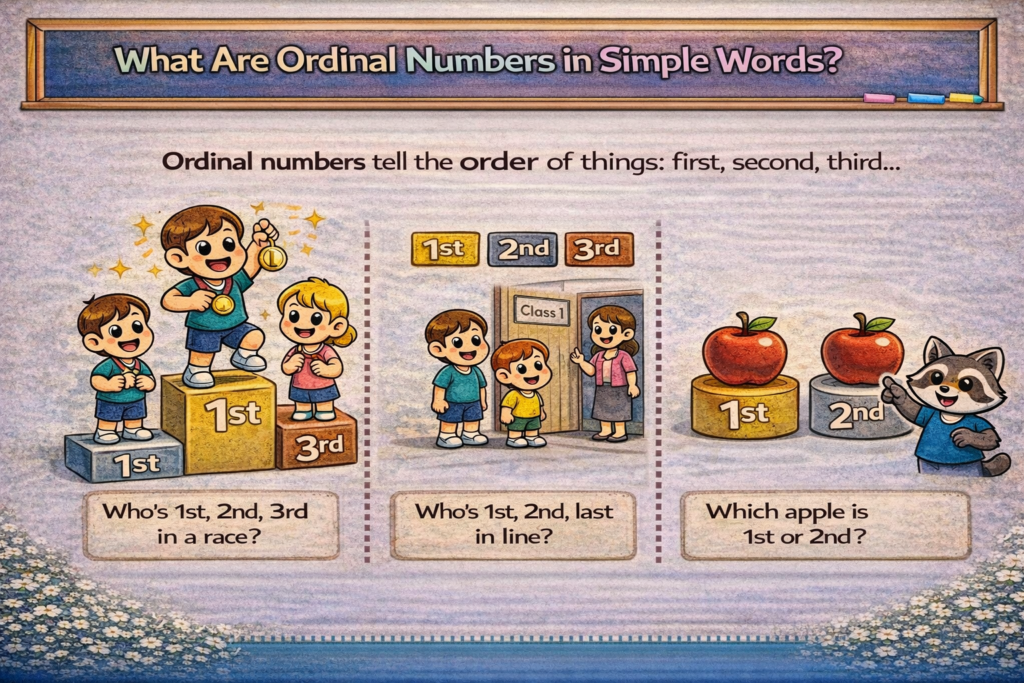
Ordinal numbers tell us the position or order of something, not the quantity. Words like first, second, and third show where a person or object stands in a sequence.
For example:
- In a race, ordinal numbers tell who came first, second, or third.
- In a line, they show who is first or last.
It’s important for children to understand the difference between counting numbers and ordinal numbers:
- Counting numbers answers “How many?” (e.g., three apples).
- Ordinal numbers answer “Which one?” (e.g., the first apple or the second apple).
This distinction helps children grasp the concept of ordinal numbers more clearly.
Examples of Ordinal Numbers Taught in Class 1
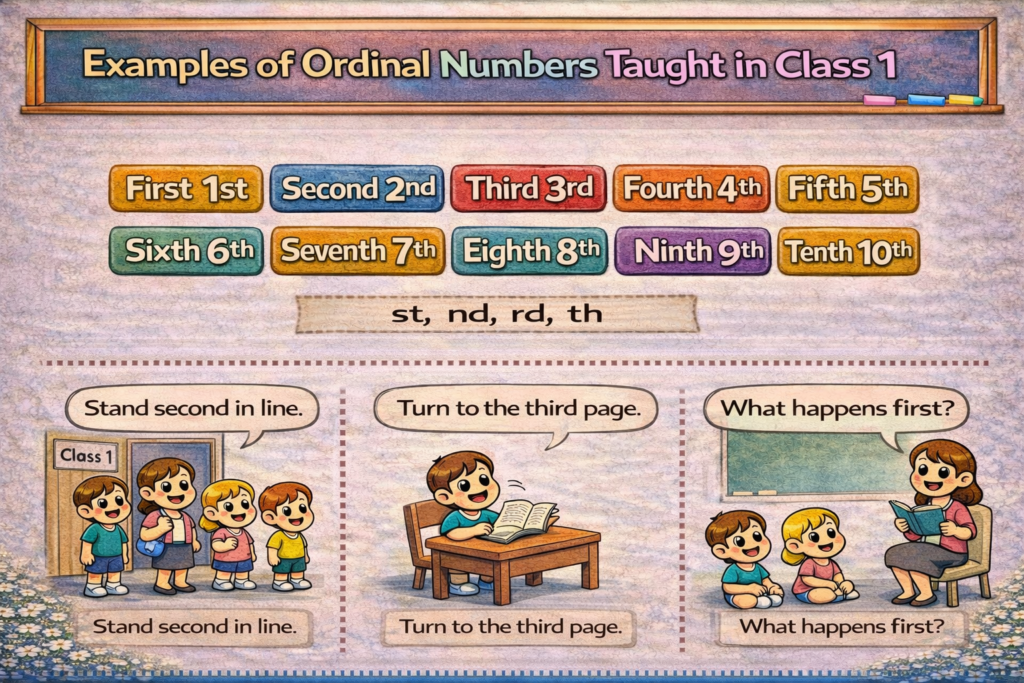
In Class 1, children start with basic ordinal numbers like first (1st), second (2nd), and third (3rd). These are the easiest for young learners to understand and use.
As they progress, students learn ordinal numbers up to tenth (10th), including:
- Fourth, fifth, sixth, seventh, eighth, ninth, and tenth.
Children also learn how to write ordinal numbers using endings like st, nd, rd, and th. For example:
- 1st, 2nd, 3rd, 4th, and so on.
Teachers often use ordinal numbers in daily activities, such as:
- “Stand second in line.”
- “Turn to the third page in the book.”
- “What happens first in the story?”
These practical examples help children understand and apply ordinal numbers naturally.
Why Are Ordinal Numbers Important in Class 1?
Ordinal numbers are important in Class 1 math because they teach order and position, not just counting. They help children understand how things are arranged.
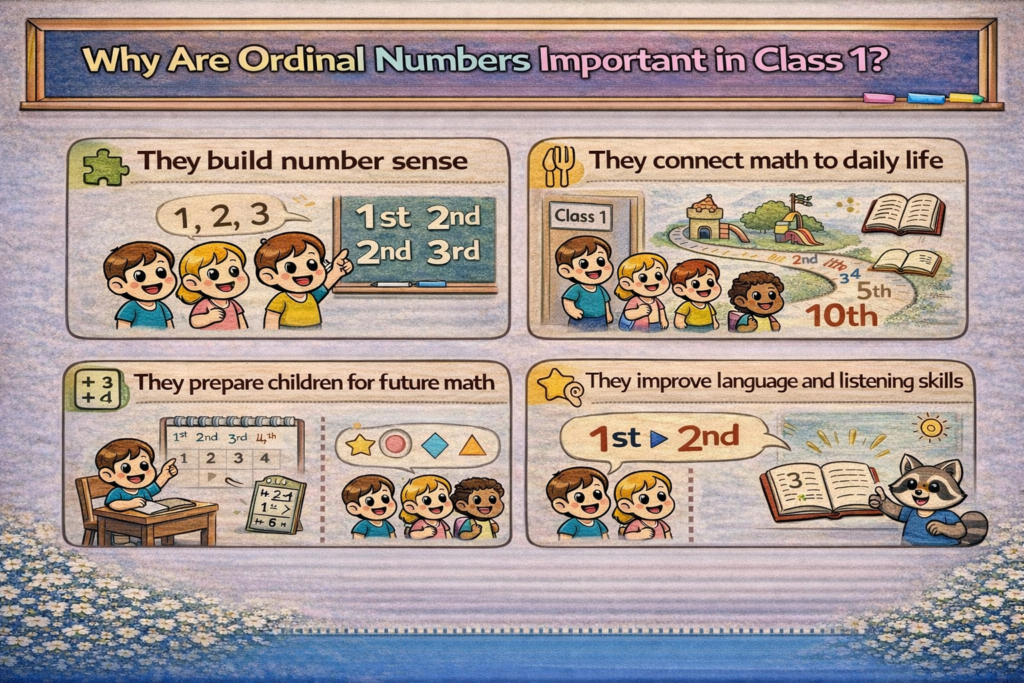
They build number sense
Words like first, second, and third help children see how numbers come in order.
They connect math to daily life
Children use ordinal numbers when lining up, taking turns, racing, or telling stories. This makes math easy to understand and fun.
They prepare children for future math
Learning order and position helps with number patterns, sequences, and problem solving later on.
They improve language and listening skills
Ordinal numbers help children follow simple instructions like “stand second in line” or “open the third page.”
They build confidence in class
When children understand order, they feel more confident during class activities and routines.
Ordinal numbers help Class 1 students move beyond basic counting. They build a strong math foundation and make learning meaningful.
Difference Between Cardinal and Ordinal Numbers
In Class 1 math, children learn two types of numbers:
- Cardinal numbers: Tell how many objects there are.
- Example: Three apples or five students.
- Ordinal numbers: Tell the position or order of something.
- Example: First apple, second student.
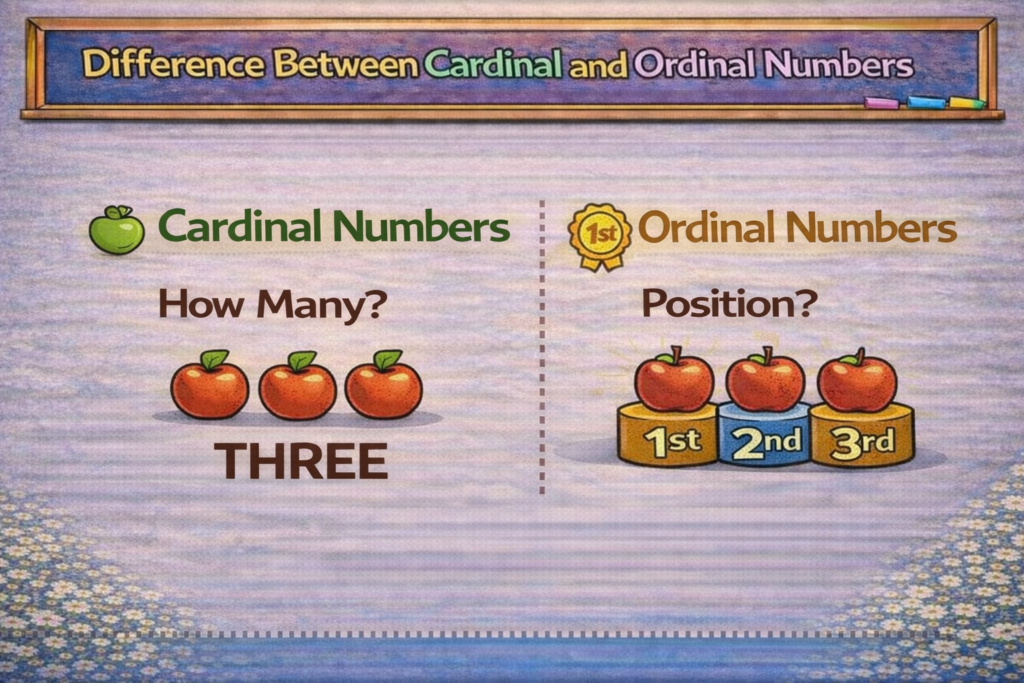
Here’s a simple comparison:
| Scenario | Cardinal (How Many?) | Ordinal (Position) |
| Race Finishers | 3 runners | 1st, 2nd, 3rd |
| Books on Shelf | 4 books | 1st, 2nd, 3rd, 4th |
| Class Line | 6 students | 1st to 6th in line |
By comparing these examples, children learn when to count and when to describe order.
Real-Life Examples of Ordinal Numbers
Ordinal numbers are part of everyday life, making them easy for children to understand through real experiences.
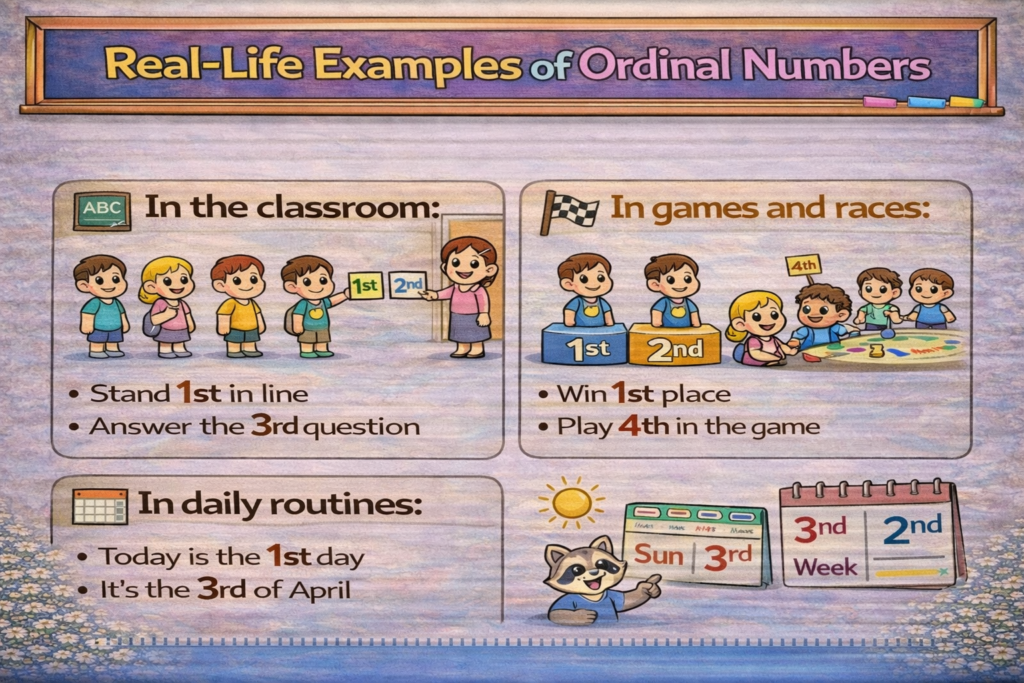
In the classroom:
- Teachers often say, “Stand first in line,” “Move to the second position,” or “The third student may enter.” These instructions help children grasp order naturally.
In games and races:
- Children learn ordinal numbers by seeing who came first, second, or third in a race.
- Taking turns in games, like being the fourth player, helps them understand sequence and practice patience.
In daily routines:
- Talking about the first day of the week, the third day of class, or the second week of the month connects ordinal numbers to time and planning.
These real-life examples make ordinal numbers fun and easy to remember.
Common Mistakes Children Make With Ordinal Numbers
It’s normal for Class 1 students to make mistakes while learning ordinal numbers. With practice and real-life examples, these errors improve over time.
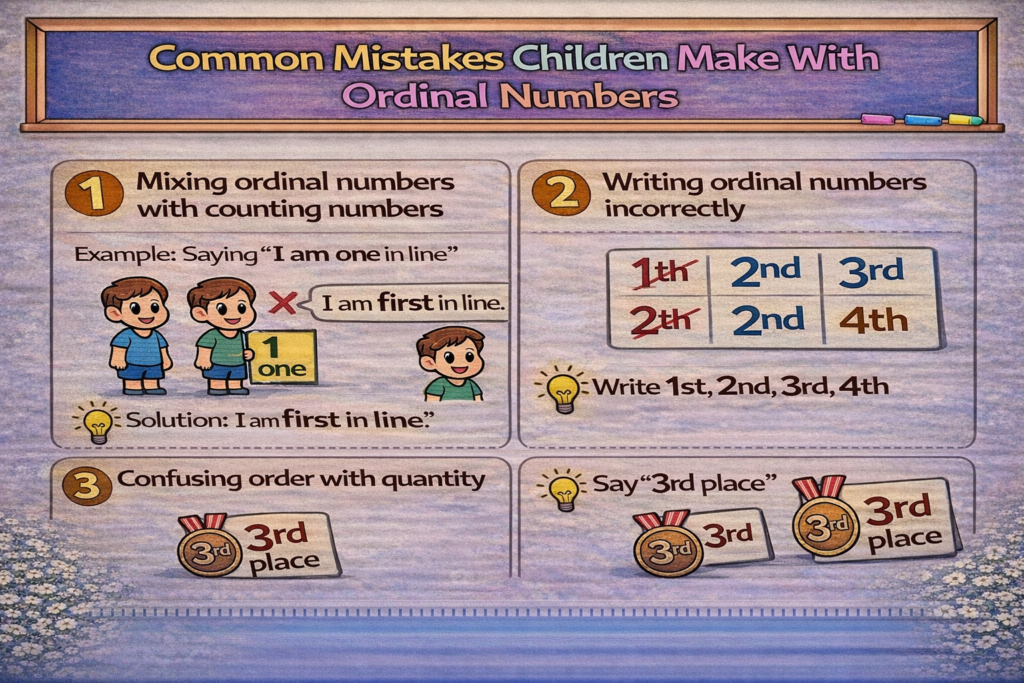
1. Mixing counting numbers with ordinal numbers
- Example: Saying “I am one in line” instead of “I am first in line.”
- Solution: Use side-by-side examples to show that one tells quantity, while first tells position.
2. Writing ordinal numbers incorrectly
- Example: Writing “1th” instead of “1st” or “2th” instead of “2nd.”
- Solution: Use charts, flashcards, and regular practice to reinforce correct forms.
3. Confusing order with quantity
- Example: Saying “three place” instead of “third place.”
- Solution: Use clear language during activities, asking “How many?” for quantity and “Which position?” for order.
With gentle correction and repetition, children gradually become confident in using ordinal numbers correctly.
Worksheets and Hands-On Activities for Ordinal Numbers
Using a mix of worksheets and hands-on activities helps children understand ordinal numbers better.
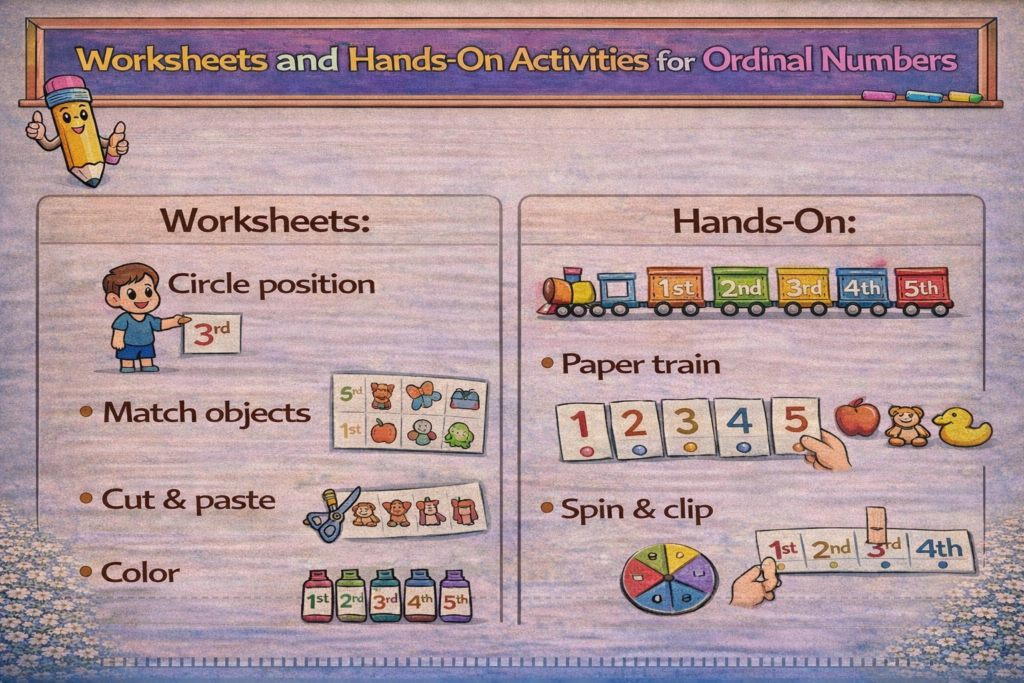
Worksheets:
- Focus on basic positions like first to fifth before moving to higher numbers.
- Activities include:
- Circling the correct position.
- Matching objects to 1st–10th.
- Cut-and-paste ordering.
- Coloring based on ordinal instructions.
Hands-On Activities:
- Create a paper train labeled 1st to 5th.
- Use number cards to arrange objects in order.
- Make spinners or clothespin activities to explore positions.
Use worksheets with movement activities. Ask children to stand in the third spot or point to the second object. This keeps learning fun and interactive.
Make Preparing for Math Olympiad Simple!



Conclusion
Ordinal numbers help Class 1 students understand position and order in a simple, meaningful way.
While small mistakes—like confusing one with first—are common, they improve with practice and real-life examples.
Parents and teachers can use fun and simple methods to teach ordinal numbers. Regular practice helps children understand them well.
These skills support future math learning and everyday problem solving.