 April 8, 2026
 14 min. read

The SOF IMO exam pattern for 2026–27 has four sections, two class groups, and zero negative marking.
Here’s the problem: students register for the IMO, start preparing, and then realise they have no clear picture of what the actual paper looks like.
- How many questions?
- Which section carries the most marks?
- How long do you have?
The confusion leads to scattered preparation, and scattered preparation leads to marks left on the table.
Before we get into the SOF IMO Exam Pattern, if you need context on the exam itself or what to study, our complete SOF IMO 2026–27 guide and class-wise syllabus breakdown have you covered.
This guide focuses specifically on the paper structure, marks distribution, and scoring strategy.
SOF IMO Exam Pattern at a Glance (2026–27)
The SOF IMO has two levels.
- Level 1 is the first round every registered student appears here at their own school.
- Level 2 is the advanced round, open only to top-performing Level 1 students.
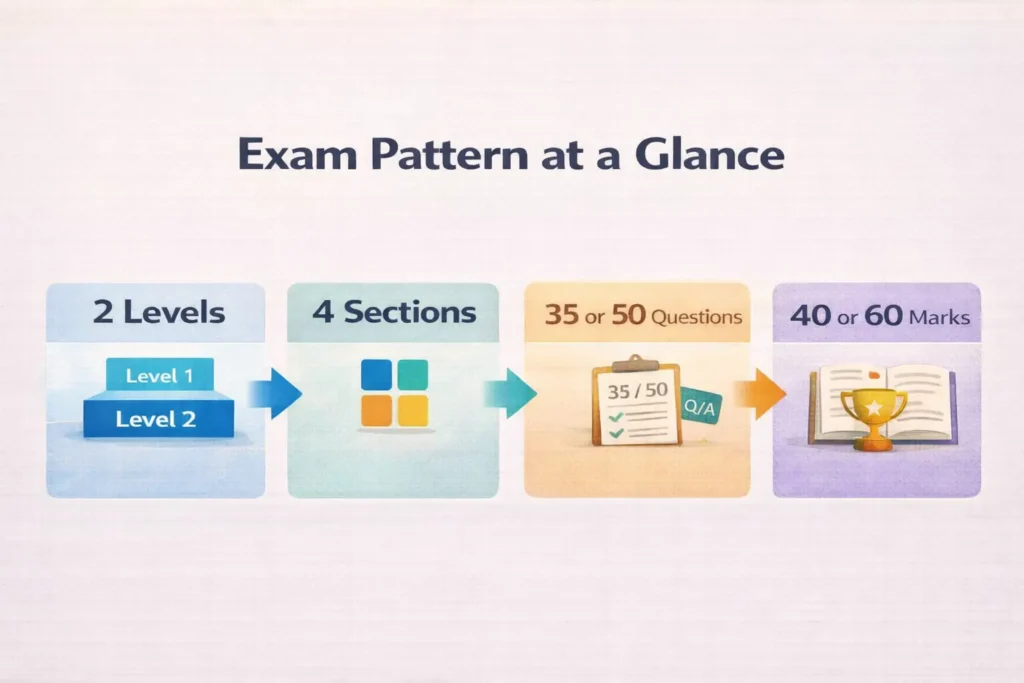
Both levels follow an MCQ (Multiple Choice Question) format.
There’s a fixed number of questions, defined marks per question, and a set exam duration.
SOF IMO Exam Pattern Overview — Level 1
| Class Group | Total Questions | Total Marks | Exam Duration |
| Classes 1 to 4 | 35 | 40 | 60 minutes |
| Classes 5 to 12 | 50 | 60 | 60 minutes |
Two things stand out immediately.
First, the paper is not the same across all classes, the volume and complexity jump significantly from Class 4 to Class 5.
Second, both groups have the same 60-minute duration, which means senior students are managing more questions in the same time window.
Level 2 has a different structure; we’ll cover that in detail in its own section below.
Section-wise Breakdown of the SOF IMO Paper
The SOF IMO Level 1 paper is divided into four sections (though the fourth is often discussed separately from the core three).
Understanding each section what it tests, how many marks it carries, and how hard it is the foundation of your exam strategy.
Section 1: Logical Reasoning
Logical Reasoning tests your ability to think, not just calculate.
Questions here involve pattern recognition, number series, analogy, classification, coding-decoding, mirror images, and spatial reasoning.
None of this is directly in your school textbook; it’s about how quickly and accurately your brain can process relationships and sequences.
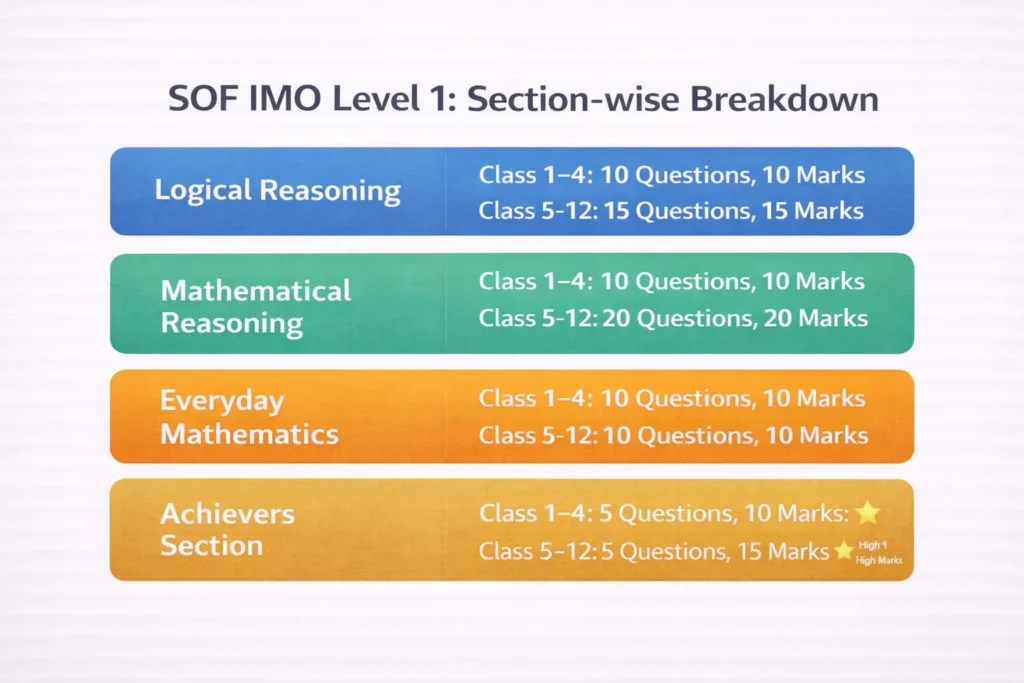
- Classes 1–4: 10 questions, 1 mark each (10 marks total)
- Classes 5–12: 15 questions, 1 mark each (15 marks total)
- Difficulty level: Low to moderate. Most students find this section manageable with practice
- Common question types: Odd one out, number/letter series, analogy pairs, direction sense, figure-based reasoning
This section is a great one to start with. It warms up your brain.
The questions are generally quicker to solve than math problems, and a strong Logical Reasoning score gives you a comfortable buffer early in the paper.
Section 2: Mathematical Reasoning
This is the heart of the IMO paper and the section that carries the most marks of any individual section.
Questions here are based directly on your school syllabus (CBSE/ICSE/State Board).
Expect topics like fractions, algebra, geometry, mensuration, number systems, probability, and more calibrated to your specific class.
- Classes 1–4: 10 questions, 1 mark each (10 marks total)
- Classes 5–12: 20 questions, 1 mark each (20 marks total)
- Difficulty level: Moderate. Difficulty scales with class level
- Common question types: Conceptual MCQs, word problems, application-based questions from the school curriculum
This section matters most for your raw score.
For Classes 5–12 students, 20 out of 50 questions that’s 40% of all questions come from here. Getting this section right is non-negotiable for a competitive score.
Section 3: Everyday Mathematics
This section bridges textbook math and real-world applications. Questions are set in everyday contexts: money, measurements, time, data interpretation, and practical problem-solving.
- Classes 1–4: 10 questions, 1 mark each (10 marks total)
- Classes 5–12: 10 questions, 1 mark each (10 marks total)
- Difficulty level: Moderate. Easier than Achievers, slightly more applied than Mathematical Reasoning
- Common question types: Word problems, data-based questions, contextual calculations
Section 4: Achievers Section
The Achievers Section is where the top scorers separate themselves from the rest.
Questions here test higher-order thinking concepts applied in unfamiliar ways, multi-step reasoning, and problems that go beyond your standard school preparation.
Here’s the critical difference: each question in the Achievers Section carries more marks than any other section.
- Classes 1–4: 5 questions × 2 marks each = 10 marks
- Classes 5–12: 5 questions × 3 marks each = 15 marks
- Difficulty level: High. These are the toughest questions in the paper
- Common question types: Advanced application problems, integrated concept questions, higher-order MCQs
With only 5 questions but disproportionately high marks, each Achievers question is worth 2–3 times a regular question.
That’s both the opportunity and the trap.
Students who spend too long chasing these questions early at the cost of simpler, guaranteed marks elsewhere often end up with a lower total score than those who do so only after completing the rest of the paper confidently.
Section-wise Marks Distribution — SOF IMO Level 1
| Section | Questions (Cl. 1–4) | Marks (Cl. 1–4) | Questions (Cl. 5–12) | Marks (Cl. 5–12) |
| Logical Reasoning | 10 | 10 | 15 | 15 |
| Mathematical Reasoning | 10 | 10 | 20 | 20 |
| Everyday Mathematics | 10 | 10 | 10 | 10 |
| Achievers Section | 5 (×2 marks) | 10 | 5 (×3 marks) | 15 |
| Grand Total | 35 | 40 | 50 | 60 |
Class-wise IMO Exam Pattern: How It Differs Across Grades
The SOF IMO isn’t one-size-fits-all. While the structure (sections + Achievers) remains consistent, the number of questions, total marks, difficulty level, and syllabus scope all change significantly based on your class.
The most important divide is between Classes 1–4 (junior level) and Classes 5–12 (senior level). Junior students face 35 questions for 40 marks.
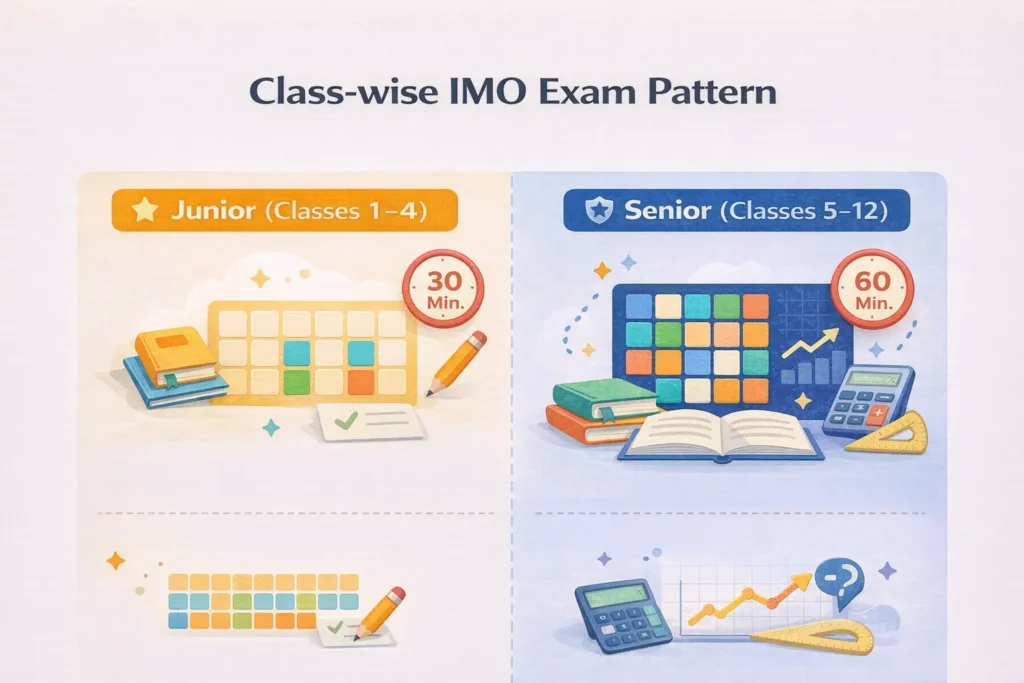
Senior students face 50 questions for 60 marks in the same 60 minutes. That’s a meaningful jump in pace, depth, and complexity.
Within each group, the syllabus itself also scales. A Class 3 student answering Mathematical Reasoning questions will face simple addition, shapes, and basic patterns.
A Class 10 student will face quadratic equations, trigonometry, and statistics. The section names are the same; the content inside them is class-specific.
Class-wise SOF IMO Exam Pattern Comparison (Level 1)
| Class | Total Questions | Total Marks | Achievers Marks/Q | Duration |
| 1 | 35 | 40 | 2 | 60 min |
| 2 | 35 | 40 | 2 | 60 min |
| 3 | 35 | 40 | 2 | 60 min |
| 4 | 35 | 40 | 2 | 60 min |
| 5 | 50 | 60 | 3 | 60 min |
| 6 | 50 | 60 | 3 | 60 min |
| 7 | 50 | 60 | 3 | 60 min |
| 8 | 50 | 60 | 3 | 60 min |
| 9 | 50 | 60 | 3 | 60 min |
| 10 | 50 | 60 | 3 | 60 min |
| 11 | 50 | 60 | 3 | 60 min |
| 12 | 50 | 60 | 3 | 60 min |
Note: The section labelled “Mathematical Reasoning” becomes “Mathematical Reasoning/Applied Mathematics” for Classes 11 and 12.
SOF IMO Level 1 vs Level 2: How the Pattern Changes

What Is Level 1?
Level 1 is the first round of the IMO, held at your school. Every registered student appears for Level 1.
The paper follows the four-section structure described above (Logical Reasoning, Mathematical Reasoning, Everyday Mathematics, Achievers Section).
What is Level 2?
Level 2 is the advanced round for top performers. Only students who qualify through their Level 1 performance are invited to appear.
Eligibility criteria: the top 5% of class-wise participants at school level, or students who score above a class-specific cut-off mark set by SOF each year. Class 1 and Class 2 students do not have a Level 2.
How the Pattern Shifts at Level 2
Level 2 has a simpler section structure but harder questions. The three-section math split of Level 1 is merged into a single broad Mathematics section, and the Achievers Section remains.
This means there’s less structural complexity but the questions themselves demand deeper conceptual understanding and stronger problem-solving ability.
SOF IMO Level 1 vs Level 2 Comparison
| Parameter | Level 1 | Level 2 |
| Who appears | All registered students | Top-performing Level 1 qualifiers |
| Classes eligible | 1 to 12 | 3 to 12 |
| Sections | LR + Math Reasoning + Everyday Math + Achievers | Mathematics + Achievers |
| Total Questions (Cl. 3–4) | 35 | 35 |
| Total Questions (Cl. 5–12) | 50 | 50 |
| Total Marks (Cl. 3–4) | 40 | 40 |
| Total Marks (Cl. 5–12) | 60 | 60 |
| Duration | 60 minutes | 60 minutes |
| Difficulty | Moderate | High |
The Level 2 paper for Classes 5–10 has 45 Mathematics questions (1 mark each) + 5 Achievers questions (3 marks each) = 50 questions, 60 marks.
For Classes 11–12, it’s 25 Mathematics + 20 Mathematical Reasoning/Applied Mathematics + 5 Achievers (3 marks each) = 50 questions, 60 marks.
Does SOF IMO Have Negative Marking?
No. The SOF IMO does not have negative marking at Level 1 or Level 2. There is no penalty for a wrong answer, only correct answers earn marks.
This has a direct strategic implication: you should attempt every single question. Leaving a question blank guarantees zero.
Attempting it gives you at minimum a 1-in-4 chance on a typical MCQ. Given that there are no marks deducted for wrong answers, an educated guess is always better than no attempt at all.
For students who are unsure of an answer, the best approach is to eliminate obviously wrong options, make the best guess from what remains, and move on, never leave a question unanswered.
SOF IMO Scoring Strategy: How to Maximize Your Marks
Understanding the pattern is step one. Using it to build a smart attempt strategy is what separates a good score from a great one.
Which Section Should You Attempt First?
Here’s a pattern-based recommended attempt order for Classes 5–12:
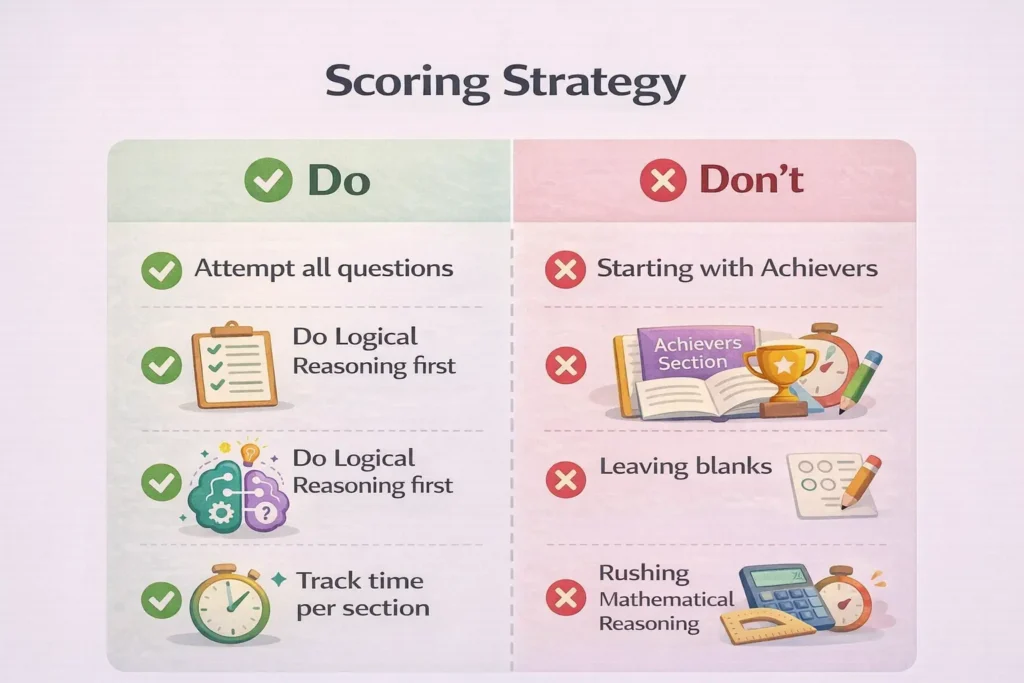
1. Logical Reasoning → 2. Mathematical Reasoning → 3. Everyday Mathematics → 4. Achievers Section
Why this order? Logical Reasoning questions are often quicker to solve and serve as a strong warm-up.
Mathematical Reasoning carries the highest number of regular marks (20 questions, 20 marks) doing it while you’re fresh and focused maximises accuracy here.
Everyday Mathematics is contextual and generally manageable. The Achievers Section should come last and tackle it after you’ve locked in all the “safer” marks.
Resist the urge to jump to the Achievers Section first because the marks-per-question look attractive. They’re harder questions.
Spending 8 minutes on one Achievers question when you could have answered 5 regular questions correctly is a poor trade.
How to Allocate Your Time During the Exam
You have 60 minutes for the full paper. Here’s how to distribute it effectively:
Suggested Time Allocation — SOF IMO Level 1
| Section | Classes 1–4 (35 Qs, 40M) | Classes 5–12 (50 Qs, 60M) |
| Logical Reasoning | 10 minutes | 12 minutes |
| Mathematical Reasoning | 12 minutes | 18 minutes |
| Everyday Mathematics | 10 minutes | 10 minutes |
| Achievers Section | 12 minutes | 12 minutes |
| Buffer / Review | 6 minutes | 8 minutes |
| Total | 60 minutes | 60 minutes |
For Classes 5–12: that’s roughly ~1 minute per regular question and ~2.5 minutes per Achievers question.
If you find yourself spending more than 2 minutes on any single regular question, mark your best guess and move forward.
Where Most Students Lose Marks And How to Avoid It
Spending too long on hard questions early. The paper is not meant to be solved in difficulty order, it’s meant to be solved in your order. If a question is taking too long, skip and return.
Rushing the Mathematical Reasoning section. Since it carries the most raw marks, a careless error in this section hurts more than anywhere else. Don’t rush it; it deserves your most careful attention.
Ignoring Logical Reasoning practice. Many students focus entirely on math and neglect Logical Reasoning because “it’s not in the syllabus.” That’s 10–15 guaranteed marks sitting on the table. Treat it as a scoring opportunity, not an afterthought.
Leaving the Achievers Section blank. Even if you’re not confident, make an attempt. With no negative marking, there’s nothing to lose.
Common Mistakes Students Make During the SOF IMO Exam
These aren’t generic warnings they’re specific to how the IMO paper is structured:
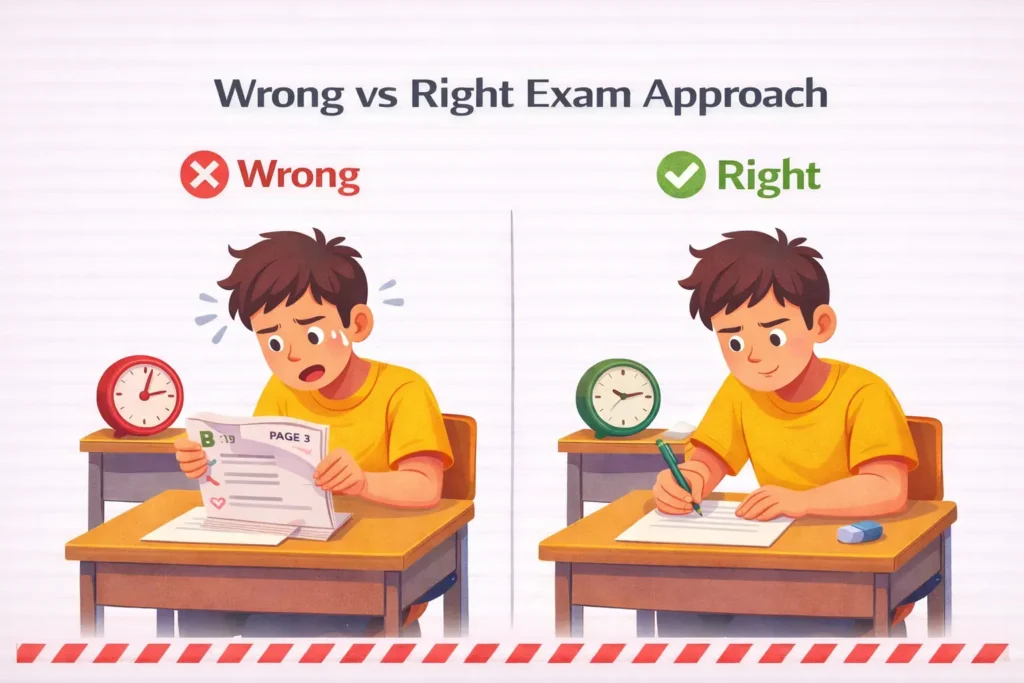
1. Starting with the Achievers Section. The 3-marks-per-question allure is real but these are the hardest questions. Starting here drains time and confidence before you’ve secured the easier marks.
2. Skipping Logical Reasoning in preparation. Students preparing only from math textbooks are often caught off-guard by Logical Reasoning questions. The section isn’t tested in school; it needs its own dedicated practice.
3. Confusing Mathematical Reasoning with “all of maths.” The Mathematical Reasoning section follows your school syllabus.
Students from CBSE schools should ensure they’ve covered every chapter of their current class Olympiad papers, often pick from chapters students consider “done and dusted.”
4. Not reading Everyday Mathematics questions carefully. These are word problems. Misreading the context (e.g., reversing a unit, missing a “not”) can flip a correct answer into a wrong one. Slow down slightly here.
5. Guessing randomly on hard questions without elimination. Since there’s no negative marking, every guess should be an informed guess. Cross out at least 1–2 obviously wrong options before picking.
6. Not managing time actively. Students who don’t track time section-by-section often end up with 10 minutes left and 15 questions unanswered. Keep a mental checkpoint at the 30-minute mark.
7. Ignoring the pattern difference between Level 1 and Level 2. Students who qualify for Level 2 and prepare using Level 1 resources are in for a shock.
Level 2 drops Logical Reasoning and Everyday Mathematics as separate sections; it’s a heavily math-intensive paper with a single merged Mathematics section.
How to Prepare Using the Exam Pattern
The IMO exam pattern tells you exactly where to invest your preparation time. Here’s how to use that information:

Logical Reasoning: This section has no textbook. The best preparation is consistent exposure to reasoning question types through practice papers.
Spend 15–20 minutes, 3–4 times per week, working through series, analogies, and figure-based problems. You’ll notice improvement within a few weeks.
Mathematical Reasoning: This is your school syllabus but applied at a sharper level. Don’t just study for your class tests.
Solve from the perspective of “how would this concept appear as an MCQ?” Work through previous year IMO papers chapter by chapter, class by class. Pay attention to which chapters appear more frequently.
Everyday Mathematics: Practice word problems. Real-world math (money, measurement, data) requires you to carefully translate a scenario into an equation.
The mistake is always in the reading, not the calculation.
Achievers Section: This is where mock tests become invaluable. Previous year Achievers questions are your best resource.
You’ll find that many are not impossibly hard; they just require two or three steps of thinking instead of one. Practice working through multi-step problems without panicking.
Timed Mock Tests: You must practice under exam conditions. Knowing the content is not enough pacing yourself across 50 questions in 60 minutes is a skill that must be developed, not assumed.
Platforms like Gonit App are built specifically around the SOF IMO pattern, giving you section-wise practice, timed mock tests, and class-specific question sets so you can rehearse exactly the way the exam is structured. Try Gonit App for free →
Make Preparing for Math Olympiad Simple!



What is the SOF IMO exam pattern for 2026–27?
The SOF IMO Level 1 exam consists of four sections: Logical Reasoning, Mathematical Reasoning, Everyday Mathematics, and Achievers Section. Students in Classes 1–4 answer 35 questions for 40 marks. Students in Classes 5–12 answer 50 questions for 60 marks. All questions are MCQ format. The exam duration is 60 minutes for all classes.
How many questions are there in the SOF IMO exam?
Classes 1 to 4 have 35 questions in Level 1. Classes 5 to 12 have 50 questions. At Level 2, the question count is the same (35 for Classes 3–4, 50 for Classes 5–12), but the section structure changes.
What are the sections in the SOF IMO paper?
The Level 1 paper has four sections: Logical Reasoning, Mathematical Reasoning, Everyday Mathematics, and the Achievers Section. At Level 2, these merge into a single broad Mathematics section plus the Achievers Section.
How many marks does the Achievers Section carry?
For Classes 1–4, the Achievers Section has 5 questions worth 2 marks each a total of 10 marks out of 40. For Classes 5–12, it has 5 questions worth 3 marks each a total of 15 marks out of 60. This is the only section where each question carries more than 1 mark.
Is there negative marking in SOF IMO?
No. The SOF IMO does not have negative marking at any level. Only correct answers earn marks. You should attempt every question, even if you’re unsure an educated guess is always better than leaving a question blank.
How long is the SOF IMO exam?
The exam duration is 60 minutes for all classes, at both Level 1 and Level 2.
What is the difference between SOF IMO Level 1 and Level 2?
Level 1 is open to all registered students and is held at their school. Level 2 is an advanced round for top Level 1 qualifiers. The paper structure is different: Level 2 replaces the three separate math-based sections of Level 1 with a single merged Mathematics section, making it a harder, more condensed test of mathematical ability.
Which section should I attempt first in the IMO exam?
The recommended order for Classes 5–12 is: Logical Reasoning → Mathematical Reasoning → Everyday Mathematics → Achievers Section. This ensures you secure the more accessible marks first and approach the toughest (highest-value) questions last, with remaining time.
How is the SOF IMO exam pattern different for different classes?
Classes 1–4 face 35 questions totalling 40 marks, with Achievers questions worth 2 marks each. Classes 5–12 face 50 questions totalling 60 marks, with Achievers questions worth 3 marks each. The syllabus within each section is also calibrated to the specific class, so content difficulty increases significantly from Class 1 to Class 12.
How can I practise for the SOF IMO exam pattern?
Use previous year SOF IMO question papers for your class, take full-length timed mock tests, and practise each section separately before combining them. Pay special attention to Logical Reasoning, which is not covered in school textbooks. Platforms like Gonit App offer class-specific, section-wise practice aligned to the exact IMO pattern. Try Gonit App for free →
Conclusion
The complete SOF IMO exam pattern for 2026–27 verified section counts, marks per question, class-wise differences, and a timed strategy that reflects how the paper actually works.
The pattern is fixed. What changes is how well you use it.
Start with the sections that guarantee marks, build your Achievers Section skills last, and always practise under timed conditions. That’s what toppers do differently.