 April 2, 2026
 13 min. read

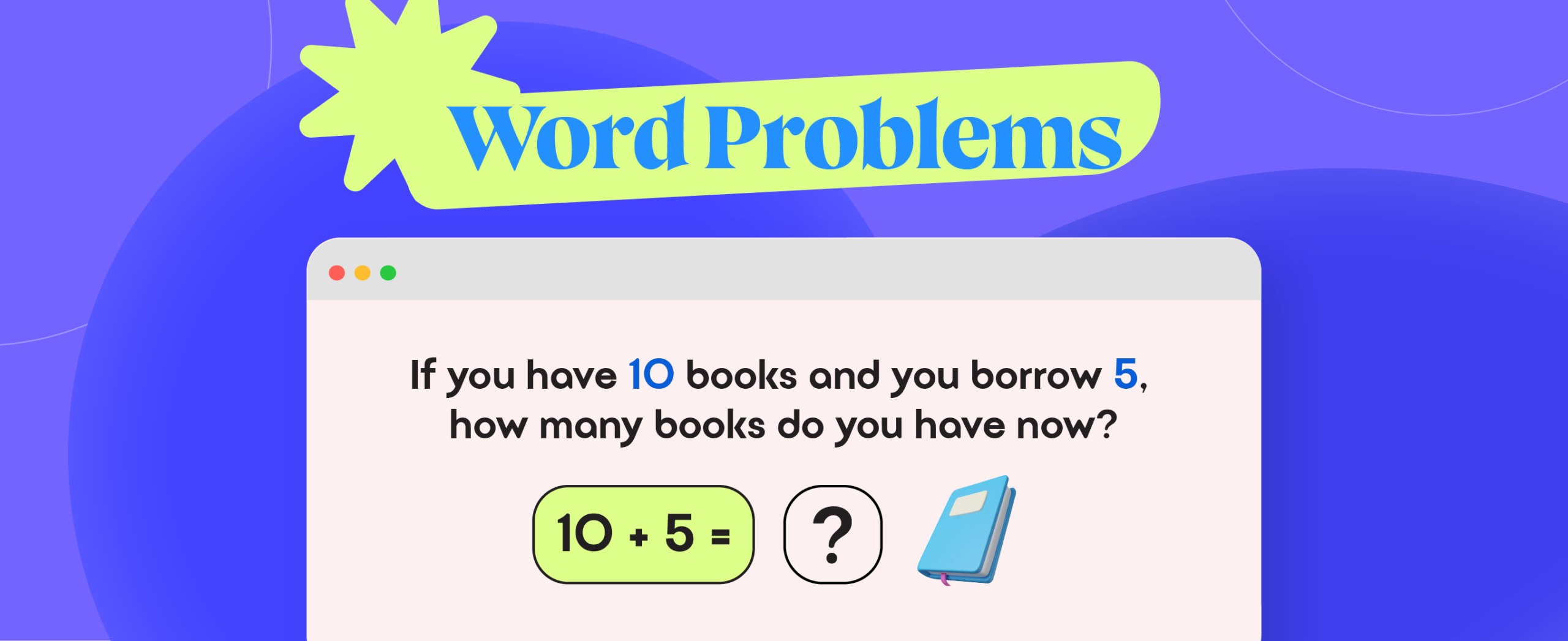
Word problems for kids are short math questions written as little stories.
Instead of asking ‘3 + 2 = ?’, they ask: “Riya has 3 apples. Her friend gives her 2 more.
How many does she have now?” Same maths but wrapped in a real situation, a child can picture.
This guide covers everything: what word problems are, how to solve them step by step, and graded examples for kids so your child always has problems at exactly the right level.
What Are Word Problems for Kids in Simple Word?
A word problem is a maths question presented as a short story or real-life situation. It gives information in sentences and asks the child to find a missing number using that information.
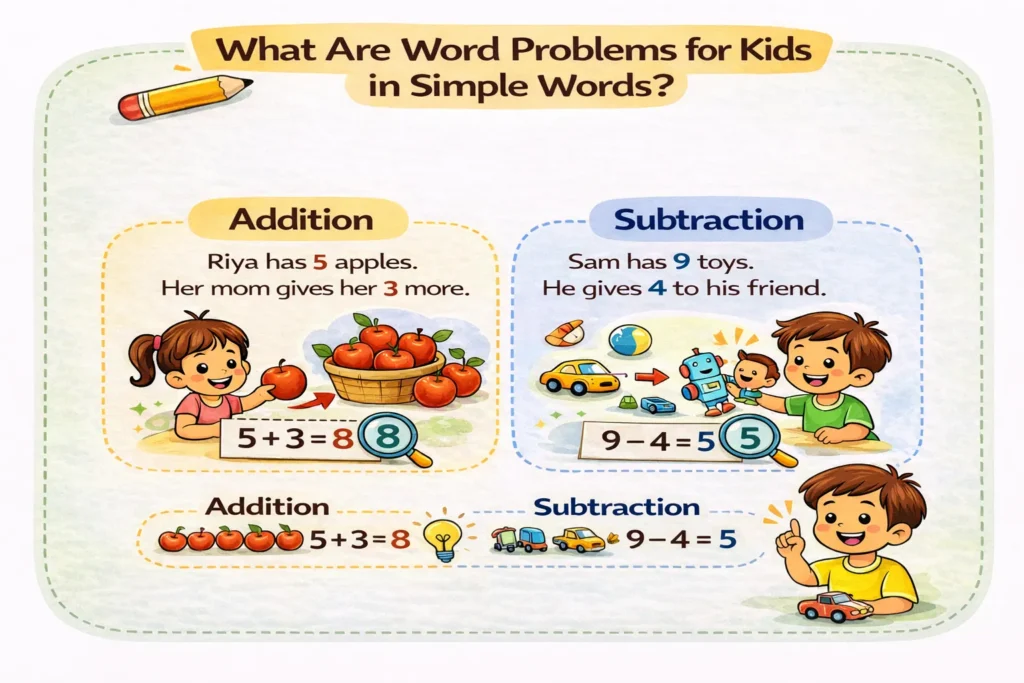
They’re sometimes called story sums, especially in Indian and South Asian curricula. Here’s the simplest way to explain it to a child:
“A number sentence hidden inside a little story.” Your job is to find the hidden question and solve it.
At this stage, word problems help children understand that maths isn’t just numbers on a page, it’s a tool for solving real problems.
That connection is one of the most important things they’ll build in Class 1.
Why Do Children Struggle with Word Problems?
Many children who are perfectly fine with ‘4 + 3 =’ freeze when the same sum appears in a story.
This is completely normal, and it happens for a few specific reasons:
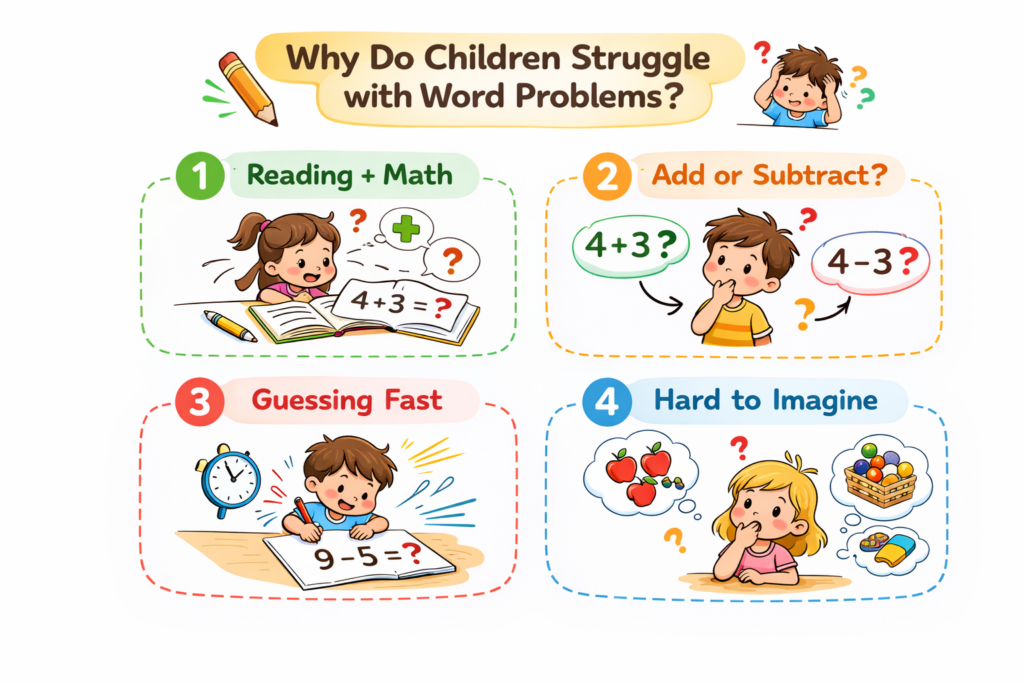
- Reading and maths at the same time. Word problems ask children to read, understand language, and do maths all at once. That’s genuinely hard for a 6-year-old.
- Not knowing which operation to choose. Children often can’t tell whether to add or subtract. They need a strategy, not just practice.
- Rushing. Many children read the numbers and guess the operation before they’ve understood the problem.
- Unfamiliar contexts. If a problem uses a scenario a child has never experienced, they can’t visualise it, so they can’t solve it.
The good news: all of these have simple fixes. The 4-step method in the next section addresses every one of them.
How to Solve Word Problems: The 4-Step Method
This method works for every word problem across all class levels. Practice it together until it becomes automatic.
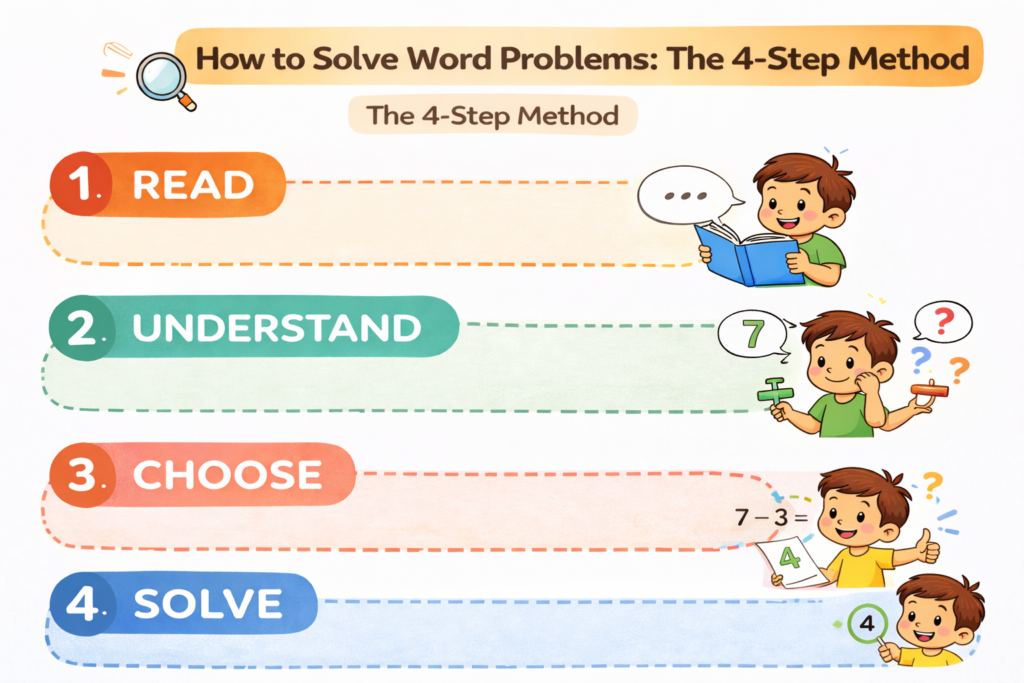
Worked Example: “Tom had 7 balloons. 3 flew away. How many does he have now?”
- Step 1: READ — Read the whole problem aloud. Don’t rush.
- Step 2: UNDERSTAND — Tom started with 7. He lost 3. We need to find how many are left.
- Step 3: CHOOSE — He lost balloons → subtract.
- Step 4: SOLVE — 7 − 3 = 4
✅ Answer: Tom has 4 balloons left.
Signal Words: Add or Subtract?
| ➕ Words that suggest ADDITION | ➖ Words that suggest SUBTRACTION |
|---|---|
| gave, got, more, altogether | lost, flew away, ate |
| total, joined, bought | gave away, dropped, broke |
| collected, found | left, fewer, remaining |
Tip: Point out signal words before asking the child to solve anything. Once they can spot them, the operation choice becomes much easier.
Class-by-Class Overview: What to Expect
| Class | Age | Number Range | Operations | Problem Types |
|---|---|---|---|---|
| Class 1 | 6–7 | 0 – 20 | Addition, Subtraction | Single-step, familiar contexts |
| Class 2 | 7–8 | 0 – 100 | Addition, Subtraction, × | Single-step, money, groups |
| Class 3 | 8–9 | 0 – 1,000 | ×, ÷, two-step | Two-step, time, measurement |
| Class 4 | 9–10 | 0 – 10,000+ | All four ops, fractions | Multi-step, fractions, geometry |
Class 1 Word Problems | Addition & Subtraction within 20
Class 1 word problems focus on addition and subtraction with numbers up to 20.
All problems use familiar everyday situations, such as food, animals, toys, and friends.
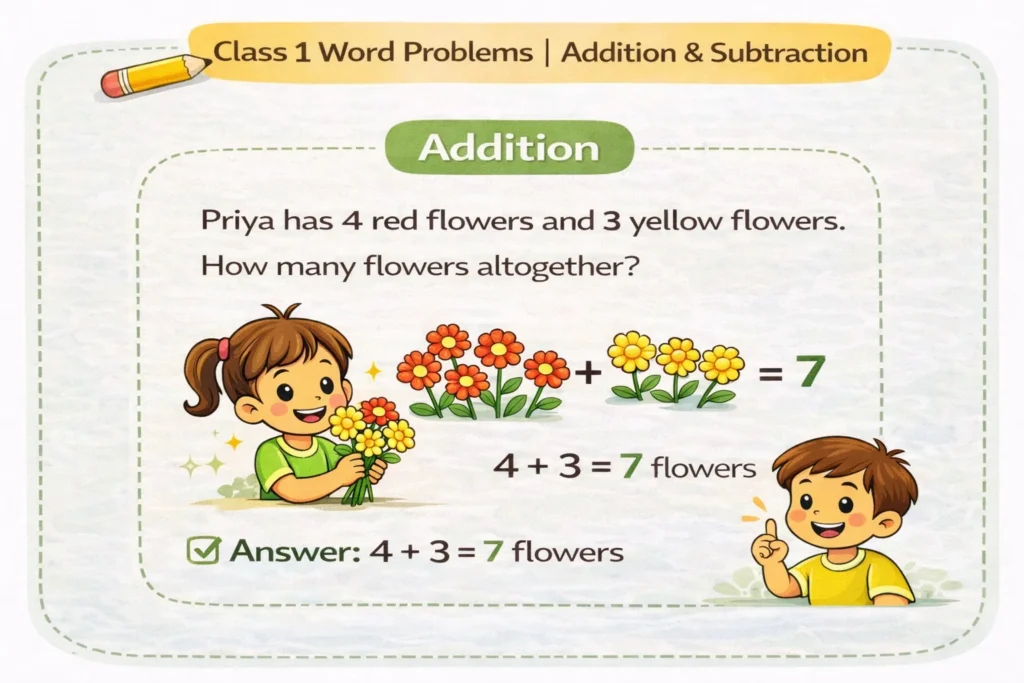
Class 1 — Addition Examples
| Priya has 4 red flowers and 3 yellow flowers. How many flowers does she have altogether?✅ Answer: 4 + 3 = 7 flowers |
| There are 5 birds on a tree. 2 more birds land on it. How many birds are there now?✅ Answer: 5 + 2 = 7 birds |
| Mia has 9 stickers. Her friend gives her 6 more. How many stickers does she have now?✅ Answer: 9 + 6 = 15 stickers |
| Sam collected 11 shells on Monday and 5 on Tuesday. How many shells did he collect in total?✅ Answer: 11 + 5 = 16 shells |
Class 1 — Subtraction Examples
| Ravi had 8 chocolates. He ate 3. How many chocolates does he have left?✅ Answer: 8 − 3 = 5 chocolates |
| There are 7 apples on a table. 4 are eaten. How many are left?✅ Answer: 7 − 4 = 3 apples |
| Rohan had 15 marbles. He gave 6 to his friend. How many marbles does he have now?✅ Answer: 15 − 6 = 9 marbles |
| Meera baked 20 biscuits. Her family ate 9. How many biscuits are left?✅ Answer: 20 − 9 = 11 biscuits |
Class 1 — Step-by-Step Worked Example
“There are 6 mangoes in a basket. Rani puts in 8 more. How many mangoes are in the basket now?”
- Step 1: READ — Read it aloud together.
- Step 2: UNDERSTAND — 6 mangoes to start, 8 more added. Find: total mangoes.
- Step 3: CHOOSE — We’re putting together → addition.
- Step 4: SOLVE — 6 + 8 = 14
✅ Answer: There are 14 mangoes in the basket.
Class 2 Word Problems | Two-Digit Numbers & Introduction to Multiplication
Class 2 word problems extend to larger numbers (up to 100), introduce two-digit addition and subtraction, and begin simple multiplication through repeated addition.
Problems draw from money, distances, and groups of objects.
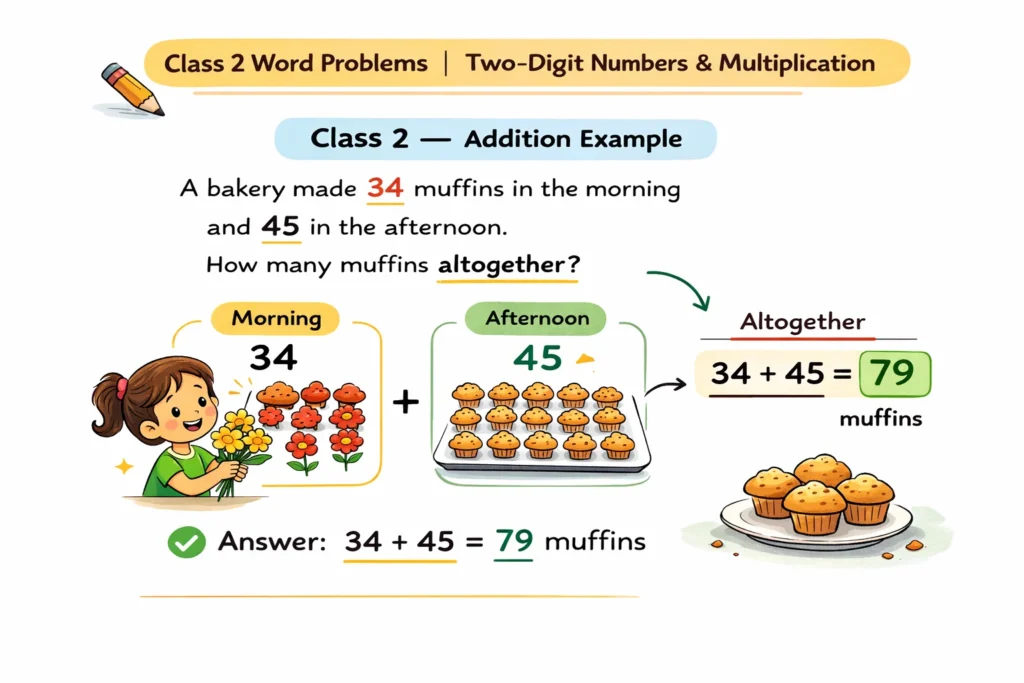
Class 2 — Addition Examples
| A bakery made 34 muffins in the morning and 45 in the afternoon. How many muffins did they make altogether?✅ Answer: 34 + 45 = 79 muffins |
| Rahul has 27 trading cards. His uncle gives him 36 more. How many cards does he have now?✅ Answer: 27 + 36 = 63 cards |
| There are 48 red beads and 25 blue beads in a jar. How many beads are there in total?✅ Answer: 48 + 25 = 73 beads |
Class 2 — Subtraction Examples
| A fruit seller had 85 bananas. He sold 47. How many bananas does he have left?✅ Answer: 85 − 47 = 38 bananas |
| Nisha had Rs 72. She spent Rs 38 on a book. How much money does she have left?✅ Answer: Rs 72 − Rs 38 = Rs 34 |
| There were 63 passengers on a bus. At the stop, 29 got off. How many passengers are left on the bus?✅ Answer: 63 − 29 = 34 passengers |
Class 2 — Multiplication (Repeated Addition) Examples
| There are 4 bags. Each bag has 5 apples. How many apples are there in all?✅ Answer: 4 x 5 = 20 apples (or: 5 + 5 + 5 + 5 = 20) |
| A spider has 8 legs. How many legs do 3 spiders have altogether?✅ Answer: 3 x 8 = 24 legs |
| Rani puts 6 flowers in each vase. She has 4 vases. How many flowers does she use in total?✅ Answer: 4 x 6 = 24 flowers |
Class 2 — Step-by-Step Worked Example
“A shopkeeper has 3 boxes of chocolates. Each box holds 9 chocolates. How many chocolates does he have in total?”
- Step 1: READ — Read it aloud together.
- Step 2: UNDERSTAND — 3 boxes, 9 chocolates each. Find: total chocolates.
- Step 3: CHOOSE — Equal groups being combined → multiplication.
- Step 4: SOLVE — 3 x 9 = 27
✅ Answer: The shopkeeper has 27 chocolates.
Class 3 Word Problems | Multiplication, Division & Multi-Step Problems
Class 3 word problems introduce division, 3-digit numbers, and two-step problems requiring more than one operation. Children also start working with time, measurement, and simple fractions in context.
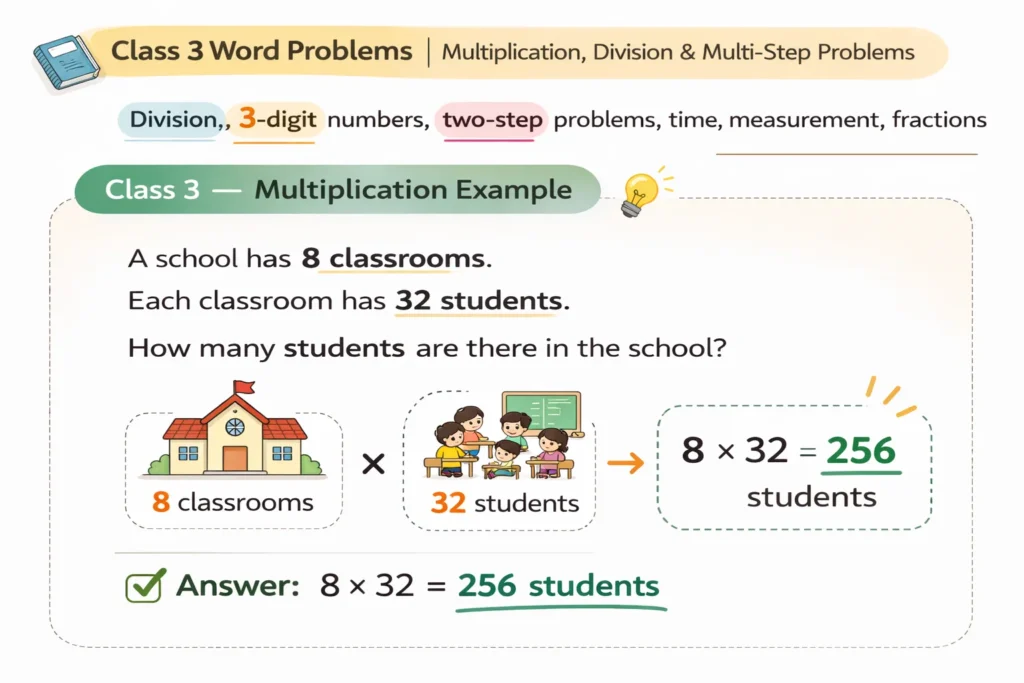
Class 3 — Multiplication Examples
| A school has 8 classrooms. Each classroom has 32 students. How many students are there in the school?✅ Answer: 8 x 32 = 256 students |
| A packet contains 24 crayons. How many crayons are there in 5 packets?✅ Answer: 5 x 24 = 120 crayons |
Class 3 — Division Examples
| A teacher has 48 stickers to give equally to 6 students. How many stickers does each student get?✅ Answer: 48 / 6 = 8 stickers each |
| There are 56 chairs to be arranged in 7 equal rows. How many chairs will be in each row?✅ Answer: 56 / 7 = 8 chairs per row |
| A baker made 72 cupcakes and packed them equally into 9 boxes. How many cupcakes are in each box?✅ Answer: 72 / 9 = 8 cupcakes per box |
Class 3 — Two-Step Problems
| Aarav had 45 stamps. He bought 15 more and then gave 20 to his friend. How many stamps does he have now?✅ Answer: Step 1: 45 + 15 = 60 Step 2: 60 – 20 = 40 stamps |
| A box had 6 rows of chocolates with 8 in each row. Nita ate 12 chocolates. How many are left?✅ Answer: Step 1: 6 x 8 = 48 Step 2: 48 – 12 = 36 chocolates |
Class 3 — Measurement & Time Examples
| Ravi walks 350 metres to school every day. How far does he walk in 5 days?✅ Answer: 350 x 5 = 1,750 metres |
| A film starts at 3:00 PM and lasts 2 hours 30 minutes. What time does it end?✅ Answer: 3:00 PM + 2 hr 30 min = 5:30 PM |
Class 3 — Step-by-Step Worked Example
“A library has 9 shelves. Each shelf holds 45 books. How many books does the library have in total?”
- Step 1: READ — Read it aloud together.
- Step 2: UNDERSTAND — 9 shelves, 45 books each. Find: total books.
- Step 3: CHOOSE — Equal groups → multiplication.
- Step 4: SOLVE — 9 x 45 = 405
✅ Answer: The library has 405 books.
Class 4 Word Problems | Fractions, Large Numbers & Multi-Step Reasoning
Class 4 word problems work with larger numbers (up to 10,000+), fractions, decimals, and multi-step reasoning. Children are expected to choose the right operation independently.
Problems draw from money, distance, data, and geometry.
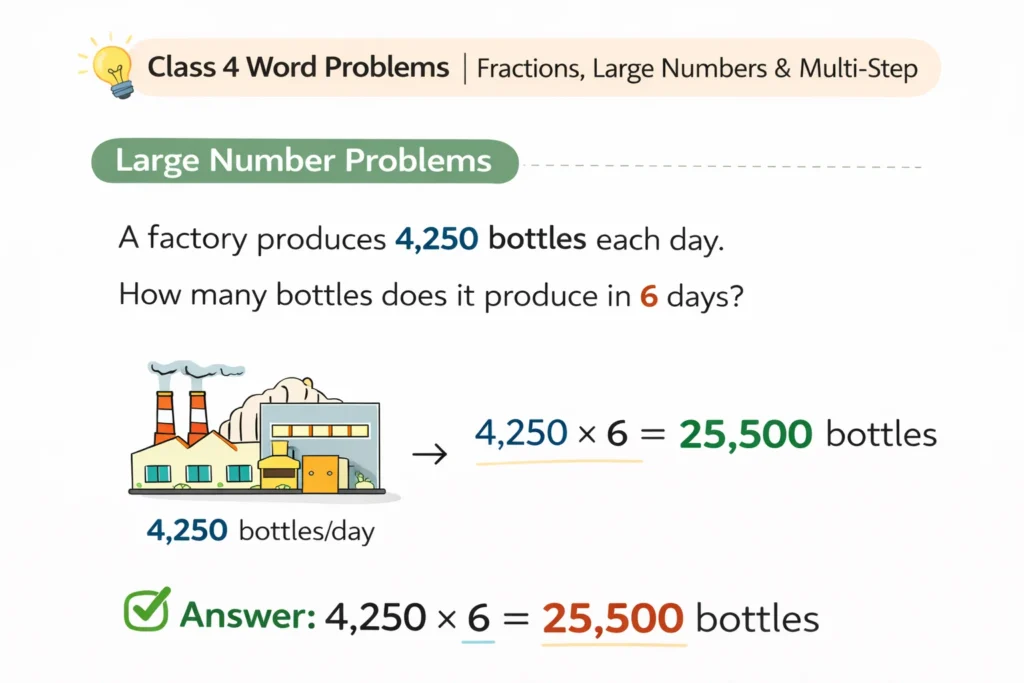
Class 4 — Large Number Problems
| A factory produces 4,250 bottles each day. How many bottles does it produce in 6 days?✅ Answer: 4,250 x 6 = 25,500 bottles |
| A stadium has 12,500 seats. 8,375 seats are occupied. How many seats are empty?✅ Answer: 12,500 – 8,375 = 4,125 seats |
Class 4 — Fractions Examples
| A pizza is cut into 8 equal slices. Kavya ate 3 slices. What fraction of the pizza did she eat?✅ Answer: 3/8 of the pizza |
| There are 24 students in a class. 1/4 of them are in the art club. How many students are in the art club?✅ Answer: 24 / 4 = 6 students |
| Rohan had 1/2 a litre of juice. He drank 1/4 litre. How much juice is left?✅ Answer: 1/2 – 1/4 = 1/4 litre remaining |
Class 4 — Money & Decimals Examples
| A shirt costs Rs 485.50 and trousers cost Rs 729.75. How much do they cost together?✅ Answer: Rs 485.50 + Rs 729.75 = Rs 1,215.25 |
| Meena had Rs 1,000. She bought 4 notebooks at Rs 65 each. How much money does she have left?✅ Answer: Step 1: 4 x Rs 65 = Rs 260 Step 2: Rs 1,000 – Rs 260 = Rs 740 |
Class 4 — Multi-Step Reasoning
| A school trip had 135 boys and 148 girls. Each bus holds 57 passengers. How many buses are needed?✅ Answer: Step 1: 135 + 148 = 283 students Step 2: 283 / 57 = 4 remainder 55, so 5 buses needed |
| A rectangle has a length of 18 cm and a width of 12 cm. What is its area? What is its perimeter?✅ Answer: Area: 18 x 12 = 216 cm2 Perimeter: 2 x (18 + 12) = 60 cm |
Class 4 — Step-by-Step Worked Example
“A bookshop has 245 story books, 178 science books, and 93 activity books. They receive a new delivery of 150 books. How many books does the shop have in total?”
- Step 1: READ — Read the full problem carefully before calculating.
- Step 2: UNDERSTAND — Three types in stock: 245, 178, 93. Delivery: 150 more. Find: total books.
- Step 3: CHOOSE — All quantities being combined → addition (two steps).
- Step 4: SOLVE — 245 + 178 + 93 = 516. Then 516 + 150 = 666.
✅ Answer: The bookshop has 666 books in total.
How to Check If Your Child Understands
You don’t need a test paper to know if your child is getting it. These quick checks work better and feel less stressful.
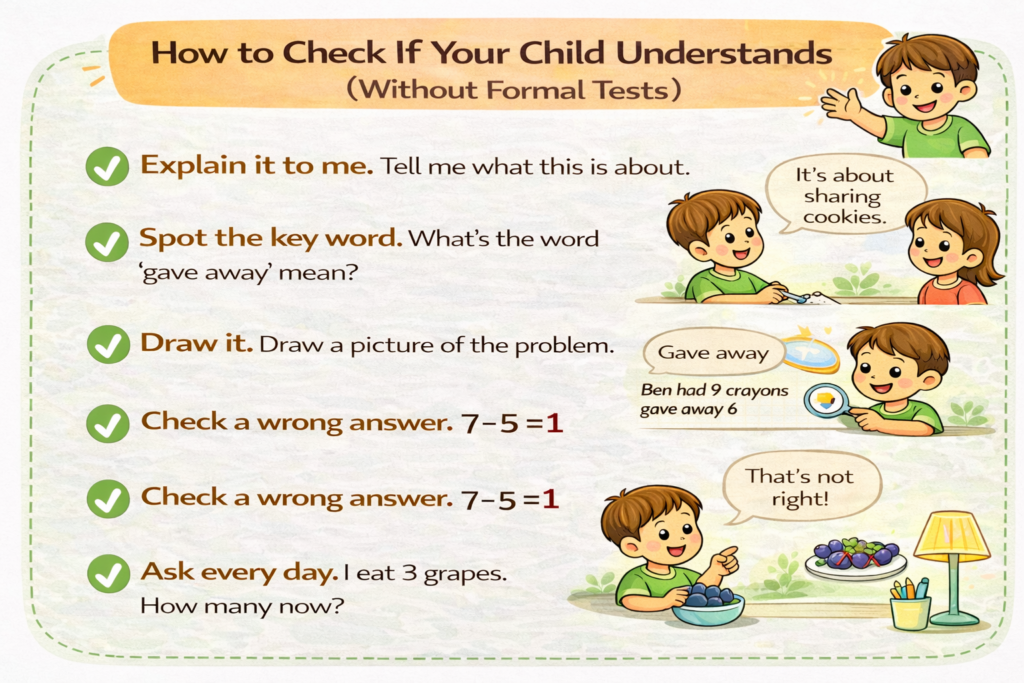
- The ‘explain it to me’ test: Ask your child to read a problem and explain what it’s about in their own words. If they can do this correctly, they understand the structure.
- The signal-word spot: Point to a problem and ask: ‘What’s the key word? What does it tell you to do?’ Correct identification means they’re ready to solve.
- The ‘draw it’ check: Ask them to draw the problem before solving. If their drawing matches the story, their comprehension is solid.
- The wrong-answer check: Give them a solved problem with a deliberate mistake. Ask: ‘Is this right? How do you know?’ A child who can spot and explain an error truly understands.
- Everyday problem check: Make up a problem during dinner, shopping, or playtime. A child who can solve an unannounced problem in real life has mastered the concept.
Common Mistakes and How to Fix Them
| Common Mistake | Why It Happens | How to Fix It |
|---|---|---|
| Adding when they should subtract | Child sees two numbers and automatically adds | Teach signal words. Ask: ‘Putting together or taking away?’ |
| Not reading the full problem | Child reads the first sentence and guesses | Make reading the whole problem a strict rule |
| Forgetting what the question asks | Child calculates but answers the wrong thing | Re-read the last sentence after solving |
| Skipping steps in multi-step problems | Child tries to do everything mentally | Write out each step separately |
| Arithmetic errors after choosing correctly | Operation right but calculation wrong | Use fingers, counters, or drawings to verify |
Teaching Tips for Parents
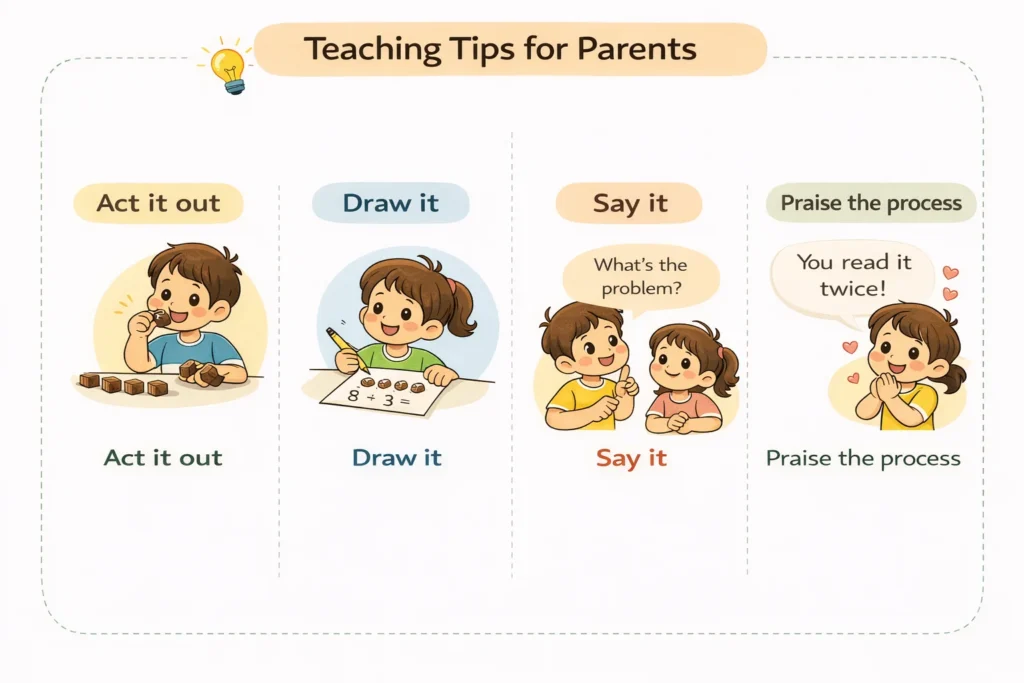
- Act it out — For ‘Ravi had 8 chocolates and ate 3,’ use actual objects. Physical acting makes abstract problems concrete.
- Draw it — Ask your child to draw the story before solving. A quick sketch is far more effective than mental arithmetic alone.
- Say it in your own words — Before solving, ask: ‘What is this problem about? What do we need to find?’ If they can explain it, they can solve it.
- Use everyday moments — ‘We have 12 grapes and you eat 4 — how many are left?’ Kitchen and snack time are the best classroom.
- Praise the process — ‘I love how you read it twice.’ Praise process over correct answers — it builds the habits that prevent mistakes.
What are word problems for Class 1?
Word problems for Class 1 are short maths questions written as real-life stories. They ask children to use addition or subtraction (with numbers up to 20) to find a missing number. They are also called story sums. The goal is to help children connect maths to everyday situations.
What is the difference between word problems and story sums?
They are the same thing. ‘Story sums’ is the common term used in Indian and South Asian school systems. ‘Word problems’ is the standard term internationally. Both refer to maths questions presented as short written scenarios.
How do I teach word problems to a Class 1 child?
Use the 4-step method: Read the full problem → Understand what is known and what is missing → Choose the operation (add or subtract) using signal words → Solve carefully. Always start with real objects or drawings before moving to written calculations.
What are addition word problems for Class 1?
Addition word problems for Class 1 use signal words like ‘altogether’, ‘gave’, ‘found’, ‘joined’, or ‘total’ to indicate that two quantities should be added. Numbers stay within 0–20. Example: ‘Priya has 5 pencils and gets 3 more. How many does she have?’
What are subtraction word problems for Class 1?
Subtraction word problems for Class 1 use signal words like ‘left’, ‘ate’, ‘gave away’, ‘flew away’, or ‘fewer’ to show that a quantity is being removed. Example: ‘Ravi had 9 grapes and ate 4. How many are left?’ Answer: 9 − 4 = 5.
Why does my child struggle with word problems but not number sums?
This is very common. Word problems require reading comprehension and maths at the same time, which is genuinely hard for young children. The most common issue is not knowing which operation to choose. Teaching signal words and using the 4-step method resolves this for most children.
What numbers should Class 1 word problems use?
Class 1 word problems should use numbers from 0 to 20. Easy problems should stay within 0–10. Slightly harder problems can go up to 20. Multi-digit numbers or two-step problems are too advanced for this level.
How many word problems should a Class 1 child practise per day?
3 to 5 problems per session is ideal. Doing fewer problems slowly and correctly using the 4-step method each time builds stronger habits than rushing through a full worksheet. Short, regular sessions (10–15 minutes) work better than long, occasional ones.
What is a word problems worksheet for Class 1?
A word problems worksheet for Class 1 is a collection of short story-based maths questions covering addition and subtraction within 20. Good worksheets include a mix of difficulty levels, clear questions, and answer keys so parents can check together with the child.
When should Class 1 children start word problems?
Children are ready for word problems once they can add and subtract confidently with numbers up to 10 and have basic reading ability. For most children, this is mid-to-late Class 1 (ages 6–7). If basic arithmetic isn’t solid yet, build that foundation first.
Make Preparing for Math Olympiad Simple!



Conclusion
Word problems aren’t harder than regular maths they just ask children to do one extra thing: read carefully before calculating.
Once your child has the 4-step method and can spot signal words, these problems become much less daunting.
Start with easy problems, act them out with real objects, and keep the tone relaxed. Confidence built now will carry your child through every stage of maths to come.
If you’d like structured concept-based maths practice for your child, including problems that build exactly these thinking skills explore what the Gonit App offers for Class 1 learners.