

Past USAMO problems and solutions are free online: Evan Chen’s notes cover every USAMO since 1996 and every USAJMO since 2010, and the AoPS wiki hosts the community archive. The problems worth trying first are problem 1 and problem 4 of a recent paper, which draw the most complete solutions.
Write your own proof and grade it out of 7 before you open anyone’s solution, because a problem you have read cannot be used for timed practice again.
The USAMO problems from every paper since 1996, and the USAJMO problems since 2010, sit in Evan Chen’s free solution notes. That’s about 30 years of papers at six problems each, with some problems shared between the two exams. The easy way to use them is to try a problem for twenty minutes, then read his solution to check your idea, without writing a proof of your own.
Once you have read the solution to a problem, you can no longer use it for a timed practice run, because you already know the main idea. When you do write a proof, you have no official key to check it against.
Evan Chen, who keeps the best-known free set, says his are personal notes and that the committee’s own solutions aren’t published. He adds that Mathematics Magazine has recently resumed publishing another version of the problems and solutions.
The contest scores your page out of 7 per problem, and no finished solution, his or the magazine’s, tells you what yours would have earned.
In grading statistics Evan Chen compiles from his own notes (rough estimates, in his words, and not official MAA figures), the most-finished problem on every USAMO and USAJMO paper from 2015 to 2026 was problem 1 or problem 4.
Some other problems are far harder to finish, and on the 2026 USAMO no one in those statistics scored a 7 on problem 3.
So write proofs on problems you can finish before you spend the real archive. The invitation-only USA Mathematical Olympiad (USAMO) follows the AIME and sets six proof problems over two days, nine hours in all. The 2027 contest is on March 20–21, 2027.
For the contest itself, read our USAMO guide: what the test asks and how it’s scored.

Where Are the Past USAMO Problems and Solutions?
Past USAMO problems and solutions are free online. Evan Chen’s notes cover every USAMO since 1996 and every USAJMO since 2010, problems included.
The AoPS wiki’s USAMO problems and solutions pages are the standard community archive.
Evan Chen says the committee’s own solutions aren’t published, though Mathematics Magazine has resumed printing its own version of both.
| Archive | What it has | What it doesn’t have | Use it for |
|---|---|---|---|
| Evan Chen’s olympiad notes | Problems and his solutions for USAMO 1996–2026 and USAJMO 2010–2026 as PDF and TeX | Official solutions: he calls these his personal notes | Problem statements first and his solution after you’ve written yours |
| Evan Chen’s USA(J)MO grading statistics | Per-problem score counts for USAMO and USAJMO from 2015 to 2026 | Official figures: he says they are close to the official numbers but not the same | Choosing which problems to try first |
| AoPS wiki: USAMO Problems and Solutions | The standard community archive of USAMO problems and solutions | The committee’s own solutions (unpublished, per Evan Chen) | Comparing more than one way into a problem |
| USAMTS past problems | Problems and solutions for Years 10–37 (1998–99 to 2025–26) plus grading rubrics for Years 20–37 | USAMO problems: it’s a different contest | Seeing how proof graders split the points |
The USAMTS row is the one most students skip and shouldn’t. It is the only free archive on this list that publishes grading rubrics, so it is the closest you can get to seeing which steps a proof grader actually pays for.
Which Past USAMO Problems Should You Try First?
Start with problem 1 or problem 4 of a recent paper. Evan Chen compiles his grading statistics from notes he takes during the grading, and he says they are close to the official numbers but not the same.
In those statistics for 2015 to 2026, the problem with the most full scores on every USAMO and USAJMO paper was problem 1 (13 papers) or problem 4 (11 papers).
The reason is structural rather than lucky. A USAMO paper runs two days of three problems each, and within each day the problems rise in difficulty. Problem 1 opens day one and problem 4 opens day two, so they are the two openers.
This is how the 2026 USAMO looked, out of 340 recorded scores:
| 2026 USAMO problem | Papers scoring a full 7 |
|---|---|
| Problem 1 | 75 |
| Problem 2 | 8 |
| Problem 3 | 0 |
| Problem 4 | 92 |
| Problem 5 | 67 |
| Problem 6 | 12 |
The 2026 USAJMO tilted the same way: 131 of 233 papers scored 7 on problem 1. Problem 1 can still be hard: in 2016 only 6 USAJMO students finished it.
Check the statistics for the specific year before you commit an evening to it.
The order we’d use:
- Pick problem 1 or 4 from a recent USAJMO or USAMO paper, and don’t open its solution.
- Set aside about 90 minutes and work on it in one go. The contest allows nine hours for six problems, which is about 90 minutes per problem.
- Write a complete solution, even if it only covers part of the problem.
- Grade your page out of 7 (next section), and only then read Evan Chen’s notes.
- Move on to problems 2 and 5 once your problem 1 and 4 write-ups come out complete more often than not.
USAJMO papers are the gentler start. The two contests run the same format on the same weekend, and a USAJMO problem 1 is usually the most finishable proof problem the MAA sets in a given year.
How Do You Grade Your Own Proof Out of 7?
Each USAMO problem is scored out of 7. The bands below are our own scheme, built from the pattern in the grading data, and they aren’t the official scoring.
- 7: complete, with every step justified. A “find all” shows the answers work and that nothing else does. An “if and only if” proves both directions. An inequality includes its equality case.
- 1–2 territory: the key idea is there, but something is missing (a claim you never proved, a case you skipped or a pattern you only checked on examples).
- 0: the problem restated, a few examples or an answer with no reasoning.
Scores between 2 and 7 depend on the problem, so each model write-up below includes our grading note for that problem.s on your first pages.
In Evan Chen’s 2026 statistics the median USAMO score was 6 out of 42, and one complete problem is worth 7.
For a weekly routine built around one finished proof, see the one-proof week in our USAMO guide.
The Three Gaps That Cost the Most Points
Almost every write-up that lands in 1–2 territory does one of three things. Check your page for these before you score it:
| Gap | What it looks like on the page | What a 7 needs instead |
|---|---|---|
| The missing half | “Find all” with the answers found but no argument that nothing else works | Both halves: these work, and nothing else does |
| The unproved claim | A step introduced with “clearly” or “it follows that” | Every claim either proved or cited by name |
| The pattern check | A rule verified on three examples and then used | A proof that the rule holds in general |
Expect low numbers on your first pages. In Evan Chen’s 2026 statistics the median USAMO score was 6 out of 42, and one complete problem is worth 7. For a weekly routine built around one finished proof, see the one-proof week in our USAMO guide.
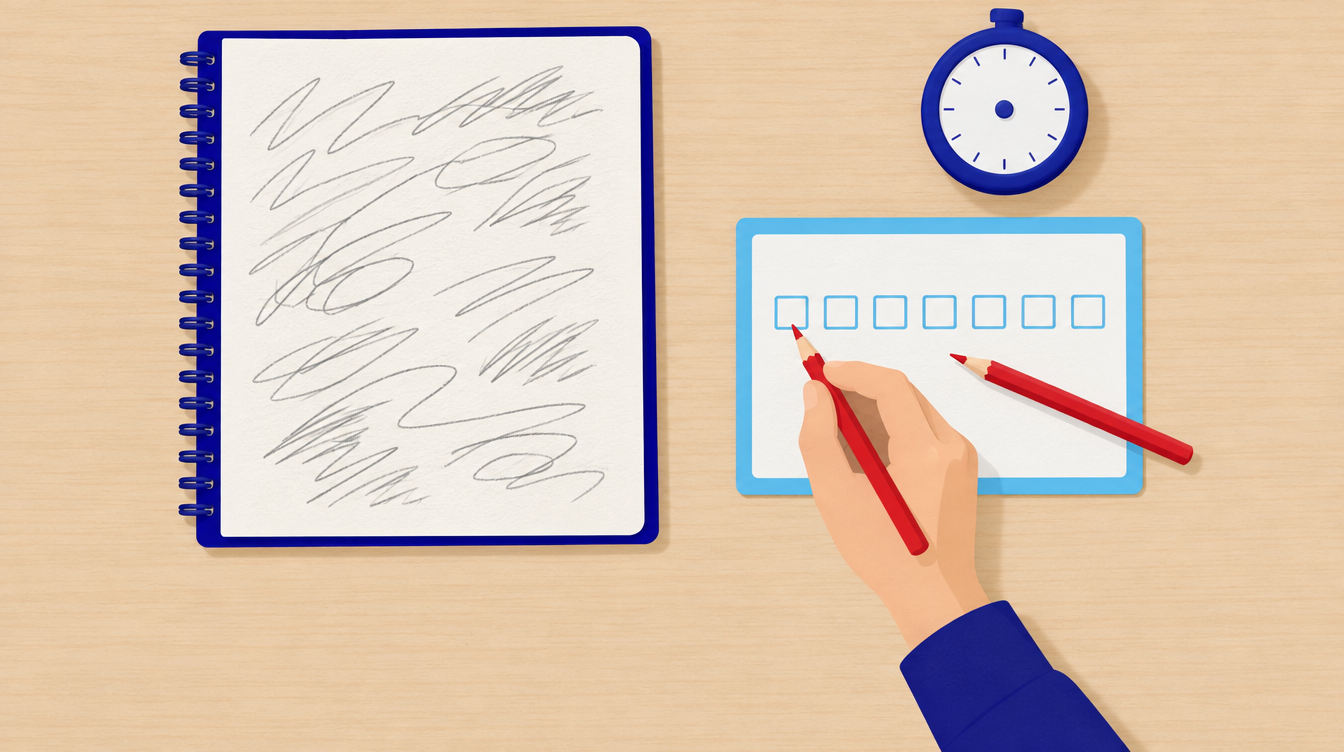
[IMAGE: A handwritten proof page next to a grading card with seven empty boxes, a red pencil and a timer, for scoring a proof out of 7]
When you grade your own page, it’s easy to fill in a step you meant to write and never did. For an outside read, try a free contest that grades your proofs.
The USAMTS is free for US citizens and residents, every solution gets a score from 0 to 5, and you can read the graders’ feedback afterwards. Its past rubrics show, problem by problem, which steps the graders paid for.
Five Practice Problems in USAMO Style
We wrote these five original problems for this page. They are gentler than real USAMO problems: warm-ups for writing a complete proof, not a simulation of the contest.
Give each one 30 to 45 minutes and write a full solution before you open the toggle. If you stall at the start, here is how to start an olympiad problem you’ve never seen.
The five cover one problem type each, chosen because each carries its own way of losing points.
| # | Topic | Proof type | The trap |
|---|---|---|---|
| 1 | Number theory | Find all | Finding the answers, not ruling out the rest |
| 2 | Algebra | Inequality with equality case | Quoting a named inequality that doesn’t apply |
| 3 | Combinatorial game | Strategy proof | Proving one move works, not classifying all |
| 4 | Geometry | If and only if | Proving one direction |
| 5 | Graph theory | Existence | Describing a process without proving it stops |
Problem 1: A Divisibility “Find All”
Find all positive integers n such that n + 3 divides n² + 30.
Show solution
Answer: n = 10 and n = 36.
Write n² + 30 = (n + 3)(n − 3) + 39. Since n + 3 divides (n + 3)(n − 3), it divides n² + 30 exactly when it divides 39.
The positive divisors of 39 are 1, 3, 13 and 39. Since n + 3 ≥ 4, n + 3 = 13 or 39, which gives n = 10 or n = 36. Both work: 10² + 30 = 130 = 13 × 10 and 36² + 30 = 1326 = 39 × 34.
How we’d grade it. A 7 needs the reduction to “n + 3 divides 39” shown, every divisor considered (n + 3 ≥ 4 rules out 1 and 3) and both answers checked. Right answers found by trial, or the reduction with no reason that other values fail, sit in 1–2 territory. Bare answers earn 0. A “find all” has two halves: these work, and nothing else does.
Problem 2: An Inequality With a Condition
Real numbers a, b, c satisfy a + b + c = 3. Prove that a² + b² + c² + ab + bc + ca ≥ 6, and find when equality holds.
Show solution
Answer: equality holds only at a = b = c = 1.
Let q = ab + bc + ca. Squaring a + b + c = 3 gives a² + b² + c² + 2q = 9, so a² + b² + c² = 9 − 2q and the left side is 9 − q. It’s enough to prove q ≤ 3.
For real numbers, a² + b² + c² − q = ½[(a − b)² + (b − c)² + (c − a)²] ≥ 0. So 9 − 2q ≥ q, which gives q ≤ 3 and a left side of at least 9 − 3 = 6.
Equality needs all three squares to be 0, so a = b = c, and with a + b + c = 3 that means a = b = c = 1 (which does give 3 + 3 = 6).
How we’d grade it. A 7 needs the rewrite to 9 − q, the sum-of-squares identity written out and the equality case. Quoting AM-GM won’t do here, because a, b and c can be negative. Testing a = b = c = 1 and calling it the minimum is 1–2 territory, and examples alone earn 0.
Problem 3: A Coin Game
A pile has 2026 coins. Two players take turns; on each turn a player removes 1, 2 or 4 coins (never more than the pile holds).
Whoever takes the last coin wins. Prove that the first player can guarantee a win, and find every first move that guarantees it.
Show solution
Answer: yes. The winning first moves are taking 1 coin or taking 4 coins.
Claim: on your turn, a pile that isn’t a multiple of 3 is a win for you, and a multiple of 3 (including 0) is a win for your opponent.
If the pile is 1 more than a multiple of 3, take 1. If it’s 2 more, take 2. Both moves are legal and leave a multiple of 3. From a multiple of 3 that is at least 3, taking 1 or 4 leaves 2 more than a multiple of 3 and taking 2 leaves 1 more.
So your opponent can never hand you back a multiple of 3, which means they never take the last coin. The pile shrinks every turn, so the game ends with you taking the last coin.
Here 2026 = 3 × 675 + 1. Taking 1 leaves 2025 and taking 4 leaves 2022, both multiples of 3, so either move wins. Taking 2 leaves 2024 = 3 × 674 + 2, which hands the same strategy to the second player.
How we’d grade it. A 7 needs the claim with both halves proved, the game shown to end and all three first moves classified. A correct proof that taking 1 wins, with no answer to “every first move”, is about a 5 by our scheme. “Take 1, then keep it a multiple of 3” with no proof that the opponent can’t break it is 1–2 territory, and so is forgetting the move of 4.
Problem 4: A Geometry “If and Only If”
Let ABC be an acute triangle. The circle with diameter BC meets side AB again at D and side AC again at E. Prove that DE is parallel to BC if and only if AB = AC.
Show solution
Since BC is a diameter, angles BDC and BEC are right angles, so CD ⊥ AB and BE ⊥ AC. The triangle is acute, so D and E lie inside the sides.
In right triangles ADC and AEB, AD = AC · cos A and AE = AB · cos A. So AD · AB = AE · AC, since both equal AB · AC · cos A. (Power of the point A gives the same key equation.)
If AB = AC: the key equation gives AD = AE, so AD/AB = AE/AC, and DE ∥ BC by the converse of the intercept theorem.
If DE ∥ BC: triangles ADE and ABC are similar, so AD/AB = AE/AC = t for some t > 0. Then t · AB² = AD · AB = AE · AC = t · AC², so AB = AC.
How we’d grade it. A 7 needs both directions and the key equation justified (right angles from the diameter, or power of a point). One direction only is about 3 to 4 by our scheme. A diagram and “by symmetry” is 1–2 territory, and restating the problem earns 0. An “if and only if” is two proofs.
roblem 5: Friends Across Two Groups
At a math camp, each of the 40 students has at least one friend among the other students (friendship is mutual).
Prove that the students can be split into two groups so that every student has at least one friend in the other group.
Show solution
Among the finitely many ways to split the 40 students into two groups, choose one with the largest number N of friendships that cross between the groups.
Suppose a student S has no friend in the other group, so all of S’s friends (at least one) are in S’s own group. Move S across. Every friendship of S now crosses, a gain of at least 1. S loses no crossing friendships because S had none, and friendships not involving S don’t change.
So N goes up, which contradicts the choice of the split. In the chosen split, then, every student has a friend in the other group.
How we’d grade it. A 7 needs the extremal choice (the largest N) stated, the move of S and the count showing that N goes up. “Keep moving students with no friend across until everyone has one”, with no reason the process stops, is 1–2 territory.
A split for a small example earns 0. The idea to keep: choose the best arrangement, then show that any flaw would make it better.Among the finitely many ways to split the 40 students into two groups, choose one with the largest number N of
What Do You Have After Five Finished Proofs?
Five pages you wrote and graded yourself. You also have an order for the real archive (problems 1 and 4 first, timed, written before you read) and an outside grader for when your own marking runs out. And every past USAMO problem you haven’t opened is still there for a proper rehearsal.
What to do next, depending on how the five went:
| How the five went | What to do next |
|---|---|
| Most reached a 7 | Move to real USAJMO problem 1s, timed at 90 minutes, still written before reading |
| Most landed in 1–2 territory | Stay on warm-ups and work the three gaps table above; the idea is arriving, the write-up isn’t |
| You stalled before writing anything | The problem is starting, not finishing. Work through how to start an olympiad problem first |
| The extremal argument in problem 5 was new | That family of ideas is worth its own session. The pigeonhole principle, with practice is the usual entry point |
Invitations to the USAMO go to top AIME scorers, so most of your practice hours still belong to the AIME stage (here is what an AIME problem looks like).
Gonit is built for that stage: olympiad-style practice by grade and topic for grades 1–12, with 10,000+ original questions answered as multiple choice or a typed answer. It won’t grade a proof, and it has no connection to the MAA.
Hints and step-by-step explanations are part of Premium. Premium is a paid, auto-renewing subscription; eligible accounts get a 7-day free trial.ed answer.
It won’t grade a proof, and it has no connection to the MAA. Hints and step-by-step explanations are part of Premium. Premium is a paid, auto-renewing subscription; eligible accounts get a 7-day free trial.
Make Preparing for Math Olympiad Simple!


Frequently Asked Questions
Where can I find past USAMO problems?
Evan Chen’s olympiad notes carry the problems and his solutions for every USAMO since 1996 and every USAJMO since 2010, as free PDF and TeX. The AoPS wiki hosts the community archive of the same problems. Both are free and need no account.
Are official USAMO solutions published?
No. Evan Chen, who keeps the best-known free set, says the committee’s own solutions are not published and that his are personal notes rather than official answers. Mathematics Magazine has resumed printing its own version of the problems and solutions.
How many problems are on the USAMO?
Six, split across two days of three problems each, with nine hours of writing time in total. Each problem is scored from 0 to 7, so the maximum score is 42.
How hard are USAMO problems?
Hard enough that a median paper scores single digits out of 42. In Evan Chen’s 2026 grading statistics the median USAMO score was 6, and no one in those statistics scored a 7 on problem 3. One complete problem is worth 7 points, which is why finishing a single proof is a reasonable first target.
Which USAMO problem is the easiest?
Problem 1 and problem 4, because they open day one and day two and the problems rise in difficulty within each day. Across every USAMO and USAJMO paper from 2015 to 2026, the problem drawing the most full scores was problem 1 on 13 papers and problem 4 on 11.
What is the difference between USAMO and USAJMO problems?
The two contests run the same format on the same weekend, six proof problems over two days, and share some problems between papers. USAJMO problems are set for the junior field and are generally the gentler starting point for someone writing their first olympiad proofs.
How do you write a USAMO-style proof?
Write for a grader who will not guess what you meant. Name your objects, justify every step rather than calling it clear, and finish the shape the problem asks for: both halves of a “find all”, both directions of an “if and only if”, and the equality case of an inequality.
Can I get my proofs graded for free?
Yes, through USAMTS, which is free for US citizens and residents who have not finished high school. Each solution is scored from 0 to 5 by a human grader and the written feedback comes back to you. Its published rubrics for Years 20 to 37 also show which steps graders paid for.
Should I read the solution if I am stuck on a USAMO problem?
Write whatever you can first, then grade that page, then read. Once you have read a solution you cannot use that problem for timed practice again, because you already know the main idea, and the archive is finite.
Related guides
- Our USAMO guide: the format, the scoring and a one-proof week
- AIME problems and how to practice them
- USAMTS: proof rounds graded with written feedback

Donald A. Kroll holds a Master's degree in Mathematics and has spent years helping students prepare for competition-level problem solving. Based in the United States, he writes about study strategy, test readiness, and the habits that turn steady practice into real results.




There are no comments posted here yet.
Sign in to leave a comment