
 July 11, 2026
 11 min. read

AMC 10 vs AMC 12 comes down to one thing first: your grade.
If you’re in grade 10 or below, take the AMC 10. It’s calibrated for your age, and the AIME cutoff is typically reached with a similar absolute score to AMC 12 despite a lower percentile target.
If you’re in grade 11 or 12, you’re only eligible for the AMC 12. If you’re a strong 9th or 10th grader, you can sit both the AMC 10 and AMC 12 in the same cycle, on different days. The format is identical; the topic ceiling is the real difference.
The AMC 10 and AMC 12 are premier, 75-minute, 25-question multiple-choice math competitions administered by the Mathematical Association of America (MAA).
Both are the first step toward AIME qualification. The AMC 10 covers math through 10th grade, while the AMC 12 covers the full high school curriculum, adding trigonometry, logarithms, and complex numbers.
Eligibility: Who Can Take Each Contest
Both rules are checked on competition day, not at registration.
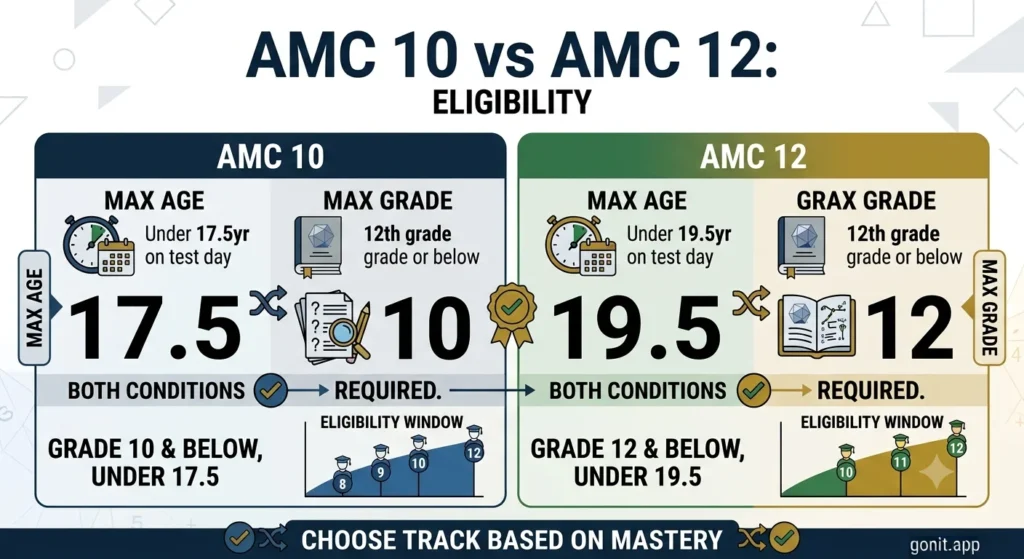
- AMC 10: Grade 10 or below, under 17.5 years old on contest day. See the full AMC age limit rules for edge cases like early graduation or grade skipping.
- AMC 12: Grade 12 or below, under 19.5 years old on contest day.
What this means in practice:
- A 9th or 10th grader is eligible for both. Most strong students in this band sit both.
- An 11th or 12th grader is only eligible for AMC 12.
- A precocious 8th grader can sit AMC 10 (and many strong middle schoolers do; see our AMC 8 vs AMC 10 guide for the middle school decision).
- You cannot sit AMC 10 and AMC 12 on the same calendar day since the contests overlap. But you can sit AMC 10A on November 5, 2026 and AMC 12B on November 13, 2026 (or any A/B mix that doesn’t conflict).
How to Register for AMC 10 and AMC 12
Registration for both contests runs through your school or an approved testing center, not directly through the MAA for individual students.
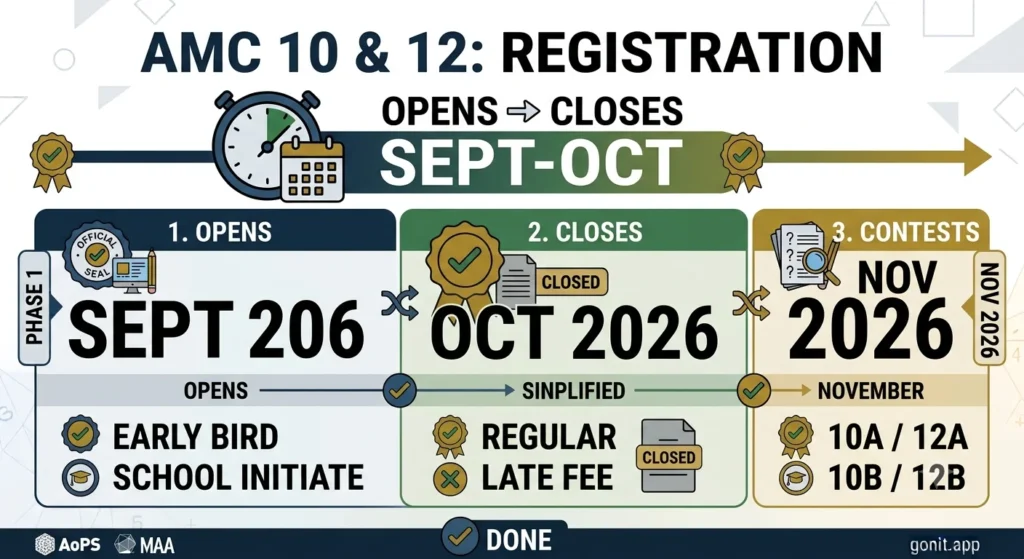
If your school doesn’t already offer the AMC, a parent or teacher can set up a center well ahead of the November window.
For a full walkthrough of deadlines, fees, and how homeschool students can register, see our dedicated AMC registration guide.
Homeschool families and independent students can register through a nearby approved center; the registration guide linked above lists what to check for.
Registration typically opens in late summer and closes several weeks before the contest date, so don’t wait until October.
The same registration covers both AMC 10 and AMC 12 competition packets, since schools order materials for both A and B versions.
Side by Side: AMC 10 vs AMC 12
| Feature | AMC 10 | AMC 12 |
| Eligibility | Grade 10 and below, under 17.5 | Grade 12 and below, under 19.5 |
| 2026 date (A) | November 5, 2026 | November 5, 2026 |
| 2026 date (B) | November 13, 2026 | November 13, 2026 |
| Questions | 25 | 25 |
| Time | 75 minutes | 75 minutes |
| Format | Multiple choice, 5 options | Multiple choice, 5 options |
| Scoring | 6 / 0 / 1.5 (max 150) | 6 / 0 / 1.5 (max 150) |
| Calculator | Not allowed | Not allowed |
| Topic ceiling | Algebra 2, full geometry, intro number theory and combinatorics | Adds trig, logs, complex numbers, sequences, advanced combinatorics |
| Calculus? | No | No, explicitly excluded |
| AIME percentile target | Top ~2.5% | Top ~5% |
| AIME cutoff (recent) | ~94.5 to 105 / 150 | ~76.5 to 100 / 150 |
| AIME pathway | AMC 10 -> AIME -> USAJMO | AMC 12 -> AIME -> USAMO |
Notice what’s identical: time, question count, scoring system, calculator policy. The format is engineered to feel the same. The differences live in two places: the topic ceiling and the AIME pathway.
The Syllabus Gap: What AMC 12 Adds
The AMC 10 covers everything you’ve seen through Algebra 2 and Geometry: linear and quadratic equations, polynomials, areas and volumes, similarity, basic counting, divisibility, and modular arithmetic.
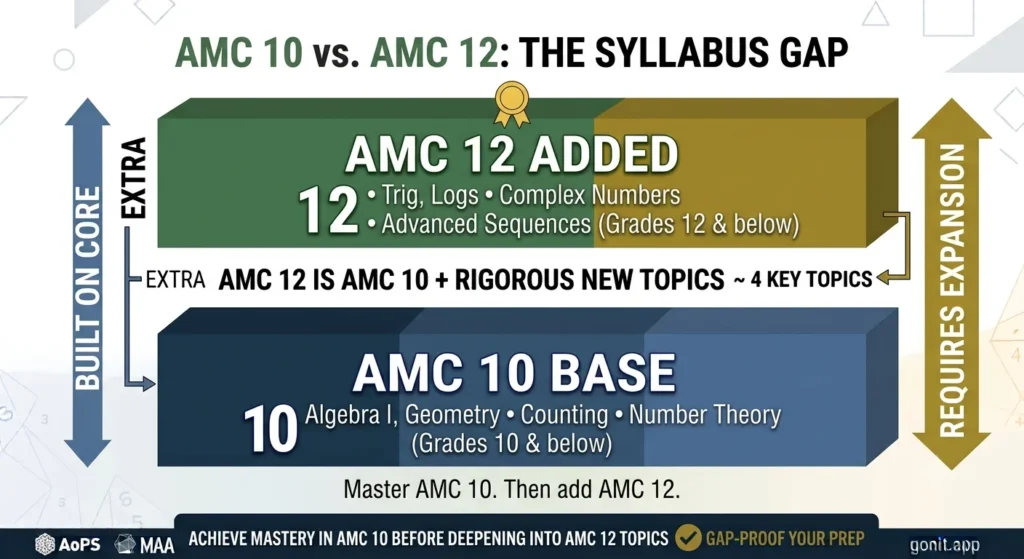
The AMC 12 adds the precalculus toolkit on top:
- Trigonometry: sine, cosine, tangent, identities, sum and difference formulas, unit circle thinking.
- Logarithms and exponentials: log laws, change of base, exponential growth and decay framed inside competition problems.
- Complex numbers: a + bi arithmetic, polar form, De Moivre’s theorem in clever disguises.
- Sequences and series: arithmetic, geometric, telescoping, recursion that looks like generating functions.
- Polynomial identities: Vieta’s formulas, factor theorem, symmetric polynomials.
- Advanced combinatorics: stars and bars, inclusion-exclusion, casework that requires real organization.
The 25 questions still split across algebra, geometry, number theory, and combinatorics, but the back half problems (20 to 25) on the AMC 12 routinely require multi-step insights that combine two of those topics.
A strong AMC 10 student moving up to AMC 12 should expect a score drop initially; the topic gap is real and takes 3 to 6 months to close.
For the full topic-by-topic breakdown across the AMC family, see our AMC syllabus guide.
Difficulty: Are AMC 12 Problems Harder?
Yes, and the question itself misses something important.
Problem 1 on the AMC 12 is harder than problem 1 on the AMC 10, but only modestly. The early problems on both contests are designed to be quick wins.
Where the gap opens is around problem 15: by 15 on the AMC 12, you’re already into multi-step territory that mostly didn’t appear until problem 20 on the AMC 10.
Problems 20 to 25 on the AMC 12 are the hardest problems most US high schoolers will ever sit in a timed contest setting.
What this means strategically: the AMC 12 rewards depth more than speed. On the AMC 10, a fast student who knows the techniques can often finish all 25 problems.
On the AMC 12, even the strongest students typically attempt 18 to 22 problems and leave the rest strategically blank.
AIME qualification: the numbers that actually matter
The single statistic both AMC 10 and AMC 12 students watch is the AIME cutoff the threshold above which you advance to the American Invitational Mathematics Examination.
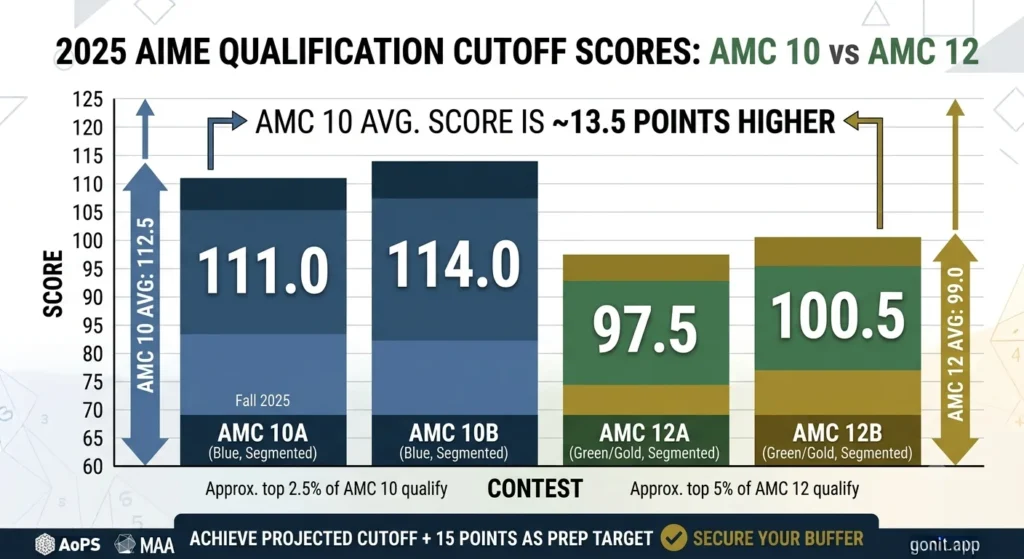
Cutoffs are set after each contest and move year to year, so treat any historical number as a rough guide, not a target you can count on.
Here are the official 2025-cycle cutoffs as a concrete reference point:
| 2025 cycle | AMC 10A | AMC 10B | AMC 12A |
| AIME cutoff | 94.5 | 105 | 76.5 |
| AMC 12B | AIME cutoff |
| 2025 cycle | 88.5 |
Two patterns worth knowing:
- The absolute cutoff is similar between AMC 10 and AMC 12, despite very different percentile targets. MAA guarantees AIME qualification to at least the top ~2.5% of AMC 10 takers vs. the top ~5% of AMC 12 takers, but because AMC 12 problems are harder, the same absolute score sits at a higher percentile. (Note: as of August 2025, MAA removed the old 120/100 score floors, so cutoffs are now set purely by the percentile targets each year.)
- AMC 10 cutoffs are usually a bit higher than AMC 12. You can see it in the 2025 numbers above 10A sat at 94.5 while 12A sat at 76.5; 10B at 105 vs 12B at 88.5. This is the practical case for 9th/10th graders to lean AMC 10: if you can solve the techniques that show up on both contests, you’re often closer to the cutoff on AMC 10 because the back-half problems demand less precalculus. For the latest official thresholds, always check the MAA AMC page directly.
For deeper AIME-target context by contest, see our pillars on the AMC 10 practice test and the AMC 12 practice test.
What Counts as a Good AMC Score?
A “good” AMC score depends entirely on which contest you sat and what you’re aiming for.
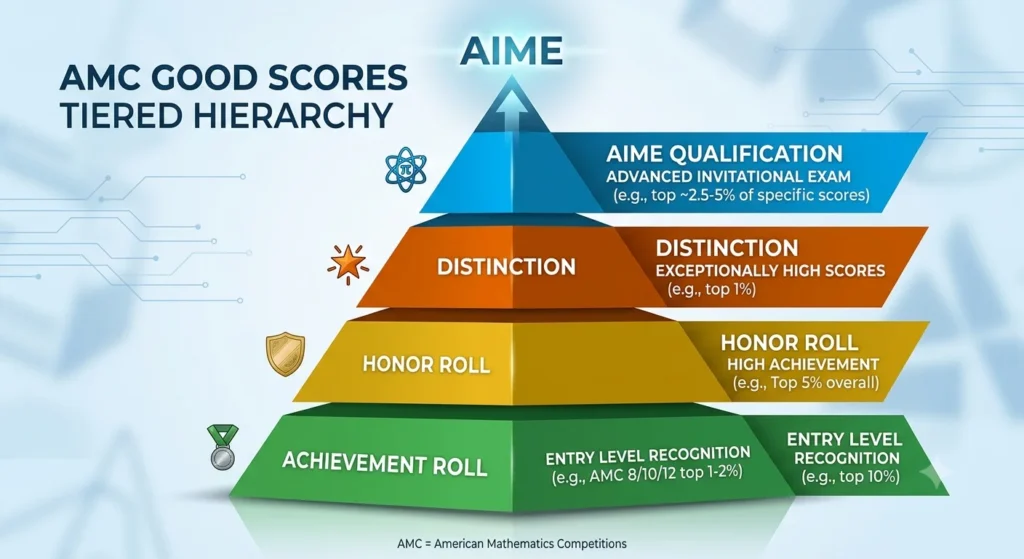
Qualifying for AIME is the headline benchmark, but plenty of students without an AIME-qualifying score still walk away with a result worth putting on an application.
Our guide to what counts as a good AMC score breaks this down by percentile, and the average AMC math scores page shows where a given raw score typically falls year over year.
- For most students, clearing the top 25% (roughly the Honor Roll cutoff on AMC 10, or a comparable band on AMC 12) is a strong, realistic goal.
- AIME qualification (top 2.5% on AMC 10, top 5% on AMC 12) is the next tier, and it’s the score colleges and competitive summer programs recognize most consistently.
- Distinction and Achievement Roll designations exist below AIME qualification and are still meaningful signals for younger students, especially 8th and 9th graders sitting AMC 10 early.
Benefits of Taking AMC 10 or AMC 12
Beyond the AIME pathway, sitting the AMC builds skills that carry over well past November.
Our full benefits of AMC math guide covers this in depth, but the short version:
- Timed problem solving under pressure, a skill that transfers directly to the SAT/ACT math sections and to college coursework.
- A concrete, well-recognized credential for college applications, particularly for students applying to competitive STEM programs.
- Exposure to problem types (combinatorics, number theory) that most school curricula skip entirely.
- A structured on-ramp to harder competitions: AIME, then USAMO or USAJMO, then international-level competitions for the strongest students.
Awards and Recognition
Both contests carry their own award tiers beyond AIME qualification, including Distinction, Achievement Roll, and Honor Roll designations, plus school-level and national-level recognition for top scorers.
See the full AMC awards breakdown for exact thresholds and what each designation looks like on a transcript or application.
Strategy if You’re Eligible for Both
If you’re a 9th or 10th grader, the question isn’t whether to sit the AMC 10; it almost always is. The question is whether to also sit the AMC 12.
Sit both if:
- You’ve already comfortably scored above the AIME cutoff on a past AMC 10 (or a timed practice paper).
- You’ve worked through trigonometry and logarithms in school or on your own.
- You’re aiming for AIME and USAMO/USAJMO, not just AIME qualification.
Stick with just AMC 10 if:
- You haven’t yet covered the precalculus topics that show up on AMC 12.
- You’re a borderline AIME qualifier and want your best score on the easier contest.
- You’re juggling APs and can’t add a second contest’s prep meaningfully.
For 9th and 10th graders sitting both, the practical schedule is AMC 10A on November 5, AMC 12B on November 13 (or vice versa, the A/B mix that doesn’t conflict).
Your AIME qualification triggers off your best score across all your AMC 10 and AMC 12 attempts, so sitting both can only help.
How to Prepare for AMC 10 or AMC 12
Whichever you sit, the prep is the same shape.
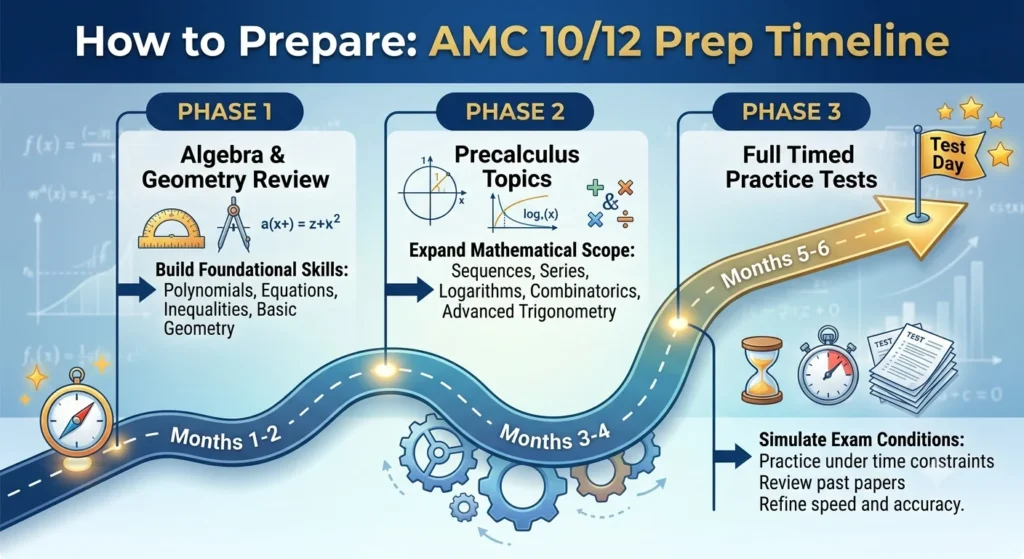
Gonit gives you a structured topic-by-topic sequence of AMC problems (algebra, combinatorics, number theory, geometry) calibrated to your current level.
The problems are everywhere; the sequence isn’t. For a week-by-week prep framework, see our how to prepare for AMC guide.
If you’re eligible for both, the prep doesn’t double; it deepens. Gonit organizes AMC 10 and AMC 12 topics into one continuous sequence, so the precalc work that gets you ready for AMC 12 also sharpens your AMC 10 back half.
I’m a senior. Should I bother with the AMC 12 if I haven’t done competition math before?
Yes, if you can find one hour a week between now and November. Even a few months of focused practice can move you 20–30 points. AIME qualification as a senior is meaningful on college applications, and even a strong AMC 12 score without qualification (top 5–10%) is a credible signal.
Can my child take both AMC 12A and AMC 12B (without AMC 10)?
Yes. Your better score across the two counts for AIME qualification. Many serious AMC 12 students sit both A and B the worst case is two reps of contest experience.
I scored 105 on AMC 10 last year. Should I move to AMC 12 this year?
Probably sit both. A 105 on AMC 10 is a strong score in the 2025 cycle it was right at the AMC 10B cutoff and comfortably above the 10A cutoff so the AMC 10 remains your safer AIME qualification path. The AMC 12 (with a few months of precalculus prep) becomes a stretch goal on top. Sitting both gives you two shots. Bear in mind that cutoffs shift each year, so confirm the current threshold on the MAA site.
Do colleges weight AMC 10 and AMC 12 differently?
Yes, marginally. AIME qualification via AMC 12 is technically a higher absolute achievement (top ~5% of a more advanced contest population). But colleges that pay attention to AMC results are looking at AIME qualification as the binary signal once you’ve cleared that threshold, the specific path matters less than the AIME score itself.
Is AMC 10 easier than AMC 12?
Not exactly easier, but narrower. AMC 10 stays inside Algebra 2 and Geometry, while AMC 12 adds trigonometry, logarithms, complex numbers, and sequences on top. A student who has covered precalculus often finds AMC 12’s back half more approachable than AMC 10’s, since the extra tools open up faster solving paths. See the AMC syllabus guide for the full topic breakdown.
What is a good AMC 10 score for a 9th grader?
For a 9th grader, clearing the Distinction or Honor Roll band is already a strong result, and reaching the AIME cutoff (roughly 94.5 to 105 in recent cycles) puts you ahead of the vast majority of test takers your age. Check our good AMC score guide for grade-adjusted context.
Make Preparing for Math Olympiad Simple!



Conclusion
The AMC 10 vs AMC 12 choice mostly comes down to grade and precalculus readiness. Grade 11 or 12 means AMC 12 is your only option, so focus prep on trig, logs, and complex numbers.
Grade 9 or 10 means the AMC 10 is your safer AIME path, and adding the AMC 12 only helps, since your best score across both counts.
Whichever seat you sit in, start early and work through topics in a structured sequence rather than jumping straight to past papers. That’s exactly what Gonit builds for you.