


Official AMC 12 past papers and answer keys are available for free in the AoPS AMC archive, and the MAA AMC is the official source for current rules and dates.
- Where to find official AMC 12 past papers
- AMC 12 in 2026: format, dates, scoring
- How the AMC 12 differs from the AMC 10
- The actual topic mix on the AMC 12
- Realistic AIME qualification targets
- AMC 12 registration and eligibility basics
- Why the AMC 12 is worth the effort
- A focused 8-week prep plan around school
- Past papers alone vs. structured topic practice
- Conclusion
- Related guides
For the 2026–27 cycle, AMC 12A falls on November 5, 2026, with AMC 12B one week later on November 13, 2026.
Both versions cover the same syllabus and carry the same difficulty standard, so which one you take (or whether you take both) is mostly a scheduling decision, not a strategic one.
This guide walks you through where to get an AMC 12 practice test and official past papers, what makes the AMC 12 different from the AMC 10, realistic AIME targets, and a prep plan that fits around AP classes.
Where to find official AMC 12 past papers
The MAA owns the contest, but the cleanest public archive of every AMC 12 past paper A and B versions, all years, lives on Art of Problem Solving’s wiki.
- AMC 12 Problems and Solutions archive (AoPS) — every problem from every AMC 12, with community-written solutions for nearly all of them.
- MAA AMC official site — registration, current rules, and post-contest official answer keys.
- MAA AIME announcements — the AIME I and AIME II dates, current cutoffs, and qualification policy.
AMC 12 in 2026: format, dates, scoring
Before you start drilling past papers, know exactly what test you’re preparing for. The format is identical across A and B versions.
- AMC 12A and AMC 12B: AMC 12A on November 5, 2026 and AMC 12B on November 13, 2026 (about a week apart). See full details on the official MAA AMC schedule, as the MAA sets them each year.
- AIME I (2026 cycle): February 5, 2026. AIME II: February 11, 2026 (alternate).
- Length: 75 minutes.
- Questions: 25, all multiple choice (five options).
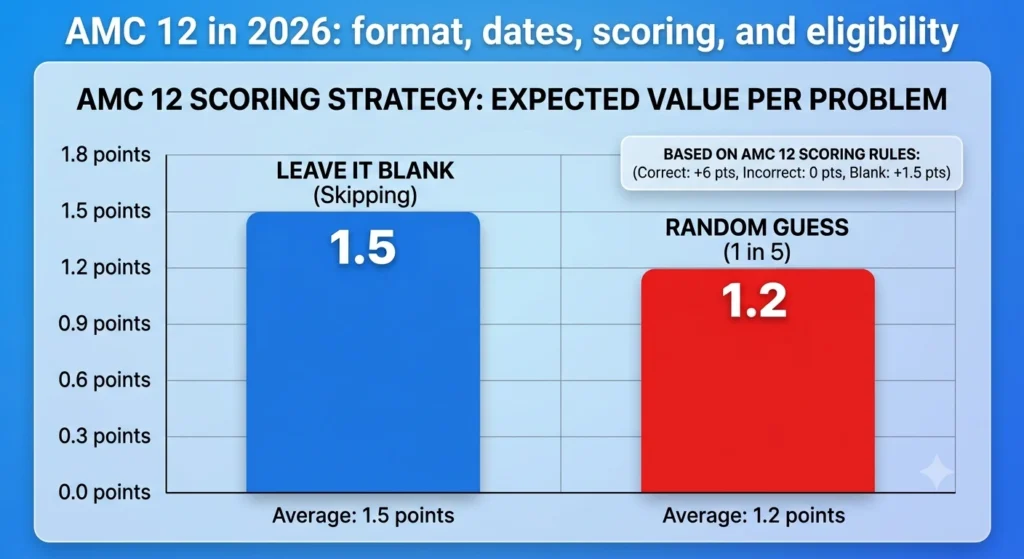
- Scoring: 6 points for each correct answer, 0 for each wrong answer, 1.5 points for each unanswered question. Maximum score: 150.
- Eligibility: grade 12 and below, maximum age 19.5 on contest day. For the full rules on grade exceptions and international eligibility, see our AMC age limit and eligibility guide.
- Calculator policy: no calculators.
- You may not take AMC 10 and AMC 12 on the same day. You can sit both an A and a B contest in the same year (e.g., AMC 12A and AMC 12B), and your better score is what counts for AIME qualification.
The 1.5-point blank rule is the most important strategic fact about the AMC 12. A random guess on a 5-option question is worth, on average, 1.2 points less than leaving it blank.
If you can’t eliminate at least one option, the math says skip it.
How the AMC 12 differs from the AMC 10
If you’ve already worked through our AMC 10 practice test guide, most of the format will feel familiar.
The differences are about content depth, not test mechanics.
| Feature | AMC 10 | AMC 12 |
|---|---|---|
| Eligibility | Grade 10 and below, max age 17.5 | Grade 12 and below, max age 19.5 |
| Questions | 25 | 25 |
| Time | 75 minutes | 75 minutes |
| Scoring | 6/0/1.5, max 150 | 6/0/1.5, max 150 |
| Topic ceiling | Up through Algebra 2 / Geometry | Adds trig, complex numbers, logs, sequences, advanced combinatorics |
| Calculus? | No | No — explicitly excluded by MAA |
| AIME qualification | At least top 2.5% | At least top 5% |
| AIME pipeline | AMC 10 → AIME → USAJMO | AMC 12 → AIME → USAMO |
The AMC 12 covers everything the AMC 10 covers, plus the precalculus toolkit: trigonometry, logarithms, complex numbers, sequences and series, and richer combinatorics.
The questions also tilt harder in the back half; problems 20–25 routinely require multi-step insight rather than a single technique.
A strong AMC 10 student moving up to AMC 12 should expect their score to drop initially; the topic gap is real and takes a few months to close.
The actual topic mix on the AMC 12
People imagine the AMC 12 as either an algebra test or a geometry test.
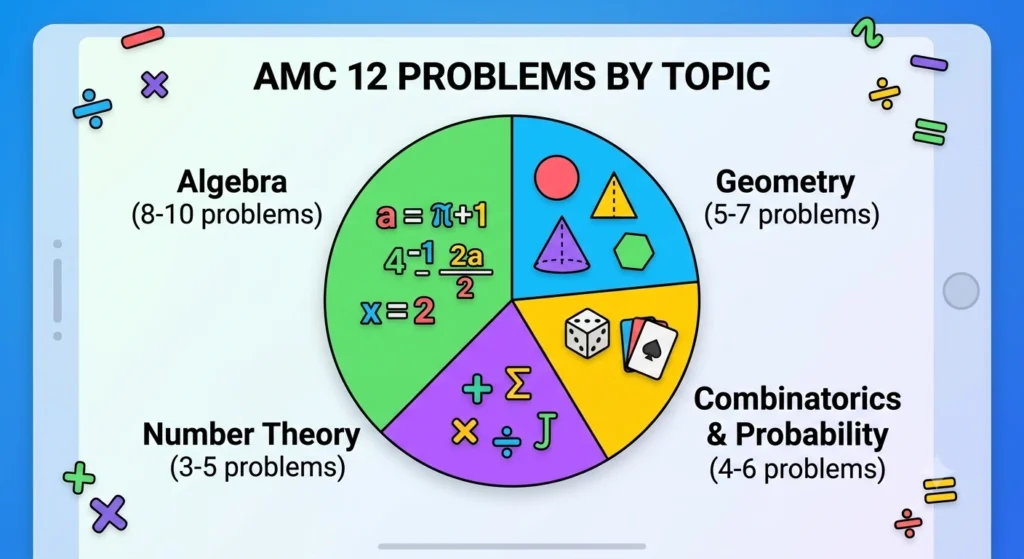
It’s neither. A typical AMC 12 distributes its 25 problems roughly like this:
- Algebra (8–10 problems): quadratics, polynomials, functional equations, logs and exponentials, sequences and series, complex numbers, Vieta’s formulas.
- Geometry (5–7 problems): triangle centers, circle theorems, trigonometric identities, coordinate geometry, 3D solids, similarity and area ratios.
- Number Theory (3–5 problems): modular arithmetic, divisibility, Diophantine equations, base representations, GCD/LCM tricks.
- Combinatorics & Probability (4–6 problems): counting in cases, complementary counting, expected value, recursion, generating functions in disguise.
There is no calculus on the AMC 12. The MAA is explicit about this. If a problem looks like it needs calculus, there is a cleverer non-calculus path to finding it is the point.
For a topic-by-topic breakdown across the full AMC family, see our AMC syllabus guide.
Realistic AIME qualification targets
The single number every AMC 12 student watches is the AIME cutoff. It moves every year because the MAA sets it so that at least the top 5% of AMC 12 takers qualify, rather than fixing a score.
(Note: the old 100-point AMC 12 qualification floor was removed as of August 2025, and international students no longer affect the cutoffs from that date.)
Because the threshold tracks difficulty, it can swing a lot from year to year.
If you want the fuller picture of what a good AMC score looks like across both AMC 10 and AMC 12, we cover that in a separate guide, along with typical average AMC math scores by grade level.
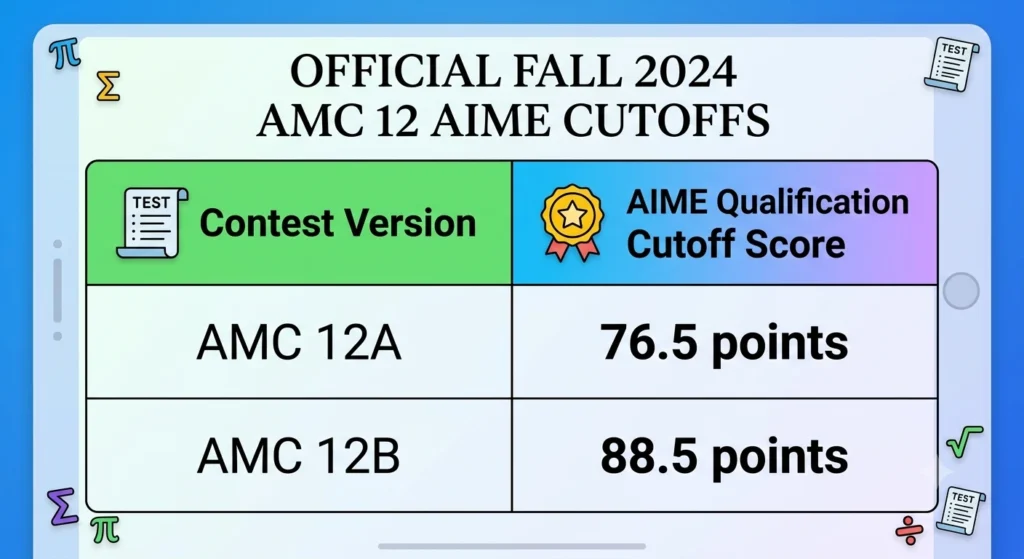
To give you a concrete anchor, here are the official cutoffs from the most recently completed cycle (Fall 2024 AMC, 2025 AIME qualification):
| 2025 AIME qualification | AMC 12A | AMC 12B |
|---|---|---|
| AIME cutoff | 76.5 | 88.5 |
| Distinction (top 5%) | 108 | 118.5 |
| Honor Roll of Distinction (top 1%) | 133.5 | 139.5 |
That year was widely described as one of the hardest AMC sittings on record, which is why the 12A cutoff dropped to 76.5.
In more typical years, AMC 12 AIME cutoffs have landed roughly in the mid-80s to around 100, with the B version often a touch higher than A (both are calibrated to the same percentile, so a higher B cutoff just means B drew a slightly stronger pool).
Always check the MAA’s official AIME threshold announcement for the current cycle rather than planning around any single past year.
A couple of takeaways from how the cutoffs behave:
- They swing meaningfully with difficulty. A hard paper can pull the cutoff down into the 70s; an easier one pushes it toward 100. You can’t predict which you’ll get.
- Don’t aim for the predicted cutoff; aim 10–15 points above it. A target around 110 gives you genuine safety in almost any year; aiming to just scrape the line leaves you sweating in December.
If you’re shooting for USAMO, the path runs AMC 12 → AIME → USAMO index, a combined score formula the MAA publishes each year.
Qualifying for AIME (and beyond) can also open the door to recognition through the AMC math competition awards program, including Distinction and Honor Roll designations.
AMC 12 registration and eligibility basics
You can’t sit the AMC 12 without registering through a school, homeschool coordinator, or approved testing center; there’s no direct individual sign-up through the MAA.
Deadlines typically fall several weeks before the November testing window, so it pays to confirm with your coordinator early. For a full walkthrough of the registration process, required forms, and fees, see our AMC registration guide.
And if you’re unsure whether you qualify by grade or age, our AMC age limit guide breaks down the exact cutoff rules, including edge cases for grade skippers and international students.
Why the AMC 12 is worth the effort
Beyond AIME qualification, the AMC 12 builds problem-solving stamina, reasoning under time pressure, and a genuinely deep grasp of precalculus topics that pays off in AP Calculus and beyond.
If you want the fuller case for why students invest the hours, our benefits of AMC math guide lays out the academic and college-admissions angles in more depth.
A focused 8-week prep plan around school
Most AMC 12 students don’t have unlimited time.
Here is a realistic plan for a junior or senior balancing AP classes, sports, and applications.
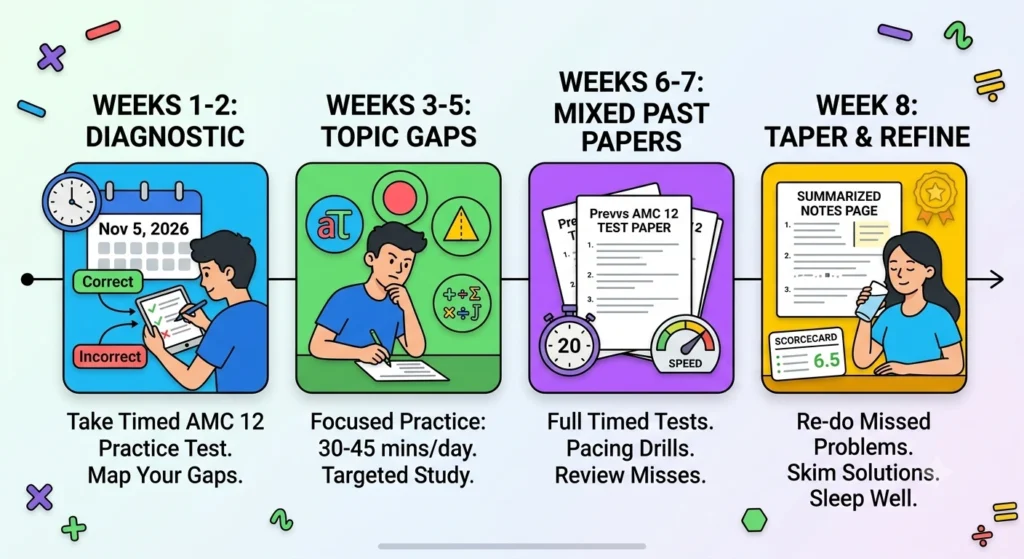
Weeks 1–2: Diagnostic. Take one full timed AMC 12 from 2022 or 2023 under contest conditions (75 minutes, no calculator, no breaks). Score it honestly. Categorize every miss by topic (algebra / geometry / number theory / combinatorics). This is your map.
Weeks 3–5: Topic gaps. Spend 30–45 minutes a day on your two weakest topic categories. Don’t grind random past papers; work focused problem sets organized by topic and difficulty. The right structure here matters more than total volume.
Weeks 6–7: Mixed past papers. Take one full-time AMC 12 every 4–5 days. Alternate A and B. Review only the misses and the questions you skipped. Watch your pacing by week 7, you should be finishing problems 1–15 in under 30 minutes, leaving 45 minutes for the back half.
Week 8: Taper and refine. No new topics. Re-do problems you previously missed and skim official solutions for elegant techniques. Sleep, hydrate, and walk into the contest fresh.
For the long-arc version of this plan covering AMC 10 → 12 → AIME, see how to prepare for the AMC.
Past papers alone vs. structured topic practice
Past papers are essential, but they’re a map of which problems you can’t solve, not a roadmap to actually solving them.
| Free past papers alone | Structured topic-by-topic practice | |
|---|---|---|
| Cost | Free | Free to start on Gonit |
| Coverage | Random by year | Sequenced by topic and difficulty |
| Feedback | Solution write-up only | Hints, step-by-step, similar-problem chains |
| Pacing | You self-manage | Daily plan adjusts to your progress |
| Tracks weak topics | No | Yes |
| Best for | Final 4 weeks of timed practice | The 4–6 months before that |
| Repeats spaced | No | Yes (spaced repetition built in) |
The honest answer: use both. Past papers for realism and pacing in the final stretch; a structured app for the daily reps that build the underlying machinery.
I’m a sophomore. Should I take the AMC 10 or the AMC 12?
Take the AMC 10. Your eligibility window for the AMC 10 is short (grade 10 and below), and the AIME cutoff is a lower percentile (top 2.5% vs. top 5%) but typically reached with a similar absolute score, making AIME qualification more achievable via the AMC 10. Save the AMC 12 for junior and senior year, when its longer topic list plays to your favor. Full grade and age rules are in our AMC age limit guide.
Can I take both AMC 12A and AMC 12B?
Yes. MAA permits sitting both, and your higher score counts for AIME qualification. Many serious students do this. Just don’t double-book you cannot sit AMC 10 and AMC 12 on the same calendar day.
How many past papers should I actually do?
Quality matters more than quantity. A focused student can hit AIME qualification with 8–10 full past papers across 8 weeks provided each one is followed by genuine review of misses, not just a glance at the answer key. Doing 30 past papers in a month with no review is worse than doing 8 with deep review.
Is the AMC 12 worth it for college applications?
For top STEM-track applications (MIT, Caltech, the Ivies, top engineering programs), AIME qualification via the AMC 12 is a meaningful, well-recognized signal. Distinction or Honor Roll of Distinction, part of the AMC math competition awards program, is stronger still. For most other applications, the AMC 12 is one of several credible STEM extracurriculars, useful but not transformative. Do it because you find the problems interesting; treat the credential as a bonus.
What is considered a good AMC 12 score?
A score in the 100 to 110 range is generally strong and clears most AIME cutoffs with room to spare, while 120+ is competitive for Distinction. What counts as “good” shifts with your grade and goals; see our full breakdown in what is a good AMC score and typical average AMC math scores for context.
Make Preparing for Math Olympiad Simple!



Conclusion
The AMC 12 rewards preparation, not raw talent. Pull official past papers from the AoPS archive, run an honest diagnostic to find your weak topics, then close those gaps with focused practice before shifting into timed papers to sharpen pacing.
Two numbers matter most: skip questions you can’t crack (the 1.5-point blank rule beats guessing), and aim 10 to 15 points above the typical AIME cutoff for safety margin.
Start early, review every miss honestly, and walk into November with a plan you’ve already tested on yourself. Start free on iOS and Android and turn your AMC 12 prep into a routine instead of a scramble.
Related guides
- AMC syllabus: AMC 8, AMC 10, AMC 12 topics explained
- How to prepare for the AMC: a complete roadmap
- AMC 10 practice test: past papers and prep strategy

Mikha Piregu is a Content Writer with experience spanning educational content, including math and math olympiad topics, as well as advocacy writing, research-based articles, and SEO-driven web content. He creates high-quality blog content, web copy, and feature articles that support brand visibility, audience engagement, and long-term organic growth through data-informed storytelling. Skilled in WordPress, WooCommerce, and modern digital tools, Mikha adapts content across various platforms, including blogs, websites, campaigns, and advocacy initiatives, with clarity and purpose.




There are no comments posted here yet.
Sign in to leave a comment