
 September 19, 2025
 9 min. read

The AMC age limit is one of the most important eligibility rules to understand before you register for any AMC competition.
The AMC 10 requires students to be in grade 10 or below and under 17.5 years old on contest day. The AMC 8 requires students to be under 14.5, and the AMC 12 allows students up to 19.5 years old.
This guide covers the age limit and eligibility rules for all three AMC competitions, AMC 8, AMC 10, and AMC 12.
So you know exactly which exam you qualify for, what happens when you’re on the boundary, and what comes next after you compete.
AMC Age Limit: Quick Reference Table
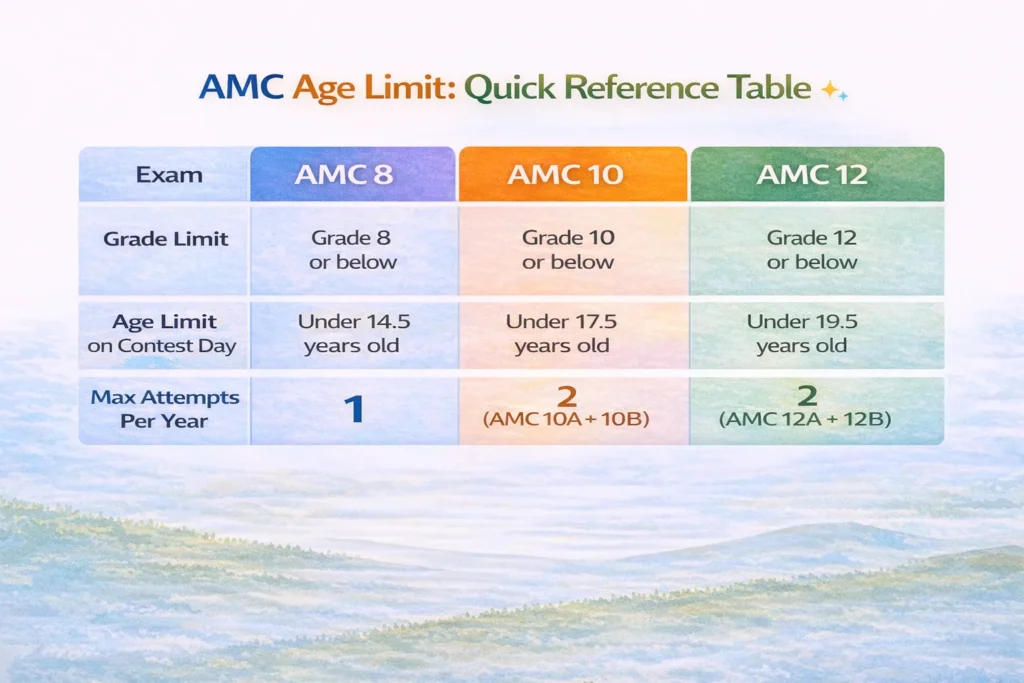
| Exam | Grade Limit | Age Limit on Contest Day | Max Attempts Per Year |
|---|---|---|---|
| AMC 8 | Grade 8 or below | Under 14.5 years old | 1 |
| AMC 10 | Grade 10 or below | Under 17.5 years old | 2 (AMC 10A + 10B) |
| AMC 12 | Grade 12 or below | Under 19.5 years old | 2 (AMC 12A + 12B) |
The key rule across all AMC exams: both conditions must be met, grade level AND age limit. Meeting one but not the other means you are ineligible for that exam.
AMC 8 Age Limit and Eligibility
The AMC 8 is designed for middle school students and is the entry-level competition in the AMC series.

- Grade requirement: Grade 8 or below
- Age requirement: Under 14.5 years old on contest day
- Format: 25 questions, 40 minutes, no calculator
- Scoring: 1 point per correct answer, no penalty for wrong answers or blanks
The AMC 8 does not directly qualify students for the AIME. Its primary purpose is to build problem-solving foundations and introduce younger students to competition mathematics.
However, strong performance on the AMC 8 is excellent preparation for the AMC 10 in subsequent years.
For students preparing to move up, understanding what type of questions are asked in math olympiads gives a useful preview of what AMC 10 and 12 problems look like.
AMC 10 Age Limit and Eligibility
The AMC 10 is the most commonly asked-about exam when it comes to age eligibility.
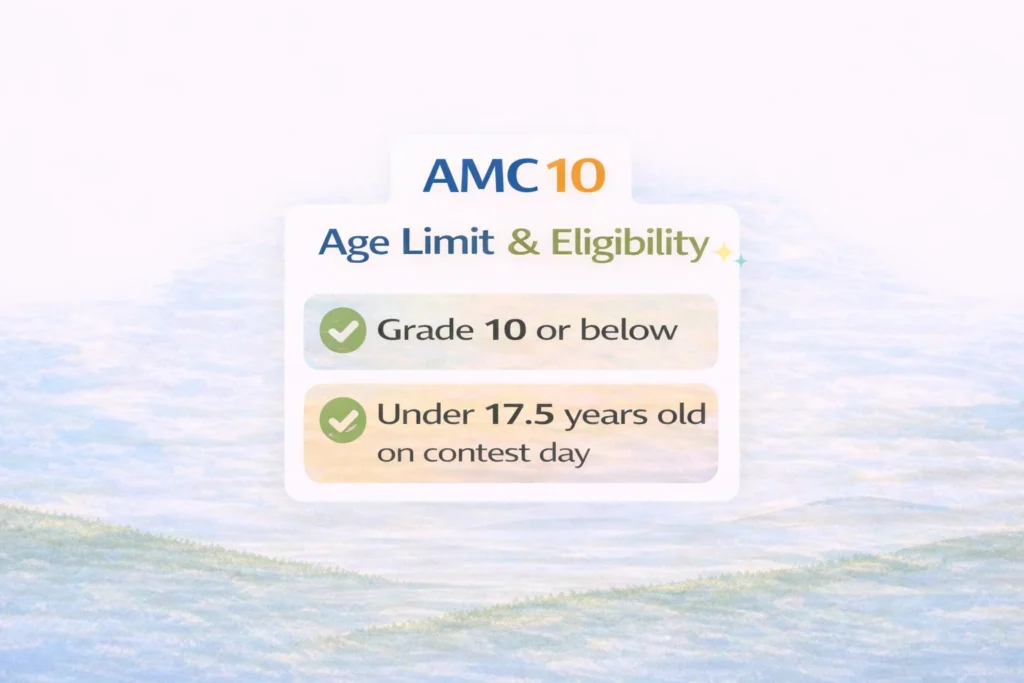
- Grade requirement: Grade 10 or below
- Age requirement: Under 17.5 years old on contest day
- Format: 30 questions, 75 minutes, no calculator
- Scoring: 6 points correct, 1.5 points blank, 0 points wrong
- Maximum score: 150
The 17.5 Age Rule — What It Means in Practice
The 17.5 age cutoff is calculated based on your age on the specific day of the contest, not your age at the start of the school year. If you turn 17.5 years old before or on contest day, you are ineligible for the AMC 10 regardless of your grade level.
Practical example: If your birthday is August 15 and the AMC 10A is held in November, you calculate whether you will be 17 years and 6 months (17.5) or older on that specific November date.
What If You Are in 10th Grade but Over 17.5?
You cannot take the AMC 10. You must register for the AMC 12 instead. Grade level alone does not determine eligibility — the age limit is a hard cutoff.
Can You Take Both AMC 10A and AMC 10B?
Yes. The AMC 10 is offered twice each year, the 10A and the 10B on different dates. Eligible students can participate in both.
Many students use the first sitting as a practice run and aim for their best score on the second sitting. Your best result from either sitting can count toward the AIME qualification.
For a full breakdown of how registration works for both sittings, see how to register for AMC math competitions.
AMC 12 Age Limit and Eligibility
The AMC 12 covers a broader and more advanced curriculum than the AMC 10 and is designed for older high school students.

- Grade requirement: Grade 12 or below
- Age requirement: Under 19.5 years old on contest day
- Format: 30 questions, 75 minutes, no calculator
- Scoring: Same as AMC 10 — 6 correct, 1.5 blank, 0 wrong
- Maximum score: 150
The AMC 12 tests additional topics not found on the AMC 10, including trigonometry, advanced algebra, and precalculus-level content.
For the full AMC syllabus breakdown across all levels, that post covers what each exam tests in detail.
Can You Take Both AMC 10 and AMC 12 in the Same Year?
Yes — if you are eligible for both. A student in 10th grade who is under 17.5 can sit for AMC 10A and AMC 12B (or AMC 10B and AMC 12A) in the same academic year, since the A and B sittings are on different dates.
You cannot take AMC 10A and AMC 12A on the same date.
Many 10th graders who are eligible for AMC 10 choose to also attempt the AMC 12 for additional practice and to assess their readiness for the following year.
Why Does the AMC Have Age Limits?
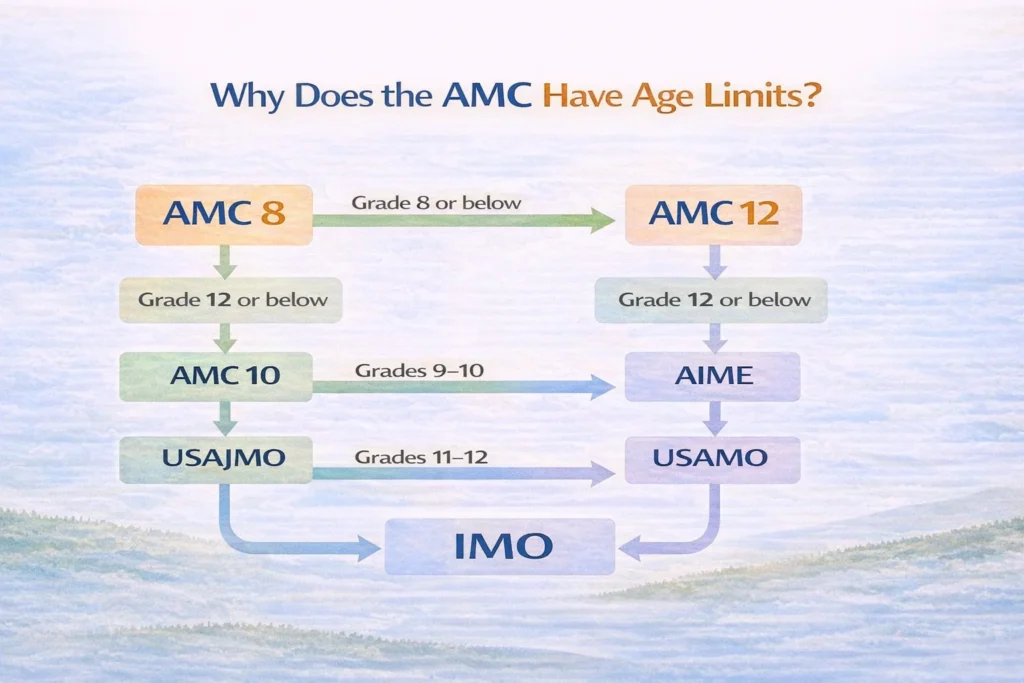
The age limits exist for two interconnected reasons: fairness and pathway integrity.
Fairness
A 17-year-old in 10th grade who has had two additional years of mathematical exposure compared to a typical 15-year-old 10th grader has a structural advantage in problem-solving depth.
The age cap ensures that students compete against peers at a genuinely similar stage of development, not just the same grade level.
Pathway Integrity
The AMC competition structure is designed as a deliberate progression:
- AMC 10 → AIME → USAJMO (for younger students, typically grades 9–10)
- AMC 12 → AIME → USAMO (for older students, typically grades 11–12)
Separating these pathways means younger students qualify for USAJMO rather than competing directly against older students for USAMO spots.
This gives high-achieving younger students a meaningful, age-appropriate milestone to work toward. For a full picture of where this pathway leads, see how to qualify for the IMO in the USA.
How Age Eligibility Affects AIME Qualification
Understanding which exam you take based on age has a direct impact on your qualification pathway.
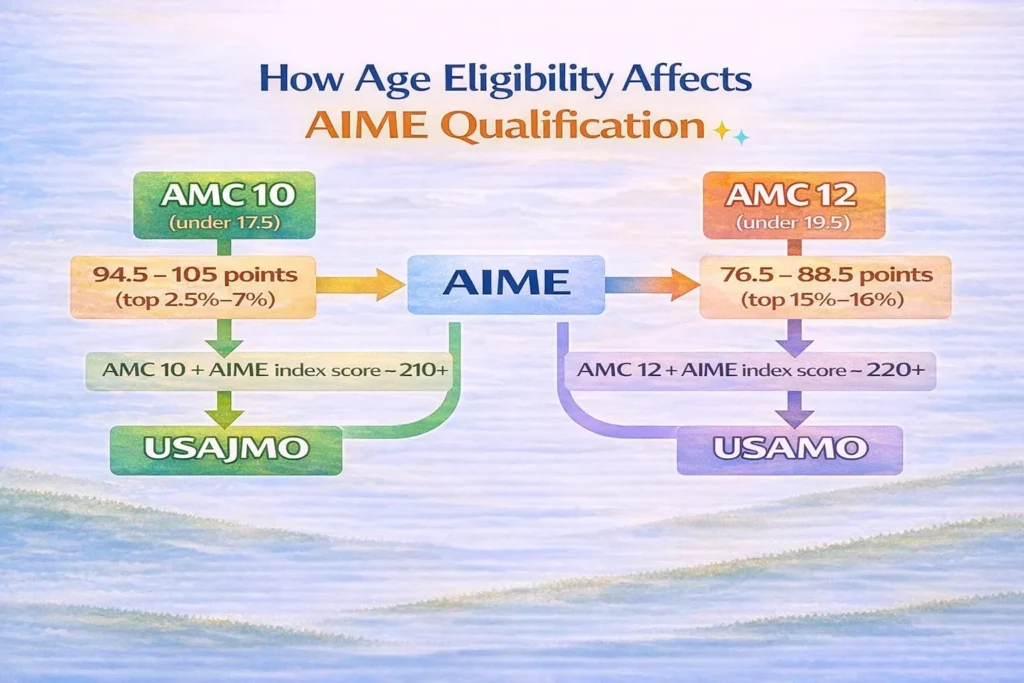
AMC 10 → AIME → USAJMO
Students who qualify for AIME through the AMC 10 are eligible for the USAJMO (USA Junior Mathematical Olympiad). This is specifically for younger competitors and uses a combined AMC 10 + AIME index score.
- Typical AIME cutoff for AMC 10: 94.5 – 105 points (top 2.5%–7%)
AMC 12 → AIME → USAMO
Students who qualify for AIME through the AMC 12 are eligible for the USAMO (USA Mathematical Olympiad). This is the senior pathway and is highly competitive.
- Typical AIME cutoff for AMC 12: 76.5 – 88.5 points (top 15%–16%)
A student who takes both AMC 10 and AMC 12 in the same year can potentially qualify through either pathway.
However, if they qualify through AMC 12, they are directed toward USAMO rather than USAJMO, even if they are young enough for USAJMO eligibility.
For context on what a competitive score looks like for each path, see what is a good AMC math competition score.
AMC 10 vs AMC 12: Which Should You Take?
If you are eligible for both AMC 10 and AMC 12, here is how to decide:
| Factor | Choose AMC 10 | Choose AMC 12 |
|---|---|---|
| Grade | Grade 9 or 10 | Grade 11 or 12 |
| Content comfort | Algebra, geometry, basic number theory | + Trigonometry, precalculus, advanced algebra |
| Competition pathway goal | USAJMO | USAMO |
| Strategy | Lower absolute cutoff in easier material | Higher material, lower absolute cutoff |
| Both eligible? | Take AMC 10 as primary | Use AMC 12 as a stretch attempt |
Most students in grades 9–10 who are eligible for both should take the AMC 10 as their primary exam and consider attempting AMC 12 on a separate date for practice and benchmarking.
For students who want to understand what the benefits of the AMC competition are beyond just rankings, that post covers the college application, cognitive, and academic development advantages.
How to Prepare Once You Know Your Eligibility
Once you have confirmed you are eligible for AMC 10 or AMC 12, preparation is the next step.

Know the Exam Format Cold
AMC 10 and 12 share the same structure — 30 questions, 75 minutes, 6/1.5/0 scoring. Understanding the scoring strategy (never guess randomly, never leave blanks) is the single easiest way to improve your score without additional content knowledge.
Build Topic Fluency by Exam Level
The AMC 10 focuses on algebra, geometry, combinatorics, number theory, and probability within a pre-calculus boundary. The AMC 12 adds trigonometry, sequences and series, and more advanced algebraic topics.
Use Past Papers With Real Timing
Practicing under actual timed conditions (75 minutes, no calculator) is non-negotiable. Reviewing every wrong answer in detail is more valuable than attempting more papers without reflection.
Aim Above the AIME Cutoff
If AIME qualification is your goal, aim 10–15 points above the historical cutoff to give yourself a buffer. For AMC 10, that means targeting 105–110+. For full preparation guidance, see how to prepare for an AMC math competition.
Can an 11th grader take the AMC 10?
No. Even if an 11th grader is under 17.5 years old, they are ineligible for the AMC 10 because grade 11 exceeds the grade 10 limit. They must take the AMC 12.
Can a 9th grader take the AMC 12?
Yes, if they are under 19.5 years old. There is no minimum grade requirement for any AMC exam — only a maximum. A highly advanced 9th grader may choose to sit the AMC 12 for additional challenge.
What if I turn 17.5 between the AMC 10A and AMC 10B dates?
Your eligibility is assessed independently for each contest date. If you are under 17.5 on the AMC 10A date, you are eligible for 10A. If you have turned 17.5 by the AMC 10B date, you are no longer eligible for 10B and would need to take AMC 12B instead.
Can a homeschooled student take the AMC?
Yes. Homeschooled students are eligible to participate and can register through a local AMC-registered school or institution that agrees to proctor the exam.
What happens if a student exceeds the age limit mid-preparation?
If a student realizes they have aged out of AMC 10 eligibility before the contest date, they should register for AMC 12 instead. The preparation content overlaps significantly, so switching exams does not require starting preparation from scratch.
For a comparison of what each exam covers, the AMC syllabus provides a clear side-by-side breakdown.
Make Preparing for Math Olympiad Simple!



Conclusion
The AMC age limit rules are straightforward once laid out clearly:
- AMC 8: Grade 8 or below, under 14.5 years old
- AMC 10: Grade 10 or below, under 17.5 years old on contest day
- AMC 12: Grade 12 or below, under 19.5 years old on contest day
Both conditions, grade level and age, must be met. If you are on the boundary, check your exact age against the specific contest date, not the start of the school year.
Knowing your eligibility early means you can register on time, choose your pathway deliberately, and begin preparation with a clear target in mind.
For a full picture of average AMC scores and what benchmark to aim for once you are registered, that post provides the year-by-year data to set your goal.