 November 18, 2025
 10 min. read

A good AMC score starts at 15 out of 25 on the AMC 8, 90+ out of 150 on the AMC 10, and 85+ on the AMC 12 puts you in competitive territory.
But what counts as a good AMC score shifts depending on your grade, your goal, and how the exam was scored that year — so the raw number alone tells you very little.
We’ve analyzed MAA historical data and score distributions across all three exams to give you the clearest good AMC score benchmarks available in 2026.
This guide breaks down what a good AMC score looks like for the AMC 8, AMC 10, and AMC 12 including 2026 Honor Roll cutoffs, AIME qualification targets, and grade-level benchmarks from 5th through 10th grade.
If you’re still learning the basics of the competition itself, start with the AMC maths competition syllabus before reading on.
How AMC Scoring Works
Understanding the scoring structure is the first step to evaluating what a “good” score actually means.

AMC 8 Scoring
- 25 questions, multiple choice
- 1 point per correct answer, no penalty for wrong answers or blanks
- Maximum score: 25
- Time limit: 40 minutes, no calculators
Because there’s no penalty for guessing, every question should be attempted. Students should never leave AMC 8 questions blank.
AMC 10 and AMC 12 Scoring
- 25 questions each (note: earlier editions had 30), multiple choice
- 6 points for correct, 1.5 points for blank, 0 points for incorrect
- Maximum score: 150
- Time limit: 75 minutes
The AMC scoring structure here means that skipping a question you’re unsure about (1.5 points) is better than guessing wrong (0 points). Strategy matters as much as content knowledge.
Understanding the point system also helps explain why the AMC 10 scoring and AMC 12 scoring produce averages that look deceptively low.
The problem difficulty is designed so that most students don’t complete every question correctly. For a deeper look at what kinds of problems appear on each level, see what type of questions are asked in math olympiads.
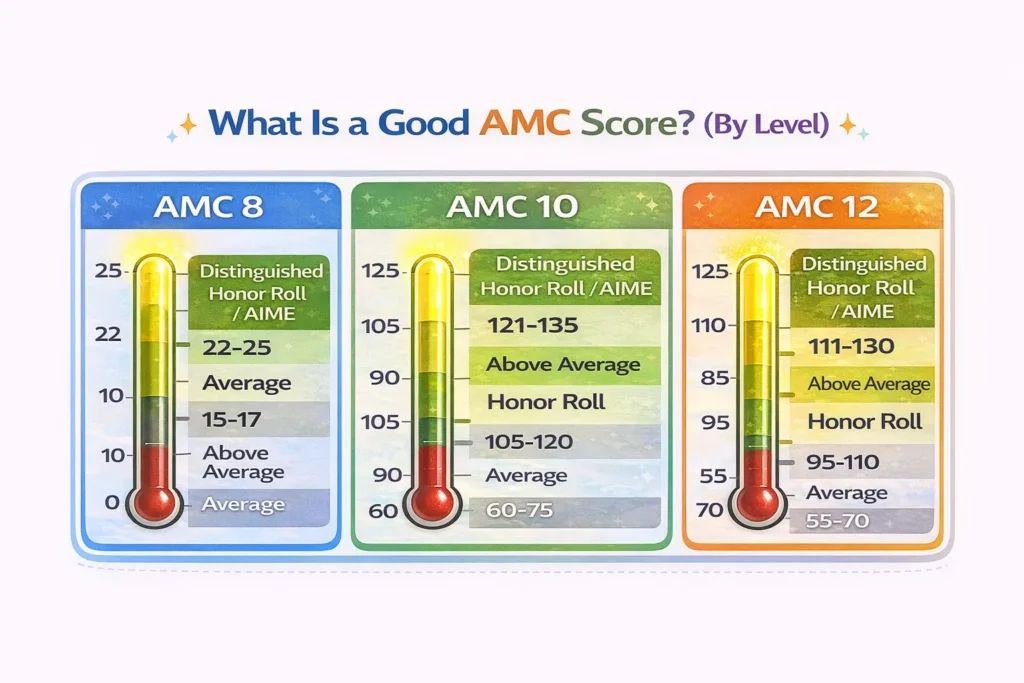
What is a Good AMC Score? (By Level)
AMC 8 — Good Score Benchmarks
| Score Range | What It Means |
|---|---|
| 15–17 | Above average — strong foundational skills |
| 18–21 | Honor Roll — top 5% nationally |
| 22–25 | Distinguished Honor Roll — top 1% nationally |
The national average for AMC 8 typically falls around 10–12 out of 25. Scoring 15 or above puts you well ahead of the majority of participants.
For students aiming at the top tier, a score of 19 or higher historically earns Honor Roll recognition, while 23+ places you in the Distinguished Honor Roll (DHR) the top 1%.
These are the benchmarks worth targeting if you plan to move up to the AMC 10.
AMC 8 Score Distribution and Percentiles
The AMC 8 score distribution is broad because it draws a large mix of grade levels and experience levels. Here’s how scores translate to percentile bands:
| Score | Approximate Percentile |
|---|---|
| 10–12 | ~50th percentile (national average) |
| 15–17 | ~70th–85th percentile |
| 18–21 | ~85th–99th percentile (Honor Roll) |
| 22–25 | Top 1% (Distinguished Honor Roll) |
The AMC 8 honor roll cutoff 2026 is expected to follow the historical pattern of 18–19+.
The AMC 8 distinguished honor roll 2026 cutoff typically falls at 22 or above, though the exact number shifts with the year’s score distribution.
What Is a Good AMC 8 Score by Grade?
Many students and parents ask what a good AMC 8 score looks like at their specific grade level.
Here’s a practical guide:
| Grade | Good AMC 8 Score | Exceptional Score |
|---|---|---|
| 5th grade | 13–15 | 17+ |
| 6th grade | 14–16 | 18+ |
| 7th grade | 16–18 | 19+ (Honor Roll) |
| 8th grade | 18–22 | 22+ (DHR) |
For a 5th grader, scoring 15 or above is strong, since most AMC 8 participants are in grades 6–8. For a 7th grader, hitting 16–18 is solid, 19+ is excellent. For an 8th grader, 22+ approaches Distinguished Honor Roll territory.
To understand exactly what recognition comes with these scores, see what the AMC maths competition awards are.

AMC 10 — Good Score Benchmarks
| Score Range | What It Means |
|---|---|
| 60–75 | Above national average |
| 90–100 | Competitive — strong shot at AIME |
| 100+ | Highly competitive — well above average |
| ~94.5–105 | Typical AIME qualification range |
The national average on the AMC 10 sits around 58–65 out of 150. Scoring above 90 is considered genuinely competitive.
The AIME qualification cutoff varies each year, but historically falls between 94.5 and 105 points for the AMC 10 — representing roughly the top 2.5% to 7% of all participants. Aiming for 100+ gives you a buffer against year-to-year variation.
For 7th graders taking the AMC 10, scoring 70+ is impressive. Anything above 90 is exceptional at that grade level. The AMC 10 scoring system rewards both accuracy and strategic use of blank answers.

AMC 12 — Good Score Benchmarks
| Score Range | What It Means |
|---|---|
| 60–70 | Above national average |
| 85–95 | Competitive — approaching AIME cutoff |
| 100+ | Strong — excellent for college applications |
| ~76.5–88.5 | Typical AIME qualification range |
AMC 12 national averages land in the mid-50s to low 60s. The AMC 12 scoring system uses the same 6/1.5/0 structure as the AMC 10, but covers harder content, which is why the AIME cutoff for AMC 12 is lower in absolute points (76.5–88.5) while still representing the top 15–16% of participants.
Students aiming for USAMO consideration need substantially higher scores typically 100+ on AMC 12 combined with a strong AIME performance.
For context on eligibility rules, see what is the age limit for the AMC.
AIME Qualification: What Score Do You Need?
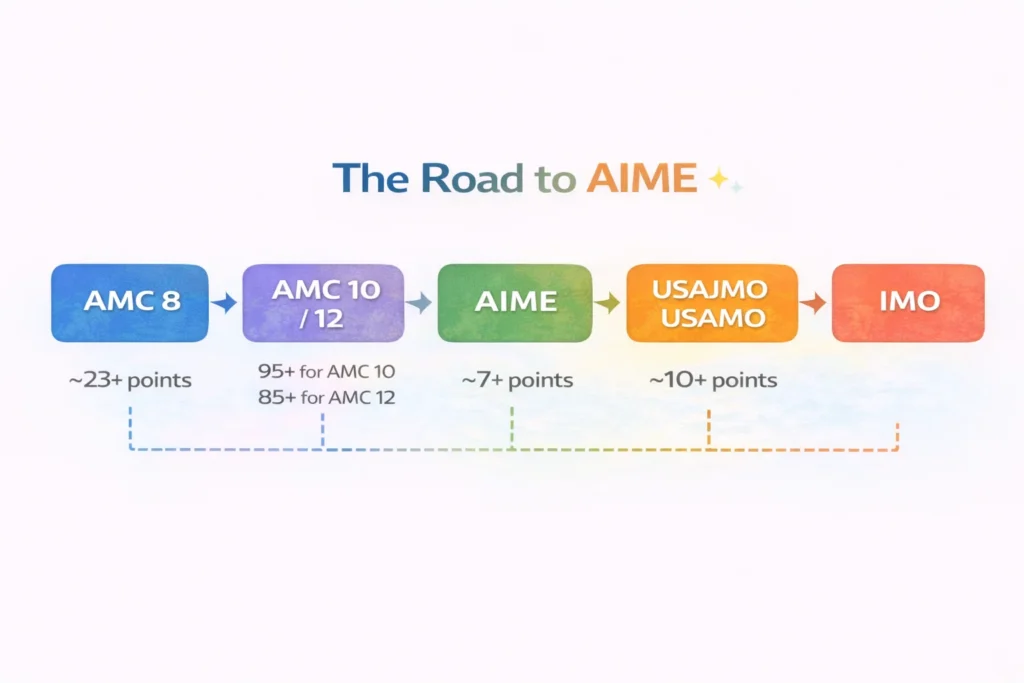
Qualifying for the AIME (American Invitational Mathematics Examination) is the primary competitive goal for most serious AMC 10 and AMC 12 participants.
Historical AIME Cutoff Ranges
| Exam | Typical Cutoff Range | Approximate Percentile |
|---|---|---|
| AMC 10 | 94.5 – 105 points | Top 2.5% – 7% |
| AMC 12 | 76.5 – 88.5 points | Top 15% – 16% |
Why do cutoffs change every year? The MAA adjusts cutoffs based on each year’s difficulty level and score distribution, rather than using fixed percentages. A harder exam in a given year may result in a lower cutoff. This is why the 2026 AMC 10 cutoff and 2026 AMC 12 cutoff will only be confirmed after the competition.
AMC 10 vs AMC 12: Which Is Better for AIME Qualification?
The AMC 10 has a higher absolute cutoff (94.5–105) but covers easier material. The AMC 12 has a lower absolute cutoff (76.5–88.5) but tests harder content. Most students in 10th grade or below find the AMC 10 more accessible.
The AMC 10 top 5% and top 2.5% markers are the clearest AIME qualification benchmarks. On the AMC 12, the top 15% is the general AIME target zone.
Practical Strategy
Rather than targeting the minimum cutoff, aim 10–15 points above the historical range to give yourself a buffer. For AMC 10, that means targeting 105–110+. For AMC 12, targeting 90–95+ is a safe goal.
For structured preparation toward AIME-level thinking, free math olympiad training online provides a solid starting framework.
What “Good” Really Means: 4 Ways to Define Your Target
A score doesn’t exist in a vacuum. Here are the four most meaningful ways to define what a good AMC score looks like for you specifically:

1. Personal Improvement
If you scored 65 on AMC 10 last year and scored 80 this year, that is a genuinely good score regardless of where it falls on any national scale. Consistent year-over-year improvement is the strongest signal of real mathematical growth.
2. Honor Roll Recognition
Honor Roll and Distinguished Honor Roll are awarded to the top performers nationally. These are meaningful achievements for college applications and future competition eligibility.
- AMC 8 Honor Roll: typically 18–19+
- AMC 8 Distinguished Honor Roll: typically 22–23+
- AMC 10/12 Honor Roll: varies by year; roughly top 5%
- AMC 10 Achievement Roll: for students in Grade 8 or below scoring in the top 1% nationally
3. AIME Qualification
For students with serious competition ambitions, qualifying for AIME is the clearest benchmark. Everything above the cutoff is “good.” Everything below it is an opportunity to identify gaps and prepare more strategically.
The AMC 10 scoring system gives students two paths to AIME: AMC 10A and AMC 10B. Sitting both gives you two chances at the cutoff in the same year.
4. College Application Value
For students not targeting AIME, any AMC score above the national average especially a percentile ranking in the top 25% adds meaningful value to a college application.
AMC scores are not required for college applications, but including a strong score, particularly Honor Roll or AIME qualification, can strengthen a STEM-focused application at competitive universities.
To understand what the full pathway beyond AMC looks like, see how to qualify for the IMO in the USA.
How to Actually Improve Your AMC Score
Knowing your target is only half the battle. Here is what consistently moves scores upward:

1. Know the Scoring Rules and Use Them
On AMC 10 and 12, never guess randomly, but never leave questions blank either. Use the process of elimination to narrow choices before committing or skipping.
2. Build Core Topic Fluency
AMC exams heavily test number theory, algebra, geometry, combinatorics, and probability. Identify which topics cost you the most points and build those up systematically.
The AMC syllabus breakdown gives a clear topic-by-topic overview for each level.
3. Practice With Past Papers Under Timed Conditions
Time pressure is a major factor. Practice full past exams under real conditions: 40 minutes for AMC 8, 75 minutes for AMC 10/12. Reviewing every missed question in detail is more valuable than simply completing more papers.
4. Develop a Skip Strategy
Attempting all 30 questions is rarely the optimal approach on AMC 10/12. Identify the 20–22 questions you can solve confidently, secure those points, and only then return to harder problems.
5. Learn From Olympiad-Level Thinking
AMC problems reward creative, non-standard approaches. Building exposure to how to get better at solving math olympiad questions trains the flexible thinking that separates average scores from high ones.
For a complete structured preparation roadmap, see how to prepare for an AMC math competition.
AMC 8 vs AMC 10 vs AMC 12: Which Is Harder?
Students often ask how difficulty compares across the three levels. Here’s the short answer:
- AMC 8: Middle school level. Arithmetic, basic algebra, geometry, counting, probability, number theory. No calculus. No advanced topics.
- AMC 10: High school level. All AMC 8 topics plus intermediate algebra, coordinate geometry, and more advanced number theory. No calculus.
- AMC 12: High school level (advanced). All AMC 10 topics plus trigonometry, advanced algebra, logarithms, and complex numbers. Still no calculus.
The AMC 8 is the recommended starting point for students in grades 6–8 who haven’t competed before. The AMC 10 is ideal for grades 9–10 with solid competition math foundations. The AMC 12 is best for students who have already performed well on AMC 10.
What is a good AMC 8 score for a 5th grader?
Scoring 15 or above as a 5th grader is strong, since most AMC 8 participants are in grades 6–8. A score of 18+ would be exceptional at that grade level.
What is the average AMC 10 score?
The national average typically falls between 58 and 65 out of 150. Anything above 75 puts you solidly above average.
Does my AMC score affect college admissions?
AMC scores are not required for college applications, but including a strong score, particularly Honor Roll or AIME qualification, can strengthen a STEM-focused application at competitive universities.
Is AMC 10 or AMC 12 better for AIME qualification?
The AMC 10 has a higher absolute cutoff (94.5–105) but covers easier material. The AMC 12 has a lower cutoff (76.5–88.5) but tests harder content. Most students find AMC 10 more accessible if they are in 10th grade or below.
What comes after a good AMC score?
AIME qualification leads to USAJMO/USAMO eligibility. From there, top performers can progress toward representing the US at the International Mathematical Olympiad. The full pathway is outlined in what is the best math competition in the world.
Make Preparing for Math Olympiad Simple!



Conclusion
A good AMC score is the one that moves you forward whether that’s hitting Honor Roll, qualifying for AIME, or simply beating your score from last year.
Here’s the quick summary: on the AMC 8, aim for 18+ for Honor Roll and 22+ for Distinguished Honor Roll. On the AMC 10, target 100+ to put yourself solidly in the AIME qualification range.
On the AMC 12, clearing 88+ keeps you competitive in most years.
Your next step is clear. Find your gap, build a focused plan, and start closing the distance to your target cutoff.
For the full data on where most students score, read our breakdown of average AMC math scores. And if you’re ready to start preparing, our guide on how to prepare for the AMC math competition gives you a structured roadmap from scratch.