 December 9, 2025
 6 min. read

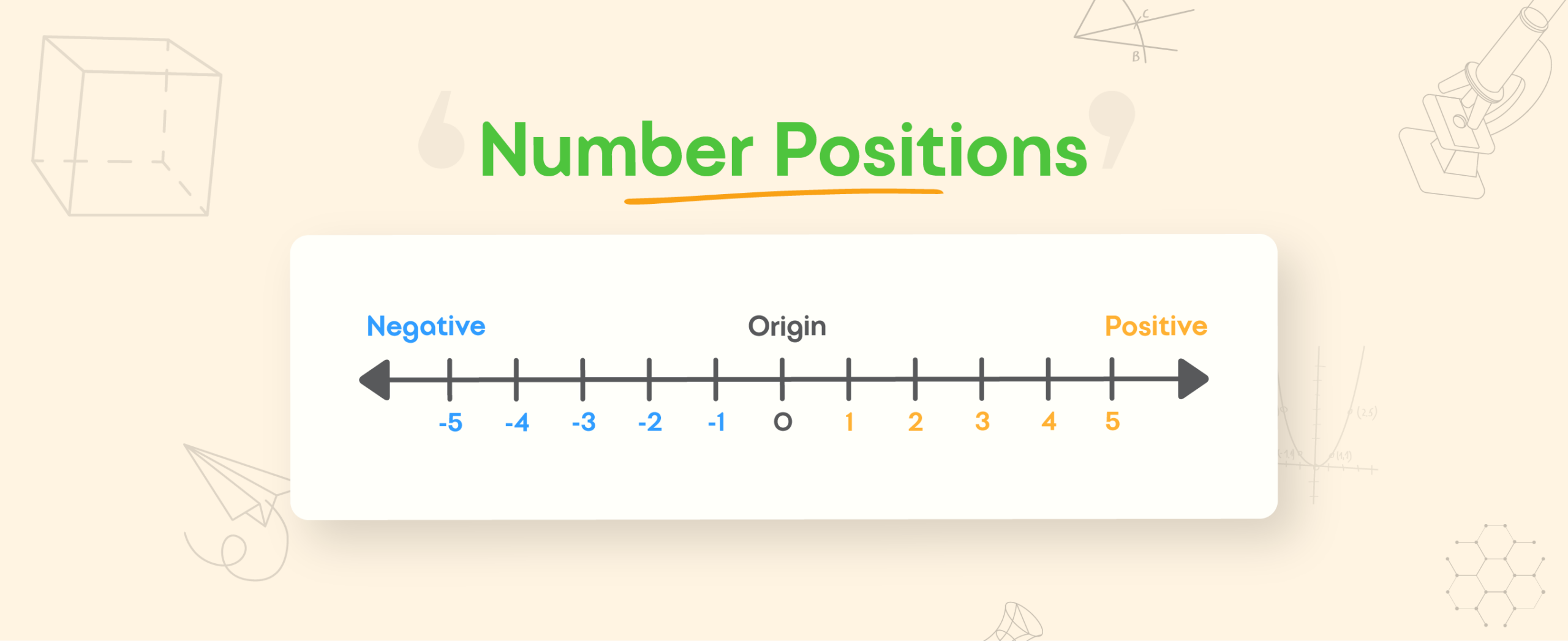
Understanding number positions on a number line is a key early math skill for Class 1 students. It helps children see where each number “lives” and how numbers are connected in order.
If your learners are new to number lines, you may want to begin with our introduction: What Is a Number Line for Class 1 Math Students
When young learners understand where numbers belong “before, after, and between” they become more confident in comparing values and using the number line to solve simple addition and subtraction problems.
These skills also build strong number sense, a topic we cover in detail in Number Sense Characteristics for Class 1.
Explain Direction
Before Class 1 students can use a number line confidently, they need to understand that number lines have a clear direction.
A great way to reinforce this visually is by practising the drawing steps found in Steps to Draw a Number Line for Class 1 Maths.

This simple idea helps children make sense of counting, comparing, adding, and subtracting.
- Left to Right = Increasing
Explain to students that numbers get bigger as we move to the right.
Show an example on the number line:
0 → 1 → 2 → 3 → 4
Say something simple like:
“Every step to the right means one more. The number gets larger each time we move right.”
This helps children understand forward counting and prepares them for addition.
- Right to Left = Decreasing
Next, show that numbers get smaller as we move to the left:
7 ← 6 ← 5 ← 4 ← 3
Tell students:
“Every step to the left means one less. The number gets smaller each time we move left.”
This introduces backward counting and supports early subtraction skills.
This introduces backward counting and early subtraction—skills also practised in How to Teach Number Line Maths to Class 1 Students.
Explain the Position of Numbers
Once children understand the direction of the number line, they can begin exploring how numbers relate to one another.
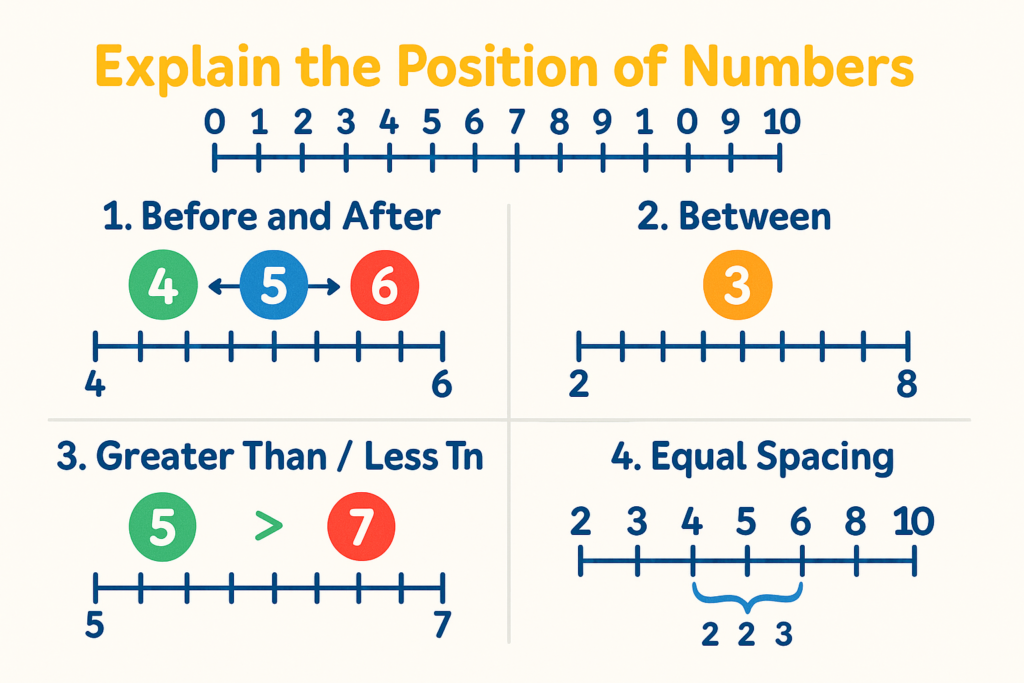
Number positions help Class 1 students make sense of before/after, in-between numbers, and simple comparisons.
1. Before and After
Show children that every number has a “neighbor” on each side.
For example, on the number line:
4 | 5 | 6
- 4 comes before 5
- 6 comes after 5
Ask guiding questions like:
- “Which number comes just before 7?”
- “Which number comes right after 3?”
This reinforces number sequencing and strengthens early counting skills.
2. Between
Help students see how some numbers sit between two others.
For example:
2 | 3 | 4
- 3 is between 2 and 4
Try asking:
- “Which number lies between 5 and 7?”
Understanding “between” builds awareness of order and placement.
3. Greater Than / Less Than
A number line makes comparing numbers easy:
- Numbers to the right are greater
- Numbers to the left are less
For example, on the line:
5 | 6 | 7
- 7 is greater than 5
- 5 is less than 6
This visual comparison prepares students to use the symbols > and < later on.
4. Equal Spacing
Explain that the number line is “fair” because each tick mark is the same distance apart.
The step from 2 to 3 is the same size as the step from 9 to 10.
Equal spacing helps children understand:
- one-to-one jumps
- counting patterns
- early addition and subtraction
This consistency makes the number line a reliable tool for all number operations.
Use Classroom Examples
Classroom demonstrations are one of the easiest ways to help Class 1 students understand number positions.
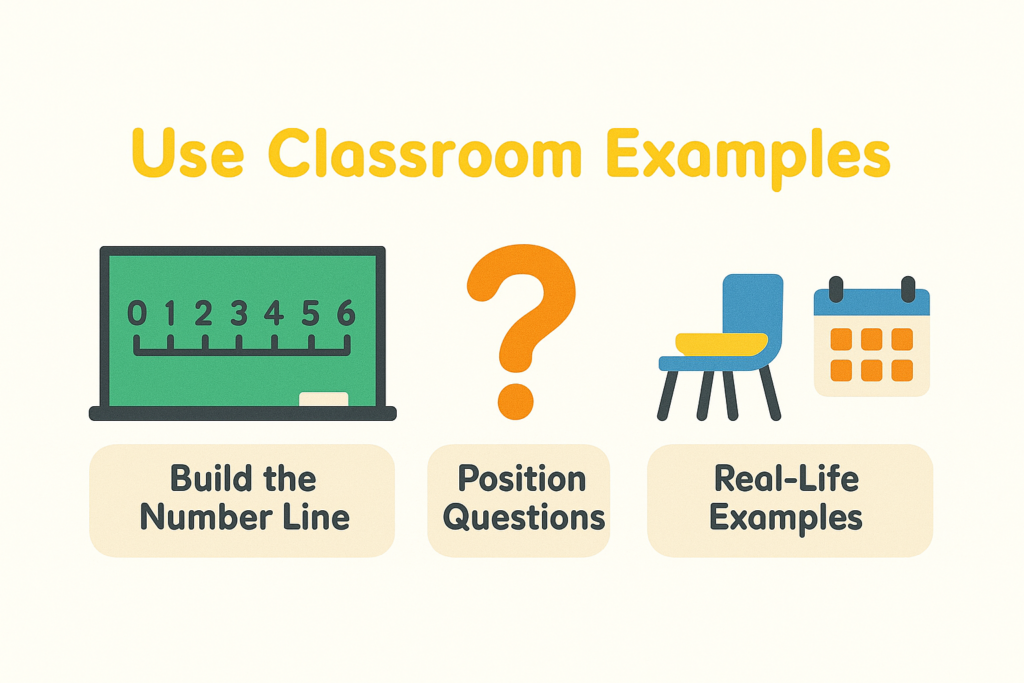
Begin by drawing a clear number line from 0 to 10 on the board. Let students help label the ticks that build ownership and confidence.
Once the number line is ready, use it regularly during math time.
Count along it together using fingers, counters, or small toys. This routine helps children see how numbers follow one another.
Ask simple position questions to reinforce their understanding:
- “What comes before 6?”
- “What comes after 3?”
- “Which number is between 4 and 6?”
These quick checks help children rely on the number line instead of counting from the beginning every time. They also strengthen awareness of number neighbors and in-between values.
Start with 0–10 until the class is comfortable, then slowly extend to 0–20 or beyond.
Real-Life Connections
Helping Class 1 students connect number positions to real-life situations makes number lines easier to understand and far more meaningful.
When children see numbers in everyday routines, the idea of “before,” “after,” and “between” becomes natural.
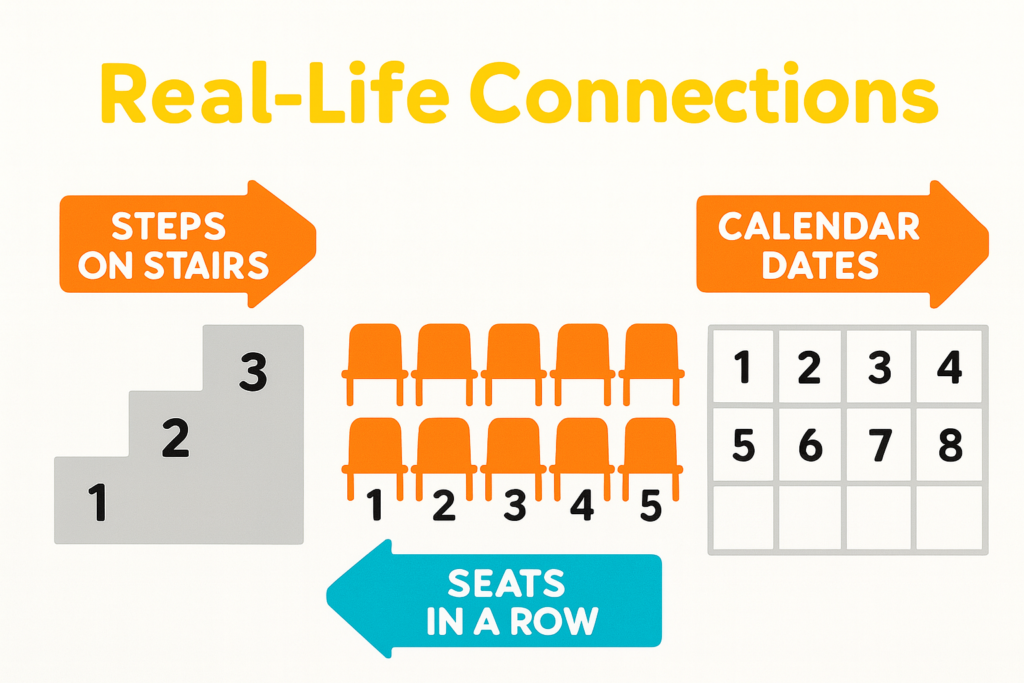
- Steps on Stairs
Each step on a staircase works just like a tick on a number line. Moving up one step is like jumping one space to the right, and moving down is like stepping to the left.
You can even number real or drawn steps—0, 1, 2, 3—and ask questions such as:
- “If you’re on step 3 and go one step up, where do you land?”
This helps children physically feel number positions. - Seats in a Row
A row of chairs or classroom seats shows clear number order, just like a number line.
Draw 10 seats and label them 1–10, then match the same numbers on a number line.
Ask:
- “Who is sitting before seat 5?”
- “Which seat is between 4 and 6?”
This reinforces fixed positions and number neighbors. - Dates on a Calendar
A calendar is basically a real-life number line arranged in rows. Days move forward one at a time, helping children understand sequence naturally.
Use a strip of numbers (1–10 or 1–31) and compare it to a calendar row.
Ask questions like:
- “What date comes after 4?”
- “Which dates are between 2 and 5?”
Activities to Reinforce Position Awareness
Fun, hands-on activities help Class 1 students build confidence and fluency with number positions on a number line.
These simple exercises strengthen skills like before/after, between, greater/less than, and number order.

1. Fill-in-the-Missing-Number Games
Give children number lines with some numbers missing, such as:
0, 1, __, 3, __, 5…
Ask them to fill in the blanks while saying the counting sequence out loud.
This strengthens their understanding of number order and neighbors.
For added practice, show only the first and last numbers (like 0 and 10) and have students complete the entire line. This helps reinforce both order and equal spacing.
2. Ordering Cards
Provide number cards (0–10 or 1–20) and ask students to arrange them in the correct sequence.
You can also:
- Mix up a small set of cards (e.g., 2, 5, 1, 4) and let children put them in order from smallest to greatest.
- Have students stand in a line holding cards to create a human number line—a fun, active way to visualize positions.
These activities help children understand before, after, and between in a physical, interactive way.
3. Number-Line Coloring Sheets
Give students worksheets where they color or trace number lines, highlight certain numbers, or draw jumps.
Try prompts like:
- “Color the number that comes before 7.”
- “Circle the number between 3 and 5.”
- “Color the number you land on if you start at 3 and jump 2 steps forward.”
This visual practice reinforces number recognition, direction (left/right), and simple operations.
These activities make number-line learning engaging and memorable, helping Class 1 students build strong number sense through play and exploration.
Make Preparing for Math Olympiad Simple!



Wrap Up
Understanding number positions on a number line helps Class 1 students make sense of how numbers are ordered, how they grow, and how they relate to one another.
Activities like filling in missing numbers, arranging number cards in order, and coloring number-line worksheets turn learning into play.
This strong foundation in number positions supports all future math learning and helps children feel comfortable and capable with numbers.