


How to teach number line maths class 1 is one of the most important questions in early mathematics, because the number line is not simply one topic among many.
It is the foundational visual model that makes number order, magnitude, counting, addition, and subtraction all visible and concrete at the same time.
When skipped in favour of abstract symbol work too early, children miss the spatial understanding of number that makes later arithmetic feel intuitive rather than arbitrary.
This guide covers the full teaching progression of the number line for class 1 students.
For the broader context, see what is number sense for Class 1 and number positions on a number line.
For the ordering skills that number line work directly supports, see “Ascending and Descending Order” for Class 1.
Why the Number Line Is the Most Important Visual Tool in Class 1
Most early number tools, such as ten-frames, counters, and base-ten blocks, represent numbers as collections of discrete objects. Essential, but only half the picture.
The number line represents numbers as positions on a continuous scale.
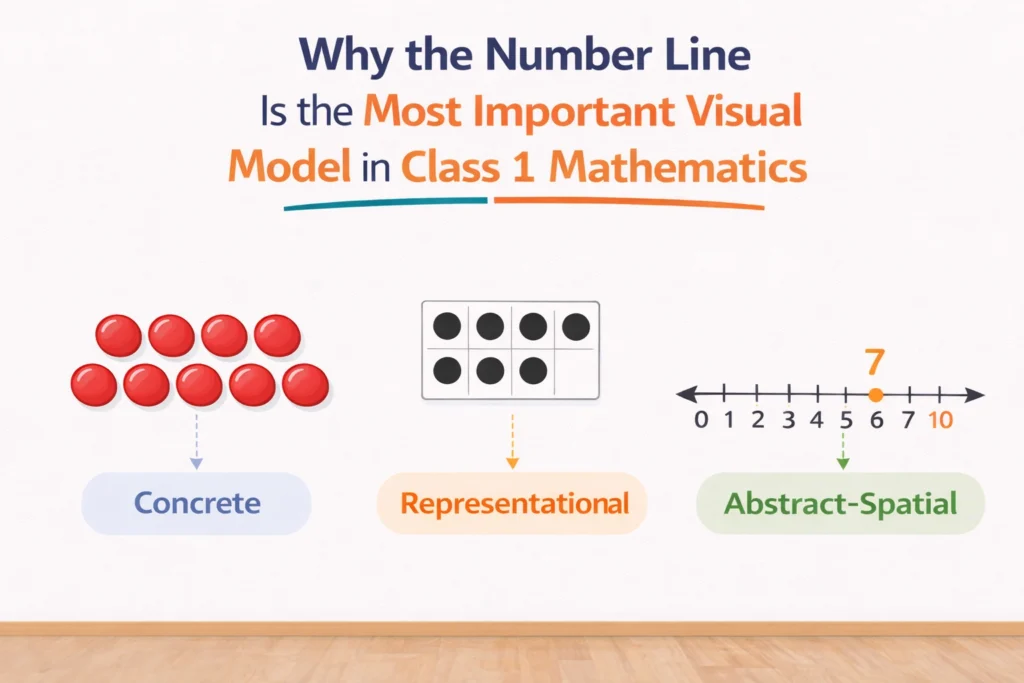
This spatial representation develops number magnitude, the intuitive sense of how large a number is, and where it sits relative to others.
Children with strong magnitude understanding know immediately that 47 is bigger than 43, that 8 is much closer to 10 than to 0, and that adding 10 always moves them exactly 10 steps right.
The number line also provides the clearest visual model for arithmetic. Addition is moving right. Subtraction is moving left.
Equal repeated jumps represent skip-counting and early multiplication foundations.
These connections make operations meaningful rather than procedural and tie directly into the broader framework covered in number sense for Class 1 and spatial understanding for Class 1.
The Three Types of Number Lines to Use Progressively
Using only one type of number line throughout Class 1 is one of the most common teaching limitations.
Each type develops a different depth of number understanding, and using all three progressively produces significantly stronger mathematical thinking.
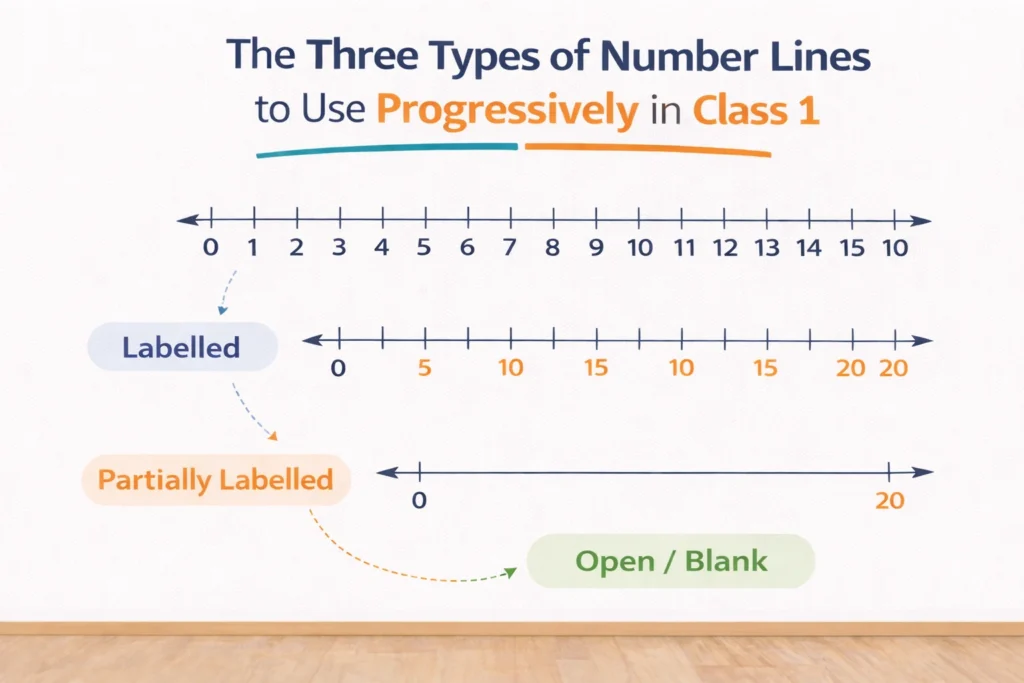
Type 1 — Fully Labelled (0–10, then 0–20): Every position is marked with its numeral. This is the correct starting point children focus on direction and order without the added challenge of locating unlabelled positions.
Use this for the first 6–8 weeks of number line work.
Type 2 — Partially Labelled (Landmark Numbers Only): Only 0, 5, 10, 15, 20 are marked on a 0–20 line. Children must use their number spacing understanding to locate intermediate positions.
This develops estimation and number magnitude in ways a fully labelled line cannot. Introduce once Type 1 work is fluent.
Type 3 — Open (Blank) Number Line: Only the start and end values are marked. Children decide which numbers to place and where, based entirely on their own understanding.
This is the most demanding type and the one that produces the deepest number sense. Introduced in the second half of Class 1.
This progression mirrors the Concrete–Representational–Abstract approach that underpins all effective early mathematics teaching, described fully in number sense teaching strategies for first graders.
The Six-Step Teaching Sequence
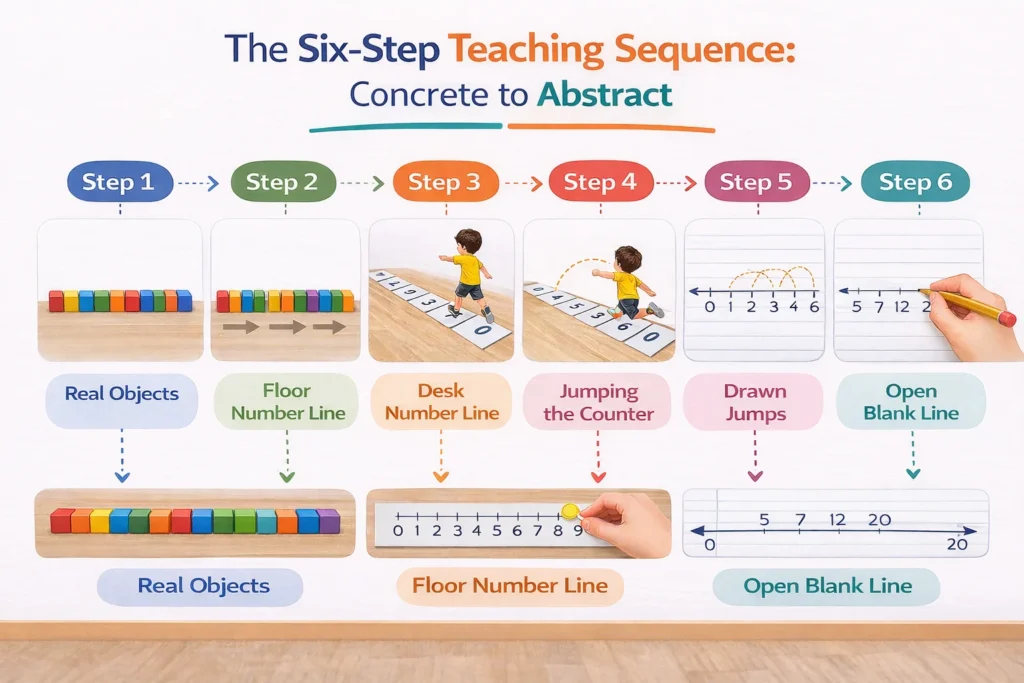
Step 1: Physical Line With Real Objects
Before any number line is shown, children arrange objects in an ordered line and understand that the line has direction.
Give children 10 blocks and ask them to arrange them in a row from fewest to most, then remove one at a time, counting backward.
This establishes the left-to-right increasing convention physically before it is represented on paper, connecting naturally to the ordering work in ascending and descending order in maths for class 1.
Step 2: Body-Scale Floor Number Line
The most effective introduction to the number line concept is a large physical line on the floor tape in the classroom or chalked on the playground where children stand on, walk along, and jump between positions.
Physical movement makes the directional conventions kinesthetically real before children visualize them mentally.
Walk the class along the line counting forward together. Establish the language: “Right gets bigger. Left gets smaller.”
Then call instructions: “Everyone on 5, take 3 steps right. Where are you?” This is addition through physical movement, before any symbol is introduced.
Step 3: Desk-Size Labelled Number Line
After 2–3 floor number line sessions, introduce individual desk-sized number lines. Place these at the top of every child’s workspace for the whole Class 1 year, not just during number line lessons.
Constant accessibility normalizes using the number line as a thinking tool across all mathematics.
Initial activity: give each child a small counter. “Place it on 5. Jump to 8. How many jumps?” “Put it back on 5.
Jump to 2. How many?” Guided counter activities build addition and subtraction intuition through physical movement before drawing or writing is involved.
Step 4: Counting and Jumping Practice
With desk number lines and counters, build the fluency that makes the number line a reliable tool. Forward counting from various starting points (not always from 0) develops counting-on ability.
Backward counting from multiple starting points builds the foundation for subtraction. Many Class 1 children who struggle with subtraction have simply never developed fluent backward counting from varied positions.
For the full counting sequence progression, what is the number sequence for class 1 maths that covers every stage?
Skip counting, jumping from marked positions by 2s, 5s, and 10s, makes the regularity of number patterns visually obvious in ways that oral practice alone cannot achieve.
Connecting directly to teach number sequences to class 1 students.
Step 5: Addition and Subtraction With Drawn Jumps
Children progress from moving a counter to drawing jumps curved arcs above the line representing each movement, landing on the answer.
For 4 + 3, start at 4, draw three forward arcs, and land on 7. For 9 − 4, start at 9, draw four backward arcs, land on 5.
The drawn jumps make direction visually permanent forward arcs for addition, backward arcs for subtraction — in a way that abstract symbols never convey to a 6-year-old seeing “+” and “−” for the first time.
Critical rule to establish: “We stand on the starting number but do not count it. The first jump takes us to the next number.” Return to this rule every session until it is automatic.
Step 6: The Open Number Line
Once Steps 1–5 are fluent, the open number line becomes the primary tool for demonstrating mathematical thinking. Present a problem (8 + 5) alongside a blank line with 8 marked.
Children decide where to jump and how to show the strategy some will make 5 individual jumps, others will jump to 10 first then add 3 more.
Both are valid, both are visible, and both generate rich mathematical discussion that develops the flexible reasoning that number sense teaching strategies for first graders describe in full.
Key Activities for Class 1
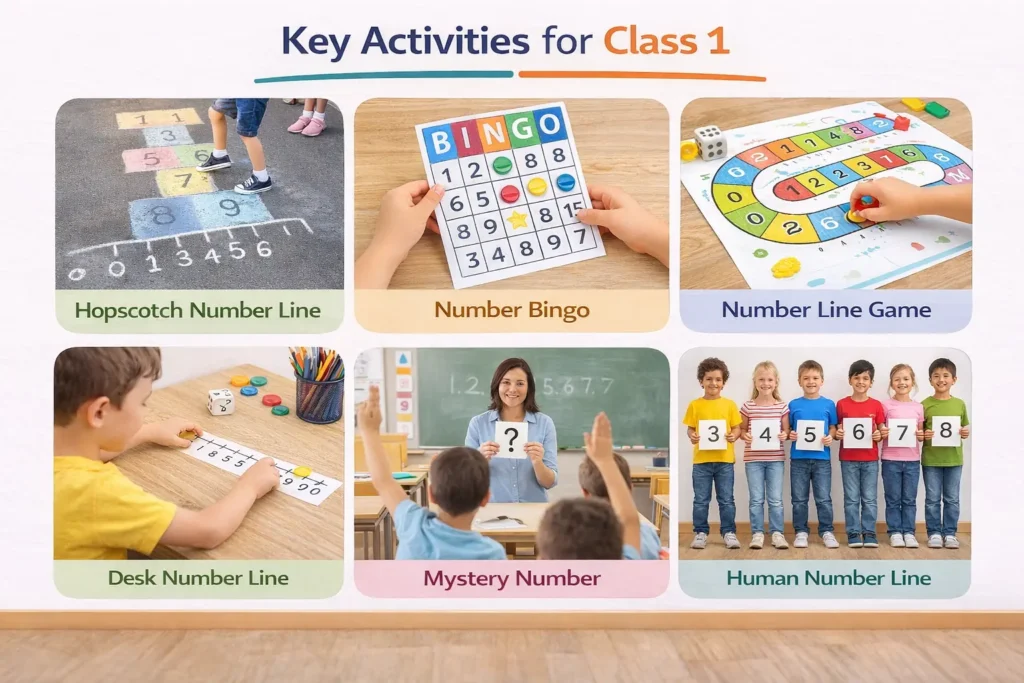
Hopscotch Number Line: Draw a 0–10 line on the playground with chalk. Children jump forward and backward following instructions — “Start at 3, jump forward 4. Where do you land?”
Physical movement is particularly effective for kinaesthetic learners and strongly reinforces the spatial reasoning in spatial understanding for class 1.
Human Number Line: Give children number cards 0–20 and ask them to arrange themselves in order. Call one child to move forward or backward while the class counts jumps aloud.
This develops both number order and the positional language connected to ordinal numbers for class 1 math.
Number Line Bingo: Give each child a bingo grid with answers 0–10. Call addition and subtraction problems.
Children solve using their number line and mark the answer. High-repetition practice in a game format that never feels like drill.
Guess My Number: Give clues and ask children to find the mystery number “I am more than 6 and less than 10. I am an even number.”
These riddle problems develop logical reasoning alongside number line fluency, and they are exactly the kind of creative thinking rewarded in the IMO syllabus for class 1.
4 Common Mistakes and How to Fix Them
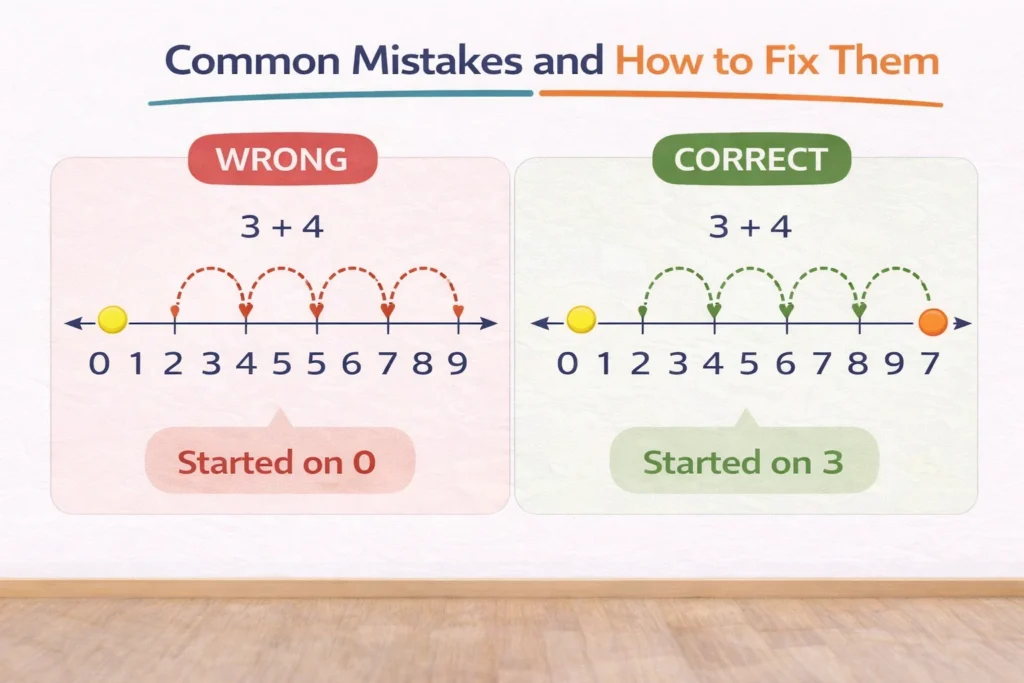
| Mistake | What It Looks Like | How to Fix It |
|---|---|---|
| Counting the starting number as jump one | 3 + 4 produces 6 instead of 7 | “We stand on the start, then jump. The jump takes us somewhere new.” Model slowly with a counter. |
| Starting from the wrong position | For 7 − 3, child starts at 0 or 3 | Ask “Where do we start?” before every problem. Highlight or circle the starting number. |
| Jumping the wrong direction | Subtraction jumps go right instead of left | Floor movement activities — physically walking backward for subtraction creates body memory. |
| Unequal jump sizes on drawn lines | A jump of 1 looks the same as a jump of 5 | Teach landmark positioning on open lines: place 0 and 10 first, then 5 in the middle, then fill others proportionally. |
Curriculum Connections
The number line is not a standalone topic it threads through the entire Class 1 curriculum. Ordering numbers on a line reinforces ascending and descending order in maths for class 1.
Equal repeated jumps introduce the repeated-addition thinking that multiplication for class 1 formalizes.
The space between whole numbers that the line makes visible lays the groundwork for fractions for class 1.
And placing two-digit numbers on a 0–100 line is one of the most effective place value consolidation activities available for the whole year.
When should I introduce the number line in Class 1?
After 2–4 weeks of concrete counting and object-comparison experience. The floor number line can appear in the first week as a movement activity; desk number lines and drawn jumps follow once the number order to 10 is secure.
Should I start with 0–10 or 0–20?
Always start with 0–10. Extend to 0–20 once that range is fully fluent, then to 0–100 in the second half of the year.
How often should children use number lines?
Every day. The desk number line should be visible and accessible during all mathematics activities throughout the whole year, not just during dedicated number line lessons.
Can parents reinforce this at home?
Yes — a number line strip fixed at child height, simple counter games, and the activities in this guide provide everything needed. The complete home resource guide at number sense resources for parents covers how to set this up effectively.
Make Preparing for Math Olympiad Simple!



Conclusion
How to teach number line maths for Class 1 comes down to one principle: move from concrete to representational to abstract, keep the number line visible daily, and use all three number line types progressively across the year.
Start with the floor. Move to the desk. Add drawn jumps. Introduce the open line when ready. Taught this way, the number line becomes a mental model children carry into every mathematical challenge ahead.
For foundations, see number sense for Class 1 and steps to draw a number line.
For the broader teaching approach, see number sense teaching strategies for first graders.

Mikha Piregu is a Content Writer with experience spanning educational content, including math and math olympiad topics, as well as advocacy writing, research-based articles, and SEO-driven web content. He creates high-quality blog content, web copy, and feature articles that support brand visibility, audience engagement, and long-term organic growth through data-informed storytelling. Skilled in WordPress, WooCommerce, and modern digital tools, Mikha adapts content across various platforms, including blogs, websites, campaigns, and advocacy initiatives, with clarity and purpose. You can reach out to him at [email protected].

There are no comments posted here yet.
Sign in to leave a comment