


The Junior Math Olympiad generally refers to competitive math tournaments tailored for elementary and middle school students to build elite problem-solving skills before high school.
For grades 1–5, the friendliest entry point is Math Kangaroo; it accepts students as early as grade 1, has no penalty for wrong answers, and is built to feel like a celebration rather than a test.
MOEMS opens at grade 4 but only through schools. Below grade 4, school math nights, library puzzle clubs, and a gentle weekly problem-solving habit at home matter more than any official contest.
This guide explains math competition options for elementary students, how to know if your child is ready, and simple ways to get started with confidence.
What “junior math olympiad” actually means
There isn’t a single competition in the US called the “Junior Math Olympiad.” It’s an umbrella phrase parents use when they’re searching for elementary-level math contests.
What actually exists is a handful of well-respected programs, plus a long tail of school-level and online events. Here’s the honest landscape:
Math Kangaroo USA — the most accessible. Open to grades 1–12. Held once a year on a single Thursday in March (March 19, 2026 for the 2026 cycle). Six grade-paired levels, multiple-choice, no penalty for wrong answers.
Individual registration your family signs up, no school coordination required. Registration runs roughly $21 (with a higher late fee), and both in-person and remote/online options are offered. This is the standard entry point for kids in grades 1–5.
MOEMS (Math Olympiads for Elementary and Middle Schools) — team-based, school-organized. Two divisions: Division E for grades 4–6 and Division M for grades 6–8. Five contests, one per month from November through March, five problems each.
Importantly: MOEMS does not accept individual student registrations; your child’s school or homeschool group has to organize a team. Many schools already run MOEMS as an after-school program; if yours doesn’t, you can ask. There is no MOEMS division for grades 1–3.
Noetic Learning Math Contest — twice-yearly, grades 2–8, also school-organized. A gentler alternative to MOEMS for younger grades that some elementary schools run.
Local and school contests — math nights, in-school problem-of-the-week boards, library puzzle clubs, Beast Academy or Art of Problem Solving online classes, district math counts.
These don’t show up on national leaderboards, but they’re often the most age-appropriate first experiences.
The AMC pathway — the AMC 8 is technically open to any student in grade 8 or below who is under 15.5 on contest day, but it’s genuinely designed for grades 6–8. A typical 3rd or 4th grader will find most of it inaccessible and frustrating. Save it for later.
Other Elementary Math Competitions Worth Knowing About
A few additional programs come up often in parent searches and are worth a mention even though they’re regional or less common:
- Continental Mathematics League (CML), school-organized, multiple grade bands starting as young as grade 2, run in monthly rounds similar to MOEMS.
- Elementary chess and math club hybrids, some enrichment centers combine logic games with math puzzles for K–3 students as a low-pressure precursor to formal contests.
- State or district-level math bees, often free, school-run, and a good gauge of readiness before committing to a national competition
Comparison Table: Junior Math Olympiad Options at a Glance
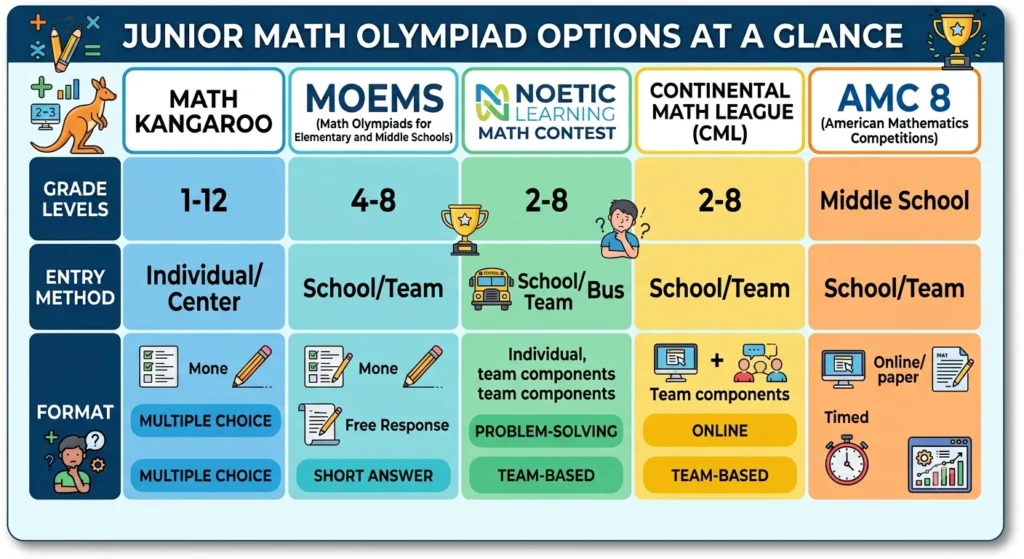
| Program | Grades | How to Enter | When | Cost | Format |
|---|---|---|---|---|---|
| Math Kangaroo | 1–12 | Individual signup | One Thursday in March | ~$21 reg (higher if late) | 24–30 MC questions |
| MOEMS Division E | 4–6 | Through school team | Nov–March, 5 contests | Per-team via school | 5 problems × 5 contests |
| Noetic Math Contest | 2–8 | Through school | Twice yearly | Per-team via school | 20 short-answer Qs |
| Continental Math League | 2–8 | Through school | Monthly rounds | Per-team via school | Varies by grade band |
| AMC 8 | 8 or below | Through school | Late January | Free (school-administered) | 25 MC, 40 min |
| Local math night | Any | Through school | Varies | Free | Varies |
Sources: Math Kangaroo USA, MOEMS, Noetic Learning, Continental Mathematics League, MAA AMC 8.
How Young Is Too Young for a Math Olympiad?
There’s no universal answer, but here are the signals to watch for, not the ones to manufacture.
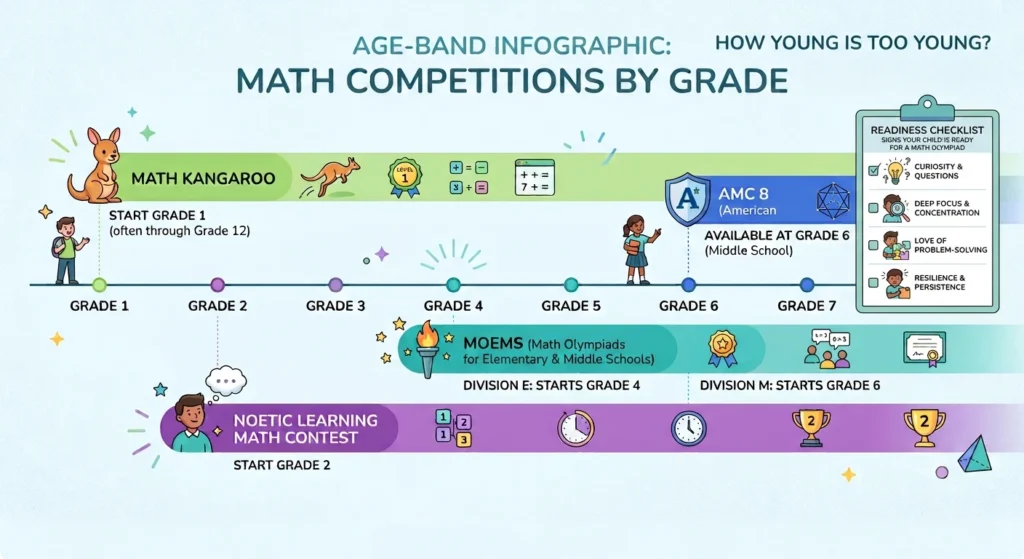
Grade 1 (ages 6–7): Math Kangaroo offers a Grade 1–2 (Pre-Ecolier) level designed specifically for this age group. If your child enjoys puzzles, can sit and focus for 30–40 minutes, and reads independently or with a parent’s help, they’re old enough.
If they’d rather build blocks, they’re also old enough for blocks. Both answers are right.
Grades 2–3: A sweet spot for first competitions. Most kids this age can handle Math Kangaroo’s Pre-Ecolier or Ecolier level if they want to try. School math contests, when available, are perfect.
This is also the age range where parents most often ask about a “math olympiad for 2nd graders” or “math olympiad for 3rd graders”, and Math Kangaroo remains the answer for both.
Grades 4–5: Now MOEMS becomes an option (through your child’s school). Math Kangaroo’s Ecolier and Benjamin levels start to feel more like the contests they’ll meet later.
Some kids are ready to do both each year, and this is often when families start layering in AoPS-style enrichment alongside contest prep.
The honest test isn’t an age, it’s a question: Does your child ever choose to do a math problem when they don’t have to?
If yes, even occasionally, they’re ready for something gentle. If not, more contests won’t manufacture interest. Books, games, and curiosity will.
How to nurture interest without pressure
The biggest mistake parents make with young kids and competition math isn’t pushing too hard it’s outsourcing the joy.
A child who associates math with their parent’s anxious face will not love math, no matter how many practice papers they finish.
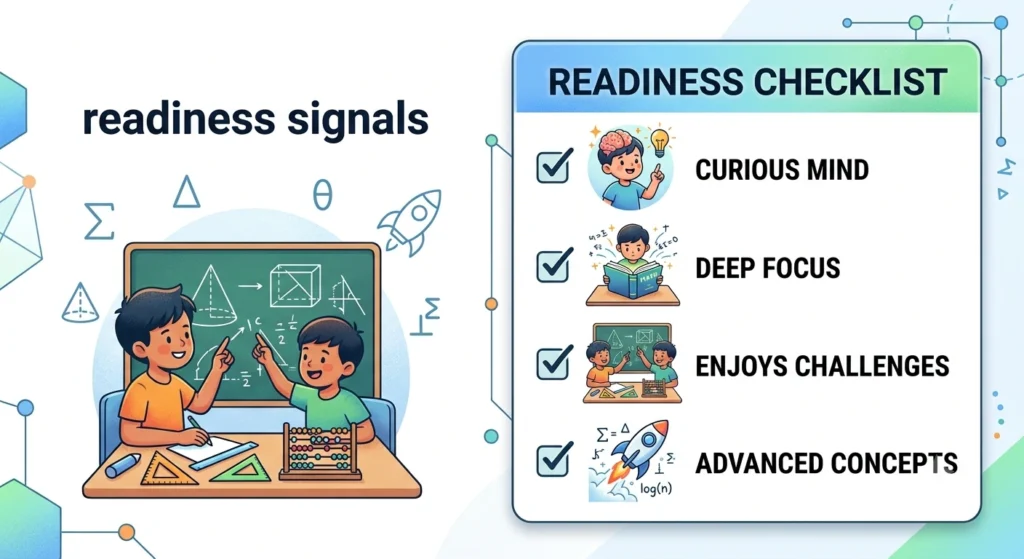
A few principles that consistently work:
Make problems a shared activity, not an assignment. Sit next to your child. Read the problem together. Get the answer wrong sometimes, on purpose, and laugh about it. Competition math at this age is a together thing.
Praise the effort and the strategy, not the answer. “I loved how you tried drawing a picture” beats “Good job, you got it right” every single time. Kids who are praised for outcomes start avoiding hard problems; kids who are praised for process lean in.
Embrace wrong answers. A wrong answer is data. It’s the most useful thing in a math practice session. Treat it that way out loud.
Don’t grind. Twenty minutes, two or three times a week, is far more effective than an hour-long Saturday session. Consistency beats intensity at every age, and especially this one.
Talk about the contest the way you’d talk about a school play. It’s something fun your child gets to do. It’s not a judgment on them, on you, or on their future.
A Gentle Starting Routine for Math Olympiad Prep
If you’d like a concrete plan that’s hard to mess up, here’s one:
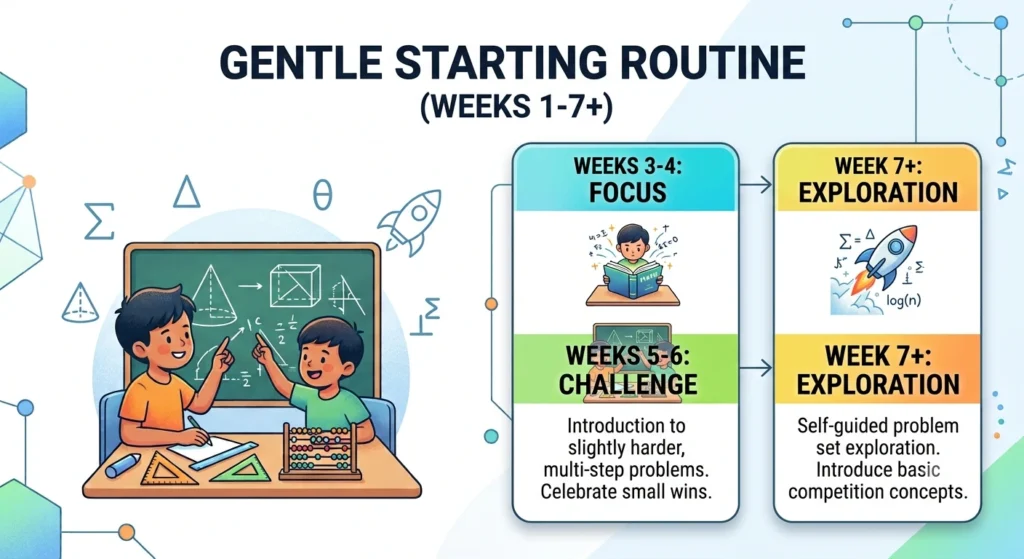
Weeks 1–2: Solve 2–3 problems together, two evenings a week. Pick easy ones from the Math Kangaroo free sample questions at your child’s grade level. No timer. No pressure. Just talk about how you’d approach each one.
Weeks 3–4: Same cadence, but let your child lead the explanation when they get one right. The act of explaining cements the thinking.
Weeks 5–6: Try a full past paper together, but split it across two sessions. Read the problems together for the first session; let your child try a few independently in the second. Discuss everything afterwards.
Weeks 7+: If your child is enjoying themselves, sign up for the next Math Kangaroo. If they’re not, take a break and try again next year. Neither is failure.
Q: My child is in 2nd grade. Are there any math olympiads they can do?
Yes. Math Kangaroo opens at grade 1 with a Pre-Ecolier level designed for this age. MOEMS doesn’t start until grade 4, and the AMC 8 isn’t realistic until middle school. For 2nd graders, Math Kangaroo plus any school-level problem-of-the-week activity is the standard path.
Q: Should my child do MOEMS or Math Kangaroo first?
For most families, it isn’t either/or. Math Kangaroo is individual and runs in March; MOEMS runs monthly from November to March through schools, so they don’t conflict. If you have to pick one, start with Kangaroo because it’s individual and doesn’t require school coordination.
Q: How much should we practice at home?
Twenty to thirty minutes, two or three times a week, is plenty for grades 1–5. Daily long sessions are counterproductive at this age and tend to kill interest faster than they build skill.
Q: My child wants to quit after a low score. What do I say?
Tell them the score is information about the test, not about them. The kids who become great at competition math aren’t the ones who started with the highest scores they’re the ones who got curious about the problems they couldn’t solve yet. Take a break; come back when curiosity returns. It almost always does.
Make Preparing for Math Olympiad Simple!



Conclution
There’s no rush, and there’s no single right age to start. A junior math olympiad isn’t a gate your child has to pass through, it’s just one of many ways to let them fall in love with a hard problem.
Math Kangaroo gives kids as young as grade 1 a low-stakes place to try, MOEMS picks up the thread at grade 4 through school, and everything in between (math nights, puzzle clubs, a shared bowl of cereal and a tricky word problem) counts just as much.
If your child is curious, start small, stay consistent, and let them lead. The scores and certificates are nice, but they’re not the point. The point is a kid who still wants to try the next hard problem tomorrow.
Related guides
- How to prepare for Math Kangaroo: a parent’s guide
- Math Kangaroo past papers and free practice tests
- Math Kangaroo levels and grade groupings explained
- Math Kangaroo vs AMC: which competition should your child start with?
- AMC 8 practice tests: free past papers and a study plan

Mikha Piregu is a Content Writer with experience spanning educational content, including math and math olympiad topics, as well as advocacy writing, research-based articles, and SEO-driven web content. He creates high-quality blog content, web copy, and feature articles that support brand visibility, audience engagement, and long-term organic growth through data-informed storytelling. Skilled in WordPress, WooCommerce, and modern digital tools, Mikha adapts content across various platforms, including blogs, websites, campaigns, and advocacy initiatives, with clarity and purpose.




There are no comments posted here yet.
Sign in to leave a comment