


Measurement for Class 1 introduces children to the basics of comparing sizes and quantities using simple, everyday terms rather than strict numbers.
- What is Measurement for Class 1?
- The 3 Types of Measurement for Class 1
- Length for Class 1
- Weight for Class 1
- Capacity for Class 1
- Step-by-Step Teaching Method for Class 1 Measurement
- Fun Measurement Activities for Class 1 (Home & Classroom)
- Common Mistakes Children Make and How to Fix Them
- Tips for Parents: Teaching Measurement at Home
- Tips for Teachers: Classroom Activities and Lesson Ideas
- Simple Worksheets and Practice Ideas for Class 1 Measurement
- Conclusion
The core concepts focus on Length, Weight, Thickness, and Capacity.
Measurement is one of the most natural things children do. They compare, they wonder, they test. The school curriculum simply gives a name to what they already love doing.
This guide is for parents and teachers of children aged 5–7. It uses simple explanations, real examples, and practical activities with no jargon or complex theory.
Let’s make measurement for Class 1 the easiest chapter your child has ever learned.
What is Measurement for Class 1?
At its simplest, measurement means finding out how big, how heavy, or how much something is and then comparing it with something else.
For Class 1 students (age 5–7), measurement doesn’t involve rulers, kilograms, or litres just yet. It starts with the most important skill of all: noticing differences.
Is this pencil longer than that one? Is this bag heavier than this lunchbox? Does this cup hold more water than this bowl?
These simple questions are the foundation of all measurement. Class 1 maths measurement focuses on three main ideas:
- Length: how long or tall something is
- Weight: how heavy or light something is
- Capacity: how much a container can hold
Understanding these three concepts gives children the building blocks for all the measurements they’ll encounter in higher classes and in everyday life.
From reading a recipe to packing a suitcase, measurement is everywhere.
The best part? You don’t need any special equipment to get started. Everything your child needs to learn Class 1 maths measurement is probably sitting in your kitchen or living room right now.
The 3 Types of Measurement for Class 1
Before we go deeper, let’s get a clear picture of all three concepts.
One of the most common mistakes in teaching measurement is mixing these up even in textbooks.
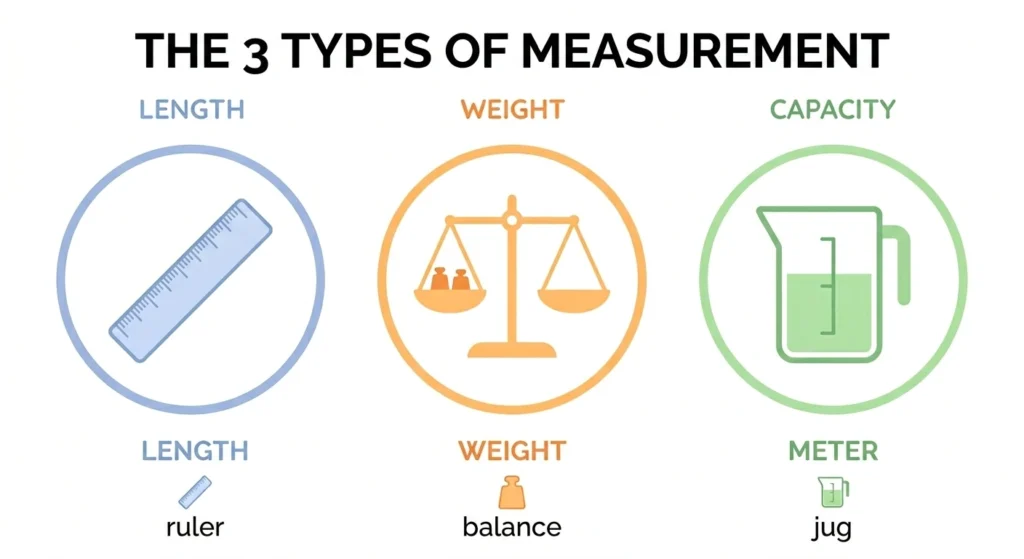
Here’s a simple way to see them side by side:
| Type of Measurement | What It Measures | Example Objects | Comparison Words |
| Length | How long, tall, or short something is | Pencil, book, table, classroom wall | Longer / Shorter, Taller / Shorter, Same length |
| Weight | How heavy or light something is | Bag, water bottle, fruit, toy brick | Heavier / Lighter, Same weight |
| Capacity | How much a container can hold inside | Cup, jug, bottle, bucket, bowl | Full / Empty, Holds more / Holds less |
Notice that each type answers a different question.
- Length = How long?
- Weight = How heavy?
- Capacity = How much does it hold?
Keep these three questions in mind whenever you introduce a new activity, and your child will never get confused.
Length for Class 1
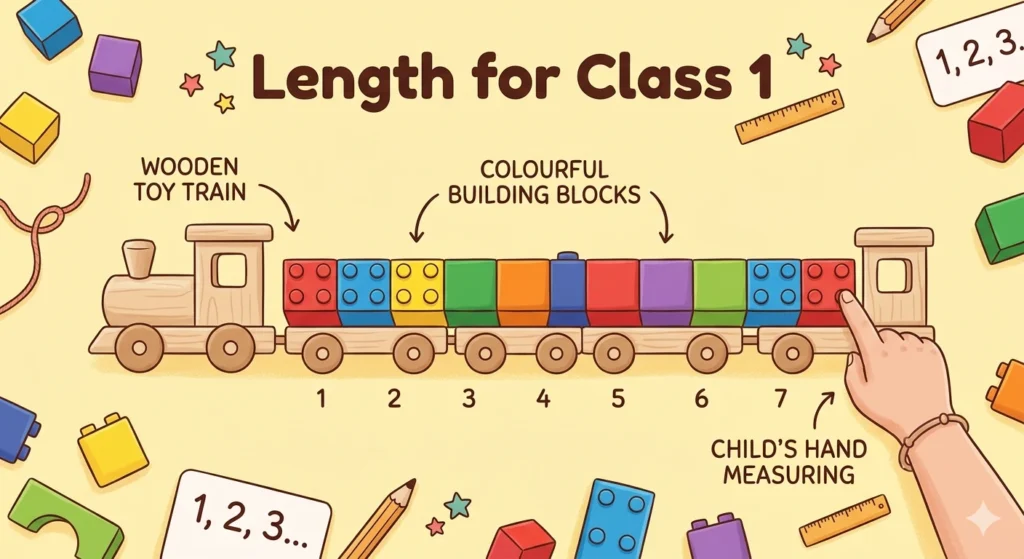
What is Length?
Length is how long, tall, or short something is from one end to the other. When we talk about length, we’re asking: “How much space does this object take up from end to end?”
For young children, the easiest way to understand length is through direct comparison, placing two objects side by side and looking.
Real-Life Examples of Length
Use objects your child already knows and loves:
- A pencil vs. a crayon: which is longer?
- A book vs. a notebook: which is taller when standing upright?
- The classroom table vs. your child’s desk: which is wider?
- Your child’s shoe vs. mummy’s shoe: which is longer?
- A spoon vs. a fork: which is longer?
Comparison Words to Teach
Make sure your child is comfortable with these words before moving on to measuring:
- Longer / Shorter
- Taller / Shorter
- Wider / Narrower
- Same length
Non-Standard Units for Length
Before introducing centimetres, children measure using non-standard units everyday objects they can count.
This teaches the concept of units without the complexity of formal measurements.
Good non-standard units for measuring length:
- Handspan (spread fingers from thumb to pinky)
- Footsteps (walk heel-to-toe alongside an object)
- Building blocks or Lego bricks placed end to end
- Pencils or crayons laid in a line
- Paper clips linked together
Simple activity: Line up 5 household objects (spoon, pencil, toothbrush, fork, straw). Ask your child to put them in order from shortest to longest. Then measure each one using blocks and count aloud.
This ordering activity connects directly to the concept of ascending and descending order in maths, which children explore more formally in later lessons.
Common Confusion: Length vs. Height
Children often mix up “length” and “height.” Here’s the simple fix: Length is measured lying flat (like a pencil on a table).
Height is measured standing up (like how tall your child is). Both use the same comparison words, but height always goes upward.
Weight for Class 1
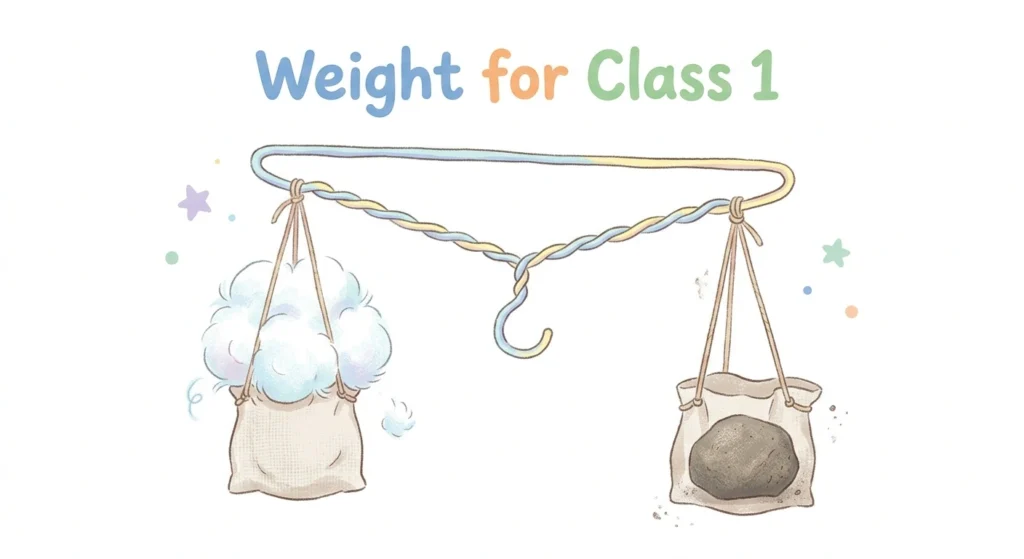
What is Weight?
Weight is how heavy or light an object is. When we talk about weight, we’re asking: “How much does this object push down when I hold it?”
Young children understand weight best through their hands. Holding an object and feeling its heaviness is far more powerful than any definition.
Real-Life Examples of Weight
- A filled school bag vs. an empty school bag
- A watermelon vs. an orange
- A hardcover book vs. a notebook
- A full water bottle vs. an empty one
- A toy brick vs. a cotton ball (same size, very different weight!)
Comparison Words to Teach
- Heavier / Lighter
- Heaviest / Lightest
- Same weight / Equal
Non-Standard Units for Weight
A simple balance scale is the best tool here. If you don’t have one, a wire hanger with two bags or bowls tied to each end works perfectly.
Non-standard units for measuring weight:
- Small stones or pebbles
- Building blocks
- Coins
- Marbles
Simple activity: Hold a full water bottle in one hand and an empty one in the other. Ask: “Which hand feels heavier?”
Then place different fruit on a balance scale and compare. Which side goes down? That one is heavier.
Common Confusion: Size Does Not Equal Weight
This is one of the biggest misconceptions at this age. A large empty box is lighter than a small stone. A big pillow is lighter than a small metal padlock.
Always show children that you can’t judge weight by looking; you have to feel it or balance it. A fluffy cotton ball looks big but weighs almost nothing. A small marble looks tiny but feels surprisingly heavy in tiny hands.
Capacity for Class 1
What is Capacity?
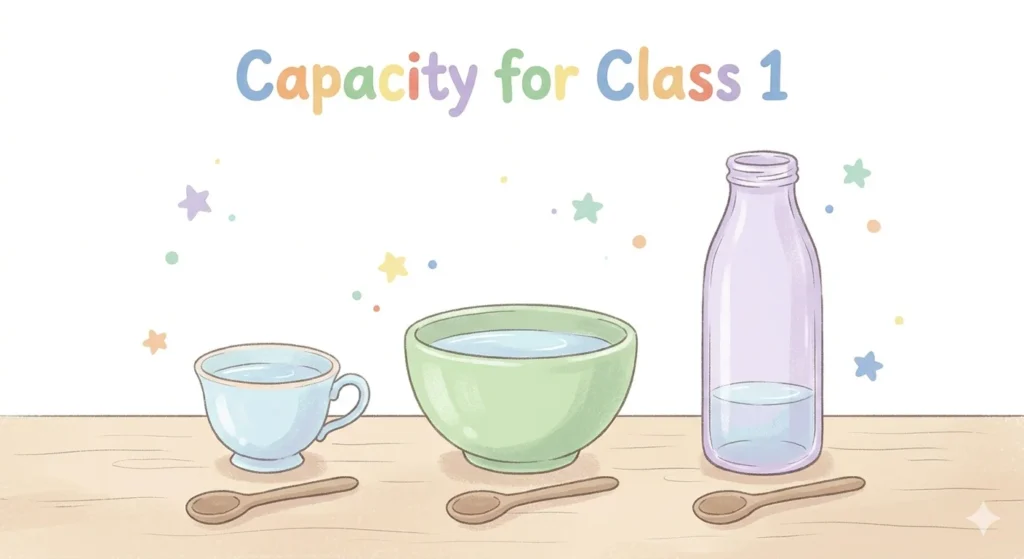
Capacity is how much a container can hold inside it. When we talk about capacity, we’re asking: “How much can this fit?”
It’s important to be clear with children: capacity is about the container, not the liquid inside. An empty jug has a capacity. A full jug also has the same capacity but it’s currently full.
Real-Life Examples of Capacity
- A tea cup vs. a mug which holds more?
- A small bottle vs. a large jug
- A cereal bowl vs. a soup bowl
- A bucket vs. a small pot
- A lunchbox vs. a schoolbag (what holds more?)
Comparison Words to Teach
- Full / Empty
- Half full / Half empty
- Holds more / Holds less
- Same capacity
Non-Standard Units for Capacity
Use a small cup or spoon as the measuring unit. Fill containers and count how many cups it takes.
- Spoonfuls of water or sand
- Small paper cupfuls
- A specific glass used consistently
Simple activity: Take three containers (a cup, a bowl, and a bottle). Fill each one with water using a small spoon, counting the spoonfuls aloud.
Which container needed the most spoonfuls? That one has the greatest capacity.
Common Confusion: Taller Does Not Mean Holds More
A tall, narrow bottle may hold less than a short, wide bowl. This surprises children every time! Show them by pouring the contents of the tall bottle into the wide bowl and watch their eyes light up.
This is one of the most memorable moments in teaching capacity, and it directly tackles the most common misconception at this age. Taller-looking doesn’t equal bigger capacity.
Step-by-Step Teaching Method for Class 1 Measurement
The biggest mistake people make when teaching measurement is starting with definitions. Don’t. Start with doing.
Here’s the teaching flow that actually works for children aged 5–7:
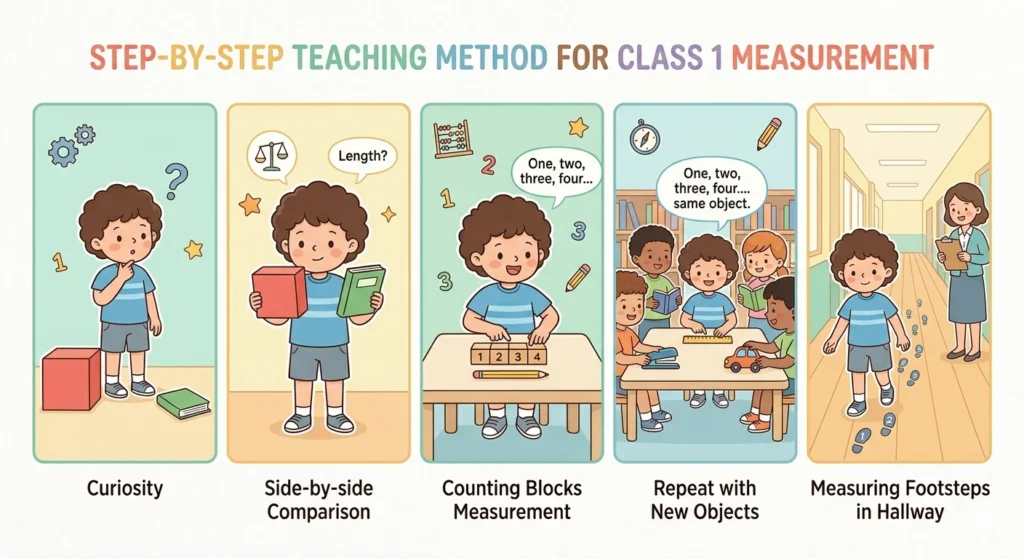
Step 1: Observe — Look and Notice
Before measuring anything, help your child simply notice a property. “Look at these two bottles. What do you notice? Which one looks taller?” Let the child observe without pressure. Ask open questions. There are no wrong answers at this stage.
Step 2: Compare — Which Has More?
Place two objects side by side and ask comparison questions. “Which pencil is longer?” “Which bag feels heavier?” “Which cup looks fuller?”
At this stage, the child is comparing directly not measuring. This is the most important skill, and it must come first.
Step 3: Use Non-Standard Units — Count to Measure
Introduce a simple non-standard unit. “Let’s count how many blocks long this pencil is.” “How many spoonfuls fill this cup?”
“How many blocks balance your lunchbox?” Counting builds the bridge between comparison and formal measurement.
Step 4: Practice — Do It Again with New Objects
Repetition builds confidence. Use different objects each time so the child builds a broad understanding, not just memory of one example. Change the objects, keep the concept.
Step 5: Apply — Find It in Real Life
This is where measurement becomes real. “How many footsteps are there in the hallway?” “Which jug do we use for watering the plants which hold more?”
“Is your lunchbox heavier than mine?” Applying measurement in daily life is what makes it stick for a lifetime.
Fun Measurement Activities for Class 1 (Home & Classroom)
All of these activities require only everyday objects. No special equipment needed.
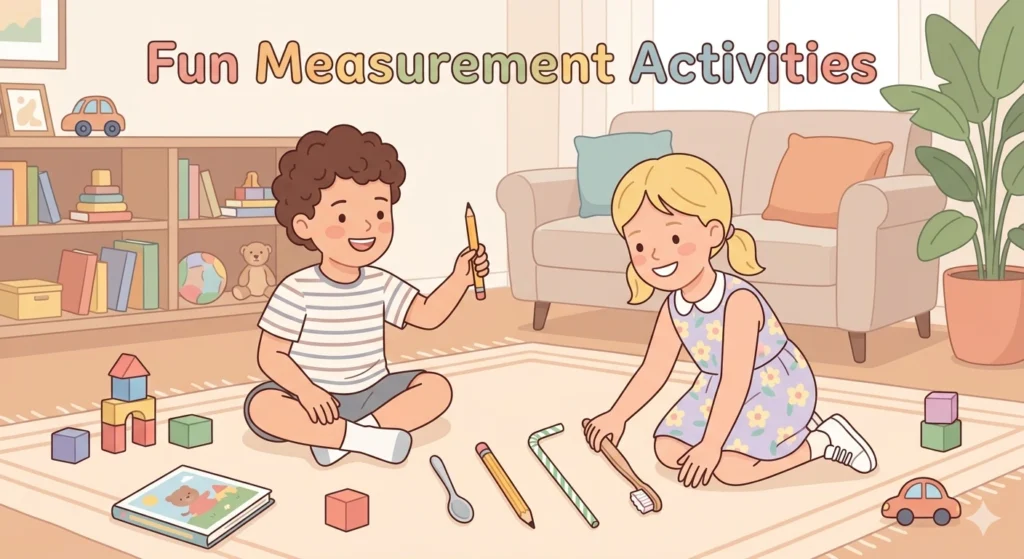
Activity 1: The Length Walk
Walk around your home or classroom and measure objects using footsteps. “How many footsteps is the sofa?”
“How many footsteps are there on the kitchen table?” Write down (or draw) the results. Then compare: which was longer the sofa or the table?
Activity 2: The Object Ordering Game
Collect 5–6 objects of different lengths (spoon, pencil, ruler, straw, toothbrush, crayon). Spread them on a table. Ask your child to arrange them from shortest to longest.
This builds comparison skills and introduces the concept of ordering, which connects beautifully to ascending and descending order in maths, where children learn to sequence numbers in the same way.
Activity 3: The Hanger Balance Scale
Hang two identical bags on each end of a wire hanger. Place an object in each bag. Watch which side drops down that side is heavier!
Ask your child to predict before placing the objects. This is the best way to make weight comparisons physical and memorable.
Activity 4: The Spoon Count Challenge
Use a small spoon and three different containers (cup, bowl, bottle). Fill each container with water using only the spoon, counting each spoonful.
Record the counts “The cup took 8 spoonfuls. The bowl took 14. The bottle took 20.” Which has the most capacity?
Activity 5: Guess the Weight
Place 5 objects in a row. Ask your child to hold each one and put them in order from lightest to heaviest before checking with a balance.
Then compare their guess with the actual result. This builds estimation skills a valuable mathematical habit.
Activity 6: Full, Half, Empty Sorting
Collect 6–8 bottles or containers. Fill some completely, some halfway, and leave some empty. Ask your child to sort them into three groups:
Full, Half Full, and Empty. Introduce the vocabulary naturally during the activity.
Activity 7: Storybook Measurement
While reading a story, pause and ask measurement questions about the pictures. “Look, which character is taller?” “Which basket looks heavier?”
“Which pot do you think holds more soup?” This connects measurement vocabulary to language and imagination.
Activity 8: The Classroom Measurement Hunt (Teachers)
Give each student a strip of paper cut to a fixed length (e.g., 15 cm). Ask them to find three objects in the classroom: one shorter than their strip, one the same length, and one longer.
Share findings as a class. This is a perfect introduction to comparing lengths with a consistent non-standard unit.
Common Mistakes Children Make and How to Fix Them
Children at this age are still building their understanding of the world, so misconceptions are completely normal.
Here are the most common ones and how to address them gently.
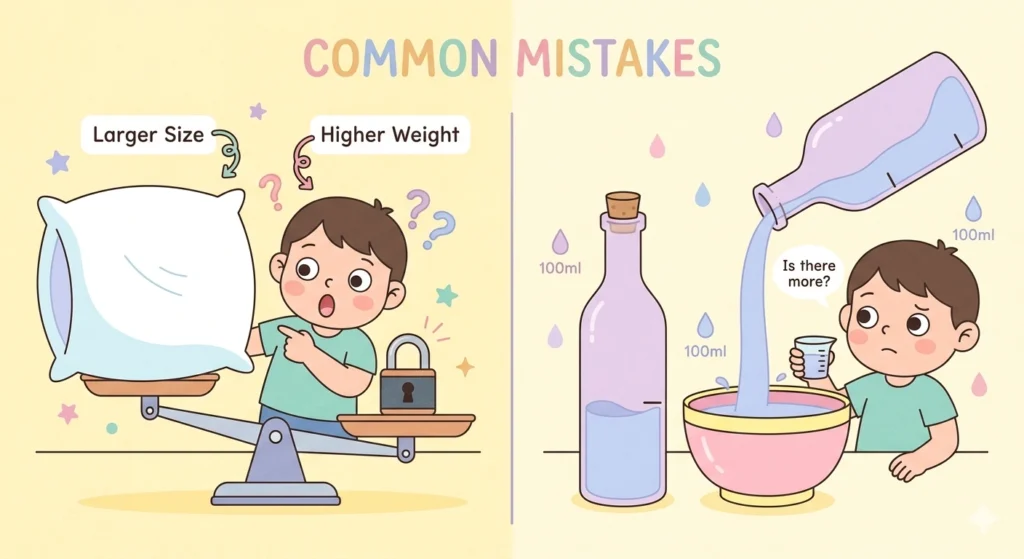
Mistake 1: “The Bigger Object Is Always Heavier”
The fix: Show them a large, light object (a big balloon or pillow) next to a small, heavy object (a metal padlock or stone).
Let them feel both. Say: “Your eyes can see how big something is, but only your hands can feel how heavy it is.”
Mistake 2: “The Taller Container Always Holds More”
The fix: Pour water from a tall, narrow bottle into a short, wide bowl. Watch their surprise as the bowl fills up.
Say: “It’s not about how tall it’s about how much space is inside.”
Mistake 3: “Longer and Taller Mean the Same Thing”
The fix: Lay a pencil flat and measure its length. Then stand it upright and say “now we’re measuring its height.”
Same pencil, same measurement but different words depending on direction. Length = flat. Height = upward.
Mistake 4: Leaving Gaps When Measuring with Units
When measuring length with blocks or paper clips, children often leave spaces between units.
The fix: Demonstrate clearly that units must touch each other with no gaps. Say: “The units are a team they must hold hands!”
Mistake 5: Confusing “Full” with “More Capacity”
A child might think a full cup has more capacity than an empty jug because the cup has more water in it right now.
The fix: Say “Let’s fill them both up to the top and see which takes more water.” Capacity is about what the container can hold when completely full.
Mistake 6: Using Different-Sized Units to Measure
If a child measures one object with big blocks and another with small blocks, the numbers won’t mean the same thing.
The fix: Always use the same size unit when comparing two objects. Say: “We’re playing fair everyone uses the same blocks!”
Tips for Parents: Teaching Measurement at Home
You don’t need to be a teacher. You don’t need worksheets, apps, or a special kit.
Here’s how to help your Class 1 child understand measurement using exactly what’s in your home right now.
Start with Comparison, Not Definitions
Don’t open with “Length is the distance between two points.” Instead, hold up two forks and ask: “Which one is longer?” That question is your lesson.
The vocabulary (longer, shorter) follows naturally from the observation.
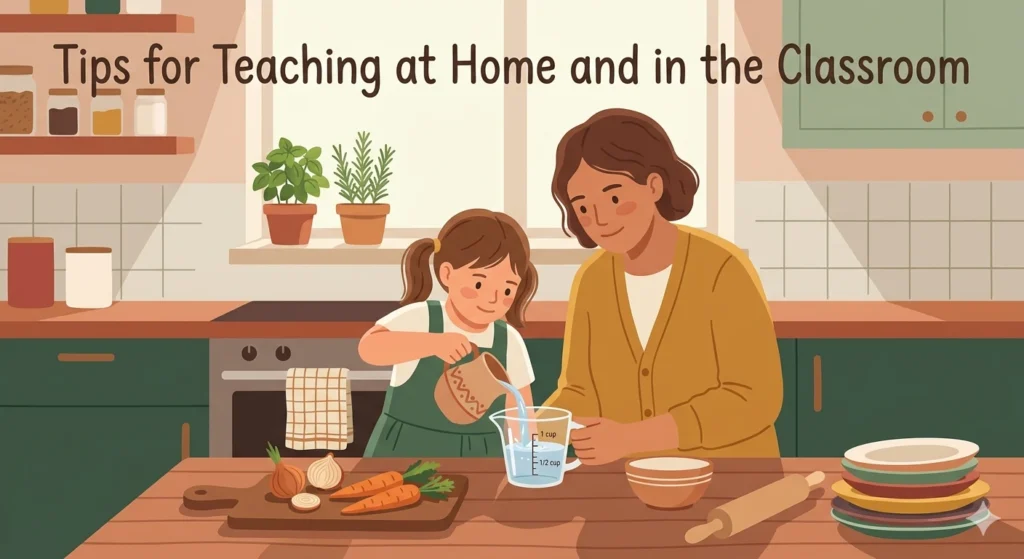
Use Cooking and Mealtime
Cooking is a measurement lesson in disguise. Ask your child to help you: “Can you fill this cup with water?” “Is this bowl big enough for the pasta?”
“Which spoon holds more, this big one or this small one?” Every answer teaches capacity, comparison, and real-world application.
Make It a Body Activity
Children are fascinated by their own bodies as measuring tools. Measure the kitchen table in handspans. Count footsteps across the hallway.
Compare your hand size to your child’s. These activities feel personal and memorable.
One Concept at a Time
Don’t mix length and weight on the same day. Pick one concept per session and stay with it.
Even 10–15 minutes of focused play is more effective than an hour of multi-topic drilling.
Celebrate Mistakes
If your child guesses the wrong object is heavier, don’t correct sharply. Instead, say: “Let’s check together!” and test it.
The moment of discovery “Oh! I was wrong!” is when real learning happens.
Narrate Daily Life
As you go about your day, narrate measurement moments. “I’m filling the jug let’s see, that’s nearly full!”
“This bag feels really heavy today.” “Your pencil is shorter than daddy’s pen.” Consistent, casual exposure builds vocabulary without any effort.
Tips for Teachers: Classroom Activities and Lesson Ideas
Organise Your Lessons by Concept
Spend at least one full lesson on each of the three measurement types before combining them. Mixing length, weight, and capacity too early is a common cause of confusion.
Suggested sequence: Length (2 lessons) → Weight (2 lessons) → Capacity (2 lessons) → Review and comparison (1 lesson).
Anchor Every Lesson in a Question
Start every lesson with a question, not a definition. “Which of these is heavier — this rock or this feather?” The question creates curiosity. The lesson answers it.
Use a Measurement Centre
Set up a small table with objects, a balance scale, and various containers. Let children explore freely for 10 minutes before the structured lesson.
Free exploration builds intuitive understanding that makes formal teaching faster.
Celebrate ‘Brilliant Mistakes’
When a child makes a measurement error (like leaving gaps between units), highlight it kindly. “This is a brilliant mistake it shows us something important!”
This approach, drawn from Maths No Problem methodology, creates psychologically safe learners who don’t fear being wrong.
Simple Assessment Ideas
You don’t need a written test to assess Class 1 measurement understanding. Try these:
- Observation during activities: Can the child correctly identify the longer/heavier/fuller object?
- Verbal questioning: Ask “How do you know this one is heavier?” to check reasoning, not just recall
- Portfolio activity: Ask students to draw two objects and label which is longer/heavier/holds more
- Show and tell measurement: Students bring an object from home and describe one of its measurable properties
Connect to Other Maths Topics
Measurement connects naturally to the number sense, counting, and ordering. When children count blocks to measure length, they’re practising counting.
When they order objects from shortest to longest, they’re practising ascending order the same skill used when sequencing numbers from smallest to largest.
Point these connections out to students; it helps them see maths as one connected story, not separate chapters.
Measurement also supports spatial understanding for Class 1, helping children develop awareness of position, size, and direction in the world around them.
Simple Worksheets and Practice Ideas for Class 1 Measurement
You don’t need a printer or a subscription.
Here are four types of practice exercises you can recreate at home or in the classroom with just paper and a pencil.
Practice Type 1: Circle the Longer / Heavier / Fuller One
Draw two simple objects side by side (or use picture cards). Ask: “Circle the longer pencil.” “Circle the heavier bag.”
“Circle the container that holds more.” This tests comparison vocabulary and recognition perfect for Class 1.
Practice Type 2: Count the Units
Draw an object (like a pencil or book) with small squares laid underneath it. Ask: “How many squares long is this pencil?”
This introduces the idea of counting units as the foundation of all formal measurement.
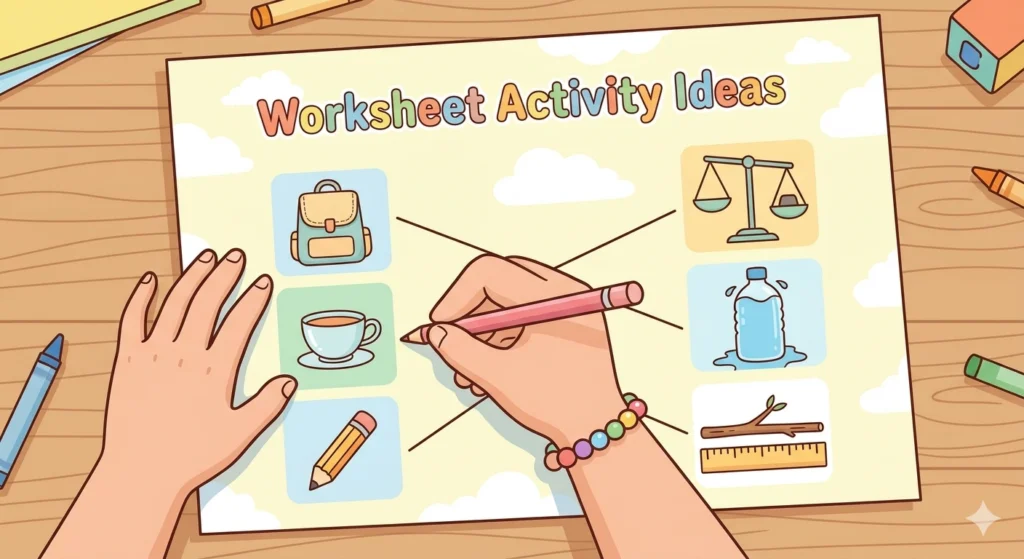
Practice Type 3: Match the Pair
Draw 4–5 objects in one column and the words “longer,” “shorter,” “heavier,” “lighter,” “full,” “empty” in another.
Ask children to draw a line matching each object to the correct description.
Practice Type 4: Odd One Out
Show three objects two that share a measurement property and one that doesn’t. “Two of these are short. Which one is long?” This builds critical thinking and visual discrimination.
It also connects beautifully to odd-one-out thinking exercises used across Class 1 maths, where children learn to identify what doesn’t belong in a group.
What are the measurement topics in Class 1 maths?
Class 1 maths measurement covers three core topics: Length (comparing how long or tall objects are), Weight (comparing how heavy or light objects are), and Capacity (comparing how much a container can hold). At this level, children focus on comparison and non-standard units of measurement rather than standard units like centimetres or kilograms.
How do you teach measurement to Class 1 students?
The most effective approach follows a simple sequence: first, have children observe and compare objects directly (“Which is longer?”). Then introduce non-standard units for counting (“How many blocks long is this?”). Finally, apply measurement in real-life contexts (“How many footsteps is the classroom?”). Always start with hands-on activities before introducing vocabulary or written practice.
What are non-standard units of measurement for Class 1?
Non-standard units are everyday objects used as measuring tools before children learn formal units like centimetres or kilograms. For length, children might use handspans, footsteps, or building blocks. For weight, they might use small stones or coins on a balance scale. For capacity, they might use spoonfuls or small cupfuls. Non-standard units help children understand the concept of measurement without the complexity of standard units.
How do you explain length, weight, and capacity to a child?
Use simple, direct language tied to their experience. Length: “How long or tall is it?” Weight: “How heavy or light is it?” Capacity: “How much can it hold?” Follow each question with a real object your child can touch and compare. The definition is far less important than the experience of observing, comparing, and describing.
What is the difference between length, weight, and capacity for kids?
Length measures how long or tall something is when you compare it with your eyes. Weight measures how heavy something is you compare by feeling or by using a balance scale. Capacity measures how much a container can hold you compared by filling them up. Each one answers a different question: How long? How heavy? How much?
What are simple measurement activities for Class 1?
Great Class 1 measurement activities include: measuring objects with building blocks and counting the blocks; using a hanger balance to compare the weight of two objects; filling containers with spoonfuls of water to compare capacity; ordering 5 objects from shortest to longest; and a “measurement walk” around the home or classroom. All of these activities require only everyday household objects.
How do I help my Class 1 child understand measurement at home?
Start by making measurement a part of your daily routines. At mealtimes, ask which spoon holds more. During bath time, ask which bottle is heavier when full. On a walk, count footsteps across a section of pavement. Use your child’s body as a measuring tool for handspans, footsteps, and arm lengths. Consistent, casual exposure across different contexts builds understanding far faster than dedicated “lesson time.”
What common mistakes do Class 1 students make in measurement?
The most common mistakes include: assuming a bigger object is always heavier (size doesn’t equal weight); thinking a taller container always holds more (taller doesn’t mean greater capacity); leaving gaps when measuring with non-standard units; and confusing length with height. These are all completely normal at this developmental stage and can be corrected with simple hands-on demonstrations rather than explanations.
Make Preparing for Math Olympiad Simple!



Conclusion
When measurement is taught through everyday experiences and play, it becomes simple and meaningful for Class 1 children.
Start with comparison. Move to counting. Apply it in real life. And above all, make it playful.
When measurement feels like a game, children don’t just understand it, they love it.

Mikha Piregu is a Content Writer with experience spanning educational content, including math and math olympiad topics, as well as advocacy writing, research-based articles, and SEO-driven web content. He creates high-quality blog content, web copy, and feature articles that support brand visibility, audience engagement, and long-term organic growth through data-informed storytelling. Skilled in WordPress, WooCommerce, and modern digital tools, Mikha adapts content across various platforms, including blogs, websites, campaigns, and advocacy initiatives, with clarity and purpose. You can reach out to him at [email protected].

There are no comments posted here yet.
Sign in to leave a comment