


Number sense for Class 1 is the ability to understand what numbers mean, how they relate to each other, and how to use them flexibly in everyday situations.
- What is Number Sense? A Clear Definition for Parents and Teachers
- The 6 Core Components of Number Sense for Class 1
- How Number Sense Grows Through Class 1: The Three Stages
- Activities That Build Number Sense at Home and School
- Number Sense and the Class 1 Math Olympiad
- Number Sense Milestones: What to Expect by Term
- Conclusion
It is the difference between a child who can recite “1, 2, 3, 4, 5” and a child who genuinely understands that 5 means five real things and that five is more than four but less than six.
Children who build robust number sense in Class 1 find addition, subtraction, multiplication, fractions, and eventually algebra more intuitive, not because they are naturally “math people,” but because every one of those concepts builds directly on the number understanding they developed early.
This guide explains exactly what number sense for Class 1 means in practice: the six core components every Class 1 child develops, how each one grows through the year, what it looks like in everyday life, and the specific activities for home and school that build it most effectively.
What is Number Sense? A Clear Definition for Parents and Teachers
Number sense is not a single skill; it is a collection of interrelated understandings about numbers that develop together over time.
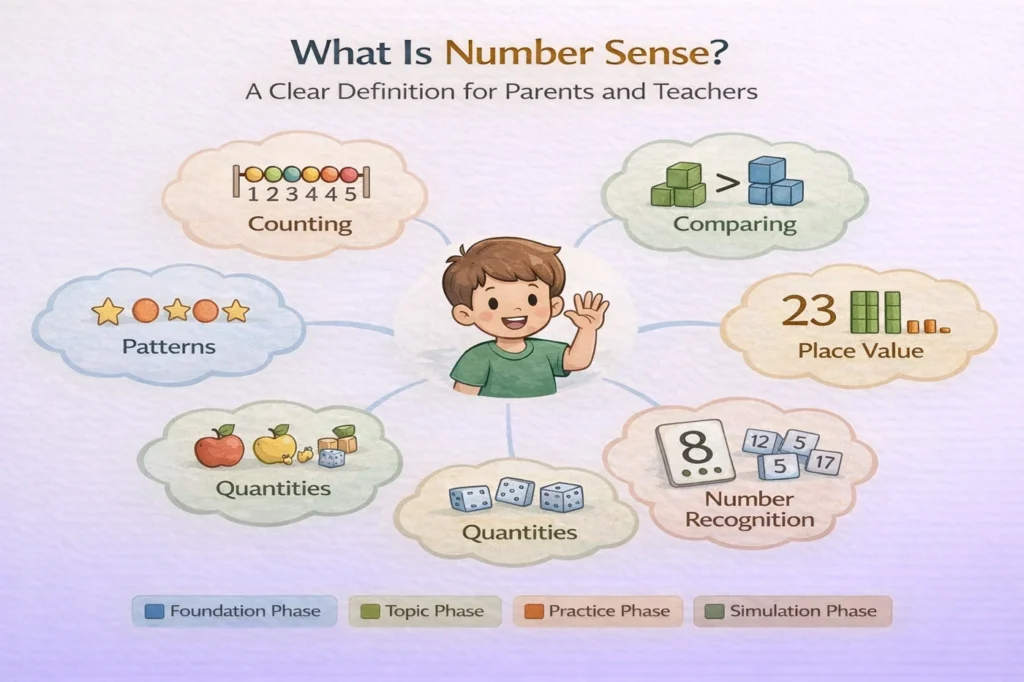
The most widely used definition in mathematics education research describes number sense as “a person’s ability to use and understand numbers, to make comparisons, and to know the effect of operations on numbers.”
For Class 1 specifically, number sense means your child can:
- Recognize written numerals (1–100) and connect them to quantities
- Count accurately forward and backward, and skip-count by 2s, 5s, and 10s
- Compare two quantities and judge which is greater, smaller, or equal
- Understand that a number represents a specific quantity of real objects
- Recognize and extend simple number patterns
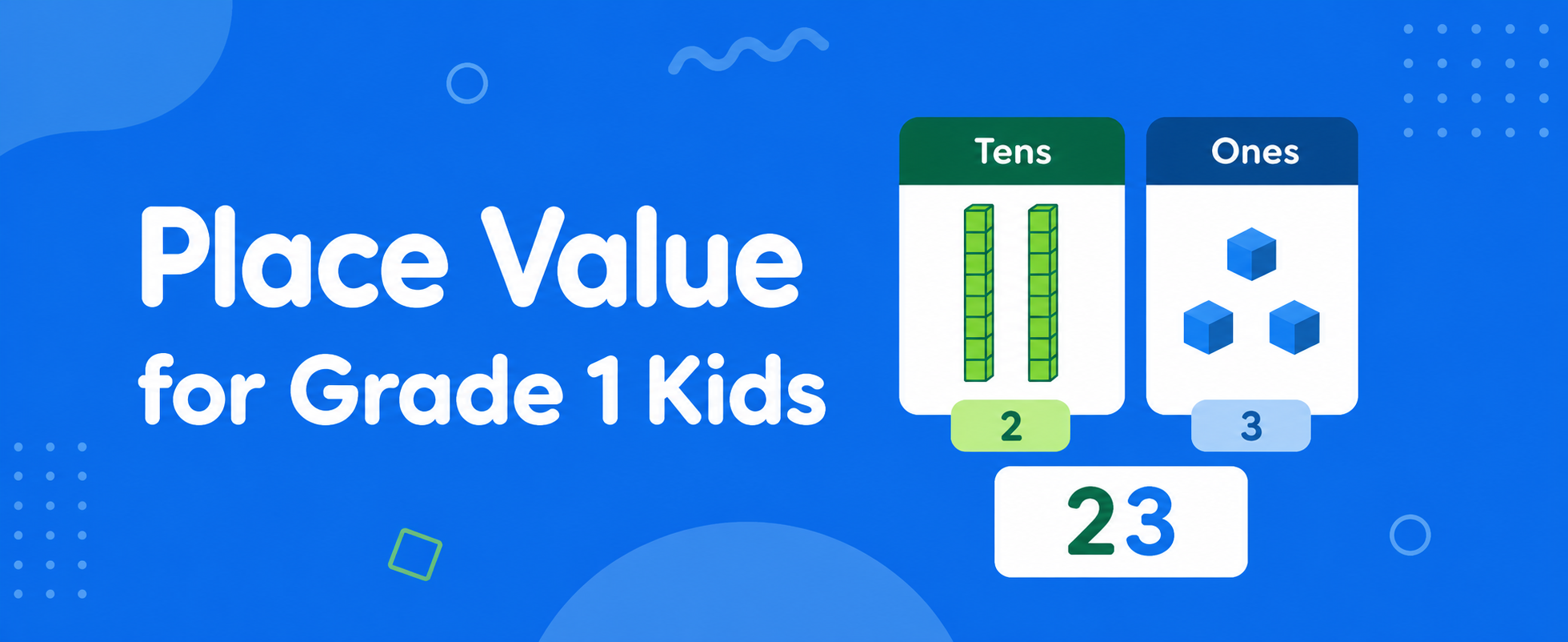
- Begin to understand place value — that 23 means 2 tens and 3 ones, not simply a “2” and a “3”
What makes number sense different from simply knowing number facts is flexibility.
A child with strong number sense does not just know that 7 + 3 = 10 — they understand that 7 and 3 together make the same as 10 singles, that 10 is the same as 1 ten, and that if you have 10 and take away 3 you have 7.
They can move between these representations fluidly because they understand the underlying relationships, not just the memorized answer.
This flexibility is what allows children to tackle unfamiliar mathematical situations the same quality that, years later, underlies competitive mathematical thinking.
The foundations built through strong Class 1 number sense connect directly to the mathematical reasoning that IMO syllabus for class 1 competitions assess at early levels.
The 6 Core Components of Number Sense for Class 1
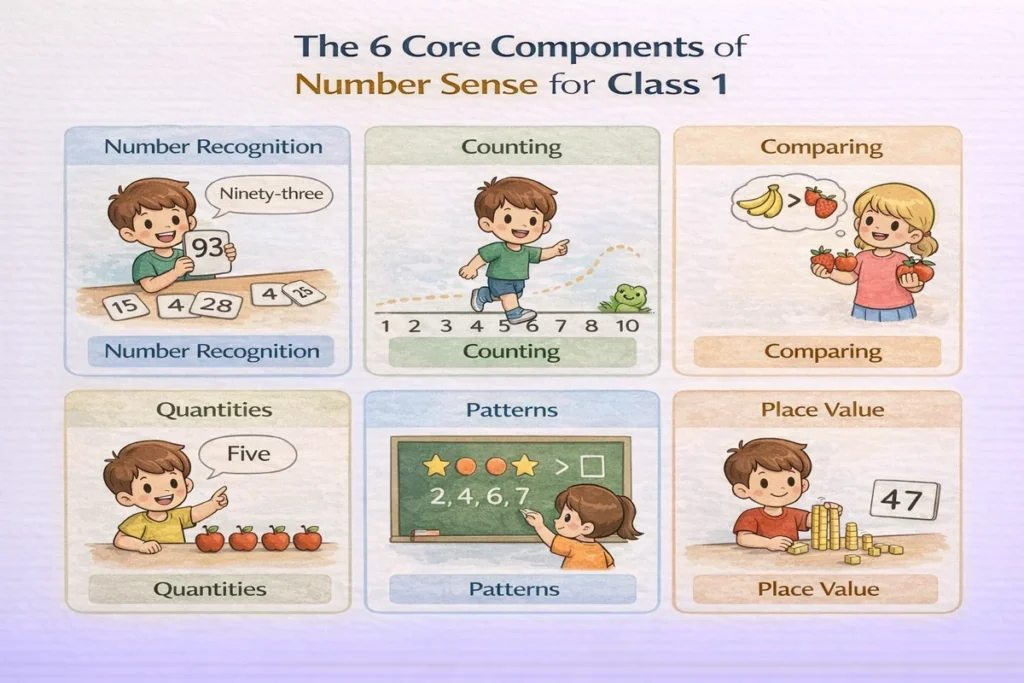
Component 1: Number Recognition (1–100)
Number recognition is the ability to see a written numeral — “7”, “23”, “84” — and immediately know which number it represents and what quantity it stands for.
This goes in both directions: seeing the symbol and knowing the quantity, and seeing a quantity and knowing which symbol represents it.
In Class 1, number recognition develops progressively. Most children begin the year confident with numbers 1–20, having encountered these in pre-school or at home.
Through Class 1, the range extends to 100, and children begin recognizing two-digit numbers as unified values rather than two separate digits placed side by side.
What it looks like at home: Your child sees the number 14 on a page and says “fourteen” without hesitation. When you ask “show me fourteen fingers” (or blocks, or crayons), they count out exactly 14 objects.
How to support it: Number cards and number hunts (finding numbers on cereal boxes, door numbers, calendars, clocks) are the most natural and effective ways to build number recognition.
Display a number line at child height somewhere in your home.
Component 2: Counting Skills
Counting is the bedrock of all early number work, but at Class 1 level it encompasses much more than reciting numbers in order. There are four distinct counting skills that Class 1 children develop:
Forward counting — saying numbers in order starting from any point, not just from 1. Being able to start at 7 and count forward to 20 is more demanding than starting from 1, and this flexibility matters.
Backward counting — counting down from any starting point. This skill is directly connected to understanding subtraction and is harder than forward counting for most children.
Skip counting — counting in equal intervals: by 2s (2, 4, 6, 8…), by 5s (5, 10, 15, 20…), and by 10s (10, 20, 30…). Skip counting builds the foundations for multiplication and for understanding place value structure.
Counting on — starting from a given number and counting up a specified amount, rather than starting from 1. “Start at 8 and count on 5 more” is a precursor to addition without the full count-from-one method.
These counting foundations connect directly to the number sequence work explored in what is the number sequence for class 1 maths and the teaching strategies in teach number sequences to class 1 students.
What it looks like at home: Your child counts the stairs as you climb them, counts backward from 10 while playing a rocket launch game, or counts by 5s when helping you count a pile of 5-cent coins.
Component 3: Comparing Numbers
Comparing numbers — determining which of two quantities is greater, smaller, or whether they are equal — develops logical thinking and decision-making alongside pure number knowledge.
At Class 1 level, this involves both comparing individual numbers (“Is 9 bigger than 6?”) and comparing quantities of real objects.
The language of comparison is as important as the mathematical judgment: greater than, less than, equal to, more, fewer, as many as.
Children who are fluent in this language find it much easier to understand written mathematical comparisons later.
This component connects naturally to ordering work. Ascending and descending order in maths for class 1 extends comparing into the full skill of arranging numbers in sequence, a direct progression from the comparison foundation built here.
What it looks like at home: Setting the table and asking “do we have enough forks for everyone? Do we have more cups or more plates?” uses comparing naturally and meaningfully.
Component 4: Understanding Quantities (One-to-One Correspondence)
One-to-one correspondence — the understanding that each object in a set corresponds to exactly one counting number is the conceptual bridge between abstract numerals and the real-world quantities they represent.
A child who truly understands one-to-one correspondence knows that “5” does not just mean saying the word “five” but that it means there are exactly five things.
This understanding underpins every arithmetic operation. Addition is combining two quantities. Subtraction is removing a quantity from a larger one.
Multiplication explored in multiplication for class 1, is combining equal quantities repeatedly. None of these makes genuine sense without the foundational understanding that numbers represent real, countable quantities.
What it looks like at home: Sorting laundry by pairs, counting out portions of food, or distributing equal numbers of game pieces around a board. All of these activities build one-to-one correspondence naturally in context.
Component 5: Number Patterns
Recognizing and extending number patterns, understanding that 2, 4, 6, 8 will be followed by 10 because each step adds 2 — is an early form of mathematical reasoning.
At the Class 1 level, pattern recognition focuses on simple repeating and growing patterns in number sequences.
This is where mathematics begins to move from memory to logic. A child who recognizes a pattern does not need to memorize every subsequent number; they can derive it.
This shift from recall to reasoning is one of the most significant cognitive developments in early mathematical education.
The skip-counting patterns from Component 2 (2s, 5s, 10s) are the most natural entry points for number pattern work. From these, Class 1 children move to recognizing patterns on hundred charts and number lines.
The deeper exploration of sequences and patterns is covered in what is the number sequence for class 1 maths.
What it looks like at home: Drawing a number line together and asking “what comes next?” or playing “I’m thinking of the next number in this pattern: 5, 10, 15, ___” makes pattern recognition playful and engaging.
Component 6: Place Value Basics (Tens and Ones)
Place value is the understanding that the position of a digit within a number determines its value that the “2” in 23 represents twenty, not two.
This is one of the most important mathematical concepts in the entire primary curriculum and one of the areas where Class 1 children most benefit from hands-on, concrete learning before abstract representation.
At Class 1 level, place value understanding focuses on tens and ones.
Children learn that two-digit numbers are composed of a certain number of tens plus a certain number of ones, that 47 is 4 tens (forty) and 7 ones (seven).
This understanding makes two-digit addition and subtraction coherent rather than procedural.
Physical base-ten blocks or bundled sticks are the most effective tools for building place value understanding — they make the abstract relationship between tens and ones visible and manipulable.
| Number | Tens | Ones |
|---|---|---|
| 13 | 1 ten | 3 ones |
| 27 | 2 tens | 7 ones |
| 45 | 4 tens | 5 ones |
| 60 | 6 tens | 0 ones |
| 98 | 9 tens | 8 ones |
How Number Sense Grows Through Class 1: The Three Stages
Number sense does not develop all at once. It follows a consistent three-stage progression through Class 1 that parents and teachers can observe and support.
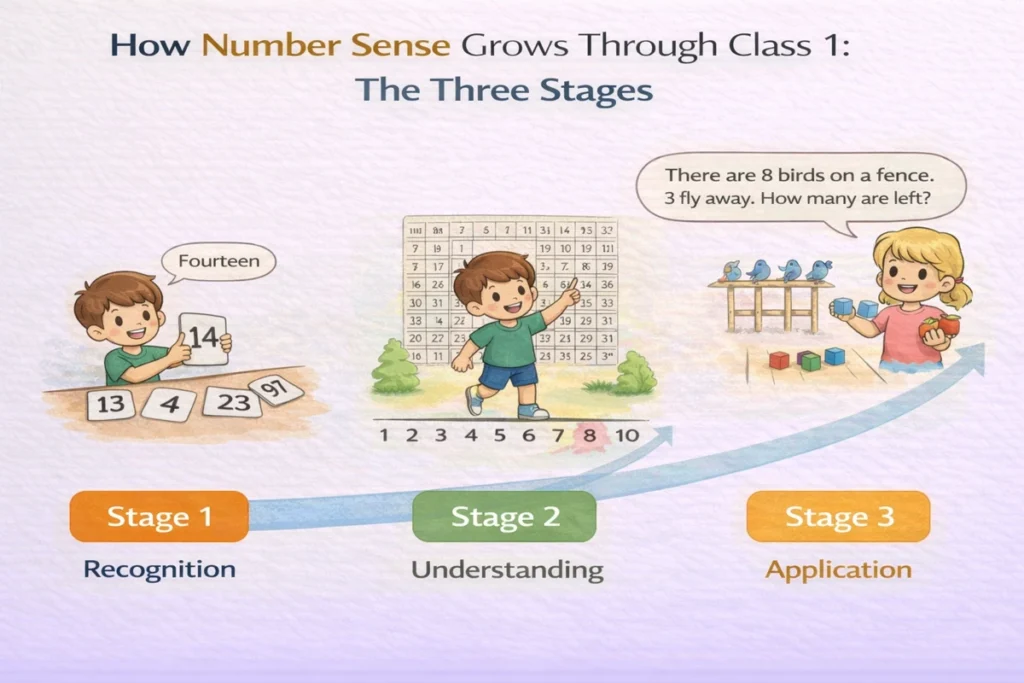
Stage 1: Recognition (Beginning of Class 1)
Children learn to identify numerals and connect them to their spoken names. Most children arrive in Class 1 confident with numbers 1–10 and build to 100 through the year.
The focus at this stage is making the connection between the written symbol, the spoken word, and the quantity it represents — using number cards, number walls, counting games, and physical objects constantly.
Key milestone: Your child sees “14” written and says “fourteen” without hesitation.
Stage 2: Understanding (Mid-Year)
With recognition secure, children begin developing genuine understanding of how numbers relate to each other.
They practice counting forward and backward from various starting points, use number lines to visualize magnitude, explore a 100-chart to discover patterns, and begin comparing numbers with confidence.
This is the stage where subitizing develops the ability to instantly recognize the quantity of a small group of objects (up to 5–6) without counting.
Subitizing is an important marker of deepening number sense and a skill actively developed through dice games, dot cards, and ten-frame activities.
The spatial reasoning that supports this visual number understanding connects directly to spatial understanding for class 1, the ability to mentally visualize and manipulate number representations in space.
Key milestone: Without counting from 1, your child sees a group of 4 objects and immediately says “four.” They can also answer “which is bigger, 17 or 23?” without needing to count up to both numbers.
Stage 3: Application (End of Class 1)
In the final stage, children begin applying their number understanding to solve real problems, such as simple addition and subtraction, skip-counting to find totals, using number patterns to predict future values, and recognizing tens and ones in two-digit numbers.
This stage is where the foundational work of Class 1 becomes the platform for Class 2 mathematics.
Children who reach a strong Stage 3 level of number sense are well prepared for the arithmetic operations, measurement, and early data concepts that follow.
The progression into fractions, another early landmark concept, is explored in fractions for class 1.
Key milestone: Your child can solve a simple story problem: “There are 8 birds on a fence. 3 fly away. How many are left?” using counting, objects, or mental reasoning without needing to be shown a procedure.
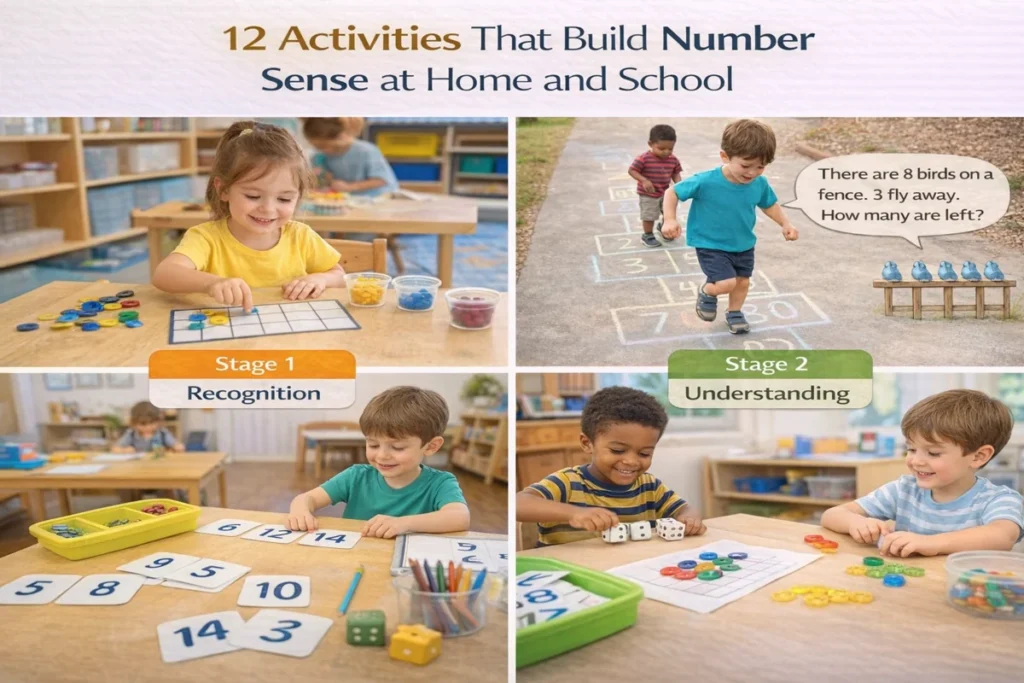
12 Activities That Build Number Sense at Home and School
The research is clear: number sense is not built through worksheets alone.
It develops through varied, hands-on, game-based, and real-world experiences that allow children to encounter numbers from multiple angles. Here are twelve proven activities organized by component:
For Number Recognition
Number Hunt: Walk around the house or neighbourhood and find as many written numbers as possible — on doors, packaging, clocks, license plates, calendars. Record them in a notebook.
This builds recognition in authentic contexts and shows children that numbers are everywhere.
Number Snap: A card matching game where one set shows numerals and another shows dot quantities. Children match the numeral to its corresponding quantity.
Played at speed, this builds fluent recognition without feeling like drilling.
For Counting Skills
Staircase Count: Count out loud every time you climb or descend stairs, forward going up, backward going down. This daily ritual builds both forward and backward counting without any special materials or dedicated time.
Skip-Count Clap: Sit facing each other. Count by 2s, taking turns saying a number and clapping once for each. The rhythm makes skip-counting memorable and the turn-taking provides gentle accountability.
Extend to 5s and 10s as fluency grows.
For Comparing Numbers
More or Less Card Game: Use a standard deck of cards (remove face cards). Each player flips a card. The player with the higher number takes both. First to collect all cards wins. T
his constant comparison — “mine is more than yours,” “equal!” — builds comparing fluency through play.
Object Comparison: At dinner, compare the number of items on different plates: “You have 7 peas, I have 5. Who has more? How many more?” This grounds comparing in concrete, meaningful real-world contexts.
The full structured approach to teaching ordering the natural extension of comparing, is covered in ascending and descending order in maths for class 1.
For Understanding Quantities
Ten Frames: A ten frame is a 2×5 grid. Fill it with counters to represent numbers up to 10, then extend to double ten frames for numbers to 20.
Ask children to fill the frame for different numbers, which builds instant quantity recognition and begins to develop addition intuition (“I need 4 more to fill the frame — so 6 + 4 = 10”).
Counting Collections: Gather a jar of everyday objects — buttons, pasta pieces, coins. Have your child sort them into groups of 10 and count the groups.
This is the most hands-on and effective way to build both quantity understanding and early place value intuition simultaneously.
For Number Patterns
Hundred Chart Colouring: Print a 1–100 chart and colour every 2nd number (or 5th, or 10th). The resulting visual patterns make skip-count sequences visible in a way that is immediately intuitive.
Children often discover patterns they were not taught, a sign that genuine mathematical reasoning is developing.
Pattern Chains: Using coloured cubes or beads, create a growing pattern and ask your child to extend it. Start simple (2 red, 2 blue, 2 red…) and gradually increase complexity.
This builds the pattern recognition that underpins later algebraic thinking.
The structured approach to teaching number sequences, including how to introduce and extend them in class, is covered in teach number sequences to class 1 students.
For Place Value
Bundle and Count: Use sticks, straws, or pencils. Have your child bundle groups of 10 with a rubber band, then count the bundles (tens) and the leftover singles (ones).
Ask: “How many tens do we have? How many ones? So what number is that?” This is the most physically intuitive way to build place value understanding.
Place Value Mat: Create a simple two-column mat labelled “Tens” and “Ones.” Give your child a two-digit number and have them place the correct number of base-ten blocks (or improvised counters) in each column.
Reverse it: put blocks on the mat and ask what number is shown.
These hands-on place value activities directly support the ordinal and positional number understanding explored in ordinal numbers for class 1 math.
Number Sense and the Class 1 Math Olympiad
Strong number sense is not only the foundation for school mathematics, but it is also the foundation for early mathematical competition performance.
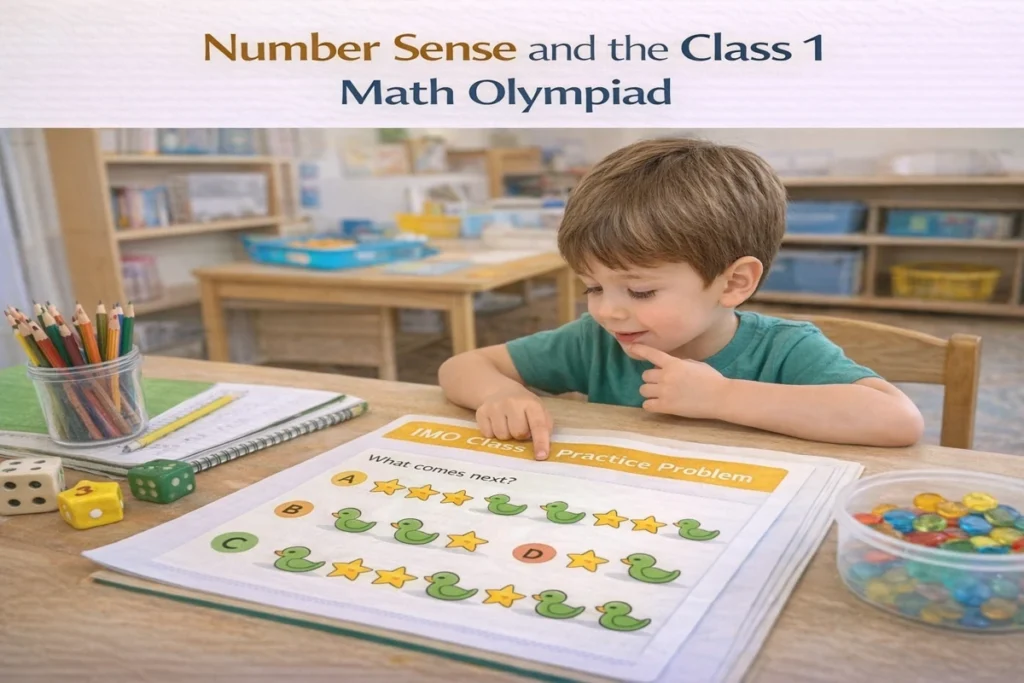
The Class 1 IMO (International Mathematics Olympiad) tests the exact skills that number sense develops: counting with accuracy and flexibility, comparing quantities, recognizing patterns, and applying number understanding to solve problems presented in unfamiliar ways.
Children with strong number sense approach Class 1 IMO problems with an important advantage: they can focus on the reasoning required by the problem rather than on basic number mechanics.
A child who still has to count from 1 to compare two quantities has less cognitive capacity available for the logical reasoning the problem is actually testing.
The IMO syllabus for class 1 covers the full range of topics assessed at the Class 1 level, and number sense, spanning counting, comparing, patterns, and place value, underpins virtually every one of them.
For parents wondering how to prepare their Class 1 child for the Math Olympiad, the most effective starting point is always ensuring strong number sense foundations.
Because Olympiad problems for Class 1 are designed to test deep numerical understanding and pattern recognition rather than advanced procedures.
Number Sense Milestones: What to Expect by Term
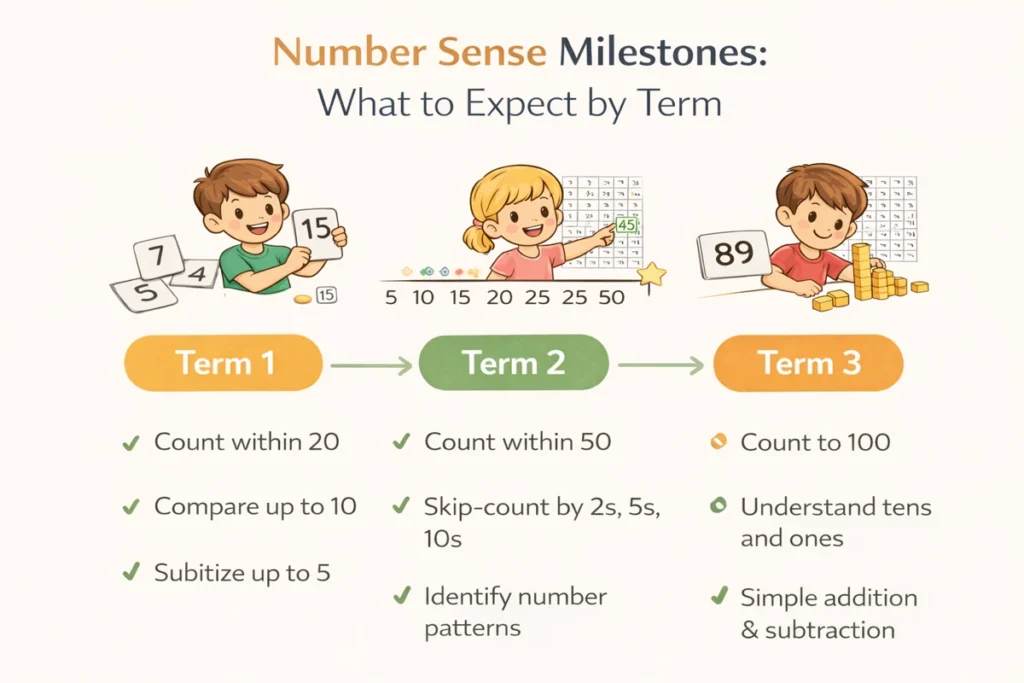
Every child develops at their own pace, but the following milestone benchmarks give parents and teachers a useful reference for whether number sense is on track through the year:
| Term | Expected Milestones |
|---|---|
| Term 1 | Recognises numerals 1–20; counts forward to 20 from any starting point; counts backward from 10; compares groups up to 10 using “more” and “fewer”; subitizes quantities up to 5 |
| Term 2 | Recognises numerals 1–50; skip-counts by 2s, 5s, 10s to 50; compares two-digit numbers to 50; identifies simple number patterns; understands one-to-one correspondence to 20 |
| Term 3 | Recognises and reads numerals to 100; skip-counts by 2s, 5s, 10s to 100; understands tens and ones in two-digit numbers; extends number patterns on a 100-chart; uses number knowledge for simple addition and subtraction |
If your child is significantly behind these milestones at any term boundary, the most effective intervention is always returning to the previous component and building genuine fluency there before progressing.
Skipping ahead rarely helps; each component genuinely depends on the ones before it.
At what age should number sense be fully developed for Class 1?
Class 1 children are typically 6–7 years old. The progression through the three stages, recognition, understanding, and application happens across the full school year. By the end of Class 1 (age 7), children with strong number sense should be fluent with numbers to 100, comfortable with tens and ones, and able to use numbers flexibly in simple problem-solving.
How do I know if my child has weak number sense?
Common signs include always counting from 1 (rather than counting on from a given number), uncertainty when comparing numbers without counting both up, inability to recognize small quantities without counting each one, and difficulty extending simple patterns. If you notice these, focused hands-on activities, particularly ten-frame work and number line practice, are the most effective response.
Can number sense be taught, or is it natural ability?
Number sense is absolutely teachable; this is one of the most consistent findings in mathematics education research. While children vary in how quickly they develop it, the activities that build number sense (varied hands-on experiences, games, and real-world application) are effective for all learners given sufficient time and the right approaches.
How does number sense connect to addition and subtraction?
Strongly. Children with deep number sense understand addition as combining quantities and subtraction as removing a quantity from a larger one. They grasp the operation conceptually. Children without this foundation memorize procedures without understanding why they work, which becomes increasingly difficult as operations become more complex.
What are the best books or apps for building Class 1 number sense?
For apps, the Gonit App provides structured number sense activities with a competition mathematics progression. Khan Academy Kids offers free guided number activities for the Class 1 level. For books, Developing Number Sense in the Primary Grades by Rusty Bresser is excellent for teachers; Bedtime Math by Laura Overdeck makes daily number sense practice feel like a family ritual for parents.
Make Preparing for Math Olympiad Simple!



Conclusion
Number sense for Class 1 is the foundation of all later math learning.
It develops through interconnected skills such as recognizing numbers, counting, comparing quantities, spotting patterns, and understanding basic place value.
These skills grow best through hands-on, game-based activities rather than worksheets alone.
As children progress from recognition to understanding and application, they build the confidence and intuition needed for future topics like addition, subtraction, and more advanced mathematical challenges.

Mikha Piregu is a Content Writer with experience spanning educational content, including math and math olympiad topics, as well as advocacy writing, research-based articles, and SEO-driven web content. He creates high-quality blog content, web copy, and feature articles that support brand visibility, audience engagement, and long-term organic growth through data-informed storytelling. Skilled in WordPress, WooCommerce, and modern digital tools, Mikha adapts content across various platforms, including blogs, websites, campaigns, and advocacy initiatives, with clarity and purpose. You can reach out to him at [email protected].

There are no comments posted here yet.
Sign in to leave a comment