April 22, 2025
 4 min. read

Multiplication for class 1 means adding equal groups again and again. It is a faster way to add the same number many times.
When children understand multiplication as repeated addition, they build strong number sense and feel confident solving small math problems.
In simple words, multiplication tells us how many objects we have in equal groups. Instead of writing 2 + 2 + 2, we can write 3 × 2. Both give the same answer.
This simple multiplication explanation helps children see patterns clearly.
What is Multiplication?
Multiplication is a way to add the same number many times.
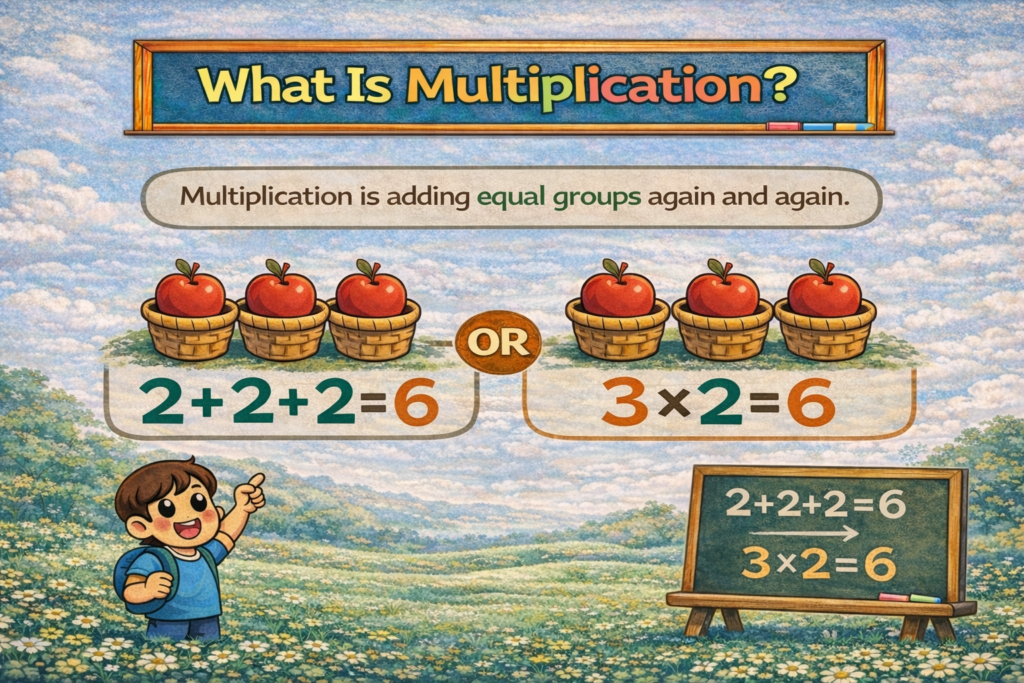
For example:
If you have 2 apples in one basket and there are 3 baskets, how many apples do you have in total?
You can add:
2 + 2 + 2 = 6
Or you can multiply:
3 × 2 = 6
Both give the same answer.
This is why multiplication for beginners should always start with repeated addition.
Multiplication as Repeated Addition
The easiest way to teach multiplication is to show that it is repeated addition.
Here is a simple table:
| Repeated Addition | Multiplication Form |
| 2 + 2 + 2 = 6 | 3 × 2 = 6 |
| 4 + 4 = 8 | 2 × 4 = 8 |
| 5 + 5 + 5 = 15 | 3 × 5 = 15 |
| 3 + 3 + 3 + 3 = 12 | 4 × 3 = 12 |
When you explain multiplication as repeated addition, children understand that:
- The first number tells how many groups.
- The second number tells how many items are in each group.
This step-by-step multiplication approach builds clarity before memorizing tables.
When explaining repeated addition, you can strengthen this concept by first revising addition and subtraction for Class 1 to build a strong foundation.
Simple Examples for Class 1
Let’s look at some multiplication examples for kids.
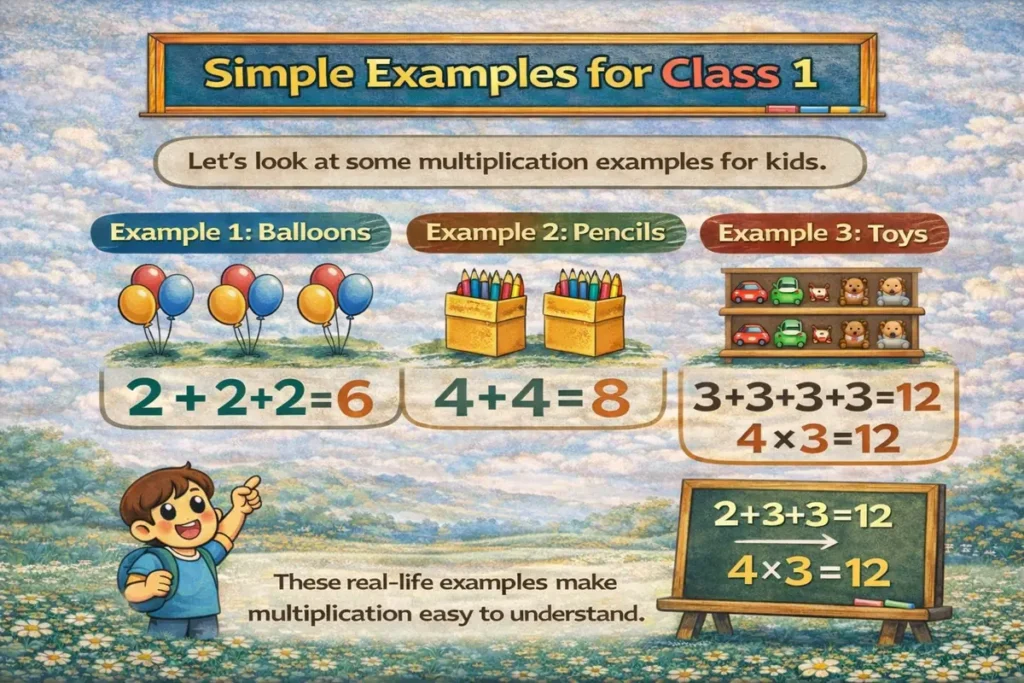
Example 1: Balloons
There are 2 balloons in each bunch.
There are 3 bunches.
2 + 2 + 2 = 6
3 × 2 = 6
Example 2: Pencils
Each box has 4 pencils.
There are 2 boxes.
4 + 4 = 8
2 × 4 = 8
Example 3: Toys
Each shelf has 3 toys.
There are 4 shelves.
3 + 3 + 3 + 3 = 12
4 × 3 = 12
These real-life examples make multiplication easy to understand.
Multiplication Using Pictures
Children learn best when they see groups clearly.
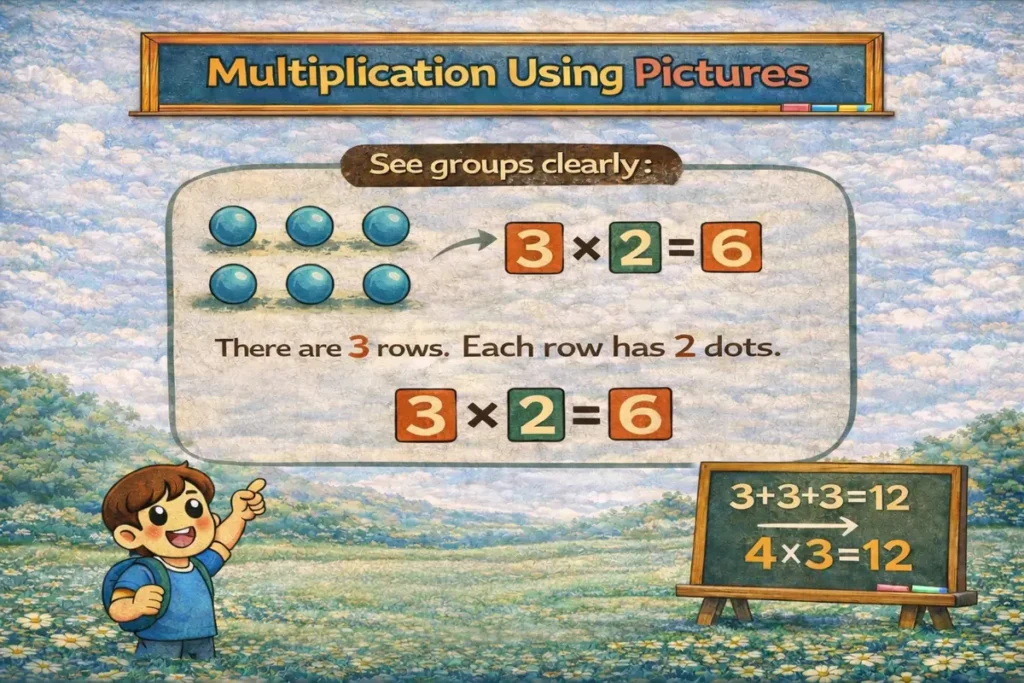
You can draw:
● ●
● ●
● ●
There are 3 rows. Each row has 2 dots.
So we write:
3 × 2 = 6
Multiplication using pictures helps children count groups instead of guessing.
Multiplication using pictures becomes even clearer when children also practice using a number line for Class 1 to visualize counting in jumps.
Step-by-Step Explanation
Here is an easy way to teach multiplication at home or in class:
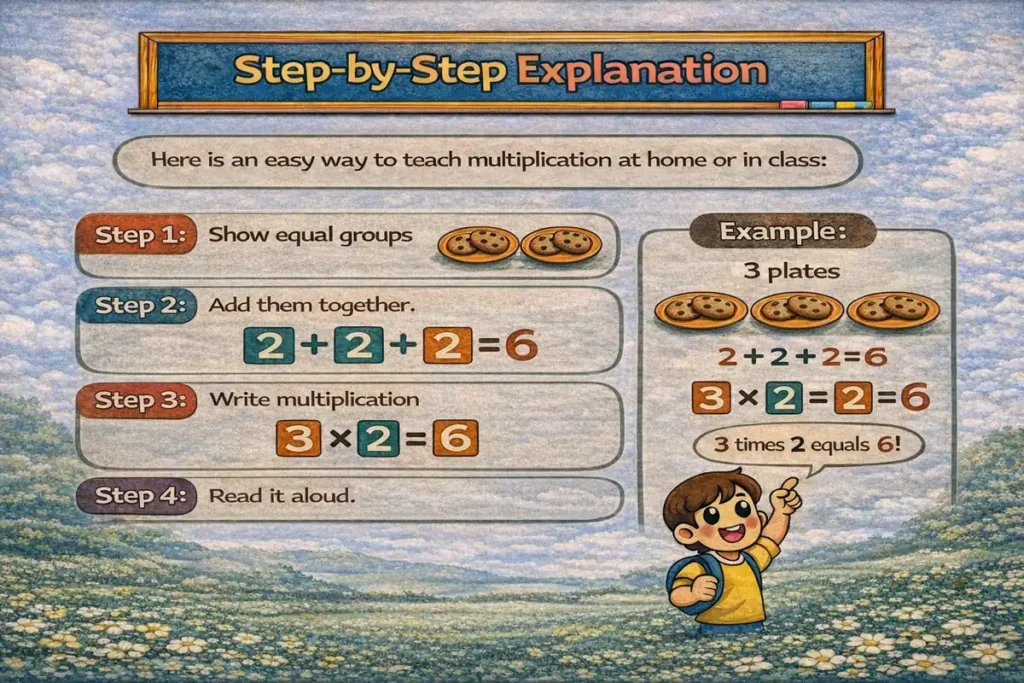
Step 1: Show equal groups using real objects (buttons, crayons, fruits).
Step 2: Add the numbers together.
Step 3: Write the multiplication sentence.
Step 4: Read it aloud.
Example:
3 plates
2 cookies on each plate
Add: 2 + 2 + 2 = 6
Multiply: 3 × 2 = 6
This step-by-step multiplication process builds strong understanding.
Small Multiplication Table (2s and 3s Only)
Table of 2
| Multiplication | Answer |
| 1 × 2 | 2 |
| 2 × 2 | 4 |
| 3 × 2 | 6 |
| 4 × 2 | 8 |
| 5 × 2 | 10 |
Table of 3
| Multiplication | Answer |
| 1 × 3 | 3 |
| 2 × 3 | 6 |
| 3 × 3 | 9 |
| 4 × 3 | 12 |
| 5 × 3 | 15 |
Do not rush children to memorize. First make sure they understand why these numbers grow.
A strong understanding of patterns improves multiplication skills, which is why developing number sense in Class 1 is very important.
Practice Questions
Try this class 1 multiplication practice section.
- 2 + 2 + 2 = ?
- 3 + 3 = ?
- 4 + 4 = ?
- 3 × 2 = ?
- 2 × 4 = ?
- 4 × 3 = ?
- Write multiplication for 5 + 5
- Write repeated addition for 3 × 2
Encourage your child to draw groups if they feel unsure.
Word Problems
Word problems help children apply multiplication in daily life.
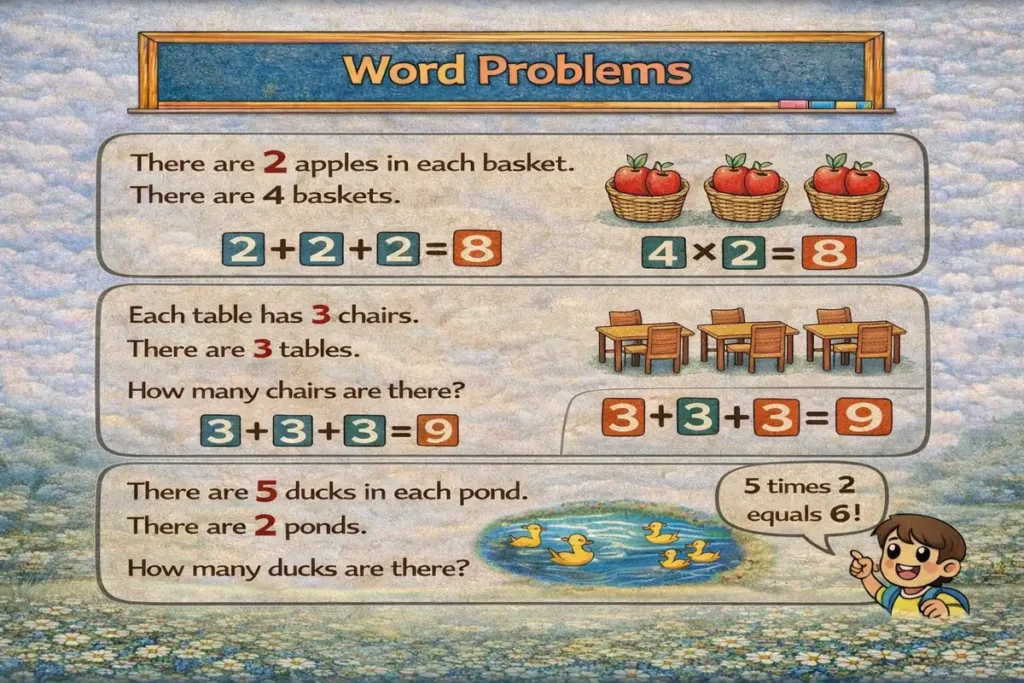
- There are 2 apples in each basket. There are 4 baskets. How many apples are there?
- Each table has 3 chairs. There are 3 tables. How many chairs are there?
- There are 5 ducks in each pond. There are 2 ponds. How many ducks are there?
Ask your child to first write repeated addition, then the multiplication sentence.
Fun Multiplication Activities
Learning should feel playful.
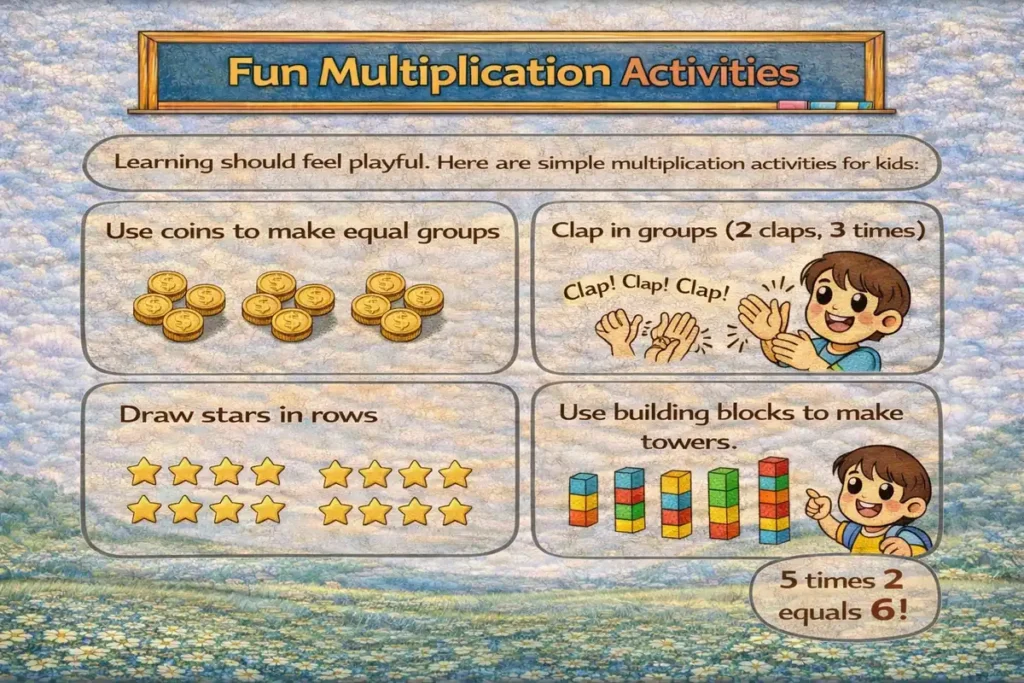
Here are simple multiplication activities for kids:
- Use coins to make equal groups.
- Clap in groups (2 claps, 3 times).
- Draw stars in rows.
- Use building blocks to make towers.
To make multiplication clearer, children should also understand positions and jumps on a line. Learn how to explain number positions on a number line in Class 1 step by step.
You can also practice visually by following these steps to draw a number line for Class 1 Maths to make learning interactive and fun.
Common Mistakes Children Make
- Mixing up the order of numbers.
- Forgetting that groups must be equal.
- Counting one group twice.
- Memorizing tables without understanding.
The easy way to teach multiplication is always to go back to equal groups.
1. What is multiplication for class 1?
Multiplication for class 1 means adding the same number again and again. It helps children count equal groups quickly.
2. How do I explain multiplication to my child?
Start with real objects. Make equal groups. Add them first. Then write the multiplication sentence.
3. Should Class 1 students memorize tables?
Understanding should come first. Memorization can come slowly after children understand repeated addition.
4. What is the easiest multiplication to start with?
Start with the table of 2. It helps children see patterns clearly.
5. Why is multiplication important?
It builds number sense and prepares children for bigger math concepts in higher grades.
Make Preparing for Math Olympiad Simple!



Final Thoughts
Multiplication for beginners should always begin with understanding groups. When children see multiplication as repeated addition, they feel confident and less afraid of math.
Give them time. Use objects. Make it fun. Stay patient.
When your child is ready to practice more, structured exercises make a big difference.