


Multiplication for class 1 means adding equal groups again and again. It is a faster way to add the same number many times.
- What is Multiplication?
- Multiplication as Repeated Addition
- How to Introduce Multiplication to Grade 1 Students
- Simple Examples for Class 1
- Multiplication Using Pictures
- Step-by-Step Explanation
- Small Multiplication Table (2s and 3s Only)
- Multiplication Sums for Class 1 (Practice Questions)
- Word Problems
- How to Explain Multiplication to a Child at Home
- Fun Multiplication Activities
- Multiplication Readiness for Class 1: What to Check
- Common Mistakes Children Make
- Final Thoughts
When children understand multiplication as repeated addition, they build strong number sense and feel confident solving small math problems.
In simple words, multiplication tells us how many objects we have in equal groups. Instead of writing 2 + 2 + 2, we can write 3 × 2. Both give the same answer.
This simple multiplication explanation helps children see patterns clearly. Whether your child is in Grade 1 or just starting to learn, this guide covers everything from the basic multiplication concept to word problems and fun activities.
What is Multiplication?
Multiplication is a way to add the same number many times.
It is one of the four basic operations in math, and it is introduced in class 1 as a foundation for higher-level arithmetic.
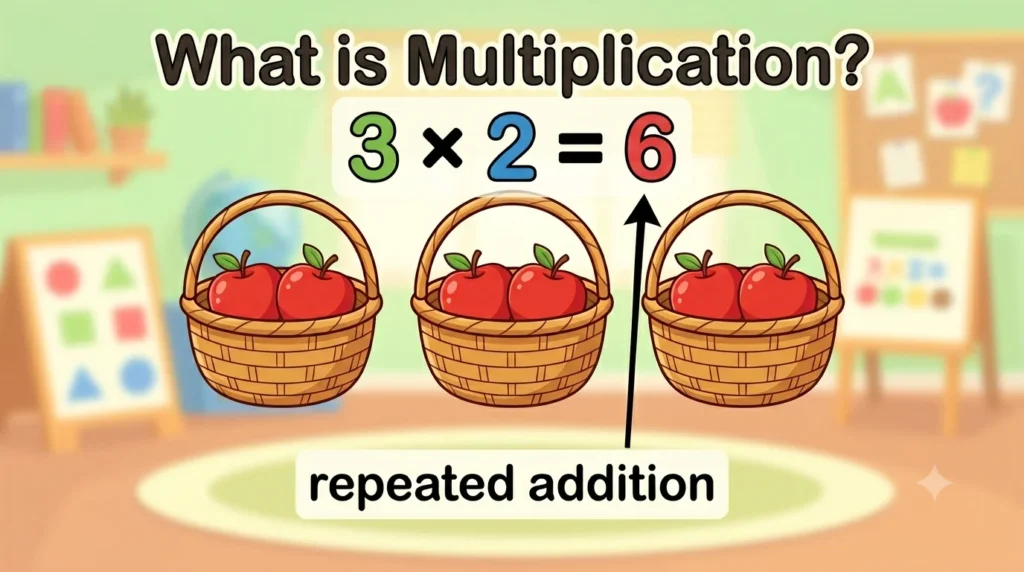
For example:
If you have 2 apples in one basket and there are 3 baskets, how many apples do you have in total?
You can add:
2 + 2 + 2 = 6
Or you can multiply:
3 × 2 = 6
Both give the same answer.
This is why multiplication for beginners should always start with repeated addition. The multiplication symbol (×) means “groups of.” So 3 × 2 means “3 groups of 2.”
Understanding what multiplication is and how it relates to equal groups helps first graders build a lasting number sense before they ever memorize a single table.
Multiplication as Repeated Addition
The easiest way to teach multiplication is to show that it is repeated addition.
Here is a simple table:
| Repeated Addition | Multiplication Form |
|---|---|
| 2 + 2 + 2 = 6 | 3 × 2 = 6 |
| 4 + 4 = 8 | 2 × 4 = 8 |
| 5 + 5 + 5 = 15 | 3 × 5 = 15 |
| 3 + 3 + 3 + 3 = 12 | 4 × 3 = 12 |
When you explain multiplication as repeated addition, children understand that:
- The first number tells how many groups.
- The second number tells how many items are in each group.
This step-by-step multiplication approach builds clarity before memorizing tables.
When explaining repeated addition, you can strengthen this concept by first revising addition and subtraction for Class 1 to build a strong foundation.
How to Introduce Multiplication to Grade 1 Students
Introducing multiplication to grade 1 students can feel tricky, but it does not have to be.
The key is to start with what children already know, counting and addition, and build from there.
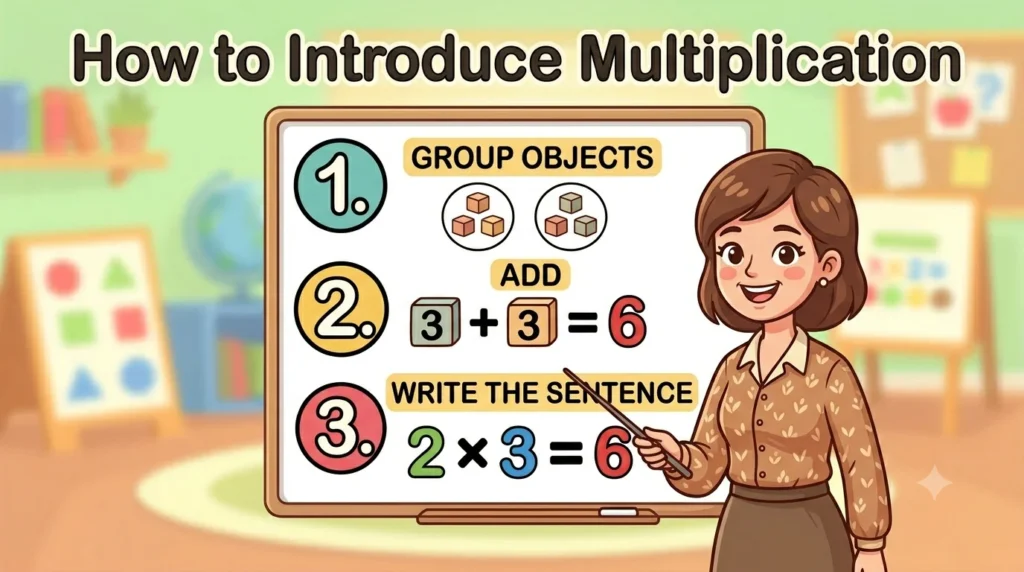
Step 1: Start With Equal Groups
Before writing any multiplication sentence, ask the child to make equal groups using real objects. Use coins, blocks, or even fruit.
Example: Put 3 coins in each cup. Use 2 cups. How many coins are there?
This teaches the concept of multiplication as equal groups — a core idea in grade 1 math.
Step 2: Connect Groups to Addition
Once the child can see and touch the groups, ask them to add the groups together. This bridges repeated addition to multiplication naturally.
Example: 3 + 3 = 6. So 2 groups of 3 = 6. We write: 2 × 3 = 6.
Step 3: Write the Multiplication Sentence
Now help them write the full multiplication sentence. Read it aloud: “Two times three equals six.”
This three-step approach is the most effective way to introduce multiplication readiness for class 1. It ensures the child understands the concept, not just the answer.
Simple Examples for Class 1
Let’s look at some multiplication examples for kids.
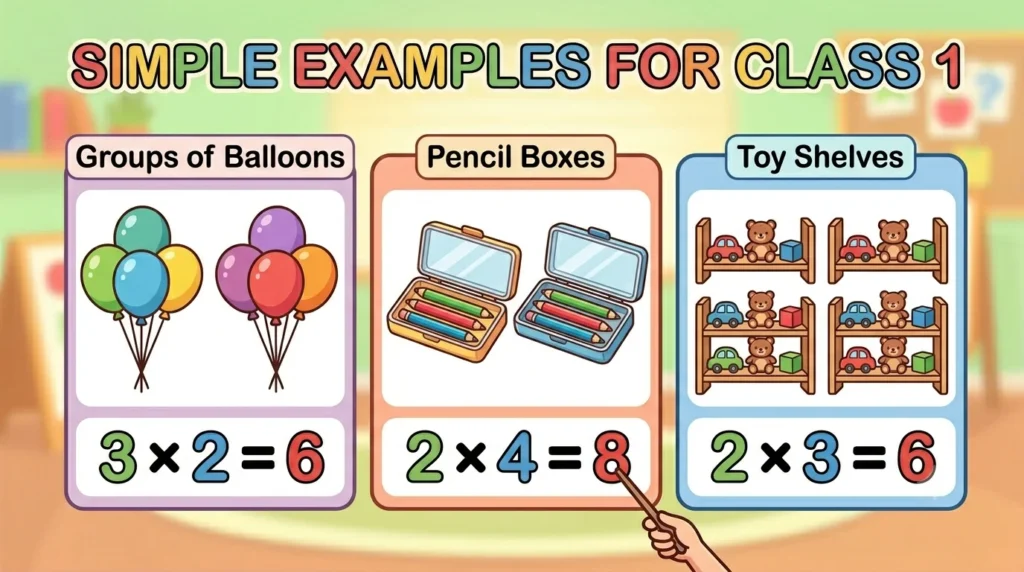
Example 1: Balloons
There are 2 balloons in each bunch. There are 3 bunches.
2 + 2 + 2 = 6 3 × 2 = 6
Example 2: Pencils
Each box has 4 pencils. There are 2 boxes.
4 + 4 = 8 2 × 4 = 8
Example 3: Toys
Each shelf has 3 toys. There are 4 shelves.
3 + 3 + 3 + 3 = 12 4 × 3 = 12
These real-life examples make multiplication easy to understand. They show multiplication as groups of equal objects exactly the way a Grade 1 student thinks.
Multiplication Using Pictures
Children learn best when they see groups clearly.
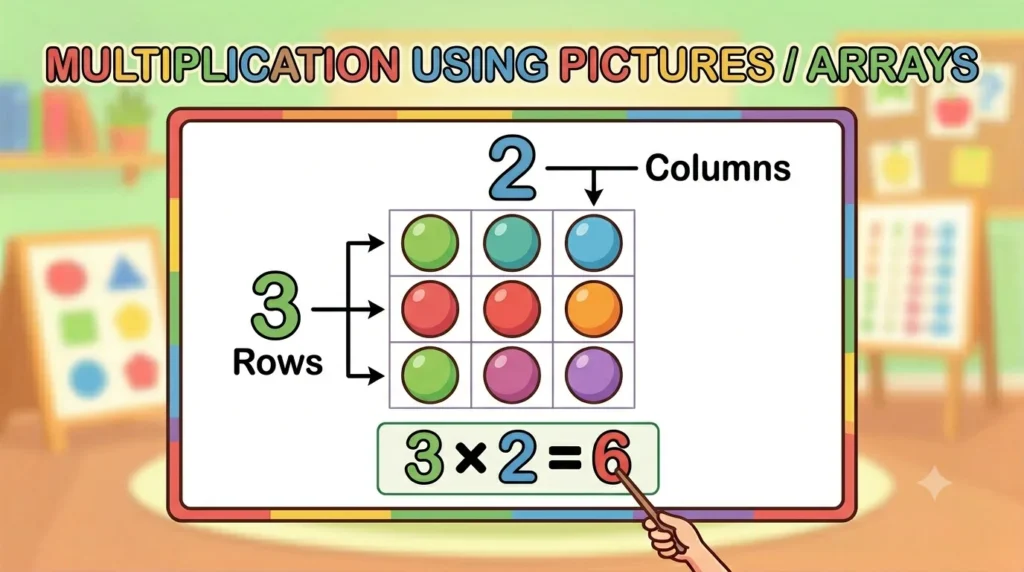
You can draw:
● ● ● ● ● ●
There are 3 rows. Each row has 2 dots.
So we write:
3 × 2 = 6
Multiplication using pictures helps children count groups instead of guessing. Visual arrays, rows and columns of dots or objects, are one of the most powerful tools for building multiplication readiness.
Multiplication using pictures becomes even clearer when children also practice using a number line for Class 1 to visualize counting in jumps.
Step-by-Step Explanation
Here is an easy way to teach multiplication at home or in class:
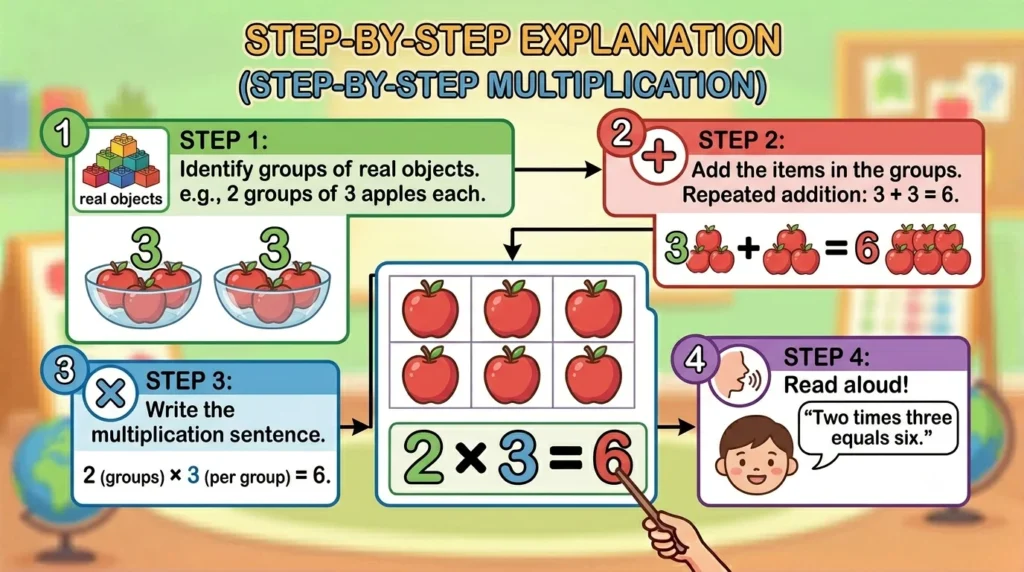
Step 1: Show equal groups using real objects (buttons, crayons, fruits).
Step 2: Add the numbers together.
Step 3: Write the multiplication sentence.
Step 4: Read it aloud.
Example:
3 plates 2 cookies on each plate
Add: 2 + 2 + 2 = 6 Multiply: 3 × 2 = 6
This step-by-step multiplication process builds a strong understanding. It turns an abstract concept into a concrete, hands-on experience exactly what class 1 students need.
Small Multiplication Table (2s and 3s Only)
Table of 2
| Multiplication | Answer |
|---|---|
| 1 × 2 | 2 |
| 2 × 2 | 4 |
| 3 × 2 | 6 |
| 4 × 2 | 8 |
| 5 × 2 | 10 |
Table of 3
| Multiplication | Answer |
|---|---|
| 1 × 3 | 3 |
| 2 × 3 | 6 |
| 3 × 3 | 9 |
| 4 × 3 | 12 |
| 5 × 3 | 15 |
Do not rush children to memorize. First make sure they understand why these numbers grow.
A strong understanding of patterns improves multiplication skills, which is why developing number sense in Class 1 is very important.
Multiplication Sums for Class 1 (Practice Questions)
Try these multiplication sums and practice exercises for class 1.
Repeated Addition to Multiplication:
- 2 + 2 + 2 = ?
- 3 + 3 = ?
- 4 + 4 = ?
Write the Multiplication Sentence: 4. 3 × 2 = ? 5. 2 × 4 = ? 6. 4 × 3 = ?
Mixed Practice: 7. Write multiplication for: 5 + 5 8. Write repeated addition for: 3 × 2 9. Draw equal groups to show: 2 × 3 10. What is 4 × 2? First add, then multiply.
Encourage your child to draw groups if they feel unsure. For extra worksheets and structured practice, you may find it helpful to explore skip counting for Class 1 which reinforces multiplication patterns.
Word Problems
Word problems help children apply multiplication in daily life.
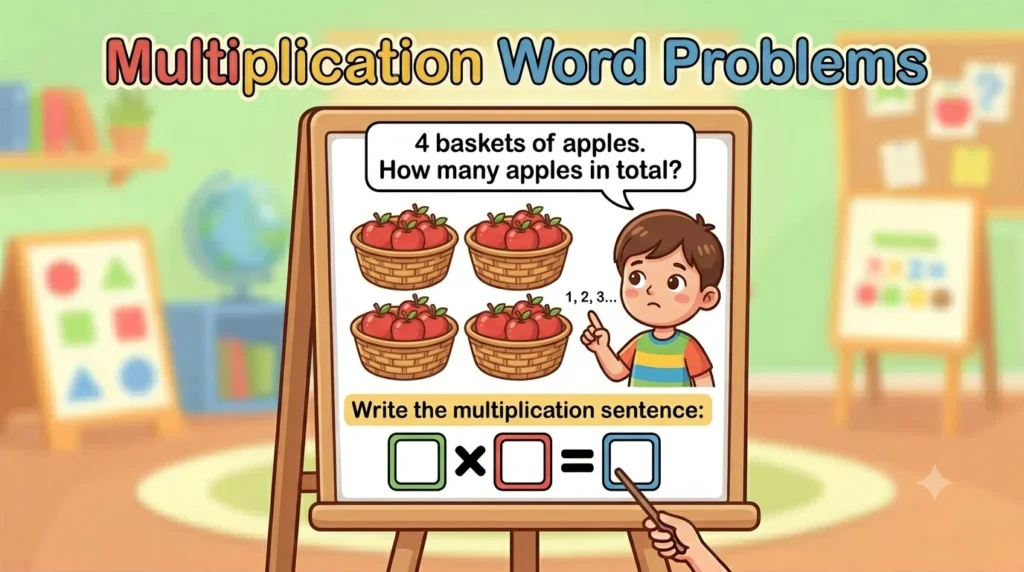
- There are 2 apples in each basket. There are 4 baskets. How many apples are there?
- Each table has 3 chairs. There are 3 tables. How many chairs are there?
- There are 5 ducks in each pond. There are 2 ponds. How many ducks are there?
- A box has 4 crayons. There are 3 boxes. How many crayons in total?
- There are 2 wheels on each bicycle. There are 5 bicycles. How many wheels are there?
Ask your child to first write repeated addition, then the multiplication sentence. This two-step approach reinforces the meaning of multiplication word problems for class 1.
How to Explain Multiplication to a Child at Home
Parents often ask: how do I explain multiplication to my child? Here is a simple method that works at home, without worksheets.
Use what’s in the kitchen. Line up 3 plates with 2 grapes on each. Ask: “How many grapes total?” Let the child count, then add, then write 3 × 2 = 6.
Use body movements. Clap 2 times, 3 rounds. Count the total claps. That is 3 × 2.
Use drawing. Ask the child to draw stars in rows. 3 rows of 2 stars = 6 stars.
The best approach for explaining multiplication to a child is always concrete before abstract. Objects first, numbers second.
Understanding the concept of multiplication also becomes easier when children understand data handling for Class 1 and grouping objects into sets.
Fun Multiplication Activities
Learning should feel playful.
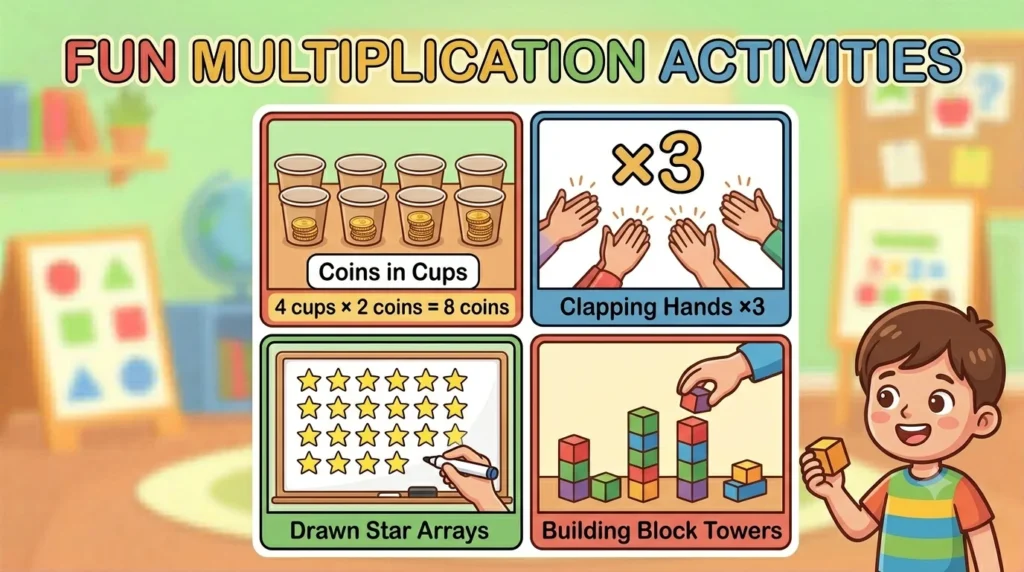
Here are simple multiplication activities for kids:
- Use coins to make equal groups.
- Clap in groups (2 claps, 3 times).
- Draw stars in rows.
- Use building blocks to make towers.
- Play “store” — put 3 items in each bag, use 2 bags. How many items?
- Roll a die, make that many groups of 2 — count the total.
To make multiplication clearer, children should also understand positions and jumps on a line. Learn how to explain number positions on a number line in Class 1 step by step.
You can also practice visually by following these steps to draw a number line for Class 1 Maths to make learning interactive and fun.
Multiplication Readiness for Class 1: What to Check
Before a child starts memorizing any tables, check that these fundamentals are in place:
- Can they count objects in a group reliably?
- Can they recognize equal groups?
- Can they do simple repeated addition (2 + 2 + 2)?
- Can they understand “how many groups” and “how many in each group”?
If the answer is yes to all four, the child is ready for formal multiplication introduction. If not, spend more time on number sense for Class 1 first.
Multiplication readiness for class 1 is not about speed it is about understanding.
Common Mistakes Children Make
- Mixing up the order of numbers.
- Forgetting that groups must be equal.
- Counting one group twice.
- Memorizing tables without understanding.
- Confusing “how many groups” with “how many in each group.”
The easy way to teach multiplication is always to go back to equal groups.
1. What is multiplication for class 1?
Multiplication for class 1 means adding the same number again and again. It helps children count equal groups quickly.
2. How do I explain multiplication to my child?
Start with real objects. Make equal groups. Add them first. Then write the multiplication sentence.
3. Should Class 1 students memorize tables?
Understanding should come first. Memorization can come slowly after children understand repeated addition.
4. What is the easiest multiplication to start with?
Start with the table of 2. It helps children see patterns clearly.
5. Why is multiplication important?
It builds number sense and prepares children for bigger math concepts in higher grades.
6. Do first graders learn multiplication?
Yes. In class 1, children learn multiplication as repeated addition and through equal groups. Full table memorization typically comes in class 2 and above.
7. What is a multiplication sentence?
A multiplication sentence is a complete math statement like 3 × 2 = 6. It tells the number of groups, the size of each group, and the total.
8. How many times is the same as multiplication?
Yes. “How many times” is another way to say multiplication. “3 times 2” means 3 groups of 2, which is 3 × 2 = 6.
Make Preparing for Math Olympiad Simple!



Final Thoughts
Multiplication for beginners should always begin with understanding groups. When children see multiplication as repeated addition, they feel confident and less afraid of math.
Give them time. Use objects. Make it fun. Stay patient. When your child is ready to practice more, structured exercises make a big difference.
You can also explore measurement for Class 1 and spatial understanding for Class 1 to build a complete math foundation alongside multiplication.

Mikha Piregu is a Content Writer with experience spanning educational content, including math and math olympiad topics, as well as advocacy writing, research-based articles, and SEO-driven web content. He creates high-quality blog content, web copy, and feature articles that support brand visibility, audience engagement, and long-term organic growth through data-informed storytelling. Skilled in WordPress, WooCommerce, and modern digital tools, Mikha adapts content across various platforms, including blogs, websites, campaigns, and advocacy initiatives, with clarity and purpose.


There are no comments posted here yet.
Sign in to leave a comment