


Class 1 (Grade 1) addition and subtraction focus on building basic number sense, visual counting, and simple calculations mostly within 20.
Addition and subtraction for Class 1 cover sums within 20, two-digit addition and subtraction without regrouping, missing number equations, number line jumps, and one-step word problems.
- Download the Free Class 1 Addition and Subtraction Worksheet PDF
- What Class 1 Addition and Subtraction Covers
- Practice Levels: Sums to 10, Sums to 20, and Two-Digit
- How to Do Two-Digit Addition and Subtraction Step by Step
- How to Tell an Addition Word Problem from a Subtraction One
- Practice Tips for the Class 1 Math Olympiad
- Common Mistakes Class 1 Students Make and How to Fix Them
- Sample Addition and Subtraction Olympiad Questions with Answers
- Worksheet PDF vs Practice App: Which to Use When
- More Class 1 Practice Resources
- Frequently Asked Questions
- Key Takeaways
You can download the full practice worksheet PDF with an answer key below, then use the worked examples and sample Olympiad questions on this page to fix the mistakes it reveals.
Whether your child is a first-time Olympiad participant or you are looking to strengthen basic arithmetic, this guide gives you the practice sheets and the teaching method together.
Download the Free Class 1 Addition and Subtraction Worksheet PDF
The free printable worksheet is 5 pages with 53 questions and a separate answer key, arranged in ten sections that go from sums within 10 up to two-digit column work. Print the answer key separately and keep it aside, since page 5 is written for the parent, not the child.
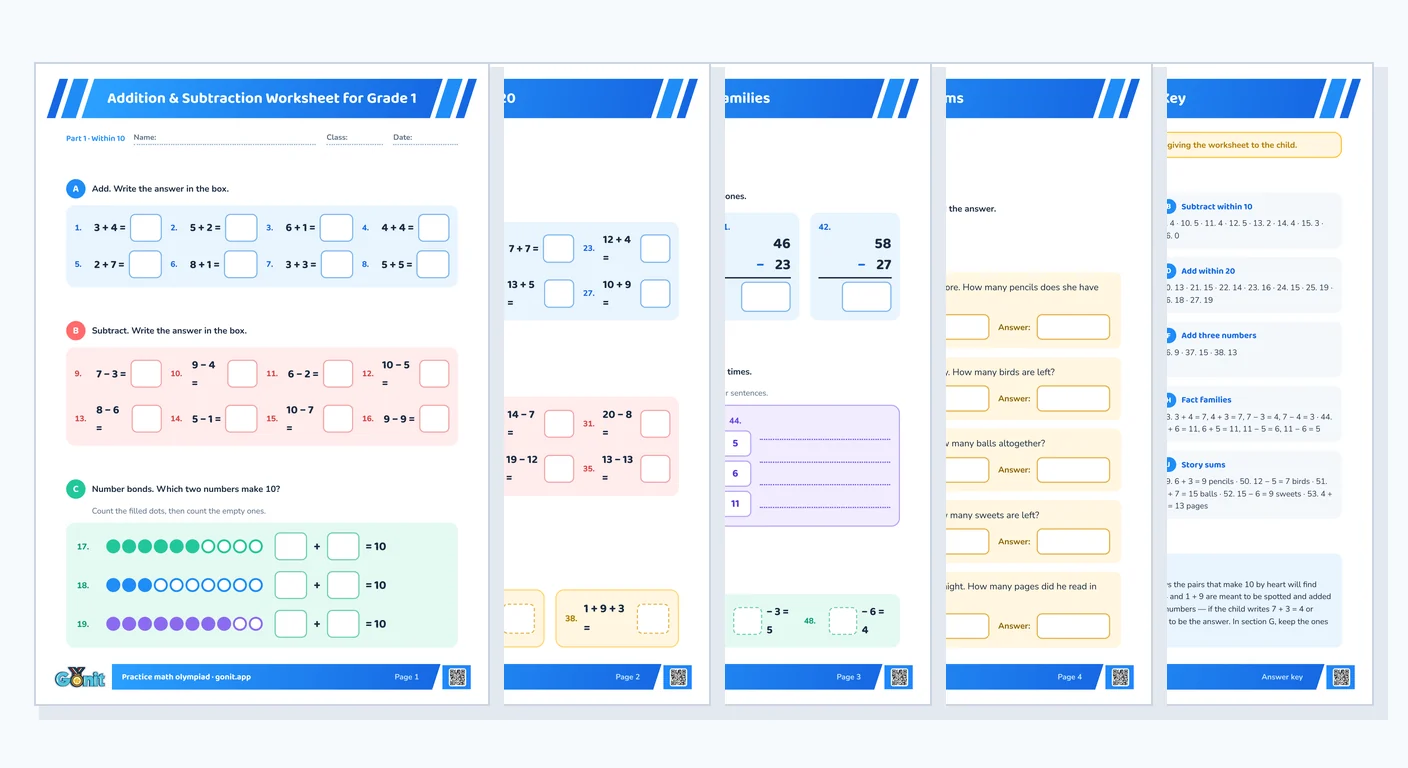
Here is what each part covers and when to use it.
| Part | Sections | What it covers | Best for |
|---|---|---|---|
| Part 1, Within 10 | A, B, C | Add and subtract within 10, number bonds to 10 with dot pictures | A child still counting on fingers |
| Part 2, Within 20 | D, E, F | Add and subtract within 20, adding three numbers | Building speed on number facts |
| Part 3, Columns and Families | G, H, I | Two-digit column sums, fact families, missing numbers | Column discipline and Olympiad-style blanks |
| Part 4, Story Sums | J | Five one-step word problems with a number sentence box | Reading and choosing the operation |
| Page 5 | Answer key | All 53 answers plus a note for parents | Marking at home |
Print one part at a time. Finishing a single page builds more confidence than half-finishing a thick booklet.
Two sections are worth extra time. Section C, number bonds to 10, is the one that makes every other page easier, because a child who knows the pairs that make 10 by heart can regroup any sum.
Section H, fact families, teaches that 3, 4, and 7 produce four number sentences: 3 + 4 = 7, 4 + 3 = 7, 7 − 3 = 4, and 7 − 4 = 3. That is the inverse relationship between addition and subtraction, and it is the fastest way to double a child’s recall without doubling the drilling.
What Class 1 Addition and Subtraction Covers
Addition is combining two groups to find how many there are in total. Subtraction is taking one amount away from another to find how many are left. In Class 1 both operations stay within 0 to 99, and subtraction never requires borrowing.
Three words tell your child which operation they are doing:
- Sum: the answer to an addition problem. In 4 + 3 = 7, the sum is 7.
- Difference: the answer to a subtraction problem. In 8 − 5 = 3, the difference is 3.
- Addend: each number being added. In 4 + 3, both 4 and 3 are addends.
Most Class 1 Olympiad syllabi test the same question types:
- Single-digit addition and subtraction: 4 + 3, 8 − 5
- Number bonds to 10: which two numbers pair up to make 10
- Two-digit addition and subtraction without regrouping: 23 + 15, 47 − 26
- Missing numbers in equations: 6 + __ = 10
- Fact families: the four number sentences one set of three numbers makes
- One-step word problems: short story sums with a single operation
- Number line questions: moving forward or backward from a start point
- Vertical column sums: numbers stacked in tens and ones
- The role of zero: 5 − 0 and 5 + 0
For the full chapter list across shapes, patterns, and measurement, see the IMO syllabus for Class 1.
Practice Levels: Sums to 10, Sums to 20, and Two-Digit
Jumping straight to two-digit sums is the most common reason Class 1 practice stalls. Work through these three levels in order, and only move up when your child answers a full sheet without counting on fingers.
Level 1: Addition and subtraction within 10
Numbers small enough to model with objects. The goal here is understanding, not speed. Examples: 3 + 4, 9 − 2, 6 + __ = 10. Finish this level by learning the number bonds to 10 by heart, because every shortcut later depends on them.
Level 2: Addition and subtraction within 20
This is where number facts need to become automatic. Examples: 8 + 7, 15 − 6, 12 − __ = 7. Olympiad papers lean heavily on this band because it tests recall under time pressure. Add three-number sums here too, such as 6 + 4 + 5, where spotting the pair that makes 10 turns a hard sum into an easy one.
Level 3: Two-digit sums without regrouping
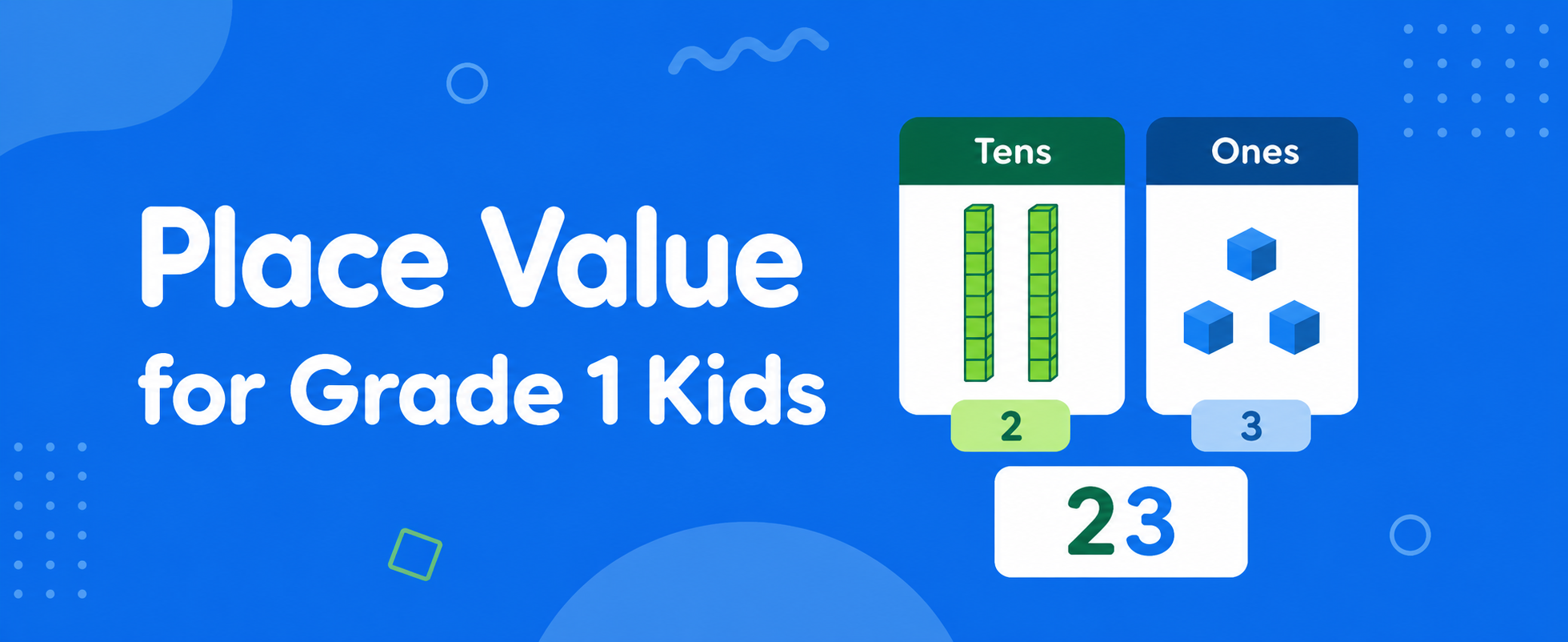
Now the skill is column discipline rather than arithmetic. Examples: 34 + 25, 47 − 23, 60 + 19. Strong place value for Grade 1 understanding matters more than speed at this level.
How to Do Two-Digit Addition and Subtraction Step by Step
Two-digit sums trip up more Class 1 students than single-digit ones, almost always because of column alignment. Here is the method to teach, worked through 34 + 25 and 47 − 23.
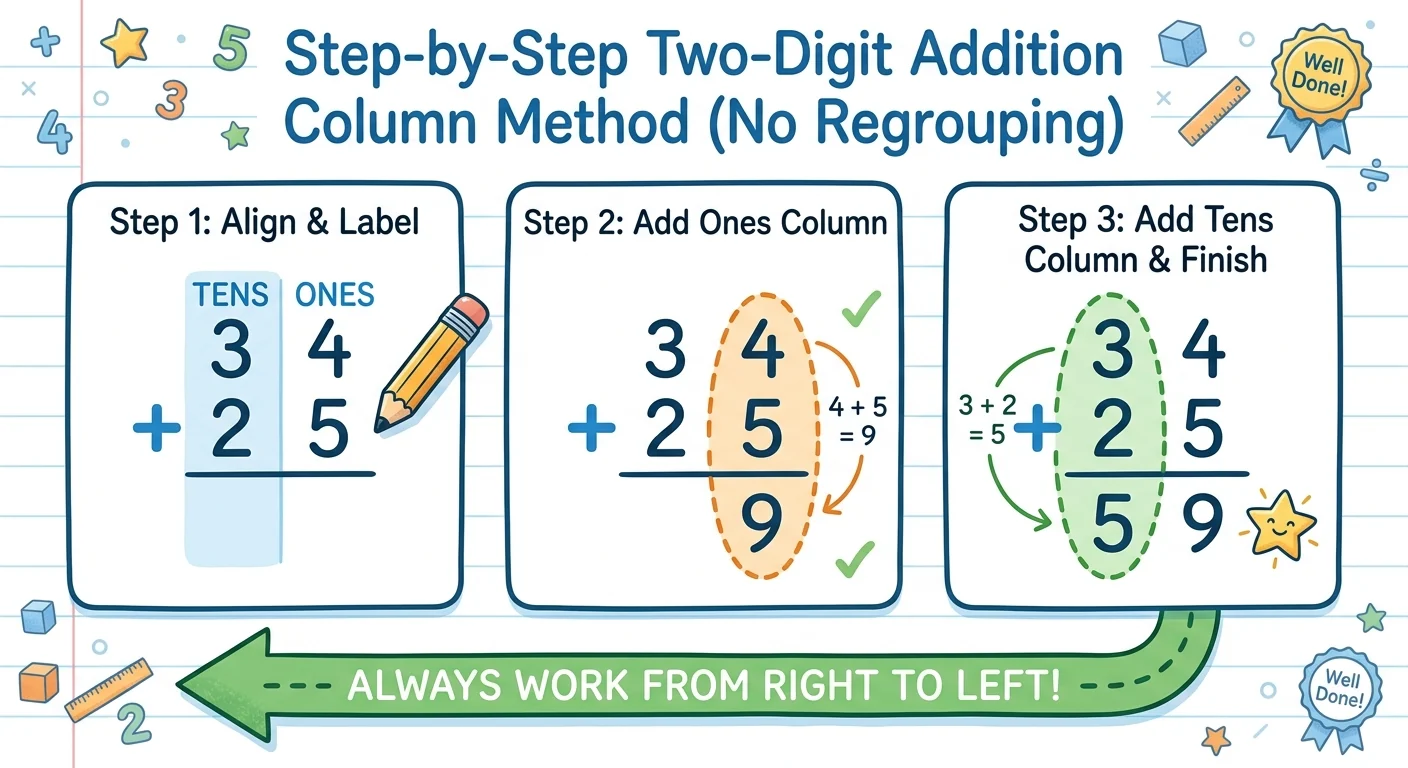
Step 1: Write the numbers in columns
Stack the two numbers so the ones digits sit above each other and the tens digits sit above each other.
  3 4
+ 2 5
-----
Step 2: Add or subtract the ones column first
Always start from the right. For 34 + 25, add 4 + 5 = 9. Write 9 under the ones column.
Step 3: Move to the tens column
Add 3 + 2 = 5. Write 5 under the tens column. The answer is 59.
  3 4
+ 2 5
-----
  5 9
Step 4: Use the same order for subtraction
For 47 − 23, subtract the ones first: 7 − 3 = 4. Then the tens: 4 − 2 = 2. The difference is 24.
Step 5: Check by reversing the operation
Addition and subtraction undo each other. If 34 + 25 = 59, then 59 − 25 should give back 34. This is called the inverse relationship, and teaching it early builds the habit of verifying answers, which matters in a timed Olympiad paper.
How to Tell an Addition Word Problem from a Subtraction One
Most word problem errors are reading errors, not math errors. Teach your child to read the question twice, underline the numbers, then look for the signal words that name the operation.
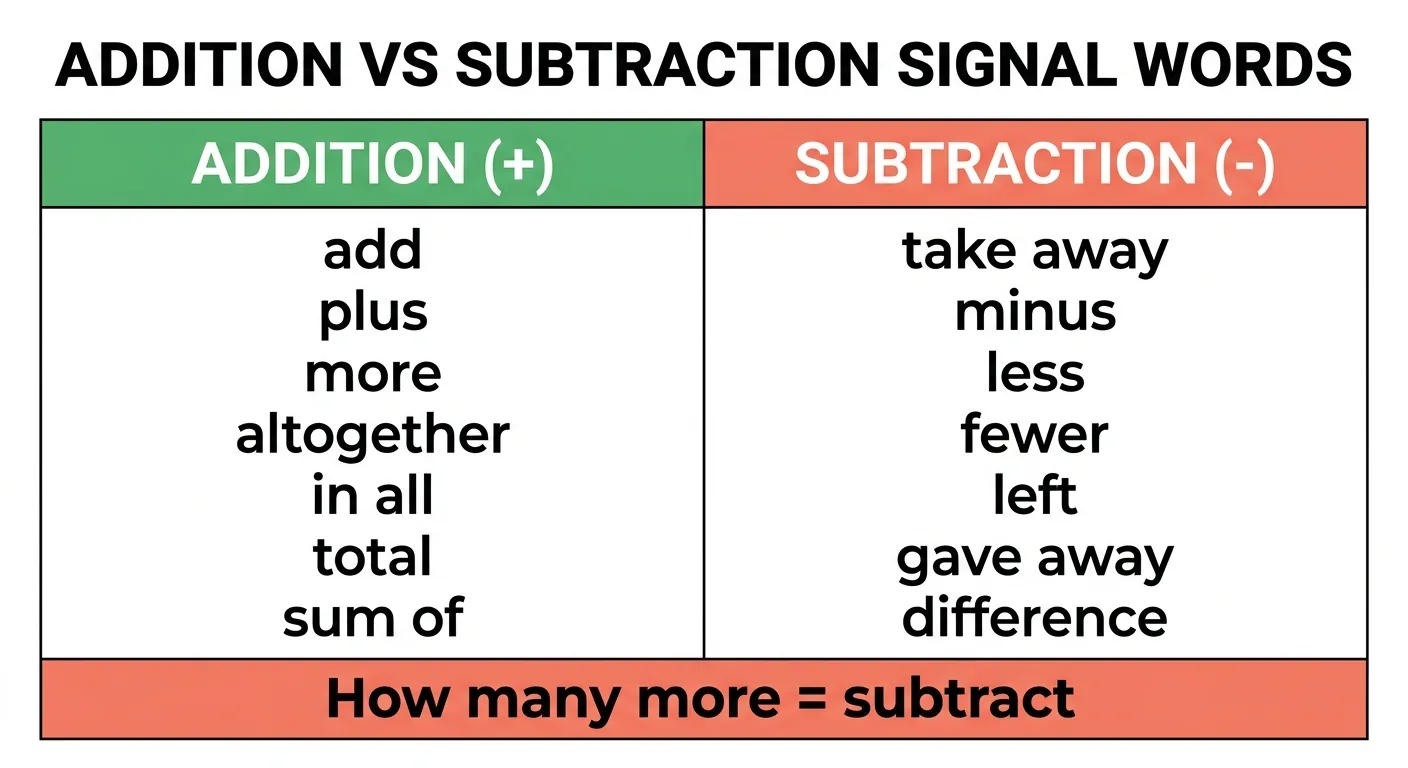
Words that signal addition: add, plus, more, altogether, in all, in total, the total of, what is the sum of.
Words that signal subtraction: take away, minus, less, fewer, left, gave away, how many more, what is the difference.
One phrase causes more wrong answers than all the others combined. How many more is a subtraction question, not an addition one. A child sees the word more and adds the two numbers instead of finding the difference.
Example: Ravi has 9 marbles. Mina has 4. How many more marbles does Ravi have? The answer is 9 − 4 = 5, not 13.
Work through more practice of this type in our guides on story sums for Class 1 and how to teach word problems to Grade 1.
Practice Tips for the Class 1 Math Olympiad
These six habits turn worksheet practice into exam-ready fluency. Pick two or three rather than trying all of them in one week.
1. Use real-life objects for practice
Use everyday items like pencils, buttons, or toys. This helps kids visualize numbers and understand quantity before they work with symbols.
Example: You have 3 apples. You get 2 more. How many apples now? The child counts and answers 5.
2. Incorporate number lines
Teach your child to move forward for addition and backward for subtraction. Olympiad papers include number line questions in almost every set.
Example: Start at 6, move 3 steps forward. Where do you land? The answer is 9.
If jumps and positions are still shaky, work through the number line for Class 1 guide first.
3. Practice mental math with two shortcuts
Olympiad questions test speed as much as accuracy. Make ten regroups a sum around a friendly number, so 8 + 5 becomes 8 + 2 + 3 = 13. Doubles means memorizing 1+1 through 10+10, which then unlocks near-doubles like 6 + 7 as 6 + 6 + 1.
4. Solve word problems out loud together
Read the question slowly, underline the numbers, and have your child say which operation they are using and why. Speaking the reasoning aloud catches the how many more trap before it becomes a habit.
5. Keep practice short and daily
Four to five problems a day beats a long weekend session. Arithmetic fluency comes from spaced repetition, and a tired six-year-old learns nothing after the first ten minutes.
6. Mix the format
Alternate the printed worksheet with flashcards, dice games, or an app. Changing the format keeps attention up without changing the skill being practiced.
Common Mistakes Class 1 Students Make and How to Fix Them
These seven errors account for most lost marks in a Class 1 paper. Each one has a specific fix, so correct the habit rather than just marking the answer wrong.
- Mixing up the plus and minus signs: Use flashcards and have them say that plus means put together and minus means take away each time.
- Misreading the question: Teach them to underline the numbers and circle the signal word.
- Starting column sums from the left: Children read left to right, so they add the tens first. Remind them that columns are always worked from the ones side.
- Counting the starting number on a number line: Moving 3 steps from 6, a child sometimes counts 6 as the first step and lands on 8. Have them put a finger on 6 and count only the jumps.
- Losing track of zero: Many students answer 5 − 0 as 0. Show with objects that taking nothing away leaves the pile unchanged.
- Misaligned two-digit sums: Use squared paper so each digit gets its own box.
- Treating how many more as addition: Covered above, and worth re-testing every few weeks because it comes back.
10 Sample Addition and Subtraction Olympiad Questions with Answers
These mirror the style used in an international mathematics olympiad Class 1 sample paper. Let your child attempt all ten before checking any answers.
Q1: What is 6 + 7?
A) 11 B) 13 C) 12 D) 14
✅ Correct Answer: B) 13
Q2: Fill in the blank: ___ + 4 = 9
A) 5 B) 6 C) 4 D) 3
✅ Correct Answer: A) 5
Q3: Rita has 10 stickers. She gives 3 to her friend. How many does she have now?
A) 7 B) 6 C) 8 D) 5
✅ Correct Answer: A) 7
Q4: What is 15 − 8?
A) 6 B) 7 C) 8 D) 9
✅ Correct Answer: B) 7
Q5: Use the number line. Start at 5 and move 4 steps forward. Where do you land?
A) 8 B) 10 C) 9 D) 7
✅ Correct Answer: C) 9
Q6: What is 34 + 25?
A) 49 B) 59 C) 69 D) 58
✅ Correct Answer: B) 59
Q7: What is 47 − 23?
A) 24 B) 34 C) 26 D) 14
✅ Correct Answer: A) 24
Q8: Which number makes this true? 12 − ___ = 7
A) 4 B) 6 C) 5 D) 3
✅ Correct Answer: C) 5
Q9: Ravi has 8 marbles. His brother gives him 6 more. How many marbles does Ravi have altogether?
A) 12 B) 13 C) 14 D) 15
✅ Correct Answer: C) 14
Q10: Sara has 11 crayons. Tom has 4. How many more crayons does Sara have?
A) 15 B) 7 C) 8 D) 6
✅ Correct Answer: B) 7
For a longer set across all chapters, try our SOF IMO sample paper collection.
Worksheet PDF vs Practice App: Which to Use When
Most parents end up using both, and they solve different problems. A printed worksheet builds handwriting and column discipline. An app gives instant feedback and holds attention longer. Here is how they compare on what matters at this age.
| What you need | Class 1 worksheet PDF | Math Olympiad practice app |
|---|---|---|
| Instant right or wrong feedback | No, a parent marks it | Yes, immediate |
| Builds neat column alignment | Yes, this is its main strength | Limited |
| Timed speed practice | Hard to manage at home | Built in |
| Holds a 6-year-old attention span | Drops off after 10 minutes | Streaks and rewards extend it |
| Progress tracking by topic | Manual | Automatic |
| Screen time | None | Needs a daily limit |
| Works offline or in exam conditions | Yes | Not the same conditions |
A practical split is the worksheet PDF for written two-digit sums and an app for daily mental math drills.
The Gonit App covers addition and subtraction for Class 1 with interactive quizzes, daily challenges, and concept-based practice built for young learners. It is free to download on Google Play.
More Class 1 Practice Resources
Once addition and subtraction are solid, these topics build directly on top of them.
- Olympiad workbooks: MTG International Mathematics Olympiad Workbooks and SOF Class 1 Maths Olympiad books. Check the current edition on the publisher page before buying, since they are revised each exam cycle.
- Next topics: skip counting for Class 1 and multiplication for Class 1, which is repeated addition in disguise.
- Number ordering: ascending and descending order for Class 1.
Make Preparing for Math Olympiad Simple!


Frequently Asked Questions
What is the addition and subtraction syllabus for Class 1?
Class 1 covers single-digit addition and subtraction, two-digit sums without regrouping, missing number equations, the role of zero, number line jumps, vertical column sums, and one-step word problems. Olympiad papers test the same topics but phrase them as timed multiple-choice questions.
Where can I download addition and subtraction worksheets for Class 1?
The worksheet PDF linked at the top of this page has 53 questions across five printable pages, covering sums within 10, number bonds, sums within 20, two-digit column sums, fact families, missing numbers, and story sums. The last page is a full answer key with a note for parents, so keep it aside before handing the sheets over.
How many sums should a Class 1 child practice daily?
Four to five problems a day is enough. Short daily practice beats a long weekend session, because arithmetic fluency comes from repetition spread over time. Mix two written column sums with two or three mental math questions.
At what age do children learn addition and subtraction?
Most children start formal addition and subtraction at age 5 or 6, in Class 1 or Grade 1. Informal counting-on and taking-away usually begins a year earlier with objects, fingers, and picture counting.
Is a Math Olympiad too hard for a Class 1 student?
No. Class 1 Olympiad papers stay inside the school syllabus and test the same addition and subtraction skills, just worded more carefully. The difficulty comes from reading the question properly, not from harder arithmetic.
How do I teach plus minus questions for Class 1 at home?
Start with objects your child can touch, move to a number line, then to written column sums. Say the operation out loud every time. Only move to two-digit sums once single-digit answers come without finger counting.
Key Takeaways
- Addition and subtraction for Class 1 stays within 0 to 99 and never needs regrouping, so accuracy and reading care matter more than difficulty.
- Work through sums to 10, then sums to 20, then two-digit columns. Skipping a level is why most practice stalls.
- Number bonds to 10 and fact families give the biggest return per minute of practice, because both unlock faster recall across every other question type.
- Always work column sums from the ones digit, then the tens, and check by reversing the operation.
- How many more is a subtraction question. It is the single most common wrong answer in Class 1 word problems.
- Four to five sums a day builds more fluency than one long weekly session.
- Pair the printable worksheet PDF with an app for timed mental math, since each covers what the other misses.
Class 1 Math Olympiads are not about perfect marks, they are about building curiosity and confidence. Keep the learning stress-free and praise every bit of progress. Addition and subtraction are stepping stones to every math concept that follows, so make sure your child enjoys getting there.
Keep practicing. Keep encouraging. And remember, every math champion starts with 1 + 1.

Contributor at Gonit Worksheets, writing about math learning that works for real kids.


There are no comments posted here yet.
Sign in to leave a comment