 December 9, 2025
 4 min. read

Number sense is the foundation of all early math learning.
It refers to a child’s intuitive understanding of numbers, how they work, how they relate to each other, and how we use them in real-life situations.
To understand why this skill is so important, you can also read Why Number Sense Is Important for Class 1 Students.
Educational researchers, including the Teachers (USA, 1989), identify five core characteristics of number sense:
- Number Meaning
- Number Relationships
- Number Magnitude
- Operations Involving Numbers
- Referents for Numbers and Quantities
Together, these characteristics help children build strong early numeracy skills and develop confidence with numbers. See here, why number sense is important
When children develop these five characteristics early, they begin to think with numbers, not just memorize them.
Characteristics of Number Sense Class 1
When Class 1 children develop strong number sense, they do far more than memorize numbers.
They begin to understand how numbers work, how they relate to each other, and how to use them confidently in daily life.
Below are the five essential characteristics of number sense, explained with simple examples and practical tips for parents and teachers.
1. Number Recognition
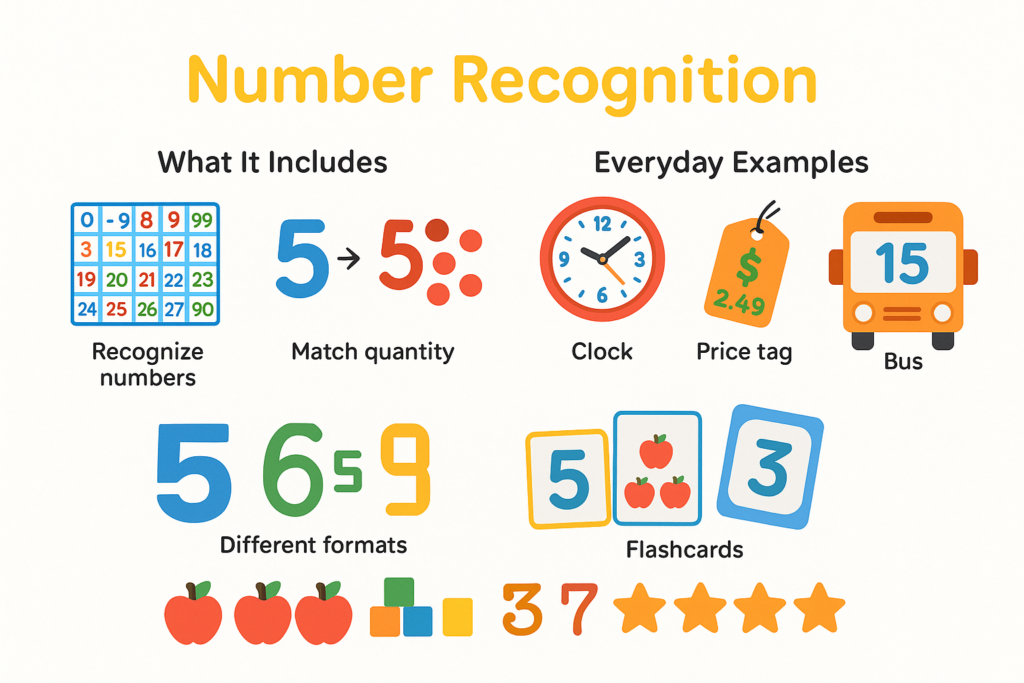
Number recognition is a child’s ability to identify numbers visually and connect them to actual quantities.
This is one of the first steps in developing strong early numeracy.
If your child is beginning to recognise numbers, using visual tools like a Number Line for Class 1 Students can make the process even easier.
What It Includes
- Recognizing numbers (0–99 for Class 1)
- Linking written symbols to real quantities (e.g., “5” = five objects)
- Identifying numbers in different formats—printed, handwritten, digital
Everyday Examples
- Spotting numbers on clocks, calendars, price tags, or buses
- Reading page numbers or room numbers aloud
- Matching number flashcards to sets of objects
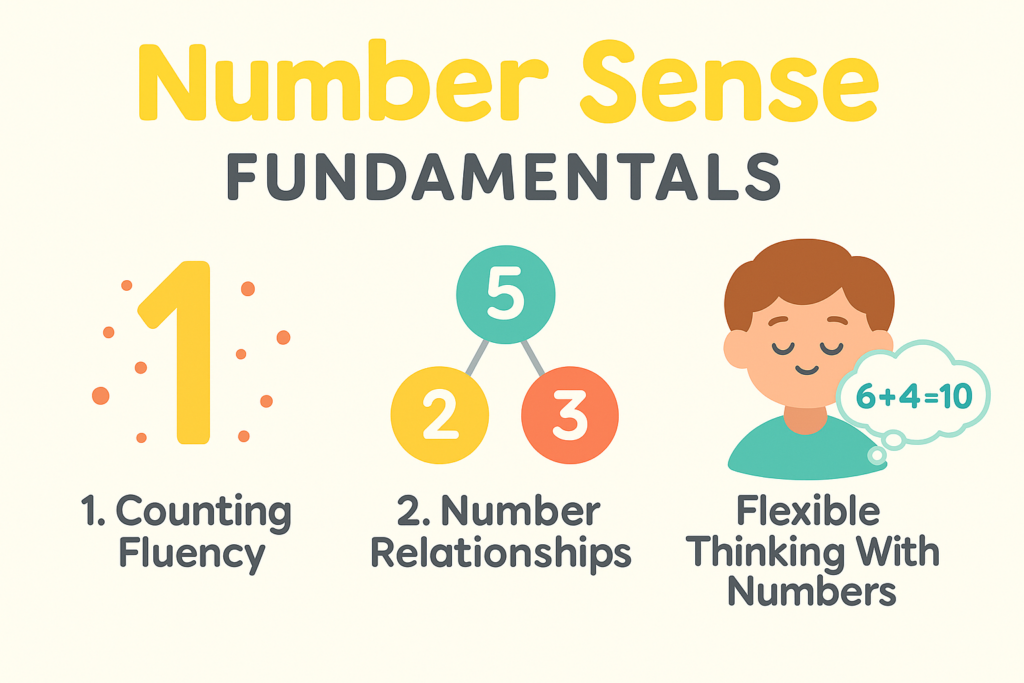
2. Counting Fluency
Counting fluency means counting accurately, confidently, and with understanding, not just reciting numbers like a rhyme.
Introducing activities like those in our guide, How to Teach Number Line Maths to Class 1 Students, can boost counting fluency with visual jumps and patterns.
Key Skills
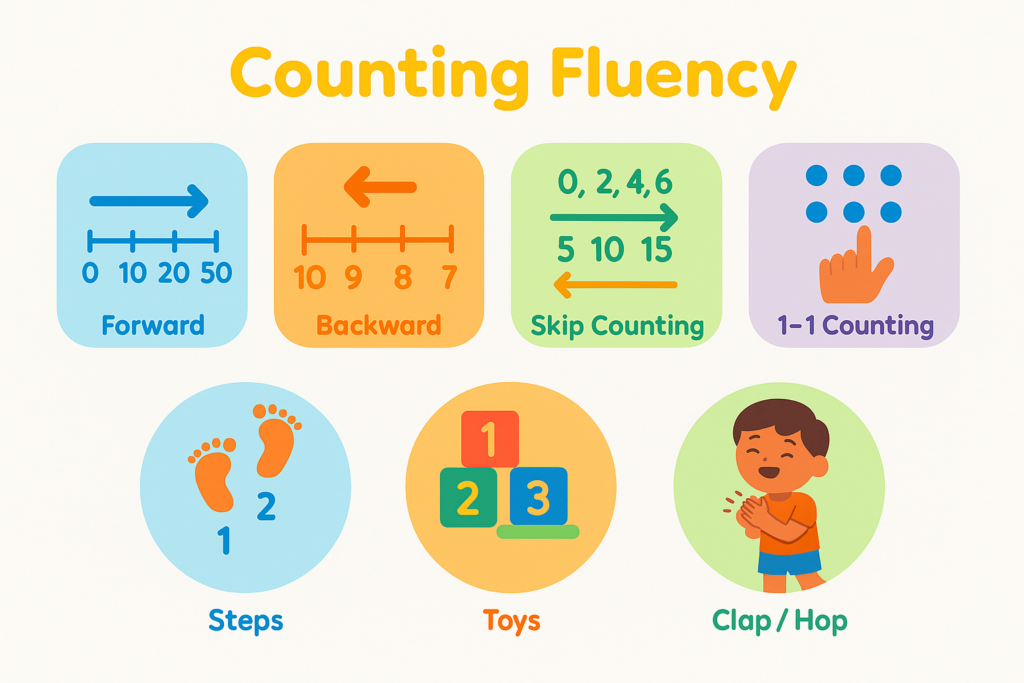
- Forward counting (0–50 or 0–100)
- Backward counting (helps with number order and subtraction)
- Skip counting by 2s, 5s, and 10s
- One-to-one correspondence—touching one object for each count
Everyday Examples
- Counting steps while walking
- Counting toys during cleanup time
- Clapping, tapping, or hopping while counting
3. Understanding Quantities
Understanding quantities teaches children that numbers represent “how much” or “how many.”
This builds a deep sense of what numbers truly mean.
Key Concepts
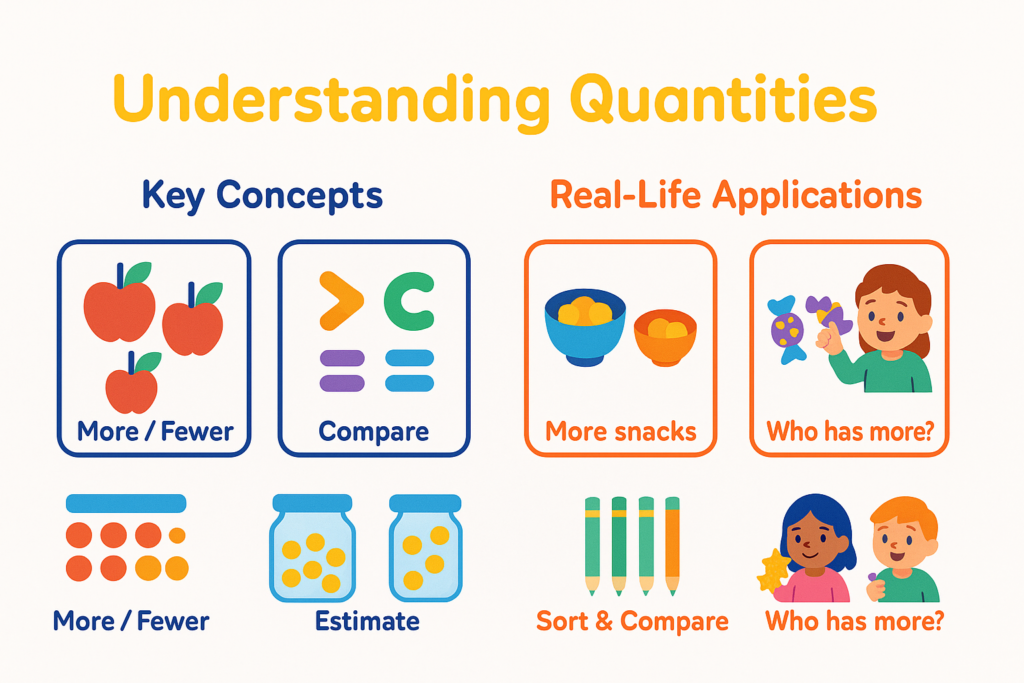
- Comparing groups (“Which has more or fewer?”)
- Understanding more, less, and equal
- Estimating before counting
Real-Life Applications
- Picking the bowl with “more snacks”
- Sorting objects and comparing the totals
- Checking who has more stickers, pencils, or candies
4. Number Relationships
Number relationships show children how numbers connect, support each other, and form patterns.
To support this skill visually, refer to our article How to Explain Number Positions on a Number Line for Class 1 Math, which covers before, after, and between numbers using clear visuals.
What It Includes
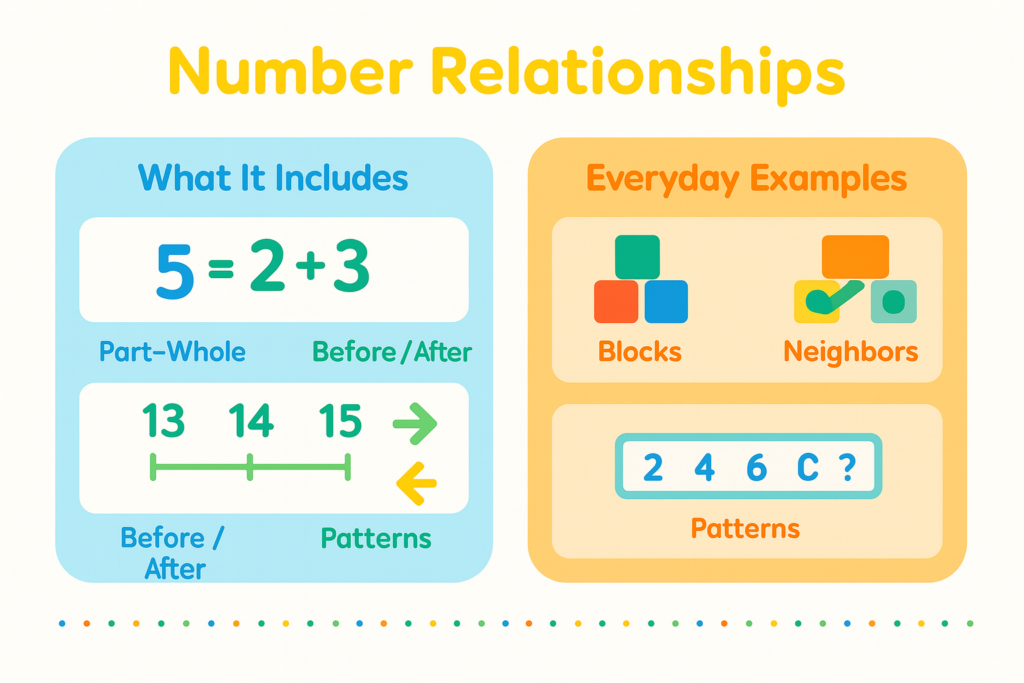
- Part–whole understanding:
Example: 5 can be split into 2 and 3. - Before/after numbers:
Example: What comes before 14? What comes after? - Patterns:
Spotting increasing or repeating number patterns.
Everyday Examples
- Using blocks to show how numbers break apart and combine
- Practicing number neighbors (9 before 10, 11 after)
- Completing patterns like 2, 4, 6, ___
5. Flexible Thinking With Numbers
Flexible thinking helps children move beyond memorizing answers and become true problem-solvers.
Visual strategies, such as drawing number lines see our guide’ Steps to Draw a Number Line’ for Class 1 Maths, help children understand concepts like counting on or making 10.
Skills Included
- Using strategies like “counting on,” “making 10,” or grouping
- Simple mental math (solving small problems without fingers)
- Thinking logically about why answers make sense
Everyday Examples
- Knowing 8 + 2 = 10 without counting every object
- Solving, “If you have 3 candies and get 1 more, how many now?”
- Finding quicker ways to count: “Let’s group these into 5s!”
Make Preparing for Math Olympiad Simple!



Conclusion
These five characteristics of number sense, number recognition, counting fluency, understanding quantities, number relationships, and flexible thinking form the foundation of early math development in Class 1.
When children learn these skills through real-life examples, visual tools, and playful practice, they build strong mathematical confidence that supports them throughout their entire education.
For more practical strategies, visit our blog post on How to Teach Number Line Maths to Class 1 Students.