


The SOF IMO awards structure includes cash prizes, medals, and certificates, which sounds straight forward on paper, but the fine print trips up even experienced Olympiad parents.
- What Are SOF IMO Awards?
- Complete SOF IMO Prize Structure 2026–27
- Cash Prizes vs. Medals vs. Certificates — What's the Difference?
- Level 1 vs. Level 2 Prizes — Key Differences
- Eligibility — Who Qualifies for Which Award?
- When and How Are Prizes Distributed?
- Are SOF IMO Awards Worth It? (Reality Check)
- Common Misconceptions About IMO Prizes
- SOF IMO Myths vs Facts
- How to Win These Prizes — Preparation Strategy
- IMO vs. Other SOF Olympiads — Prize Comparison
- Conclusion:
We tested the official SOF portal, cross-checked results announcements from the last three seasons, and mapped every award tier so you don’t have to piece it together yourself.
In this complete SOF IMO 2026–27 guide, you’ll find the full SOF IMO award structure
Exact prize amounts by rank, the difference between Level 1 and Level 2 awards, zonal rank eligibility, tie-breaking rules, and the realistic timeline for receiving your medal or certificate.
What Are SOF IMO Awards?
The Science Olympiad Foundation (SOF) runs the International Mathematics Olympiad every year for students in Classes 1 through 12.
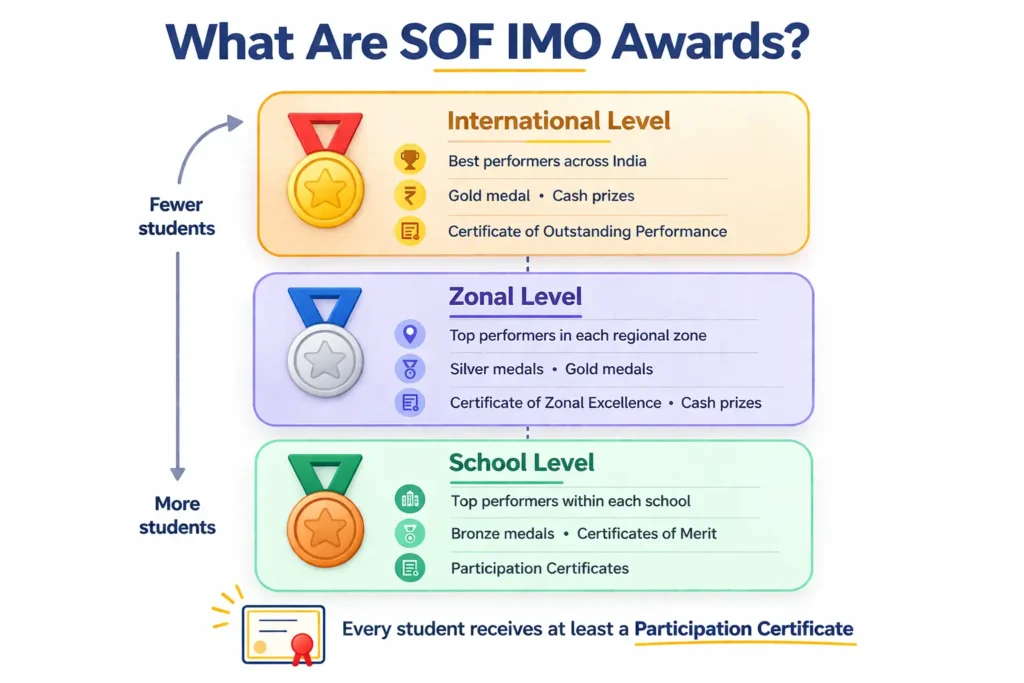
The award system is designed to recognise performance at three distinct levels:
- International Level — the very best performers across all of India (and registered international centres)
- Zonal Level — top performers in each of SOF’s regional zones
- School Level — top performers within each student’s own school
Awards come in three forms: cash prizes, medals (Gold, Silver, Bronze), and certificates (ranging from a basic Participation Certificate to a prestigious Certificate of Outstanding Performance).
There are also separate awards for schools and teachers.
Not everyone wins cash. Not everyone wins a medal. But every student who writes the exam goes home with at least a Participation Certificate which is the floor, not the ceiling.
Your score relative to the SOF IMO exam pattern and marking scheme determines which tier you land in and understanding that structure is the first step to aiming higher
Complete SOF IMO Prize Structure 2026–27
Let’s get into the numbers. Below is the complete, rank-wise award breakdown for the current season.
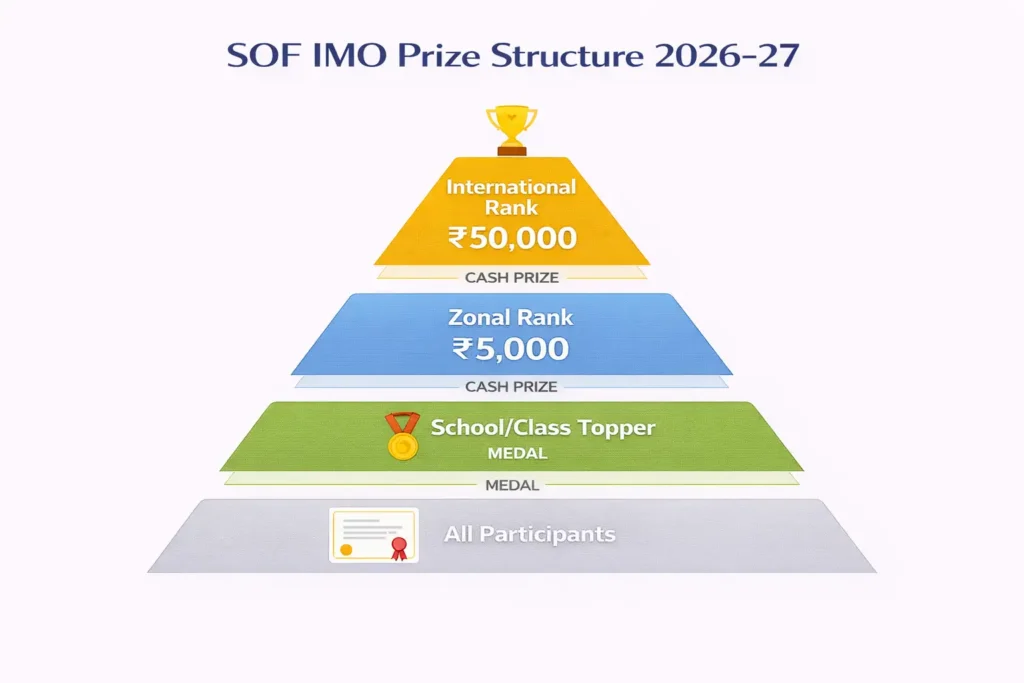
🥇 International Rank Awards
International ranks are awarded to the top students across all participating schools in India and abroad, within each class (Class 1–12 separately).
| International Rank | Cash Prize | Medal | Certificate |
|---|---|---|---|
| Rank 1 (per class) | ₹50,000 | Gold Medal 🥇 | Certificate of Outstanding Performance |
| Rank 2 (per class) | ₹25,000 | Gold Medal 🥇 | Certificate of Outstanding Performance |
| Rank 3 (per class) | ₹10,000 | Gold Medal 🥇 | Certificate of Outstanding Performance |
| Ranks 4–10 (per class) | Gift Voucher + Trophy | Gold Medal 🥇 | Certificate of Excellence |
| Ranks 11–25 (per class) | Gift Voucher | Silver Medal 🥈 | Certificate of Excellence |
💡 Important: International ranks are highly competitive. Only one student per class can hold Rank 1 internationally. Given that hundreds of thousands of students participate, the odds are genuinely slim but that’s exactly what makes it prestigious.
🏆 Zonal Rank Awards
SOF divides India into zones (broadly corresponding to regions/states). Zonal ranks are awarded separately for each class within each zone.
This means more students can win zonal medals than international ones.
| Zonal Rank | Cash Prize | Medal | Certificate |
|---|---|---|---|
| Zone Rank 1 (per class, per zone) | ₹5,000 | Gold Medal 🥇 | Certificate of Zonal Excellence |
| Zone Rank 2 | ₹2,500 | Silver Medal 🥈 | Certificate of Zonal Excellence |
| Zone Rank 3 | ₹1,000 | Bronze Medal 🥉 | Certificate of Zonal Excellence |
| Zone Ranks 4–10 | Gift Voucher | Medal of Distinction | Certificate of Zonal Excellence |
| Zone Ranks 11–25 | — | — | Certificate of Merit |
Note: The number of zones and exact zone boundaries are defined by SOF and may be adjusted year to year. Check the official SOF website (sofworld.org) for the zone list applicable to your state.
🏫 School-Level Awards
These awards are the most widely distributed and the most realistic target for most students.
Every student competes with classmates in their own school.
| Award | Who Gets It | Prize |
|---|---|---|
| Class Topper | Highest scorer in each class at the school (Rank 1) | Medal of Distinction + Certificate |
| Top 3 in Class | 2nd and 3rd highest scorers in each class at the school | Certificate of Merit |
| Merit Certificate | Students scoring above SOF’s cut-off percentile (~top 25%) | Certificate of Merit |
| Participation Certificate | All students who appeared for the exam | Participation Certificate |
✅ Every student who sits the IMO receives a Participation Certificate. Students who score well (typically top 25% in their school or above a national cut-off) earn a Merit Certificate instead.
🎓 Awards for Schools & Teachers
SOF also recognises institutions that foster excellence in Olympiad participation.
These are separate from student awards.
| Award | Criteria | Prize |
|---|---|---|
| Best School Award | Top-performing school (by student results) | Trophy + Certificate + Cash Award |
| School Excellence Award | High participation + strong results collectively | Certificate of Excellence |
| Best Teacher Award | Teacher whose students perform exceptionally | Trophy + Certificate + Cash Award |
| Best Principal Award | Principal of Best School | Trophy + Certificate |
These awards give schools and teachers a direct incentive to encourage Olympiad participation and they’re a genuine point of pride in school communities.
Cash Prizes vs. Medals vs. Certificates — What’s the Difference?
These three categories are often lumped together, but they’re very different in who qualifies for them.
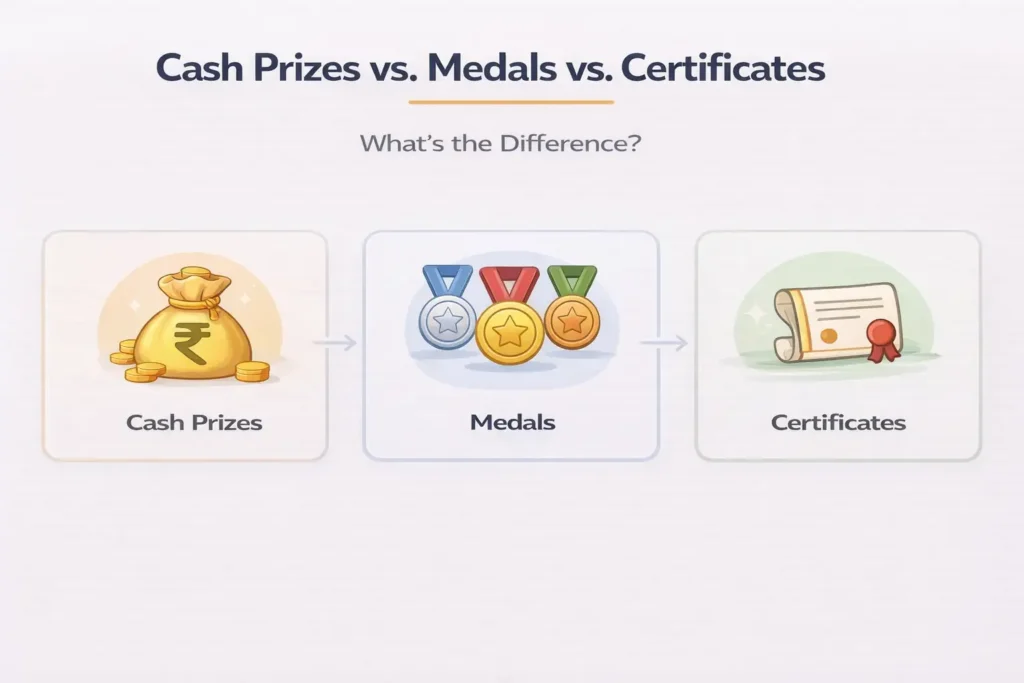
💰 Cash Prizes
Cash prizes are reserved exclusively for International Rank 1–3 and Zonal Rank 1–3 winners.
These students are among the top performers nationally and regionally within their class. The prize is transferred via cheque or demand draft to the student’s school and disbursed accordingly.
Reaching this level requires not just scoring high, it requires scoring higher than every other student of your class level in your zone or in the country.
🥇 Medals
Medals Gold, Silver, Bronze, and Medal of Distinction go to students who rank within the top 25 internationally or top 25 zonally, plus Class Toppers at school level.
A Gold Medal is genuinely prestigious. A Medal of Distinction (school-level) is meaningful recognition but more attainable.
📜 Certificates
Certificates are the most broadly distributed award. There are four types:
- Certificate of Outstanding Performance — Top 3 internationally (rare, very prestigious)
- Certificate of Excellence / Zonal Excellence — International Ranks 4–25 or Zonal winners
- Certificate of Merit — School-level top performers and students above the national cut-off
- Participation Certificate — Every student who appears for the exam
Level 1 vs. Level 2 Prizes — Key Differences
SOF IMO has two levels.
Level 1 is the first exam all students take. Level 2 is the advanced exam for top qualifiers.
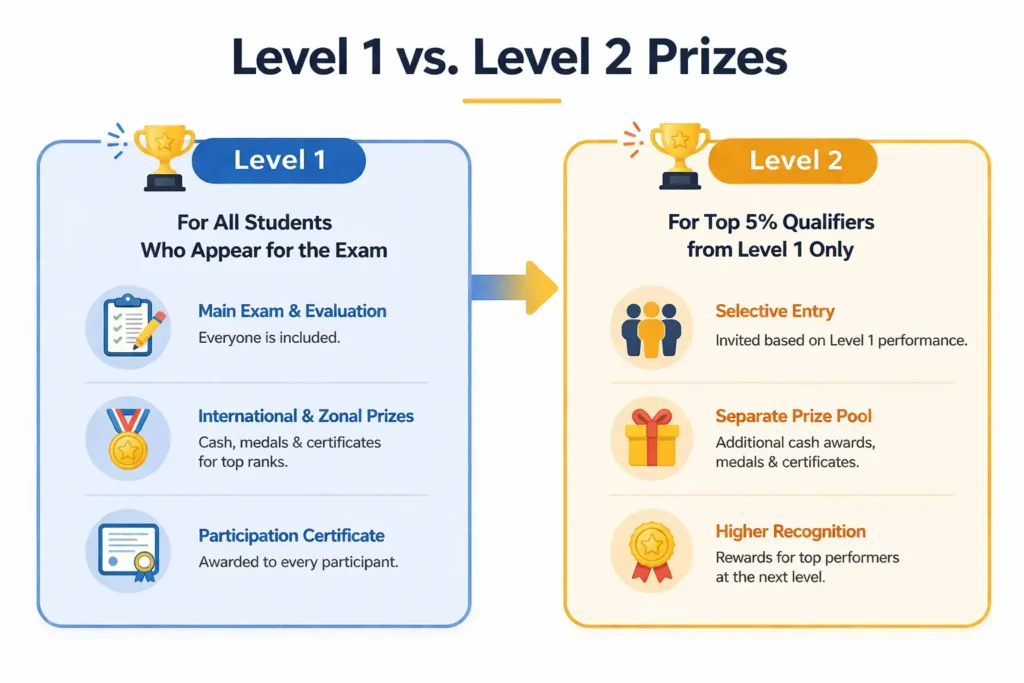
Who Qualifies for Level 2?
A student qualifies for Level 2 if they meet one of these conditions from Level 1:
- Top 5% of students in their class nationally
- Class Rank 1 in their school (regardless of national percentile)
- Zone Rank 1 in their class in their zone
📌 Class 1 and Class 2 students do NOT have a Level 2 exam. Awards for these classes are based entirely on Level 1 performance.
Level 1 vs Level 2 Prize Comparison
| Category | Level 1 Awards | Level 2 Awards |
|---|---|---|
| International Rank 1 | ₹50,000 + Gold Medal + Certificate | ₹50,000 + Gold Medal + Certificate (separate Level 2 ranking) |
| Zonal Rank 1 | ₹5,000 + Gold Medal | ₹5,000 + Gold Medal (separate Level 2 ranking) |
| School-Level Topper | Medal of Distinction + Certificate | Not applicable (Level 2 is national/zonal only) |
| Participation | Participation Certificate | Certificate of Participation (Level 2) |
| Eligibility | All registered students | Top ~5% from Level 1 + Class/Zone Rank 1 |
| Classes eligible | Classes 1–12 | Classes 3–12 only |
Winning at Level 2 is separate from Level 1 a student who ranks internationally at Level 2 gets prizes for that performance independently.
Qualifying for Level 2 is itself an achievement worth highlighting in academic profiles.
Eligibility — Who Qualifies for Which Award?
To avoid confusion, here’s a clear breakdown of eligibility conditions:
| Award | Eligibility Condition |
|---|---|
| Participation Certificate | Appeared for IMO Level 1 (automatic) |
| Merit Certificate | Scored above SOF’s cut-off (typically top 25% or a fixed minimum %) |
| School Class Topper Medal | Rank 1 in your class within your school |
| Zonal Rank Award | Achieved a top 1–25 rank in your zone for your class |
| International Rank Award | Achieved a top 1–25 rank nationally for your class |
| Level 2 Qualification | Top ~5% nationally in class, or Class Rank 1 at school, or Zone Rank 1 |
Tie-Breaking Rules
When two or more students have the same total score, SOF uses this priority order to determine the higher rank:
- Step 1: Higher score in the Achievers Section (the advanced, higher-difficulty section of the paper)
- Step 2: Lower time taken to complete the exam (where proctored time data is available)
- Step 3: If a tie persists, both students share the same rank
This is why students are often advised to attempt the Achievers Section carefully; it directly determines your rank in a tie.
See how the full SOF IMO exam pattern is structured to understand exactly how marks are allocated.
When and How Are Prizes Distributed?
One of the most frequently asked questions and one most articles skip entirely.
Here’s the typical timeline:
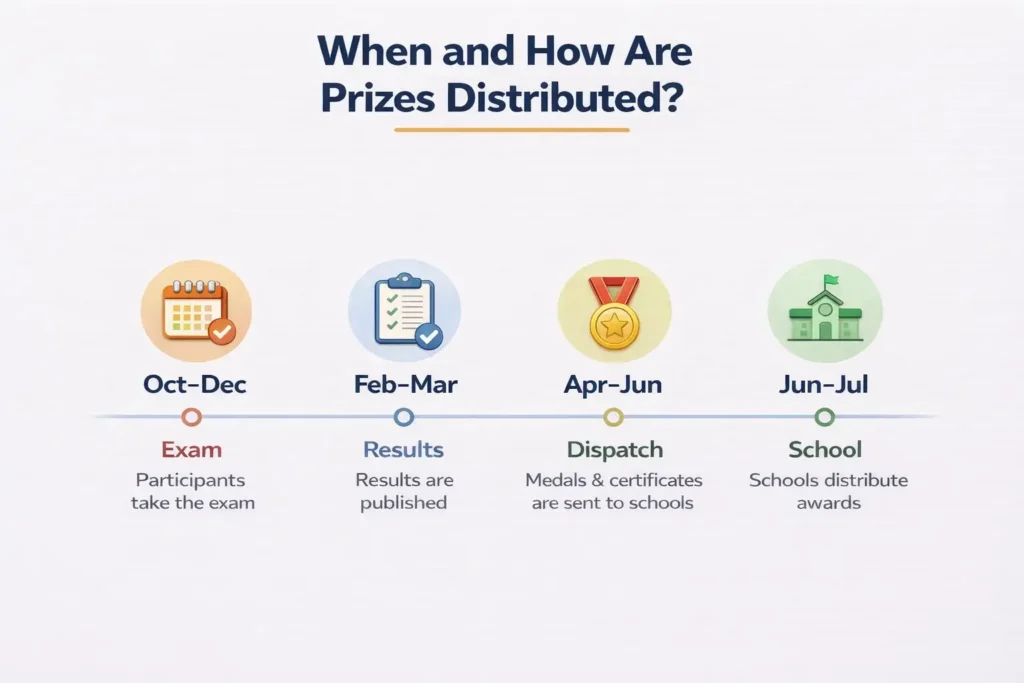
| Stage | Typical Timeframe | What Happens |
|---|---|---|
| Exam | October–December | Students appear for IMO Level 1 |
| Level 2 Exam | January–February | Level 2 for qualifiers |
| Results Announced | February–March | Scores and ranks published on sofworld.org follow our guide on how to check SOF IMO results 2026–27 for a step-by-step walkthrough |
| Award Despatch | April–June | Medals, certificates, and trophies dispatched to schools |
| Cash Disbursement | April–June | Cheques/DDs sent to schools for top rank winners |
| School Distribution | June–July | Schools distribute awards before or at the annual prize day |
For exact Level 1 and Level 2 result dates, see our dedicated SOF IMO result date 2026–27 page for the latest confirmed timeline.
⚠️ Awards are sent to the registered school address, not to students directly. Make sure your school actively participates in the distribution. If you don’t receive your award within 3 months of school reopening, contact SOF at [email protected].
Are SOF IMO Awards Worth It? (Reality Check)
This is the section most platforms are afraid to write but it’s the one you actually need.
The Honest Probability
SOF IMO has over 5 million students participating across India every year. International Rank 1 per class means you are literally the #1 student in your class across the country.
Only 12 students (one per class from Class 1 to 12) can hold that title in a given year.
Zonal ranks are more attainable but you’re still competing with tens of thousands of students per zone per class.
Getting a zonal medal requires exceptional preparation and consistent performance.
What Most Students Realistically Receive
- The majority of participating students receive a Participation Certificate.
- Students who prepare reasonably well (2–4 months of focused practice) can realistically aim for a Merit Certificate or school-level recognition.
- Students in the top 10–15% of their school cohort may win a school-level Class Topper medal.
- Zonal medals require top-decile performance nationally achievable with structured, sustained preparation.
Long-Term Academic Benefits
Even if your child doesn’t win a cash prize, IMO participation and recognition has real academic value:
- Merit Certificates and medals look excellent on school profiles, scholarship applications, and competitive entrance interviews.
- The preparation process itself builds mathematical reasoning, speed, and accuracy that pays dividends in board exams and JEE/NEET prep.
- Zonal or International medals are significant differentiators in IIT-JEE interviews, undergraduate applications, and résumés.
Is IMO Worth the Investment?
For most students, yes; if approached realistically. The registration fee is modest (typically ₹125–200).
The preparation builds genuine skills. Even a Merit Certificate is meaningful recognition.
The risk of disappointment comes from expecting cash prizes when the realistic target is a certificate.
Set honest goals, prepare well, and the experience is almost always positive.
Common Misconceptions About IMO Prizes
Here are the myths we see repeated most often and the facts that correct them.
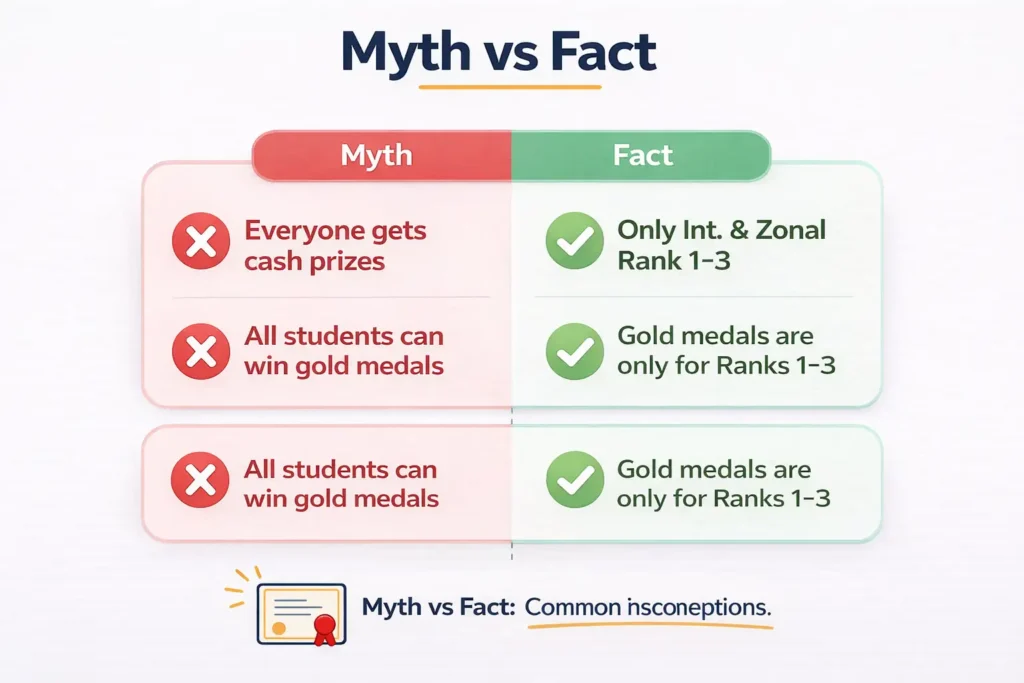
SOF IMO Myths vs Facts
| ❌ MYTH | ✅ FACT |
|---|---|
| Everyone who participates gets a cash prize | Cash prizes are awarded only to International Rank 1–3 and Zonal Rank 1–3 per class. Most students receive certificates, not cash. |
| A Participation Certificate means I performed well | A Participation Certificate only confirms exam participation. A Merit Certificate is the first real sign of above-average performance. |
| Getting into Level 2 means I’ve won a prize | Qualifying for Level 2 is an achievement, but not an award. Prizes require ranking among the top performers in Level 2 results. |
| The IMO gold medal is the same as an Olympics gold medal | The SOF IMO Gold Medal is a school-level Olympiad award, different from the International Mathematical Olympiad (IMO), which is a global competition. |
| My rank is national even if I only have a Participation Certificate | Ranks are given based on performance. Participation alone does not guarantee a rank, especially at national level. |
How to Win These Prizes — Preparation Strategy
Wanting a medal and earning one are different things. Here’s what the students who actually win do differently.
1. Know the Exam Pattern
IMO Level 1 has three sections: Logical Reasoning, Mathematical Reasoning, and Achievers Section.
The Achievers Section carries more marks per question and, crucially, determines rank in a tie. Don’t ignore it.
Before you practise a single question, read through the full SOF IMO exam pattern and marking scheme knowing how the paper is structured, tells you exactly where to spend your time.
2. Master the Syllabus Completely
The IMO syllabus is based on the school curriculum but extends into application and problem-solving.
Students who score in the top 5% have mastered their grade’s concepts and can apply them creatively under time pressure.
Use the class-wise SOF IMO syllabus breakdown to identify which topics carry the most weight for your grade and tackle those first.
3. Practice Previous Year Papers
Familiarity with the question format is half the battle.
SOF releases previous years’ papers and works through at least 3 years of papers for your class before exam day.
You can find class-wise SOF IMO sample papers with free PDF download use them under timed conditions to simulate the real exam, not just as reading material.
4. Use a Structured Practice Platform
Random practice isn’t enough.
You need something that tracks where you’re weak, gives you targeted problems, and simulates real IMO conditions.
5. Aim for the Achievers Section
Most students skip or rush the Achievers Section.
The students who win zonal medals don’t. Spend at least 30% of your practice time on Achievers-level problems for your class.
Make Preparing for Math Olympiad Simple!



IMO vs. Other SOF Olympiads — Prize Comparison
SOF runs several Olympiads NSO (Science), IEO (English), IGKO (General Knowledge), among others.
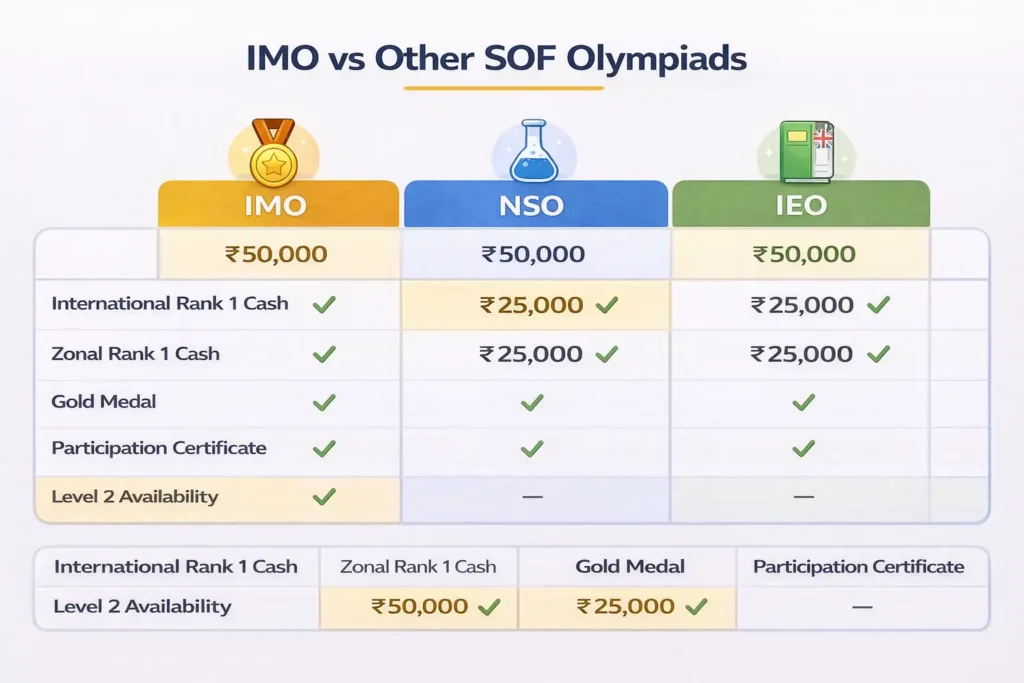
Here’s how the prize structure compares:
| Category | IMO (Maths) | NSO (Science) | IEO (English) |
|---|---|---|---|
| International Rank 1 Cash | ₹50,000 | ₹50,000 | ₹50,000 |
| Zonal Rank 1 Cash | ₹5,000 | ₹5,000 | ₹5,000 |
| Gold Medal | Yes (Int. Rank 1–10) | Yes (Int. Rank 1–10) | Yes (Int. Rank 1–10) |
| Participation Certificate | Yes (all students) | Yes (all students) | Yes (all students) |
| Level 2 Available | Yes (Classes 3–12) | Yes (Classes 3–12) | Yes (Classes 3–12) |
| School/Teacher Awards | Yes | Yes | Yes |
The prize structures across SOF Olympiads are virtually identical at equivalent ranks.
The difference lies in the subject, the syllabus, and the competition pool. IMO typically has one of the largest participation bases among all SOF exams.
How much cash prize does IMO Rank 1 get?
The International Rank 1 winner in each class receives ₹50,000 cash, a Gold Medal, and a Certificate of Outstanding Performance. This is one of the largest cash prizes in any school-level Olympiad in India.
Do all students get IMO certificates?
Yes — every student who appears for the IMO receives at minimum a Participation Certificate. Students who score above SOF’s performance cut-off (typically top 25%) receive a Merit Certificate instead.
What is a zonal rank in SOF IMO?
SOF divides India into regional zones. A zonal rank is your rank among all students of your class within your specific zone. Zonal Ranks 1–3 carry cash prizes and medals. Zonal ranks are more attainable than international ranks but still highly competitive.
What is the difference between Level 1 and Level 2 prizes?
Level 1 prizes are awarded based on your performance in the first exam, which all students take. Level 2 prizes are separate awards given to top performers in the second-stage exam, which only the top ~5% from Level 1 qualify for. Winning at Level 2 is more prestigious than Level 1 equivalents.
How do I check my SOF IMO rank?
Results are published on the official SOF website at sofworld.org. You can check your rank and score by entering your roll number after results are declared, typically in February–March.
When will I receive my medal or certificate?
Awards are dispatched to schools between April and June, following results in February–March. Your school will distribute them, often at an annual prize ceremony. If you haven’t received yours by July, contact SOF at [email protected].
What happens if two students have the same score?
Ties are broken first by the score in the Achievers Section. If that’s also equal, the student who completed the exam in less time is ranked higher. In rare cases where both metrics are tied, students share the same rank.
Is the SOF IMO gold medal the same as the International Mathematical Olympiad?
No. The SOF IMO (International Mathematics Olympiad) is a school-level Olympiad run by the Science Olympiad Foundation in India. The International Mathematical Olympiad (also abbreviated IMO) is an entirely different, global competition for pre-university students, organised under a different body. Both are prestigious — but they’re completely separate competitions.
Make Preparing for Math Olympiad Simple!
Conclusion:
The SOF IMO award system has three clear tiers: cash prizes for the very top international and zonal ranks, medals for consistent high performers, and certificates for every student who shows up and competes.
Most students will earn a Participation or Merit Certificate and that’s a genuine achievement worth working towards.
The students who go further and land zonal or international medals do one thing differently: they prepare with intent, not just with effort.

Mikha Piregu is a Content Writer with experience spanning educational content, including math and math olympiad topics, as well as advocacy writing, research-based articles, and SEO-driven web content. He creates high-quality blog content, web copy, and feature articles that support brand visibility, audience engagement, and long-term organic growth through data-informed storytelling. Skilled in WordPress, WooCommerce, and modern digital tools, Mikha adapts content across various platforms, including blogs, websites, campaigns, and advocacy initiatives, with clarity and purpose.

There are no comments posted here yet.
Sign in to leave a comment