


SOF IMO sample papers are free class-wise practice papers for the SOF International Mathematics Olympiad, set to the current exam pattern for Classes 1 to 12. Every paper on this page follows the Level 1 structure of Logical Reasoning, Mathematical Reasoning, Everyday Mathematics and the Achievers Section, and every PDF carries an answer key. Classes 1 to 4 attempt 35 questions in 60 minutes; Classes 5 to 12 attempt 50.
- SOF IMO Exam Pattern 2026-27
- SOF IMO Sample Papers 2026-27: Class-Wise Free PDF Download
- SOF IMO Previous Year Question Papers: What to Solve and When
- SOF IMO Level 1 vs Level 2 Papers: What Changes
- SOF IMO Books, Workbooks and Worksheets: What Is Actually Free
- How to Use SOF IMO Sample Papers Effectively
- SOF IMO Syllabus Overview: Class-Wise Summary
- SOF IMO Preparation Tips to Score Higher
- SOF IMO Answer Keys and Solutions: How to Check a Score
- Frequently Asked Questions
- Conclusion
The SOF International Mathematics Olympiad is conducted annually by the Science Olympiad Foundation for students in Classes 1–12, across two competitive levels.
Sample papers matter because they do three things at once.
They simulate real exam conditions, reveal which topics carry the most weight, and build the speed and accuracy that makes a difference on exam day.
This page gives you everything: free SOF IMO sample paper PDFs with answers, the previous year question papers worth solving, the full exam pattern for 2026-27 and a clear preparation strategy. Nothing here needs a sign-up, an email address or a registration form. Pick your class, open the PDF, start the timer.
If you also need the topic-by-topic breakdown before downloading, check the SOF IMO syllabus guide first then come back here for the papers.
SOF IMO Exam Pattern 2026-27
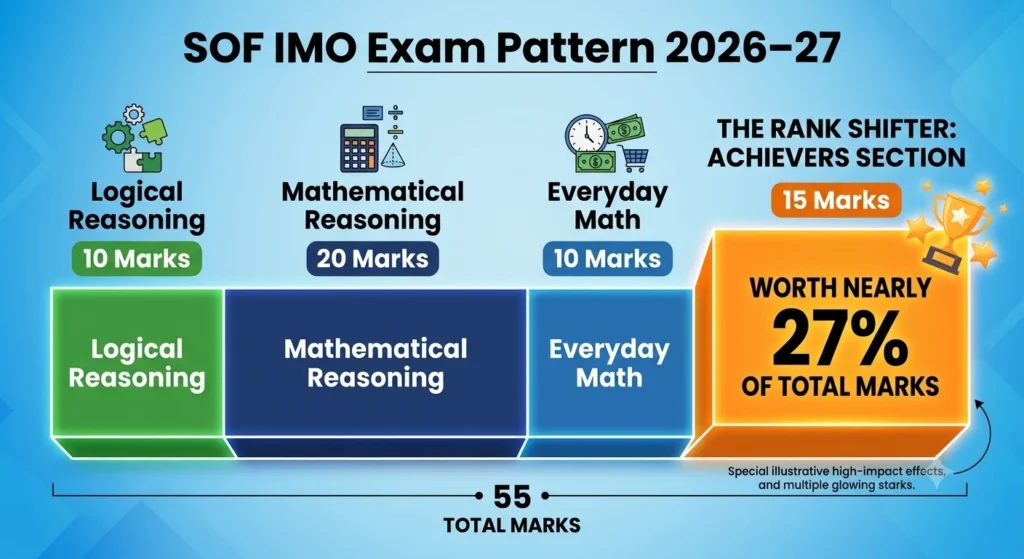
The SOF IMO Level 1 paper is a 60-minute multiple-choice test in English, divided into four sections. Classes 1 to 4 answer 35 questions for 40 marks. Classes 5 to 12 answer 50 questions for 60 marks.
The section names stay the same across both class groups. The question count and the marks per question are what change.
SOF IMO Level 1 Paper Pattern: Classes 1 to 4
| Section | No. of Questions | Marks per Question | Total Marks |
| Logical Reasoning | 10 | 1 | 10 |
| Mathematical Reasoning | 10 | 1 | 10 |
| Everyday Mathematics | 10 | 1 | 10 |
| Achievers Section | 5 | 2 | 10 |
| Total | 35 | Mixed | 40 |
SOF IMO Level 1 Paper Pattern: Classes 5 to 12
| Section | No. of Questions | Marks per Question | Total Marks |
| Logical Reasoning | 15 | 1 | 15 |
| Mathematical Reasoning | 20 | 1 | 20 |
| Everyday Mathematics | 10 | 1 | 10 |
| Achievers Section | 5 | 3 | 15 |
| Total | 50 | Mixed | 60 |
For Classes 11 and 12, the second section is titled Mathematical Reasoning or Applied Mathematics, depending on the stream. The marks are identical.
The Achievers Section deserves special attention. Those five questions carry a full quarter of the paper: 15 of 60 marks for Classes 5 to 12, and 10 of 40 marks for Classes 1 to 4.
They are harder, but that is also where ranks shift.
A student who answers 3 or 4 Achievers Section questions correctly while their peers skip them can jump dozens of positions in the rankings.
See the full breakdown of SOF IMO awards and prizes to understand what those ranks are worth.
SOF IMO Level 2 Paper Pattern
The SOF IMO Level 2 paper drops the four-section split and tests mathematics directly, with the Achievers Section still attached. Level 2 is held only for Classes 3 to 12, so there is no Level 2 paper for Classes 1 and 2.
| Class Group | Sections | Total Questions | Total Marks |
| Classes 3 to 4 | Mathematics (30), Achievers (5) | 35 | 40 |
| Classes 5 to 10 | Mathematics (45), Achievers (5) | 50 | 60 |
| Classes 11 to 12 | Mathematics (25), Mathematical Reasoning (20), Achievers (5) | 50 | 60 |
The questions are noticeably harder, the candidate pool is far smaller, and the emphasis shifts to conceptual depth and higher-order reasoning.
Read our SOF IMO Level 2 preparation guide for the full strategy.
There is no negative marking in either level. Always verify the current year’s pattern in the official Science Olympiad Foundation bulletin for your class, since SOF can revise question counts between sessions.
SOF IMO Sample Papers 2026-27: Class-Wise Free PDF Download
Select your class below to open your SOF IMO sample paper PDF. Each paper is set to the 2026-27 session pattern and includes an answer key.
There is no registration step and no email wall. Pick your class, open the PDF, and start the timer.
Practice IMO Now (Class 1–12)


SOF IMO Sample Papers Class 1: Free PDF with Answer Key
Key topics: Number sense, basic counting, simple addition and subtraction, patterns, shapes, and spatial reasoning.
The Class 1 paper is designed to be approachable for first-time participants, but patterns and logical reasoning questions can trip up students who haven’t practised them specifically.
The SOF IMO sample paper for Class 1 helps children understand the format before exam day which is often more valuable than the content itself at this level. Class 1 students sit Level 1 only, so one well-used paper plus steady daily practice is enough preparation.
Answer key included in the PDF. Additional solutions available on Gonit App.
SOF IMO Sample Papers Class 2: Free PDF with Answer Key
Key topics: Addition and subtraction (2-digit), basic multiplication concepts, time and calendar, shapes, and simple patterns.
Class 2 introduces slightly more structured problem types.
Students benefit from attempting the sample paper under timed conditions even 30 minutes of focused practice makes a difference. Once the paper is done, class 2 maths olympiad worksheets on the same topics are the cheapest way to fix whatever the paper exposed.
Answer key included. Worked solutions available on Gonit App.
SOF IMO Sample Papers Class 3: Free PDF with Answer Key
Key topics: Multiplication and division, fractions (basic), measurement, geometry shapes, and data handling (simple bar graphs).
Class 3 is the first level at which Level 2 eligibility kicks in.
Students aiming beyond Level 1 should treat these sample papers as a baseline and push toward Gonit App’s timed practice sets for deeper preparation. A Class 3 student who clears Level 1 will sit a 35-question Level 2 paper with no Logical Reasoning section at all.
Answer key included. Level 2 practice available on Gonit App.
SOF IMO Sample Papers Class 4: Free PDF with Answer Key
Key topics: Large numbers, factors and multiples, fractions and decimals (intro), perimeter and area basics, simple geometry.
By Class 4, the Everyday Mathematics section becomes more word-problem heavy.
Practising the SOF IMO Class 4 sample paper helps students get comfortable converting real-world scenarios into equations quickly. If word problems are the sticking point, work through how to solve math word problems before the next attempt.
Answer key included. Solutions available on Gonit App.
SOF IMO Sample Papers Class 5: Free PDF with Answer Key
Key topics: Fractions and decimals, LCM and HCF, ratio and proportion, basic geometry, area and perimeter, data interpretation.
Class 5 is where the Level 1 paper jumps from 35 questions to 50, and Logical Reasoning expands from 10 questions to 15. That is a real change in pace, not just in content.
Downloading the SOF IMO Class 5 sample paper and attempting it in one sitting is strongly recommended before moving to concept-based practice.
Answer key included. Solutions available on Gonit App.
Practice IMO Now (Class 1–12)
SOF IMO Sample Papers Class 6: Free PDF with Answer Key
Key topics: Integers, fractions, decimals, basic algebra, mensuration, geometry, ratio and proportion, data handling.
Class 6 is one of the highest-demand classes for SOF IMO sample papers and for good reason.
The jump from Class 5 to Class 6 content is significant, and the Achievers Section becomes noticeably harder. Students who qualify will also want Class 6 Level 2 practice, which carries 45 mathematics questions and no reasoning section.
Answer key included. Step-by-step solutions available on Gonit App.
SOF IMO Sample Papers Class 7: Free PDF with Answer Key
Key topics: Integers, fractions and decimals, simple equations, lines and angles, triangles, congruence, data handling, rational numbers.
Class 7 papers have a strong focus on geometry and algebra.
Students often underestimate the logical reasoning section practising the full SOF IMO Class 7 sample paper helps calibrate time allocation across sections. If lines, angles and triangles are the weak spot, the types of angles explainer is the faster fix than another full paper.
Answer key included. Solutions available on Gonit App.
SOF IMO Sample Papers Class 8: Free PDF with Answer Key
Key topics: Linear equations, quadrilaterals, squares and square roots, cubes, algebraic expressions, mensuration, data handling, probability.
Class 8 is another high-demand class for sample papers and the Achievers Section at this level is genuinely challenging.
Students who want to compete for top ranks should attempt at least 3 or 4 full papers before exam day, mixing this sample paper with older SOF IMO question papers.
Answer key included. Step-by-step solutions for all sections available on Gonit App — including Achievers Section explanations.
SOF IMO Sample Papers Class 9: Free PDF with Answer Key
Key topics: Polynomials, coordinate geometry, lines and angles, triangles, quadrilaterals, circles, surface areas, statistics, probability.
Class 9 papers draw heavily from the standard NCERT Class 9 syllabus but push problem complexity higher.
The SOF IMO Class 9 sample paper with solutions is especially useful for students who want to understand where their conceptual gaps are.
Answer key included. SOF class 9 IMO sample paper solutions available on Gonit App.
SOF IMO Sample Papers Class 10: Free PDF with Answer Key
Key topics: Real numbers, polynomials, pair of linear equations, quadratic equations, arithmetic progressions, circles, trigonometry, statistics, probability.
Class 10 students are often balancing board exam prep alongside Olympiad preparation.
The SOF IMO Class 10 sample paper is designed to complement not conflict with standard board preparation.
Most topics overlap significantly with the Class 10 NCERT syllabus. An hour on an IMO paper is rarely an hour taken away from boards.
Answer key included. Full solutions available on Gonit App.
SOF IMO Sample Papers Class 11: Free PDF with Answer Key
Key topics: Sets, relations and functions, trigonometric functions, complex numbers, quadratic equations, permutations and combinations, binomial theorem, sequences and series, straight lines, conic sections, limits and derivatives, statistics, probability.
Class 11 marks a significant jump in mathematical complexity; the shift from Class 10 algebra to calculus-adjacent topics and combinatorics catches many students off guard.
The SOF IMO Class 11 sample paper helps bridge that gap, giving students a clear sense of question depth and the reasoning style expected at this level before they sit the actual exam. At Classes 11 and 12 the second section is Mathematical Reasoning or Applied Mathematics, depending on the stream.
Answer key included. Full solutions available on Gonit App.
SOF IMO Sample Papers Class 12: Free PDF with Answer Key
Key topics: Relations and functions, inverse trigonometric functions, matrices and determinants, continuity and differentiability, applications of derivatives, integrals, differential equations, vector algebra, three-dimensional geometry, linear programming, probability.
Class 12 students are navigating one of the most demanding academic years: board exams, entrance prep, and Olympiad competition all at once.
The SOF IMO Class 12 sample paper is built around the same core syllabus, so practice here reinforces board and entrance exam readiness rather than pulling focus away from it.
The Achievers Section at this level demands strong conceptual clarity, particularly in calculus and probability.
Answer key included. Full solutions available on Gonit App.
SOF IMO Previous Year Question Papers: What to Solve and When
A SOF IMO previous year question paper, often shortened to PYQ, is a paper actually used in an earlier session of the exam. Sample papers teach the format; previous year papers show the real difficulty curve and the question types SOF returns to year after year. Most students need one sample paper per class and three to five previous year papers.
SOF releases one official sample paper per class per level each session, free. That single paper runs out fast once a student is preparing seriously. Previous year papers are what fill the gap, and they come from three places: SOF workbooks and previous years’ paper collections, copies kept by schools that run the exam, and practice platforms that have licensed or rebuilt the question sets.
Sample Paper vs Previous Year Paper vs Timed Mock
| Criterion | Sample paper | Previous year paper | Timed mock attempt |
| What it is | One paper per class per level, issued for the current session | A full paper from an earlier session of the exam | Any paper sat under real exam conditions |
| Where to get it | Free on this page, and on the official SOF site | SOF workbooks, previous years’ paper collections, practice apps | A paper you already have, plus a 60-minute timer |
| Best for | Learning the section split and the question style | Seeing genuine difficulty and repeated question patterns | Measuring score, speed and exam-day nerve |
| How many to use | One per class, read closely | 3 to 5 from recent sessions | At least 3 before exam day |
| Where it falls short | Only one exists per session | A few topics carry older syllabus wording | Shows what went wrong, not why |
How Many Previous Year Papers Is Enough
Three to five previous year papers, spread across the last few sessions, is the point where returns start to flatten for most students. A Class 3 student who has solved five papers has seen nearly every question pattern SOF uses at that level.
The order matters more than the count. Solve the current sample paper first to learn the format, then two previous year papers to find weak topics, then fix those topics, then the remaining papers as timed mocks. Solving five papers back to back without fixing anything in between produces five similar scores.
If you want a view of how other students and apps structure that sequence, our honest review of SOF IMO preparation apps covers the official SOF Olympiad Trainer alongside the alternatives.
SOF IMO Level 1 vs Level 2 Papers: What Changes
Level 1 is the school round that every registered student in Classes 1 to 12 sits. Level 2 is the second round, held only for Classes 3 to 12, and only for students who clear Level 1. The Level 2 paper drops Logical Reasoning and Everyday Mathematics and tests mathematics almost end to end, which is why a student who practised only Level 1 papers can be caught out.
| Criterion | Level 1 | Level 2 |
| Who sits it | Classes 1 to 12, every registered student | Classes 3 to 12, Level 1 qualifiers only |
| How you get in | Register through your school | Qualify on your Level 1 result |
| Sections | Logical Reasoning, Mathematical Reasoning, Everyday Mathematics, Achievers | Mathematics and Achievers, with Mathematical Reasoning added for Classes 11 and 12 |
| Paper size | 35 questions for Classes 1 to 4, 50 for Classes 5 to 12 | 35 questions for Classes 3 and 4, 50 for Classes 5 to 12 |
| Difficulty | School syllabus with a reasoning layer on top | Multi-step problems and higher-order reasoning |
| What to practise | Full papers, all four sections, against the clock | Mathematics depth; reasoning drills matter much less |
SOF publishes the qualifying criteria for Level 2 each session, and it has typically covered a small top slice of each class along with the top rank holders inside a school. Treat any percentage you read, here or anywhere else, as a guide and check the official notification for your session.
Level 2 is held after Level 1 results are out, usually early in the following calendar year. Students of Classes 1 and 2 sit Level 1 only, so a Class 1 parent looking for a Level 2 paper is looking for something that does not exist.
Preparation for Level 2 is a different exercise from preparation for Level 1. The reasoning sections you drilled no longer appear, and the marks sit in sustained problem solving instead, which is where a structured approach to olympiad problems pays off more than extra question volume.
SOF IMO Books, Workbooks and Worksheets: What Is Actually Free
The material SOF itself releases free is the class-wise sample paper and the syllabus. Olympiad workbooks, previous years’ paper collections and prep guides are published commercially and are not issued as free PDFs. That is worth knowing before you spend an evening chasing a download link, because most results for SOF olympiad books PDF free download lead to copies that are unofficial, incomplete, or built on an older session’s pattern.
Which Resource Does What
| Resource | What it gives you | Cost | Best used |
| Official sample paper | One current-pattern paper per class per level, with answers | Free | First, to learn the format |
| Previous years’ paper collection | Several past papers in one volume | Paid | After the sample paper, to find weak topics |
| Olympiad workbook | Chapter-wise questions matched to the class syllabus | Paid | Alongside school work, across the term |
| Printable worksheets | Short topic drills, usually 10 to 20 questions | Free to paid | To fix one weak topic quickly |
| App practice | Question sets with hints and per-topic progress | Free to start | Daily reps between full papers |
A workbook earns its place when it is chapter-wise and matched to your class syllabus, because that is the thing a sample paper cannot give you. One paper tells you that fractions are weak. A workbook gives you forty fraction questions to do something about it.
Worksheets work the other way round. They are short, single-topic and quick to mark, which makes them the right tool for a Class 2 student who needs ten more subtraction questions rather than another full paper. Parents of younger children usually get more out of a worksheet set with answers than out of a workbook the child cannot read alone.
If you are weighing publishers and exam boards against each other, the same logic applies across foundations, and our guide to SilverZone olympiad books walks through how to judge a book before buying it.
⚠️ On free PDF copies: a file from an unofficial source is often a scan of an older session, missing the answer key, or missing the Achievers Section entirely. If you do use one, check the paper against the current pattern tables above before trusting the question count.
Interesting app for practice math.
“Gonit is a really helpful app for brushing up math skills. The interface is simple and clean, and the practice sets actually make learning fun. Great for quick revision or testing myself on the go. Definitely worth keeping installed.”
How to Use SOF IMO Sample Papers Effectively
Use a sample paper as a measurement, not as revision. Sit it once under exam conditions, mark it against the answer key, sort the mistakes by topic, fix those topics, then sit the next paper. Downloading a paper and skimming through it builds nothing.
Here is how to actually use these papers to improve your score:
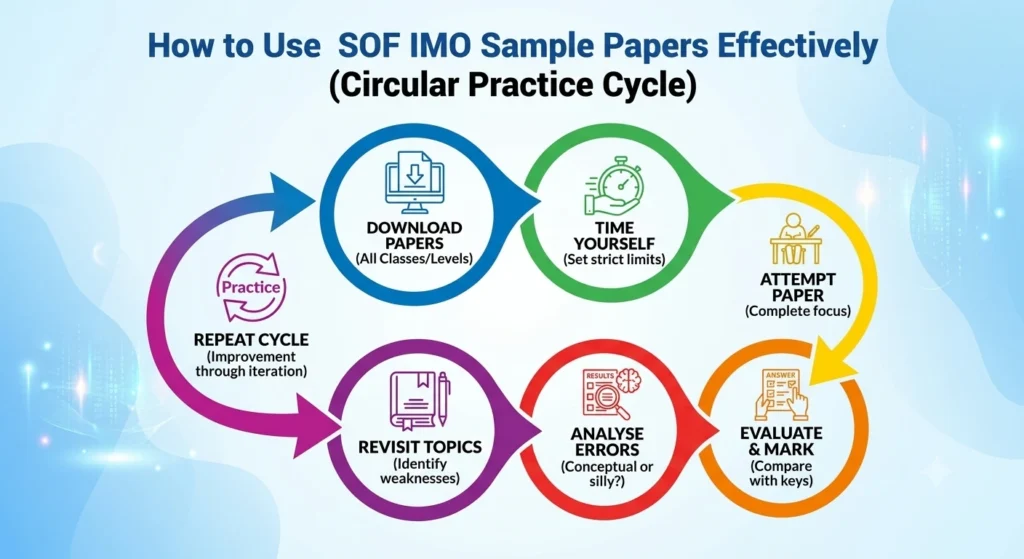
Step 1: Download the sample paper for your class. Use the class-specific links above.
Make sure it’s the right level (Level 1 or Level 2) and the most recent session available.
Step 2: Set a timer matching the actual exam duration. SOF IMO is typically 60 minutes.
Set the timer before you start, not after you’ve already read a few questions. Simulating real conditions is the entire point.
Step 3: Attempt the full paper without interruption. No textbook, no calculator (unless permitted), no stopping.
Treat it like exam day. This is the only way to get an honest measure of where you stand.
Step 4: Self-evaluate using the answer key. Mark every answer as correct, incorrect, or skipped.
Do not stop at the score. Sort the wrong answers into groups, because that is where the learning starts.
Step 5: Analyse mistakes topic by topic. If you got 4 geometry questions wrong, that’s a geometry gap not bad luck.
Go back to the specific concept, not just the question. Ask: did I not know the concept, or did I misread the question, or did I run out of time?
Step 6: Revisit weak topics using Gonit App’s concept-based practice modules. Targeted concept practice after identifying your weak areas is far more effective than attempting another full paper immediately.
Use Gonit App’s structured modules to rebuild understanding before your next full test.
Step 7: Repeat with at least 3–4 papers before exam day. Your score should improve across attempts if it doesn’t, the issue is concept clarity, not practice volume. Address that first.
💡 Pro Tip: Pay special attention to Achievers Section questions. You don’t need to get all five right, solving even 2–3 of them correctly can significantly improve your rank, because most students skip them entirely.
How to Turn a Sample Paper into a Mock Test
A sample paper becomes a mock test the moment you sit it under exam rules: 60 minutes, one sitting, no notes, every question attempted because there is no negative marking. The difference is not the paper. It is the conditions.
Mark it section by section rather than as one total. A score of 38 tells you very little. The same 38 split across the four sections tells you exactly what to work on next.
| Section | Questions (Classes 5 to 12) | Marks | A low score here means |
| Logical Reasoning | 15 | 15 | Pattern and sequence practice, not maths revision |
| Mathematical Reasoning | 20 | 20 | A specific chapter gap to go back to |
| Everyday Mathematics | 10 | 10 | Word problems and unit conversion need work |
| Achievers Section | 5 | 15 | Multi-step problems under time pressure |
Copy that table into a notebook, add a score column, and fill one row per attempt. Three attempts in, the pattern across rows is usually obvious, and it is almost never the pattern the student expected.
SOF IMO Syllabus Overview: Class-Wise Summary
The SOF IMO syllabus tracks the standard school curriculum for each class, with extra weight on logical reasoning and higher-order problem solving. A student who is comfortable with their own class syllabus already covers most of the mathematics; the olympiad difficulty sits in how the questions are framed.
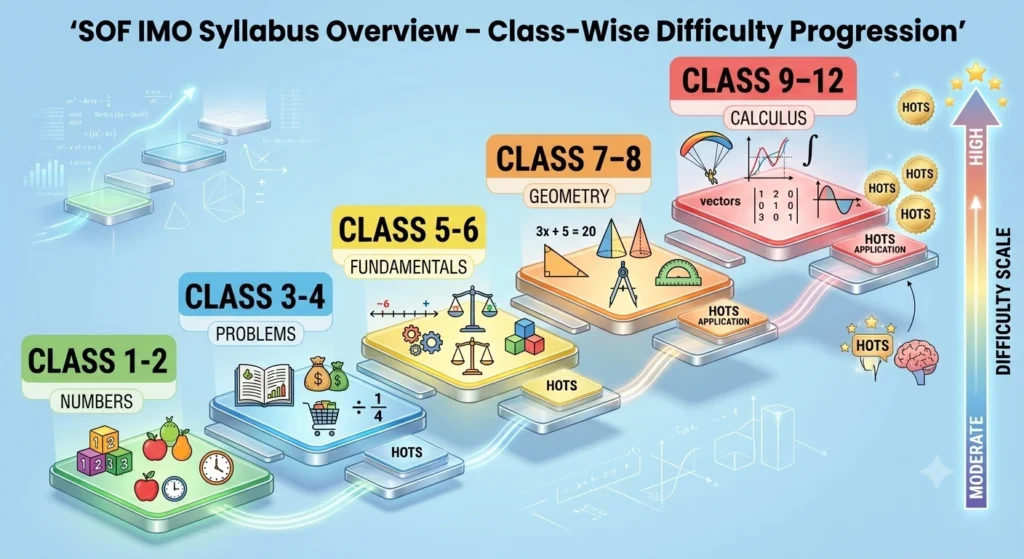
Here’s a quick class-wise breakdown:
| Class | Key Topics |
| 1–2 | Patterns, shapes, basic counting, simple addition and subtraction |
| 3–4 | Multiplication, fractions, geometry basics, data handling |
| 5–6 | Decimals, ratios, basic algebra, mensuration |
| 7–8 | Algebra, geometry, statistics, number systems |
| 9–12 | Polynomials, coordinate geometry, trigonometry, probability |
That is a summary, not the complete syllabus. For the full topic-by-topic breakdown for your class, see the link below.
If you want to explore the Full IMO Syllabus Class-Wise check it out here.
SOF IMO Preparation Tips to Score Higher
Good preparation is not about doing more. It is about doing the right things in the right order: school syllabus first, then full papers to benchmark, then targeted practice on whatever the papers exposed.
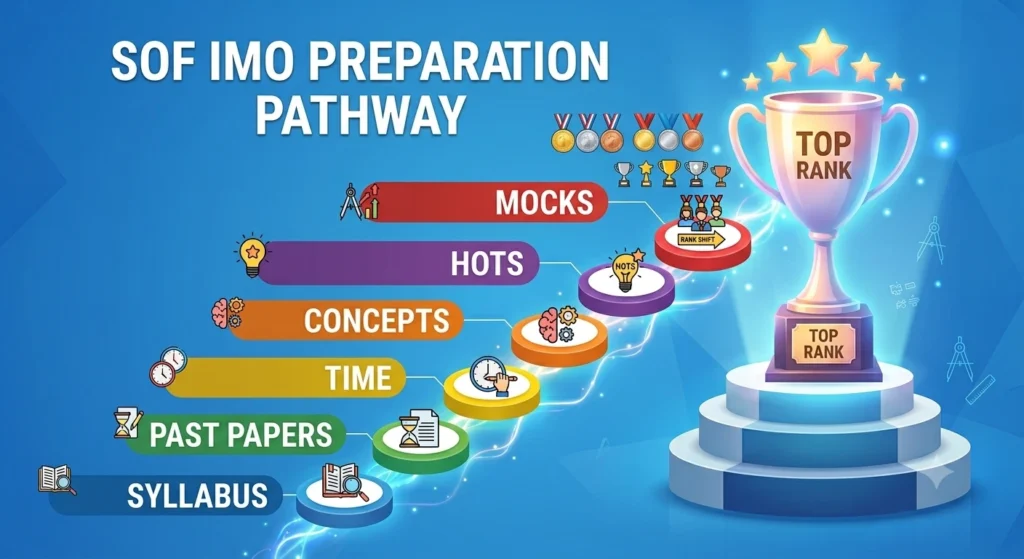
- Start with your standard curriculum. IMO builds directly on school math. For a structured week-by-week roadmap, see our 60-day SOF IMO preparation strategy.
- Use sample papers to benchmark, not just practice. Your first paper attempt tells you where you are. Every subsequent attempt should show measurable improvement in a specific area.
- Prioritise the Achievers Section. Most students either skip it or guess. If you can reliably solve 2–3 Achievers questions in your class, you’ll outrank a large chunk of the field.
- Build mental math speed. The 60-minute clock is unforgiving. Gonit App’s timed drills are built specifically for this short, focused, and calibrated Olympiad-style problems.
- Track your progress. Attempt → evaluate → identify gaps → targeted practice → re-attempt. This loop, repeated 3–4 times before the exam, is more effective than any shortcut.
- Join a mock test series. Full-length mock tests under timed conditions are the closest you can get to real exam experience without actually being in the exam.
Gonit App’s structured Olympiad practice path is built for exactly this preparation sequence. Start Practising Free on Gonit App →
If you want the habits that separate a good score from a top rank, our guide on how to get full marks in a maths olympiad goes further into exam-day execution.
SOF IMO Answer Keys and Solutions: How to Check a Score
Every sample paper PDF on this page carries its own answer key, so a student can mark the paper the moment the timer stops. The official answer key for the real exam is a separate document: SOF publishes it on its own site after each Level 1 exam date, with the result following some weeks later.
Marking a SOF IMO paper is simple arithmetic, and it is worth doing by hand rather than by eye.
- Give 1 mark for each correct answer in Logical Reasoning, Mathematical Reasoning and Everyday Mathematics.
- Give 2 marks per correct Achievers answer for Classes 1 to 4, or 3 marks for Classes 5 to 12.
- Give 0 for a wrong answer and 0 for a skipped one. There is no negative marking, so a blank is never better than a guess.
- Add the section totals, then write the score as a fraction of 40 marks (Classes 1 to 4) or 60 marks (Classes 5 to 12).
Worked example, Class 6. A student gets 12 of 15 in Logical Reasoning, 16 of 20 in Mathematical Reasoning, 8 of 10 in Everyday Mathematics, and 2 of 5 in the Achievers Section.
12 plus 16 is 28. 28 plus 8 is 36 marks from the first three sections. 2 Achievers questions at 3 marks each is 6. 36 plus 6 is 42 out of 60.
Two more Achievers questions would take the same student to 48 out of 60, without a single extra mark anywhere else in the paper. That is the arithmetic behind every piece of advice on this page about the Achievers Section.
An answer key tells a student what they got wrong. It does not tell them why, and the why is what changes the next score. Where a question was missed by a whole method rather than a slip, work the solution through step by step before moving on, and check whether the same method appears elsewhere in the paper.
For the official key and result timeline for the current session, see our guide on when SOF IMO results are declared.
Frequently Asked Questions
What is SOF IMO?
The SOF International Mathematics Olympiad is a school-level mathematics competition for students in Classes 1 to 12, conducted annually by the Science Olympiad Foundation. It tests mathematical reasoning, logical thinking and problem solving across two competitive levels, and it is written in school during school hours.
How many levels does SOF IMO have?
SOF IMO has two levels. Level 1 is open to all registered students from Classes 1 to 12 and is conducted in school. Level 2 is held only for qualifying students from Classes 3 to 12, with harder questions, a far smaller candidate pool and a stronger focus on advanced reasoning.
Are SOF IMO sample papers free to download?
Yes. SOF IMO sample papers for Classes 1 to 12 are available as free PDF downloads on this page, and SOF publishes its own class-wise sample papers free on its official site. Each PDF here includes an answer key, with step-by-step solutions available on Gonit App for most class levels.
Do I need to register or sign up to download the papers?
No. The class-wise PDFs on this page open directly, with no account, no email address and no payment step. A student can open the paper for their class, print it or read it on screen, and start the timer straight away.
Which is the best sample paper for SOF IMO Class 8?
The best SOF IMO Class 8 sample paper is one that matches the current exam pattern and includes the Achievers Section, since that section carries a quarter of the marks. The Class 8 paper on this page is set to the 2026-27 pattern and covers algebra, quadrilaterals, mensuration and data handling, with full solutions available on Gonit App.
Are SOF IMO sample papers available for Class 11 and Class 12?
Yes. SOF IMO runs for Classes 1 to 12, and both Class 11 and Class 12 papers are available on this page as free PDFs with answer keys. At these two classes the second section is titled Mathematical Reasoning or Applied Mathematics depending on the stream, and the paper carries 50 questions for 60 marks.
How is SOF IMO Level 2 different from Level 1?
Level 2 removes the Logical Reasoning and Everyday Mathematics sections and tests mathematics almost end to end, so preparation has to shift from broad section practice to sustained problem solving. Only Level 1 qualifiers from Classes 3 to 12 sit it. A student who practised nothing but Level 1 papers will find the question style unfamiliar.
Can I use 2018 or 2019 sample papers for 2026-27 preparation?
Yes, older SOF IMO papers stay useful. The core syllabus and section structure have been stable for years, so an older paper still shows real question types, difficulty and topic weight. Check the question count against the current pattern before timing yourself, since paper sizes have been revised in the past.
Where can I get SOF IMO Class 6 Level 2 sample papers?
Class 6 Level 2 practice is available on Gonit App, built to the harder Level 2 pattern of 45 mathematics questions plus a 5-question Achievers Section. SOF also publishes an official Level 2 sample paper per class on its own site. Level 2 material is only worth attempting once a student has cleared Level 1.
Is there negative marking in the SOF IMO exam?
No. SOF IMO does not deduct marks for wrong answers at either level, so leaving a question blank gains nothing over attempting it. Students should answer every question, including the Achievers Section, even where a guess is the only option left on the clock.
Are SOF IMO question papers available in Hindi?
No. SOF IMO is conducted in English only, and the sample papers follow the same medium. Students who study mathematics in Hindi, Bengali or another language should practise the English terms for the operations and shapes on their syllabus, since the wording of the question is often the harder part of the paper.
Make Preparing for Math Olympiad Simple!
Conclusion
The students who perform best in SOF IMO aren’t always the most naturally gifted; they’re the ones who practised with real papers, identified their weak spots early, and fixed them before exam day.
That’s a repeatable process, and this page gives you everything you need to run it: the class-wise sample paper, the previous year papers worth adding, the current exam pattern, and a marking method that turns a score into a plan.
Whether you’re a student attempting your first paper, a parent supporting your child’s prep, or a teacher building a structured practice plan this is your one trusted starting point.
Download your class-specific SOF IMO sample paper PDF today and give your preparation a structured head start with Gonit App. After the exam, track your score using our guide on SOF IMO results 2026–27.

Mikha Piregu is a Content Writer with experience spanning educational content, including math and math olympiad topics, as well as advocacy writing, research-based articles, and SEO-driven web content. He creates high-quality blog content, web copy, and feature articles that support brand visibility, audience engagement, and long-term organic growth through data-informed storytelling. Skilled in WordPress, WooCommerce, and modern digital tools, Mikha adapts content across various platforms, including blogs, websites, campaigns, and advocacy initiatives, with clarity and purpose.

There are no comments posted here yet.
Sign in to leave a comment