


The numerator is the top number in a fraction, and the denominator is the bottom number, but knowing which is which is just the beginning.
- What is the Numerator and Denominator of a Fraction?
- What Does the Numerator Tell Us?
- What Does the Denominator Tell Us?
- Numerator vs. Denominator: A Simple Side-by-Side Comparison
- Real-Life Examples of Numerator and Denominator
- How to Identify the Numerator and Denominator in Any Fraction
- Common Mistakes Students Make
- Memory Tricks for Remembering the Difference
- How to Teach Numerator and Denominator to Kids
- Hands-On Activities for Home and Classroom
- Practice Questions
- Conclusion
A fraction represents a part of a whole. It consists of two numbers separated by a horizontal line known as the fraction bar or vinculum.
Most resources dump a definition and move on. That leaves parents frustrated and kids confused, especially when the words numerator and denominator sound so similar.
In this guide, you’ll learn what is the numerator and denominator of a fraction mean using simple examples, memory tricks, and easy activities for home or classroom use.
What is the Numerator and Denominator of a Fraction?
A fraction has two parts separated by a fraction bar. The numerator is the top number, which tells you how many equal parts are being considered.
The denominator is the bottom number, which tells you how many equal parts the whole has been divided into. In the fraction 3/4, the numerator is 3, and the denominator is 4.
That’s the short version. Now let’s look at each part more closely.
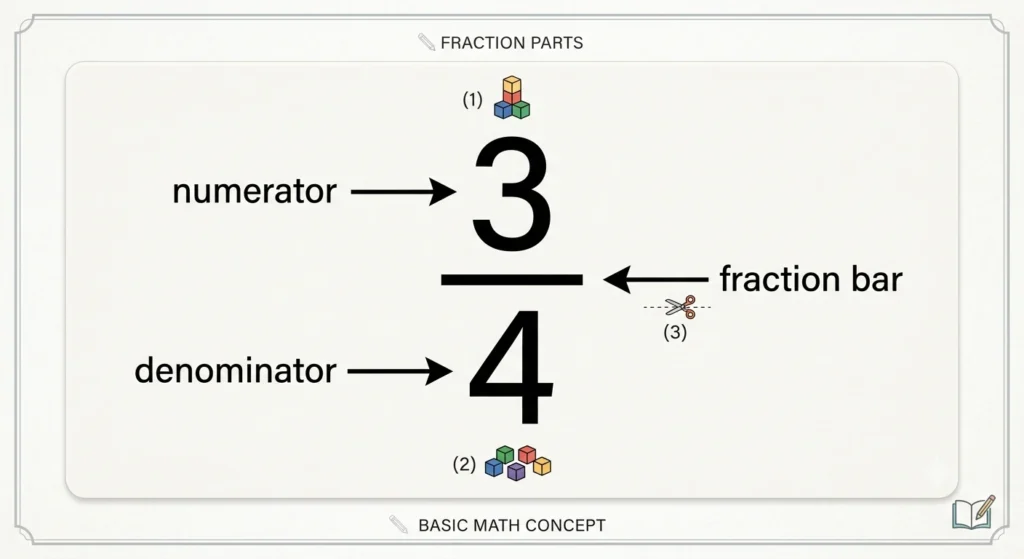
A fraction looks like this:
3 ← numerator
___
4 ← denominator
What Does the Numerator Tell Us?
The numerator is the number on top of the fraction bar.
It answers the question: How many parts are we talking about?
Think of the numerator as the number that counts something. It counts how many equal pieces have been selected, eaten, coloured, used, or taken.
Example: In the fraction 2/5, the numerator is 2. This means 2 parts out of the total are being focused on, maybe 2 out of 5 students raised their hands, or 2 out of 5 apples were red.
The numerator can be any whole number, including zero (which would mean none of the parts) or even a number larger than the denominator (which gives us what’s called an improper fraction but don’t worry about that for now).
Understanding how numbers relate to each other is a key part of number sense for Class 1, which is the foundation fractions build on.
What Does the Denominator Tell Us?
The denominator is the number on the bottom of the fraction bar.
It answers the question: How many equal parts is the whole divided into?
Think of the denominator as the total the full picture. It tells you how many equal pieces make up the whole thing before anyone takes any.
Example: In the fraction 2/5, the denominator is 5. This means the whole thing (the chocolate bar, the class, the pizza) was divided into 5 equal parts.
One critical thing to remember: the denominator can never be zero. Why? Because you can’t divide something into zero parts that doesn’t make any sense! A denominator of zero would make the fraction undefined.
Numerator vs. Denominator: A Simple Side-by-Side Comparison
| Numerator | Denominator | |
| Where is it? | Top of the fraction | Bottom of the fraction |
| What does it tell you? | How many parts you have | How many total equal parts exist |
| What does it count? | The parts selected or used | The parts the whole is divided into |
| Can it be zero? | Yes (means none taken) | No (undefined) |
| Example in 3/8 | 3 | 8 |
In the fraction 3/8:
- The denominator tells you the pizza was cut into 8 equal slices.
- The numerator tells you that you ate 3 of those slices.
Real-Life Examples of Numerator and Denominator
The best way to understand fraction terminology is to see it in action.
Here are some everyday examples you can picture clearly.
🍕 Sharing a Pizza
You and your friends order a pizza. It gets cut into 6 equal slices. You eat 2 slices.
The fraction is: 2/6
- Denominator = 6 (total slices the pizza was cut into)
- Numerator = 2 (the slices you ate)
🍫 A Chocolate Bar
You have a chocolate bar with 8 equal squares. You break off 3 squares to share.
The fraction is: 3/8
- Denominator = 8 (total squares)
- Numerator = 3 (squares broken off)
🍎 A Bag of Fruit
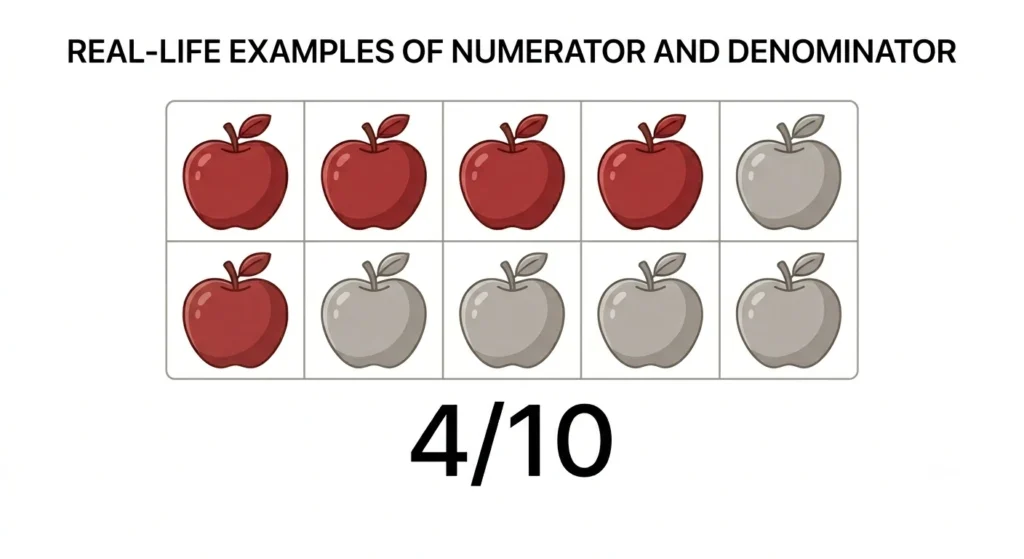
A bag has 10 pieces of fruit. 4 of them are apples.
The fraction of apples is: 4/10
- Denominator = 10 (total pieces of fruit)
- Numerator = 4 (pieces that are apples)
📚 Students in a Classroom
A class has 20 students. 12 of them finished their homework.
The fraction who finished is: 12/20
- Denominator = 20 (total students)
- Numerator = 12 (students who finished)
Notice a pattern? The denominator is always the whole group or the total, and the numerator is always the specific part you’re looking at.
How to Identify the Numerator and Denominator in Any Fraction
Here’s a simple two-step process you can use every time you see a fraction:
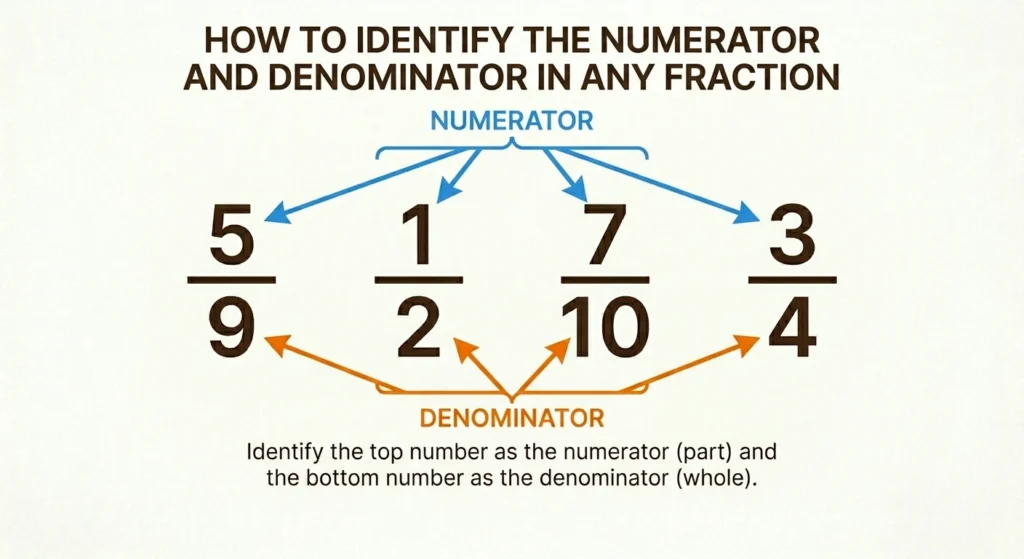
Step 1: Look for the fraction bar (the line between the two numbers).
Step 2: The number above the bar is the numerator. The number below the bar is the denominator.
Let’s practise with a few fractions:
- 5/9 → Numerator: 5, Denominator: 9
- 1/2 → Numerator: 1, Denominator: 2
- 7/10 → Numerator: 7, Denominator: 10
- 3/4 → Numerator: 3, Denominator: 4
Simple, right? The position tells you everything. Above = numerator. Below = denominator.”
Common Mistakes Students Make
When children first learn about numerators and denominators, a few mistakes come up again and again.
Being aware of these helps you catch and correct them early.
Mistake 1: Swapping the numerator and denominator
This is the most common error. A student sees 3/4 and calls 4 the numerator and 3 the denominator.
Fix: Remind them: “Top = numerator, bottom = denominator.” You can write it out and circle each one.
Mistake 2: Thinking the denominator is the answer
Some children confuse the denominator with the total number of parts taken. They think “the bottom number is what I have.”
Fix: Use a clear visual. Draw 4 equal boxes. Colour 3 of them. Ask: “How many boxes total? How many coloured?” The total (4) is the denominator; the coloured ones (3) are the numerator.
Mistake 3: Not understanding the “equal parts” rule
Children sometimes try to make fractions from shapes that aren’t divided equally. Half a circle might look like “one piece out of two” even if the pieces are different sizes — but that’s not a valid fraction.
Fix: Always emphasise the word equal. Before working on numerators and denominators, check that students understand what “equal parts” means.
Mistake 4: Thinking a larger numerator always means more
Students sometimes assume 3/4 is less than 1/2 because 3 > 1 but 4 > 2. This is a comparison misconception that comes later, but it’s rooted in not understanding what each number means.
Fix: Keep the focus on understanding what each number represents before moving on to comparing fractions.
Memory Tricks for Remembering the Difference
Here are two tricks that work really well, especially for younger learners.
Trick 1: “D is Down”
The word Denominator starts with the letter D, and so does Down. So the denominator is the one that goes down at the bottom of the fraction.
Denominator = Down
Once you remember that, the numerator must be on top. Easy!
Trick 2: The “Upstairs, Downstairs” House
Picture a fraction as a little house. The numerator lives upstairs; it’s the smaller, more specific number representing the parts you’re counting.
The denominator lives downstairs; it’s the big ground floor representing the whole, total number of parts.
Some teachers even draw a little house around the fraction to help kids visualise this. Try it!
Trick 3: “N is Number taken, D is Divided total”
- Numerator = the Number of parts you have
- Denominator = how many parts the whole was Divided into
This one works well for older students who want a meaning-based reminder.
How to Teach Numerator and Denominator to Kids
If you’re a parent, teacher, or tutor explaining this concept for the first time, here’s a simple approach that works beautifully.
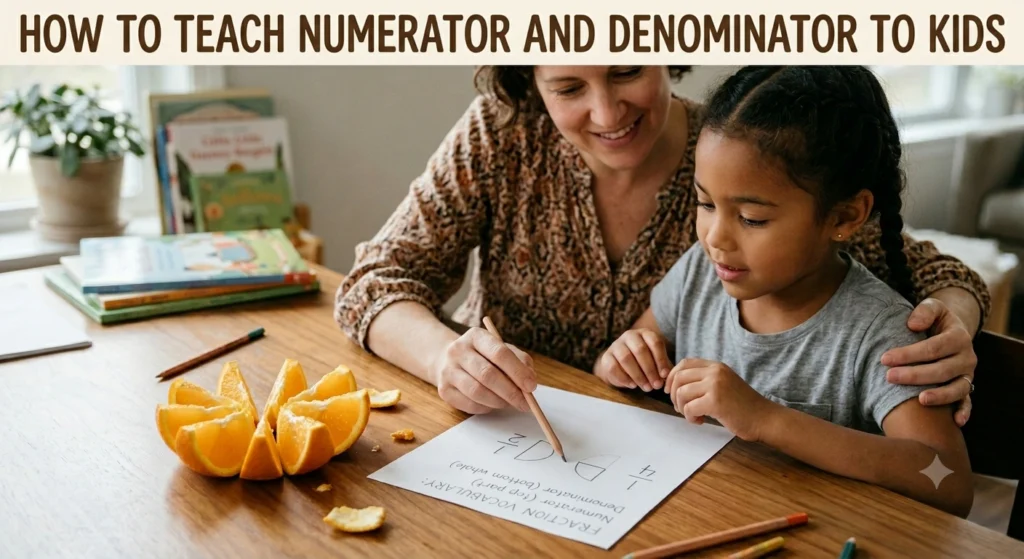
Step 1: Start with a real object
Don’t start with a written fraction. Start with something physical. (This same hands-on approach works brilliantly for teaching addition and subtraction for Class 1 familiar territory for most young learners before fractions arrive.)
A banana broken into pieces, an orange divided into segments, or a piece of paper folded and torn into equal strips.
Ask: “How many pieces do we have in total?” That total becomes the denominator.
Step 2: Take some away (or colour some)
Now select some of the pieces pick up 2 out of 4 orange segments, or colour 3 out of 5 squares on paper.
Ask: “How many did we take (or colour)?” That’s the numerator.
Step 3: Write the fraction together
Once they’ve seen it with their hands, write the fraction together. Help the child place the right number on top and the right number on bottom.
Say: “The part we took goes on top. The total pieces go on the bottom.”
Step 4: Name the parts
Now introduce the words. “The top number has a special name it’s called the numerator. The bottom number is called the denominator.”
Don’t introduce the vocabulary first. Build the concept with real objects, then name it.
Step 5: Practise with lots of examples
Use different objects, different contexts, different fractions. The more variety, the more confident the child will become.
Hands-On Activities for Home and Classroom
These simple activities reinforce numerator and denominator in a fun, memorable way.

Activity 1: Paper Folding Fractions
You need: a plain sheet of paper.
Fold the paper into equal parts (2, 3, or 4 folds). Open it up. Count the sections that’s the denominator. Colour in some of the sections.
Count the coloured ones, that’s the numerator. Write the fraction together.
This is incredibly effective because children create the fraction with their own hands.
Activity 2: Fraction Snack Time
Use any snack that comes in pieces crackers, grapes, orange segments, or raisins.
Count all the pieces (denominator). Ask your child to put some into a bowl (numerator). Write the fraction. Talk through what each number means.
Learning is stickier when it’s connected to food!
Activity 3: Fraction Walk
Go on a mini walk around the classroom or home. Find sets of objects: 5 books on a shelf with 2 standing upright, 8 crayons with 3 that are broken, 10 toys with 4 that are red.
For each set, write the fraction and identify the numerator and denominator. This shows children that fractions exist everywhere in real life.
Activity 4: Fraction Flip Cards
Write fractions on index cards (e.g., 2/5, 7/10, 1/3). On the back of each card, ask students to write or say:
- Which number is the numerator?
- Which number is the denominator?
- What does each number mean in this fraction?
This works well as a quick review game or confidence-builder before a test.
Activity 5: Draw Your Fraction
Give the child a fraction (like 3/5) and ask them to draw it. They must:
- Draw a shape and divide it into 5 equal parts (the denominator)
- Shade in 3 parts (the numerator)
Then ask them to write the fraction and explain each number. This combines writing, drawing, and explaining three powerful ways of reinforcing understanding.
Practice Questions
Try these on your own or use them with a student. Answers follow.
If you’d like more practice after this, our collection of word problems for kids includes fraction-based scenarios designed for beginner learners.
And if your student is ready to go deeper, check out our resource on number sense for Class 1 because fraction understanding grows directly from a strong number sense foundation.
1. In the fraction 5/8, what is the numerator and what is the denominator?
2. A watermelon is cut into 6 equal slices. You eat 2 slices. Write this as a fraction and identify the numerator and denominator.
3. Look at this fraction: 9/12. What does the 9 represent? What does the 12 represent?
4. A class of 30 students has 18 students who prefer maths over art. Write this as a fraction. Name the numerator and denominator.
5. True or False: In the fraction 7/10, the denominator is 7.
Answers:
- Numerator: 5 (the parts we’re counting). Denominator: 8 (the total equal parts).
- Fraction: 2/6. Numerator: 2 (slices eaten). Denominator: 6 (total slices).
- The 9 is the numerator the number of parts selected. The 12 is the denominator of the total equal parts.
- Fraction: 18/30. Numerator: 18 (students who prefer maths). Denominator: 30 (total students).
- False. The denominator is 10 (on the bottom). The numerator is 7 (on the top).
What is a numerator?
The numerator is the top number in a fraction. It tells you how many equal parts of the whole you are counting or considering.
What is a denominator?
The denominator is the bottom number in a fraction. It tells you how many equal parts the whole has been divided into.
What does the numerator tell us?
The numerator tells you how many of the total equal parts you’re talking about, how many have been taken, used, shaded, or selected.
Why is the denominator important?
The denominator defines the size of each part. Without it, you wouldn’t know how big or small the pieces are. A fraction of 1/2 is very different from 1/10, and it’s the denominator that makes that difference.
How do numerators and denominators work together?
Together, they give you the full picture of a fraction. The denominator creates the equal parts; the numerator counts them.
Can the numerator be larger than the denominator?
Yes! When the numerator is larger than the denominator (like 7/4), it’s called an improper fraction. This means you have more than one whole, which can also be written as a mixed number.
Where is the numerator located in a fraction? T
The numerator is always the number above the fraction bar (the top number).
Where is the denominator located in a fraction?
The denominator is always the number below the fraction bar (the bottom number).
What are the parts of a fraction?
A fraction has three parts: the numerator (top), the fraction bar (middle line), and the denominator (bottom).
How do you explain numerator and denominator to children?
Start with a physical object divided into equal parts (like a folded paper or sliced fruit). Count the total pieces (denominator) and the pieces selected (numerator). Write the fraction together, then introduce the vocabulary. Always build the concept before teaching the words.
Make Preparing for Math Olympiad Simple!



Conclusion
Understanding the numerator and denominator of a fraction is one of those foundational math skills that makes everything else easier.
Once you understand what each number in a fraction actually means, everything else falls into place.
The numerator (top) counts the parts you have; the denominator (bottom) tells you how many equal parts the whole was divided into. Keep that distinction clear, and fractions stop feeling scary.
Start there, use the memory tricks, and let the practice questions build their confidence one fraction at a time.

Mikha Piregu is a Content Writer with experience spanning educational content, including math and math olympiad topics, as well as advocacy writing, research-based articles, and SEO-driven web content. He creates high-quality blog content, web copy, and feature articles that support brand visibility, audience engagement, and long-term organic growth through data-informed storytelling. Skilled in WordPress, WooCommerce, and modern digital tools, Mikha adapts content across various platforms, including blogs, websites, campaigns, and advocacy initiatives, with clarity and purpose. You can reach out to him at [email protected].



There are no comments posted here yet.
Sign in to leave a comment