


The Indian Olympiad Qualifier in Mathematics (IOQM) 2026 syllabus primarily covers pre-college mathematics up to the Class 12 level, excluding Calculus. The paper carries 100 marks across 30 integer-answer questions in 3 hours, and there is no negative marking.
- What Is IOQM? Quick Overview
- IOQM Exam Pattern at a Glance
- Complete IOQM 2026 Syllabus: Topic-Wise Breakdown
- What Is Not in the IOQM Syllabus?
- IOQM Topic Weightage & Priority Chart
- IOQM Formula Sheet: Theorems Worth Knowing Cold
- Properties of 2026 Worth Knowing Before the Paper
- Is the IOQM Syllabus Different for Class 8, 9, 10, 11, and 12?
- IOQM Syllabus vs School Maths: Key Differences
- Is IOQM Harder Than JEE Advanced?
- How to Prepare the IOQM Syllabus: Topic-Wise Strategy
- Complete IOQM Preparation Roadmap
- IOQM Previous Year Papers and Chapter-Wise PYQ Practice
- What Counts as a Good IOQM Score?
- Best Books & Resources for IOQM Syllabus
- Common Mistakes Students Make While Preparing for IOQM
- Frequently Asked Questions About the IOQM Syllabus
- Conclusion
This syllabus applies to the 2026 (2026-27 session) IOQM exam, and it stays the same whether you are in Class 8 or Class 12. The topic list, chapters, and weightage below apply to every eligible class, so there is no separate “Class 9 syllabus” or “Class 11 syllabus” to hunt down.
The core areas of focus include Algebra, Geometry, Number Theory, and Combinatorics, testing advanced mathematical reasoning rather than standard rote memorization.
The IOQM 2026 syllabus looks simple on paper until you actually start preparing.
Dozens of subtopics you have never seen in school, no clear priorities, and problem styles that make NCERT feel like a warm-up.
This guide covers the IOQM syllabus, a full topic-wise (or chapter-wise, if that is the term you use) breakdown, difficulty labels, weightage, the marking scheme, exam-day rules, school-vs-IOQM gap analysis, past-year trends, a 6-month roadmap, and top books for each area.
What Is IOQM? Quick Overview
The Indian Olympiad Qualifier in Mathematics (IOQM) is the first stage in India’s Mathematical Olympiad selection process. That is also the IOQM full form, which is worth knowing because the exam is listed under several names across coaching sites and forums.
It is conducted jointly by the Mathematics Teachers’ Association (MTA) and the Homi Bhabha Centre for Science Education (HBCSE).
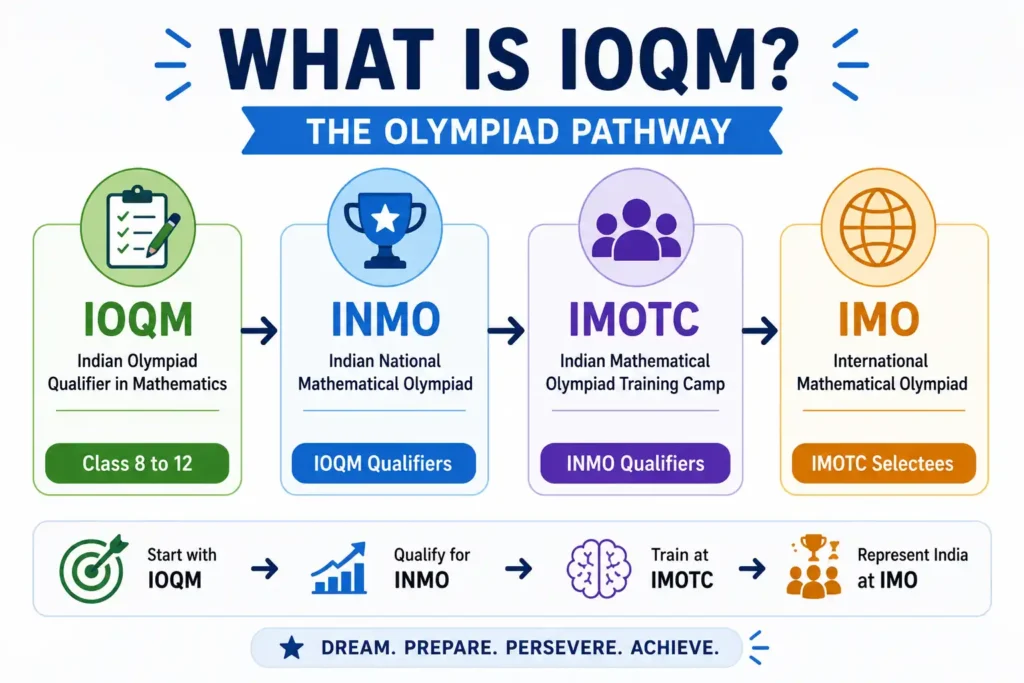
IOQM replaced the earlier RMO/Pre-RMO system to create a single, nationwide qualifying examination. So if you are wondering whether pre-RMO and IOQM are the same exam, the honest answer is that IOQM is the successor to Pre-RMO, and RMO now sits inside the same pipeline as a regional layer rather than as a separate entry point.
Where IOQM Fits in the Olympiad Pathway
These four stages are also commonly called the four levels of the Olympiad pipeline. So when people ask about IOQM levels, IOQM all stages, or how many stages IOQM has, they mean this same progression: IOQM, then INMO, then IMOTC, then IMO.
| Stage 1 | IOQM | Open to students in Classes 8-12. Top performers qualify for INMO. |
| Stage 2 | INMO (Indian National Mathematical Olympiad) | Top IOQM scorers are invited. Top ~30 qualify for the training camp. |
| Stage 3 | IMOTC (IMO Training Camp) | Intensive training; team of 6 selected for IMO. |
| Stage 4 | IMO (International Mathematical Olympiad) | India’s team competes globally. |
That also answers the common follow-up question about what comes after RMO or what the next exam is once you clear this stage. Each level narrows the field, and only the IOQM stage is open entry.
Want to understand how the full IMO qualification pipeline works, including how INMO fits in? Read our guide on how to prepare for the IMO.
IOQM Exam Pattern at a Glance
Before the syllabus itself, here is the IOQM exam pattern for 2026. Most of the questions people ask about marks distribution, paper pattern, and question type are answered in this single table.
| Parameter | Details |
|---|---|
| Duration | 3 hours |
| Total Questions | 30 |
| Total Marks | 100 |
| Question Types | Integer-answer problems (no multiple choice) |
| Marking Scheme | Questions 1-10: 2 marks each; Questions 11-20: 3 marks each; Questions 21-30: 5 marks each |
| Negative Marking | No |
| Eligibility | Students of Classes 8-12 (born on or after a specified cutoff date) |
IOQM Total Marks and Marking Scheme Explained
The IOQM total marks figure is 100. Because there is no negative marking, the full marks and the maximum marks for the paper are the same number, so 100 out of 100 is theoretically achievable.
Here is how those 100 marks are distributed, which is what most people mean when they search for IOQM marks distribution or the IOQM blueprint.
| Question Numbers | Marks per Question | Number of Questions | Total Marks |
|---|---|---|---|
| Q1 to Q10 | 2 marks | 10 | 20 |
| Q11 to Q20 | 3 marks | 10 | 30 |
| Q21 to Q30 | 5 marks | 10 | 50 |
| Overall | Mixed | 30 | 100 |
Two things follow from this table that students routinely miss. First, the last ten questions alone carry half the paper, so your 5-mark accuracy matters more than raw attempt count. Second, the first twenty questions carry 50 marks between them and are usually the faster ones, which means a clean, unhurried first hour is worth more than a heroic attempt at Q30.
Is There Negative Marking in IOQM?
No. IOQM has no negative marking, so there is no penalty for attempting a question and getting it wrong. This is one of the clearest differences from JEE, where a wrong answer actively costs you marks.
Practically, that means you should leave nothing blank. Even a reasoned guess on an integer-answer question is free, and on questions where you can bound the answer to a small range, an educated guess is better than an empty box.
Is IOQM MCQ or Subjective?
IOQM is neither MCQ nor fully subjective. It uses integer-answer questions, which sit between the two formats. Every question requires a non-negative integer answer that you calculate and write in, so there is no option list to eliminate from and no proof to write out either.
This is why the question “is IOQM objective or subjective” keeps getting conflicting answers online. The paper is objective in the sense that your answer is either right or wrong with no partial credit, but it is not multiple choice, so you cannot back-solve from given options. You only submit final numerical answers, not written solutions. Proof writing enters the picture at INMO, the next stage.
IOQM Exam Day Rules: Timing, Calculator and Geometry Box
A large share of last-minute questions have nothing to do with the syllabus and everything to do with exam-day logistics. Here is the short version.
| Question | Answer |
|---|---|
| How long is the paper? | 3 hours in a single sitting, with all 30 questions in one paper. |
| Is a calculator allowed? | No. IOQM is designed so that every answer is reachable by hand; calculators and smart devices are not permitted. |
| Is a geometry box or scale allowed? | Basic geometric instruments are generally permitted for rough construction, but you should confirm against the instructions printed on your admit card for the current cycle. |
| How do you record answers? | On an OMR-style answer sheet where you enter the digits of your integer answer. Practice filling one before exam day. |
| Is it computer based? | No. IOQM is a pen-and-paper exam conducted at designated centres. |
| Which classes can appear? | Classes 8 through 12, subject to the date-of-birth cutoff in the official notification. |
The paper tests deep conceptual understanding and creative problem-solving, not rote formulas. Every mark counts, and knowing which topics carry the most weight helps you allocate preparation time wisely.
Complete IOQM 2026 Syllabus: Topic-Wise Breakdown
The IOQM maths syllabus spans four pillars: Algebra, Number Theory, Geometry, and Combinatorics. These are also the four subjects, or chapters, most students mean when they ask what IOQM covers.
Below is the complete chapter-wise syllabus with explanations, difficulty classifications, and weightage indicators based on analysis of previous year papers (2023-2025).
Algebra
The IOQM algebra syllabus covers far more than what you see in school textbooks. While NCERT algebra stops at quadratic equations and basic sequences, IOQM expects you to work with inequalities, polynomials of higher degree, functional equations, and algebraic manipulation at a competition level.
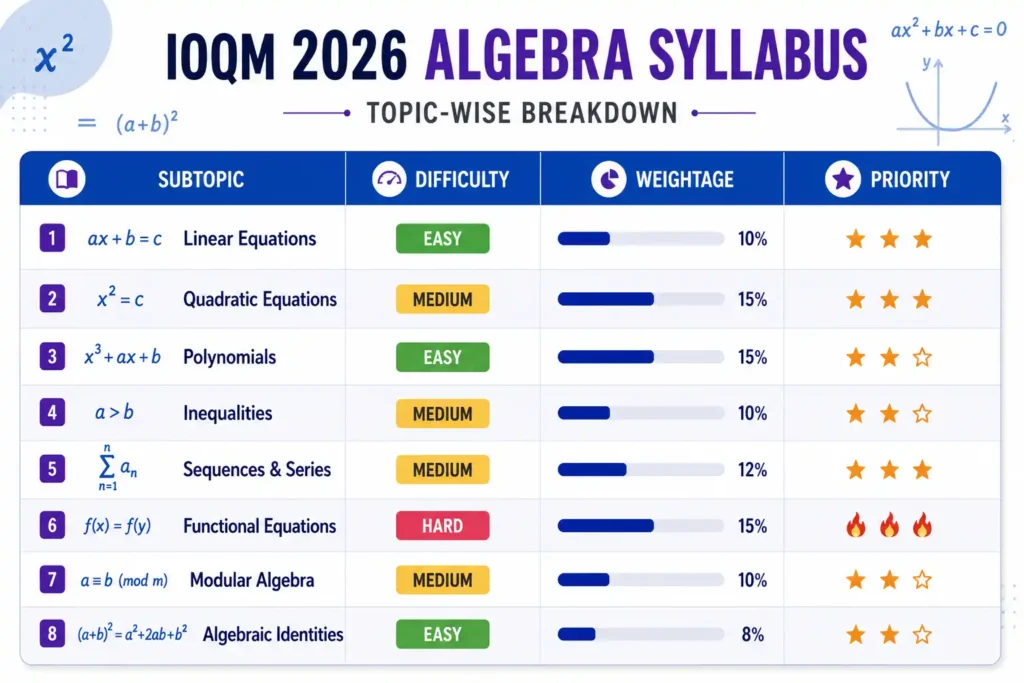
| Subtopic | What It Covers | Difficulty | Weightage | Key Concepts |
|---|---|---|---|---|
| Equations & Expressions | Solving systems of equations (linear and nonlinear), factoring complex expressions, symmetric expressions, substitution techniques | Beginner to Intermediate | Medium | Simon’s Favourite Factoring Trick, substitution, homogenization |
| Inequalities | AM-GM, Cauchy-Schwarz, Power Mean, Schur’s inequality, rearrangement inequality, proving and applying classical inequalities | Intermediate to Advanced | High | AM-GM applications, Cauchy-Schwarz in Engel form, bounding techniques |
| Polynomials | Roots and coefficients (Vieta’s formulas), irreducibility, polynomial division, factor/remainder theorems for higher degrees, symmetric polynomials | Intermediate | High | Vieta’s relations, root-finding, polynomial identities |
| Sequences & Series | Arithmetic and geometric progressions (beyond school level), telescoping series, recursive sequences, finding closed forms | Beginner to Intermediate | Medium | Telescoping, characteristic equation method, generating functions (introductory) |
| Functional Equations | Finding all functions satisfying given conditions, injectivity/surjectivity arguments, substitution strategies, Cauchy-type equations | Advanced | Medium | Substitution strategies, proving injectivity, Cauchy’s functional equation |
| Algebraic Identities & Manipulations | Sophie Germain identity, sum of cubes/powers, completing the square in advanced settings, algebraic number theory basics | Intermediate | Low to Medium | Standard identities, creative factorizations |
Key takeaway: Inequalities and polynomials are the highest-weightage algebra topics. If you are short on time, prioritize these over functional equations.
Number Theory
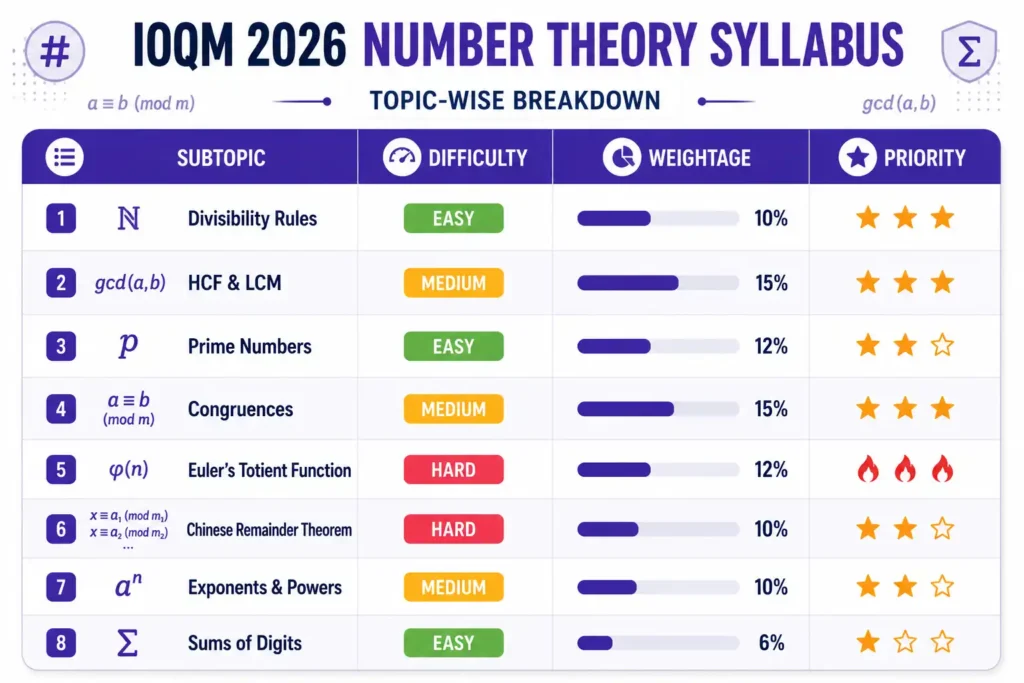
Number theory is the backbone of IOQM preparation. It appears consistently across all difficulty levels, from the opening 2-mark questions to the toughest 5-mark problems.
The IOQM number theory syllabus requires comfort with divisibility, primes, modular arithmetic, and Diophantine equations. Judged purely on number theory weightage in IOQM, modular arithmetic is the single most valuable chapter you can master.
| Subtopic | What It Covers | Difficulty | Weightage | Key Concepts |
|---|---|---|---|---|
| Divisibility | Divisibility rules, properties, divisor functions, perfect numbers, sum/count of divisors | Beginner | High | τ(n), σ(n), divisibility tricks, factor counting |
| Prime Numbers | Fundamental Theorem of Arithmetic, prime factorization, properties of primes, Bertrand’s Postulate (basic awareness) | Beginner to Intermediate | High | Unique factorization, prime decomposition, infinitude of primes |
| Modular Arithmetic | Congruences, Fermat’s Little Theorem, Euler’s theorem, Chinese Remainder Theorem (CRT), Wilson’s theorem, order of elements | Intermediate to Advanced | High | Fermat’s Little Theorem, CRT applications, modular inverses |
| GCD & LCM | Euclidean algorithm, properties of GCD/LCM, Bezout’s identity, applications in problem-solving | Beginner to Intermediate | Medium | Extended Euclidean algorithm, Bezout’s lemma |
| Diophantine Equations | Linear Diophantine equations, Pell’s equation (basic), Pythagorean triples, solving equations in integers | Intermediate to Advanced | Medium to High | Parametric solutions, infinite descent, modular argument to prove no solution |
| Number Theoretic Functions | Euler’s totient function φ(n), Möbius function (basic), Legendre symbol (introductory) | Advanced | Low to Medium | Totient properties, multiplicativity |
| p-adic Valuation / Lifting the Exponent | vₚ(n), LTE lemma applications | Advanced | Low | LTE lemma, valuation arguments |
Geometry
Geometry is often the area students underestimate, and the area where the most marks are lost.
The IOQM geometry syllabus demands a strong foundation in Euclidean geometry, circle theorems, and trigonometry applied to geometric problems. Coordinate geometry also appears, but synthetic (proof-based) geometry dominates, which is why geometry weightage in IOQM rewards angle chasing far more than formula recall.
| Subtopic | What It Covers | Difficulty | Weightage | Key Concepts |
|---|---|---|---|---|
| Triangles | Congruence and similarity, area formulas (Heron’s, shoelace), Stewart’s theorem, angle bisector theorem, mass point geometry, cevians | Beginner to Intermediate | High | Ceva’s theorem, Menelaus’ theorem, area ratios |
| Circles | Power of a Point, radical axes, cyclic quadrilaterals, tangent-secant relationships, Ptolemy’s theorem, inscribed angle theorem | Intermediate to Advanced | High | Power of a Point, Ptolemy’s inequality, cyclic quad properties |
| Coordinate Geometry | Distance, section formula, equations of lines/circles, locus problems, transformations in the coordinate plane | Intermediate | Medium | Shoelace formula, parametric representation, rotation/reflection |
| Trigonometry | Trigonometric identities applied to geometry, sine/cosine rule, trigonometric substitutions in geometric proofs, inverse trig (basic) | Intermediate | Medium to High | Sine rule, cosine rule, trig-cevian relations |
| Quadrilaterals & Polygons | Properties of special quadrilaterals, cyclic polygons, area of polygons, regular polygon properties | Intermediate | Medium | Brahmagupta’s formula, properties of cyclic/tangential quads |
| Geometric Transformations | Reflections, rotations, translations, homothety, spiral similarity, inversion (introductory) | Advanced | Low to Medium | Homothety, spiral similarity concepts |
| 3D Geometry (Basic) | Surface area and volume of solids, Euler’s formula for polyhedra, cross-sections | Beginner | Low | Euler’s polyhedron formula V – E + F = 2 |
Key takeaway: Triangles and circles are the highest-weightage geometry topics by a significant margin. Invest heavily in Euclidean geometry fundamentals before touching advanced topics like inversion.
Combinatorics
Combinatorics is the area that feels most different from school maths.
The IOQM combinatorics syllabus tests your ability to count systematically, construct clever arguments, and think logically about discrete structures. Many students find this the most challenging area because it relies less on formulas and more on ingenuity.
| Subtopic | What It Covers | Difficulty | Weightage | Key Concepts |
|---|---|---|---|---|
| Counting Principles | Addition and multiplication principles, complementary counting, overcounting and correction, systematic enumeration | Beginner | High | Bijection, complementary counting, constructive counting |
| Permutations & Combinations | Arrangements, selections, multiset permutations, distributions (stars and bars), derangements, circular permutations | Beginner to Intermediate | High | Stars and bars, derangements formula, inclusion-exclusion |
| Pigeonhole Principle | Basic and generalized pigeonhole, applications in number theory and geometry, extremal pigeonhole | Intermediate | High | Generalized PHP, Erdős-Szekeres theorem (basic) |
| Inclusion-Exclusion | Counting with overlapping sets, derangement derivation, sieve methods | Intermediate | Medium to High | PIE formula, applications to Euler’s totient |
| Recurrence Relations | Setting up recurrences, solving linear recurrences, Fibonacci-type problems | Intermediate | Medium | Characteristic equation, Fibonacci sequence properties |
| Graph Theory (Basic) | Graphs, trees, Euler/Hamiltonian paths, degree-sum formula, coloring problems, bipartite graphs | Intermediate to Advanced | Medium | Handshaking lemma, graph coloring, Ramsey-type problems (basic) |
| Combinatorial Identities & Arguments | Pascal’s identity, Vandermonde’s identity, double counting, combinatorial proofs | Intermediate | Low to Medium | Hockey stick identity, double counting technique |
| Probability (Discrete) | Basic probability, expected value, conditional probability, geometric probability (introductory) | Beginner to Intermediate | Low | Expected value, linearity of expectation |
Key takeaway: Counting principles, permutations and combinations, and the pigeonhole principle are the core of IOQM combinatorics. Do not skip graph theory. It appears more frequently than students expect.
What Is Not in the IOQM Syllabus?
Knowing the boundaries saves as much time as knowing the topics. Several chapters students assume are included are simply not tested.
| Topic | Status in IOQM | What This Means for You |
|---|---|---|
| Calculus | Not included | Limits, derivatives and integrals do not appear. If you are in Class 11 or 12 and used to JEE-style calculus, none of it transfers here. |
| Trigonometry | Included, but only as a tool | Trigonometry does come in IOQM, mainly through the sine rule, cosine rule and trigonometric substitutions inside geometry problems, not as a standalone chapter. |
| Coordinate geometry | Included, secondary | It appears, but synthetic geometry solutions are usually cleaner and score faster. |
| Statistics and data handling | Not tested | School-style statistics has no meaningful presence in the paper. |
| Matrices, determinants, vectors | Not tested | These are JEE and board topics, not Olympiad qualifier topics at this stage. |
| Formal proof writing | Not at this stage | IOQM asks for integer answers only. Proof writing becomes essential at INMO. |
This is also the clearest answer to whether the IOQM and JEE syllabus are the same. They overlap in algebra and trigonometry, but IOQM removes calculus entirely and adds modular arithmetic, combinatorial reasoning and Olympiad geometry that JEE never touches.
IOQM Topic Weightage & Priority Chart
Based on analysis of IOQM papers from 2023 to 2025, here is an approximate breakdown of how marks are distributed across the four major areas.
If you are specifically looking for the IOQM chapter wise weightage, the topic-wise weightage, or simply the weightage of chapters in IOQM, this table and the one below it are the most reliable references we have.
| Topic Area | Approximate Weightage (%) | Priority Level | Preparation Time Needed |
|---|---|---|---|
| Number Theory | 25-30% | Highest | 6-8 weeks |
| Geometry | 25-30% | Highest | 6-8 weeks |
| Combinatorics | 20-25% | High | 5-7 weeks |
| Algebra | 15-25% | High | 4-6 weeks |
Within Each Area: Highest Weightage Subtopics
| Area | Top 3 Subtopics by Frequency |
|---|---|
| Number Theory | Modular arithmetic, Divisibility, Diophantine equations |
| Geometry | Circles (cyclic quads, Power of a Point), Triangles (cevians, similarity), Trigonometric applications |
| Combinatorics | Counting & P/C, Pigeonhole principle, Inclusion-exclusion |
| Algebra | Inequalities, Polynomials (Vieta’s), Sequences |
The IOQM topic distribution is not fixed year to year, but Number Theory and Geometry have consistently been the dominant areas. A student who is strong in these two areas and decent in combinatorics is well-positioned to qualify.
If you only have time to cover a handful of high weightage chapters, work in this order: modular arithmetic, circle geometry, counting and pigeonhole, then inequalities and Vieta’s formulas. Those five cover a disproportionate share of a typical paper.
IOQM Formula Sheet: Theorems Worth Knowing Cold
There is no official IOQM formula sheet, and no single PDF covers everything. What actually helps is a short list of results you should be able to recall without thinking, because recognising when to apply them is the real skill.
| Area | Results to Know Cold | Typical Use |
|---|---|---|
| Number Theory | Fermat’s Little Theorem, Euler’s theorem and φ(n), Chinese Remainder Theorem, Wilson’s theorem, divisor count τ(n) and divisor sum σ(n) from prime factorization | Remainder questions, last-digit questions, counting divisors, proving no integer solutions exist |
| Algebra | AM-GM, Cauchy-Schwarz (including Engel form), Vieta’s formulas, Sophie Germain identity, telescoping sums, difference and sum of powers factorizations | Bounding a maximum or minimum, relating roots to coefficients, collapsing long sums |
| Geometry | Power of a Point, Ptolemy’s theorem, Ceva and Menelaus, angle bisector theorem, Heron and shoelace area formulas, Brahmagupta’s formula, Euler’s polyhedron formula | Length chasing, cyclic quadrilateral proofs, area ratio problems |
| Combinatorics | Stars and bars, inclusion-exclusion, derangement formula, pigeonhole in its generalized form, hockey stick and Vandermonde identities, handshaking lemma | Distribution counting, counting with restrictions, existence arguments |
Build this into a one-page sheet of your own as you study rather than downloading someone else’s. Writing the result down the first time you need it is what makes you recognise it again under time pressure.
Properties of 2026 Worth Knowing Before the Paper
Olympiad papers often slip the current year number into a question, so a few facts about 2026 are cheap to memorize and occasionally save a minute.
| Property | Value |
|---|---|
| Prime factorization | 2026 = 2 × 10¹³, and 1013 is prime |
| Number of divisors | 4 (namely 1, 2, 1013 and 2026) |
| Sum of divisors | 3042 |
| Euler totient φ(2026) | 1012 |
| Useful identity | 2026 = 45² + 1, since 2025 = 45² |
| Digit sum | 10, so 2026 is not divisible by 3 or 9 |
That 45 squared relationship is the one to remember. Year-flavoured problems often hide a difference of squares or a near-square structure.
Is the IOQM Syllabus Different for Class 8, 9, 10, 11, and 12?
No. The IOQM syllabus does not change by class.
Whether you are in Class 8 or Class 12, you sit the same paper, covering the same four areas (Algebra, Number Theory, Geometry, Combinatorics), in the same integer-answer format, with the same marking scheme described above. The IOQM question paper is the same for all classes.
What actually changes across classes is not the syllabus. It is how much of it you have already picked up in school, and how much runway you have before the exam.
| Class | School Foundation Already Covered | Biggest IOQM Gap | Realistic Prep Timeline |
|---|---|---|---|
| Class 8 | Basic algebra, early geometry | Modular arithmetic, inequalities, and most of combinatorics are new | 8-10 months |
| Class 9 | NCERT algebra and geometry basics | Number theory depth and advanced circle geometry are new | 7-9 months |
| Class 10 | Quadratics, coordinate geometry | Inequalities, functional equations, and graph theory are new | 6-8 months |
| Class 11 | Sequences, basic trigonometry | Olympiad-specific tools (Vieta’s, Power of a Point, pigeonhole) are new | 5-7 months |
| Class 12 | Full NCERT coverage, including trigonometry | Mostly gaps in modular arithmetic and combinatorial reasoning | 4-6 months |
So if you searched for an IOQM Class 8 syllabus, Class 9 syllabus, Class 10 syllabus, Class 11 syllabus or Class 12 syllabus expecting a different topic list, there is not one.
Use the topic-wise breakdown above regardless of your class, and adjust only your starting point and pace based on how much you have already covered in school.
Planning for the next cycle? The same applies to the 2027 syllabus. The four-area structure and the 100-mark pattern have been stable since IOQM replaced Pre-RMO, so anyone preparing for the 2026-27 or 2027-28 session can use this breakdown and simply re-check the official notification for dates and eligibility cutoffs.
IOQM Syllabus vs School Maths: Key Differences
One of the most common questions parents and students ask is this: how different is the IOQM syllabus from school maths?
The short answer is that it is very different in depth, approach, and difficulty.
| Concept | School / NCERT Level | IOQM Level | Difficulty Jump |
|---|---|---|---|
| Divisibility | Basic rules (2, 3, 5, 9, 11) | Divisor functions, perfect number properties, advanced factorization | Moderate |
| Modular Arithmetic | Not in NCERT syllabus | Fermat’s Little Theorem, CRT, modular inverses, order | Very High |
| Quadratic Equations | Solving with formula, basic word problems | Vieta’s formulas for higher-degree polynomials, root bounds, symmetric functions | High |
| Inequalities | Simple linear/quadratic inequalities | AM-GM, Cauchy-Schwarz, Schur’s, bounding arguments | Very High |
| Geometry | Basic theorems, area formulas, simple proofs | Power of a Point, Ceva/Menelaus, spiral similarity, homothety, radical axes | Very High |
| Combinatorics | Basic P & C formulas from Class 11 | Pigeonhole, inclusion-exclusion, graph theory, double counting, bijective proofs | Very High |
| Trigonometry | Identities, solving equations | Trig in geometric proofs, sine/cosine rule in advanced settings | High |
If you have been preparing for the SOF IMO and are wondering how IOQM compares, check our detailed SOF IMO vs IOQM comparison.
The jump in difficulty is significant.
Is IOQM Harder Than JEE Advanced?
In terms of problem-solving depth, yes. In terms of syllabus size and speed pressure, no. The two exams are hard in different directions, which is why comparing them with a single number never quite works.
| Dimension | IOQM | JEE Advanced |
|---|---|---|
| Syllabus breadth | Narrow: four areas, no calculus | Wide: full physics, chemistry and maths including calculus |
| Depth per question | Very high. One idea, deeply hidden | Moderate to high, but more standardized |
| What it rewards | Creative insight and construction | Speed, accuracy and pattern recognition at scale |
| Predictability | Low. Problems are designed to be unfamiliar | Higher. Question types repeat across years |
| Negative marking | None | Yes, on most question types |
| Answer format | Integer answers only | Mixed: MCQ, numerical, matching |
A JEE Advanced topper can score poorly on IOQM without Olympiad-specific practice, and a strong Olympiad student can struggle with JEE timing. The skill sets overlap but they are not interchangeable.
On the related question of how hard IOQM actually is on its own terms, treat the first ten questions as school-plus level, the middle ten as genuinely competitive, and the last ten as Olympiad proper. Most students who qualify do so by being clean and fast through the first twenty rather than by cracking the hardest problems.
How to Prepare the IOQM Syllabus: Topic-Wise Strategy
Number Theory Preparation
Study order: Divisibility, then Primes and Factorization, then GCD/LCM, then Modular Arithmetic, then Diophantine Equations, then advanced topics (totient, LTE).
Master first: Divisibility rules and factor counting, then modular arithmetic. This is non-negotiable because it appears everywhere.
Practice approach: Start with direct computation problems (find remainders, count divisors). Then move to proof-style problems like showing that n² + 1 is never divisible by 3. Previous IOQM questions on number theory are the best practice material.
Common mistakes: Students often skip modular arithmetic basics and jump straight to theorems like CRT. This leads to weak foundational understanding. Another mistake is not practicing enough Diophantine equation problems. They look simple but require careful casework.
Time allocation: 6-8 weeks, with 1.5-2 hours daily.
Geometry Preparation
Study order: Triangle basics (congruence, similarity, area), then circle theorems, then coordinate geometry, then trigonometric applications, then quadrilaterals, then transformations.
Master first: Angle chasing, similarity, and the basic circle theorems (inscribed angle, tangent-radius, Power of a Point). Without these, advanced problems are impossible.
Practice approach: Draw diagrams for every problem. Never try to solve geometry in your head. After solving, ask whether you could have solved it a different way. Geometry often has multiple solution paths (synthetic, coordinate, trigonometric), and seeing all of them builds flexibility.
Common mistakes: The biggest mistake is avoiding geometry altogether because it feels hard. Geometry is high-weightage and highly learnable. Structured practice yields fast improvement. Another mistake is relying too heavily on coordinate methods when synthetic approaches are cleaner.
Time allocation: 6-8 weeks, with 1.5-2 hours daily. Spend extra time on circles.
Combinatorics Preparation
Study order: Counting principles, then P & C, then inclusion-exclusion, then pigeonhole, then recurrences, then graph theory basics.
Master first: Systematic counting techniques (complementary counting, overcounting correction) and the pigeonhole principle. These form the foundation for everything else.
Practice approach: For every counting problem, try to solve it two ways, a direct approach and a complementary approach. For pigeonhole problems, always identify what the pigeons and the holes are before starting.
Common mistakes: Students memorize formulas (nCr, nPr) without understanding when to apply each technique. Combinatorics punishes formula-based thinking. Another mistake is ignoring graph theory, which has appeared in IOQM more frequently in recent years.
Time allocation: 5-7 weeks, with 1-1.5 hours daily.
Algebra Preparation
Study order: Algebraic manipulation, then sequences, then polynomials (Vieta’s), then inequalities, then functional equations.
Master first: Clean algebraic manipulation and Vieta’s formulas. These are prerequisites for nearly every algebra problem at IOQM level.
Practice approach: For inequalities, start by mastering AM-GM thoroughly. It handles 60-70% of IOQM inequality problems. Only then move to Cauchy-Schwarz and other advanced inequalities. For functional equations, practice substitution strategies (plug in 0, 1, -1, swap variables).
Common mistakes: Spending too much time on functional equations when they are less frequent than inequalities and polynomials. Also, not being comfortable with algebraic identity manipulation. This is a prerequisite skill, not a separate topic.
Time allocation: 4-6 weeks, with 1-1.5 hours daily.
How to Prepare for IOQM in Class 9, 10, 11 and 12
The syllabus is identical across classes, so what changes is sequencing and realistic load. Here is how to adapt the plan.
| Class | Where to Start | What to Protect |
|---|---|---|
| Class 8 and 9 | Divisibility and counting principles first, because they need the least school background. Add angle chasing early. | Do not rush into inequalities. Build arithmetic fluency and problem-reading habits instead. |
| Class 10 | Modular arithmetic and circle theorems, layered on top of your quadratics and coordinate geometry base. | Board exam term. Keep Olympiad practice to shorter, more frequent sessions. |
| Class 11 | Polynomials with Vieta’s and P & C, since school already introduced both. Then push into pigeonhole and Power of a Point. | This is usually the highest-yield year. Protect four to five sessions a week even during JEE coaching. |
| Class 12 | Straight to the gaps: modular arithmetic, combinatorial reasoning, Olympiad geometry. Skip anything already covered. | Time. With boards and entrance prep running, a compressed 4-month plan with heavy PYQ focus beats a broad syllabus sweep. |
Complete IOQM Preparation Roadmap
Here is a 6-month roadmap assuming you are starting from a strong school maths base but limited Olympiad experience.
| Phase | Timeline | Topics | Focus Area | Weekly Hours |
|---|---|---|---|---|
| Phase 1: Foundation | Months 1-2 | Divisibility, primes, triangle basics, counting principles, algebraic manipulation | Build core skills and learn Olympiad language | 8-10 hrs/week |
| Phase 2: Intermediate | Months 3-4 | Modular arithmetic, circle theorems, P&C, pigeonhole, inequalities, polynomials | Solve competition-level problems; develop stamina | 10-12 hrs/week |
| Phase 3: Advanced | Months 5-6 | Diophantine equations, geometric transformations, graph theory, functional equations, CRT, inclusion-exclusion | Timed practice, full mock tests, review weak areas | 12-15 hrs/week |
Phase 1 (Months 1-2): Foundation Building
Focus on learning the topics that school does not cover. Divisibility and basic number theory should be your first priority. They are the easiest to pick up and the most frequently tested.
In geometry, make sure you are comfortable with triangle congruence and similarity and basic angle chasing. In combinatorics, learn the counting principles. In algebra, practice clean manipulation.
Do not attempt hard problems yet. Solve many easy-to-medium problems to build fluency.
Phase 2 (Months 3-4): Intermediate Problem Solving
This is where the real IOQM preparation topics come into play. Learn modular arithmetic and circle theorems. These are the gateway to solving 3-mark and 5-mark problems.
Start attempting past IOQM papers, the easier questions first. Time yourself occasionally, but do not make speed the primary goal yet.
For practice strategies that work across all math competitions, check out our guide on how to get better at solving math Olympiad questions.
Phase 3 (Months 5-6): Advanced Concepts & Timed Practice
Cover the remaining advanced topics (Diophantine equations, geometric transformations, graph theory, functional equations). Shift your practice to full-length timed mock tests.
Analyze every mistake. Categorize errors as conceptual gaps, silly mistakes, or time management issues. Focus your remaining time on whichever category is costing you the most marks.
For specific techniques on maximizing your score, read our post on how to get full marks in maths Olympiad.
IOQM Previous Year Papers and Chapter-Wise PYQ Practice
Past papers are the highest-return study material available, and they are free. Once you have covered a chapter, the fastest way to test whether you actually own it is to pull every previous year question on that chapter and work through them in one sitting.
A practical way to run chapter-wise PYQ practice:
- Collect the last five to six IOQM papers along with Pre-RMO papers, which share the same integer-answer format.
- Tag every question by area (Algebra, Number Theory, Geometry, Combinatorics) and by subtopic.
- Solve them chapter by chapter first, untimed, so you can see which techniques repeat.
- Then re-solve full papers under 3-hour timing in the final two months.
- Keep a log of the questions you could not crack and revisit them after two weeks.
Doing this reveals the most repeated question types quickly. Remainder and last-digit problems, divisor counting, cyclic quadrilateral length chasing, stars-and-bars distributions and pigeonhole existence arguments show up in some form nearly every year.
Mock tests matter for a different reason. They train the decision of which question to abandon, which is the single most common cause of a disappointing score among students who knew enough to do better.
What Counts as a Good IOQM Score?
There is no fixed passing mark in IOQM. Qualification is based on a cutoff that MTA and HBCSE set each year, and it varies by class and by state or region, so the same score can qualify one year and fall short the next.
That said, students usually want a benchmark, so here is a realistic way to read your score out of 100.
| Score Band | What It Usually Means | What to Do Next |
|---|---|---|
| Below 20 | Foundations are still forming. You are likely solving the 2-mark band only. | Go back to divisibility, counting and angle chasing. Volume of easy problems beats difficulty at this stage. |
| 20 to 30 | A genuinely decent score for a first attempt, especially in Class 8 to 10. | Push into the 3-mark band: modular arithmetic and circle theorems are the usual unlock. |
| 30 to 50 | Competitive. Many qualifiers historically sit in this range depending on class and year. | Work on accuracy and timing. Losing 5 marks to a silly error is the main risk now. |
| Above 50 | Strong. You are solving into the 5-mark band. | Shift towards INMO-level preparation, including proof writing, which IOQM does not test. |
Because the cutoff moves, treat these bands as orientation rather than a promise. Always check the official cutoff announcement for your class and category once results are declared.
On the question of the highest marks ever scored, a perfect 100 is possible in principle since there is no negative marking, and a small number of students each year land in the very high range. It is not a useful target for planning. A consistent 35 to 45 with clean execution is a far more achievable goal for most serious candidates.
Best Books & Resources for IOQM Syllabus
| Topic Area | Book / Resource | Author | Best For | Difficulty Level |
|---|---|---|---|---|
| All Areas | Challenge and Thrill of Pre-College Mathematics | V. Krishnamurthy et al. | Building Olympiad foundations; Indian context | Beginner to Intermediate |
| All Areas | Problem Primer for the Olympiad | C.R. Pranesachar et al. | Structured practice with Indian Olympiad problems | Intermediate |
| All Areas | The Art and Craft of Problem Solving | Paul Zeitz | Developing problem-solving mindset | Intermediate to Advanced |
| Number Theory | Elementary Number Theory (excerpts) | David Burton | Comprehensive number theory coverage | Intermediate |
| Number Theory | 104 Number Theory Problems | Titu Andreescu | Focused competition practice | Intermediate to Advanced |
| Geometry | Euclidean Geometry in Mathematical Olympiads (EGMO) | Evan Chen | Modern, competition-focused geometry | Intermediate to Advanced |
| Geometry | Geometry Revisited | Coxeter & Greitzer | Classic geometric insight | Intermediate |
| Combinatorics | Principles and Techniques in Combinatorics | Chen Chuan-Chong & Koh Khee-Meng | Clear explanations of counting techniques | Beginner to Intermediate |
| Combinatorics | 102 Combinatorial Problems | Titu Andreescu | Competition-level practice | Intermediate to Advanced |
| Algebra | Polynomials (Springer) | E.J. Barbeau | Deep polynomial understanding | Intermediate |
| Algebra | Inequalities: A Mathematical Olympiad Approach | Radmila Bulajich Manfrino et al. | Competition-grade inequality skills | Intermediate to Advanced |
| Free Resource | Gonit App, IOQM topic-wise practice | Gonit | Structured daily practice, Olympiad-style problems | All Levels |
For beginners, start with Challenge and Thrill of Pre-College Mathematics and Problem Primer for the Olympiad. These are written for the Indian Olympiad context and cover exactly what you need.
For advanced students already comfortable with foundations, jump to the topic-specific books above.
A word on coaching modules. Allen, Arihant and similar publishers sell IOQM study material that is useful mainly for organized practice sets, but they are not a substitute for the classic Olympiad texts, which teach the reasoning style the paper actually rewards. If you are building short notes for revision, write them yourself from the books rather than downloading a ready-made PDF.
We also maintain a curated list of free math Olympiad training online resources if you are looking for additional free material.
Common Mistakes Students Make While Preparing for IOQM
1. Ignoring Geometry. Geometry carries 25-30% of the total marks, yet many students avoid it because it feels less formulaic. This is a costly mistake. Geometry is highly learnable with structured practice. Dedicate time to it from Day 1.
2. Weak Combinatorics Preparation. Students who come from a JEE-preparation background often treat combinatorics as P&C formulas. IOQM combinatorics is far more about logical reasoning: pigeonhole arguments, double counting, and constructive proofs. Approach it with a problem-solving mindset, not a formula sheet.
3. Memorizing Instead of Problem-Solving. IOQM does not test whether you know theorems. It tests whether you can use them creatively. Memorizing Fermat’s Little Theorem is useless if you cannot recognize when a problem requires modular arithmetic. Solve problems. Do not just read theory.
4. Not Practicing Previous Year Questions. Past IOQM papers are the single best predictor of what you will face. Students who skip them miss out on understanding the exam’s style, difficulty progression, and frequently tested patterns. You can find a breakdown of common problem types in our Math Olympiad questions guide.
5. Studying Topics in the Wrong Order. Jumping to functional equations before mastering basic algebra, or attempting geometric transformations before understanding circle theorems, leads to frustration and wasted time. Follow the study order recommended in each topic section above.
6. Underestimating Number Theory Depth. Number theory looks deceptively simple at first (divisibility rules, primes). But IOQM tests it at depth. Modular arithmetic problems can be quite challenging, and Diophantine equations require careful reasoning. Do not assume you are done with number theory after covering the basics.
7. Not Timing Practice Sessions. IOQM gives you 3 hours for 30 questions. Time pressure is real, especially on the 5-mark problems. Start incorporating timed practice from Month 3 onward.
8. Treating No Negative Marking as Permission to Guess Blindly. There is no penalty, so you should fill every box. But guessing early wastes the minutes you needed for a question you could have solved. Guess at the end, not in the middle.
Frequently Asked Questions About the IOQM Syllabus
What is the IOQM syllabus for 2026?
The IOQM 2026 syllabus covers four major areas: Algebra (equations, inequalities, polynomials, sequences, functional equations), Number Theory (divisibility, primes, modular arithmetic, Diophantine equations), Geometry (triangles, circles, coordinate geometry, trigonometry, transformations), and Combinatorics (counting principles, permutations and combinations, pigeonhole principle, graph theory, inclusion-exclusion). The syllabus is based on pre-college mathematics and goes significantly beyond the NCERT curriculum.
What is the full form of IOQM?
IOQM stands for Indian Olympiad Qualifier in Mathematics. It is the first stage of the national mathematical Olympiad selection process, conducted jointly by the Mathematics Teachers’ Association and the Homi Bhabha Centre for Science Education.
How many questions and marks does IOQM have in total?
IOQM has 30 questions for a total of 100 marks. Questions 1-10 carry 2 marks each, questions 11-20 carry 3 marks each, and questions 21-30 carry 5 marks each. There is no negative marking, so the full marks and the maximum marks for the paper are the same number, 100.
Is there negative marking in IOQM?
No. IOQM 2026 has no negative marking, so there is no penalty for attempting a question and getting it wrong. This is different from JEE, where an incorrect answer costs you marks. Attempt every question you have a reasonable idea about, since a wrong answer does not cost you anything.
Is IOQM MCQ based or subjective?
IOQM is not MCQ-based. It uses integer-answer questions, where you work out a numerical answer and write it in directly. There are no answer choices to pick from or eliminate, and no written proof is required either, so the paper rewards actual problem-solving over educated guessing.
What is the IOQM paper pattern?
One paper, 3 hours, 30 integer-answer questions worth 100 marks in total, no negative marking, and the same paper for every eligible class. Answers are entered on an OMR-style sheet rather than written out as solutions.
Is the IOQM syllabus different for Classes 8, 9, 10, 11, and 12?
No. IOQM does not have a separate syllabus for each class. Every eligible student, from Class 8 through Class 12, is tested on the same four areas from the same paper. Preparation time needed varies by class, but the topic list stays the same.
Which topic has the highest weightage in IOQM?
Number Theory and Geometry consistently carry the highest weightage, each accounting for approximately 25-30% of total marks. Combinatorics follows at 20-25%, and Algebra at 15-25%. Within these areas, modular arithmetic, circle geometry, and counting and pigeonhole problems are the most frequently tested subtopics.
Which topic is hardest in IOQM?
Most students find Geometry the hardest area because it requires spatial visualization and proof-construction skills that school maths does not develop. Combinatorics is a close second because it relies on ingenuity rather than standard methods. Difficulty is subjective, though. A student strong in visual thinking may find geometry easier than abstract number theory problems.
Does IOQM include calculus or trigonometry?
Calculus is not part of the IOQM syllabus at all. Trigonometry is included, but as a tool inside geometry problems, mainly the sine rule, cosine rule and trigonometric substitutions, rather than as a standalone chapter.
Is IOQM harder than JEE Maths?
Yes, in terms of problem-solving depth. JEE tests speed and breadth across a wider syllabus including calculus, which IOQM does not cover. IOQM tests creative mathematical thinking on a narrower syllabus. A JEE Advanced topper might score poorly on IOQM without specific Olympiad preparation, and vice versa. The skill sets overlap but are not identical.
What is a good score in IOQM?
There is no fixed passing mark, since the cutoff changes by year and class. As a rough guide, 20 to 30 is a solid first attempt for younger students, 30 to 50 is competitive, and above 50 is strong. Always check the official cutoff released after results for the definitive answer.
What are the different levels or stages of IOQM?
IOQM sits at Stage 1 of a four-level pipeline. Stage 1 is IOQM itself, Stage 2 is INMO (Indian National Mathematical Olympiad), Stage 3 is the IMOTC (IMO Training Camp), and Stage 4 is the IMO (International Mathematical Olympiad), where India’s selected team competes globally. Each level narrows the field further.
Is a calculator allowed in IOQM?
No. Calculators and electronic devices are not permitted. Every problem is designed to be solvable by hand, and heavy computation is usually a sign that you have missed a cleaner approach.
Can I complete the IOQM syllabus in 6 months?
Yes, 6 months is sufficient if you study 8-15 hours per week with a structured plan. This guide’s preparation roadmap is designed for exactly this timeline. Students with prior Olympiad exposure or strong school maths foundations may need less time. Complete beginners should ideally start 8-10 months before the exam.
Can a Class 8 student prepare for IOQM?
Absolutely. Class 8 students are eligible and can certainly prepare for it. The key is foundation-building: learn the topics school has not covered yet (modular arithmetic, basic combinatorics, Euclidean geometry beyond NCERT) and gradually build up to competition-level problems. A Class 8 student with 10-12 months of structured preparation can perform well. Starting early also gives you multiple attempts before Class 12.
How is the IOQM syllabus different from school maths?
The IOQM syllabus goes far beyond NCERT in both depth and approach. Topics like modular arithmetic, Diophantine equations, Power of a Point, pigeonhole principle, and functional equations are not covered in school at all. Even overlapping topics are tested at a much higher level of complexity. School maths rewards memorization and procedure. IOQM rewards creative problem-solving and mathematical reasoning.
What are the best books for IOQM preparation?
For beginners: Challenge and Thrill of Pre-College Mathematics and Problem Primer for the Olympiad. For intermediate students: The Art and Craft of Problem Solving by Paul Zeitz. For topic-specific depth: EGMO by Evan Chen for geometry, 104 Number Theory Problems by Titu Andreescu for number theory, and Principles and Techniques in Combinatorics by Chen and Koh for combinatorics.
Will the IOQM 2027 syllabus be different?
There is no indication that it will be. The four-area structure and the 100-mark integer-answer pattern have been stable since IOQM replaced Pre-RMO, so this breakdown is a reliable base for the 2026-27 and 2027-28 cycles. Re-check the official notification each year for dates and eligibility details.
Is there a PDF version of the IOQM syllabus?
MTA and HBCSE do not release a single official syllabus PDF. This page is built to work as the closest equivalent: every topic, difficulty level, and weightage is laid out in one place, so you can bookmark or print it instead of hunting for a scattered PDF.
Make Preparing for Math Olympiad Simple!



Conclusion
The IOQM syllabus 2026 covers a lot of ground, but every topic in this guide is ranked by priority so you do not waste time on the wrong things.
Focus on Number Theory and Geometry first. They carry over half the marks. Layer in Combinatorics and Algebra using the study order above. Then shift to timed mock tests in your final two months.
Keep the exam pattern in view while you plan: 30 questions, 100 marks, 3 hours, integer answers, and no negative marking. That structure rewards clean execution on the first twenty questions far more than heroics on the last ten.

Mikha Piregu is a Content Writer with experience spanning educational content, including math and math olympiad topics, as well as advocacy writing, research-based articles, and SEO-driven web content. He creates high-quality blog content, web copy, and feature articles that support brand visibility, audience engagement, and long-term organic growth through data-informed storytelling. Skilled in WordPress, WooCommerce, and modern digital tools, Mikha adapts content across various platforms, including blogs, websites, campaigns, and advocacy initiatives, with clarity and purpose.




There are no comments posted here yet.
Sign in to leave a comment