


The Official Math Kangaroo past papers and sample questions are free on the Math Kangaroo USA site, with answer keys and free sample questions by grade level.
- Where to find official Math Kangaroo past papers
- How Math Kangaroo works in 2026
- How Math Kangaroo differs from the AMC
- How young children should practice without burnout
- A gentle weekly practice routine by grade band
- What the scores and awards mean
- Free past papers vs. a structured practice sequence
- Final thoughts
- Related guides
The 2026 contest was Thursday, March 19, 2026, and for young children, 15–30 minutes of playful practice a few times a week is plenty.
This guide walks you through where to find official past papers, how Kangaroo differs from the AMC pathway you may have read about, and a gentle weekly routine you can actually stick to without burnout.
Where to find official Math Kangaroo past papers
Math Kangaroo USA publishes a generous library of free practice material.
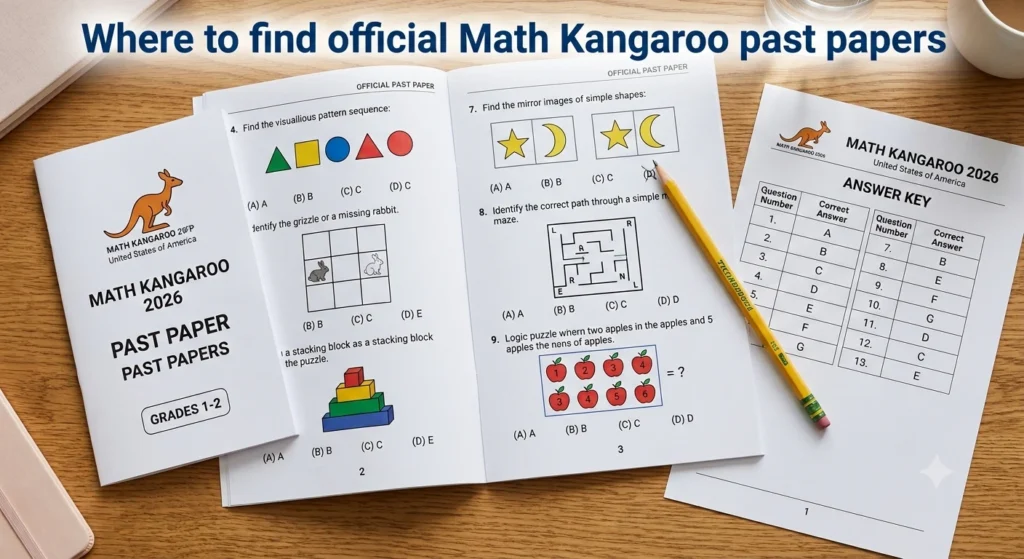
You don’t need to buy anything to get started. Bookmark these three pages.
- Free sample questions by grade — short sets of representative problems, organized by grade level. This is the best place to start if your child has never seen Kangaroo before.
- Past PDF exams — full past papers your child can attempt under realistic timing.
- Answer keys — solutions for each past paper, so you can check work together.
A note on copyright: please don’t redistribute these PDFs or share them outside your family. Math Kangaroo USA, NFP, a nonprofit run with the International Math Kangaroo Committee, makes them free so families can practice and link friends to the official pages instead.
For paid practice, the official store sells past-paper booklets organized by year and level. They’re inexpensive and well-edited, but the free PDFs are plenty for most families.
Math Kangaroo practice by grade level
Different grade bands need different kinds of support, since the exam content and reading demands shift a lot between grades 1–4 and grades 5–12:
- Grades 1–2: Focus on picture-based problems, counting, shapes, and simple patterns. Read questions aloud rather than expecting independent reading.
- Grades 3–4: Introduce timed mini-sets (10–15 minutes) and light word-problem practice.
- Grades 5–8: Mix past papers with topic-specific practice (fractions, ratios, basic geometry, logic puzzles).
- Grades 9–12: Past papers become the main tool, alongside light exposure to AMC-style problems for students who want more challenge.\
How Math Kangaroo works in 2026
Before you dive into practice, it helps to know exactly what your child will face on contest day.
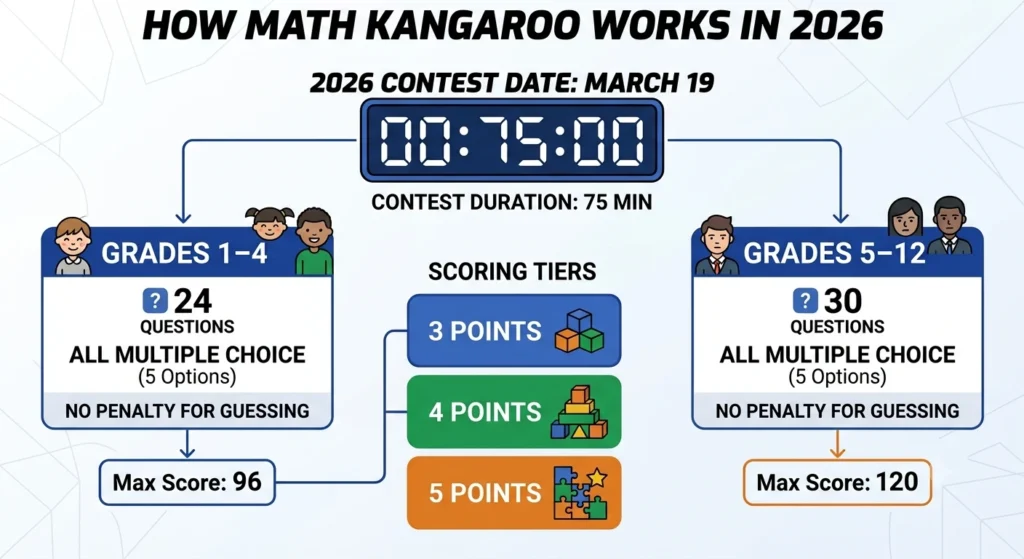
Here are the rules, verified against the official Math Kangaroo FAQ.
- 2026 contest date: Thursday, March 19, 2026 (always the third Thursday of March).
- 2027 registration: the registration window typically opens in mid-September and runs through late December, with a late-registration period in January. Confirm the exact 2027 dates on the official Math Kangaroo USA site once they’re published.
- Time limit: 75 minutes.
- Format: all multiple choice, five answer options per question.
- Grades 1–4: 24 questions, maximum score 96.
- Grades 5–12: 30 questions, maximum score 120.
- Scoring tiers: one-third of questions are worth 3 points (easier), one-third 4 points (medium), one-third 5 points (harder).
- No penalty for wrong answers. If your child isn’t sure, they should guess.
- Eligibility: grades 1 through 12. Kindergarten students may participate at the grade 1 level.
- Fees: approximately $18 for regular registration and $35 for late registration, with a remote option around $28 (confirm current fees on the official site, as they can change each year).
The “no penalty” rule is the single most important thing to tell your child before contest day.
They should answer every question, even if it means a thoughtful guess on the last few. Leaving a question blank is a guaranteed zero; a guess has a 20% shot.
Is Math Kangaroo hard?
Most kids find Math Kangaroo more approachable than a typical school test because the questions lean on logic, pattern recognition, and visual reasoning rather than heavy computation or memorized formulas.
That said, the last few questions in each scoring tier are intentionally trickier since they’re designed to challenge even strong students.
If your child is working at or slightly above grade level, the exam should feel doable with modest practice, not overwhelming.
How Math Kangaroo differs from the AMC
How Math Kangaroo differs from the AMC and other math olympiads
Many parents arrive at Math Kangaroo after hearing about the AMC (American Mathematics Competitions, run by the MAA), or after researching options such as SOF IMO, Silverzone, or IOQM for older students.
They’re all valuable, but they serve very different ages and purposes.
| Feature | Math Kangaroo | AMC 8 |
|---|---|---|
| Grades | 1–12 (K participates as grade 1) | Grade 8 and below |
| Contest date | 3rd Thursday of March | Late January |
| Questions | 24 (grades 1–4) / 30 (grades 5–12) | 25 |
| Time | 75 minutes | 40 minutes |
| Scoring | 3/4/5-point tiers, no penalty | 1 point per correct, 0 otherwise |
| Vibe | Accessible, playful, broad participation | Competitive, start of the AMC → AIME → USAMO pathway |
| Awards | Plush kangaroos, ribbons, medals, summer camps | Honor Roll, Distinguished Honor Roll |
If your child is in grade 5 or below, Math Kangaroo is almost certainly the better starting point since it’s designed for them.
If they’re in grades 6–8 and loving it, you can add the AMC 8 the following winter; the two contests rhyme nicely.
Families exploring the broader math olympiad landscape for elementary and middle schoolers often also compare Math Kangaroo against SOF IMO and Silverzone’s IOM; see our guide on the difference between Math Olympiad and Kangaroo Math for a full side-by-side.
How young children should practice without burnout
Here is the most important section of this guide. Math contest burnout in elementary-school kids is real, and it almost always comes from parents (lovingly) over-scheduling practice.
A child who dreads Saturday morning “Kangaroo prep” will not perform better than one who looks forward to fifteen minutes of puzzles before bed.

A few principles that work:
- Short sessions, often. Two or three 15–30 minute sessions per week beat one long weekend cram. Young brains consolidate problem-solving patterns during rest.
- Mix media. Some sessions are paper past papers. Some are an app on the couch. Some are a logic puzzle book at breakfast. Variety keeps it fresh.
- Talk through one problem together. Instead of grading a stack, pick the one problem your child found hardest and walk through it on a whiteboard. The “aha” matters more than the score.
- Skip the leaderboard talk. Don’t mention medals, top-3 state, or what other kids scored. Save awards for after the contest.
- Stop when it stops being fun. If your child groans, end the session. Always leave them wanting one more problem, not less.
- Read the question aloud for grades 1–2. Many young kids have the math skills but not the reading stamina. Reading aloud removes a barrier that has nothing to do with math.
If your child says “I don’t get it” three times in a row, the material is too hard, not them. Step down a grade level on the official sample questions page and rebuild confidence.
Building general problem-solving skills and comfort with word problems alongside Kangaroo-specific practice tends to help even more than drilling past papers alone.
A gentle weekly practice routine by grade band
Use this as a starting point and adjust to your child’s energy. The point is consistency over intensity.
| Grade band | Questions on test | Max score | Suggested practice per week | What to focus on |
|---|---|---|---|---|
| Grades 1–2 | 24 | 96 | 15–20 min, 2× per week | Picture puzzles, counting patterns, simple shapes |
| Grades 3–4 | 24 | 96 | 20–30 min, 2–3× per week | Logic puzzles, simple geometry, number patterns |
| Grades 5–6 | 30 | 120 | 30 min, 3× per week | Multi-step word problems, fractions, basic geometry |
| Grades 7–8 | 30 | 120 | 30–45 min, 3× per week | Pre-algebra, geometry, simple combinatorics |
Eight weeks out from the contest, mix in one timed full past paper every other weekend. Use a kitchen timer, sit at a real table, and let your child experience 75 minutes of focused work. Review only the problems they got wrong or skipped.
Two weeks out, stop introducing new topics. Re-do problems they previously struggled with. Confidence beats novelty in the final stretch.
For a step-by-step preparation timeline, see our companion guide on how to prepare for Math Kangaroo.
Building core skills that support Math Kangaroo success
A lot of Math Kangaroo readiness actually comes from everyday elementary math fluency, not contest-specific drilling. Depending on your child’s grade, it can help to shore up:
- Number sense and number ordering
- Skip counting and forward and backward counting
- Fractions and numerator/denominator basics
- Geometry and shapes for pattern and spatial-reasoning questions
- Spatial understanding more broadly, since several Kangaroo questions are visual rather than numeric
These foundational skills pay off across Math Kangaroo, SOF IMO, and regular classroom math alike.
What the scores and awards mean
Every participant receives a certificate of participation and a small gift, there are no “losers” at Math Kangaroo, which is part of why so many families love it.
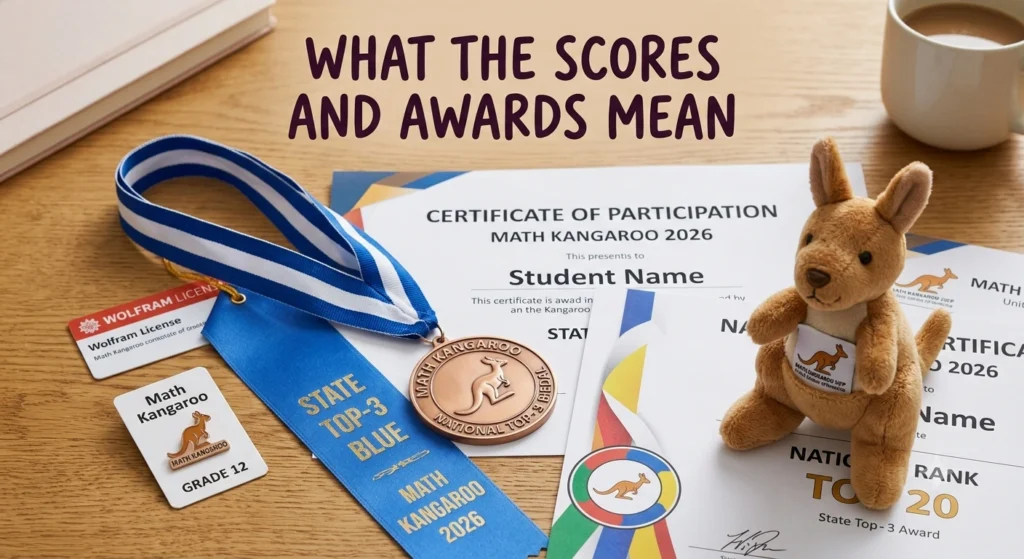
Beyond that, the official awards page lists a generous set of recognitions:
- Gold, Silver, and Bronze medals to the top 3 scorers nationally per grade level.
- Plush kangaroos to the top 10 scorers in grades 1–11; a Math Kangaroo Keepsake for the top 10 in grade 12.
- Wolfram licenses for top 20 scorers in grades 6–12.
- State Blue, Red, and White ribbons for the top 3 in each state per grade level.
- College grants for graduating high school seniors.
- International Math Camp at Zakopane, Poland (10 students) and the Asia Camp at Boao, China (16 students).
For perspective, the 2026 cycle drew 60,504 participants (up from 53,562 in 2025), with roughly 7,650 students earning National Top-20 placements and about 2,180 earning State Top-3 finishes across all grades.
Awards are common; set expectations with your child that participating is the win, and anything beyond is a happy bonus. For more on what your child can earn, see our guide to Math Kangaroo prizes and awards.
Free past papers vs. a structured practice sequence
Past papers are wonderful, but they’re a pile of problems, not a curriculum.
Here’s how the two approaches compare.
| Free past papers | Structured practice app | |
|---|---|---|
| Best for | Realistic timed simulation | Daily skill-building |
| Difficulty progression | None (mixed difficulty) | Gradual, grade-matched |
| Feedback | Answer key only | Hints and explanations |
| Consistency | Depends on parent scheduling | Built-in daily habit |
The honest answer is that you want both. Use past papers for realistic timed runs in the final weeks. Use a structured app for the steady, daily practice that builds the underlying skills.
Want a calmer way to practice than a stack of PDFs? Gonit gives your child a structured, age-appropriate sequence of Kangaroo-style problems one short session at a time, with hints when they get stuck. The problems are everywhere; the sequence isn’t. Start free on iOS and Android →
Q: My child is in kindergarten. Can they participate?
Yes. Kindergarten students are welcome to register and participate at the grade 1 level. Read questions aloud, sit nearby for support, and treat it as a fun outing. Many K students enjoy the puzzles even if they don’t finish all 24.
Q: Is there negative marking on Math Kangaroo?
No. There is no penalty for incorrect answers. Tell your child to answer every question — a guess is always better than a blank, since the test is multiple choice with five options.
Q: How many past papers should my child do before the contest?
For grades 1–4, two or three full past papers in the final month is plenty. For grades 5–8, aim for four to six full past papers across the final eight weeks, spaced out so you can review mistakes between sessions. More than that and you risk burnout.
Q: My child is anxious about the contest. What should I do?
Lean into the “no penalty, just try” framing. Practice at home with the same 75-minute timer so contest day feels familiar, not foreign. On contest morning, eat a real breakfast, arrive early, and remind them that every participant gets a certificate and a small gift. For more on what to expect on the day, see our guide to Math Kangaroo participation.
Q: Where can I find Math Kangaroo practice worksheets for free?
The official Math Kangaroo USA site offers free sample questions by grade and downloadable past PDF exams with answer keys, no purchase needed. Apps like Gonit supplement these with daily, hint-guided practice sets.
Q: What is a good Math Kangaroo score?
There’s no single universal “passing” score, since scoring is norm-referenced by grade and year. Roughly speaking, correctly answering half to two-thirds of the questions with reasonable accuracy on the harder tier puts a child in a solid, competitive range, but the certificate and experience matter more than the number for most families.
Make Preparing for Math Olympiad Simple!



Final thoughts
Math Kangaroo works best when it stays what it was designed to be: a fun, low-stakes day that gets kids excited about problem-solving rather than anxious about a score.
Free official past papers and sample questions give you everything you need to start, and a short, consistent practice rhythm (not long cram sessions) is what actually builds confidence between now and March 19, 2026.
Whether you stick with printed past papers, add a structured app like Gonit for daily practice, or mix both, the goal is the same: help your child enjoy the puzzles enough to want to do one more.
Related guides
- How to prepare for Math Kangaroo, a full preparation timeline
- Math Kangaroo prizes and awards, what your child can earn
- Math Kangaroo participation, what contest day looks like
- What is Kangaroo Math?, a beginner-friendly overview
- Difference between Math Olympiad and Kangaroo Math
- How to prepare for the Junior Math Olympiad

Mikha Piregu is a Content Writer with experience spanning educational content, including math and math olympiad topics, as well as advocacy writing, research-based articles, and SEO-driven web content. He creates high-quality blog content, web copy, and feature articles that support brand visibility, audience engagement, and long-term organic growth through data-informed storytelling. Skilled in WordPress, WooCommerce, and modern digital tools, Mikha adapts content across various platforms, including blogs, websites, campaigns, and advocacy initiatives, with clarity and purpose.




There are no comments posted here yet.
Sign in to leave a comment