


To improve your problem-solving skills for the International Mathematical Olympiad (IMO), you must shift from memorizing formulas to building a structured mental toolkit and practicing deep analytical reflection
- Why You Are Not Improving Despite Studying Theory
- How to Improve Problem Solving Skills for the IMO
- Advanced Problem-Solving Strategies Beyond the School Curriculum
- How to Move from School Maths to Olympiad Problem Solving
- Structured Training Programs and Practice Tests
- A Weekly Practice Routine
- Frequently Asked Questions
- Key Takeaways
How to improve problem-solving skills for IMO comes down to one habit: solve hard problems you cannot immediately do, sit with them long enough to find a method yourself, and log why each failure happened.
That distinction is the reason most students plateau. They study more theory, their topic knowledge improves, and their competition scores do not move. This guide covers why that happens, the techniques that close the gap, and a weekly routine you can actually keep.
Why You Are Not Improving Despite Studying Theory
If you know the theory but still cannot solve olympiad problems, the problem is not knowledge. It is that you have never practised the part of the work that olympiads actually test: deciding what to try when nothing obvious applies.
School maths and olympiad maths train two different things.
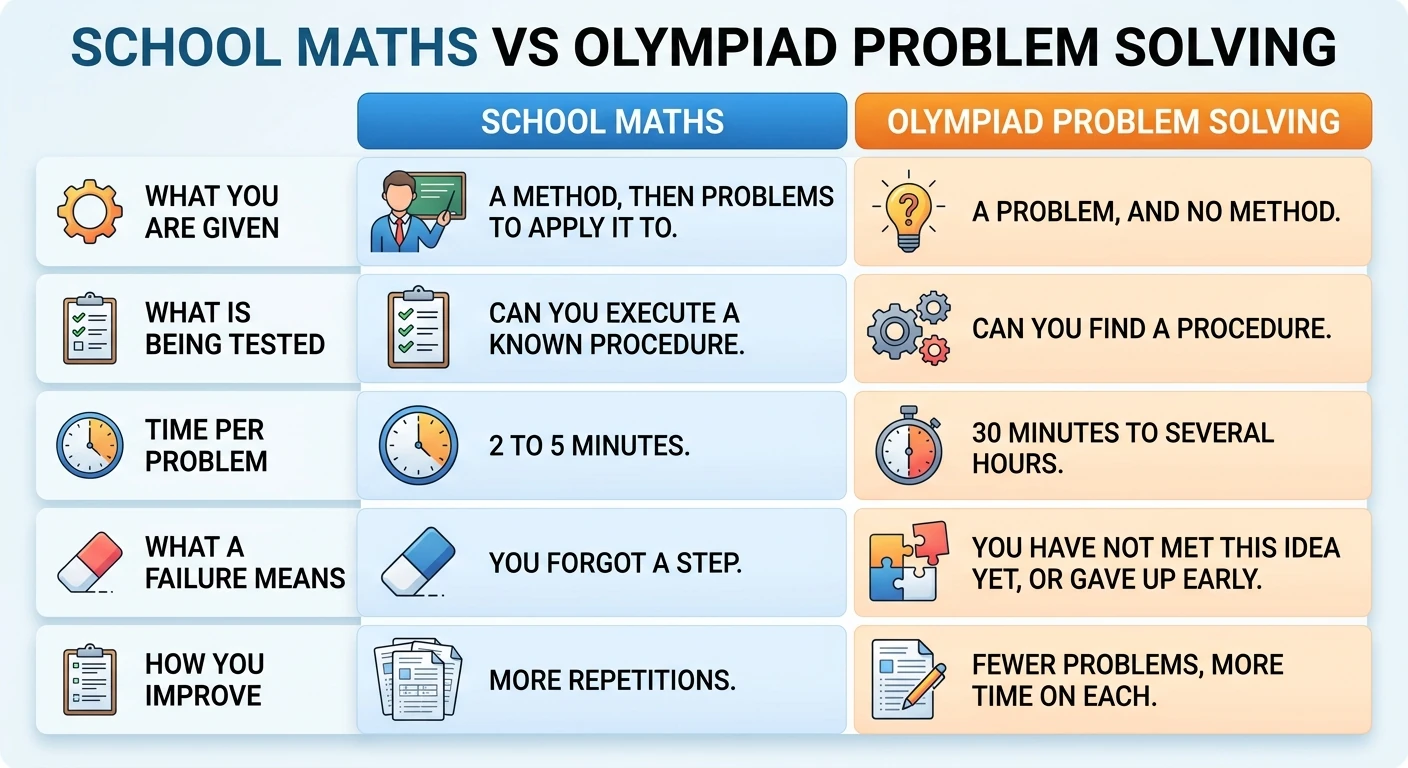
| School maths | Olympiad problem solving | |
|---|---|---|
| What you are given | A method, then problems to apply it to | A problem, and no method |
| What is being tested | Can you execute a known procedure | Can you find a procedure |
| Time per problem | 2 to 5 minutes | 30 minutes to several hours |
| What a failure means | You forgot a step | You have not met this idea yet, or you gave up early |
| How you improve | More repetitions | Fewer problems, more time on each |
Four specific habits cause the plateau:
- Reading solutions too early. If you look after ten minutes, you learn the solution but not how to find solutions. Give every problem at least 30 to 45 minutes before you look.
- Practising at the wrong difficulty. Problems you can already do build confidence, not skill. Roughly half your problems should be ones you fail.
- Not recording why you failed. “I got it wrong” is useless. “I did not think to look at the problem modulo 9” is a lesson you can act on.
- Treating practice as volume. Thirty routine problems teach less than three hard ones worked properly.
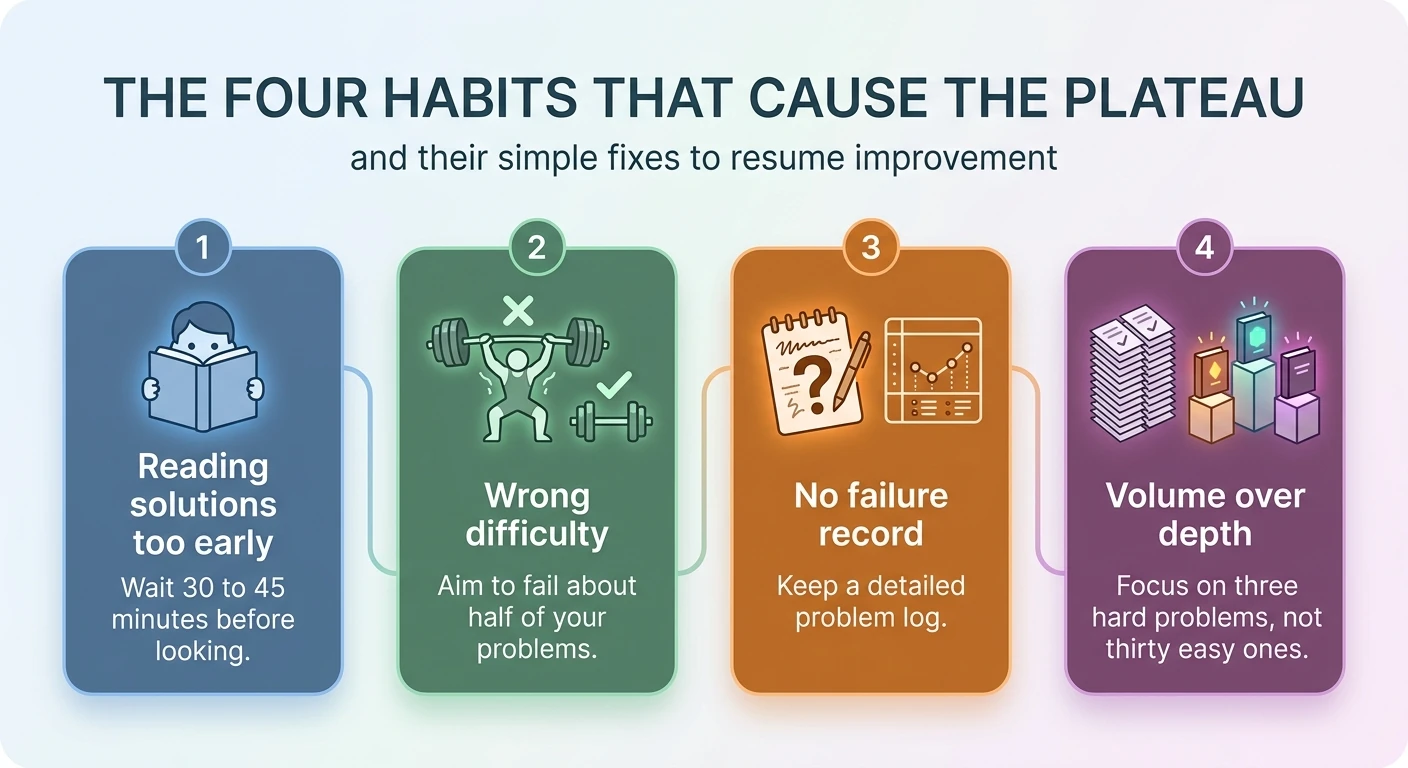
The fix is to change what practice looks like rather than how much of it you do.
How to Improve Problem Solving Skills for the IMO
Work through these in order. The early steps build the raw material, and the later ones build the skill of using it under pressure.
Step 1: Learn the Four Topic Areas and Their Question Patterns
IMO and national olympiad problems come from four areas. Knowing which area a problem belongs to narrows your options immediately, which is often half the work.
- Number theory: divisibility, remainders, primes, Diophantine equations
- Algebra: inequalities, functional equations, polynomials
- Geometry: angle chasing, similar triangles, circles, configurations
- Combinatorics: counting, pigeonhole, invariants, graph problems
Read through past papers before you try to solve any, simply to see what the questions look like. Our collection of math olympiad questions shows the style at each level.
Step 2: Build Fundamentals That Transfer
A strong foundation means being fluent with a small number of ideas, not having read a large number of chapters. Fluency means you can use an idea without looking it up, under time pressure, in an unfamiliar setting.
Two books cover most of what the early rounds need:
- Problem-Solving Strategies by Arthur Engel: organised by technique rather than topic, which is the right way round for olympiad work
- Mathematical Olympiad Treasures by Titu Andreescu: graded problems with full solutions
Work through them by solving, not by reading. A chapter you have read and a chapter whose problems you have done are not the same chapter.
Step 3: Train Your Response to Being Stuck
Being stuck is the normal state during an olympiad, not a sign something has gone wrong. What separates strong solvers is having a list of things to try when nothing is obvious.
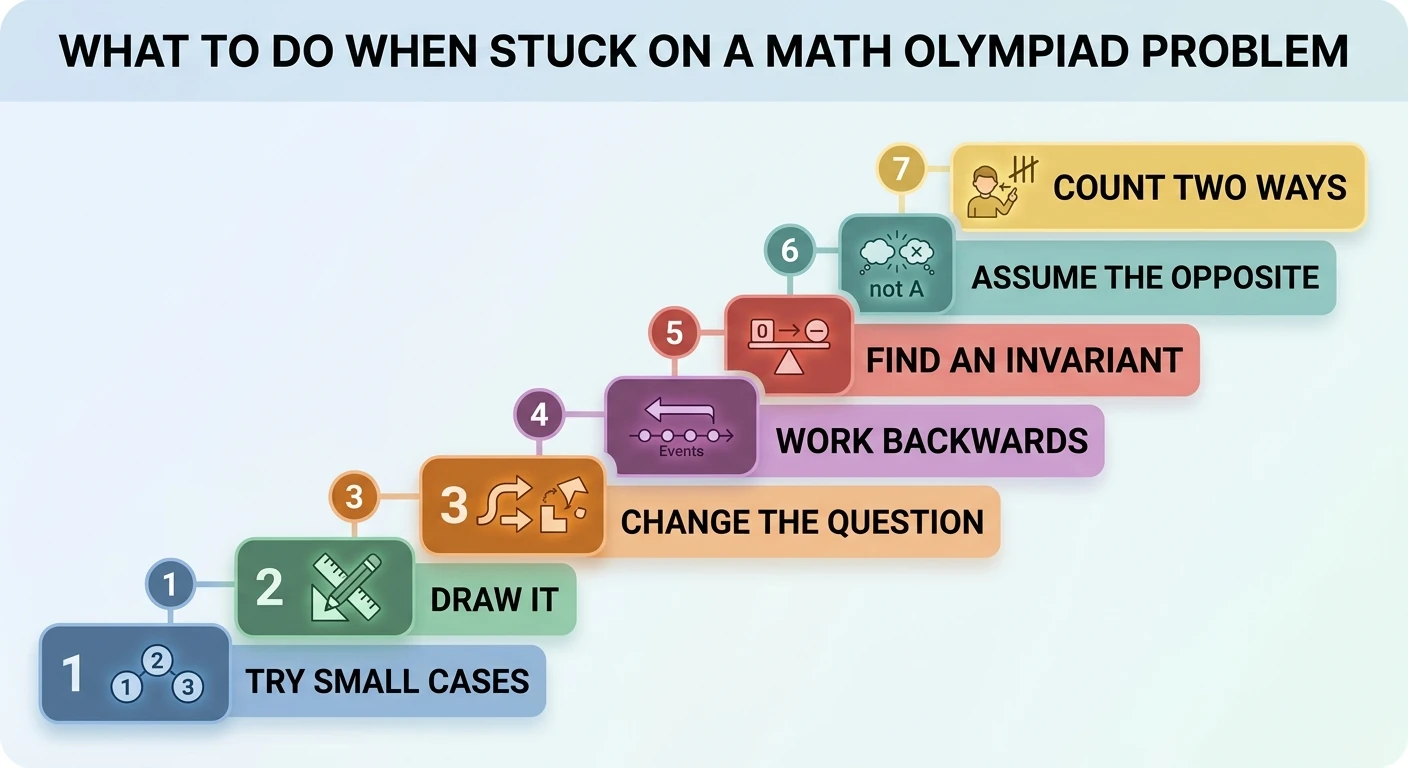
When you are stuck, work through this list:
- Try small cases. Set n equal to 1, 2, 3 and look for a pattern.
- Draw it. Even for non-geometry problems, a diagram or table often exposes structure.
- Change the question. Solve an easier version, then ask what blocked the general case.
- Work backwards from what you are asked to prove.
- Look for an invariant, something that does not change as the process runs.
- Assume the opposite and look for a contradiction.
- Count the same thing two ways.
Practise the list deliberately. When you get stuck, name which one you are trying rather than staring at the page.
Step 4: Learn the Named Techniques
Most olympiad problems yield to one of a relatively small set of techniques. Learning them by name makes them easier to reach for.
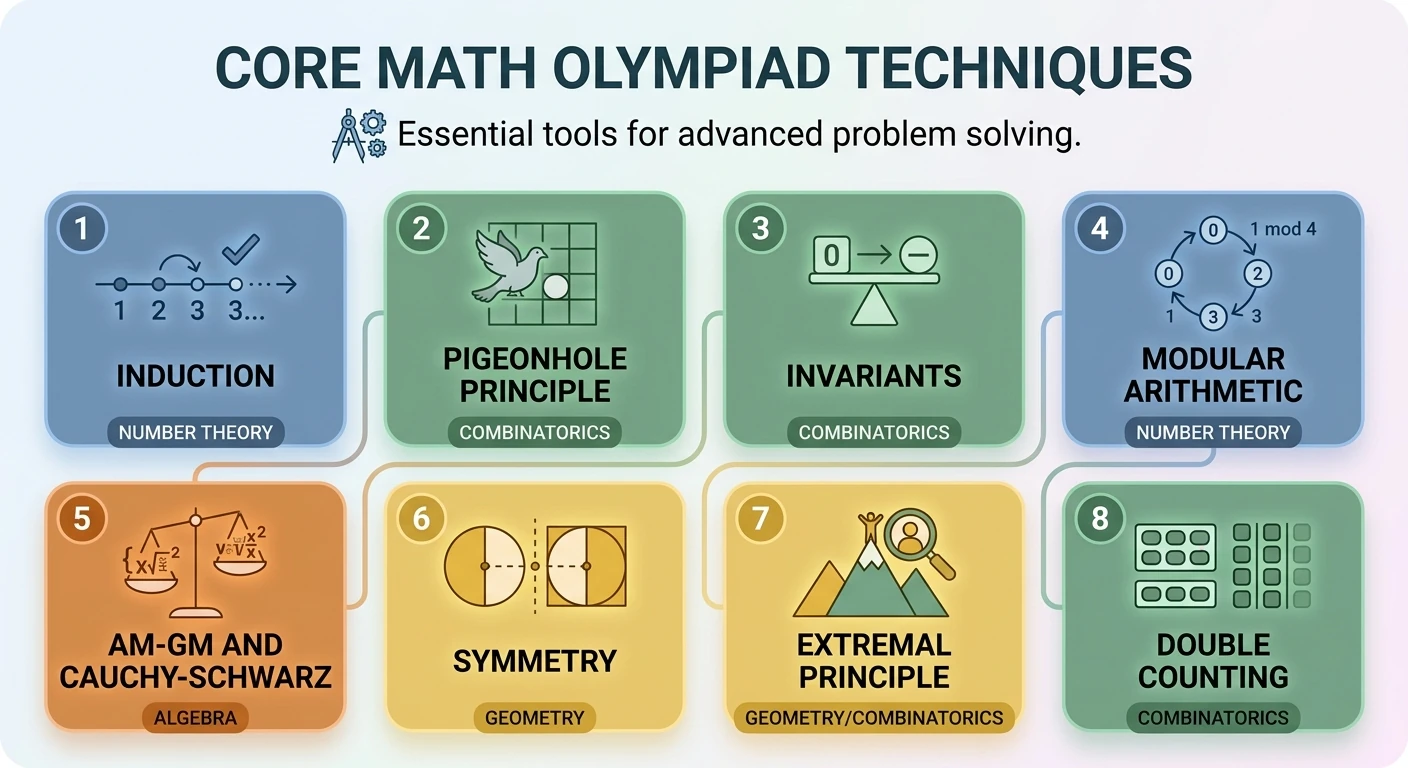
| Technique | Mainly used in | What it is good for |
|---|---|---|
| Mathematical induction | Number theory, algebra | Statements that hold for every n |
| Pigeonhole principle | Combinatorics | Proving something must repeat or collide |
| Invariants and monovariants | Combinatorics | Processes, games, “is this reachable” |
| Modular arithmetic | Number theory | Divisibility, last digits, impossibility proofs |
| AM-GM and Cauchy-Schwarz | Algebra | Inequalities |
| Symmetry | Geometry, algebra | Reducing cases, simplifying configurations |
| Extremal principle | Combinatorics, geometry | Arguments that start “take the largest…” |
| Double counting | Combinatorics | Identities and existence proofs |
Learn one technique at a time and do ten problems using it before moving on. Mixed practice comes later, once each tool is familiar.
Step 5: Solve Past Papers and Keep a Problem Log
Past papers are the most efficient practice material because they show you the real difficulty, not a textbook’s idea of it. But the log is what converts practice into improvement.
For every problem you fail, record three things:
- What you tried and how long you spent
- The idea you were missing, stated in one line
- The topic area, so you can see patterns across weeks
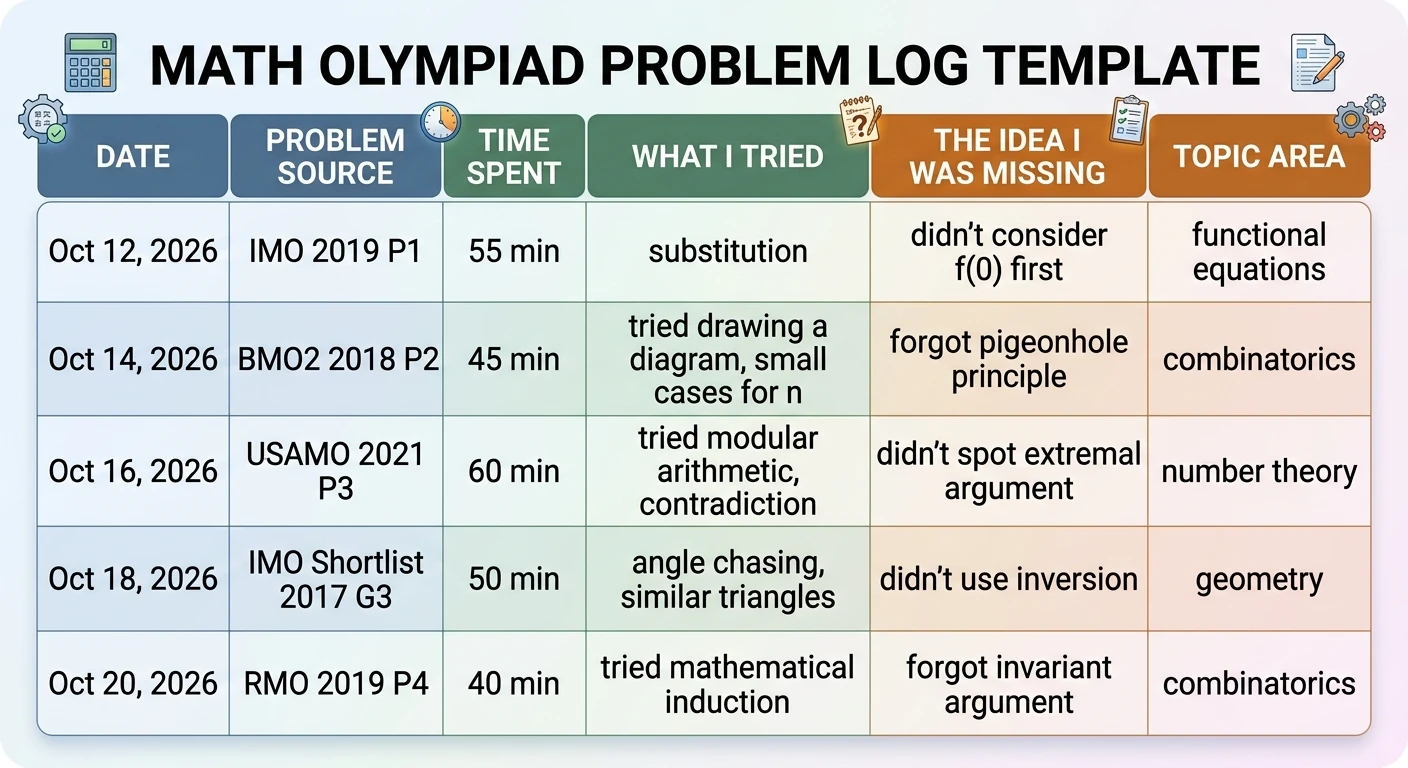
After a month, the log tells you exactly what to study. Most students find their failures cluster in one or two areas rather than spreading evenly, which is useful information you cannot get any other way.
Past papers are available from the official IMO archive at imo-official.org and from national bodies. Our guide to how to solve math olympiad problems covers approach in more depth.
Step 6: Practise Under Time Pressure, But Not Always
Timed practice and untimed practice train different things, and you need both.
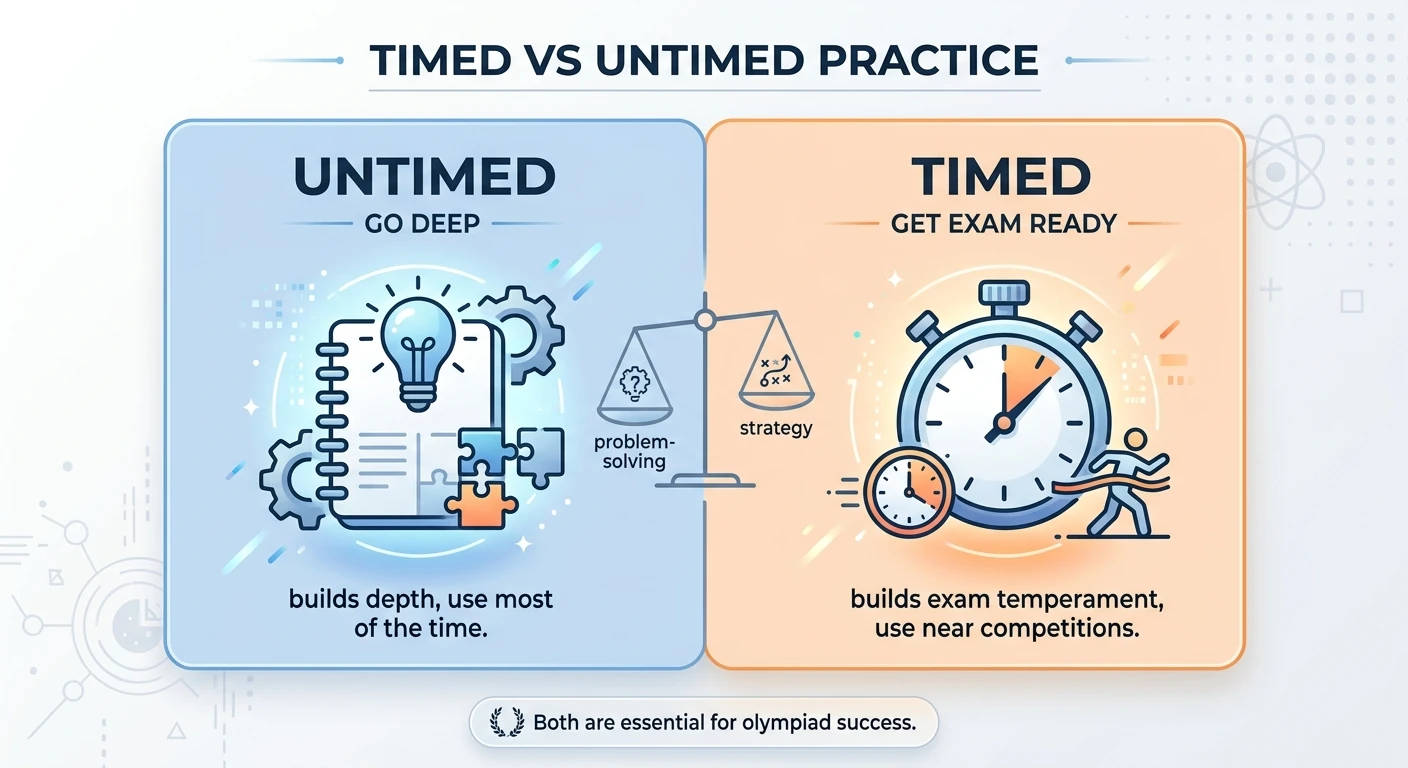
- Untimed sessions build the ability to go deep. Give yourself an hour on one problem with no clock.
- Timed sessions build exam temperament. Simulate the real paper, including the decision to abandon a problem and come back.
Do untimed work most of the time and timed work closer to a competition. Reversing that order is a common mistake, because constant time pressure teaches you to give up quickly, which is the opposite of the skill you want. How to get full marks in maths olympiad covers exam-day technique specifically.
Step 7: Learn from Stronger Solvers
Reading someone else’s approach to a problem you failed is worth more than reading the official solution, because it shows the thinking rather than the finished argument.
- Discuss problems with peers working at or slightly above your level
- Post attempts on olympiad forums and ask what you missed, not for the answer
- Watch solvers work through unseen problems rather than present polished solutions
Advanced Problem-Solving Strategies Beyond the School Curriculum
Once the basic techniques are familiar, the next level is strategic rather than technical. These are habits strong solvers use that no school syllabus teaches.
- Spend time understanding before solving. Restate the problem in your own words and identify exactly what is being asked. Five minutes here saves thirty later.
- Generalise deliberately. After solving, ask what happens if a condition is dropped. This is how you build intuition rather than a collection of answers.
- Collect ideas, not solutions. Keep a running list of techniques that surprised you, phrased as “when I see X, consider Y.”
- Work at the edge. Pick problems you have roughly a one in three chance of solving. Harder than that wastes time, easier than that wastes effort.
- Write full proofs even when you do not have to. Writing exposes gaps that mental solving hides, and senior rounds are marked on the argument, not the answer.
How to Move from School Maths to Olympiad Problem Solving
The transition takes most students several months, and it is uncomfortable because scores drop before they rise. Expect to solve far fewer problems than you are used to.
A sensible progression looks like this:
- Start with junior-level olympiad problems, even if you are older. They use the same thinking with less machinery.
- Do one topic at a time rather than mixed papers, until each technique is familiar.
- Move to mixed problems once you can recognise which area a problem belongs to.
- Add timed papers last.
Younger students should begin with the junior math olympiad guide, and middle schoolers with competition math for middle school.
Structured Training Programs and Practice Tests
If you want structure rather than self-study, several routes offer graded problems and regular tests. What matters is whether the program gives you problems at your edge and feedback on your reasoning, not whether it has a famous name.
- National olympiad training camps: the strongest option if you qualify, since problems and feedback come from past olympiad participants
- Online olympiad courses: useful for structure and pacing, variable in quality
- Self-study with a problem log: free and effective if you are disciplined about the log
- Practice apps: good for daily reps and spotting topic gaps, weaker for full proof work
Free structured material is collected in free math olympiad training online, and the best apps for SOF IMO preparation reviews the daily-practice options honestly. If you are working towards the national rounds, how to prepare for the IMO covers the full preparation timeline rather than the skill itself.
A Weekly Practice Routine
Consistency matters more than intensity. This routine takes four to six hours a week and suits a student in school full time.
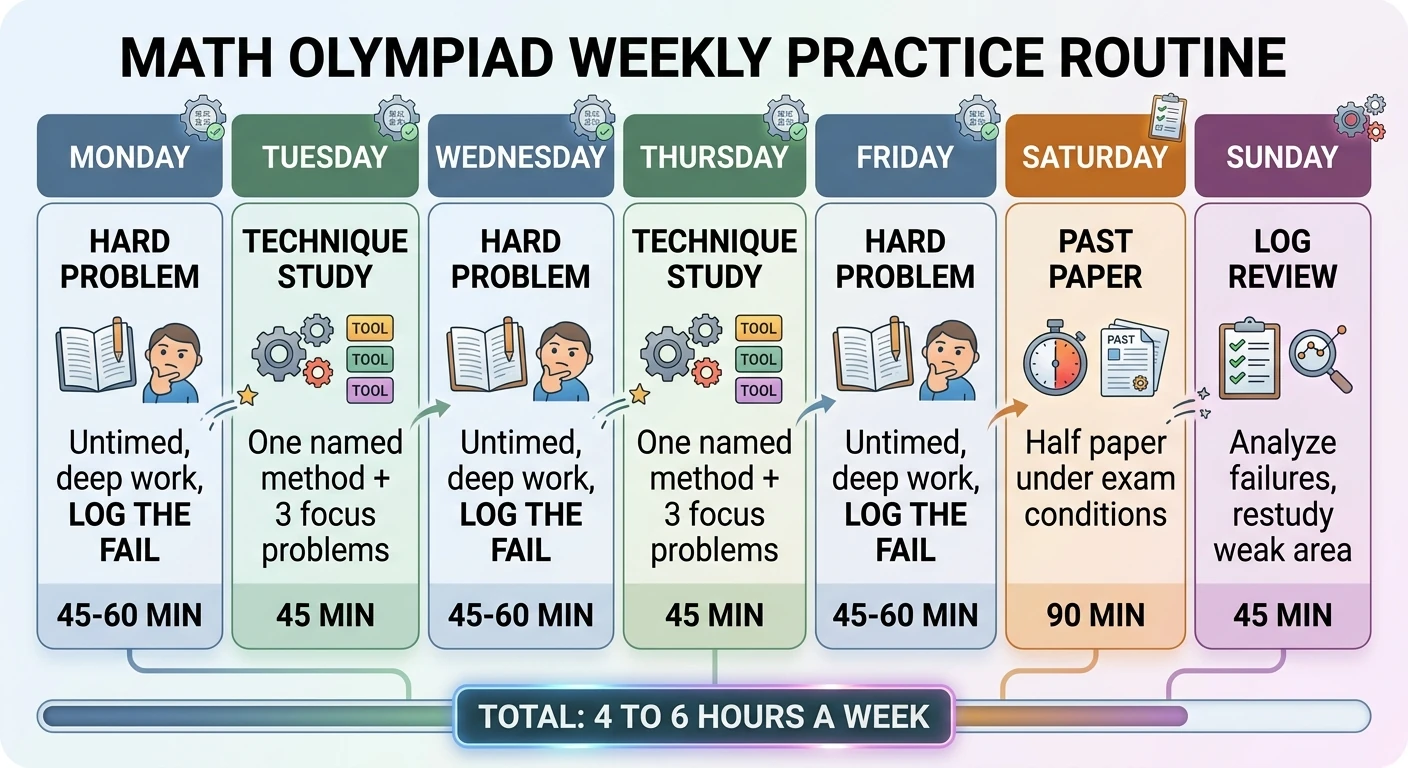
| Day | Session | Time |
|---|---|---|
| Mon, Wed, Fri | One hard problem, untimed, logged | 45 to 60 min |
| Tue, Thu | Technique study, then 3 problems using it | 45 min |
| Saturday | Half a past paper under exam conditions | 90 min |
| Sunday | Review the week’s log, restudy one weak area | 45 min |
Adjust the volume, not the shape. A student doing three sessions a week properly will improve faster than one doing seven sessions of skimming solutions.
Make Preparing for Math Olympiad Simple!


Frequently Asked Questions
Why am I not improving at olympiad problem solving despite studying theory?
Because theory and problem solving are different skills. Studying theory teaches you what tools exist, while problem solving teaches you which tool to reach for when nothing is obvious. The fix is to spend more time stuck on hard problems and less time reading, and to log the specific idea you were missing each time you fail.
How long should I spend on a problem before looking at the solution?
At least 30 to 45 minutes for a genuinely hard problem, and ideally longer across more than one sitting. Looking early is the single most common reason students stop improving, because the struggle itself is what builds the skill.
How do I get better at math olympiad problems quickly?
There is no fast route, but the fastest available one is fewer problems worked properly rather than many worked shallowly. Three hard problems a week with a written log will outperform thirty routine problems.
What are the most important olympiad problem-solving techniques?
Induction, the pigeonhole principle, invariants, modular arithmetic, AM-GM and Cauchy-Schwarz inequalities, symmetry, the extremal principle and double counting. Learn them one at a time, with about ten problems each, before mixing them.
Is there a training program with regular practice tests?
National training camps, online olympiad courses and practice apps all offer structured problems and tests. What matters is whether the program sets problems at your current edge and gives feedback on your reasoning rather than just marking answers.
How do I move from school maths to olympiad level?
Start with junior-level olympiad problems regardless of your age, work one topic at a time until each technique is familiar, then move to mixed problems, and add timed papers last. Expect several months and expect your solve rate to drop before it rises.
How many hours a week should I practise?
Four to six hours is enough for most school students, split across short daily sessions rather than one long one. Consistency matters more than total volume at this stage.
Do I need to write full proofs when practising?
Yes, once you are working towards senior rounds. Writing exposes gaps that mental solving hides, and rounds like RMO, INMO and the IMO itself are marked on the argument rather than the final answer.
Key Takeaways
- Problem solving improves through struggle, not through reading solutions. Give every hard problem 30 to 45 minutes before you look.
- The theory plateau is caused by practising at the wrong difficulty and not recording why each failure happened.
- A problem log is the highest-leverage habit available, because it tells you exactly what to study next.
- Learn the named techniques one at a time, roughly ten problems each, before mixing them.
- Do untimed deep work most of the time and timed papers closer to a competition, not the other way round.
- Four to six hours a week, kept consistently, beats occasional long sessions.
Ready to practise? Start with math olympiad questions to find problems at your level, or read how to solve math olympiad problems for a deeper look at approach.

Contributor at Gonit Worksheets, writing about math learning that works for real kids.



There are no comments posted here yet.
Sign in to leave a comment