

A full past paper is the wrong first Mu Alpha Theta practice test for most of your room. The chapter’s first contest is a few weeks out, most of your members are in Geometry or Algebra 2, and Thursday’s meeting is 45 minutes long. The official archive is right there, with years of National Convention tests filed by division and event. So you print one, hand it out cold and grade it right or wrong.
A national Individual Test is 30 questions in 60 minutes, so it doesn’t fit the meeting. First-years leave most of a convention-level paper blank or guess their way through it. Right-or-wrong grading also hides the rule that shapes every score: 5 points for a correct answer, 1 for a blank and 0 for a wrong one. A student who guesses on everything learns the opposite of what the scoring rewards.
Save the full papers for later in the season. Start with a short set at your students’ own division, scored the contest way, because the scoring is a skill you can teach in one meeting. Below you’ll find where the official tests live, how the scoring works, five original problems with solutions and a 20-problem worksheet. If you’re still setting the chapter up, start with our Mu Alpha Theta guide for sponsors, which covers requirements, fees and the 2027 convention.
Where Are the Official Mu Alpha Theta Past Tests?
Mu Alpha Theta, the National High School and Two-Year College Mathematics Honor Society, posts its old tests for free. Two archives come from the society itself, Florida’s state affiliate keeps a third, and the Rocket City Math League sends its tests to the schools that register.
| Archive | What it has | What it lacks | Use it for |
|---|---|---|---|
| National Convention past tests | A filterable archive going back to 1995, sorted by year, division and event (Open topic tests included); most tests have a solutions file | Some years are missing, 2020 among them; recent years also have their own pages, such as past tests 2024. As of October 6, 2026, the 2026 convention tests weren’t posted yet | Full timed papers later in the season |
| Log1 past tests | Rounds by topic from 2007–08 through 2018–19, plus 2021 tests for Mu, Alpha and Theta | Answer files are listed for the 2021 tests; the older rounds are posted as tests | Topic-by-topic practice |
| FAMAT test bank | Links to regional tests, regular-season tests from 2022 on and State Convention tests from 2016 on | Built around Florida’s own competitions | Extra sets if you’re in Florida |
| Rocket City Math League | Tests, solutions and guidelines are emailed to each school or made available online | No public archive on the society’s contest page | Practice for chapters that enter RCML (it’s free) |
The tests belong to the society, so link your students to them and don’t republish them in your own handouts. The Log1 Contest returns in 2026–27, which makes the Log1 rounds the closest match to what your chapter might take at school this year.
Which Division Are Your Students Practicing For?
Mu Alpha Theta places each student by the math course they’re in, and the order runs from Theta (entry) to Mu (top).
| Division | Who it’s for |
|---|---|
| Theta | Completed Geometry and/or Algebra 2, not in a higher course |
| Alpha | Past Algebra 2 (precalculus), never in calculus |
| Mu | Taking or has taken calculus |
Most first-year members are Theta. The 2027 Theta topic tests cover nine areas: Analytic Geometry; Area and Volume; Applications; Logs and Exponents; Triangles; Combinatorics and Probability; Equations and Inequalities; Circles and Polygons; and Sequences and Series. The problems below follow that spread.
Should Your Students Guess? How the Scoring Works
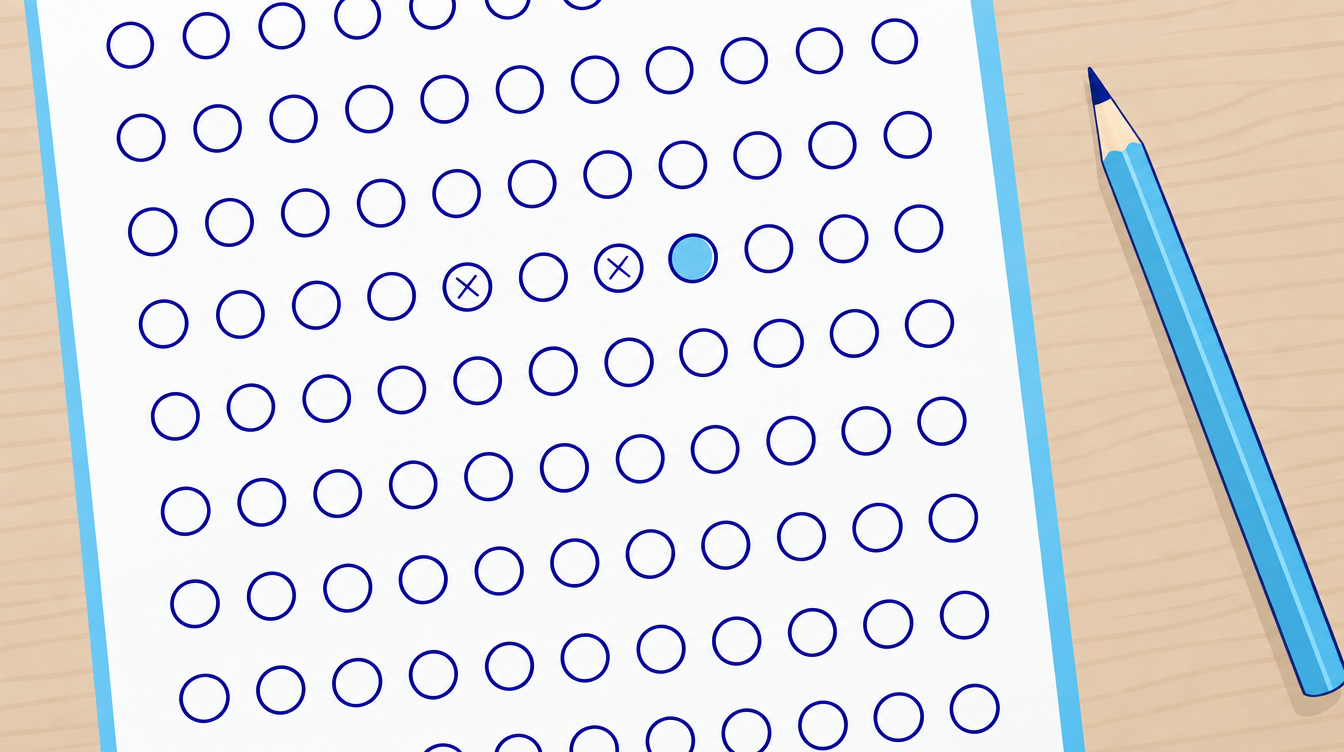
Every Individual Test question has five choices, A to E, and E is NOTA, which means none of the above answers are correct. A correct answer earns 5 points, a blank earns 1 and a wrong answer earns 0.
Do the arithmetic once with your students. A blind guess among five choices is right one time in five, so on average it earns 5 × 1/5 = 1 point, exactly what a blank earns. Rule out one choice and a guess among the remaining four averages 1.25 points. Rule out two and it’s about 1.67.
That gives you one rule to teach: guess only after you’ve crossed out at least one choice. Choice E is the tricky one. It is sometimes right, so students can’t cross it out by default, and choosing it means trusting that their own number really isn’t among A to D.
A Five-Problem Mu Alpha Theta Practice Test (Theta Style)
These five are original problems we wrote for this page in the style of a Theta Individual Test, easy to hard. None is copied or adapted from a Mu Alpha Theta test. Give your students about two minutes each, which is the pace of a 30-question, 60-minute paper.
Problem 1
A rectangle has a perimeter of 30 and a diagonal of length 11. What is its area?
A. 44 B. 48 C. 50 D. 52 E. NOTA
Show solution
Answer: D (52). Call the sides l and w. Then l + w = 15 and l² + w² = 11² = 121. Square the first equation: l² + 2lw + w² = 225, so 2lw = 225 − 121 = 104 and lw = 52. The sides aren’t whole numbers, and you never need to find them.
Problem 2
If 4x = 9, what is 8x?
A. 18 B. 27 C. 36 D. 81 E. NOTA
Show solution
Answer: B (27). Since 4x = (2x)², we get (2x)² = 9, and 2x is positive, so 2x = 3. Then 8x = (2x)³ = 3³ = 27. You never need to find x itself.
Problem 3
Two fair six-sided dice are rolled. What is the probability that the product of the two numbers is a multiple of 6?
A. 11/36 B. 1/3 C. 5/12 D. 1/2 E. NOTA
Show solution
Answer: C (5/12). Count the ordered pairs out of 36. If either die shows 6, the product works: that’s 11 pairs. Without a 6, the product needs a 3 and an even number, so one die shows 3 and the other shows 2 or 4, in either order, which is 4 pairs. That gives 11 + 4 = 15, and 15/36 = 5/12.
Problem 4
In an arithmetic sequence, the 3rd term is 11 and the 8th term is 31. What is the sum of the first 20 terms?
A. 800 B. 840 C. 860 D. 880 E. NOTA
Show solution
Answer: E (NOTA). From the 3rd term to the 8th is five steps, so 5d = 31 − 11 = 20 and d = 4. The first term is 11 − 2(4) = 3, and the 20th term is 3 + 19(4) = 79. The sum is 20 × (3 + 79) / 2 = 820, which isn’t listed, so the answer is NOTA.
Problem 5
How many four-digit positive integers are even and have digits that add up to 5?
A. 22 B. 20 C. 25 D. 35 E. NOTA
Show solution
Answer: A (22). An even number ends in 0, 2 or 4 here, since the digits add up to only 5. The first digit is at least 1, so write it as 1 + a’. If the last digit is 0, the other three digits add up to 5, so a’ + b + c = 4: C(6, 2) = 15 ways. If it is 2, a’ + b + c = 2: C(4, 2) = 6 ways. If it is 4, the number must be 1004: 1 way. That gives 15 + 6 + 1 = 22. (Choice D, 35, counts the odd numbers too.)
How to Run the Full Worksheet in One Meeting
The worksheet has these five plus 15 more original problems, still Theta level apart from two Alpha questions near the end, with an answer key and short solutions. Here is a 45-minute plan:
- Five minutes: put the 5-1-0 scoring on the board and do the guessing arithmetic together.
- Thirty minutes: students work alone on the 20 problems, with no calculators, as on the real test.
- Five minutes: students score their own sheet the contest way, 5 per correct answer, 1 per blank and 0 per wrong answer.
- Five minutes: everyone picks one problem they got wrong and one they left blank, and checks the short solution.
Thirty minutes for 20 problems is a little faster than the real pace of two minutes a question, which is the point for a practice round. Collect the two problems each student chose: after two or three meetings, those slips tell you which topics to teach next better than a total score does.
Printable worksheet: download the full 20-problem set as a free PDF, with an answer key and short solutions. It prints on US Letter paper.
Run it once and you’ll have something a full past paper can’t give you in week one: a room that knows how the test is scored, a list of the topics your Theta students miss, and a plan for when to bring out the national archive. Between meetings, students who want more of this kind of question can practise in the Gonit app. It has 10,000+ olympiad-style multiple-choice questions for grades 1–12, sorted by grade, topic and difficulty. It isn’t a Mu Alpha Theta test bank and has no connection to the society.
Related guides

Louise R. Fox holds a Ph.D. in Mathematics and brings a researcher's perspective to how students actually learn the subject. Based in the United States, she writes about olympiad-level problem solving and the deeper thinking skills that carry students well beyond the classroom.




There are no comments posted here yet.
Sign in to leave a comment