


To use AMC 10 practice tests well, work through official past papers from the AoPS wiki and the MAA, simulate the real 75-minute timed format, and target the AIME cutoff (historically 94.5 to 105).
- What the AMC 10 Actually Is
- Where to find official AMC 10 past papers
- The Role of Timed Simulation
- Pacing Strategy: 25 Questions in 75 Minutes
- Handling the Difficulty Curve
- Score Targets and What They Mean
- AMC 10 vs AMC 12: Choosing the Right Practice Track
- A Realistic 12 Week AMC 10 Prep Plan
- Free Past Papers vs Structured Practice
- Common Mistakes Students Make on AMC 10 Practice Tests
- How to Review Mistakes: The Error Log
- The Bottom Line
Review every missed problem in an error log. The problems are everywhere; the sequence isn’t.
This guide covers where to find official AMC 10 past papers, how timed simulation works, pacing for the difficulty curve, realistic AIME targets, a 12-week prep plan, and how to review mistakes.
The next AMC 10s run in November 2026, AMC 10A on November 5, 2026, and AMC 10B on November 13, 2026. Confirm the exact dates on the official MAA AMC schedule, as the MAA sets them each year.
What the AMC 10 Actually Is
Get the format clear before grabbing a past paper:
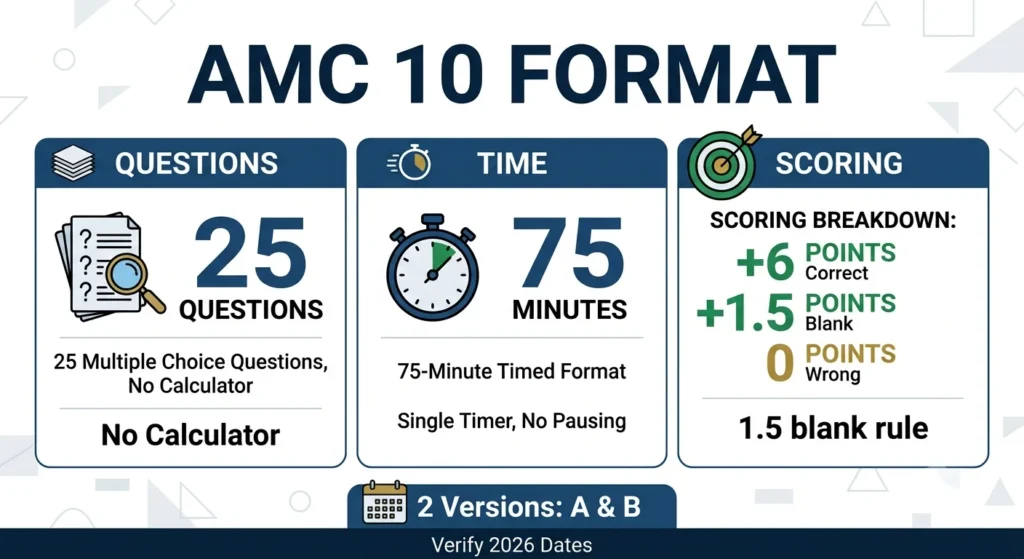
- 25 multiple choice questions, 75 minutes, no calculator
- Scoring: 6 points correct, 1.5 blank, 0 wrong, max 150
- Two versions per cycle, AMC 10A and AMC 10B, different dates and problems. You can take both
- Eligibility: grade 10 or below, under 17.5 years old on test day
- AMC 10 and AMC 12 run on the same day, but you can’t take both on the same date
The 1.5 point blank rule changes everything. Random guessing has an expected value of 6 divided by 5, or 1.2 points, worse than blanking. Unless you can eliminate at least one answer, blank beats guess.
Registration is handled by schools, not students. The MAA sets Early Bird, Regular, and Late registration deadlines each cycle (typically late September through late October).
See our AMC registration guide for the confirmed 2026 to 27 dates.
Where to find official AMC 10 past papers
AMC 10 Past Papers by Year (2022 to 2025)
These links open the free AoPS Wiki pages for each recent AMC 10, with every problem, worked solutions and the answer key. The problems are copyright of the MAA.
Looking for the 2026 contest dates rather than past papers? See AMC 10 dates for 2026.
Three sources cover every official AMC 10 ever administered:
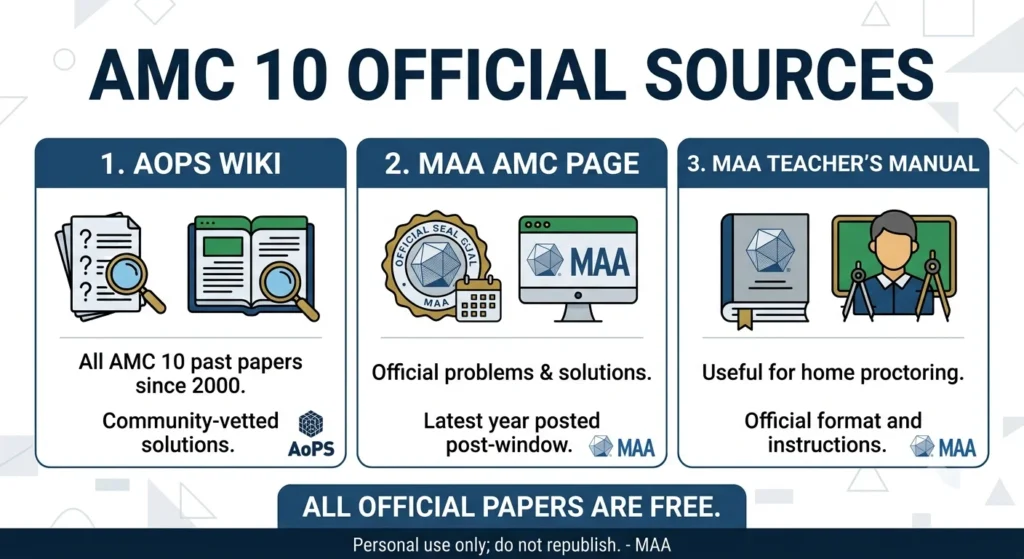
- AoPS AMC 10 wiki. Every AMC 10 from 2000 onward with multiple community-vetted solutions per problem.
- MAA’s AMC page. Official problems and solutions; the latest year posts after the November window closes.
- 2024-25 MAA Teacher’s Manual. Official format and proctor instructions useful for parents running timed mocks at home.
A few warnings:
- Don’t pay for “exclusive” papers. Everything official is free.
- Skip AI-generated practice tests. Wrong difficulty curves and frequent answer-key errors.
- Don’t republish problems. The MAA holds the copyright personal use only.
Save the three to four most recent years (both A and B) for the last month of prep.
AMC 10 Practice Test PDF: What to Download and Print
Most official AMC 10 practice test PDF files come straight from the MAA or the AoPS wiki as plain, printable documents rather than interactive quizzes.
For a real mock, download the plain pdf version of a past AMC 10A or AMC 10B, print it, and pair it with a blank answer grid and scratch paper.
Be careful with practice test PDF bundles sold on third-party sites, they are frequently mistyped, missing diagrams, or paired with an incorrect answer key.
The Role of Timed Simulation
You cannot prepare for the AMC 10 untimed. The pressure is more brutal than students expect, it’s not the math that’s hard, it’s the math at speed.
A full timed AMC 10 practice test means:
- 75 minutes, single timer, no pausing
- Phone and devices in another room. Music off
- Print the paper or use a non-interactive pdf. No solution previews
- Blank scratch paper, pencil, eraser. No calculator
- Mark and skip. Circle uncertain questions, don’t burn three minutes deciding to skip
- No solutions during the test. Save them for the review block
One full mock equals 75 minutes of testing plus 45 to 60 minutes of review, about two hours total. The review is where the score actually moves, see the error log section below.
For broader strategy this routine plugs into, see our how to prepare for the AMC guide.
Pacing Strategy: 25 Questions in 75 Minutes
Three minutes per problem on average, but never actually pace that way. The curve is steep, problems 1 to 10 should take 60 to 90 seconds, and problems 20 to 25 might take five to seven minutes.
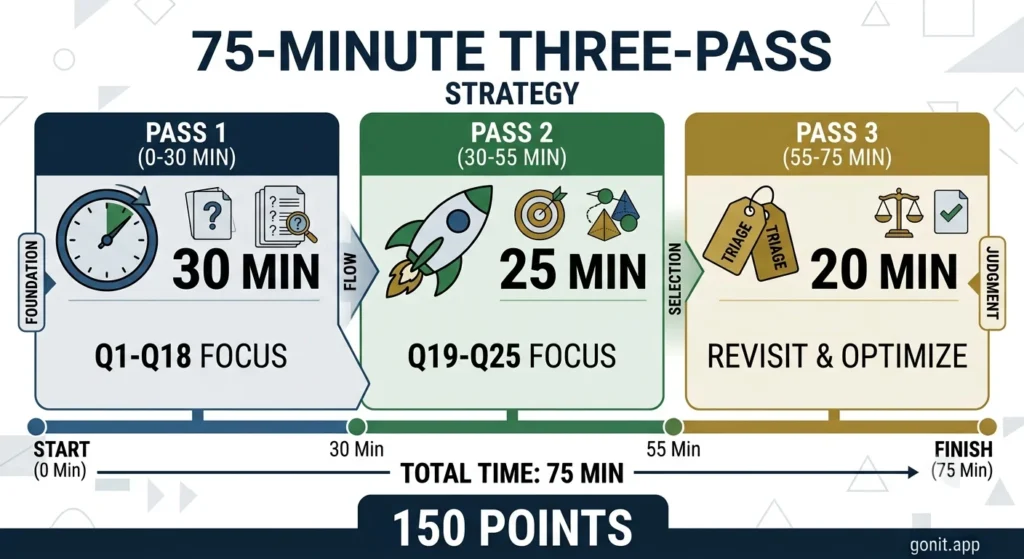
Use three passes instead:
- Pass 1, sweep the front (0 to 30 min, problems 1 to 18). Work in order. If no clear path in 60 to 90 seconds, mark and move on. Bank every easy point before clock pressure builds.
- Pass 2, attack the back (30 to 55 min, problems 19 to 25). Where points and time both live. Three to seven minutes per problem. Five honest minutes with nothing, skip.
- Pass 3, triage marked problems (55 to 75 min). Can you eliminate at least one answer? If yes, attempt. If no, blank.
Two rules most students learn the hard way:
- Easy problems matter as much as hard ones. Six points whether it’s number 2 or number 22. Slow down on the front half
- Don’t trust the almost have it feeling. Five minutes on a problem you’ll miss is six points of opportunity cost elsewhere
Handling the Difficulty Curve
The curve isn’t a smooth ramp, it’s three plateaus:
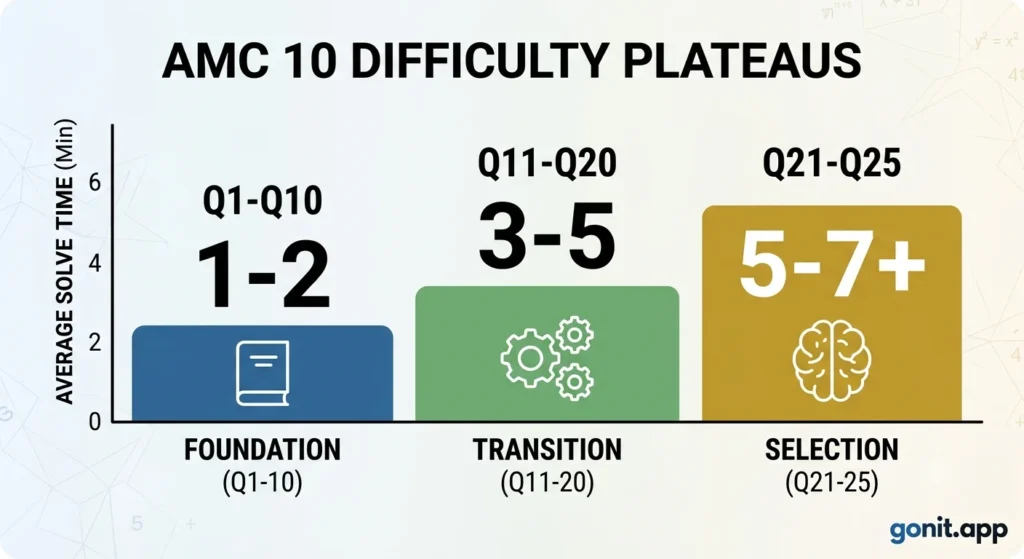
- Problems 1 to 10 (foundation). Direct concept application. Speed and accuracy. Strong students score 10 out of 10 here.
- Problems 11 to 20 (transition). Multi-step problems combining two or three concepts. About 80 percent of score variance lives here.
- Problems 21 to 25 (selection). Olympiad style insight. Most AIME qualifiers solve only two or three.
The implication: don’t spend your prep exclusively on problems 21 to 25. A student who reliably scores 18 out of 25 on the front and middle, plus two of the last five, hits the AIME cutoff in most years, far more achievable than cracking the last five reliably. For the topic level breakdown, see our AMC syllabus guide.
Score Targets and What They Mean
The score that matters most is the AIME qualification cutoff, the threshold to earn an invitation to the American Invitational Mathematics Examination.
From the 2026-27 cycle, every eligible student who scores 100 or more on the AMC 10 is invited to the AIME.
From the 2026-27 cycle, the AIME qualifying score on the AMC 10 is fixed at 100 out of 150. That makes your practice target simple: average 100 or more on timed past papers.
For context on what counts as a strong score overall, see our guide on what is a good AMC score and our breakdown of average AMC math scores.
Recent official AIME cutoffs from the MAA:
| Cycle | AMC 10A cutoff | AMC 10B cutoff |
| 2025 | 105 | 99 |
| 2024 | 94.5 | 105 |
| 2023 | 103.5 | 105 |
| 2022 | 93 | 94.5 |
In practical terms:
- 60 to 75: above the national average (about 58 to 65). A reasonable first year score
- 90 to 100: genuinely competitive, AIME adjacent in some years
- 100 to 110: solid AIME qualification range in most years
- 120 plus: comfortably clears recent qualification cutoffs (which have run in the 94.5 to 105 range), giving a strong buffer against a hard year
Don’t target the predicted cutoff, target 10 to 15 points above it. A student aiming for 110 hits 105 on a tough day, one aiming for 95 lands below in a hard year.
The AIME follows about three months after the AMC 10. The 2027 AIME is a single exam on February 5 or 6, 2027, taken at Pearson testing centers.
AMC 10 vs AMC 12: Choosing the Right Practice Track
Some students preparing for the AMC 10 also weigh whether the AMC 12 is a better fit, especially in 10th grade.
Both exams share several problems in the middle of each paper, but the AMC 12 leans harder into precalculus-level topics like trigonometry, logarithms, and complex numbers, while the AMC 10 stays within a geometry, algebra, counting, and number theory band.
If you’re not sure which syllabus matches your current level, our AMC syllabus guide maps out the topic differences year by year, and our guide to the benefits of AMC math covers why either track is worth the prep time.
Age eligibility differs slightly between the two exams, so check the AMC age limit rules before you register for either one.
As a rule of thumb, if a student is already comfortable with the full AMC 10 syllabus and has room to grow, trial AMC 12 practice problems can show whether the jump makes sense for the following cycle.
A Realistic 12 Week AMC 10 Prep Plan
Assumes a baseline of comfortable with algebra and geometry, and an AIME target.
Adjust so week 12 ends the week of the AMC 10A or B you’re taking.
| Phase | Weeks | What to do | Time per week |
| Diagnose | 1 | One full timed AMC 10 practice test (use a 2 year old paper). Start the error log. Identify top 2 weakest topics. | 2 hrs |
| Foundation | 2 to 4 | Topic by topic drilling on weakest areas (usually counting or 3D geometry). 10 to 15 problems per session, 4 sessions per week. | 5 to 6 hrs |
| Build | 5 to 7 | Mixed problem sets across all topics. One mini mock per week (problems 1 to 18 in 45 min). Pacing drills. | 6 to 7 hrs |
| Simulate | 8 to 10 | One full timed past paper per week (recent years). 45 min of error log review after each. Topic drilling on off days. | 7 to 8 hrs |
| Taper | 11 | One last full mock early in the week. Light error log review only. No new content. | 4 to 5 hrs |
| Test week | 12 | Three to five problems per day from old papers. Sleep. No new content. | 2 to 3 hrs |
Notes on the plan:
- 30 to 45 minutes a day, 5 days a week beats two hour weekend crams. Consistency wins on the AMC 10
- Topic order: algebra, then number theory, then counting and probability, then geometry. Most students find counting hardest, so give it extra time
- Skip a week during school finals. Better to pause than burn out
Free Past Papers vs Structured Practice
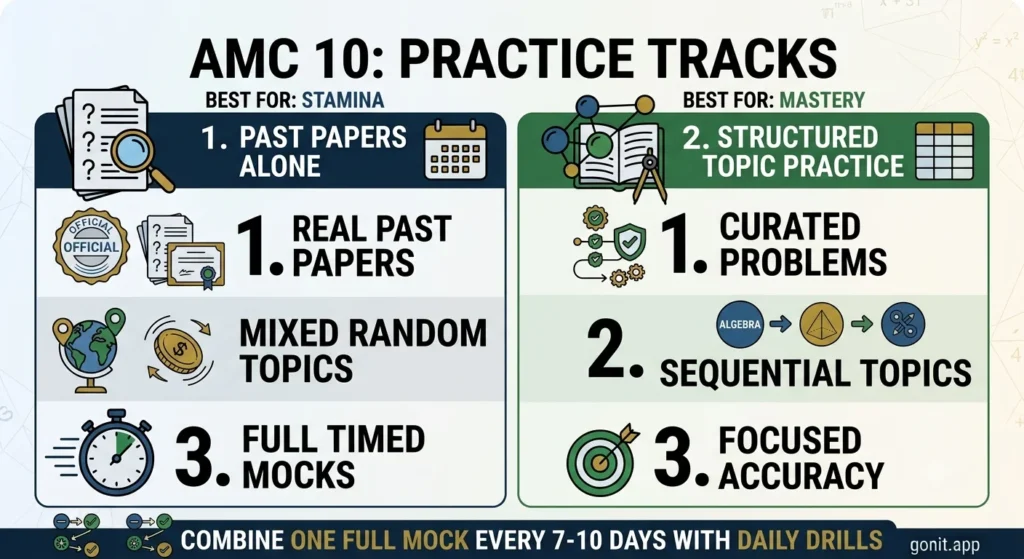
Past papers are non-negotiable, the only authentic source. But papers alone don’t tell you which topic to drill next, and crowd-sourced solutions vary in quality.
| Past papers alone | Structured topic by topic practice | |
| Authenticity | Real AMC 10 problems, exact format | Curated AMC 10 style and difficulty |
| Coverage | Mixed every test, no per topic focus | One topic at a time, in sequence |
| Diagnoses weak topics? | Only with many tests plus careful logging | Built in, per topic mastery as you go |
| Worked solutions | Crowd sourced, quality varies | One reviewed solution per problem |
| Pacing practice | Strong, full timed papers | Limited, focused on accuracy |
| Best for | Building exam stamina | Closing topic gaps between mocks |
| Use it for | One full mock every 7 to 10 days | The 4 to 5 short sessions between mocks |
This is the gap Gonit fills. It sequences AMC 10 topics in the right order, gives short daily problem sets, names the technique in every worked solution, and tracks per-topic mastery.
Combine it with one full past paper every 7 to 10 days, and you have the structure AMC coaches recommend.
Common Mistakes Students Make on AMC 10 Practice Tests
A few patterns show up again and again when reviewing AMC 10 practice tests:
- Guessing on every blank instead of leaving low confidence questions blank, which quietly costs points given the 1.5 point blank rule
- Practicing untimed for weeks, then panicking the first time a real clock is running
- Spending too long on problems 21 to 25 in practice, at the expense of consistent accuracy on problems 1 to 18
- Skipping the review step after a mock, so the same mistake type repeats test after test
- Ignoring the difference between a careless error and a real content gap, which leads to drilling the wrong topic
Fixing even two of these usually moves a score more than another stack of unreviewed past papers.
How to Review Mistakes: The Error Log
The highest leverage habit between AMC 10 practice tests is an error log. Without it, more practice tests are busywork.

A simple doc, a Google Doc, Notion page, or spreadsheet, recording every missed problem (or lucky guess), and why. For each, record:
- Paper and problem number (for example, “2023 AMC 10A, number 17”)
- Topic (for example, “counting, complementary”)
- Mistake type: Read (misread), Set-up (framed wrong), Execute (computation error), or Time (clock)
- Correct move in one sentence. “Use Pick’s theorem.” “Count the complement.” “Apply Vieta’s formulas.”
After three or four mocks, patterns emerge. Eight Set-up errors in counting? Drill casework, not more full tests. Six Time errors at problems 13 to 18? Pacing drills, not harder problems. The error log turns ten practice papers into measurable improvement instead of a stack of pdfs. Same review method as our AMC 8 practice guide, scaled up.
How to Use an AMC 10 Answer Key the Right Way
An AMC 10 answer key tells you what you got wrong, not why. Before checking the key, mark which problems you were unsure about while taking the test.
After checking the key, for every miss, write down whether it was a Read, Set-up, Execute, or Time error before you look at the full worked solution.
Only then read the official or AoPS solution, and compare it to what you actually wrote on your scratch paper.
Checking the answer key too early skips the diagnostic step that makes the error log useful, so the order matters as much as doing it at all.
How many AMC 10 practice tests should I take?
Four to eight full timed papers across a 12-week plan. Fewer than four and pacing never solidifies; more than eight and you use up the recent papers that double as predictive mocks late. Quality of review beats raw volume one thoroughly logged mock beats three skimmed ones.
Should I take both AMC 10A and AMC 10B?
If you can, yes. They’re different problems on different days (AMC 10A on November 5, 2026 and AMC 10B on November 13, 2026), and the MAA uses your higher score for AIME qualification. A bad A can be recovered the following week on B.
What score do I need for AIME qualification?
From the 2026-27 cycle, you need 100 or more out of 150 on the AMC 10A or AMC 10B to qualify for the 2027 AIME, as long as you meet the other eligibility rules.
I’m in 8th grade. Should I take the AMC 10 instead of AMC 8?
Many strong middle schoolers do both AMC 8 in January and AMC 10 in November of the same school year. Eligibility only requires grade 10 or below and under 17.5, so 8th graders are welcome. But the AMC 10 is significantly harder, so start with solid algebra and a strong AMC 8 score first. The AMC 8 practice guide is the right starting point.
Can I practice AMC 10 problems online instead of on paper?
Yes, for topic-by-topic drilling, an app-based format like Gonit works well since it can check answers instantly and track per-topic mastery. For full-length mocks, though, print the paper. The AMC 10 is a paper-based exam, and reading dense problems on a screen under time pressure practices a different skill than the real test.
Where can I find a free AMC 10 practice test?
The MAA’s AMC page and the AoPS AMC 10 wiki both host every official AMC 10 free of charge, going back to 2000. Both include the original problems, and AoPS adds community solutions. Avoid paid exclusive AMC 10 practice test pdf bundles, since the underlying problems are free everywhere.
Where can I find AMC 10 past papers?
Free AMC 10 past papers, with solutions and answer keys, are on the AoPS Wiki. This page links the 2022 to 2025 AMC 10A and AMC 10B papers.
Are AMC 10 past papers free?
Yes. Past AMC 10 problems, solutions and answer keys are free to read on the AoPS Wiki. Official printed copies can be bought from the MAA.
The Bottom Line
Students who get the most out of AMC 10 practice tests do four things:
- Use real past papers from official archives, saving the most recent three to four years for the final month
- Simulate real timed conditions, 75 minutes, no calculator, phone away, single timer
- Use three pass pacing (sweep front, attack back, triage marked) rather than racing problem by problem
- Keep an error log that turns every mistake into a specific lesson for next week’s topic drilling
A practice test is only as valuable as the review that follows it. Twelve focused weeks of a real AMC 10 prep plan beats six months of casual problem solving.
Make Preparing for Math Olympiad Simple!



Related guides on gonit.app
- AMC syllabus: a complete topic map for AMC 8, 10 and 12, the underlying curriculum your AMC 10 practice is sampling from.
- How to prepare for the AMC: a 12-week plan that works, the broader prep system this guide plugs into.
- AMC 8 Practice Test: How to Practice the Right Way, for middle schoolers building the foundation before AMC 10.

Mikha Piregu is a Content Writer with experience spanning educational content, including math and math olympiad topics, as well as advocacy writing, research-based articles, and SEO-driven web content. He creates high-quality blog content, web copy, and feature articles that support brand visibility, audience engagement, and long-term organic growth through data-informed storytelling. Skilled in WordPress, WooCommerce, and modern digital tools, Mikha adapts content across various platforms, including blogs, websites, campaigns, and advocacy initiatives, with clarity and purpose.



There are no comments posted here yet.
Sign in to leave a comment