


Angles are formed when two rays meet at a common endpoint called the vertex, and an angle measures the amount of turn between those rays in degrees.
- What is an Angle?
- Arms and Vertex, the Two Parts of Every Angle
- Why Angles Are Measured in Degrees
- The 5 Main Types of Angles
- Types of Angles Chart
- Angles as Fractions of a Full Turn
- Angles All Around You
- How Angles Are Measured
- Why Arm Length Does Not Change an Angle
- Angle Pairs Your Child Will Meet Next
- Types of Angles for Class 4 (CBSE and NCERT)
- Common Mistakes Students Make With Angles
- Eight Hands-On Angle Activities
- Tips for Parents Teaching Angles at Home
- Tips for Teachers Delivering an Angle Lesson
- Practice Questions on Types of Angles
- Conclusion
The types of angles are classified by that measurement: zero (0°), acute (under 90°), right (exactly 90°), obtuse (90° to 180°), straight (exactly 180°), reflex (180° to 360°), and complete (exactly 360°). A Grade 4 student needs five of these. This guide covers each with charts, examples, and practice.
If your child is just starting out with geometry for kids, angles are the first topic where naming things actually matters. Get the five types straight now and triangles, quadrilaterals and measurement all get easier later.
What is an Angle?
An angle is the figure formed when two rays start from the same point. That shared point is the vertex, and the amount of opening between the two rays is what we measure.
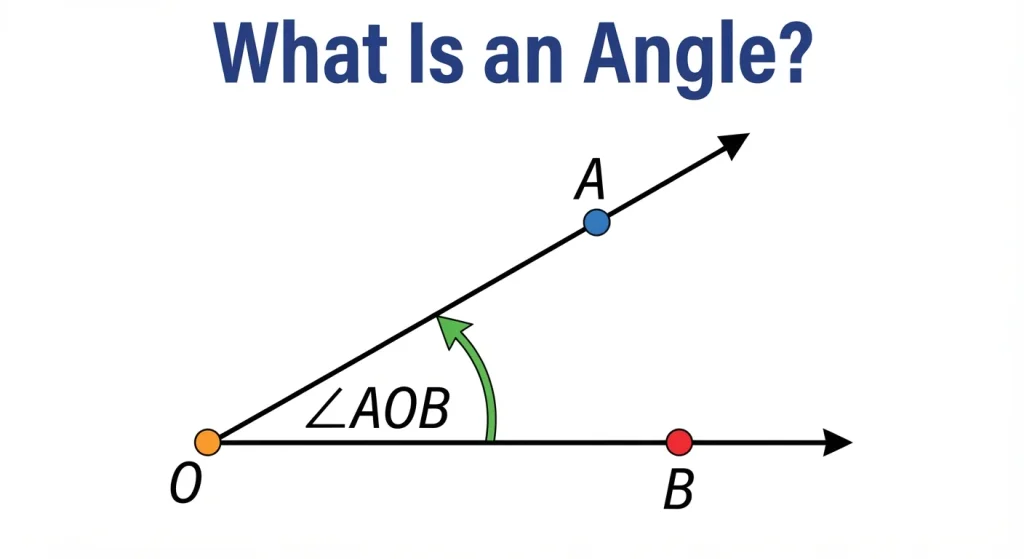
The symbol for an angle is . If the vertex is O and the arms pass through A and B, we write the angle as AOB, with the vertex letter always in the middle.
Here is the idea that makes everything else click. An angle is not a shape and it is not a length. It is an amount of opening, or an amount of turn. Open a pair of scissors slightly and the angle is small. Open them wide and the angle is large. The blades never changed. Only the turn between them did.
Angles are also what give geometrical shapes their character. A square is a square because of its angles, not its sides alone.
Arms and Vertex, the Two Parts of Every Angle
Every angle has exactly two parts your child should be able to point at and name.
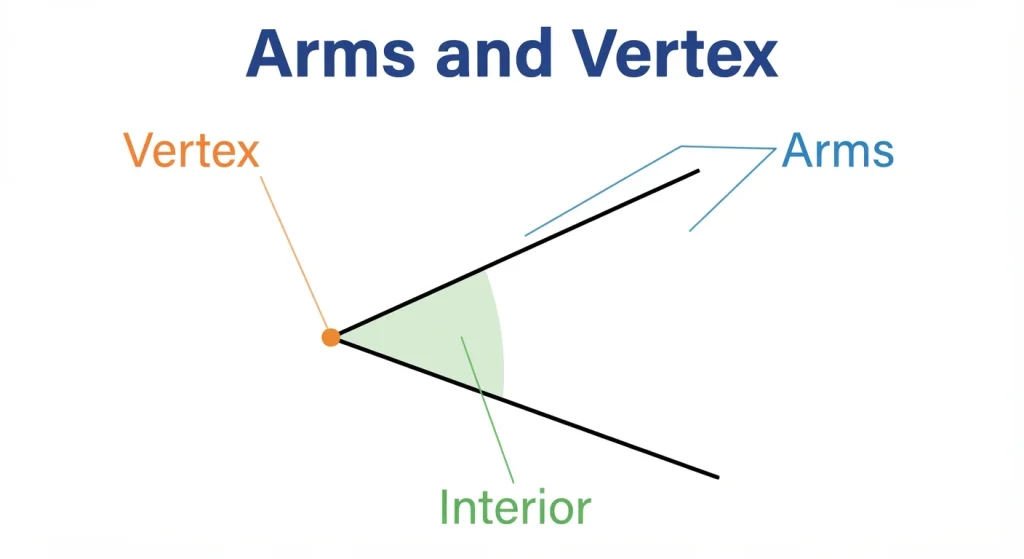
The vertex is the corner point where the two rays meet. In AOB, the vertex is O. If a child cannot find the vertex, they will place a protractor wrongly every single time, so this is worth drilling until it is automatic.
The arms are the two rays that form the angle. In AOB the arms are OA and OB. Because arms are rays, they start at the vertex and continue outward, which is exactly why how long you draw them makes no difference at all.
The region between the two arms is the interior of the angle. When a diagram shades an angle, the interior is what is shaded, and the small arc drawn near the vertex tells you which opening is being measured.
Why Angles Are Measured in Degrees
A degree is the unit we use for angles, written as a small circle after the number, like 45°.
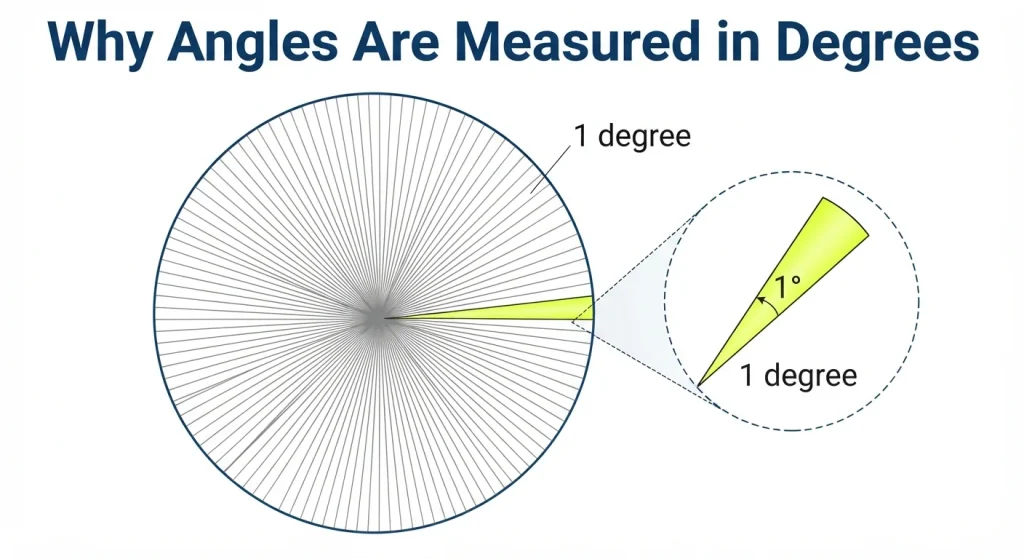
Picture one full turn, all the way around and back to the start. Split that full turn into 360 equal slices. One of those slices is one degree.
So a degree is a tiny amount of turn, which is why angle measures are usually numbers in the tens or hundreds. A notebook corner is 90 of those slices. A half turn is 180. A full turn is all 360.
Why 360 and not 100? Ancient astronomers picked it because 360 divides neatly by 2, 3, 4, 5, 6, 8, 9, 10 and 12. That is also why angle questions keep using friendly numbers like 30, 45, 60, 90 and 120.
The 5 Main Types of Angles
There are five main types of angles based on how far the turn has gone: acute, right, obtuse, straight and reflex. They are not five separate ideas to memorise. They are five regions on one scale running from 0 degrees to 360 degrees, and every angle your child meets lands in exactly one of them.
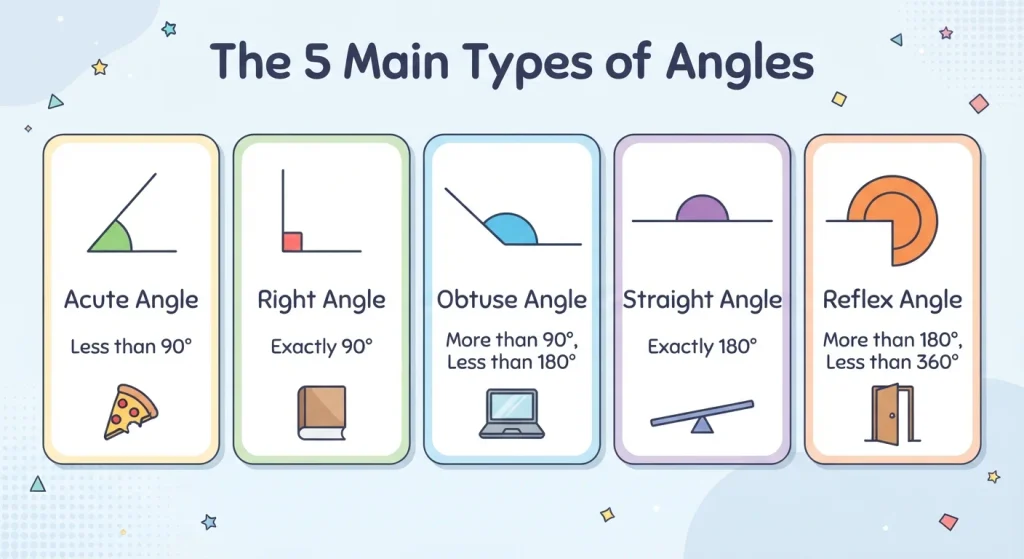
Read them in order and the pattern is obvious. The turn gets bigger each time.
Acute Angle, Less Than 90 Degrees
An acute angle measures more than 0 degrees and less than 90 degrees. It looks sharp and narrow, like a wedge.
Examples: 15°, 30°, 45°, 60°, 75°, 89°.
Everyday example: the tip of a pizza slice. Cut a pizza into eight slices and each tip is 45 degrees. The sharp point of a capital letter A is acute too.
How to spot it: if the opening is smaller than the corner of a notebook, it is acute. That notebook corner is the reference every child should carry in their head.
Right Angle, Exactly 90 Degrees
A right angle measures exactly 90 degrees. It is a quarter of a full turn, and it is the most important angle in the chapter because every other type is described in relation to it.
In diagrams, a right angle is marked with a small square at the vertex instead of a curved arc. Teach your child to look for that square. Two lines meeting at a right angle are called perpendicular.
Everyday example: the corner of a book, a window frame, a chessboard square, the point where a wall meets the floor.
How to spot it: hold the corner of any sheet of paper against the angle. Exact fit, no gap and no overlap, means right angle.
Obtuse Angle, More Than 90 and Less Than 180 Degrees
An obtuse angle measures more than 90 degrees but less than 180 degrees. It is wider than a right angle but has not flattened into a straight line.
Examples: 95°, 104°, 130°, 145°, 179°.
Everyday example: a laptop screen tilted back for comfortable typing, a door opened wide against a wall, the back of a reclining chair.
How to spot it: put the paper corner against it. Clearly wider than the paper corner, but the arms have not fallen into a straight line, means obtuse.
Straight Angle, Exactly 180 Degrees
A straight angle measures exactly 180 degrees. The two arms point in opposite directions, so together they form a straight line.
A straight angle is half of a full turn. It is also two right angles side by side, since 90 + 90 = 180, which is a fact worth remembering for later questions.
Everyday example: a see-saw balanced level, an open book pressed flat on a table, a straightened arm at the elbow.
Watch out: children often argue that a straight angle is “just a line, not an angle”. It is an angle. The vertex is still there in the middle, and the turn from one arm to the other is a half turn.
Reflex Angle, More Than 180 and Less Than 360 Degrees
A reflex angle measures more than 180 degrees but less than 360 degrees. This is the one that trips children up most, so slow down here.
Whenever two arms meet they actually create two angles: the smaller opening on one side, the larger opening on the other. The two always add up to 360 degrees. The larger one, if it is more than 180 degrees, is the reflex angle.
That means the same picture can show a 60 degree acute angle and a 300 degree reflex angle at the same time. Which one is meant depends on which side the arc is drawn. Teach your child to find the arc first.
Everyday example: the wide opening behind a door pushed almost flat against the wall.
Quick method: measure the smaller angle and subtract from 360. Smaller angle 110 degrees means the reflex angle is 360 − 110 = 250 degrees.
Types of Angles Chart
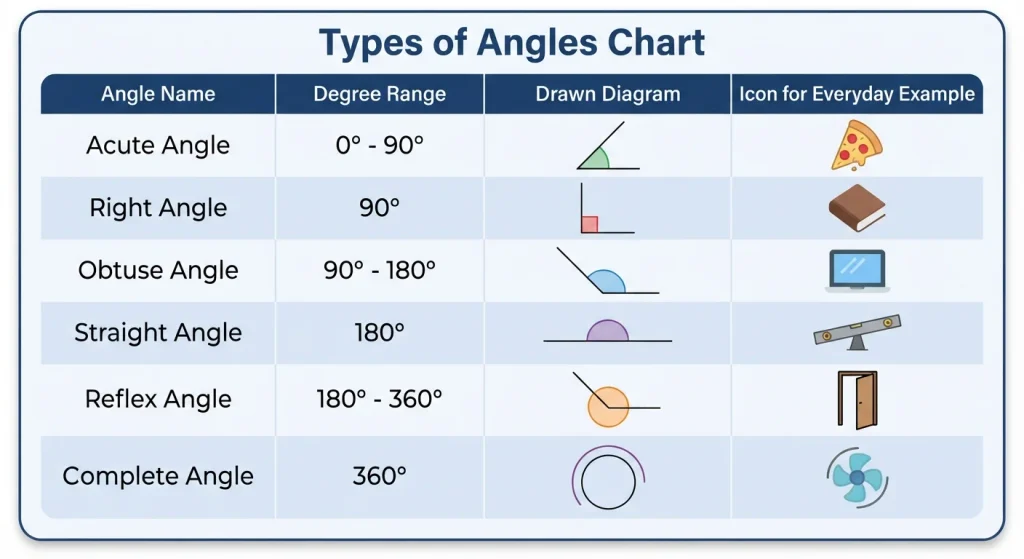
| Angle type | Degree range | Picture cue | Everyday example |
|---|---|---|---|
| Acute angle | More than 0° and less than 90° | Sharp and narrow, smaller than a notebook corner | Tip of a pizza slice |
| Right angle | Exactly 90° | A perfect L, marked with a small square | Corner of a book |
| Obtuse angle | More than 90° and less than 180° | Wide, clearly bigger than a notebook corner but not flat | Tilted laptop screen |
| Straight angle | Exactly 180° | A straight line with the vertex in the middle | Level see-saw |
| Reflex angle | More than 180° and less than 360° | The larger opening on the outside of two arms | Door pushed back against a wall |
| Complete angle | Exactly 360° | One full turn, both arms lying together | One spin of a fan blade |
Print this chart and keep it near the study table. Ask your child to name the type before reaching for a protractor. Estimating first and measuring second is what builds real number sense.
Angles as Fractions of a Full Turn
Every angle is a piece of one full turn, which makes angles one of the easiest places to connect geometry with fractions. A full turn is 360 degrees, so half a turn is 180 degrees, a quarter turn is 90 degrees, and three quarters of a turn is 270 degrees.
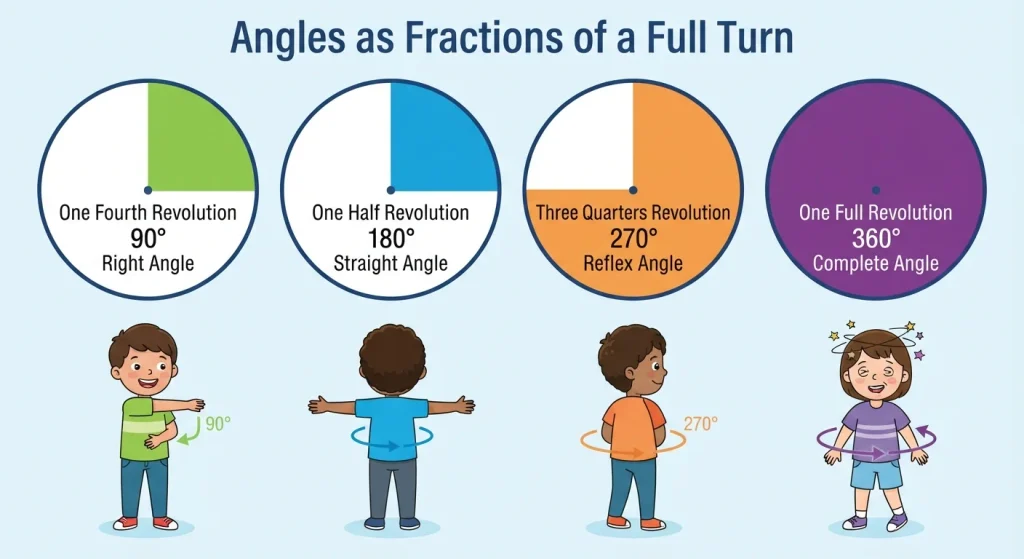
What Is the Angle Name for One Fourth Revolution?
The angle name for one fourth revolution is a right angle, which measures 90 degrees. One fourth of 360 degrees is 90 degrees, so turning a quarter of the way around, like facing north and then turning to face east, creates exactly one right angle.
The Full Turn Table
| Fraction of a turn | Degrees | Angle name |
|---|---|---|
| One fourth revolution | 90° | Right angle |
| One half revolution | 180° | Straight angle |
| Three fourths revolution | 270° | Reflex angle |
| One full revolution | 360° | Complete angle |
Notice that three fourths of a turn gives a reflex angle. That is the cleanest way to show a child that reflex angles are ordinary, not exotic. They are simply turns that have gone past halfway.
Seeing It on a Clock Face
A clock turns a fraction-of-a-turn idea into something a child can watch. The minute hand sweeps a quarter turn in 15 minutes, a half turn in 30 minutes, three quarters in 45 minutes and a full turn in one hour.
Point at the hour hand too. From 12 to 3 is a quarter turn and a right angle. From 12 to 6 is a half turn and a straight angle. If your child is still shaky on telling time on a clock, teaching both together works better than teaching either alone, because each one explains the other.
Angles All Around You
Give your child ten minutes and a notebook and they can find every type without leaving the room.
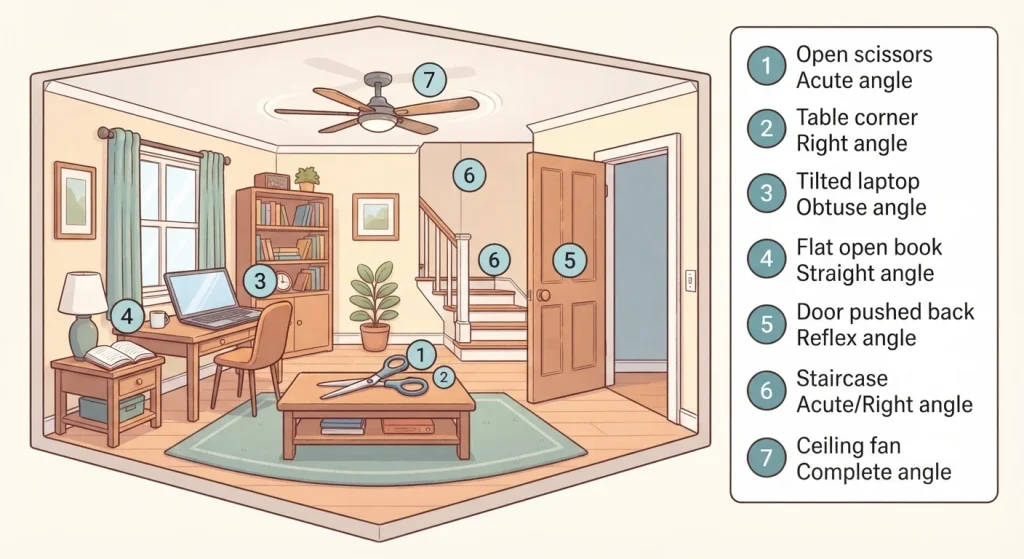
- Acute: the tip of a pizza slice, slightly open scissors, the point of a watermelon wedge, the peak of a drawn roof.
- Right: a table corner, a window frame, a tile, a chessboard square, where a wall meets the floor.
- Obtuse: a tilted laptop screen, a reclined chair back, a ladder leaning on a wall, a book lying nearly flat.
- Straight: a level see-saw, a fully open book pressed flat, a straightened arm.
- Reflex: the opening behind a door pushed back to the wall, the outside opening of wide-open scissors.
- Complete: one full turn of a ceiling fan blade, one rotation of a bicycle wheel.
A staircase is worth a separate look, because each step shows a right angle where the tread meets the riser, repeated all the way up. Clock hands, as covered above, give you every type across a single hour.
How Angles Are Measured
Angles are measured with a protractor, a half-circle tool marked from 0 to 180 degrees with two scales running in opposite directions.
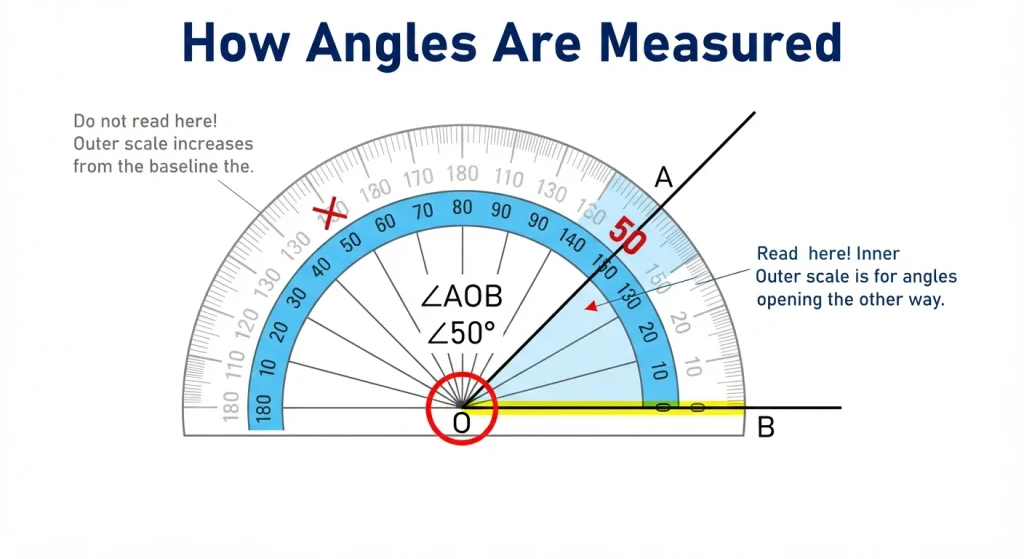
The method in short: place the centre point of the protractor exactly on the vertex, turn it so one arm lies flat along the 0 degree baseline, then read where the second arm crosses the curved edge.
The one step children skip is checking which scale to read. A protractor has an inner and an outer scale, and you must use the one whose 0 sits on the arm you lined up. Skip that check and a 50 degree angle gets written down as 130 degrees. The safeguard is to estimate before measuring: if the angle clearly looks sharper than a notebook corner, any reading above 90 is wrong, and subtracting from 180 will fix it.
If an arm is too short to reach the curved edge, just extend it with a ruler. Making an arm longer never changes the angle.
For a reflex angle, a standard protractor will not reach past 180 degrees, so measure the smaller angle and subtract from 360.
For the full step-by-step method, including drawing an angle of a given measure, see our guide on [how to use a protractor]([ARTICLE 2 URL]).
Why Arm Length Does Not Change an Angle
This is the misconception behind more wrong answers than every other angle error combined.
Children see two angles, one drawn with short arms and one with long arms, and say the long-armed one is bigger. More ink on the page, bigger angle. It feels obvious and it is completely wrong.
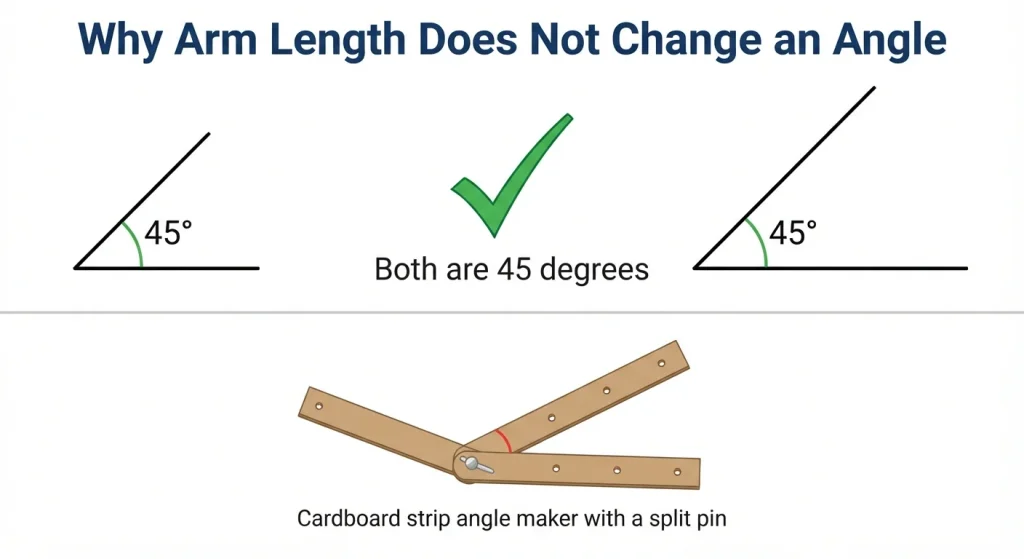
The length of the arms has nothing to do with the size of the angle. An angle measures the opening between the arms, not how far the arms travel. Extend both arms to the edge of the page, or across the room, and the angle stays exactly the same.
A thirty-second fix: open a pair of scissors a little and note the opening. Now ask whether longer blades would push them further apart. They would not.
Better still, build it. Cut two short cardboard strips and two long ones, join each pair at one end with a split pin, open both to the same opening and lay one on top of the other. Different arm lengths, identical angle. Children remember what they make.
Then run it in reverse. Draw a 40 degree angle with very long arms beside a 70 degree angle with very short arms and ask which is bigger. Let your child answer wrongly once, then measure both together. That single corrected mistake teaches more than ten repetitions of the rule.
One related trap: the arc drawn near the vertex only marks which opening is being measured. A bigger arc does not mean a bigger angle either.
Angle Pairs Your Child Will Meet Next
Angle types describe one angle alone. Angle pairs describe how two angles relate, and they arrive in Class 5 and Class 6.
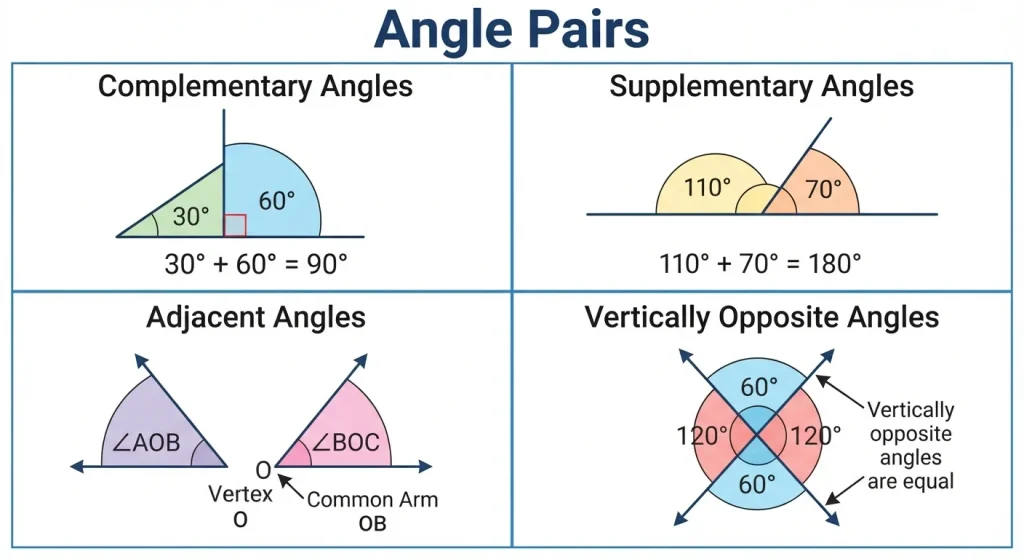
- Complementary angles add up to 90 degrees. The complement of 35 degrees is 55 degrees, since 35 + 55 = 90.
- Supplementary angles add up to 180 degrees. The supplement of 125 degrees is 55 degrees, since 125 + 55 = 180.
- Adjacent angles share a vertex and one arm, and their interiors do not overlap. Think of two cake slices cut from the same centre, sitting side by side.
- Vertically opposite angles are the pairs directly across from each other where two straight lines cross. They are always equal.
A memory hook that sticks: C comes before S in the alphabet, and 90 comes before 180. Complementary is the 90 one.
Types of Angles for Class 4 (CBSE and NCERT)
In the CBSE and NCERT Class 4 Maths syllabus, angles appear inside the shapes and patterns strand rather than as a standalone geometry chapter. What is expected at this stage is recognition, not calculation.
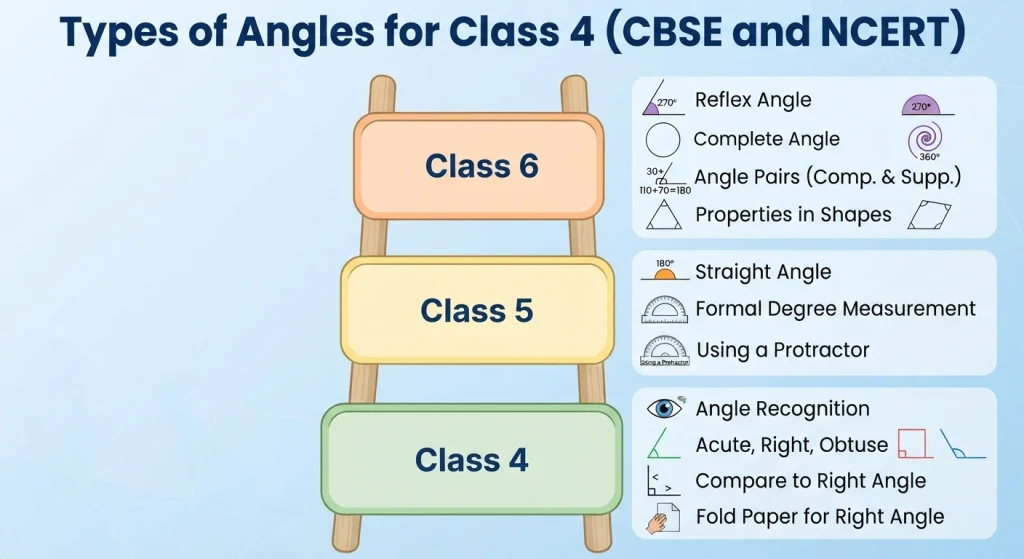
What a Class 4 student is expected to do:
- Identify an angle as the opening formed by two arms meeting at a vertex
- Recognise and name acute, right and obtuse angles on sight
- Compare angles as smaller than, equal to, or larger than a right angle
- Spot right angles in the classroom and at home
- Make a right angle by folding paper twice, with no protractor needed
What arrives in Class 5: the straight angle, formal degree measurement and the protractor.
What arrives in Class 6: reflex and complete angles, angle pairs, and the angle properties of triangles and quadrilaterals.
This is why a Class 4 child who can confidently sort angles into smaller-than, equal-to and bigger-than a right angle is exactly where they need to be, even without a protractor in hand. If you are building up from earlier years, our Grade 2 geometry guide covers the shape recognition that comes first.
Common Mistakes Students Make With Angles
Thinking longer arms mean a bigger angle. The most common error of all. Fix it with the cardboard strip model above, and reinforce it every time a diagram has uneven arms.
Reading the wrong protractor scale. A 40 degree angle recorded as 140 degrees. Fix it by always checking which scale has its 0 on the baseline arm, and by estimating before reading.
Confusing obtuse with reflex. Both are “big”, so children mix them. Fix it with the hard boundary: obtuse stops at 180 degrees. Anything wider than a straight line is reflex.
Placing the protractor’s edge on the vertex instead of the centre point. Every reading is off by a few degrees and the child never knows why. Fix it by making them point at the centre mark before every measurement.
Saying a straight angle is not an angle. Fix it by drawing the vertex dot clearly and sweeping a finger through the half turn.
Assuming the bigger arc means the bigger angle. Fix it by drawing the same 50 degree angle twice with arcs of different sizes and measuring both.
Eight Hands-On Angle Activities
Every activity uses materials you already have.
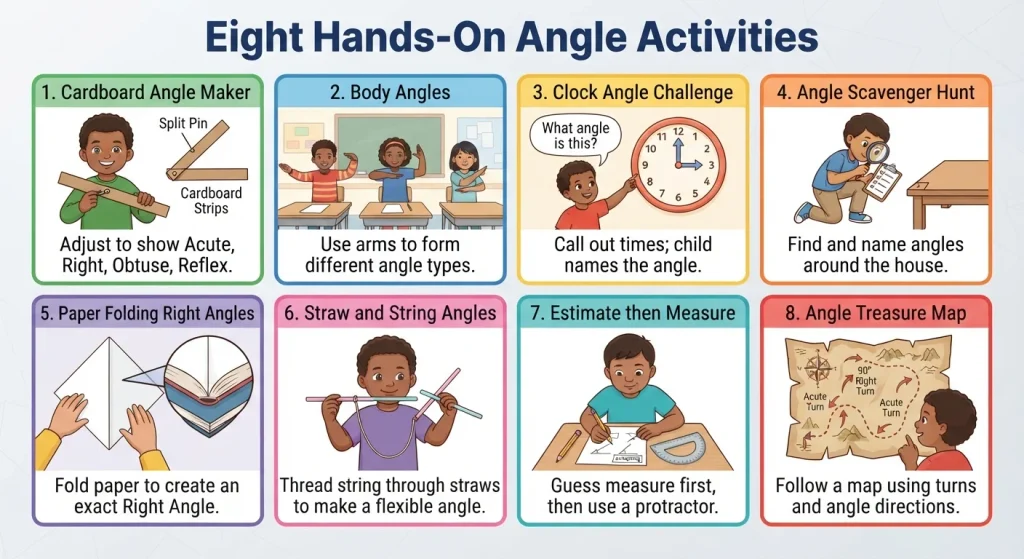
1. The cardboard angle maker. Two cardboard strips joined at one end with a split pin. Call out a type, your child opens the strips to match. Covers every type including reflex and makes the arm-length point obvious.
2. Body angles. Call out acute, right, obtuse, straight, and have children form the angle with their arms. Fast, physical, and a strong whole-class warm-up.
3. Clock angle challenge. Ask what type of angle the hands make at 3, 5, 6, 1 and 9 o’clock. Then reverse it: name a time that makes an obtuse angle.
4. Angle scavenger hunt. Ten minutes around the house with a tally sheet for each type. Require an estimated measure beside each find, not just a name. This is one of the better ways to build spatial understanding without it feeling like maths.
5. Paper folding right angles. Fold any paper in half, then in half again along the fold. The corner you made is an exact right angle. Use it as a comparison tool for the rest of the lesson. This is the NCERT approach and it is still the best one.
6. Straw and thread angles. Thread string through two drinking straws and tie it to make a flexible angle that opens and closes.
7. Estimate then measure. Draw ten angles. Your child writes an estimate beside each, then measures and records the difference. Within 10 degrees scores a point. This game is what stops protractor errors, and it quietly sharpens visual reasoning skills at the same time.
8. Angle treasure map. Write directions using turns: walk five steps, make a right angle turn left, walk three steps, make an acute turn right. Connects angles back to rotation and direction, which is where the idea came from.
Tips for Parents Teaching Angles at Home
Start with turning, not drawing. Have your child physically turn a quarter, a half and a full turn before any diagram appears. The vocabulary sticks when it is attached to a movement they made.
Use the notebook corner as the universal reference. Bigger than the corner is obtuse, smaller is acute, exactly equal is right. That single comparison handles almost all Grade 4 work.
Estimate before measuring, every time. A child who estimates 50 will notice that 130 is wrong. A child who does not estimate writes down whatever the protractor seems to say.
Correct with a measurement, not a statement. When your child insists the long-armed angle is bigger, do not just say no. Measure both together and let the protractor settle it.
Keep sessions short. Fifteen to twenty focused minutes beats an hour of drifting. Geometry rewards frequency over duration.
Use the precise words. Vertex, arms, degrees. Those are the words on the exam paper, and familiarity removes a whole layer of difficulty.
Tips for Teachers Delivering an Angle Lesson
Open with rotation, not definition. Have the class stand and turn a quarter, a half, a full turn, then write 90, 180 and 360 on the board beside those turns. The numbers now mean something before any definition arrives.
Teach the five types in degree order in one go. Presenting them as one ordered sequence takes less time than teaching them separately and retains far better, because students see a scale instead of a list.
Fold right angles before handing out protractors. Every student gets a personal reference tool, the equipment bottleneck disappears, and the protractor becomes a refinement rather than a mystery.
Pre-teach the scale trap. Put a 50 degree angle on the board, show both readings, 50 and 130, and ask which is right and why. Far more effective than correcting thirty notebooks afterwards.
Use deliberately misleading diagrams. A 30 degree angle with long arms beside a 100 degree angle with short arms. Let the class vote before measuring. The surprise does the teaching, and the reasoning it forces is exactly the kind of critical thinking that carries into harder topics.
Finish with a reasoning question, not a measuring question. “Two lines cross and one angle is 110 degrees. Find the other three without a protractor.” That shift from measuring to reasoning is the real goal of the chapter.
Practice Questions on Types of Angles
Name the type of angle for each measure.
- 72°: Acute, more than 0 and less than 90.
- 90°: Right angle, exactly a quarter turn.
- 145°: Obtuse, more than 90 and less than 180.
- 180°: Straight angle, a half turn.
- 265°: Reflex, more than 180 and less than 360.
- 104°: Obtuse, just past a right angle.
- 89°: Acute, one degree short of a right angle.
- 360°: Complete angle, one full turn.
- 270°: Reflex, three fourths of a full turn.
- 45°: Acute, half of a right angle.
Two to think about:
- Angle A has 2 cm arms. Angle B is identical but drawn with 8 cm arms. Which is bigger? Answer: Neither. They are equal. Arm length never changes the measure of an angle.
- The smaller angle between two arms is 95°. What is the reflex angle on the other side? 265°, because 360 − 95 = 265.
Want more practice on paper? Download the printable [angles worksheet]([WORKSHEET PDF URL]). For word-problem style questions that use angle vocabulary in context, see our guide on how to solve math word problems.
Make Preparing for Math Olympiad Simple!


What are the different types of angles?
The five main types of angles are acute (more than 0 and less than 90 degrees), right (exactly 90 degrees), obtuse (more than 90 and less than 180 degrees), straight (exactly 180 degrees) and reflex (more than 180 and less than 360 degrees). A complete angle of exactly 360 degrees is usually counted as a sixth.
What are the 12 types of angles?
The count of 12 comes from adding angle pairs and transversal angles to the six basic types. The six basic types are acute, right, obtuse, straight, reflex and complete. The additional ones are complementary, supplementary, adjacent, vertically opposite, corresponding and alternate angles. A Grade 4 student only needs the first five.
What type of angle is 104 degrees?
An angle of 104 degrees is an obtuse angle, because it is more than 90 degrees and less than 180 degrees. It is wider than a right angle but has not opened into a straight line.
What is the angle name for one fourth revolution?
One fourth revolution is a right angle, measuring 90 degrees. One fourth of 360 degrees is 90 degrees, so a quarter turn always produces a right angle.
How many degrees is a full revolution?
A full revolution is 360 degrees. It is called a complete angle, and it is the same as four right angles or two straight angles.
Is a straight line an angle?
Yes, a straight line through a marked vertex is a straight angle measuring 180 degrees. The two arms point in exactly opposite directions, and the turn from one arm to the other is a half turn.
What is the difference between an acute and an obtuse angle?
An acute angle measures less than 90 degrees and looks sharp and narrow. An obtuse angle measures more than 90 degrees but less than 180 degrees and looks wide and open. The dividing line between them is the right angle at exactly 90 degrees, so comparing with the corner of a sheet of paper settles it instantly.
What is the difference between an obtuse angle and a reflex angle?
An obtuse angle measures between 90 and 180 degrees. A reflex angle measures between 180 and 360 degrees. The boundary is the straight angle at 180 degrees, so any angle wider than a straight line is reflex.
How can I teach angle types at home without special materials?
Join two cardboard strips with a split pin to make an adjustable angle, fold a sheet of paper twice to create an exact right angle for comparison, and run an angle scavenger hunt around the house. Those three cover identification, comparison and real-life recognition with nothing bought.
Conclusion
Angles look like a memory test when they are taught as five labels. They stop looking like one the moment a child sees them as five stops along a single turn, with the right angle sitting in the middle as the reference for everything else.
Three things to take away. The notebook corner is the fastest classification tool your child owns. Estimating before measuring prevents almost every protractor error. And arm length never changes an angle.
From here, the same five types carry straight into triangles, quadrilaterals and the angle reasoning behind math olympiad questions.

Mikha Piregu is a Content Writer with experience spanning educational content, including math and math olympiad topics, as well as advocacy writing, research-based articles, and SEO-driven web content. He creates high-quality blog content, web copy, and feature articles that support brand visibility, audience engagement, and long-term organic growth through data-informed storytelling. Skilled in WordPress, WooCommerce, and modern digital tools, Mikha adapts content across various platforms, including blogs, websites, campaigns, and advocacy initiatives, with clarity and purpose.

There are no comments posted here yet.
Sign in to leave a comment