September 22, 2025
 9 min. read

If you’ve searched for the AMC maths competition syllabus and come back with a vague list “algebra, geometry, number theory,” you’re not alone.
Most articles online list topics without explaining what they mean at each level, how hard they are, or whether your child actually needs calculus (spoiler: they don’t).
This guide breaks down the American Mathematics Competitions syllabus level by level AMC 8, AMC 10, and AMC 12 with specific subtopics, a side-by-side comparison, and a clear progression ladder.
What Is the AMC? A Quick Overview
The American Mathematics Competitions (AMC) is a national problem-solving competition run by the Mathematical Association of America (MAA).
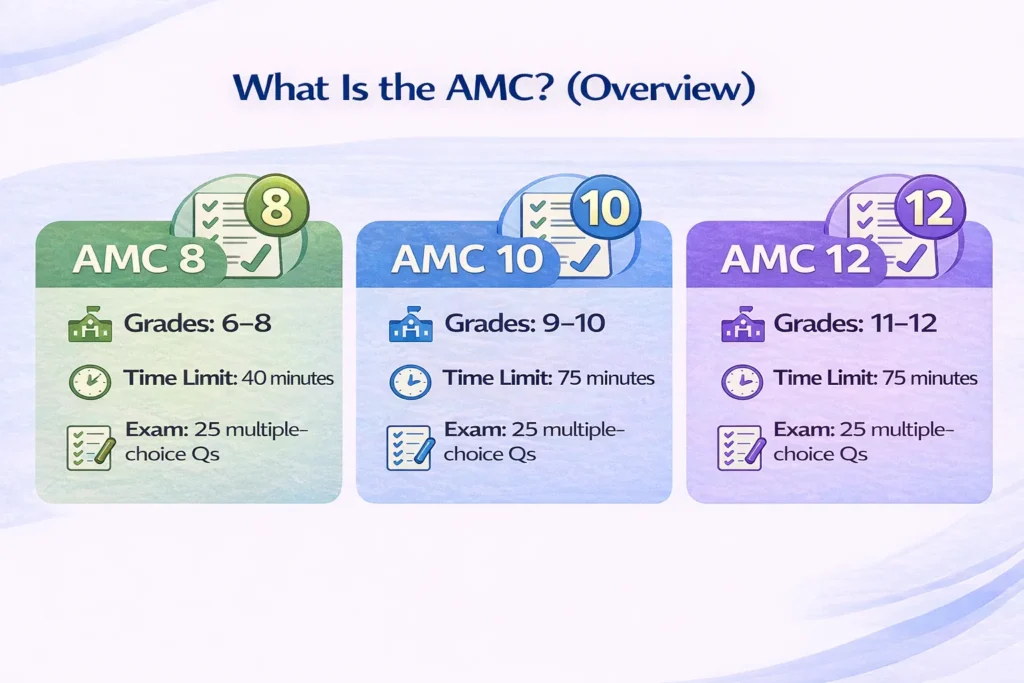
Over 300,000 students across 50+ countries participate each year. There are three exam levels:
| Exam | Grade Level | Format | When |
| AMC 8 | Grade 8 and below (max age: 15.5) | 25 questions / 40 min | January |
| AMC 10 | Grade 10 and below (max age: 17.5) | 25 questions / 75 min | November |
| AMC 12 | Grade 12 and below (max age: 19.5) | 25 questions / 75 min | November |
All three are multiple-choice with no calculators allowed. High scorers on AMC 10 and AMC 12 advance to the AIME — the next step toward the USA Mathematical Olympiad (USAMO).
AMC 8 Syllabus Breakdown
The AMC 8 tests middle-school mathematics, but the problem-solving style is harder than school exams. Here’s what’s covered:
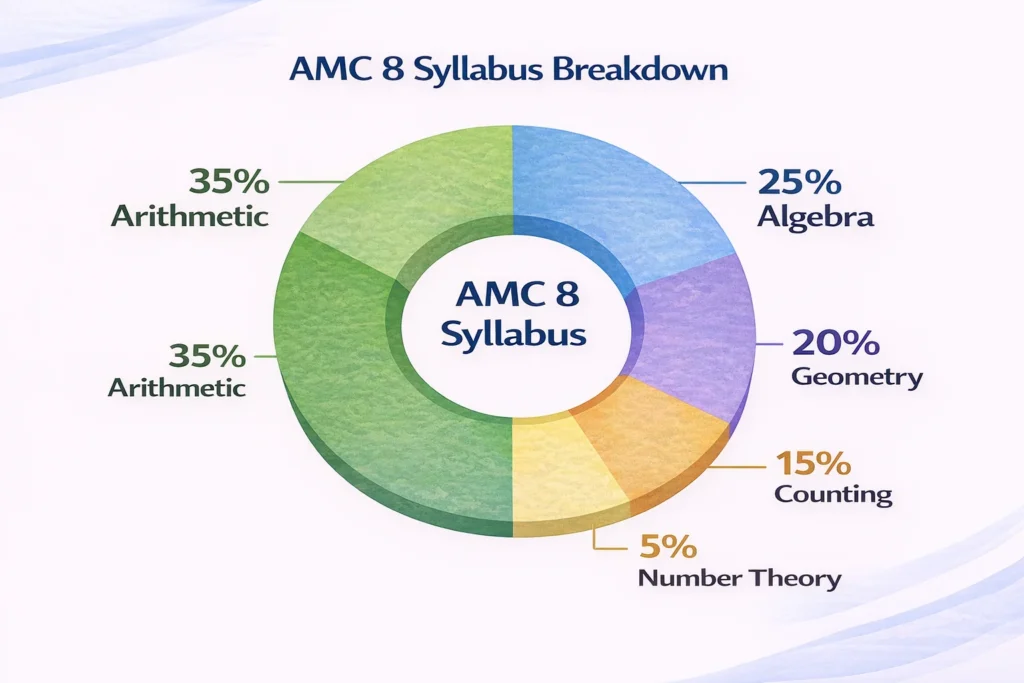
Arithmetic and Number Sense — fractions, decimals, percentages, ratios, and proportional reasoning, applied through multi-step word problems rather than simple calculations.
Introductory Algebra — setting up and solving linear equations, basic coordinate geometry, and simple quadratic expressions in context.
Geometry Basics — area and perimeter of rectangles, triangles, and circles; the Pythagorean theorem; spatial reasoning; and composite figure problems.
Counting and Probability (Combinatorics) — basic permutations (ordered arrangements) and combinations (unordered selections), and straightforward probability. For example: “How many ways can 4 students stand in a line?”
Number Theory Basics — prime numbers, prime factorization, divisibility rules, greatest common divisors (GCD), and least common multiples (LCM).
How it compares to school: AMC 8 topics overlap with Grades 6–8 school math, but the problems demand more creative thinking. A school test asks you to find the area of a triangle.
An AMC 8 question shows you a triangle inside a pentagon and asks you to find the shaded region — using the same formula, but in a less obvious way.
AMC 10 Syllabus Breakdown
The AMC 10 is a significant step up. It’s designed for Grade 10 and below, but most students benefit from dedicated preparation starting in Grade 7 or 8. For a full strategy, see our AMC preparation guide.
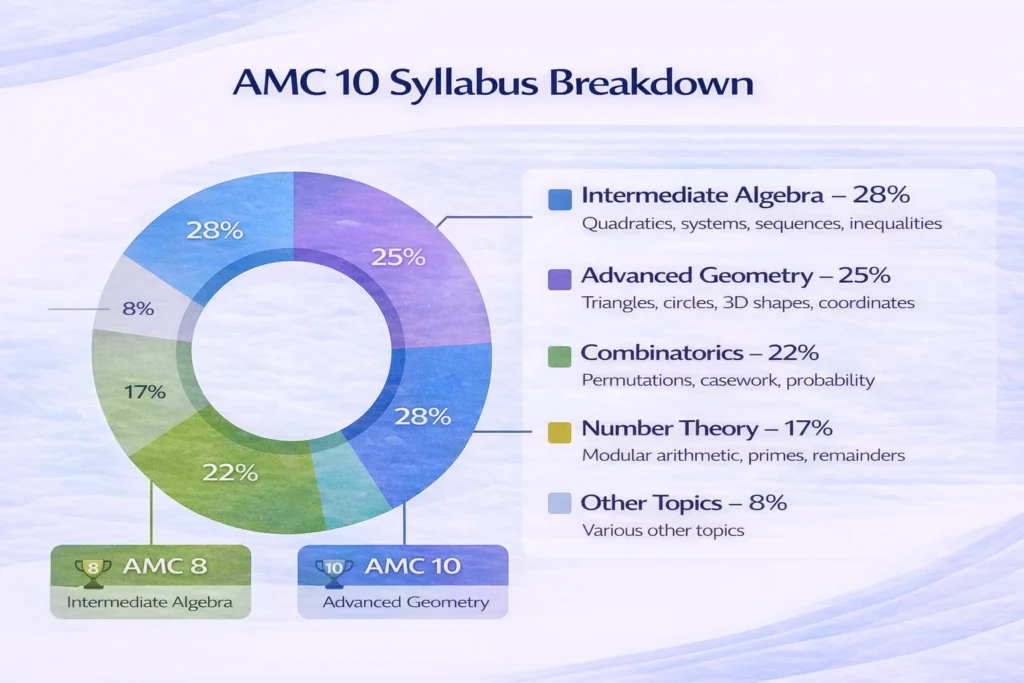
Intermediate Algebra — quadratic equations and functions, factoring techniques, systems of equations, arithmetic and geometric sequences, inequalities, and polynomial manipulation.
Advanced Geometry — triangle similarity and congruence, circle theorems (inscribed angles, tangent lines, arc lengths), coordinate geometry with complex configurations, and 3D shapes (prisms, pyramids, cylinders).
Combinatorics — this expands significantly from AMC 8. Expect permutations with restrictions, the multiplication principle, casework (splitting problems into cases), complementary counting, and probability with combinatorial reasoning. This is the area students most underestimate.
Number Theory — modular arithmetic (clock-like arithmetic with remainders), properties of primes, the Euclidean algorithm, and Diophantine equations (whole-number solutions to equations).
Does AMC 10 Include Calculus?
No. AMC 10 does not include calculus. The MAA officially excludes it. Derivatives, integrals, and limits do not appear anywhere on the AMC 10. This is the single most common misconception about the AMC maths competition syllabus.
How it compares to school: AMC 10 overlaps with parts of Algebra I, Geometry, and Algebra II — but combinatorics and number theory are rarely taught in school, making specific competition prep essential.
AMC 12 Syllabus Breakdown
The AMC 12 covers the full high school mathematics curriculum. It’s the hardest of the three levels and is open to students in Grade 12 and below.
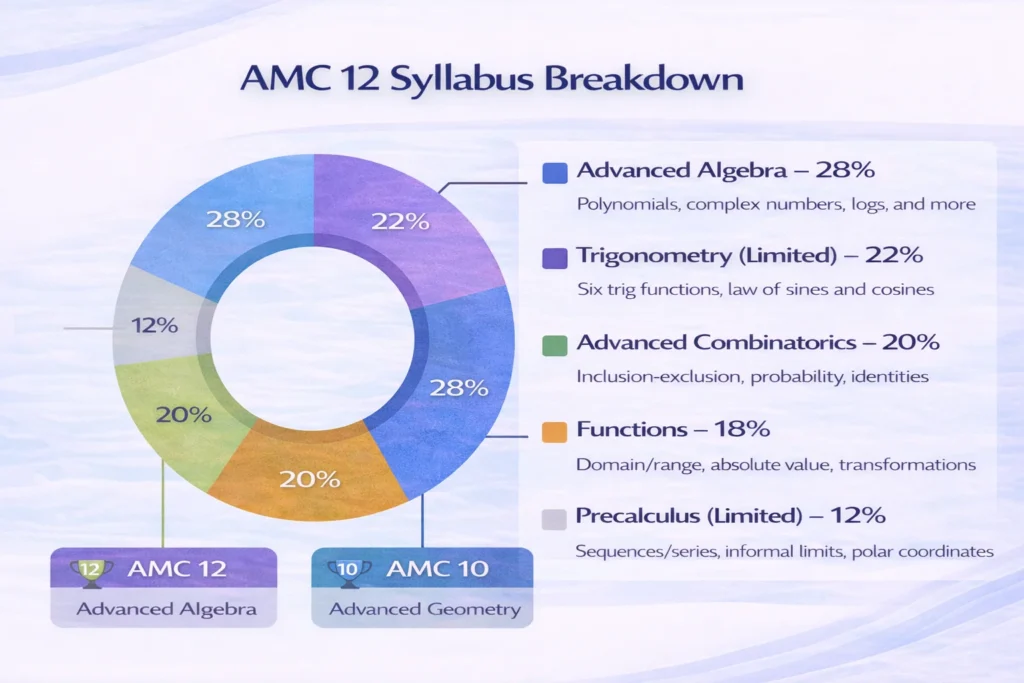
Advanced Algebra — everything in AMC 10, plus polynomial division, Vieta’s formulas, complex numbers, logarithms, exponential functions, and function composition and inverses.
Trigonometry (Limited) — the six trig functions, the unit circle, law of sines, and law of cosines. This is not a full trigonometry course — it appears primarily in geometry-based problems.
Advanced Combinatorics — inclusion-exclusion, conditional probability, expected value, and combinatorial identities.
Functions — domain and range, piecewise functions, absolute value functions, and transformations.
Precalculus (Limited) — deeper sequences and series, informal limits (conceptual, not computational), and isolated polar coordinate problems.
Does AMC 12 Include Calculus?
No. AMC 12 does not include calculus. The MAA is explicit: calculus is excluded from the AMC 12. Your child does not need it.
How it differs from AMC 10: AMC 12 adds trigonometry, complex numbers, logarithms, and deeper function theory. About 10–15 questions overlap with the AMC 10, but the remaining problems require a significantly broader mathematical toolkit.
AMC 8 vs AMC 10 vs AMC 12: Side-by-Side Comparison
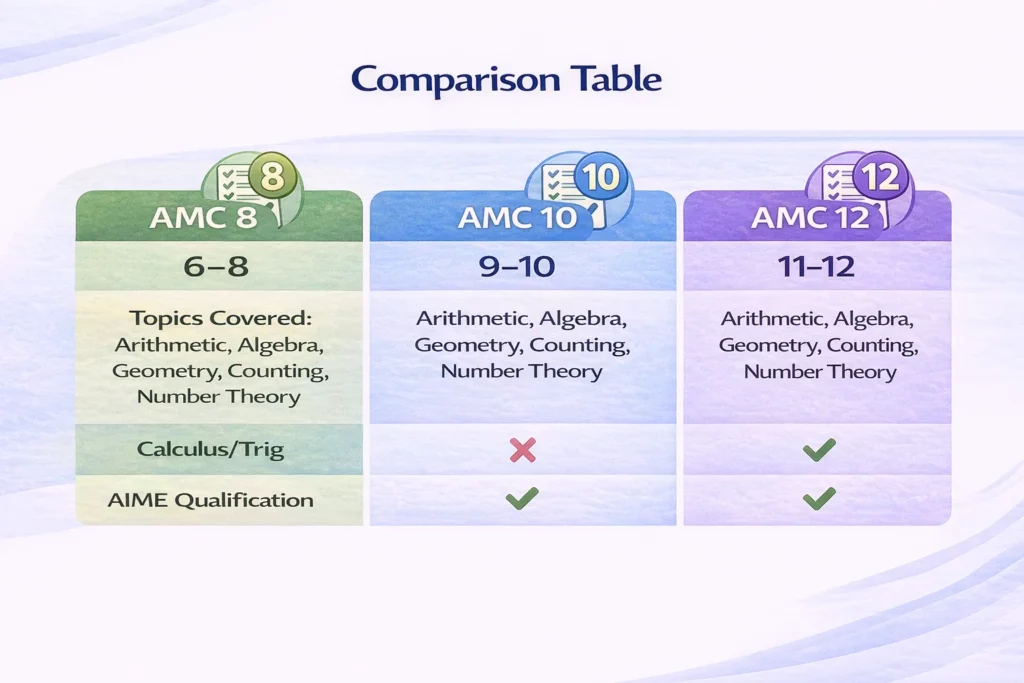
| Feature | AMC 8 | AMC 10 | AMC 12 |
| Algebra | Basic (linear, word problems) | Intermediate (quadratics, sequences) | Advanced (polynomials, logs, complex #s) |
| Geometry | Basics (area, Pythagorean) | Intermediate (circles, 3D, similarity) | Advanced (trig, harder configurations) |
| Number Theory | Basic (primes, GCD, LCM) | Intermediate (modular arithmetic) | Advanced |
| Combinatorics | Basic (permutations, probability) | Intermediate (casework, complementary) | Advanced (inclusion-exclusion, expected value) |
| Trigonometry | No | No | Limited |
| Calculus | No | No | No |
| Typical avg. score | ~10–12 / 25 | ~57–65 / 150 | ~55–65 / 150 |
| Leads to | AMC 10 prep | AIME (top ~2.5–7%) | AIME (top ~5–15%) |
Topic Weight Distribution
Knowing which topics appear most often helps you prepare smarter, not harder.
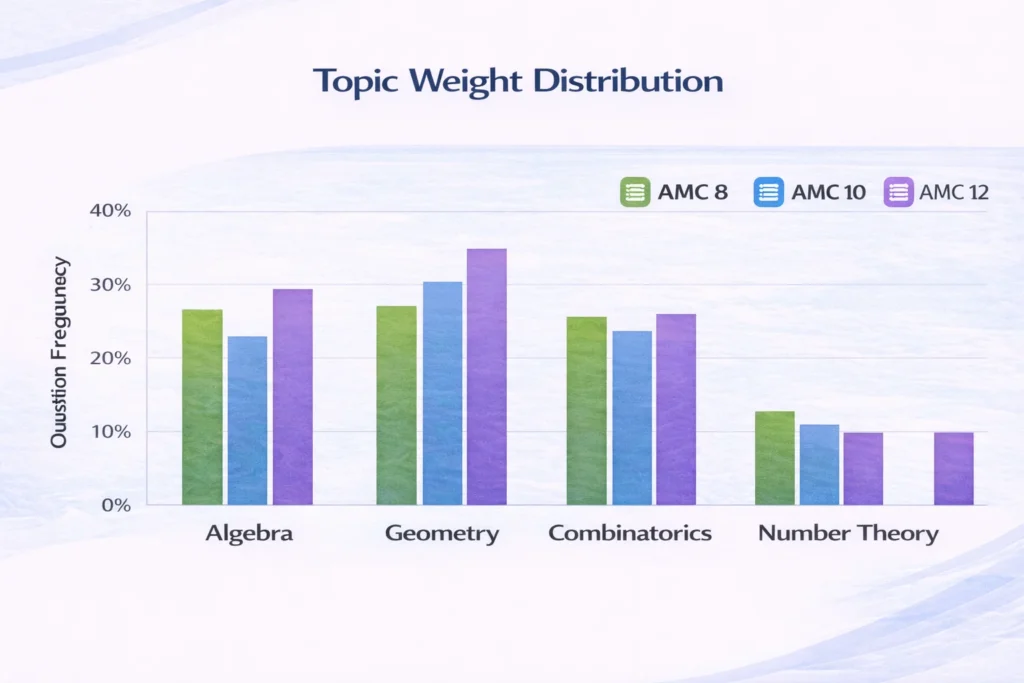
AMC 8 (25 questions)
- Geometry & Spatial Reasoning: 5–7 questions — consistently the largest category
- Arithmetic & Word Problems: 5–7 questions — appears at every difficulty level
- Counting & Probability: 3–5 questions — growing in recent exams
- Algebra: 3–5 questions — increasingly word-problem driven
- Number Theory: 2–4 questions — essential for harder questions
AMC 10 (25 questions)
- Algebra: 7–9 questions — the largest single category
- Geometry: 6–8 questions — consistent throughout
- Combinatorics & Probability: 4–6 questions — the biggest differentiator for high scorers
- Number Theory: 3–5 questions — common in mid-difficulty problems
AMC 12 (25 questions)
- Algebra (incl. functions, complex numbers): 8–10 questions — dominant
- Geometry (incl. trigonometry): 5–7 questions
- Combinatorics & Probability: 4–6 questions — often the hardest problems
- Number Theory: 3–4 questions
Key insight: Combinatorics is the most underprepared topic for students coming from school math and it’s heavily represented across all three levels. Prioritize it.
The Progression Ladder: AMC 8 → AMC 10 → AMC 12 → AIME
Think of the AMC pathway as a ladder, with each step requiring stronger foundations and new mathematical tools:
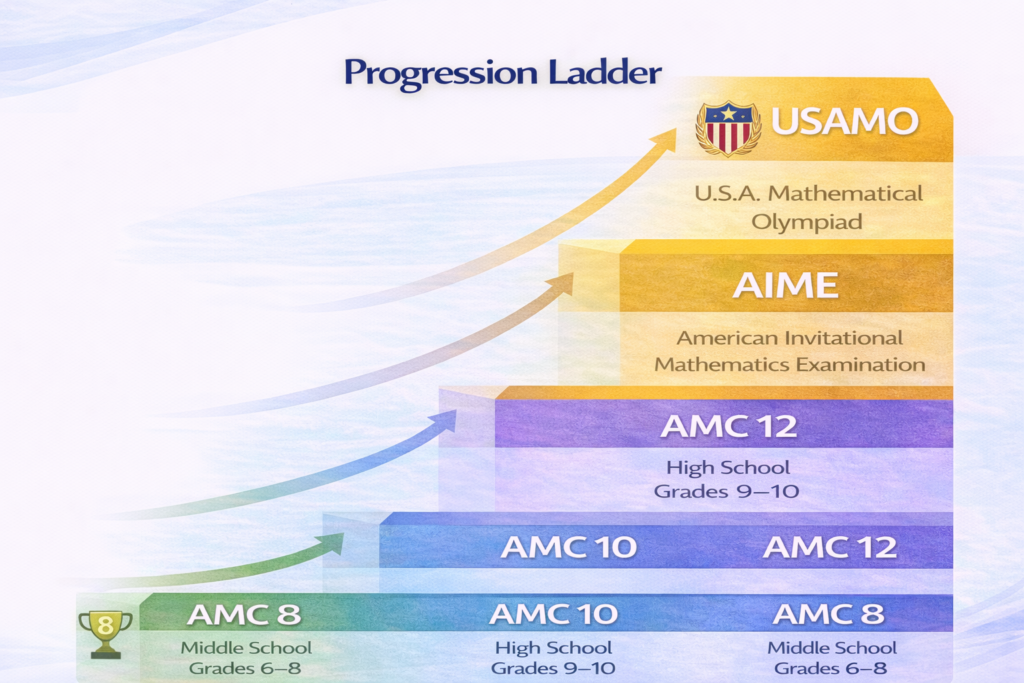
AMC 8 (Foundation) → Arithmetic, basic algebra, geometry basics, counting basics
AMC 10 (Intermediate) → Adds quadratics, combinatorics, number theory, advanced geometry
AMC 12 (Advanced) → Adds trigonometry, logarithms, complex numbers, advanced functions
AIME (Elite) → Integer-answer format, 15 questions, 3 hours. No multiple choice. Top ~2.5–7% of AMC 10 takers qualify. Topics required to qualify for AIME include mastery of all AMC 12 content plus deeper problem-solving ability.
What is AIME? The American Invitational Mathematics Examination is where top AMC scorers advance. Qualifying is a significant achievement — it places a student in the top 2.5–7% nationally. Answers are integers from 0 to 999, and problems require combining ideas from multiple mathematical areas. Check average AMC scores to understand what scores typically lead to AIME qualification.
What Is NOT on the AMC Syllabus
This is where most confusion lives. Here’s a clear list of what the AMC does not test:
- Calculus — not on AMC 8, AMC 10, or AMC 12. No derivatives, integrals, or limits.
- Trigonometry — not on AMC 8 or AMC 10. Limited on AMC 12 only.
- Proof-based mathematics — the AMC is multiple choice. No written proofs are required (that’s USAMO and IMO territory).
- Statistics — formal methods like standard deviation or regression are not tested.
- Matrices and linear algebra — not included at any AMC level.
Where to Start Based on Your Grade
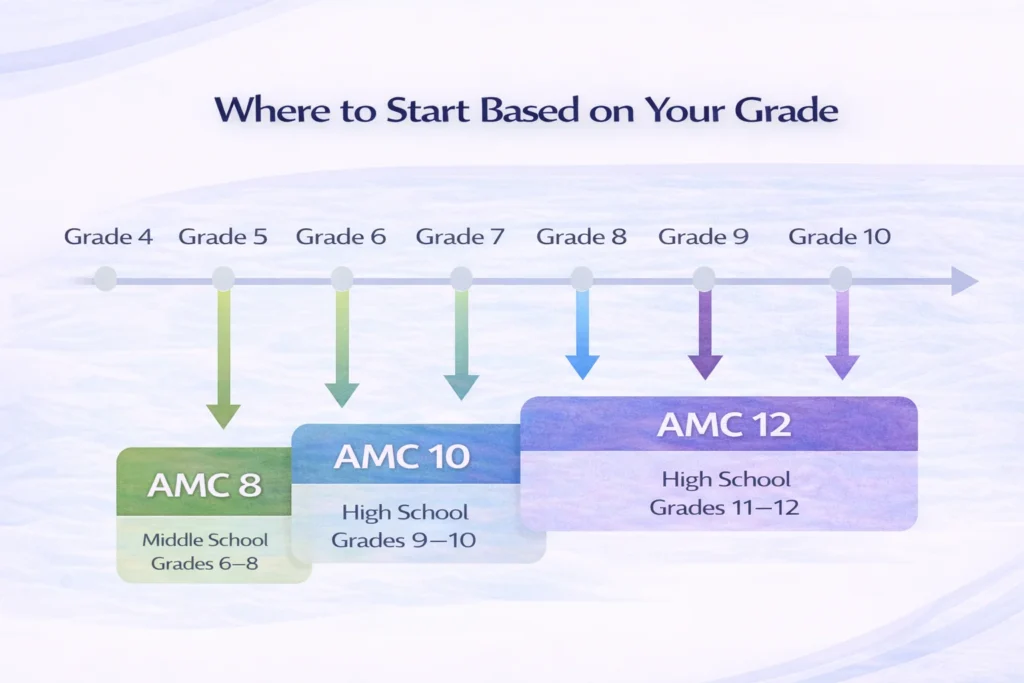
| Current Grade | Recommended Starting Point |
| Grade 4–5 | AMC 8 (exploration — low pressure) |
| Grade 6 | AMC 8 with focused preparation |
| Grade 7 | AMC 8 this year → begin AMC 10 prep |
| Grade 8 | AMC 8 (if new) or AMC 10 (if AMC 8 experienced) |
| Grade 9 | AMC 10 with solid preparation |
| Grade 10 | AMC 10 or AMC 12 (based on math level) |
| Grade 11–12 | AMC 12 |
If your child has already taken the AMC 10, review your score against what is a good AMC score and identify which topic areas cost the most points.
That analysis should drive the next preparation phase. For younger students just starting, explore free Olympiad prep resources to build problem-solving foundations early.
What topics are on the AMC 8?
The AMC 8 covers five areas: arithmetic and proportional reasoning, introductory algebra, basic geometry (areas, perimeters, Pythagorean theorem), counting and probability, and number theory basics (primes, GCD, LCM). No calculators are allowed.
Does AMC include calculus?
No. Calculus is explicitly excluded from AMC 8, AMC 10, and AMC 12. Students do not need derivatives, integrals, or limits at any AMC level. This is the most common misconception about the AMC maths competition syllabus.
What is the difference between AMC 10 and AMC 12?
Both have 25 questions in 75 minutes and share 10–15 overlapping problems. AMC 12 adds trigonometry, logarithms, complex numbers, and advanced function theory — none of which appear on AMC 10. AMC 12 problems are also harder at the upper end. Students should choose based on their math preparation level, not their grade alone.
What math do I need to know for AMC 10?
Students need intermediate algebra (quadratics, sequences, systems), intermediate geometry (circle theorems, similarity, 3D shapes), combinatorics (permutations, combinations, casework), and number theory (modular arithmetic, prime properties). Trigonometry and calculus are not required.
How hard is AMC compared to school math?
Significantly harder in problem-solving style, even when the topics overlap. School math tests whether you can apply a known procedure. AMC problems require you to figure out which ideas to combine and how — often in unexpected ways. This is a learnable skill, but it takes dedicated competition-math practice to develop.
What topics should I study first for AMC?
AMC 8: Start with geometry (most frequent) and combinatorics (least covered in school). AMC 10: Prioritize algebra, then combinatorics and number theory. AMC 12: Master all AMC 10 areas first, then add trigonometry, logarithms, and complex numbers. In all cases, practicing past AMC problems is your single most effective study tool.
Make Preparing for Math Olympiad Simple!



Conclusion
The AMC syllabus is more manageable than it looks. No calculus. No proofs. No surprises — once you know what’s actually on each exam.
AMC 8 builds the foundation. AMC 10 sharpens problem-solving. AMC 12 broadens the mathematical toolkit. And every level rewards the same thing: students who practice thinking flexibly, not just memorizing formulas.
Whether your child is in Grade 5, taking their first look at the AMC 8, or in Grade 10 aiming for AIME qualification, the path forward is the same: start at the right level, focus on the right topics, and practice with real competition problems.