


The Indian National Mathematical Olympiad (INMO) is a highly selective high school mathematics competition held annually in India.
- What is INMO?
- The Complete Olympiad Pathway: IOQM → RMO → INMO → IMOTC → IMO
- INMO 2026 Eligibility Criteria
- INMO 2026 Exam Date, Registration & Admit Card
- INMO Exam Pattern
- Complete INMO Syllabus: Topic-Wise Breakdown
- RMO vs. INMO: Understanding the Difficulty Jump
- How to Write Olympiad Proofs That Score
- INMO Preparation Strategy & Roadmap
- Best Books & Resources for INMO Preparation
- Previous Year Trends & High-Frequency Topics
- INMO Cutoff & Qualification Insights
- Common Mistakes to Avoid in INMO Preparation
- Start Your INMO 2026 Preparation Today
It is conducted by the Homi Bhabha Centre for Science Education (HBCSE) under the aegis of the National Board for Higher Mathematics (NBHM).
INMO 2026 is the make-or-break stage that decides which students advance toward representing India at the International Mathematical Olympiad (IMO).
This guide covers syllabus breakdown, proof-writing technique, a phased study plan, book recommendations, cutoff analysis, and the full IOQM → RMO → INMO → IMOTC → IMO pathway.
What is INMO?
INMO stands for the Indian National Mathematical Olympiad.
It is the third and most critical stage in India’s Mathematical Olympiad selection process.
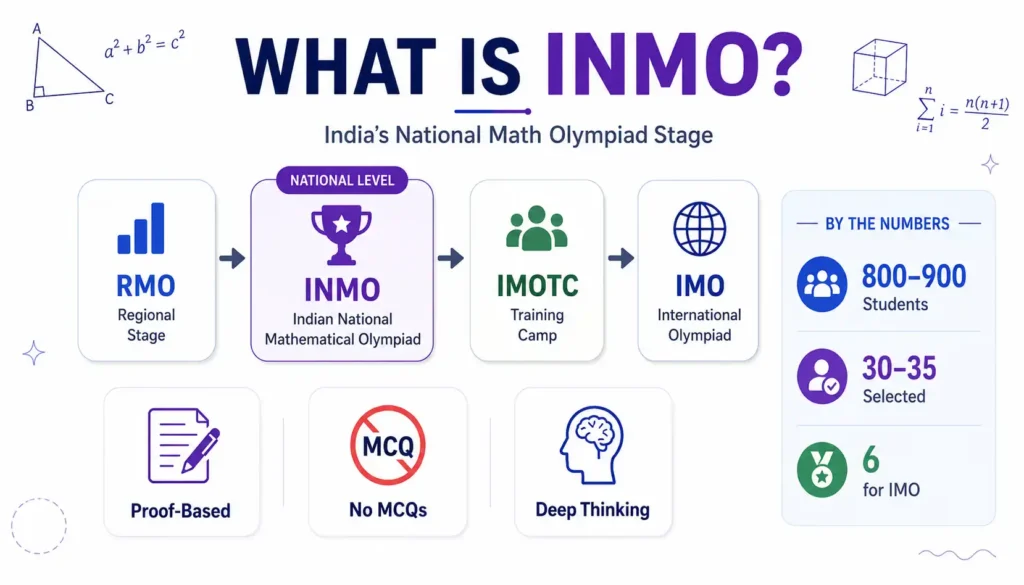
Sitting between the Regional Mathematical Olympiad (RMO) and the Indian Mathematical Olympiad Training Camp (IMOTC).
Unlike school-level math exams or even competitive entrance tests like JEE, INMO is entirely subjective and proof-based.
There are no multiple-choice questions. There is no partial marking for formulaic answers.
You’re expected to construct complete mathematical proofs: rigorous, logical arguments that demonstrate why something is true, not just that it’s true.
Here’s why INMO matters so much in the broader picture:
- It is the national-level filter that identifies India’s strongest young mathematicians.
- Only about 30–35 students out of roughly 800–900 INMO participants are selected for IMOTC each year.
- IMOTC is where the final team of 6 students is chosen to represent India at the IMO.
- Every Indian IMO medalist in history has come through this exact pipeline.
In short, if you want to represent India in mathematics on the world stage, INMO is the gate you must pass through.
The Complete Olympiad Pathway: IOQM → RMO → INMO → IMOTC → IMO
Understanding where INMO fits in the broader Olympiad selection process is essential.
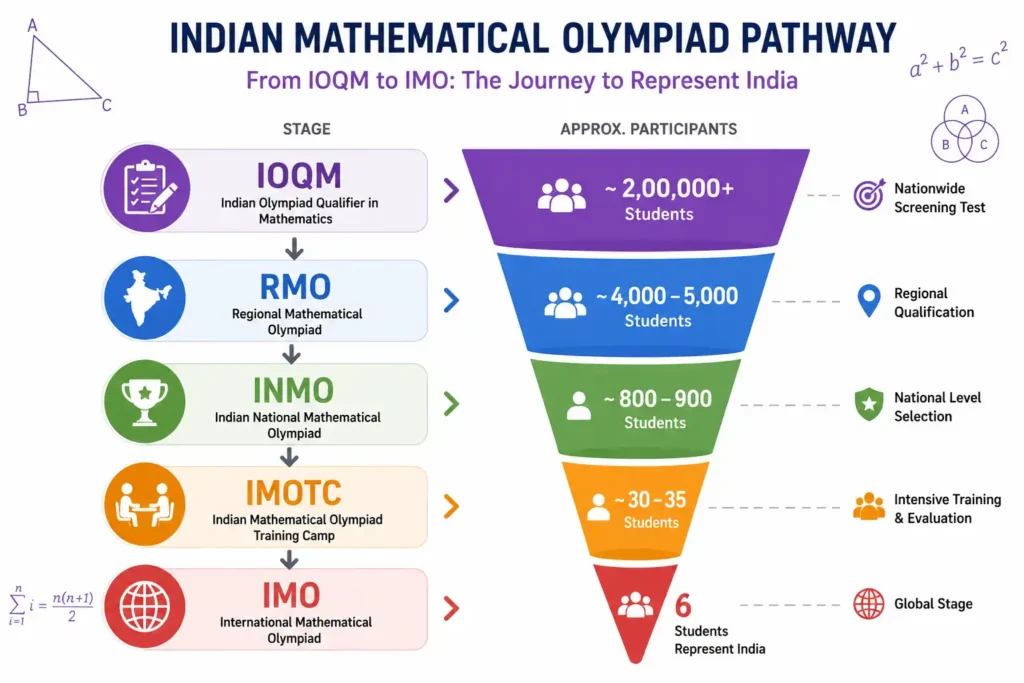
Here’s the complete pathway:
| Stage | Full Name | Format | Purpose |
| IOQM | Indian Olympiad Qualifier in Mathematics | Objective (MCQ-based) | Initial screening from a large pool of students |
| RMO | Regional Mathematical Olympiad | Subjective (6 problems, 3 hours) | Regional-level selection of strong problem solvers |
| INMO | Indian National Mathematical Olympiad | Subjective (6 problems, 4 hours) | National-level selection, the make-or-break stage |
| IMOTC | Indian Mathematical Olympiad Training Camp | Training + selection tests | Intensive training camp; final team of 6 selected for IMO |
| IMO | International Mathematical Olympiad | 6 problems over 2 days (4.5 hours each) | The best math competition in the world for pre-university students |

💡 Key takeaway:
INMO is the decisive filter. It's the stage where India's potential IMO team members are identified. Everything before it is qualification; everything after it is refinement and selection.
INMO 2026 Eligibility Criteria
INMO eligibility is not open to direct registration.
You must qualify through the preceding stages of the Olympiad pathway.
To be eligible for INMO 2026, you must:
- Have qualified through RMO 2025 (conducted in your respective region)
- Be an Indian citizen (or meet specific residency criteria as defined by HBCSE)
- Typically be a student in Classes 8–12 (or equivalent) during the academic year
- Meet the age criterion, born on or after a specific cutoff date (typically August 1 of a designated year; check the official HBCSE notification for INMO 2026 for the exact date)
Important notes:
- Students who have been selected for IMOTC in a previous year may receive direct entry to INMO (policies vary by year, so check official notifications).
- Each region sends a fixed number of qualifiers to INMO based on RMO performance.
- There is no separate INMO 2026 registration process. Qualified RMO students are automatically enrolled.
For the most current eligibility details, always refer to the official HBCSE website (olympiads.hbcse.tifr.res.in). If you’re earlier in the pipeline, our IOQM guide covers the first qualification stage in detail.
INMO 2026 Exam Date, Registration & Admit Card
INMO is typically conducted in January each year.
For INMO 2026:
| Detail | Information |
| Expected Exam Date | January 2026 (exact date to be announced by HBCSE) |
| Duration | 4 hours |
| Conducting Body | HBCSE / NBHM |
| Mode | Pen-and-paper, conducted at designated centres |
| Registration | Automatic for RMO qualifiers, no separate application needed |
| Admit Card | Distributed through regional coordinators or available on the HBCSE portal |
| Results | Typically announced in February–March on the official HBCSE website |
Note: The INMO 2026 exam date, admit card distribution timeline, and result date will be confirmed through official HBCSE notifications. Bookmark the HBCSE Olympiad page and check regularly after RMO results are declared.
INMO Exam Pattern
| Aspect | Details |
| Number of Problems | 6 |
| Duration | 4 hours |
| Question Type | Subjective: complete proof-based solutions required |
| Topics Covered | Algebra, Combinatorics, Geometry, Number Theory |
| Marking | Each problem is evaluated holistically for correctness and rigour of proof (not step-marking) |
| Calculators / Aids | Not permitted |
| Language | English (Hindi translations may be available) |
What “Subjective and Proof-Based” Actually Means
Each INMO problem requires you to either prove a statement or find and prove a result.
Your solution must be a self-contained logical argument. Evaluators assess:
- Correctness: Is the mathematical reasoning valid throughout?
- Completeness: Are all cases handled? Are assumptions justified?
- Clarity: Can the reader follow your argument without filling in gaps?
- Rigour: Are logical steps properly justified, not hand-waved?
A half-correct proof that trails off or skips key steps typically receives very little credit. A clean, complete proof of even one or two problems can be more valuable than scattered partial work across all six.
For a deeper look at math Olympiad questions and what they demand, check out our dedicated breakdown.
Complete INMO Syllabus: Topic-Wise Breakdown
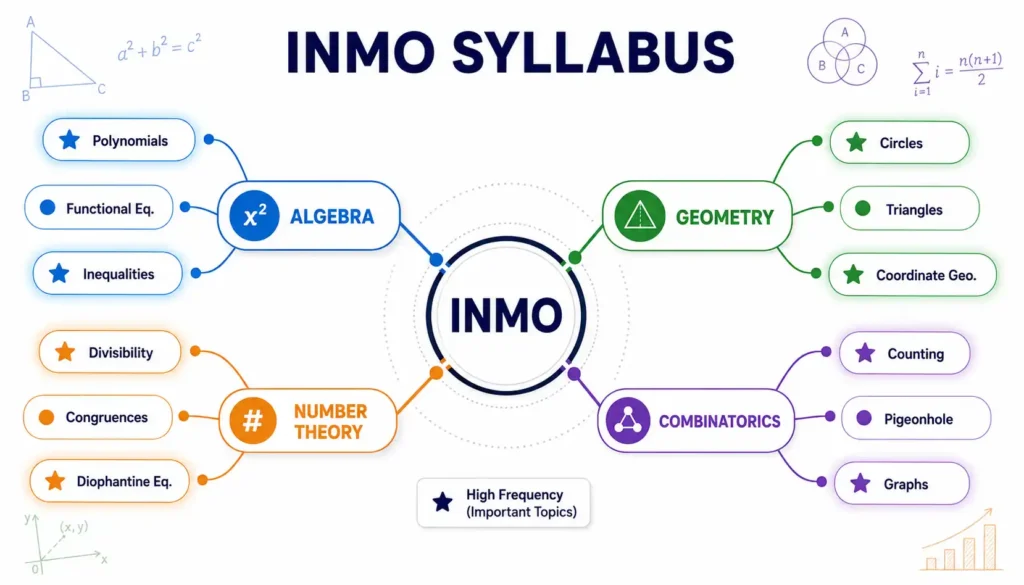
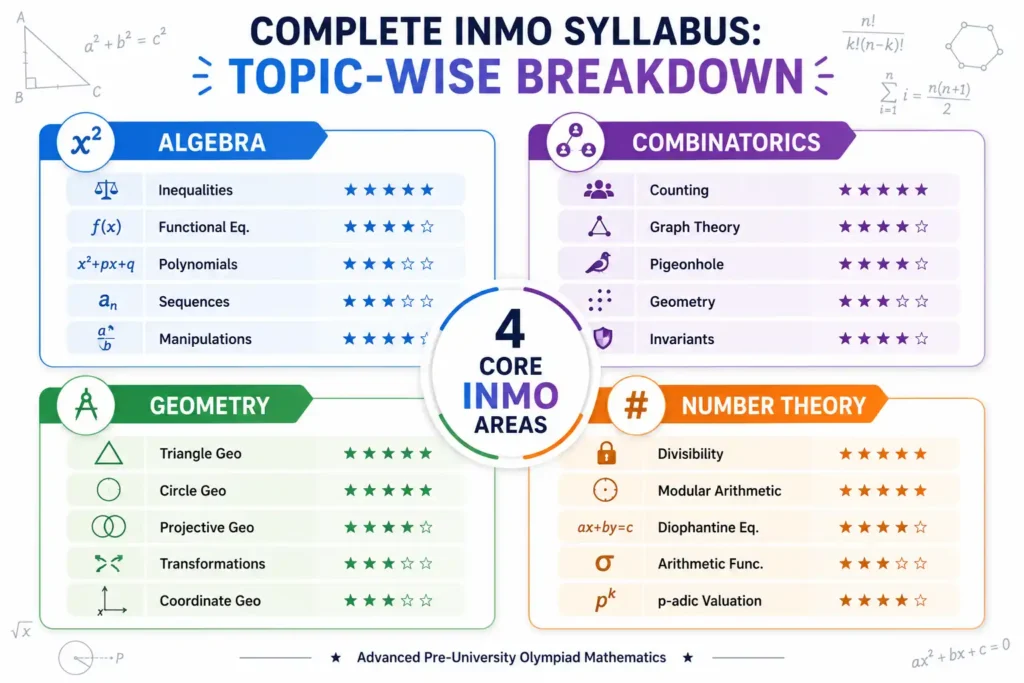
INMO doesn’t follow a textbook syllabus. Instead, it draws from four broad areas of mathematics at an advanced pre-university level.
Here’s a deep breakdown of what each area covers and which subtopics appear most frequently.
Algebra
| Subtopic | Key Concepts | INMO Frequency |
| Inequalities | AM-GM, Cauchy-Schwarz, Schur, power mean, rearrangement inequality | ★★★★★ |
| Functional equations | Cauchy’s equation, injective/surjective determination, substitution strategies | ★★★★☆ |
| Polynomials | Root-finding, irreducibility, integer/rational polynomial problems | ★★★☆☆ |
| Sequences & series | Recursive sequences, convergence arguments, bounding techniques | ★★★☆☆ |
| Algebraic manipulations | Factoring, substitution, symmetry exploitation | ★★★★☆ |
Preparation insight:
INMO algebra problems frequently combine inequalities with clever substitution or functional equation techniques. Pure computation won't help. You need to develop an instinct for which inequality applies and how to set up the substitution.
Combinatorics
| Subtopic | Key Concepts | INMO Frequency |
| Counting arguments | Bijections, double counting, inclusion-exclusion | ★★★★★ |
| Graph theory | Colouring, Ramsey-type arguments, extremal problems, Euler/Hamiltonian paths | ★★★★☆ |
| Pigeonhole principle | Advanced applications, generalised pigeonhole | ★★★★☆ |
| Combinatorial geometry | Convex hull arguments, point configurations, lattice problems | ★★★☆☆ |
| Game theory & strategy | Winning strategy proofs, invariant-based arguments | ★★★☆☆ |
| Invariants & monovariants | Parity arguments, colouring invariants, potential functions | ★★★★☆ |
Preparation insight:
Combinatorics at INMO level is where many students struggle most. There's no formulaic approach. Each problem requires a creative construction or a clever counting argument. Practice building intuition through exposure to diverse problem types.
Geometry
| Subtopic | Key Concepts | INMO Frequency |
| Projective & inversive geometry | Cross-ratio, harmonic conjugates, circle inversion | ★★★★☆ |
| Triangle geometry | Cevians, pedal triangles, nine-point circle, Euler line | ★★★★★ |
| Circle geometry | Power of a point, radical axes, Ptolemy’s theorem, cyclic quadrilaterals | ★★★★★ |
| Transformations | Spiral similarities, reflections, homotheties | ★★★☆☆ |
| Coordinate/trigonometric approaches | Trig-cevian methods, complex number geometry, barycentric coordinates | ★★★☆☆ |
Preparation insight:
Geometry problems at INMO level are notoriously tricky because they require you to "see" the right construction. Building geometric intuition takes time. Work through classic configurations repeatedly until auxiliary lines and circle properties become second nature.
Number Theory
| Subtopic | Key Concepts | INMO Frequency |
| Divisibility & primes | Unique factorisation, GCD/LCM properties, prime distribution | ★★★★★ |
| Modular arithmetic | Chinese Remainder Theorem, Fermat’s little theorem, quadratic residues | ★★★★★ |
| Diophantine equations | Pell equations, parametric solutions, descent, modular obstructions | ★★★★☆ |
| Arithmetic functions | Euler’s totient, Möbius function, divisor sum properties | ★★★☆☆ |
| p-adic valuations | Order of primes in factorials, Lifting the Exponent Lemma (LTE) | ★★★★☆ |
Preparation insight:
Number theory problems at INMO often combine modular arithmetic with clever divisibility arguments or Diophantine analysis. LTE (Lifting the Exponent Lemma) and p-adic valuations are high-yield tools that many students underutilise.
RMO vs. INMO: Understanding the Difficulty Jump
If you’ve qualified RMO, congratulations. But don’t assume INMO is “just harder RMO problems.” The nature of the challenge changes fundamentally.
Understanding the SOF IMO vs IOQM distinction is one thing; the RMO-to-INMO leap is a different beast entirely.
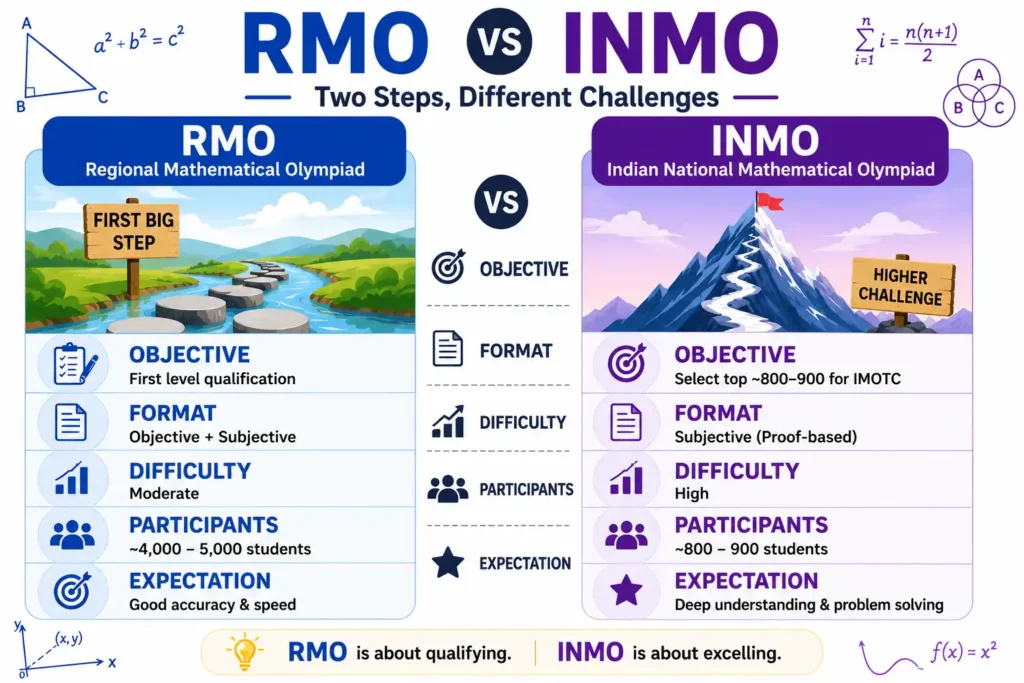
| Dimension | RMO | INMO |
| Number of problems | 6 | 6 |
| Duration | 3 hours | 4 hours |
| Problem difficulty | Accessible with solid foundations | Requires deep insight and creative techniques |
| Proof expectations | Correct reasoning valued; some looseness tolerated | Rigorous, complete proofs expected; presentation matters |
| Topic depth | Standard Olympiad tools suffice | Advanced tools needed (inversions, LTE, advanced combinatorics) |
| Multi-topic problems | Rare; problems typically stay within one area | Common; problems blend algebra with number theory, geometry with combinatorics |
| Creative thinking | Important but often one key insight solves the problem | Essential; problems may require multiple non-obvious steps chained together |
| Competition level | Regional (top students per region qualify) | National (roughly 3–4% selection rate for IMOTC) |
| Time per problem | ~30 minutes | ~40 minutes (but problems demand more) |
How to Write Olympiad Proofs That Score
This is where most INMO resources fall short, and where your preparation can gain the biggest edge.
Writing good proofs is a skill, and it can be systematically improved.
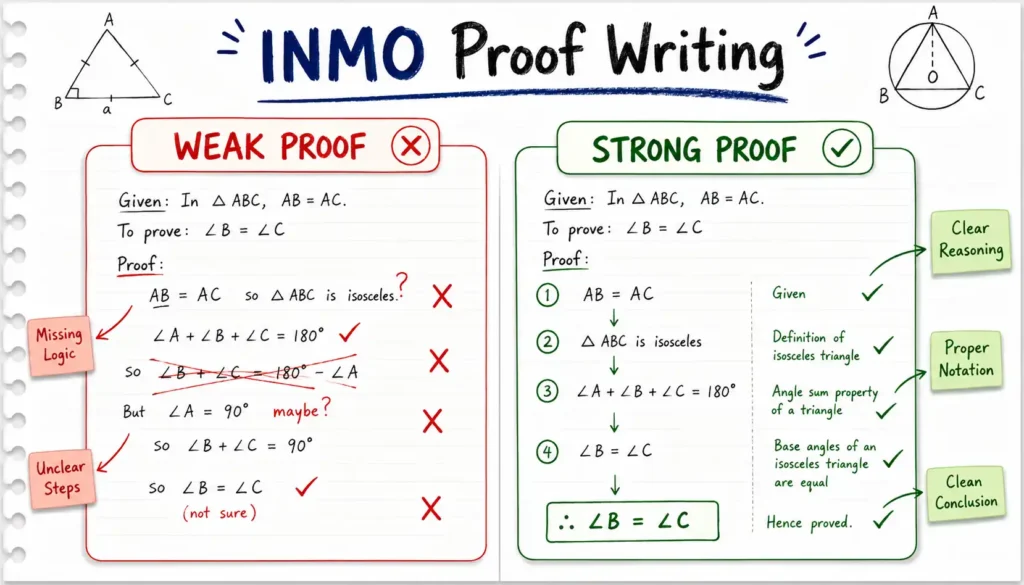
Structure of a Strong Proof
A well-written INMO solution typically follows this structure:
- Claim statement. Restate what you’re proving, clearly and concisely.
- Setup. Define notation, introduce variables, state any preliminary observations.
- Core argument. The main logical chain, broken into clearly labelled steps or cases.
- Case handling. If the proof splits into cases, handle each one completely. State when you’re done with a case.
- Conclusion. Tie back to the original claim. End with a clear statement like “This completes the proof” or “Hence proved” or the ∎ symbol.
Example: Strong Proof vs. Weak Proof
Problem (simplified illustration): Prove that for all positive integers n, the expression n³ − n is divisible by 6.
❌ Weak proof:
“n³ − n = n(n²−1) = n(n−1)(n+1). Since these are three consecutive numbers, one is divisible by 2 and one by 3, so the product is divisible by 6.”
This is correct but sloppy. Why must one of three consecutive integers be divisible by 2? By 3? These are the claims that need justification.
✅ Strong proof:
We factor: n³ − n = n(n−1)(n+1) = (n−1) · n · (n+1), which is the product of three consecutive integers.
Among any three consecutive integers, at least one is even (divisible by 2), since consecutive integers alternate parity. Furthermore, among any three consecutive integers, exactly one is divisible by 3, since the residues modulo 3 of consecutive integers cycle through {0, 1, 2}.
Therefore (n−1) · n · (n+1) is divisible by both 2 and 3. Since gcd(2, 3) = 1, it follows that the product is divisible by 2 × 3 = 6. ∎
The difference: every logical step is justified, not just stated.
Common Proof-Writing Mistakes
| Mistake | Why It Costs Marks | Fix |
| Skipping “obvious” steps | What’s obvious to you may not be logically justified | Write as if the reader needs convincing at every step |
| Incomplete case analysis | Missing even one case invalidates the entire proof | List all cases explicitly before starting; check off each one |
| Circular reasoning | Assuming what you’re trying to prove | State your assumptions clearly; trace the logical chain forward |
| Vague language (“clearly,” “it’s easy to see”) | Signals hand-waving to evaluators | Replace with actual justification |
| Messy notation | Hard to follow = easy to lose marks | Define notation upfront; be consistent throughout |
| No conclusion statement | Evaluator unsure if you finished | Always end with a clear concluding statement |
It’s the kind of structured practice that turns good mathematical thinking into polished, scoring proofs.
Learn more about how to get better at solving math Olympiad questions.
INMO Preparation Strategy & Roadmap
Preparing for INMO requires a structured, phased approach.
Here’s a realistic roadmap for the roughly 5 months between RMO qualification (typically October–November) and INMO (typically January).
If you want a broader foundation, our guide on how to improve problem-solving skills for IMO covers the underlying mindset.
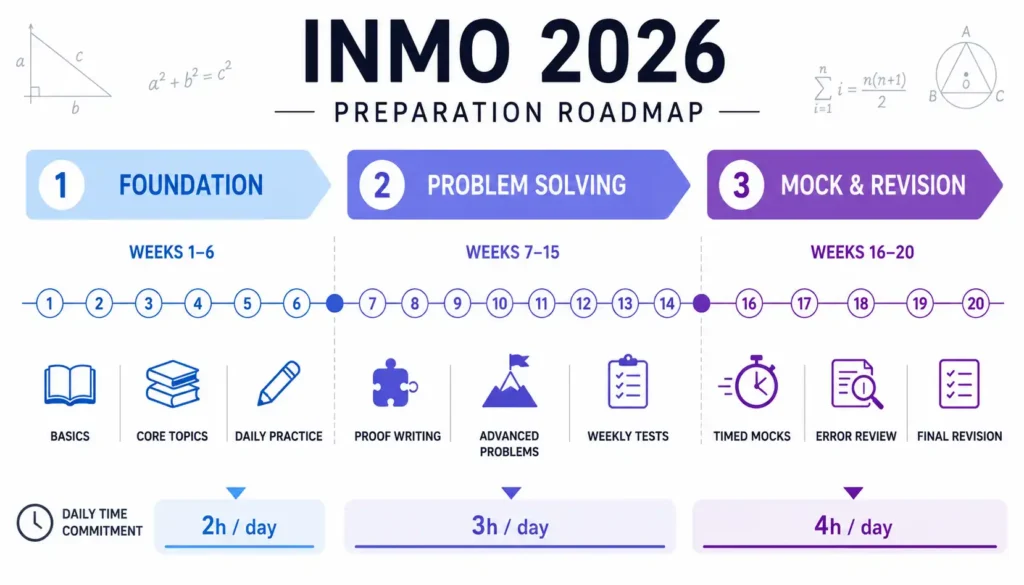
Phase 1: Foundation Strengthening (Weeks 1–6)
Goal: Fill gaps in advanced Olympiad theory and build fluency with key tools.
- Study the advanced techniques for each of the four areas that go beyond RMO level: inversive geometry, generating functions, advanced inequalities (Schur, SOS), LTE lemma, and advanced counting (generating functions, bijective proofs).
- Solve 3–4 problems daily from standard Olympiad textbooks (see Books section below). Focus on understanding solutions deeply rather than rushing through problem counts.
- Write complete proofs for every problem you solve, even during practice. This is non-negotiable. Proof-writing fluency comes from consistent practice.
- Review your solutions critically. After solving (or attempting) a problem, compare your proof with the official/standard solution. Where did you lose rigour? Where could you have been more efficient?
Phase 2: Advanced Problem Solving (Weeks 7–14)
Goal: Tackle INMO-level and international Olympiad problems. Develop multi-step problem-solving ability.
- Work through INMO previous year papers (at least the last 8–10 years). Time yourself on individual problems.
- Supplement with international Olympiad problems. ISL (IMO Shortlist) problems at the easier end, Balkan MO, and APMO problems are excellent INMO-level practice.
- Focus on cross-topic problems that blend techniques from multiple areas. These are the problems that distinguish INMO from RMO.
- Practice problem selection. In mock settings, spend 10–15 minutes reading all 6 problems before deciding which to attempt first. Choosing wisely is a real exam skill.
- Weekly topic rotation. Dedicate each week to one primary topic area while maintaining light practice in others.
Phase 3: Mock Tests & Exam Simulation (Weeks 15–20)
Goal: Build exam stamina, refine time management, and peak at the right moment.
- Full mock tests every weekend. 6 problems, 4 hours, strict timing, no references. Use previous INMO papers or curated problem sets.
- Post-mock review is more important than the mock itself. For each problem, ask: Did I choose the right approach? Where did I get stuck? Was my proof complete and clear?
- Time allocation strategy: Spend the first 15 minutes reading all problems. Budget 35–40 minutes per problem you attempt. It’s better to write 2–3 clean, complete solutions than to attempt all 6 with half-finished proofs.
- Light new problem-solving. Don’t learn major new techniques in the final 2–3 weeks. Focus on consolidation and confidence-building.
- Manage stress. INMO preparation is intense. Take rest days. Maintain sleep. If you’re burning out, one day off is worth more than three days of unfocused work.
Also check out our tips on how to get full marks in maths Olympiad for exam-day execution strategies.
| Phase | Duration | Focus | Daily Time |
| Phase 1: Foundation | Weeks 1–6 | Theory gaps + core tools | 2–3 hours |
| Phase 2: Advanced | Weeks 7–14 | Hard problems + cross-topic work | 3–4 hours |
| Phase 3: Mock & Revision | Weeks 15–20 | Timed mocks + review | 2–3 hours (+ weekend mocks) |
Best Books & Resources for INMO Preparation
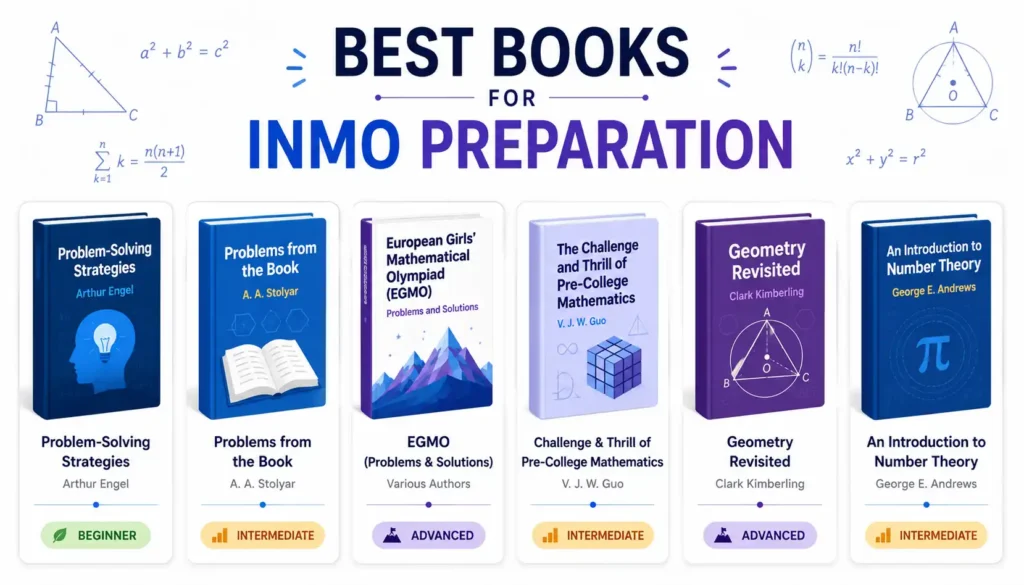
| Book | Author(s) | Best For | Level |
| Challenge and Thrill of Pre-College Mathematics | Pranesachar, Venkatachala, Yogananda | Foundation building across all topics | RMO → INMO bridge |
| Problem-Solving Strategies | Arthur Engel | Systematic problem-solving techniques | INMO |
| Problems from the Book | Titu Andreescu, Gabriel Dospinescu | Advanced problems across all areas | INMO → IMO |
| Euclidean Geometry in Mathematical Olympiads (EGMO) | Evan Chen | Comprehensive geometry | INMO → IMO |
| 104 Number Theory Problems | Titu Andreescu et al. | Focused number theory training | INMO |
| A Path to Combinatorics Through Counting | Titu Andreescu, Zuming Feng | Combinatorics foundation and techniques | RMO → INMO |
| Functional Equations | B.J. Venkatachala | Functional equations mastery | INMO |
| Inequalities: An Approach Through Problems | B.J. Venkatachala | Inequality techniques and practice | INMO |
Other Essential Resources
- INMO previous year papers (available on HBCSE website and various Olympiad archives): the single most important practice resource.
- IMO Shortlist problems (especially C1–C3, N1–N3, G1–G3, A1–A3): excellent for INMO-level practice.
- Art of Problem Solving (AoPS) forums: community discussions, alternative solutions, and a massive problem archive.
- Evan Chen’s handouts (web.evanchen.cc): free, high-quality handouts on specific Olympiad topics.
- Gonit App: structured Olympiad practice with concept-based learning for building daily problem-solving habits
- Free math Olympiad training online: our curated list of free resources available to every aspirant.
Make Preparing for Math Olympiad Simple!



Previous Year Trends & High-Frequency Topics
Based on analysis of INMO papers from the last decade, here’s how topics distribute:
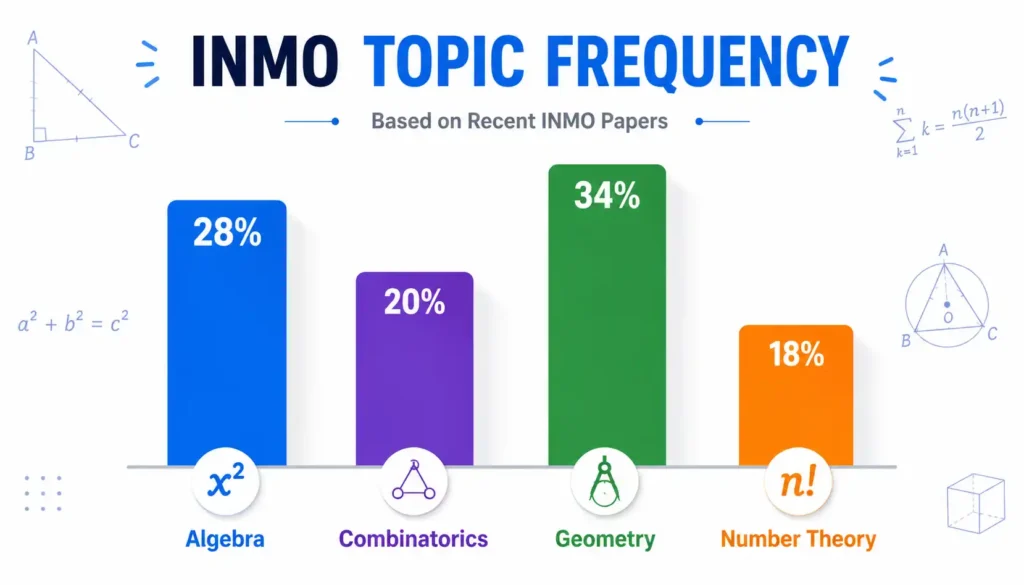
| Topic Area | Approximate Frequency (problems per paper) | Trend |
| Combinatorics | 1–2 per paper | Stable; nearly always present |
| Number Theory | 1–2 per paper | Stable; Diophantine equations especially common |
| Geometry | 1–2 per paper | Stable; often one of the harder problems |
| Algebra (Inequalities) | 1 per paper | Present most years; difficulty varies |
| Algebra (Functional Equations) | 0–1 per paper | Appears every 2–3 years |
High-Frequency Specific Concepts
- Cyclic quadrilateral properties and power-of-a-point arguments (geometry)
- Modular arithmetic and divisibility in Diophantine problems (number theory)
- Pigeonhole principle in non-obvious settings (combinatorics)
- AM-GM and Cauchy-Schwarz in inequality chains (algebra)
- Invariant/monovariant arguments (combinatorics)
- Graph colouring and extremal arguments (combinatorics)
Strategic implication: You cannot afford to be weak in any of the four areas. But if you must prioritise, combinatorics and number theory together account for roughly half or more of most INMO papers.
INMO Cutoff & Qualification Insights
INMO doesn’t publish a traditional “cutoff score” like entrance exams.
Selection for IMOTC is based on overall performance evaluated holistically by a committee.
Here’s what we can say based on historical patterns:
| Metric | Approximate Value |
| Total INMO participants | ~800–900 nationally |
| IMOTC selections | ~30–35 students |
| Effective selection rate | ~3–4% |
| Competitive benchmark | Solving 3–4 problems substantially (with complete proofs) is typically competitive |
| Minimum for consideration | At least 1–2 complete, rigorous proofs |
What “Solving a Problem” Means at INMO
A “solved” problem at INMO means a complete, rigorous proof, not a partially correct argument or an answer without justification.
The committee reads solutions carefully and distinguishes between:
- Full solve: complete, correct, well-presented proof
- Significant progress: correct approach with a key step missing or a minor gap
- Partial progress: some useful ideas but incomplete argument
- Minimal/no progress: scattered observations without a coherent direction
The difference between IMOTC selection and non-selection often comes down to proof quality and completeness, not just the number of problems attempted.
Common Mistakes to Avoid in INMO Preparation
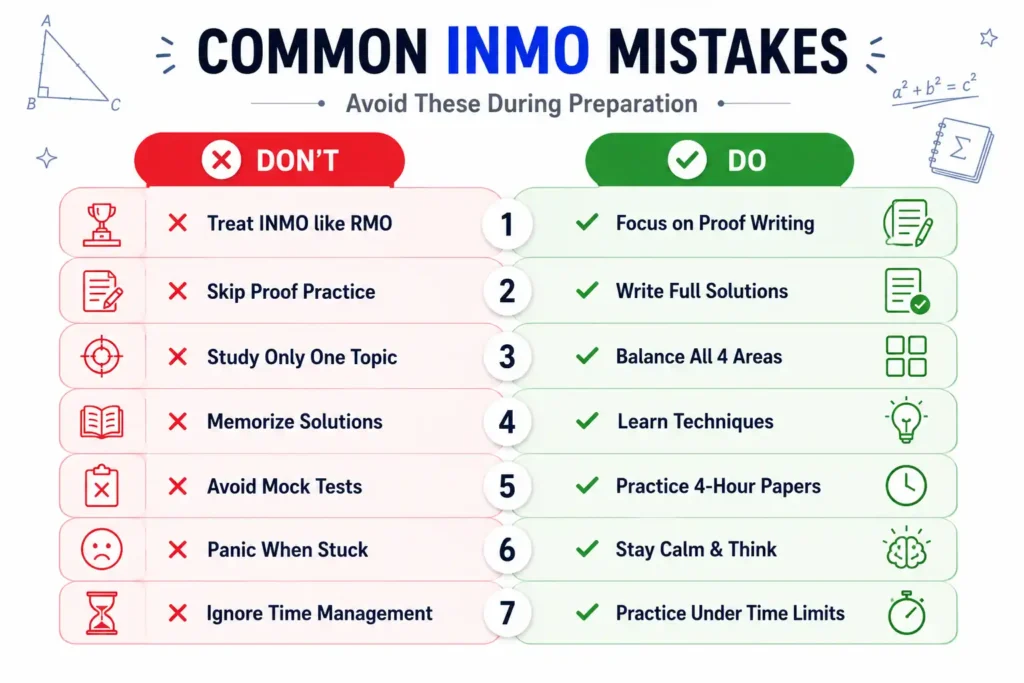
1. Treating INMO like a harder version of RMO. The difficulty jump is qualitative, not just quantitative.
Your preparation approach must change: more emphasis on proof-writing, more exposure to advanced techniques, more practice with multi-step problems.
2. Neglecting proof-writing practice. Solving a problem “in your head” and writing a complete proof are very different skills.
If you don’t practice writing proofs during preparation, you’ll waste exam time struggling with presentation.
3. Over-focusing on one topic area. INMO consistently tests all four areas.
Being exceptional at number theory but weak at geometry means you’re gambling on the paper composition.
4. Memorizing solutions instead of understanding techniques. When you read a solution, ask: What was the key insight? What technique made this work? Where else could this approach apply?
Pattern recognition, not memorization, is what transfers to new problems.
5. Skipping mock tests. A 4-hour subjective exam is physically and mentally demanding.
If your first experience with that format is the actual INMO, you’re at a significant disadvantage.
6. Ignoring the emotional dimension. Feeling stuck on INMO problems is normal. The problems are designed to be hard.
Developing comfort with struggle, the ability to keep thinking productively even when you’re not making visible progress, is itself a skill that needs practice.
7. Underestimating time management. Four hours sounds like a lot until you’re staring at 6 problems and realising that clean proof-writing takes far longer than rough problem-solving.
For a broader perspective on what the purpose of the math Olympiad really is, read our detailed exploration. It can help reframe your approach to preparation.
How hard is INMO?
INMO is one of the hardest mathematics examinations at the school level in India. The problems require creative insight, advanced technique, and polished proofreading. It’s significantly harder than RMO, and the competition is intense: only about 3–4% of participants are selected for IMOTC. If you can solve 2–3 INMO problems completely in practice, you’re at a competitive level.
Can I qualify for INMO without coaching?
Yes. Many IMOTC selectees have prepared without formal coaching, using quality textbooks, previous year papers, online resources, and peer discussion. What matters is consistent, structured practice with a focus on proof-writing, not whether you’re in a classroom.
How many students reach IMOTC from INMO?
Approximately 30–35 students are selected for IMOTC each year from roughly 800–900 INMO participants. From IMOTC, a team of 6 is selected for IMO.
What is the INMO to IMO pathway?
The pathway is: INMO → IMOTC (training camp at HBCSE, Mumbai) → selection tests during IMOTC → final team of 6 → IMO. The entire process from INMO to IMO typically spans about 6 months.
How is INMO different from RMO?
INMO problems are substantially harder, require more advanced mathematical tools, demand higher proof-writing standards, and often blend techniques across multiple topic areas. The exam is an hour longer (4 hours vs. 3), and the competition is national rather than regional. See Section 7 for a detailed comparison.
What is the INMO 2026 exam date?
INMO 2026 is expected to be held in January 2026. The exact date will be announced by HBCSE. Check the official HBCSE Olympiad page for confirmed dates.
Is there negative marking in INMO?
No. INMO is a subjective, proof-based exam. There is no concept of negative marking. Problems are evaluated based on the quality and completeness of your proofs.
Make Preparing for Math Olympiad Simple!
Start Your INMO 2026 Preparation Today
INMO is the single most important filter in India’s Math Olympiad pathway, and preparing for it requires more than just solving hard problems.
It demands structured topic mastery, rigorous proof-writing practice, and a realistic understanding of what the exam expects.
This guide gives you the complete picture. Now it comes down to execution.

Mikha Piregu is a Content Writer with experience spanning educational content, including math and math olympiad topics, as well as advocacy writing, research-based articles, and SEO-driven web content. He creates high-quality blog content, web copy, and feature articles that support brand visibility, audience engagement, and long-term organic growth through data-informed storytelling. Skilled in WordPress, WooCommerce, and modern digital tools, Mikha adapts content across various platforms, including blogs, websites, campaigns, and advocacy initiatives, with clarity and purpose.




There are no comments posted here yet.
Sign in to leave a comment