


The Regional Mathematical Olympiad (RMO) in India is the second stage of the Mathematical Olympiad Programme leading to the International Mathematical Olympiad (IMO).
- What Is RMO? Full Form and Purpose
- India's Mathematical Olympiad Pathway: IOQM to RMO to INMO to IMO
- RMO 2026 Eligibility and Qualification Criteria
- RMO 2026 Exam Date, Registration, and Admit Card
- RMO Exam Pattern and Marking Scheme
- Complete RMO Syllabus 2026: Topic-Wise Breakdown
- IOQM vs RMO: Understanding the Difficulty Jump
- Previous Year RMO Cutoff Analysis and 2026 Expectations
- How to Prepare for RMO 2026: Complete Strategy
- Best Books and Resources for RMO Preparation
- Proof-Writing and Olympiad Thinking: What Makes RMO Different
- Common Mistakes to Avoid in RMO Preparation
- RMO Result 2026: When and How to Check
- Start Your RMO 2026 Preparation Today
The exam is administered by the Homi Bhabha Centre for Science Education (HBCSE) and tests students through subjective, proof-based problems in Algebra, Geometry, Number Theory, and Combinatorics.
If you qualify through IOQM, RMO 2026 is your next big step.
This guide explains the RMO syllabus, preparation strategy, cutoff trends, best books, and the full IOQM → RMO → INMO pathway in a clear, topic-wise format.
What Is RMO? Full Form and Purpose
RMO stands for the Regional Mathematical Olympiad. It is the second stage of India’s Mathematical Olympiad selection process.
Conducted under the supervision of the Homi Bhabha Centre for Science Education (HBCSE) and the National Board for Higher Mathematics (NBHM).
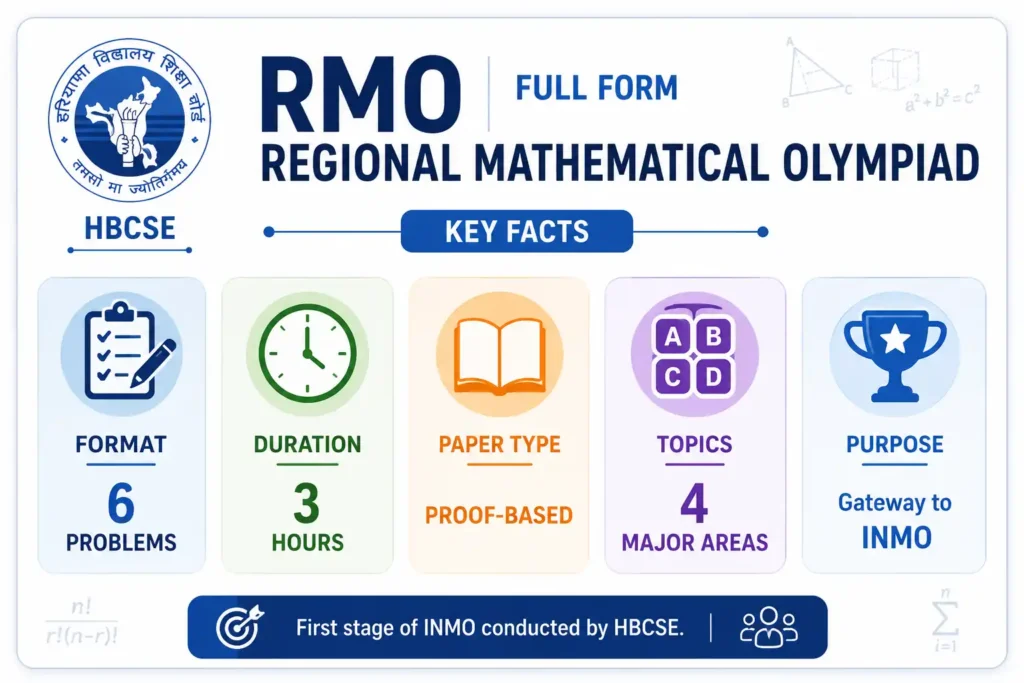
The Regional Mathematical Olympiad 2026 serves as the qualifying examination for the Indian National Mathematical Olympiad (INMO).
Students who perform well at INMO go on to represent India at the International Mathematical Olympiad (IMO), the most prestigious mathematics competition in the world.
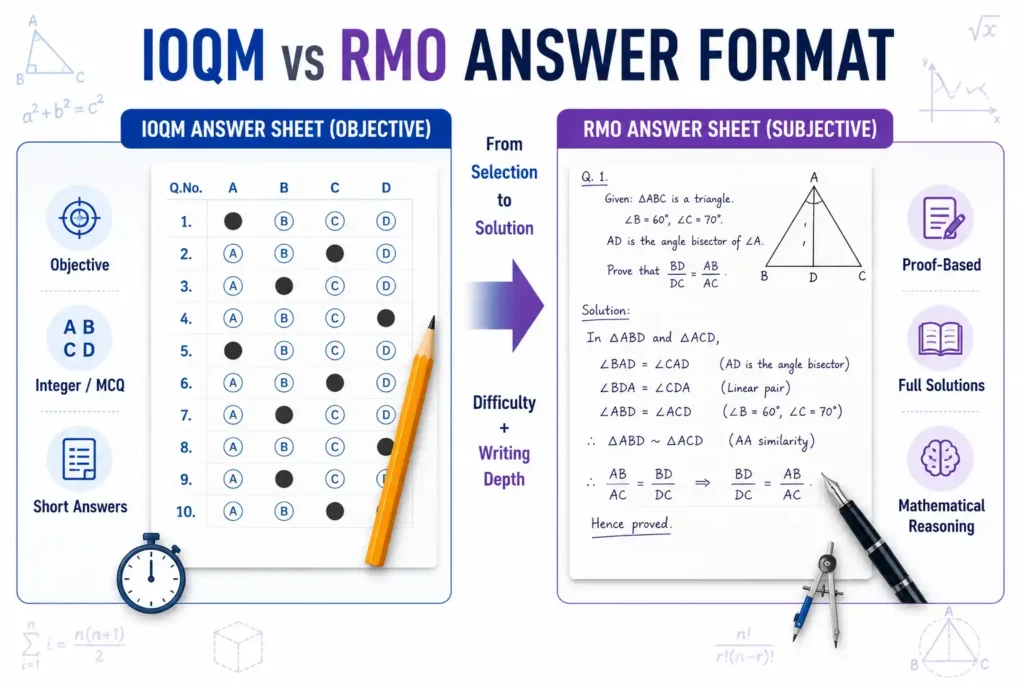
Unlike school-level math exams or even IOQM, RMO is entirely subjective. There are no multiple-choice questions. Every problem requires a complete, logically rigorous proof or solution.
This fundamental difference is what makes RMO both challenging and rewarding. It tests genuine mathematical thinking, not pattern recognition or elimination strategies.
RMO is conducted region-wise across India, with each region selecting its top performers for INMO.
The exam typically includes 6 problems to be solved in 3 hours, covering Algebra, Geometry, Number Theory, and Combinatorics at a level significantly beyond the school curriculum.
India’s Mathematical Olympiad Pathway: IOQM to RMO to INMO to IMO
Understanding how RMO fits into the larger Olympiad selection process is essential.
Here is how the Maths Olympiad India pathway works:
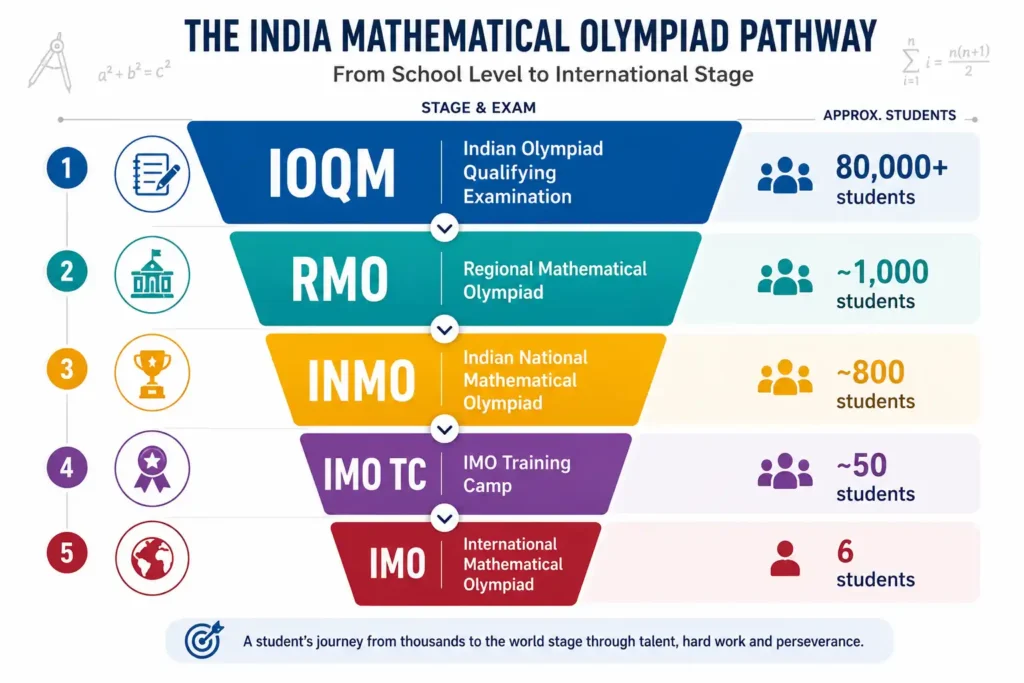
Stage 1: IOQM (Indian Olympiad Qualifier in Mathematics) The entry point. IOQM is an objective exam (multiple-choice) conducted by the Mathematics Teachers’ Association of India (MTA-I) in collaboration with HBCSE.
Approximately 80,000 to 1,00,000 students appear for IOQM each year. Top performers (typically the top 800 to 1,000 students nationally, with region-wise allocation) qualify for RMO.
Stage 2: RMO (Regional Mathematical Olympiad) The bridge stage. RMO is a subjective, proof-based exam conducted at the regional level. Around 800 to 1,000 students appear across all regions, and roughly 30 to 35 students per region qualify for INMO.
The IOQM to RMO pathway represents the first major difficulty jump, from objective to subjective, from answer-finding to proof-writing.
Stage 3: INMO (Indian National Mathematical Olympiad) The national selection round. Around 800 students from all regions appear for INMO.
Approximately 35 to 50 students are selected for the next stage. Problems at INMO are significantly harder than RMO, requiring deep mathematical maturity.
Stage 4: IMOTC (IMO Training Camp) Selected INMO qualifiers attend an intensive training camp at HBCSE, Mumbai.
Through multiple rounds of selection tests during the camp, 6 students are chosen to represent India.
Stage 5: IMO (International Mathematical Olympiad) The final stage. India’s 6-member team competes against teams from 100+ countries in the world’s most prestigious mathematics competition.
The RMO to INMO pathway is where serious Olympiad careers are built.
Qualifying RMO means you are among the top 1,000 math students in India. Qualifying INMO puts you in elite territory.
RMO 2026 Eligibility and Qualification Criteria
RMO 2026 eligibility is straightforward but strict:
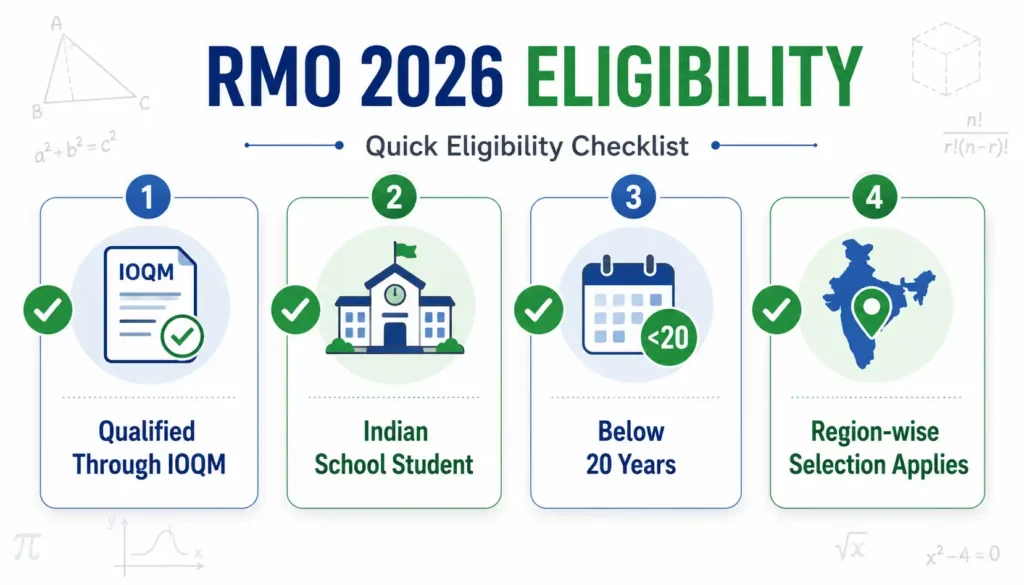
Who can appear for RMO 2026?
- Students must have qualified through IOQM 2025-26 (the qualifying round conducted by MTA-I/HBCSE).
- Students must be enrolled in a recognized school in India and must not have been born before a specific cutoff date (typically, students must be under 20 years of age as of a specified date, though in practice most RMO candidates are in classes 8 to 12).
- The student must belong to the region from which they qualified through IOQM.
IOQM Qualification Requirements:
- IOQM results determine region-wise merit lists. The number of students qualifying for RMO from each region is determined by HBCSE based on the total number of IOQM candidates from that region.
- There is no separate registration or application for RMO. Qualification through IOQM automatically makes you eligible. HBCSE communicates directly with qualified students through their registered schools or contact details.
Important Note: The exact RMO 2026 eligibility criteria and qualification numbers will be confirmed in the official HBCSE notification. Always verify details on the official HBCSE website once the notification is released.
RMO 2026 Exam Date, Registration, and Admit Card
RMO 2026 Exam Date: The Regional Mathematical Olympiad is typically conducted in October or November each year.
Based on previous years’ patterns, the RMO 2026 exam date is expected to fall in October to November 2026.
The exact date will be announced by HBCSE through the official notification.
RMO 2026 Registration Process: Unlike many competitive exams, RMO does not require a separate registration or application form.
The RMO registration process works as follows:
| Step | Details |
| 1. Qualify IOQM | Clear the IOQM cutoff for your region |
| 2. Confirmation from HBCSE | HBCSE sends the list of qualified students to regional coordinators |
| 3. Center Allocation | Regional coordinators assign exam centers |
| 4. Admit Card | RMO admit card 2026 is issued through regional coordinators or the HBCSE portal |
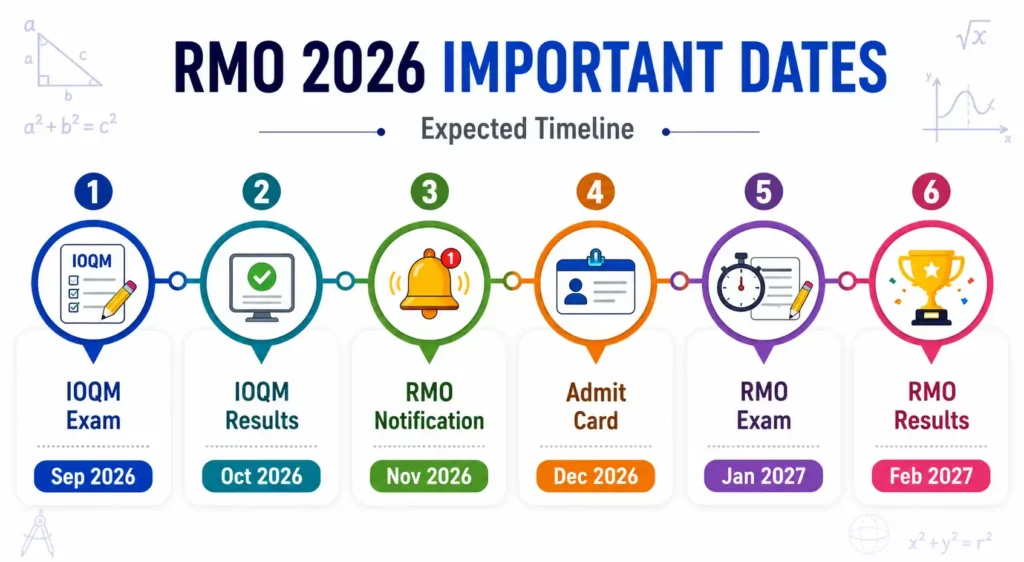
Key Dates Timeline (Expected):
| Event | Expected Timeline |
| IOQM 2025-26 Exam | August to September 2025 |
| IOQM Results | September to October 2025 |
| RMO 2026 Notification | September to October 2026 |
| RMO 2026 Admit Card | October 2026 |
| RMO 2026 Exam | October to November 2026 |
| RMO 2026 Results | November to December 2026 |
Note: These dates are based on historical patterns. Always check the official HBCSE website for confirmed dates. The RMO application form 2026 process and admit card distribution will be managed through regional Olympiad coordinators.
RMO Exam Pattern and Marking Scheme
The RMO exam pattern is fundamentally different from IOQM and most exams students are used to.
Understanding this difference early is critical for effective preparation.
| Feature | Details |
| Exam Duration | 3 hours |
| Number of Problems | 6 |
| Question Type | Subjective, full proof/solution required |
| Topics Covered | Algebra, Geometry, Number Theory, Combinatorics |
| Answer Format | Detailed written proofs on answer sheets |
| Marking Approach | Each problem is evaluated holistically for correctness, completeness, and rigor of proof |
| Negative Marking | None |
| Difficulty Range | Problems range from accessible (solvable with solid fundamentals) to challenging (requiring creative insight) |
What This Means for You: At RMO, getting the right answer is not enough. You must prove why it is right. A correct numerical answer without rigorous justification earns minimal credit.
Conversely, a well-structured proof with a minor computational error may still earn significant partial credit.
This is the heart of the Regional Mathematical Olympiad exam pattern: it rewards mathematical thinking over mechanical computation.
Each problem typically requires 20 to 40 minutes of focused work. Attempting 3 to 4 problems well is generally more effective than attempting all 6 poorly.
Complete RMO Syllabus 2026: Topic-Wise Breakdown
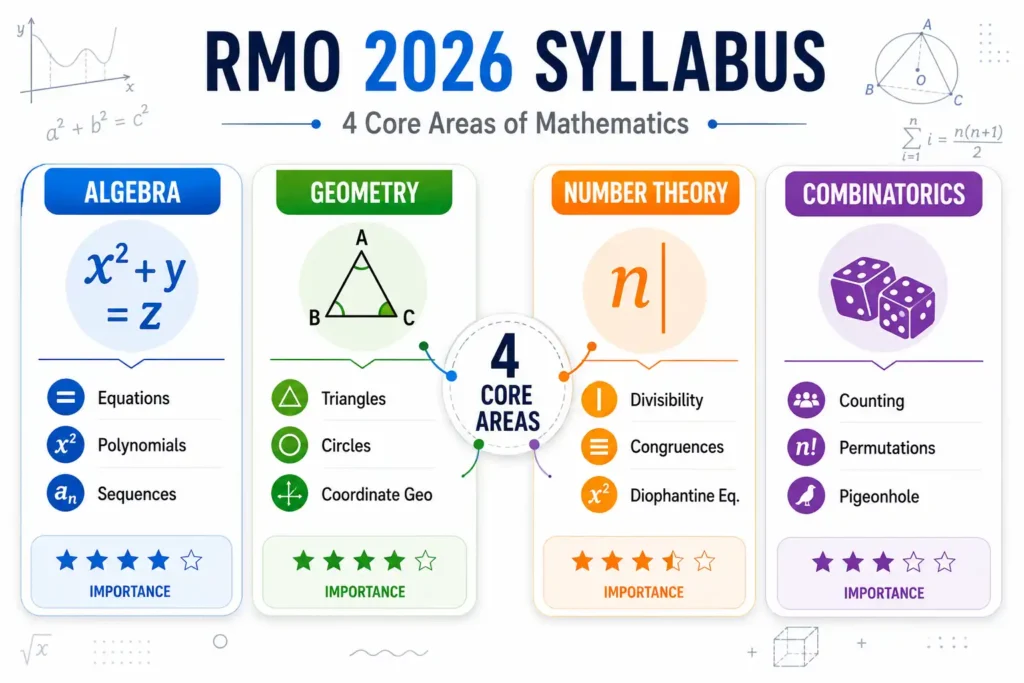
The RMO 2026 syllabus covers four major areas.
While there is no officially prescribed “syllabus” document, the problems can draw from any area of pre-calculus mathematics.
The following breakdown reflects the consistently tested topics based on decades of RMO papers.
Algebra
| Subtopic | Importance | Key Concepts |
| Inequalities (AM-GM, Cauchy-Schwarz, Power Mean) | ★★★★★ | Proving inequality bounds, optimization, algebraic manipulation |
| Functional Equations | ★★★★☆ | Finding all functions satisfying given conditions, substitution strategies |
| Polynomials | ★★★★☆ | Roots, Vieta’s formulas, irreducibility, integer-valued polynomials |
| Sequences and Series | ★★★☆☆ | Recurrence relations, convergence, telescoping, pattern identification |
| Algebraic Identities and Manipulation | ★★★☆☆ | Factoring, substitution, Simon’s Favourite Factoring Trick |
Geometry
| Subtopic | Importance | Key Concepts |
| Triangle Geometry | ★★★★★ | Circumcircle, incircle, orthocenter, centroid, angle chasing |
| Circle Geometry | ★★★★★ | Cyclic quadrilaterals, power of a point, radical axes, tangent properties |
| Geometric Transformations | ★★★☆☆ | Reflection, rotation, homothety, inversion (advanced) |
| Coordinate Geometry (Olympiad-style) | ★★☆☆☆ | Occasionally useful but synthetic methods are preferred |
| Area and Length Methods | ★★★☆☆ | Ratios, cevians (Ceva’s and Menelaus’s theorems), Stewart’s theorem |
Number Theory
| Subtopic | Importance | Key Concepts |
| Divisibility and Primes | ★★★★★ | GCD/LCM, Euclidean algorithm, unique factorization |
| Modular Arithmetic | ★★★★★ | Congruences, Fermat’s Little Theorem, Chinese Remainder Theorem |
| Diophantine Equations | ★★★★☆ | Integer solutions, modular constraints, infinite descent, Pell equations |
| Number Theoretic Functions | ★★★☆☆ | Euler’s totient, divisor functions, Mobius function |
| p-adic Valuation and Lifting the Exponent | ★★★☆☆ | Advanced technique for divisibility problems |
Combinatorics
| Subtopic | Importance | Key Concepts |
| Counting Principles | ★★★★★ | Bijections, double counting, inclusion-exclusion |
| Pigeonhole Principle | ★★★★★ | Existence proofs, generalized pigeonhole |
| Graph Theory (Basics) | ★★★☆☆ | Euler/Hamiltonian paths, coloring, trees, degree arguments |
| Combinatorial Games | ★★☆☆☆ | Strategy-stealing, invariants, monovariants |
| Combinatorial Geometry | ★★★☆☆ | Extremal problems, coloring, configurations |

Preparation Focus:
Geometry and Number Theory together account for roughly 50 to 60% of RMO problems historically. Inequalities (Algebra) and Pigeonhole/Counting (Combinatorics) are the next most frequent. Prioritize accordingly, but do not ignore any area. RMO problems often blend topics.
IOQM vs RMO: Understanding the Difficulty Jump
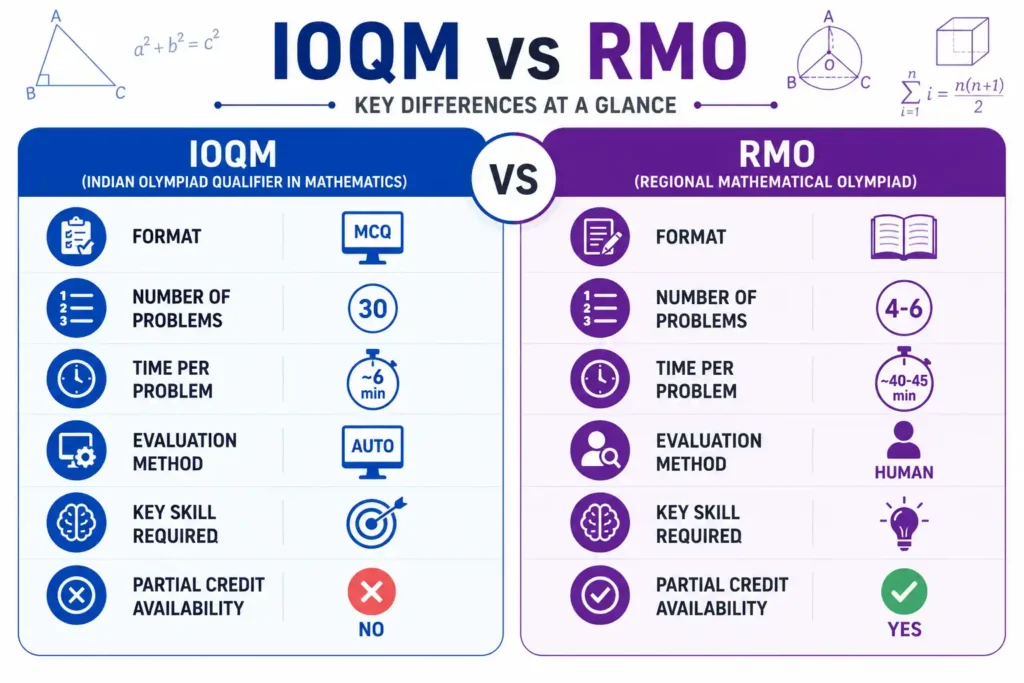
This is the question every IOQM qualifier asks: How much harder is RMO compared to IOQM?
The answer is not just “harder.” It is a fundamentally different type of challenge.
| Dimension | IOQM | RMO |
| Format | Objective (answer-based) | Subjective (proof-based) |
| Number of Problems | 30 | 6 |
| Duration | 3 hours | 3 hours |
| Time per Problem | About 6 minutes | About 30 minutes |
| What’s Evaluated | Final answer correctness | Logical rigor, proof structure, completeness |
| Partial Credit | None (right or wrong) | Yes, well-structured incomplete proofs earn credit |
| Difficulty Ceiling | Moderate-hard computational problems | Problems requiring creative insight and construction |
| Key Skill | Speed, accuracy, pattern recognition | Deep thinking, proof writing, mathematical creativity |
| Guessing | Possible (eliminates options) | Not possible, every claim must be justified |
| Preparation Style | Solve many problems quickly | Solve fewer problems deeply and write complete proofs |
The Real Difficulty Jump: The gap between IOQM and RMO is not just about harder problems. It is about a different way of doing mathematics. At IOQM, you find answers. At RMO, you construct arguments.
A student who scored well on IOQM through speed and pattern recognition may struggle at RMO if they have not trained in structured proof-writing.
The RMO difficulty level is comparable to the easier problems on international olympiad shortlists.
Problems 1 and 2 on an RMO paper are typically accessible to well-prepared students. Problems 5 and 6 are genuinely hard, sometimes unsolved by most candidates.
What This Means for Your Preparation: If you are transitioning from IOQM, your study approach needs to change fundamentally. Stop optimizing for speed.
Start spending 30 to 60 minutes on a single problem. Write out every step of your reasoning. Get comfortable with being stuck. That is where real mathematical thinking happens.
Previous Year RMO Cutoff Analysis and 2026 Expectations
Understanding RMO cutoff trends helps set realistic targets and manage expectations.
RMO cutoffs vary significantly by region because selection is done region-wise.
Approximate Previous Year RMO Cutoffs (Out of about 102 total marks):
| Region | 2022 Cutoff Range | 2023 Cutoff Range | 2024 Cutoff Range | Trend |
| Mumbai | 45 to 55 | 42 to 52 | 45 to 55 | Stable |
| Delhi | 40 to 50 | 38 to 48 | 42 to 52 | Slight increase |
| Kolkata | 38 to 48 | 35 to 45 | 40 to 50 | Increasing |
| Chennai | 35 to 45 | 38 to 48 | 40 to 48 | Increasing |
| Other Regions | 30 to 45 | 30 to 42 | 32 to 45 | Varies |
Note: These are approximate ranges based on community-reported data and may not reflect exact official cutoffs. HBCSE does not always publish cutoffs publicly.
Expected RMO 2026 Cutoff: Based on trends, expect cutoffs in the range of 35 to 55 marks depending on region and paper difficulty.
Competitive regions like Mumbai and Delhi tend to have higher cutoffs. Aim for at least 50+ marks (solving 3 problems substantially) to be in a comfortable qualifying range for most regions.
What These Numbers Mean: Solving 3 out of 6 problems completely and rigorously is typically sufficient to qualify. This is why depth matters more than breadth at RMO.
It is better to write 3 perfect proofs than 6 incomplete attempts. The RMO marks vs cutoff equation rewards thoroughness.
How to Prepare for RMO 2026: Complete Strategy
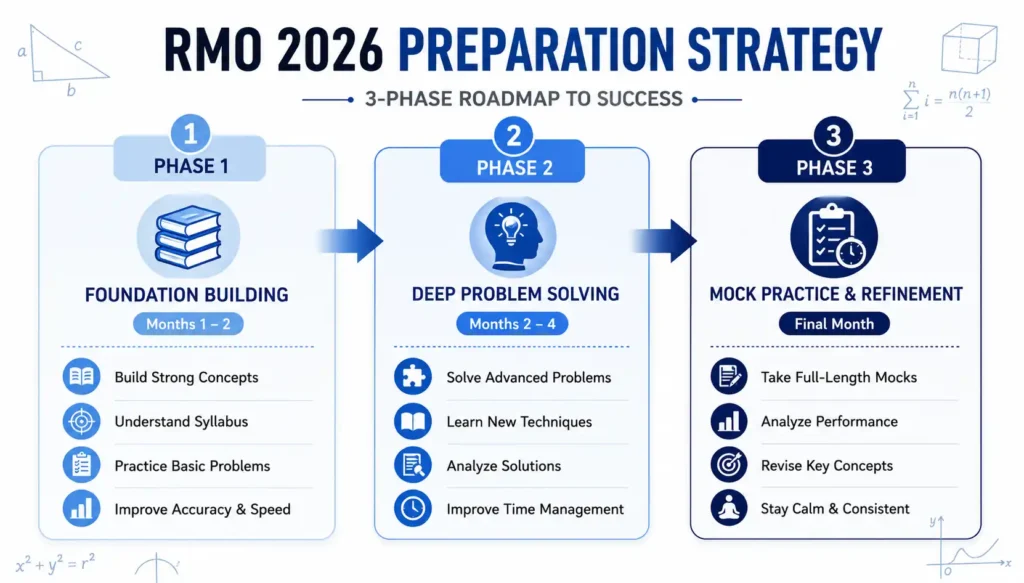
Here is a phased preparation roadmap designed for students who have qualified IOQM and have approximately 4 to 5 months before RMO.
Adjust the timeline based on when you start.
Phase 1: Foundation Building (Months 1 to 2)
Goal: Build core Olympiad knowledge and transition from objective to subjective problem-solving.
Topic Priorities:
- Start with Number Theory. It is the most accessible for students coming from IOQM and builds proof-writing intuition naturally (divisibility arguments, modular arithmetic proofs).
- Simultaneously begin Geometry fundamentals: angle chasing, cyclic quadrilaterals, standard configurations. Geometry requires the most practice time, so start early.
- Cover Inequality basics: AM-GM, Cauchy-Schwarz, rearrangement inequality.
Daily Practice (2 to 3 hours):
- Spend 1 hour learning theory from Olympiad textbooks (see book recommendations below).
- Spend 1 to 1.5 hours attempting problems. Work on each problem for at least 20 minutes before checking solutions.
- Spend 30 minutes writing up solutions formally, even for problems you solved mentally.
Key Habit: Start writing complete proofs from Day 1. Do not just find the answer. Write out why it is correct, why each step follows from the previous one.
Use the Gonit App to practice Olympiad-style problems and build this habit with structured, concept-based challenges.
Phase 2: Deep Problem Solving (Months 2 to 4)
Goal: Develop problem-solving depth and tackle competition-level difficulty.
Topic Priorities:
- Advance to Functional Equations, Diophantine Equations, and advanced Geometry (power of a point, radical axes, homothety).
- Deep dive into Combinatorics: double counting, pigeonhole, graph theory basics.
- Solve previous year RMO papers, at least 5 to 8 papers under timed conditions.
Daily Practice (3 to 4 hours):
- Attempt 2 to 3 RMO-level problems daily. Allow 30 to 45 minutes per problem.
- After solving (or giving up after genuine effort), study the official solution carefully. Understand not just what the solution does, but how someone would think of it.
- Maintain a problem journal: record problems, your approach, where you got stuck, and key insights from the solution.
Weekly Practice:
- One timed mock: 6 problems, 3 hours, strict conditions.
- Review mock performance: Which topics are weak? Which problem types cause the most difficulty?
RMO previous year question papers and RMO sample papers are your most valuable resources in this phase. They reveal patterns in problem style and difficulty that no textbook can replicate.
Phase 3: Mock Practice and Refinement (Final Month)
Goal: Simulate exam conditions and optimize performance strategy.
Focus Areas:
- Take at least 4 to 5 full-length timed mocks using previous year papers or curated problem sets.
- Focus on exam strategy: Which problems to attempt first? When to move on from a stuck problem? How to allocate your 3 hours across 6 problems?
- Refine proof-writing. Ensure your proofs are clean, well-organized, and easy for a grader to follow.
- Revisit weak topics identified during Phase 2 mocks.
Recommended Strategy for Exam Day:
- Read all 6 problems carefully (10 minutes).
- Identify the 2 to 3 problems that feel most accessible.
- Solve your strongest problem first and build confidence.
- Attempt 2 to 3 more problems, spending 30 to 40 minutes each.
- Use remaining time to refine proofs and check for gaps.
Best Books and Resources for RMO Preparation
Choosing the right study materials is critical.
Here is a curated list organized by topic and difficulty:
| Book | Author(s) | Focus Area | Difficulty | Best For |
| Challenge and Thrill of Pre-College Mathematics | Krishnamurthy, Pranesachar et al. | All topics | Beginner to Intermediate | Building Olympiad foundations |
| Problem-Solving Strategies | Arthur Engel | All topics | Intermediate to Advanced | Developing problem-solving techniques |
| An Excursion in Mathematics | Bhaskaracharya Pratishthana | All topics | Intermediate | Indian Olympiad focus |
| Inequalities: An Approach Through Problems | B.J. Venkatachala | Algebra (Inequalities) | Intermediate to Advanced | Mastering inequality proofs |
| Functional Equations | B.J. Venkatachala | Algebra (Functional Eqs) | Intermediate to Advanced | Deep functional equation practice |
| Challenges in Geometry | Shailesh Shirali | Geometry | Intermediate | Building geometric intuition |
| Euclidean Geometry in Mathematical Olympiads | Evan Chen | Geometry | Advanced | Olympiad-level geometry mastery |
| Elementary Number Theory | David Burton | Number Theory | Beginner to Intermediate | Solid number theory fundamentals |
| 104 Number Theory Problems | Titu Andreescu | Number Theory | Intermediate to Advanced | Competition-focused practice |
| Problem Solving Through Recreational Mathematics | Averbach and Chein | Combinatorics, Logic | Beginner | Gentle introduction to problem-solving |
| Previous Year RMO/INMO Papers | HBCSE | All topics | Varies | Essential, the most important resource |
Additional Resources:
- Art of Problem Solving (AoPS) community: online forums with Olympiad problem discussions
- HBCSE official website: past papers and selection details
- Gonit App: structured Olympiad practice with concept-based learning for building daily problem-solving habits
- Evan Chen’s handouts (web): excellent free resources for geometry and combinatorics
Make Preparing for Math Olympiad Simple!



Proof-Writing and Olympiad Thinking: What Makes RMO Different
If you have only written solutions for objective exams before, RMO will require a fundamental shift in how you communicate mathematics.
This section addresses what many students overlook: the craft of proof-writing.
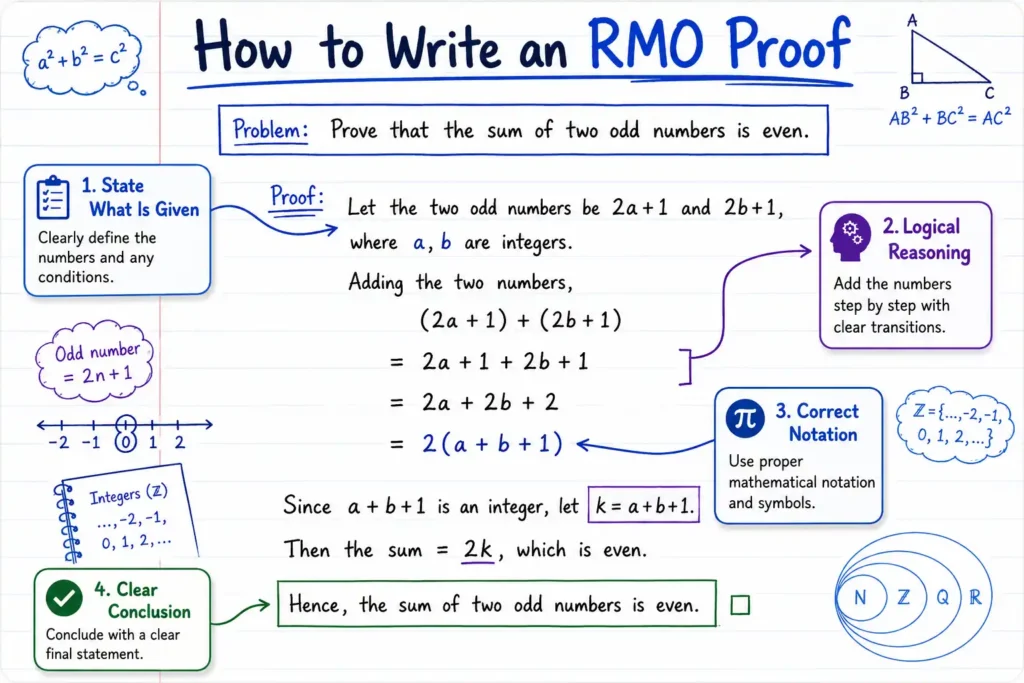
What Makes a Good RMO Proof: A strong proof is logically complete, clearly structured, and easy for the reader (grader) to follow.
Every step should follow from either a given condition, a previously proven statement, or a well-known theorem. You should never leave logical gaps with phrases like “it is obvious that” or “clearly.”
Types of Proofs You Will Need:
- Direct proof: establish the result by logical deduction from given facts.
- Proof by contradiction: assume the opposite and derive an impossibility.
- Mathematical induction: prove a base case and an inductive step (common in number theory and combinatorics).
- Constructive proof: explicitly build the object or example the problem asks for.
- Proof by cases: divide into exhaustive cases and prove each.
How to Develop Proof-Writing Skills:
- Read model solutions carefully. Pay attention to structure, not just content. Notice how each step connects to the next.
- Write solutions in full, even for practice problems. Avoid the temptation to stop once you “see” the answer.
- Have someone review your proofs. A teacher, mentor, or study partner can spot logical gaps you have become blind to.
- Practice stating what you are proving before you prove it. Clarity of goal leads to clarity of argument.
RMO rewards students who can think creatively and communicate precisely.
Developing this skill takes deliberate practice, but it is also what makes Olympiad mathematics deeply satisfying.
Common Mistakes to Avoid in RMO Preparation
Based on patterns observed in students who attempt RMO, here are the most common pitfalls:
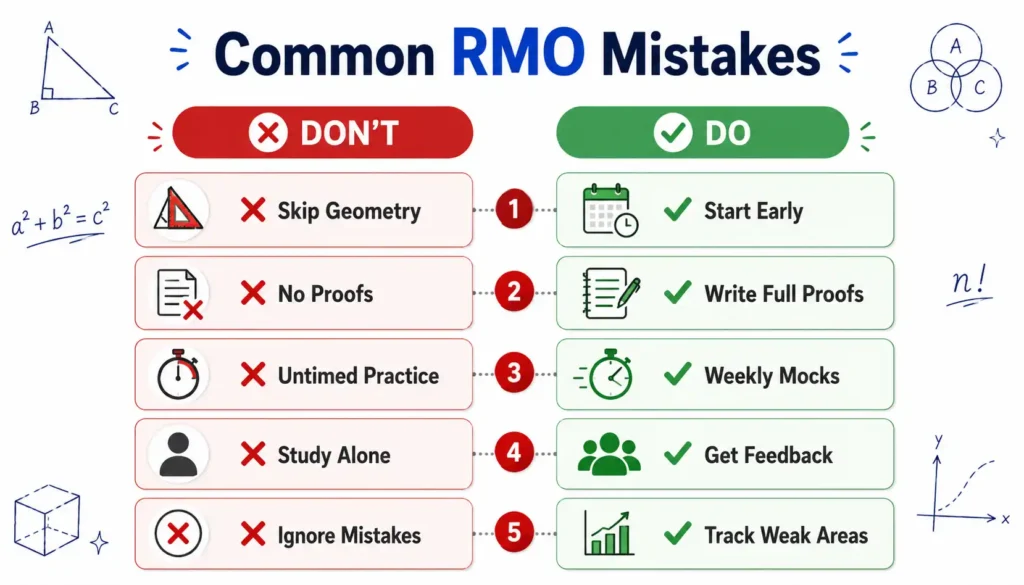
1. Neglecting Geometry. Geometry consistently appears in RMO (usually 1 to 2 problems per paper) and is the topic most students find uncomfortable.
Avoiding it is tempting but costly. Start geometry early and practice consistently.
2. Poor Proof-Writing Habits. Writing “therefore the answer is X” without rigorous justification loses marks. Every claim needs support.
Practice writing proofs that a skeptical reader would accept.
3. Not Practicing Under Timed Conditions. Solving problems with unlimited time and no pressure is useful for learning but does not prepare you for the exam environment.
Regular timed practice is essential.
4. Ignoring Number Theory Depth. Students comfortable with basic modular arithmetic may skip advanced topics like Lifting the Exponent Lemma or p-adic valuations.
These tools appear regularly in harder RMO problems.
5. Over-Relying on Computational Approaches. RMO problems reward elegant reasoning over brute-force computation.
If your solution involves pages of algebraic manipulation, there is probably a cleaner approach.
6. Studying Without a Problem Journal. Random practice without tracking what you have learned leads to repeating the same mistakes.
Maintain a journal of key insights, techniques, and problem types you have struggled with.
7. Preparing Alone Without Feedback. Mathematics at the Olympiad level benefits enormously from discussion, mentorship, and peer review.
Join study groups, online communities, or use platforms like the Gonit App that provide structured problem-solving environments.
RMO Result 2026: When and How to Check
Expected RMO Result 2026 Timeline: RMO results are typically declared within 4 to 6 weeks of the exam date.
Based on an October to November 2026 exam, expect results by December 2026 to January 2027.
How to Check Results:
- Results are published on the HBCSE official website.
- Regional coordinators may also communicate results directly to schools.
- Qualifying students receive information about INMO registration and preparation.
After Results:
Students who qualify for RMO should begin INMO preparation immediately.
The RMO selection process feeds directly into INMO, and the jump in difficulty from RMO to INMO is significant.
The preparation strategy remains similar: deeper problems, more advanced techniques, and greater emphasis on creative problem-solving.
What is the full form of RMO?
RMO stands for Regional Mathematical Olympiad. It is the second stage of India’s Mathematical Olympiad selection process, conducted by HBCSE/NBHM to select students for the Indian National Mathematical Olympiad (INMO).
How hard is RMO?
RMO is significantly harder than IOQM and school-level mathematics competitions. It requires complete, rigorous proof-writing rather than objective answers. Problems demand creative mathematical thinking and deep conceptual understanding. Most students who qualify IOQM find RMO challenging initially, but focused preparation over 4 to 5 months can bridge the gap.
Can I prepare for RMO without coaching?
Yes, many successful RMO qualifiers have prepared through self-study using good books, online resources, and consistent practice. The key is having the right materials, a structured study plan, and ideally some form of feedback on your proof-writing, whether from a teacher, mentor, online community, or dedicated practice platforms like the Gonit App. Coaching can accelerate preparation but is not a requirement.
How many students qualify for RMO?
Approximately 800 to 1,000 students across India qualify for RMO through IOQM each year. From RMO, around 30 to 35 students per region qualify for INMO.
What is the difference between IOQM and RMO?
IOQM is an objective (answer-based) exam testing speed and accuracy across 30 problems, while RMO is a subjective (proof-based) exam with 6 challenging problems requiring detailed mathematical proofs. The key differences are: format (objective vs. subjective), time per problem (6 min vs. 30 min), evaluation criteria (answer vs. proof quality), and the role of mathematical writing and reasoning.
What is the RMO 2026 exam date?
The RMO 2026 exam is expected to be held in October to November 2026, based on previous years’ patterns. The exact date will be announced by HBCSE through the official notification on their website.
What is the RMO syllabus?
The RMO syllabus covers four main areas: Algebra (inequalities, functional equations, polynomials), Geometry (triangle and circle geometry, cyclic quadrilaterals, transformations), Number Theory (divisibility, modular arithmetic, Diophantine equations), and Combinatorics (counting principles, pigeonhole, graph theory). There is no official prescribed syllabus. Problems can draw from any area of pre-calculus mathematics.
Make Preparing for Math Olympiad Simple!
Start Your RMO 2026 Preparation Today
RMO is tough, but a clear plan makes it manageable. Start by solving 2–3 previous year problems, identify your weak areas, follow a phased study plan, and practice proof-writing daily.
Use the right books, review past RMO papers, and build consistency with Olympiad-style practice on the Gonit App.
Start today, stay disciplined, and your preparation will keep improving.
Want to understand the first stage better? Read our IOQM Complete Guide and Olympiad preparation strategy articles.

Mikha Piregu is a Content Writer with experience spanning educational content, including math and math olympiad topics, as well as advocacy writing, research-based articles, and SEO-driven web content. He creates high-quality blog content, web copy, and feature articles that support brand visibility, audience engagement, and long-term organic growth through data-informed storytelling. Skilled in WordPress, WooCommerce, and modern digital tools, Mikha adapts content across various platforms, including blogs, websites, campaigns, and advocacy initiatives, with clarity and purpose.




There are no comments posted here yet.
Sign in to leave a comment