April 22, 2026
 18 min. read

Sixty days. One big exam. And right now, you’re probably staring at a mountain of topics wondering where to even start.
That feeling is completely normal. Here’s the truth: 60 days is enough. Not barely enough. It’s actually enough if you follow the right plan.
This guide is specifically built to teach you how to prepare for SOF IMO without wasting a single day on scattered, ineffective study.
We’ll cover the full exam structure, section-wise strategy, class-specific tips, mock test integration, and the most common mistakes students make in short-term prep.
Let’s get started.
Understanding the SOF IMO Exam Pattern Before You Prepare
Before you plan a single study session, know exactly what you’re being tested on.
If you haven’t already, read our detailed breakdown of the SOF IMO exam pattern, it covers section-wise marks, time limits, and how the scoring works across all classes.
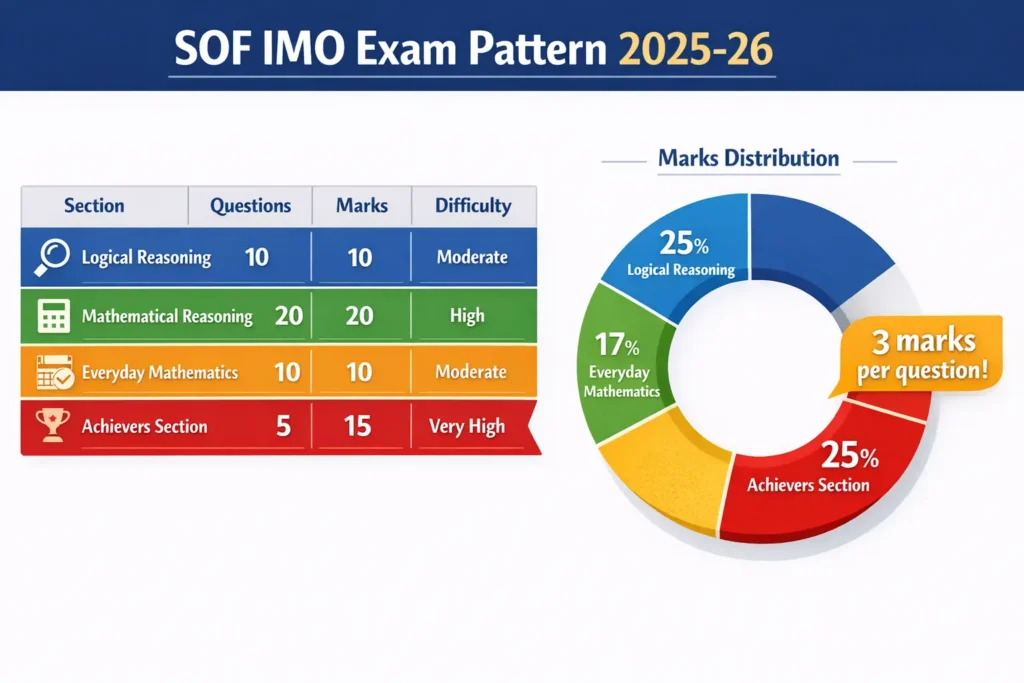
Section-Wise Exam Pattern (Classes 5–12)
| Section | No. of Questions | Marks per Question | Total Marks | Difficulty |
| Section 1: Logical Reasoning | 15 | 1 | 15 | Easy–Moderate |
| Section 2: Mathematical Reasoning | 20 | 1 | 20 | Moderate |
| Section 3: Everyday Mathematics | 10 | 1 | 10 | Moderate |
| Section 4: Achievers Section | 5 | 3 | 15 | Hard |
| Total | 50 | — | 60 | — |
For Classes 1–4: The paper has 35 questions, no Everyday Mathematics section, and carries 40 marks total.
Key details:
- Duration: 60 minutes
- No negative marking for wrong answers
- All questions are MCQ (multiple choice)
- Medium: English only
- Syllabus: Based on CBSE, ICSE, and major State Boards
The Achievers Section: Why It’s the Game-Changer
Each Achievers Section question carries 3 marks three times a regular question. With only 5 questions, this section accounts for 25% of your total score (15 out of 60 marks).
Yet most students treat it as an afterthought or skip it entirely.
Here’s the insight: two students with identical regular-question performance can be separated by an entire rank tier based solely on the Achievers Section.
If you answer 3 out of 5 Achievers questions correctly, you gain 9 marks that most of your competition doesn’t have.
Know the pattern → Know where to focus → Outperform students who studied just as hard but not as smart.
The 60-Day SOF IMO Preparation Plan — Phase by Phase
Here’s the core of this guide.
The plan is split into three phases that build on each other and don’t skip ahead.
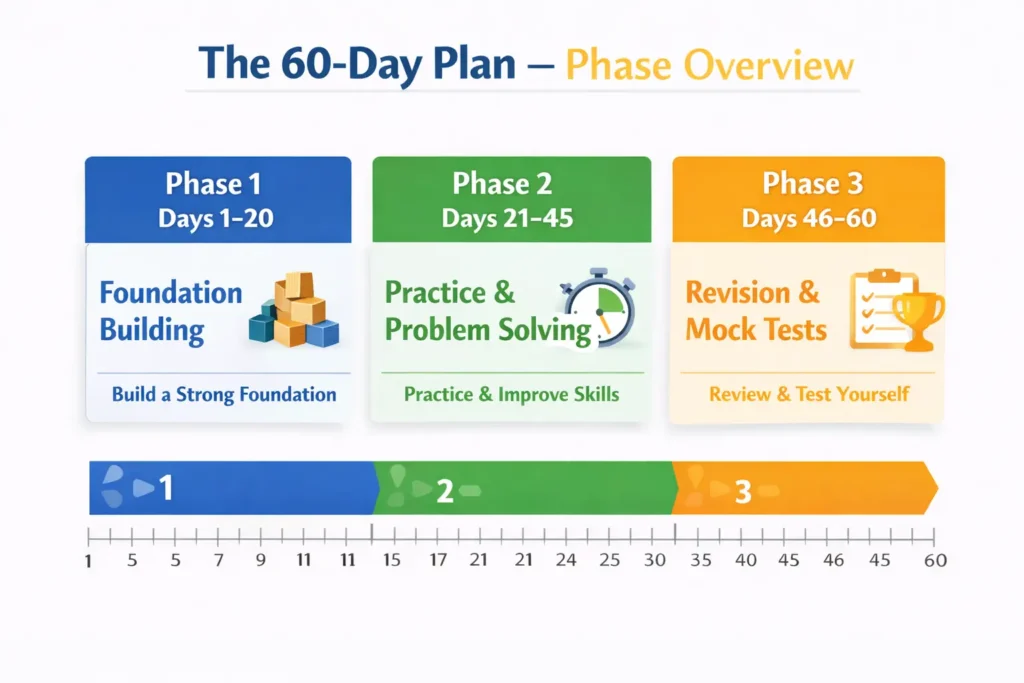
Phase 1 — Foundation Building (Days 1–20)
Goal: Build solid concept clarity across all syllabus topics before you attempt any serious practice.
Daily time commitment: 45–60 minutes
Why this phase matters: You cannot solve Olympiad-level problems if your foundational concepts have gaps.
Phase 1 is about plugging those gaps not about being fast. Speed comes later.
Before diving in, download the class-wise SOF IMO syllabus so you know exactly which topics to cover and in what order.
What to do each day:
- Study 1–2 core Mathematical Reasoning topics from your class syllabus
- Read concepts, understand worked examples, then solve 5–10 straightforward problems
- Don’t aim for Olympiad difficulty yet aim for clarity
- Spend the last 5 minutes of each session reviewing what you covered
Week-by-Week Study Table: Phase 1 (Days 1–20)
| Week | Days | Focus Topics | Daily Time | Section Priority |
| Week 1 | 1–7 | Number systems, computation operations, fractions/decimals (as per your class) | 50 min | Mathematical Reasoning |
| Week 2 | 8–14 | Geometry, measurement, perimeter/area, symmetry | 50 min | Mathematical Reasoning |
| Week 3 (partial) | 15–20 | Data handling + start Logical Reasoning basics (patterns, analogies, series) | 55 min | Math + Logical Reasoning intro |
Struggling with a topic? Don’t spend more than 2 days on any single concept. Mark it, move forward, and return to it in Phase 2.
Stalling on one topic in Phase 1 is one of the most common preparation mistakes.
Recommended resources for Phase 1:
- Your current class NCERT/school math textbook (primary reference)
- Previous class NCERT book (40% of questions come from the prior class!)
- SOF official IMO workbooks (class-wise)
Phase 2 — Practice & Problem Solving (Days 21–45)
Goal: Apply what you’ve built. Shift from passive concept study to active, timed problem-solving. This is where real Olympiad preparation happens.
Daily time commitment: 60–75 minutes
The shift: In Phase 1, you were learning. In Phase 2, you’re training.
Think of it like the difference between studying swimming technique and actually getting in the pool.
This is also a good time to work through SOF IMO sample papers, they’re the most accurate representation of actual exam question styles and difficulty levels.
Week-by-Week Study Table: Phase 2 (Days 21–45)
| Week | Days | Focus | Daily Time | Key Activity |
| Week 4 | 21–27 | Mathematical Reasoning practice (previous year question types) | 65 min | 20–25 problems/day, untimed |
| Week 5 | 28–34 | Logical Reasoning intensive + Everyday Mathematics | 65 min | 15 LR + 10 EM problems/day |
| Week 6 | 35–41 | Achievers Section introduction + mixed practice | 70 min | 5 Achievers Qs/day + mixed set |
| Week 7 (partial) | 42–45 | First mock tests + error analysis | 75 min | 1 full mock test every 2 days |
Logical Reasoning integration: Don’t leave Logical Reasoning for last. From Week 4, do 5 LR questions daily as warm-up before your main math session.
By Week 5, you’ll find your LR speed has quietly improved.
Achievers Section integration (days 35+): Start with understanding the question format; these aren’t harder versions of regular questions, they’re a different type of thinking.
Spend 10–15 minutes each day on Achievers-style problems. (More on strategy in the section-wise guide below.)
Introducing mock tests (Days 42+): Take your first full-length mock in Week 7. Don’t worry about the score. Use it to see where your time goes and which sections drain you.
How to analyze mistakes:
- After every practice session, write down every question you got wrong
- Note why you got it wrong: concept gap? Careless error? Ran out of time?
- This becomes your personal error log your single most powerful revision tool
Phase 3 — Revision & Mock Tests (Days 46–60)
Goal: Consolidate everything. Lock in your knowledge, eliminate weak spots, and simulate exam conditions until they feel natural.
Daily time commitment: 60–90 minutes
Final 2-Week Revision Table (Days 46–60)
| Days | Activity | Time |
| 46–48 | Revisit error log from Phase 2; re-study flagged topics | 60 min |
| 49–51 | Full mock test + deep review session (2–3 hours total including review) | 90 min |
| 52–54 | Achievers Section deep practice; speed drills for Logical Reasoning | 70 min |
| 55–57 | Full mock test + error log update | 90 min |
| 58–59 | Light revision: formulas, concept summaries, Logical Reasoning patterns | 45 min |
| Day 60 | Rest, light review of personal notes, sleep on time | 30 min |
Mock test schedule in Phase 3:
- Minimum: 3 full-length mock tests in Days 46–60
- Ideal: 4–5 mocks, with at least 48 hours between each for proper review
- Every mock test should be taken under strict exam conditions: 60 minutes, no breaks, no looking up answers mid-test
5-day pre-exam strategy (Days 56–60):
- Day 56: Review your error log focus only on your top 10 weak areas
- Day 57: One last full mock test
- Day 58: Light concept revision; revisit formulas and patterns
- Day 59: Rest your brain. No heavy studying. Just a quick scan of notes.
- Day 60 (exam day or day before): Get 8 hours of sleep. Trust the work you’ve done.
Section-Wise Preparation Strategy
How to Prepare Logical Reasoning for SOF IMO
Logical Reasoning tests your ability to spot patterns and think systematically not your math knowledge.
This is great news because it can be improved quickly with the right practice.
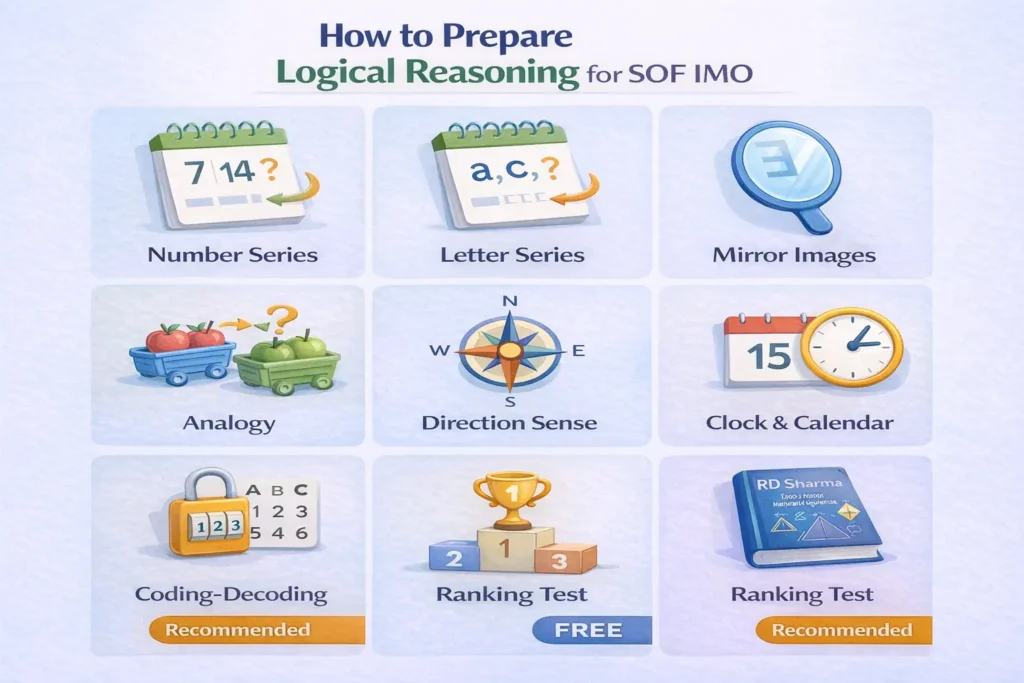
Common question types:
- Series completion (number and letter series)
- Analogy and classification
- Mirror images and geometrical patterns
- Coding-decoding
- Direction sense and ranking
- Clock and calendar problems
Key skills to develop: Visual pattern recognition, quick elimination of wrong options, and systematic step-by-step thinking.
Practice approach:
- Do 10–15 LR questions daily from Week 2 onwards
- Always use the elimination method knock out obviously wrong options first
- For visual questions (mirror images, patterns), practice drawing quick sketches
- Time yourself: target 30–45 seconds per LR question
Time allocation within 60 days: Start with 10 minutes/day in Phase 1, scale to 15–20 minutes/day in Phase 2, and maintain that in Phase 3.
How to Prepare Mathematical Reasoning for SOF IMO
Mathematical Reasoning is the largest section (20 questions, 20 marks) and the backbone of your score.
The syllabus is 60% current class and 40% previous class which means you actually need to revise two years of content.
For a complete topic-by-topic list, refer to the official SOF IMO syllabus by class.
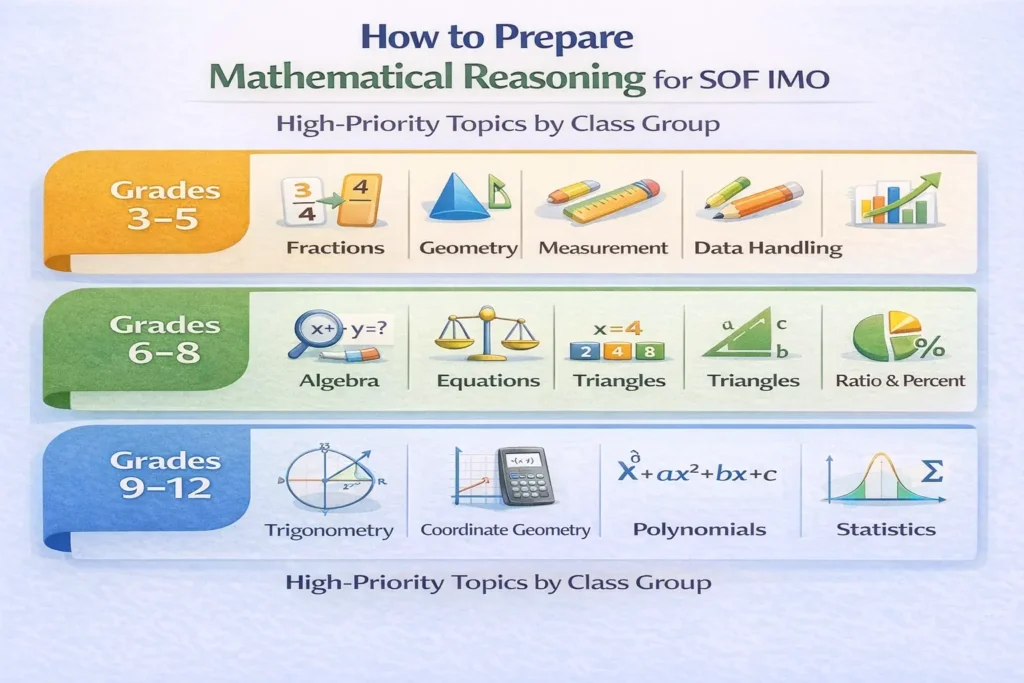
High-priority topics by class group:
Grades 3–5: Number sense, computation operations, fractions and decimals, measurement (length/weight/capacity/time), geometry basics, perimeter and area, data handling
Grades 6–8: Integers, rational numbers, algebraic expressions, linear equations, triangles and quadrilaterals, circles, percentage and ratio, data handling and probability
Grades 9–12: Real numbers, polynomials, coordinate geometry, trigonometry, quadratic equations, statistics, constructions, mensuration (9–10); calculus basics, vectors, probability, coordinate geometry (11–12)
Concept-first approach: Never skip to practice if your concept is unclear. One solid concept understood deeply is worth 5 topics memorized superficially.
In Phase 1, spend 70% of your time on concepts and 30% on practice. Flip that ratio in Phase 2.
Handling unfamiliar question formats: Break it down what concept is it testing? What’s the most logical first step?
Olympiad questions are tricky, not impossible; they require familiar concepts applied in new ways.
Read our guide on how to solve math word problems for strategies that transfer directly to Everyday Mathematics questions.
How to Crack the Achievers Section (Most Ignored by Students)
This section deserves its own spotlight because most guides don’t give it one.
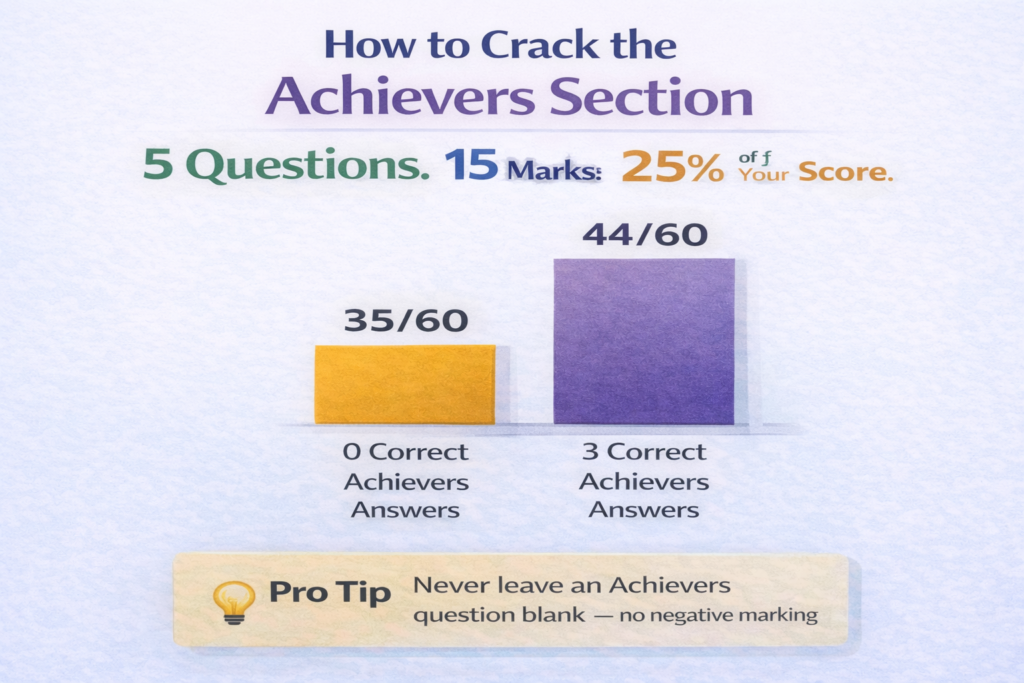
What makes it different: The Achievers Section doesn’t just test whether you know a concept. It tests whether you can apply it under pressure in an unfamiliar scenario.
Think multi-step problems, problems that combine two topics, or problems that require you to reason backwards from an answer.
Why it makes or breaks your rank: As noted earlier, 5 questions × 3 marks = 15 marks, which is 25% of the total score.
The Achievers Section is the primary differentiator between students with similar foundational knowledge.
Missing 3 of these questions while your peer gets them all right is the difference between a school rank and a zonal rank.
See exactly what SOF IMO awards and prizes are at stake; it puts the Achievers Section into sharp perspective.
Specific strategies:
- Understand the question deeply before calculating. Most Achievers questions that students get wrong aren’t actually hard; they’re misread.
Re-read every question at least twice. - Work backwards. For many Achievers questions, plugging in the answer options is faster than solving from scratch.
Try option C first (often close to the middle value), and use it to narrow down. - Don’t skip guessing smartly. With no negative marking, never leave an Achievers question blank.
Even a logical guess using elimination gets you a 25–50% chance of 3 marks. - Practice HOTS (Higher Order Thinking Skills) questions daily from Day 35 onwards. SOF’s official workbooks flag these separately.
For additional strategies on getting top marks, read our guide on how to get full marks in a maths Olympiad. - Time budget it correctly. With 60 minutes for 50 questions, that’s about 72 seconds per question on average.
But Achievers’ questions take longer.
In the actual exam, answer Sections 1–3 first, then give Achievers your full remaining time.
Class-Wise Preparation Tips
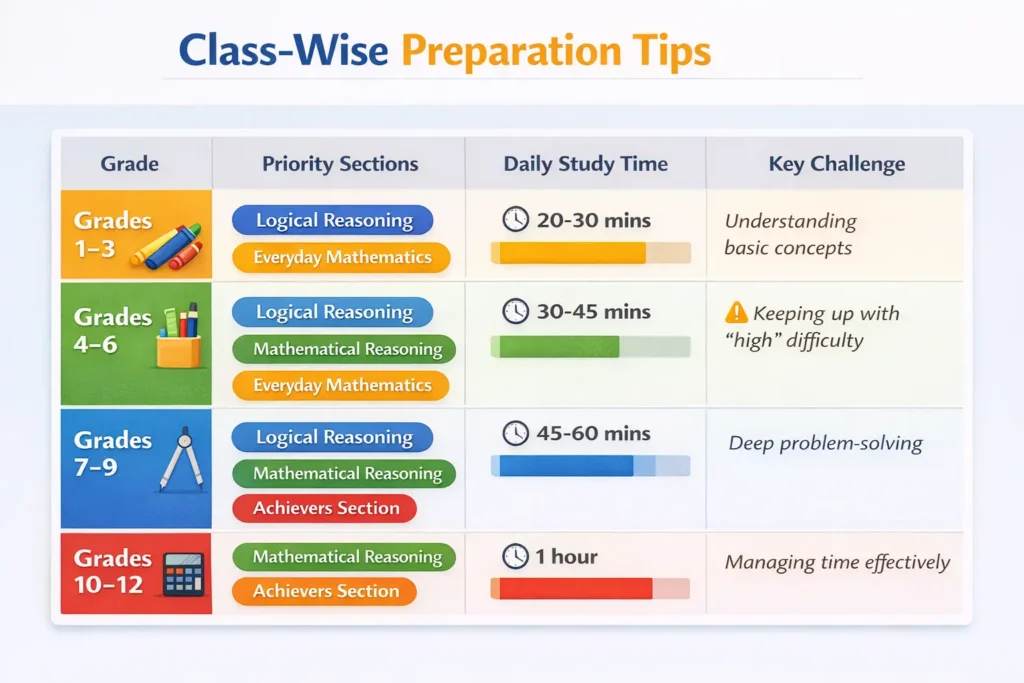
Grades 1–3: Foundation First
At this stage, the IMO is about building number sense and logical thinking, not intense competition.
Parents play a huge role here.
- Parent’s role: Sit with your child during study sessions, make it fun, use visual aids and games for concepts
- Focus areas: Basic operations, patterns, simple geometry, measurement
- Daily time: 20–30 minutes is enough consistency matters more than duration
- Key challenge: Attention span. Keep sessions short and varied.
Grades 4–6: Balancing School and Olympiad
This is the sweet spot where Olympiad preparation starts to meaningfully diverge from school curriculum but not by much.
- Focus areas: Fractions, decimals, geometry, data handling + Logical Reasoning basics
- Daily time: 40–50 minutes
- Strategy: After completing school homework, dedicate a focused Olympiad block. Don’t mix them.
- Key challenge: Treating Olympiad prep as “extra homework” rather than a skill-building activity
Students preparing in this range often benefit from improving their approach to math word problems, a skill that feeds directly into the Everyday Mathematics section.
Grades 7–9: Deeper Problem-Solving
By middle school, students can self-direct their preparation more independently.
- Focus areas: Algebra, geometry, rational numbers, linear equations + starting Achievers Section seriously
- Daily time: 60–75 minutes
- Strategy: Error logs are especially important here. Start mock tests earlier (Week 4).
- Key challenge: Overconfidence from school performance. Olympiad difficulty is a step up expect to struggle initially.
Grades 10–12: Advanced Topics + Level 2 Awareness
At this level, Level 2 is a realistic goal, and preparation needs to reflect that.
Read our SOF IMO Level 2 preparation guide to understand exactly what the advanced round demands.
- Focus areas: Trigonometry, coordinate geometry, statistics, probability, application-based problems
- Daily time: 75–90 minutes
- Strategy: Past paper analysis becomes even more critical. Simulate full 60-minute exams weekly from Phase 2.
- Key challenge: Balancing board exam preparation with Olympiad prep. Solution: align topics where possible, since the Olympiad syllabus mirrors school curriculum.
Class-wise Summary Table
| Grade Group | Priority Sections | Daily Study Time | Key Challenge |
| Grades 1–3 | Math Reasoning, Logical Reasoning | 20–30 min | Attention span |
| Grades 4–6 | Math + Everyday Math + LR | 40–50 min | Staying consistent |
| Grades 7–9 | All sections, esp. Achievers | 60–75 min | Olympiad difficulty gap |
| Grades 10–12 | Achievers + Applied Math | 75–90 min | Balancing boards + Olympiad |
How to Use Mock Tests Effectively in Your 60-Day Plan
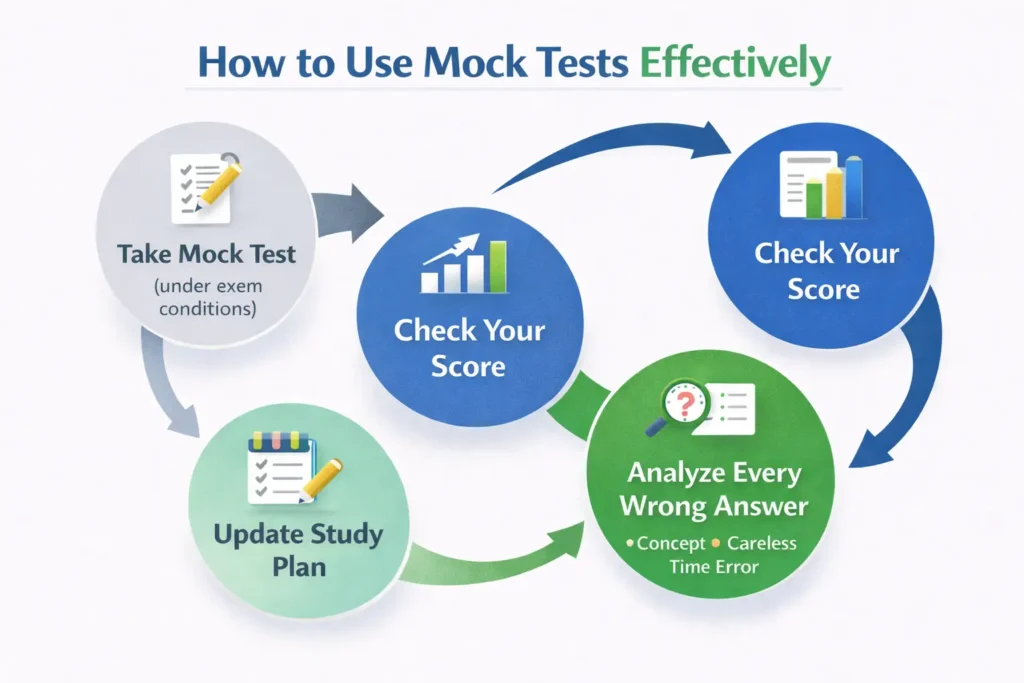
Mock tests are the single most misused tool in Olympiad preparation.
Most students either take too few, take them too late, or worst of all check the score and move on without reviewing properly.
When to start mock tests:
- Beginners: Day 42 (start of Week 7)
- Intermediate students: Day 35 (mid-Week 6)
- Advanced students: Day 28 (start of Week 5)
How many mock tests to take in 60 days:
- Minimum: 5 full-length mock tests
- Recommended: 6–8 mocks, spaced out, with review time between each\
Use SOF IMO sample papers as your primary mock test source; they’re the most accurate available and closely mirror the real exam format and difficulty.
How to analyze results (the right way): After every mock test, do a structured review:
- Mark every wrong answer in your error log
- Categorize each error: concept error, careless error, or time error
- For concept errors go back and study that topic
- For careless errors identify the specific habit causing it (misreading? rushing?)
- For time errors adjust your section-wise timing in the next mock
Mock test vs. practice questions: Practice questions build skills. Mock tests reveal gaps and test your exam temperament.
You need both but they serve different purposes. Never replace mock test review time with more practice questions.
Tips to Improve Speed and Accuracy for SOF IMO
With 60 minutes for 50 questions, you have an average of 72 seconds per question.
That’s tight especially for Achievers Section questions. Speed and accuracy are trainable skills.
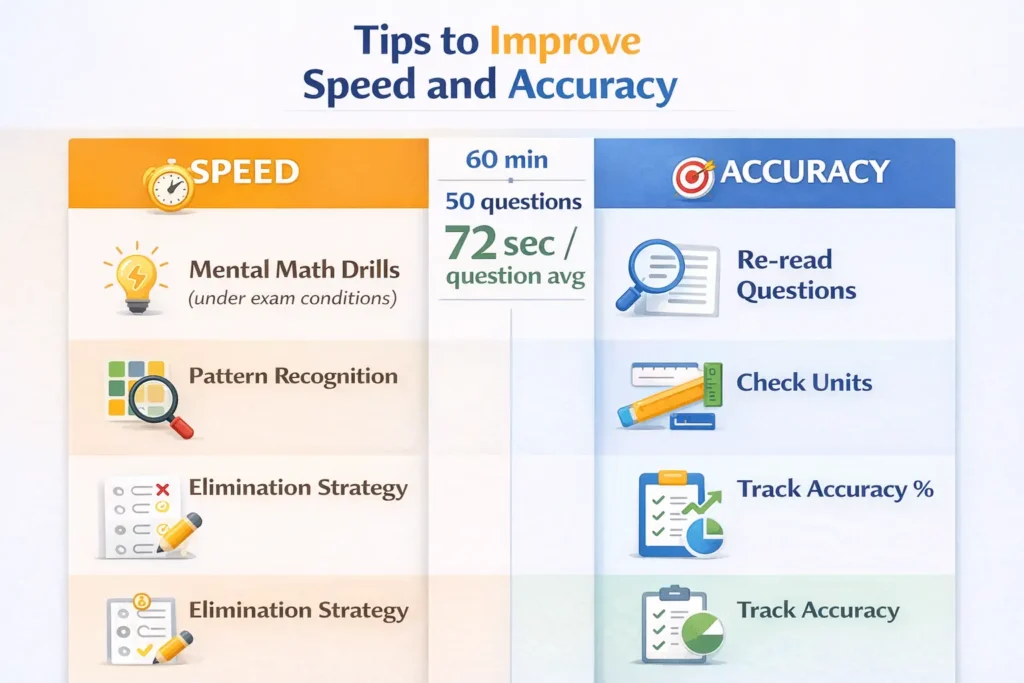
For speed:
- Mental math drills: Practice multiplication tables, squares (1–25), cubes (1–10), and percentage-fraction equivalents until they’re automatic. 5 minutes/day makes a massive difference.
- Pattern recognition: Many LR questions have patterns you’ll see repeatedly. The more you practice, the faster you spot them.
- Elimination strategy: Don’t solve every question from scratch. For MCQs, try to eliminate 2 wrong options first, then solve. Often you can get to the answer faster.
- Section sequencing: In the actual exam, do Logical Reasoning first (fastest), then Mathematical Reasoning, then Everyday Mathematics, then Achievers last (most time-intensive).
For accuracy:
- Re-read before answering: For problems involving “which is NOT true” or “least/greatest” misreading is the #1 source of careless errors.
- Check unit consistency: In measurement and geometry problems, make sure you’re working in the same units throughout.
- Daily accuracy tracking: In your practice sessions, track your accuracy percentage. Aim for 80%+ in Sections 1–3 before moving to mock tests.
Common Mistakes Students Make During IMO Preparation and How to Fix Them
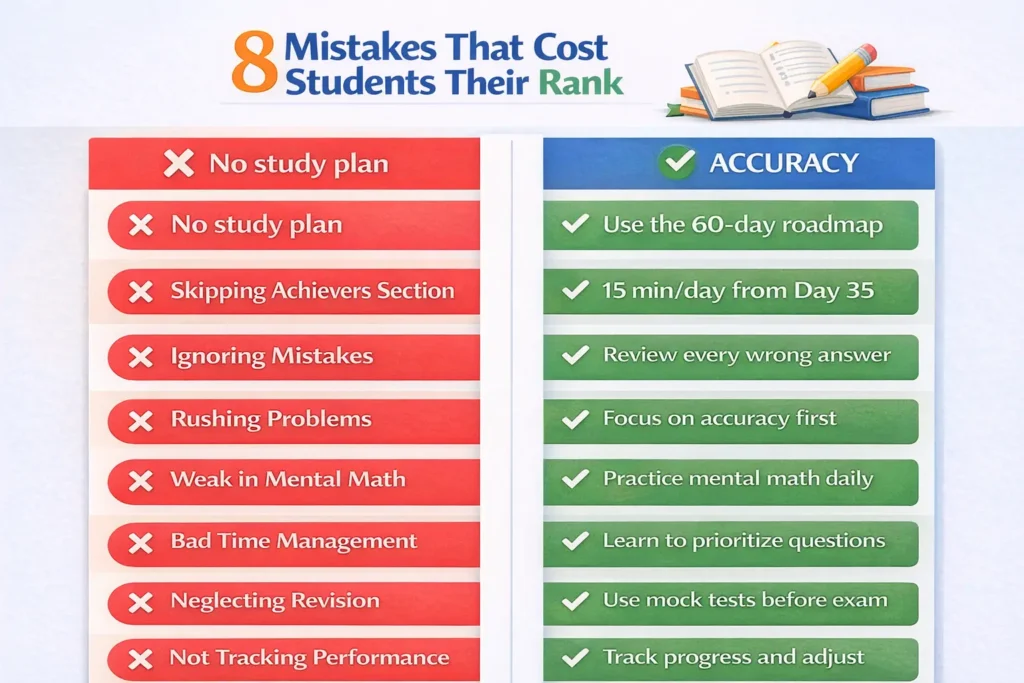
1. No structured plan just “studying math” randomly Fix: Use the three-phase plan above. Write down which topics you’ll cover each week.
2. Studying all topics with equal effort Fix: Prioritize Mathematical Reasoning (highest question count) and Achievers Section (highest marks per question).
Not all topics are equally weighted.
3. Completely ignoring the Achievers Section Fix: Dedicate 15 minutes/day to HOTS practice from Day 35.
Even getting 2–3 Achievers questions right dramatically improves your rank.
4. Passive learning (reading notes, watching videos) without practicing Fix: 60% of your study time should be active problem-solving pencil in hand, working through questions.
Reading about math is not the same as doing math.
5. Not reviewing mistakes Fix: Start an error log from Day 1.
After every session, write what you got wrong and why. Review it weekly.
6. Saving mock tests for the last week Fix: Start mock tests in Phase 2 (Day 35–42, depending on your level).
You need time to adjust your preparation based on mock test results.
7. Forgetting the previous class syllabus Fix: Remember 40% of Level 1 questions come from the previous class syllabus.
In Phase 1, revise at least the key topics from your previous year.
8. Studying in inconsistent bursts instead of daily sessions Fix: 45 focused minutes every day beats 4 hours on Saturday.
To go deeper on general Olympiad improvement, read our guide on how to get better at solving math Olympiad questions; many of those principles apply directly to SOF IMO prep.
Set a fixed daily study time and protect it.
Beginner vs. Advanced Students Customize Your 60-Day Plan
Not everyone starting this 60-day journey is in the same place.
Use this table to customize your approach.
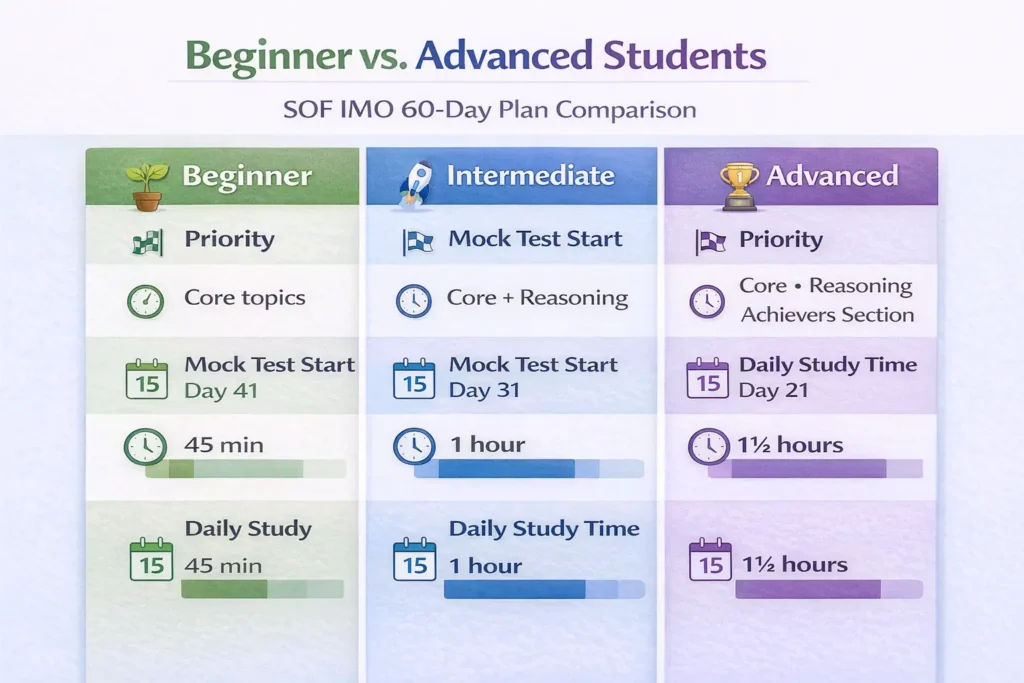
| Element | Beginner | Intermediate | Advanced |
| Phase 1 focus | Build all basics from scratch; no rushing | Strengthen weak topics; revise previous class | Light review only; move to practice faster |
| Phase 2 focus | Practice standard questions; focus on accuracy | Timed practice + Achievers Section intro | Full past papers + deep Achievers work |
| Phase 3 focus | Revise fundamentals + attempt mocks | Mock tests + detailed error analysis | Speed drills + mock test refinement |
| First mock test | Day 42 (Week 7) | Day 35 (Week 6) | Day 28 (Week 5) |
| Daily study time | 45–60 min | 60–75 min | 75–90 min |
| Achievers Section start | Day 40 | Day 35 | Day 21 |
How to know which category you’re in:
- Beginner: You struggle with school math or are taking Olympiad for the first time
- Intermediate: You do well in school math and have taken Olympiad before but didn’t rank
- Advanced: You ranked in your school or zone previously and are aiming for top-100 or Level 2
Recommended Books and Resources for SOF IMO Preparation
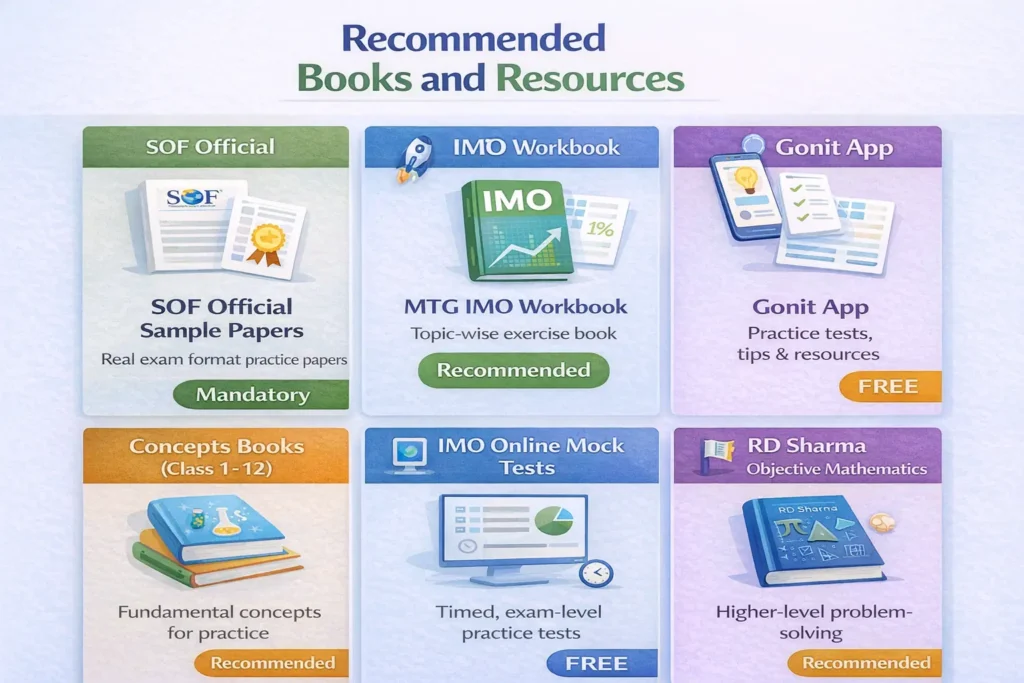
Mandatory starting points:
- SOF official sample papers and previous year question papers: Available on the SOF website (sofworld.org). These are your most accurate preparation materials. Do all of them.
- SOF IMO class-wise workbooks: Published by MTG Learning Media and available through schools and online. These are specifically structured for Olympiad preparation.
Strongly recommended:
- Mathematics Olympiad by BMA Publications (class-wise editions): Good for concept building plus Olympiad-level questions
- Olympiad Champs Mathematics by Disha Publications — Excellent for HOTS and Achievers-level practice
- NCERT textbooks for your current and previous class — the backbone of the syllabus
Online resources:
- SOF’s official website for syllabus, sample papers, and pattern updates
- The Gonit App built specifically for Math Olympiad preparation with class-wise exercises, timed practice, and structured progress tracking
Make Preparing for Math Olympiad Simple!



How many days are enough to prepare for SOF IMO?
60 days is a realistic and sufficient timeline for most students, provided preparation is structured and consistent. Students who follow a phase-wise plan, building concepts first, then practicing, then revising, consistently perform better than those who study more hours but without direction.
Can I prepare for SOF IMO in 60 days if I’m a beginner?
Yes. Beginners can prepare effectively in 60 days by focusing on Phase 1 (concept clarity) for a full 20 days before moving to practice. The key is not skipping steps. Beginners who jump straight to past papers without solid concepts waste time.
What is the best study plan for SOF IMO for Class 5 or Class 8?
The three-phase plan in this guide applies to all classes, but topic priorities differ. Class 5 should focus on fractions, decimals, geometry, and measurement. Class 8 should prioritize algebraic expressions, linear equations, quadrilaterals, and rational numbers while also reviewing key Class 7 topics, since 40% of questions come from the previous year.
How many hours a day should I study for IMO?
For most students, 45–75 minutes of focused, daily practice is more effective than longer irregular sessions. Use the class-group table in this guide to find the recommended daily time for your level.
Is SOF IMO Level 2 preparation different from Level 1?
The syllabus is the same, but the difficulty increases significantly in Level 2. All Level 2 questions are from the current class only (no previous class mix). For full details on dates, eligibility, and what to expect, see our complete guide to SOF IMO 2026–27.
What are the most important topics for SOF IMO?
The most important topics are those in the Mathematical Reasoning section, since it has the highest question count. For your specific class, focus on the 5–6 core topics that make up the majority of that section. Check the full SOF IMO syllabus for a class-wise breakdown.
How do I prepare for the Achievers Section?
Start by understanding what HOTS questions look like they require multi-step reasoning and application. Practice 5 Achievers-style questions daily from Day 35 onwards. Use the elimination method, work backwards from answer options, and never leave these blank (no negative marking). Understanding the SOF IMO awards structure will also show you exactly why those 5 questions matter so much to your final rank.
Which books are best for SOF IMO preparation?
Start with SOF official sample papers and previous year papers (mandatory), then use the SOF MTG workbooks for your class. Supplement with BMA or Disha Olympiad series for additional HOTS practice. Your school NCERT textbook remains the core syllabus reference.
Conclusion
You came into this guide with 60 days and a vague plan.
You’re leaving with something much more useful: a phase-by-phase roadmap, a daily study structure, a mock test strategy, and a clear fix for every common mistake students make preparing for SOF IMO.
Start with Phase 1 tomorrow. Download the official SOF IMO syllabus for your grade, spend the first week on Logical Reasoning, and map your Mathematical Reasoning topics by level of confidence. That’s your Day 1.
Sixty days from now, you won’t just have sat the exam. You’ll have prepared for it properly.
For everything else, dates, registration, and eligibility, the complete SOF IMO 2026–27 guide has you covered