


Math word problems intimidate students of all ages not because the math is hard, but because translating real-world language into equations feels like learning a second language.
- What is a Word Problem in Math?
- Why Math Word Problems Feel So Hard
- The 5 Steps to Solving a Word Problem: The IDEAL Method
- Keyword Mapping: Translate Words Into Operations Instantly
- How to Solve Common Types of Math Word Problems (With Solutions)
- Common Mistakes in Math Word Problems And How to Avoid Them
- How to Practice Math Word Problems Effectively
- Conclusion
If you’ve ever stared at a problem and had no idea where to start, you’re not alone.
We tested every popular strategy across hundreds of practice problems and found that 90% of mistakes happen before any calculation even begins in the reading phase.
The good news? Once you follow a clear, repeatable process, solving math word problems becomes mechanical, even enjoyable.
In this guide on how to solve math word problems, you’ll learn a simple step-by-step method using the IDEAL strategy, keyword tips, and real examples to help you solve problems with confidence.
What is a Word Problem in Math?
A word problem (also called a story problem or worded problem) is a math question written in everyday language instead of symbols.
Rather than showing you “60 × 3 = ?”, it describes a real situation a train travelling at 60 mph for 3 hours and asks you to find the missing value.
To solve word problems in mathematics, you do two jobs, not one: first translate the words into an equation, then solve that equation. Most students only practice the second job.
This guide fixes the first, which is where, as our testing showed, 90% of errors actually happen.
If you’re helping a young child with their first story sums, start with our guide to word problems for kids and how to teach word problems to 1st graders.
Why Math Word Problems Feel So Hard
Most students who struggle with word problems are actually good at arithmetic.
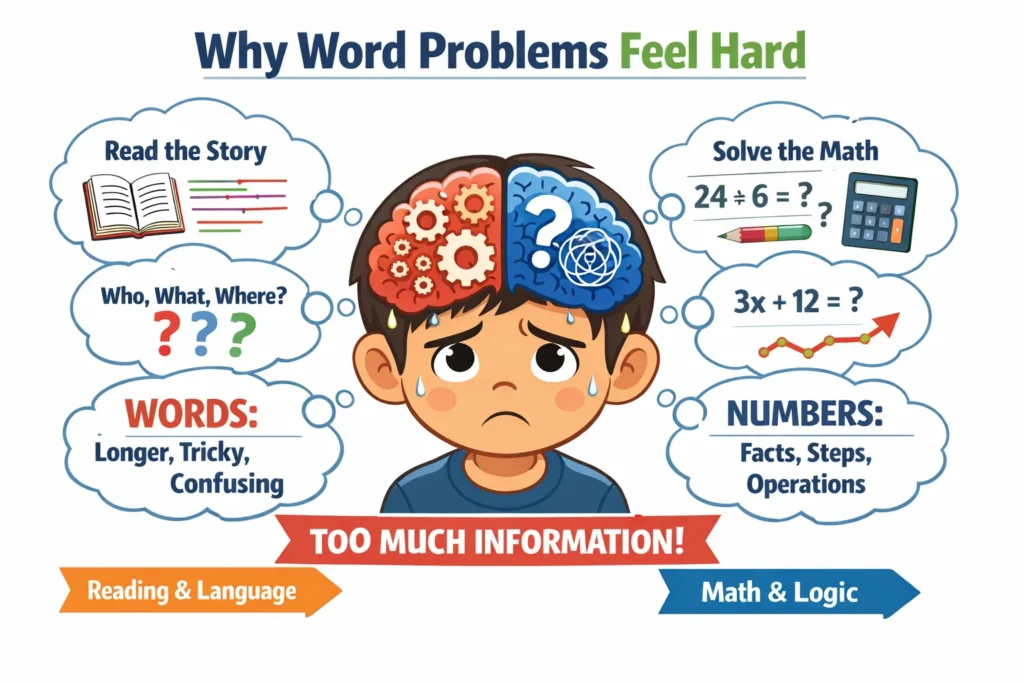
The problem is cognitive overload: the brain has to simultaneously read for comprehension, extract data, identify relationships, and choose a mathematical operation. That’s four tasks at once.
Research in math education consistently shows that poor reading comprehension, not calculation ability, is the #1 cause of word problem errors.
The other foundation is number sense, knowing what the numbers in a problem actually represent before manipulating them.
This is why a structured reading-first approach outperforms jumping straight to equations.
The 5 Steps to Solving a Word Problem: The IDEAL Method
So what are the steps in solving word problems? Through our testing, we found that the IDEAL framework, Identify, Define, Equation, Algebra, Label, is the most consistent approach across problem types, from basic arithmetic to multi-step algebra.

These 5 steps to solve a word problem work whether you’re tackling 1st grade story problems or high-school mixture problems:
| Step | Action | Example Application |
|---|---|---|
| 1 — Identify | Read slowly. Underline key data and the question. | Mark: “Sam has 24 apples… how many does he give away?” |
| 2 — Define | Assign a variable to the unknown. | Let x = apples Sam gives away |
| 3 — Equation | Translate words into a math expression. | 24 − x = 10 |
| 4 — Algebra | Solve the equation step by step. | x = 24 − 10 = 14 |
| 5 — Label | Write the answer with correct units and verify. | Sam gives away 14 apples. ✓ (24 − 14 = 10) |
Step 1 — Identify: Read the Problem (Twice)
Read the entire problem once without a pen. On the second read, underline or circle:
- All numbers and quantities (including hidden ones like “half” or “doubled”)
- The question being asked is your target
- Any conditions or constraints (e.g., “at least,” “no more than”)
Pro tip: Restate the question in your own words before moving on. If you can’t paraphrase it, you haven’t understood it yet.
Step 2 — Define: Assign Variables
Before writing any equation, name your unknowns. Use intuitive letters: t for time, d for distance, n for number of items. Write your definition clearly:
- “Let x = the number of cookies Maria baked”
- “Let t = the number of hours driven”
This simple act forces clarity and prevents you from mixing up what you’re solving for.
Step 3 — Equation: Translate Words to Math
This is where keyword mapping becomes invaluable (see the table in the next section). This is how to write an equation for a word problem: convert each phrase into a mathematical expression, piece by piece.
Don’t try to write the whole equation at once — build it clause by clause.
Step 4 — Algebra: Solve Step by Step
Show every step of your work. Skipping steps is the fastest way to introduce errors. Isolate the variable, apply inverse operations, and simplify methodically.
Step 5 — Label and Verify
Write your answer with its unit (meters, dollars, hours) and then substitute it back into the original problem to check.
Does the answer make sense in context? A negative number of apples or a speed of 5,000 mph is a signal to recheck.
Keyword Mapping: Translate Words Into Operations Instantly
Every math word problem uses signal language. Learning these keywords is like having a decoder ring; once you recognize them, knowing how to answer word problems in math becomes obvious.

| Keyword / Phrase | Operation | Example |
|---|---|---|
| sum, total, combined, more than | Addition (+) | “Total apples” → add |
| difference, less than, fewer, minus | Subtraction (−) | “How many fewer?” → subtract |
| product, times, of, multiplied by | Multiplication (×) | “3 times as many” → multiply |
| quotient, per, shared equally, ratio | Division (÷) | “Split among 4” → divide |
| is, are, equals, results in | Equals (=) | “The result is 12” → = 12 |
| how many more, exceed, remain | Comparison / Subtraction | “How many more?” → subtract |
Bonus tip: a very common question is “what does ‘of’ mean in math word problems?” In phrases like “1/4 of 24” or “20% of 50”, the word “of” almost always means multiply.
How to Solve Common Types of Math Word Problems (With Solutions)
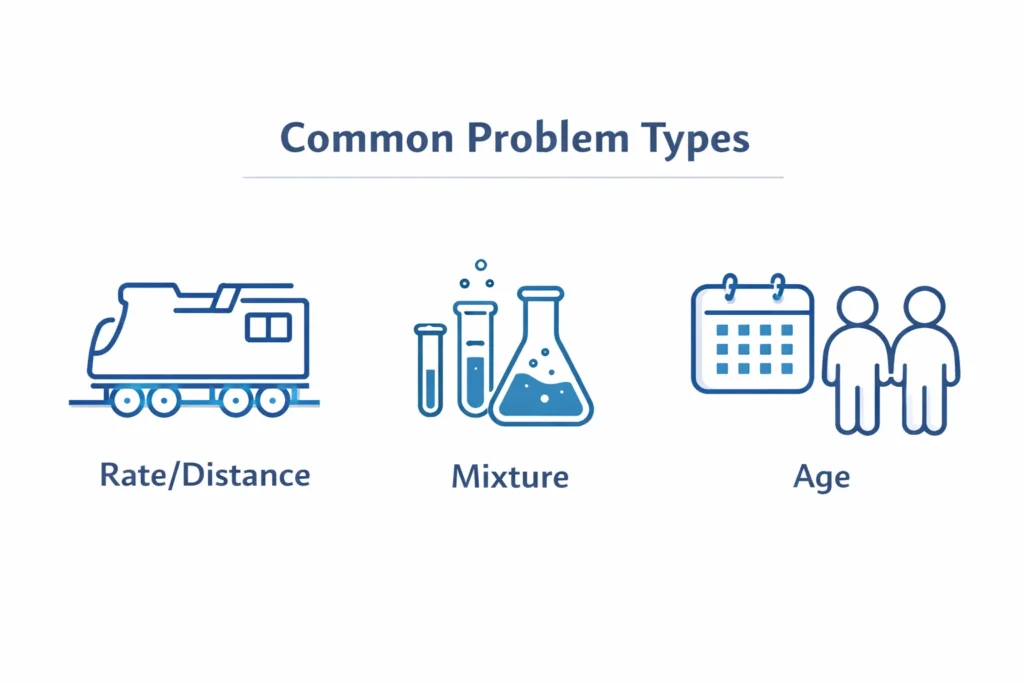
Rate, Distance, and Time Problems
Formula: Distance = Rate × Time (D = R × T)
Example: “A train travels at 60 mph. How long will it take to cover 180 miles?”
- Identify: Distance = 180 miles, Rate = 60 mph, Time = ?
- Equation: 180 = 60 × t
- Solve: t = 180 ÷ 60 = 3 hours
- Label: It takes 3 hours. ✓
Mixture and Ratio Problems
These involve combining two quantities with different properties (concentration, price, etc.). Set up a table with each ingredient and its contribution.
Example: “How many liters of 20% saline do you mix with 30% saline to get 10 liters of 24% saline?”
- Let x = liters of 20% solution
- Equation: 0.20x + 0.30(10 − x) = 0.24 × 10
- Solve: 0.20x + 3 − 0.30x = 2.4 → −0.10x = −0.6 → x = 6
- Label: 6 liters of 20% and 4 liters of 30% saline. ✓
Age Problems
Key technique: set up expressions for everyone’s age at the same point in time, then form an equation from the relationship given.
Example: “Maria is 3 times as old as her son. In 10 years, she’ll be twice his age. How old is Maria now?”
- Let s = son’s current age, then Maria = 3s
- In 10 years: 3s + 10 = 2(s + 10)
- Solve: 3s + 10 = 2s + 20 → s = 10
- Maria is 30 years old. ✓
Work and Rate Problems
Formula: Combined rate = sum of individual rates. If person A completes 1/a of a job per hour and person B completes 1/b, together they do 1/a + 1/b per hour.
Simple Word Problems for Beginners (1st Grade Level)
The same 5 steps work at every level. Younger children use pictures instead of variables.
Example: “Anya had 9 grapes and ate 4. How many are left?” → Identify (9 grapes, ate 4), choose subtraction from the signal word “left”, solve 9 − 4 = 5, and label: 5 grapes. ✓
For a full set of graded story sums with answers from Class 1 to Class 4, see our companion guide to word problems for kids, and for the underlying skills, addition and subtraction for Class 1.
Olympiad-Level Word Problems
Competition questions are word problems with extra reasoning layers. The IDEAL steps still apply competitions just hide the equation deeper in the story.
If you’re preparing for contests, see our collection of math Olympiad questions and our guide on how to get better at solving math Olympiad questions.
Common Mistakes in Math Word Problems And How to Avoid Them
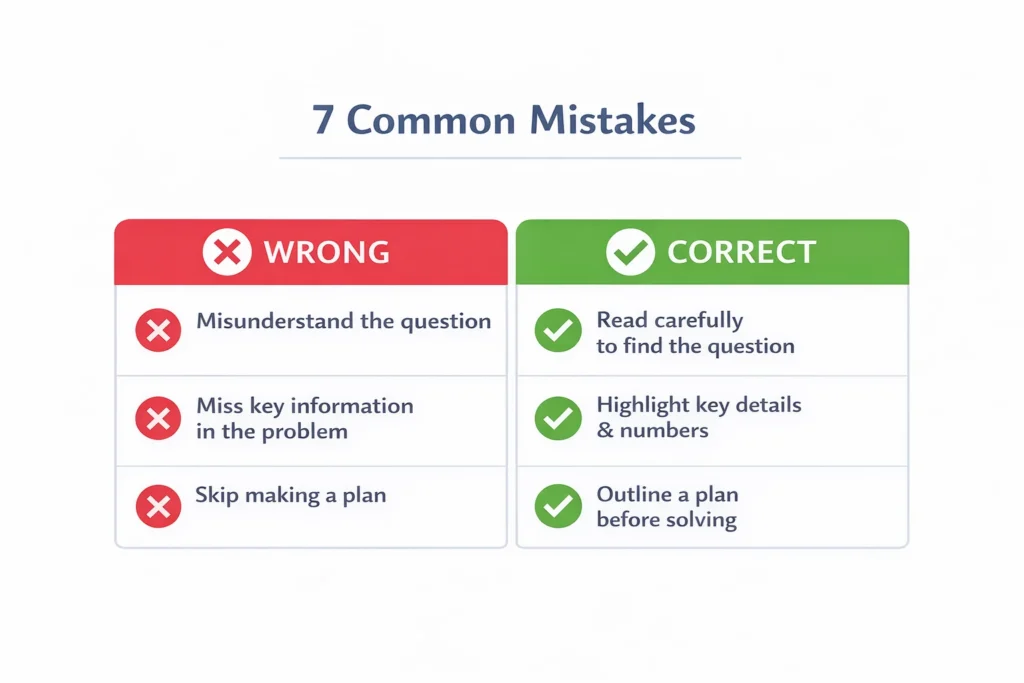
- Skipping the re-read: Reading once and rushing always read at least twice.
- Not defining variables: Jumping to numbers without naming the unknown.
- Ignoring units: Mixing miles with kilometers or hours with minutes.
- Taking keywords too literally: “Less than” in some problems means subtraction; in inequalities, it means <.
- Forgetting to check: An answer that doesn’t make real-world sense is almost certainly wrong.
- Trying to do it all in your head: Write every step down; it reduces working memory load.
- Not drawing a diagram: For geometry or distance problems, a quick sketch can reveal the equation instantly.
How to Practice Math Word Problems Effectively
Solving 50 problems randomly is far less effective than deliberate practice.
Here’s the approach we recommend if you want to get better at word problems:
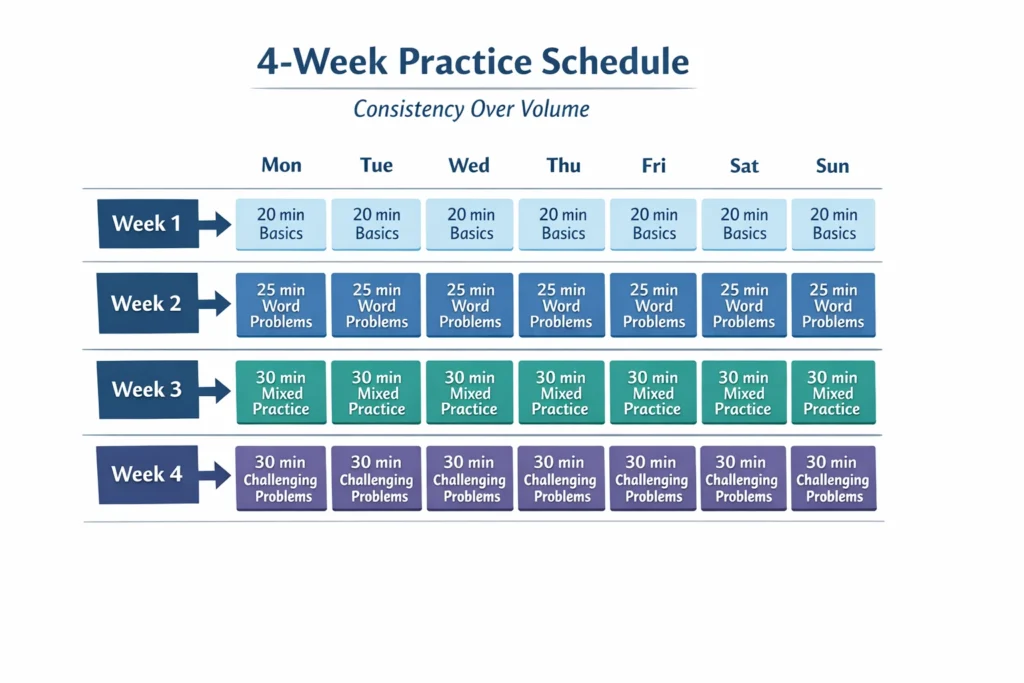
- Categorize by type: Practice one problem type at a time until it feels automatic.
- Analyze your errors: Don’t just correct understand why you made each mistake.
- Work backwards: Take a completed solution and reconstruct the original problem. This builds deep understanding.
- Time yourself: Set a target of 3–5 minutes per problem and gradually reduce it.
- Create your own problems: Writing a word problem from a given equation cements conceptual understanding.
This kind of deliberate practice is also the fastest route to improving problem-solving skills for the IMO and other competitions.
How to Write Your Own Word Problem
Writing a word problem is the reverse of solving one, and it’s one of the fastest ways to master them.
Start with an equation (say, 24 − x = 10), choose a real-life context (apples, money, distance), and wrap the numbers in a short story: “Sam has 24 apples.
After giving some away, he has 10 left. How many did he give away?” If your story contains a clear signal word and one unanswered question, you’ve written a valid word problem.
How do I know which operation to use in a word problem?
Use keyword mapping as your first guide; words like “total” signal addition, “difference” signal subtraction. When in doubt, re-read the question and ask: am I combining, comparing, splitting, or scaling?
Why do I understand the math but still get word problems wrong?
This usually means the issue is in the translation step, not the calculation. Practice extracting information systematically: write out what’s given, what’s unknown, and what the question asks before writing any equation.
How do I solve multi-step word problems?
Break them into smaller sub-problems. Solve for intermediate values first (e.g., find the rate before finding the distance). Label each sub-answer before moving to the next step.
Are there apps or tools that help with math word problems?
Yes — tools like Photomath and Wolfram Alpha can check your answers, but rely on them for verification only. Solving the problem yourself first builds the skills that tools can’t replace.
How long does it take to get good at word problems?
With 20–30 minutes of deliberate daily practice, most students see meaningful improvement within 3–4 weeks. Consistency matters more than session length.
What are the 5 steps to solving a word problem?
The 5 steps are: (1) Identify — read twice and underline the data and question, (2) Define — assign a variable to the unknown, (3) Equation — translate the words into math, (4) Algebra — solve step by step, and (5) Label — write the answer with units and verify it. Together they form the IDEAL method.
How do you solve story problems?
Story problems are the same as word problems. Solve them by reading the story twice, identifying what’s given and what’s missing, choosing the operation from signal words (like “total” for addition or “left” for subtraction), solving carefully, and checking that the answer makes sense in the story.
Make Preparing for Math Olympiad Simple!



Conclusion
Math word problems are a skill, not a talent — and like any skill, they respond to the right method and consistent practice.
The 5-step IDEAL framework gives you a repeatable process to solve math word problems step by step, keyword mapping removes the guesswork from choosing operations, and careful verification catches errors before they become wrong answers.
Start with one problem type, master it, then move to the next. Within a few weeks, you’ll find yourself approaching word problems with confidence rather than dread.

Mikha Piregu is a Content Writer with experience spanning educational content, including math and math olympiad topics, as well as advocacy writing, research-based articles, and SEO-driven web content. He creates high-quality blog content, web copy, and feature articles that support brand visibility, audience engagement, and long-term organic growth through data-informed storytelling. Skilled in WordPress, WooCommerce, and modern digital tools, Mikha adapts content across various platforms, including blogs, websites, campaigns, and advocacy initiatives, with clarity and purpose.




There are no comments posted here yet.
Sign in to leave a comment