
 June 18, 2026
 12 min. read

The distance formula in geometry is an algebraic method used to calculate the shortest, straight-line distance between two points on a coordinate plane.
Most students first encounter it in grades 6–8, and many find it confusing because textbooks drop it in front of them without explaining where it comes from.
The good news is that the distance formula in geometry is not a rule to memorize. It’s a pattern you can see, understand, and reconstruct any time you need it.
This guide walks through exactly that, starting from coordinates, building up to the Pythagorean Theorem connection, and finishing with worked examples you can follow step by step.
What Does “Distance” Mean in Geometry?
In everyday life, distance is simply how far apart two things are.
In geometry, that idea stays the same, but we need to be more precise about how we measure it.
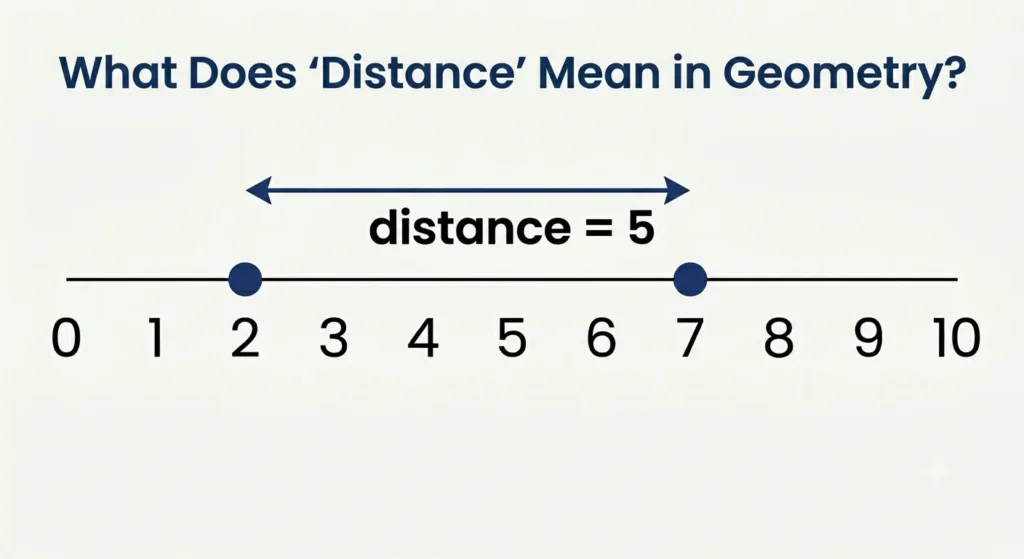
When points sit on a number line, distance is easy. If one point is at 2 and another is at 7, the distance between them is 5.
You just subtract. If you need a refresher on how number lines work, read our guide on number lines for Class 1. But things get more interesting once you move off that single line and onto a flat surface called a coordinate plane.
A coordinate plane is a grid made up of two number lines that cross each other at a right angle. One line runs left and right, and one runs up and down.
On this grid, every location is described by two numbers, not one. Once you’re working in two directions at the same time, a simple subtraction no longer gives you the full picture.
You need something more powerful, and that’s exactly where the distance formula for coordinate geometry comes in.
Understanding Coordinates and the Coordinate Plane
Before using the distance formula, it helps to feel comfortable with how coordinates work.
If you’ve already plotted points on a grid, this will feel familiar. If not, here’s a quick foundation.
How to Read an Ordered Pair
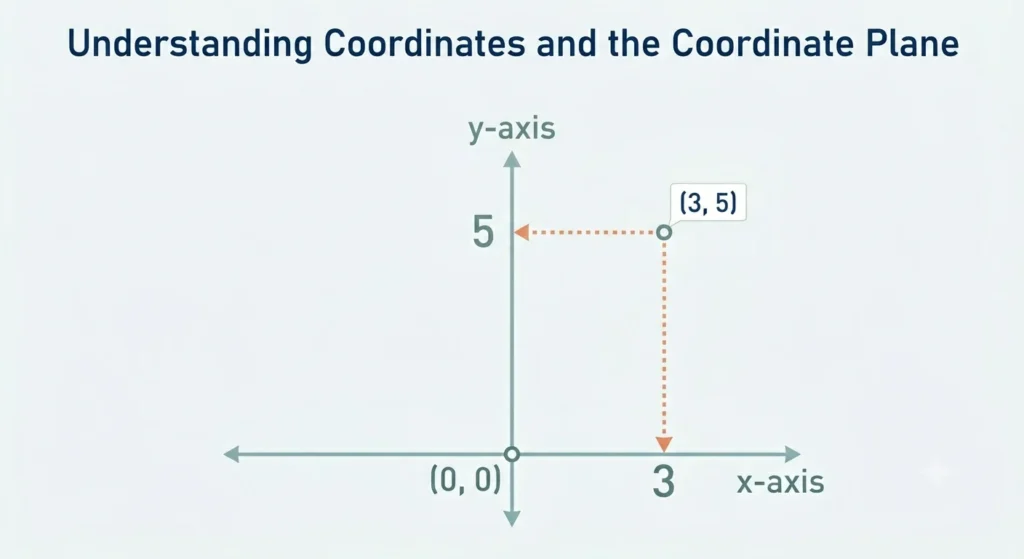
Every point on a coordinate plane is described using an ordered pair, written as (x, y). The first number, x, tells you how far to move left or right from the center of the grid. The second number, y, tells you how far to move up or down.
For example, the point (3, 5) means: move 3 spaces to the right, then 5 spaces up. The point (0, 0) is the very center of the grid, called the origin.
Plotting Points: A Quick Refresher
To plot a point, always start at the origin. Move along the horizontal line first, using the x value. Then move vertically, using the y value.
Mark that spot. Do the same for a second point and you’ll have two locations on the grid that you can measure between.
Understanding how shapes and positions work on a grid connects directly to broader spatial reasoning skills.
Our article on spatial understanding for Class 1 covers the foundational visual thinking that underpins coordinate work. Once you can plot two points, you’re ready to find the distance between them.
Why Do We Need a Distance Formula?
Here’s the problem. Say you have two points on a coordinate plane: point A at (1, 2) and point B at (4, 6). You want to know how far apart they are in a straight line.
You could try subtracting the x values: 4 minus 1 is 3. You could subtract the y values: 6 minus 2 is 4. But neither of those numbers tells you the actual diagonal distance between the two points.
The straight line connecting A to B cuts diagonally across the grid, and neither the horizontal gap nor the vertical gap alone captures that.
This is why we need a formula. Calculating distance in geometry when two points are on a diagonal requires a method that accounts for both the horizontal and vertical separation at the same time. The distance formula does exactly that.
The Distance Formula and the Pythagorean Theorem
The distance formula didn’t appear from nowhere. It comes directly from one of the most famous ideas in all of mathematics: the Pythagorean Theorem.
If you’ve ever seen the equation a² + b² = c², you’ve already met the idea behind the distance formula.
Drawing the Right Triangle Between Two Points
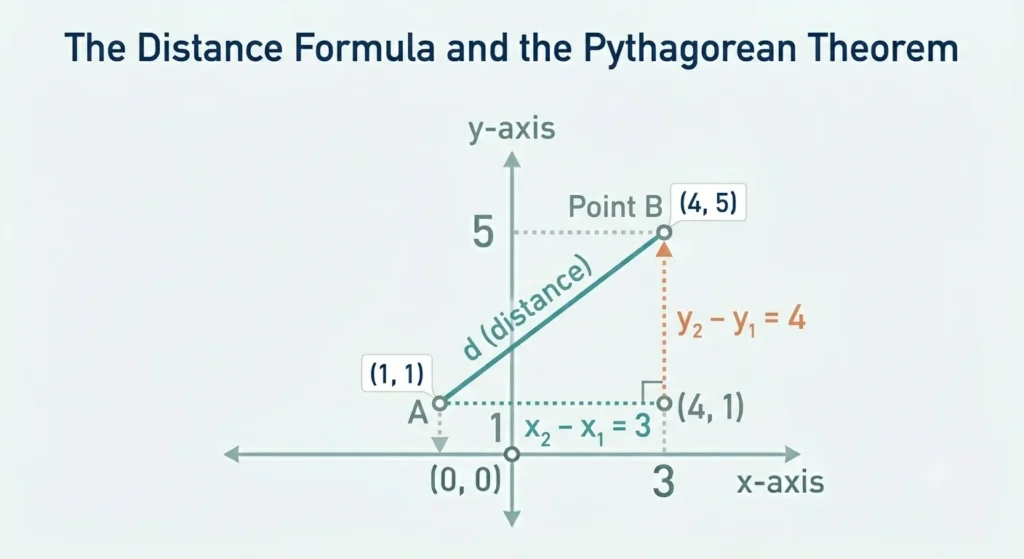
Here’s the key insight. When you draw a straight line between two points on a coordinate plane, you can always create a right triangle around that line. Here’s how it works.
Take your two points, A and B. Draw a horizontal line going sideways from point A. Then draw a vertical line going straight up from point B until it meets your horizontal line.
You’ve just made a right triangle, and the diagonal line connecting A to B is the hypotenuse, the longest side.
The horizontal leg of that triangle is the difference in the x values of the two points. The vertical leg is the difference in the y values. The hypotenuse, the distance you’re looking for, is what the Pythagorean Theorem helps you find.
From Pythagorean Theorem to Distance Formula
The Pythagorean Theorem says that in a right triangle, the square of the hypotenuse equals the sum of the squares of the other two sides.
In plain terms: multiply each leg by itself, add those two results together, and take the square root. That gives you the hypotenuse.
When you apply that same logic to the coordinate plane, you get the distance formula. The horizontal leg is (x₂ minus x₁).
The vertical leg is (y₂ minus y₁). Square each one, add them together, and take the square root. That’s the distance between your two points.
d = √[(x₂ − x₁)² + (y₂ − y₁)²]
The connection between the Pythagorean theorem and distance formula is not a coincidence.
They are the same idea applied in the same way, just described on a coordinate grid instead of a drawn triangle.
The Distance Formula, Step by Step
Now let’s put the formula to work. The coordinate geometry distance formula looks like this:
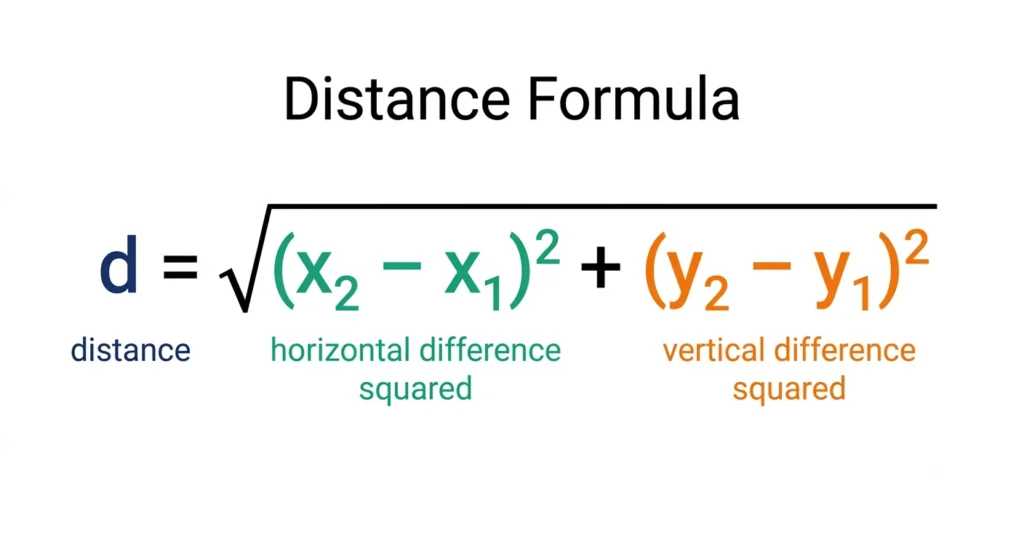
d = √[(x₂ − x₁)² + (y₂ − y₁)²]
Here’s what each part means:
- d is the distance you’re solving for
- (x₁, y₁) are the coordinates of your first point
- (x₂, y₂) are the coordinates of your second point
- The square root wraps around the whole calculation
The order in which you label your two points as “first” and “second” doesn’t matter. Because you’re squaring the differences, any negative signs disappear. You’ll get the same distance either way.
Example 1: Simple Coordinates
Find the distance between point A at (1, 1) and point B at (4, 5).
Step 1: Identify the coordinates. x₁ = 1, y₁ = 1, x₂ = 4, y₂ = 5.
Step 2: Subtract the x values. 4 − 1 = 3.
Step 3: Subtract the y values. 5 − 1 = 4.
Step 4: Square each result. 3² = 9 and 4² = 16.
Step 5: Add them together. 9 + 16 = 25.
Step 6: Take the square root. √25 = 5.
The distance between A and B is exactly 5 units. You can check this intuitively: those numbers (3, 4, 5) form a Pythagorean triple, a classic right triangle.
Example 2: Slightly Harder Coordinates
Find the distance between point C at (2, 3) and point D at (7, 7).
Step 1: x₁ = 2, y₁ = 3, x₂ = 7, y₂ = 7.
Step 2: 7 − 2 = 5.
Step 3: 7 − 3 = 4.
Step 4: 5² = 25 and 4² = 16.
Step 5: 25 + 16 = 41.
Step 6: √41 is approximately 6.4.
The distance is about 6.4 units. Not a whole number this time, and that’s completely normal.
Most distance formula answers come out as decimals or square roots that don’t simplify to clean whole numbers.
Real-Life Applications of the Distance Formula
The distance formula isn’t just an abstract math exercise.
It shows up constantly in the real world, often in tools you probably use every day.
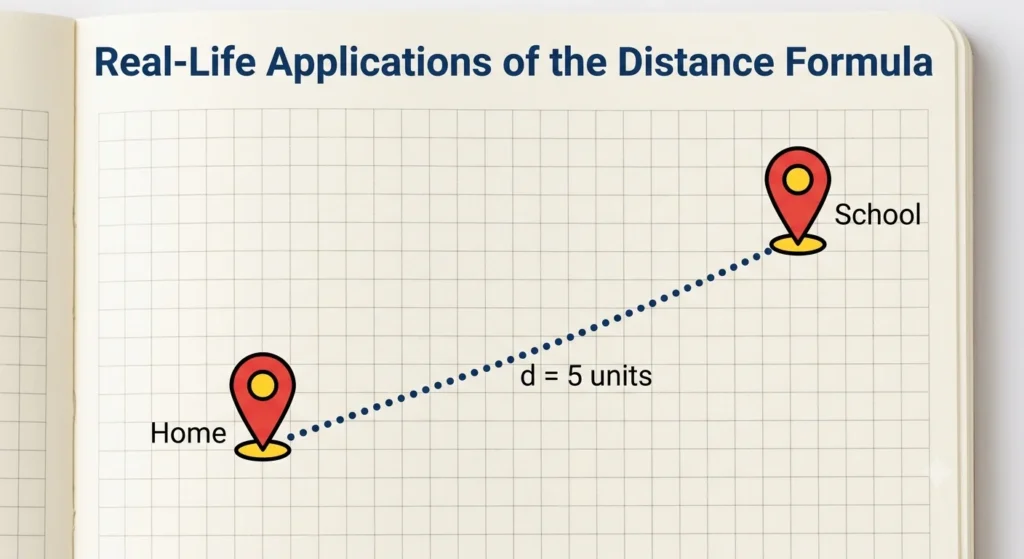
Maps and navigation use this idea every time an app calculates the straight-line distance between two locations. GPS systems work by finding your position as a point and then measuring distance to the nearest satellites or signals.
Video games rely on distance calculations constantly. Whenever a game checks whether two characters are close enough to interact, or whether a player is within range of an obstacle, it’s often using a version of the distance formula behind the scenes.
Architecture and design use coordinate geometry to lay out measurements on blueprints and calculate diagonal spans across rooms or structural supports.
Once you know how to use the distance formula, you start seeing geometry in the physical world rather than just on paper.
You can also explore how geometrical shapes connect to real-world patterns to build on this spatial thinking.
Common Mistakes Students Make
Even once you understand the formula, a few small errors tend to come up repeatedly.
Here are the most common ones to watch for.
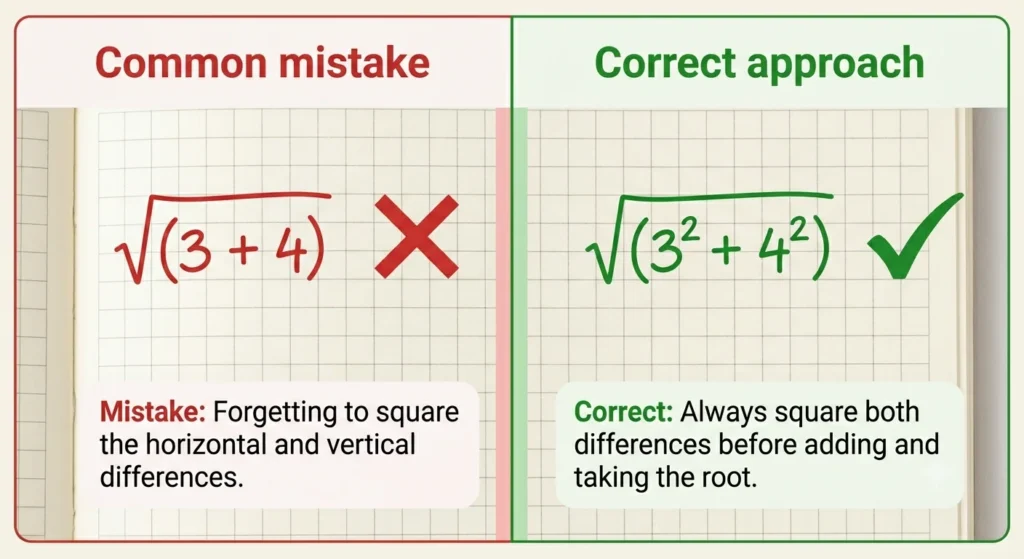
Subtracting in the wrong direction. Some students subtract x₁ from x₂ for one pair and then accidentally reverse it for the y values.
It doesn’t change the final answer because you’re squaring the result anyway, but keeping it consistent helps you stay organized and avoids arithmetic errors.
Forgetting to square the differences. It’s easy to subtract 4 − 1 and get 3, then write just 3 under the square root instead of 3². Always square both differences before adding.
Forgetting the square root. The formula ends with a square root. Some students do everything correctly and then present the answer as the sum inside the root sign rather than the square root of that sum. The square root is what gives you the actual distance.
Using the wrong coordinates for each variable. When you label your points, assign x₁ and y₁ together from the same point, and x₂ and y₂ together from the other.
Mixing a y from one point with an x from another will give you the wrong answer.
Tips for Remembering and Using the Formula
The best way to remember the distance formula is to remember where it comes from. Every time you see two points on a grid, picture the right triangle hiding between them.
The distance is the hypotenuse, the two legs are the differences in coordinates, and the Pythagorean Theorem does the rest.
A few practical tips that help:
Write out the formula and label every part before you plug in any numbers. This slows you down in a good way and reduces arithmetic mistakes.
Sketch the two points on a small grid, even a rough one, before solving. Seeing the triangle visually helps you catch errors.
When the answer doesn’t simplify to a whole number, leave it as a square root unless the question asks for a decimal. √41 is a perfectly correct answer.
Practice Questions with Solutions
Try these on your own, then check the solutions below.
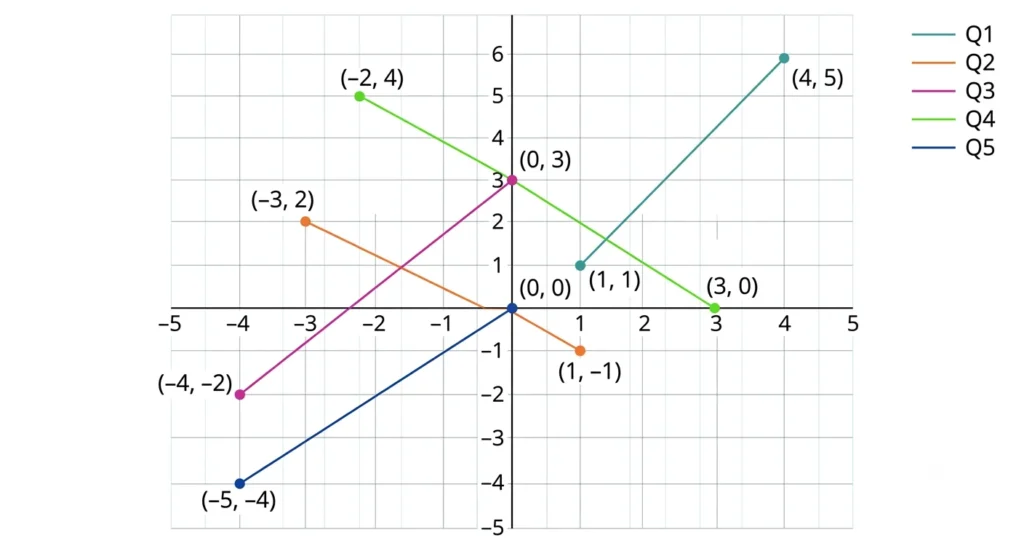
Question 1. Find the distance between (0, 0) and (3, 4). Solution: √(3² + 4²) = √(9 + 16) = √25 = 5
Question 2. Find the distance between (2, 1) and (6, 4). Solution: √((6−2)² + (4−1)²) = √(16 + 9) = √25 = 5
Question 3. Find the distance between (1, 2) and (5, 5). Solution: √((5−1)² + (5−2)²) = √(16 + 9) = √25 = 5
Question 4. Find the distance between (0, 3) and (4, 0). Solution: √(4² + 3²) = √(16 + 9) = √25 = 5
Question 5. Find the distance between (1, 1) and (4, 7). Solution: √((4−1)² + (7−1)²) = √(9 + 36) = √45 ≈ 6.7
How the Distance Formula Connects to Future Math
Mastering how to find distance between two points on a graph is a foundational skill.
Once you’re comfortable here, you’re ready for a wide range of more advanced topics.
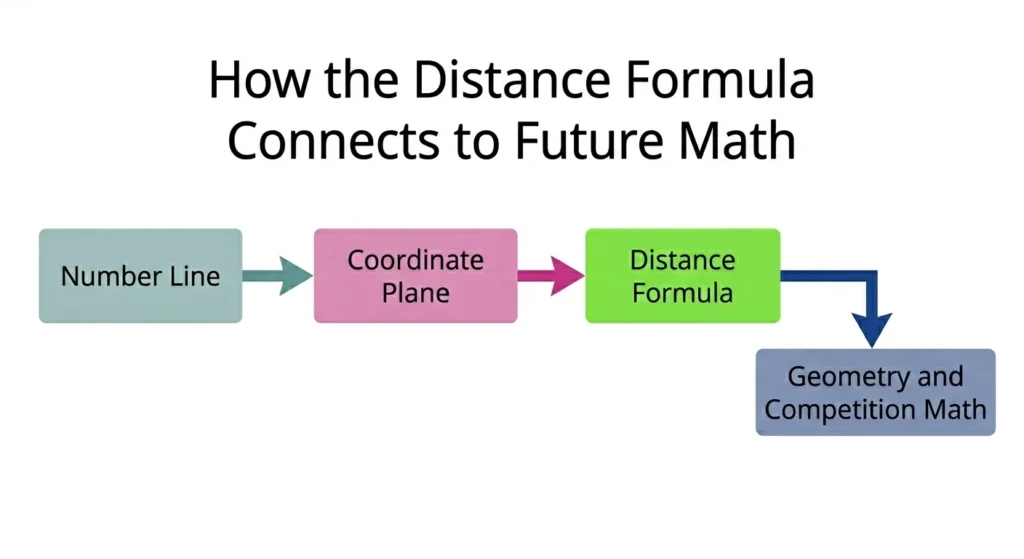
In higher geometry, the distance formula helps you understand circles (the set of all points a fixed distance from a center), midpoints, and coordinate proofs.
In coordinate geometry for beginners, this formula is often the first step into analytic geometry, where algebra and geometry come together.
Students working through Class 8 topics like factorisation in maths will find that fluency with algebraic methods, including the distance formula, carries across many areas of the curriculum.
For students preparing for competition math and Math Olympiad problems, fluency with coordinate geometry is essential.
Many contest problems involve placing figures on a coordinate plane and using distance relationships to find lengths, prove congruence, or calculate areas. Building strong intuition now makes those later problems far more approachable.
You can explore what those problems look like in our guide to Math Olympiad questions, or see how the AMC syllabus incorporates coordinate geometry in our AMC syllabus overview.
What is the distance formula in geometry?
The distance formula in geometry is a calculation used to find the exact straight-line length between two points on a coordinate plane. It is written as d = √[(x₂ − x₁)² + (y₂ − y₁)²] and is derived directly from the Pythagorean Theorem.
How do I use the distance formula step by step?
Start by identifying the coordinates of your two points. Subtract the x values and square the result. Subtract the y values and square that result. Add the two squared values together. Take the square root of that sum. The result is the distance.
Why does the distance formula use a square root?
Because the distance formula comes from the Pythagorean Theorem (a² + b² = c²), and solving for c, the hypotenuse, requires taking the square root of both sides. The square root converts the sum of squared differences back into a single length.
What is the difference between the distance formula and the Pythagorean Theorem?
They are essentially the same idea. The Pythagorean Theorem describes the relationship between the sides of a right triangle. The distance formula applies that same relationship to two points on a coordinate grid, treating the horizontal and vertical gaps as the legs of a hidden right triangle.
Can the distance formula give a negative answer?
No. Because both differences are squared before being added, the value inside the square root is always zero or positive. The square root of a positive number is always positive, so distances are always zero or greater.
Make Preparing for Math Olympiad Simple!



Conclusion
The distance formula in geometry is one of those ideas that looks intimidating on paper but makes complete sense once you see the right triangle hiding between two points.
It comes directly from the Pythagorean Theorem, it works on any two coordinates, and it becomes second nature with a little practice.
The next step is to try the practice questions in this guide, sketch the triangle for each one, and notice how quickly the method starts to feel natural.