 June 17, 2026
 21 min. read

Visual reasoning for kids is the cognitive ability to analyze, process, and mentally manipulate visual information, shapes, patterns, and images, to solve problems without relying on words.
Visual reasoning for kids is a foundational skill that supports success in math, problem-solving, reading, and STEM learning.
In this guide, you’ll learn what visual reasoning is, why it matters, and how to develop it through simple, engaging activities at home or in the classroom.
No jargon. No flashcards. Just practical, evidence-informed ideas you can start using today.
What is Visual Reasoning for Kids?
Visual reasoning is the ability to look at visual information, shapes, patterns, images, and spatial arrangements, and use that information to think, compare, and solve problems.
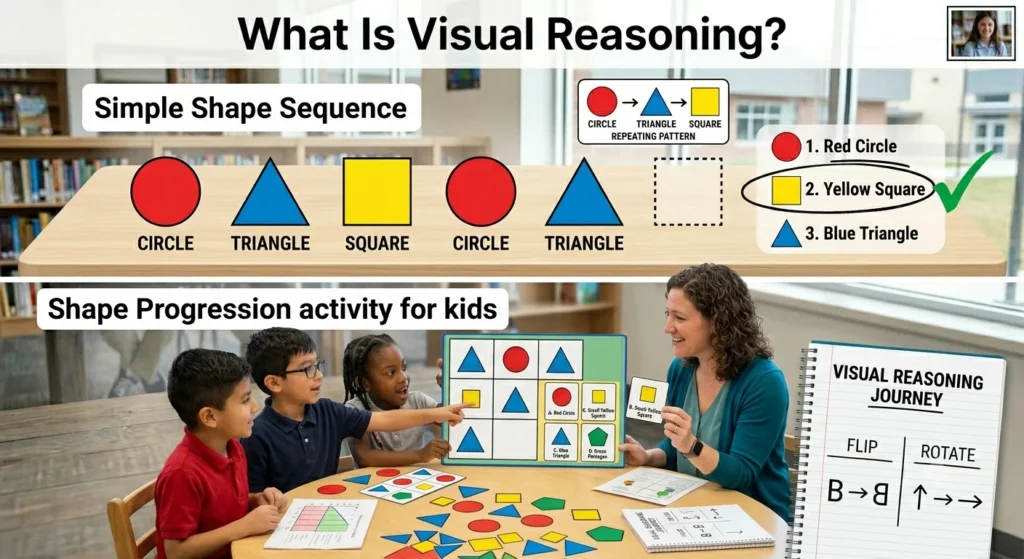
It’s not just about seeing. It’s about making sense of what you see.
When a child looks at a sequence of shapes and figures out what comes next, that’s visual reasoning.
When they realise one of these objects doesn’t belong with the others, that’s visual reasoning. When they imagine how a folded piece of paper will look when unfolded, that’s visual reasoning too.
Unlike verbal reasoning (which relies on language and words), visual reasoning works through images, patterns, and spatial relationships.
It’s sometimes called non-verbal reasoning, and it plays out constantly in everyday life: sorting laundry by colour, reading a map, understanding a graph, or navigating a new place.
Here’s a simple definition worth bookmarking:
Visual reasoning for kids = the ability to observe, interpret, and mentally manipulate visual information to understand patterns, make comparisons, and solve problems.
This definition covers a surprisingly wide range of skills, from spotting that two shapes are mirror images of each other, to predicting what a sequence will look like three steps later.
Why Visual Reasoning Skills Matter More Than You Think
Most parents focus on reading and maths when thinking about school readiness. Visual reasoning tends to get overlooked. That’s a mistake.
Here’s why visual reasoning matters, not just in school, but in real life:
It builds the foundation for mathematical thinking. Before children learn numbers formally, they learn to compare sizes, sort objects, and notice patterns.
These are all visual reasoning skills. Research consistently shows that strong spatial and visual reasoning in early childhood predicts better maths performance later.
It supports reading comprehension. Understanding the sequence of a story, interpreting diagrams, decoding charts; all of these depend partly on visual processing skills.
Children who struggle with visual reasoning often struggle to interpret what they read, even when their decoding is fine.
It develops problem-solving ability. Real-world problems rarely come with words. A child figuring out how to fit toys into a box, or why their LEGO model isn’t matching the picture, is doing applied visual problem-solving. This kind of thinking is more transferable than rote memorisation.
It’s the language of STEM. Engineers, architects, scientists, surgeons, coders; they all use visual and spatial reasoning every single day.
Building this skill early gives children a real advantage in any technical field.
It boosts confidence. Children who develop strong visual reasoning skills often find pattern-based and logical tasks more approachable.
That builds confidence across all kinds of learning.
The good news: visual reasoning is not fixed. It’s a trainable skill. Every activity, game, and puzzle your child engages with is actively developing their visual brain.
How Visual Reasoning Develops in Children
Visual reasoning doesn’t appear overnight.
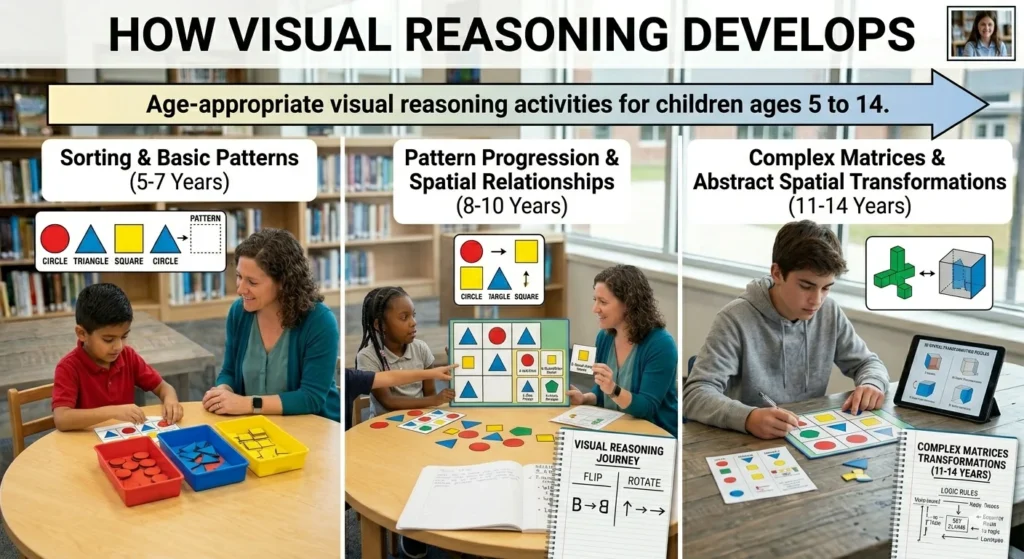
It develops in stages, and the activities that suit a 6-year-old will look completely different from those that challenge a 12-year-old. Here’s a rough developmental map.
Early Learners (Ages 5–7)
At this stage, children are just beginning to notice visual similarities and differences. They can match identical shapes, sort objects by colour and size, and complete very simple patterns (red, blue, red, blue…).
Their visual memory is short, and they need concrete, hands-on materials; physical objects work much better than abstract symbols at this age.
Key skills emerging: shape recognition, colour and size sorting, basic pattern completion, matching identical objects, simple sequencing.
Mid-Level Learners (Ages 8–10)
Children at this stage can work with more abstract visual information. They can identify more complex repeating patterns, understand rotation and reflection of shapes, and begin to reason about spatial relationships (what fits where, which shape is the “odd one out”).
They can hold visual information in working memory for longer, which opens up more complex puzzles.
Key skills emerging: pattern extension, reflection and rotation of shapes, object classification by multiple attributes, visual analogy (A is to B as C is to ___), reading diagrams and charts.
Advanced Learners (Ages 11–14)
At this stage, visual reasoning becomes more abstract and logical. Children can mentally manipulate 3D objects, interpret complex diagrams, work with overlapping patterns, and solve multi-step visual problems.
They’re ready for non-verbal reasoning tests, matrix puzzles, and visual logic challenges, including the kinds of spatial and pattern problems found in math olympiad questions.
Key skills emerging: 3D spatial reasoning, complex pattern matrices, visual deduction, mental rotation, embedded figures, and logical sequencing across multiple steps.
The Four Core Visual Reasoning Skills
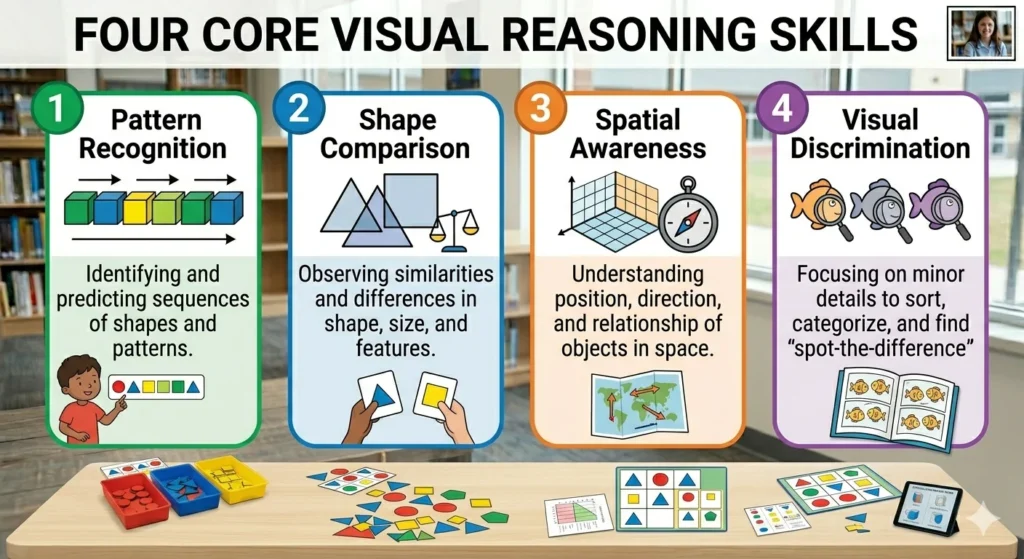
Visual reasoning isn’t a single ability. It’s a cluster of related skills that develop together.
Understanding these helps you choose the right activities for your child.
1. Pattern Recognition
The ability to notice that things repeat, progress, or relate to each other in a consistent way. Pattern recognition is the bedrock of mathematical thinking.
A child who can spot that triangles are getting bigger by one unit each step is already doing early algebraic reasoning.
You can see this skill in action with something as simple as alphabet patterns for class 1, where children learn to continue and predict sequences.
2. Shape and Object Comparison
The ability to look at two or more shapes or images and identify similarities and differences; size, orientation, colour, detail, or number of sides.
This skill underpins visual discrimination, classification, and analogy tasks.
A strong grounding in geometrical shapes for grade 1 gives children the vocabulary they need to describe and compare what they see.
3. Spatial Awareness
The ability to understand where objects are in relation to each other, and how they’d look if moved, rotated, or reflected.
Spatial awareness is closely linked to geometry and is critical for understanding maps, diagrams, and physical design.
A dedicated focus on spatial understanding for class 1 builds this foundational layer early.
4. Visual Discrimination
The ability to spot subtle differences between similar images or patterns. This is the “spot the difference” skill; noticing that one shape has an extra side, or that one face in a group is facing a different direction.
Visual discrimination builds attention to detail and precision, and activities like odd one out for class 1 are a direct, ready-to-use entry point.
Visual Reasoning Activities for Kids at Home
The best way to build visual reasoning skills is through play, not worksheets.
Here are activities for each developmental stage, using materials you probably already have at home.
Simple Observation Games (Ages 5–7)
Sock Sort: Tip a basket of clean, unmatched socks onto the floor. Ask your child to find pairs. To make it harder, include near-identical socks with tiny differences (different toe colour, slightly different stripe).
This builds visual discrimination, spotting subtle differences between similar objects.
Pattern Walks: On any walk, challenge your child to find five patterns. Brick walls, garden railings, leaf shapes, pavement tiles; patterns are everywhere. Ask: “What comes next?” or “What’s the rule here?”
This makes visual reasoning a habit, not a task.
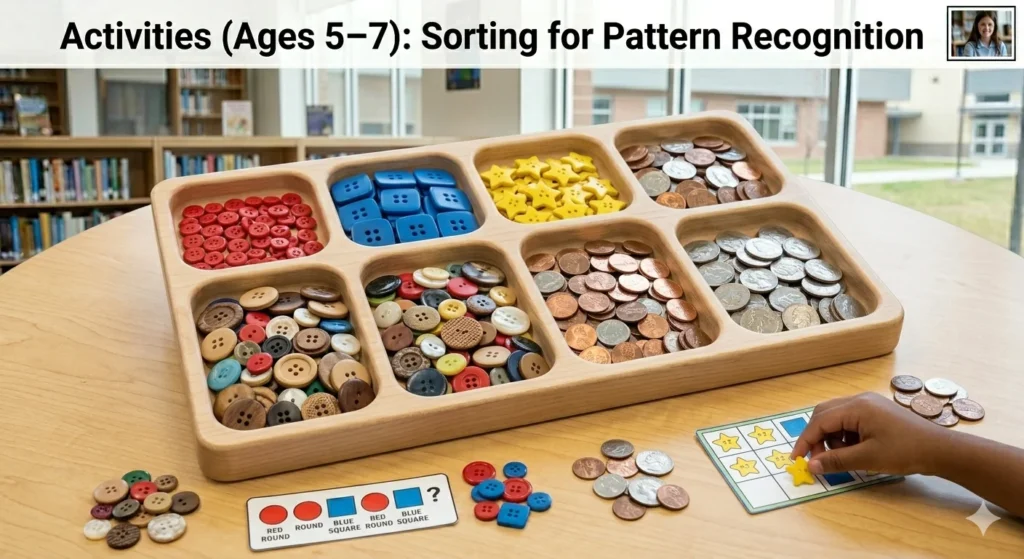
Shape Sorting Trays: Use an ice cube tray and a collection of small household objects; buttons, coins, clips, beans. Ask children to sort by one rule (colour, shape, size), then two rules at once.
Combining attributes is a key early visual reasoning skill.
Copy the Pattern: Lay out a simple pattern using coloured blocks, stickers, or coins. Ask your child to copy it exactly, then extend it. This builds visual memory and sequencing.
Mirror Magic: Hold a small mirror against a simple drawing. Ask: “What does it look like? Is it the same or different?” This introduces the concept of reflection in a concrete, tactile way.
Pattern-Building Activities (Ages 7–10)
Grid Patterns: Draw a 4×4 grid. Fill in some squares to create a simple pattern; diagonal, checkerboard, or L-shape. Ask your child to fill in the rest by continuing the rule. Progress to 6×6 grids with more complex patterns.
Tangrams: A tangram is a set of seven geometric shapes that fit together to form hundreds of different images. They’re inexpensive, endlessly reusable, and build both spatial awareness and shape reasoning.
Challenge children to build a given shape, then create their own.
Odd One Out Sets: Prepare groups of four objects or drawings; three that share a hidden rule, one that doesn’t. “Which one doesn’t belong? Why?” The “why” is the important part.
It forces children to articulate their visual reasoning verbally, reinforcing the skill.
Flip or Turn? Draw a simple asymmetric shape on paper. Ask your child to draw what it would look like flipped horizontally, flipped vertically, or rotated 90°.
Check by folding or turning the paper. This is a hands-on introduction to mental rotation.
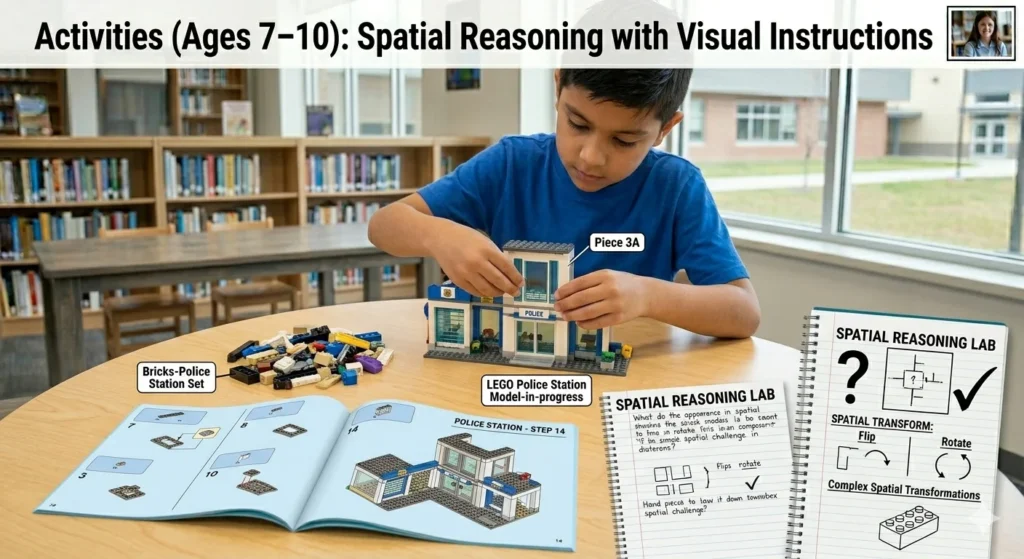
LEGO Challenges: Show a picture of a simple LEGO model and ask your child to build it using only the pieces in a limited selection. This requires spatial problem-solving, trial and error, and 3D visual thinking.
Spatial Reasoning Challenges (Ages 8–12)
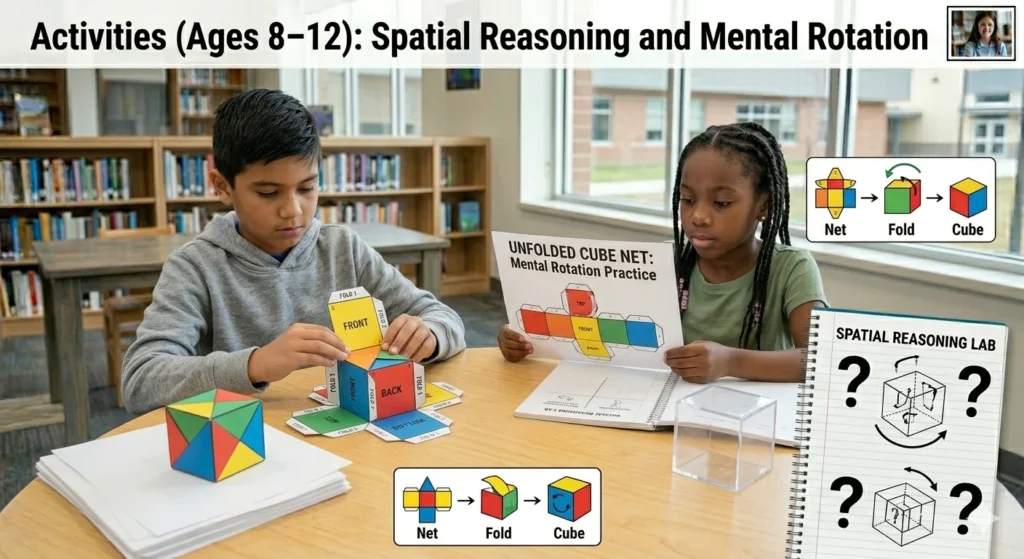
Map Drawing: Ask your child to draw a bird’s-eye-view map of their bedroom, the garden, or their route to school. This requires understanding of spatial relationships, scale, and perspective; real-world spatial reasoning.
Paper Folding: Fold a piece of paper in half, then half again. Make a single hole-punch in one corner. Ask: “When we unfold it, how many holes will there be, and where?”
Let children predict, then unfold to check. This builds mental rotation and spatial prediction skills.
Shadow Matching: On a sunny day, take objects outside and ask children to match the object to its shadow from a set of options. Rotate the object and ask which shadow now matches. Simple, free, and surprisingly challenging.
Net Challenges: Show a child a flat net (a cross-shaped arrangement of squares, like an unfolded box). Ask: “If you fold this up, what 3D shape does it make?”
Then show several nets and ask which one folds into a cube. This is a classic spatial reasoning challenge used in competitive maths.
Floor Plan Design: Give your child a sheet of squared paper and ask them to design a floor plan for their dream bedroom, or a classroom, using a fixed number of squares for each item.
This combines spatial reasoning, measurement thinking, and creative problem-solving.
Advanced Visual Puzzles (Ages 10–14)
Matrix Puzzles: These are grids (usually 3×3) where each row and column follows a visual rule. Raven’s Progressive Matrices are a classic example.
The child must figure out the missing piece in the bottom-right corner. Free examples are widely available online and in non-verbal reasoning workbooks.
Embedded Figures: Show a complex image, then ask the child to find a simple shape hidden within it. The pentagon inside the architecture diagram. Higher-level attention:
The triangle inside the star. This test visual discrimination and attention at a higher level.
Analogy Grids: These tasks follow the structure: “Shape A is to Shape B as Shape C is to ___?” Visual analogies require children to identify the rule connecting two shapes (one is a rotated version, one is missing a segment, etc.) and apply it to a new pair.
For a broader look at this type of reasoning, math analogies for kids cover the concept across numerical and visual formats.
Isometric Drawing: Drawing 3D shapes on dot paper (isometric grid) develops the ability to mentally represent and communicate 3D objects in 2D.
It’s used in engineering and design education and builds strong spatial reasoning.
Cipher Maps: Create a simple grid key; e.g. black circle = 1, white circle = 2, triangle = 3. Give children a coded message using the shapes and ask them to decode it. This adds a logical dimension to visual pattern work.
Visual Reasoning in the Classroom
Teachers have a natural advantage: a classroom is full of opportunities to weave visual reasoning into everyday lessons.
Morning Pattern: At the start of each day, display a visual pattern on the board; simple for early learners, complex for older students, and ask a child to identify the rule or complete the sequence. This takes two minutes and builds pattern recognition as a daily habit.
Sorting Centres: Set up a table with collections of objects (buttons, shapes, natural materials) and rotating sorting challenges. Each week, change the sorting rule. This keeps the activity fresh and progressively builds classification skills.
Visual Maths: Whenever possible, represent maths problems visually. Arrays for multiplication. Fraction bars for fractions. Coordinate grids for early algebra. Connecting visual and numerical representations deepens both skills simultaneously.
Diagram Discussions: Before asking students to interpret a diagram or graph, ask: “What do you notice first? What’s the same? What’s different?” Building observation habits before analysis reduces the guessing that many children resort to.
Spot the Change: Display a drawing on the board. While children close their eyes (or turn around), change one thing. Children must identify what changed. This is visual memory and attention to detail in a no-pressure, game-format context.
Classroom Orienteering: Ask children to navigate between locations in the school using a simple map you’ve drawn. Making maps and reading maps both develop spatial reasoning, and it gets children out of their seats.
Beyond Worksheets: Real-Life Visual Thinking Activities
Worksheets have their place, but visual reasoning flourishes most in the real world.
Here are everyday situations you can turn into visual thinking moments.
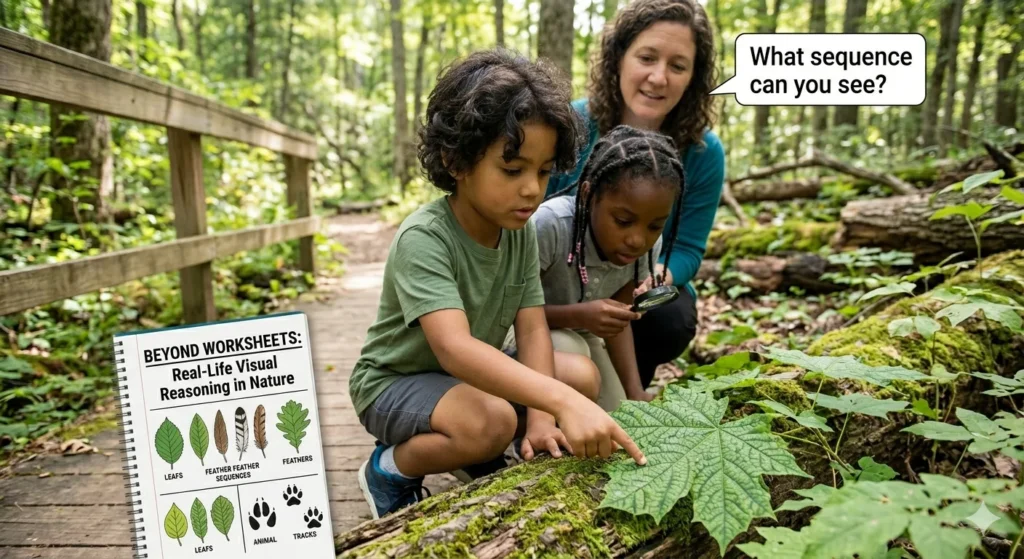
At the supermarket: Ask your child to find items by shape; “which tins are cylindrical? Which boxes are cubes?” Sort the shopping bag by size and shape.
Spot the odd one out on the shelf display. Real-world visual discrimination, no worksheet needed.
In the kitchen: Cooking is full of visual reasoning. Measuring involves spatial understanding. Cutting vegetables into equal portions requires visual comparison.
Recognising which container the food will fit into before pouring is a classic spatial reasoning task.
In nature: Leaves, shells, flowers, and insects are covered in patterns, symmetry, and visual structure. Asking a child “does this leaf have a line of symmetry?” or “what pattern do you see in this shell spiral?” connects visual reasoning to the natural world.
In art: Drawing, collage, and craft naturally develop spatial awareness and visual comparison. Ask a child to reproduce a simple image freehand; the act of looking carefully and translating what they see is a powerful visual reasoning exercise.
On the street: Brickwork, tile patterns, building facades, road markings; the built environment is a treasure trove of visual patterns. “Can you find a repeating pattern?” becomes a habit of observation rather than a formal task.
The key shift is from “let’s do a visual reasoning worksheet” to “let’s look at the world with visual reasoning eyes.” Once children develop that habit, the skill builds continuously.
How Visual Reasoning Connects to Math and Reading
Visual reasoning isn’t a separate subject. It’s deeply woven into core academic skills.
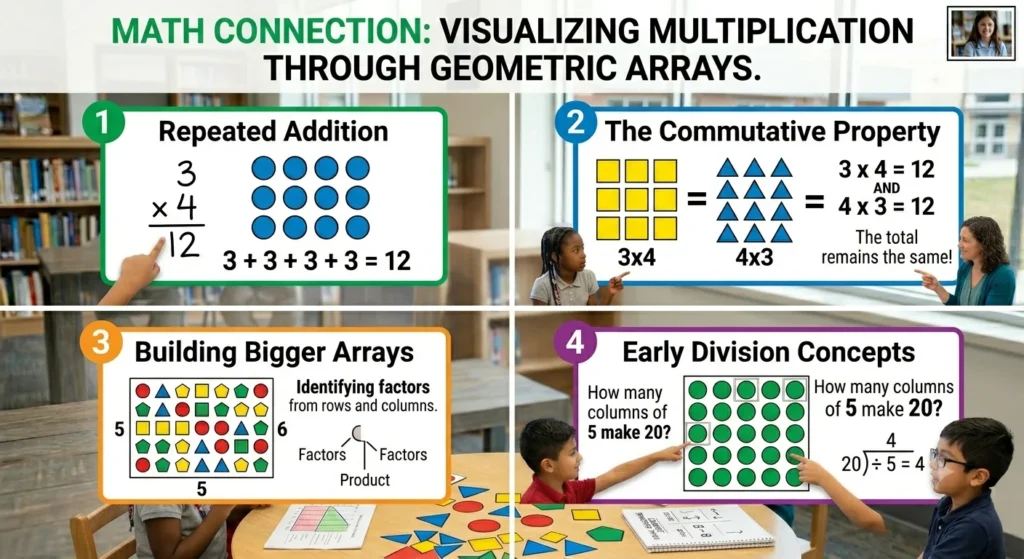
In mathematics:
- Number sense: Understanding that five objects arranged in a line is the same quantity as five objects clustered together is a visual reasoning insight.
- Geometry: Entirely dependent on visual reasoning; symmetry, congruence, area, angles, transformations.
- Data interpretation: Reading graphs, interpreting tables, and understanding probability diagrams all require visual processing.
- Algebra: Pattern recognition, the heart of algebra, is a visual reasoning skill applied to numbers.
- Problem-solving: Drawing diagrams and visual representations is one of the most powerful strategies for tackling word problems for kids. Children who visualise problems solve them more successfully. Building this habit early also feeds directly into improving problem-solving skills for competitive maths.
In reading and literacy:
- Story sequencing: Understanding narrative order requires the same mental sequencing that pattern recognition builds.
- Diagram comprehension: Science and geography texts are packed with visual information. Children who struggle with visual processing often miss content carried in diagrams, maps, and charts.
- Letter recognition: Early reading depends on visual discrimination; distinguishing d from b, p from q, was from saw. These confusions are fundamentally visual reasoning failures.
- Reading fluency: Some research suggests that poor visual processing speed affects how quickly and accurately children decode written text.
When you build visual reasoning through play, you’re not just building a puzzle skill. You’re building the cognitive infrastructure that supports learning across the curriculum.
Common Mistakes Children Make in Visual Reasoning Tasks
Understanding where children typically go wrong helps you respond with the right support, not frustration.
Rushing past observation. Many children jump straight to answering before they’ve really looked. They scan rather than observe.
The fix: encourage children to spend 10–15 seconds just looking before they attempt an answer. Narrating what they see out loud helps slow this down.
Fixating on one feature. A child might notice that all the shapes are circles and miss that one of them has a different fill.
They’re looking, but not looking at everything. Teach them to check multiple attributes: shape, size, colour, orientation, and number of sides.
Struggling with rotation. Mental rotation is hard, especially for younger children. Many will rotate the paper rather than rotate the image in their mind. That’s fine to start with.
The goal is gradually to internalise the rotation. Using physical objects that you can actually rotate builds the skill first, then paper-based tasks can transfer it.
Confusing reflection and rotation. These look similar but follow different rules. Use a small mirror to demonstrate reflection.
Use a spinner or turntable to demonstrate rotation. The distinction becomes clearer with physical demonstration than with verbal explanation.
Not trusting their intuition. Some children second-guess themselves constantly, even when their initial visual impression is correct.
Reassure them that visual reasoning is partly intuitive. Confidence in pattern recognition often just needs encouragement and successful repetition.
Giving up on complex patterns. When a pattern has more than one rule operating simultaneously (e.g., size increasing while colour alternates), children often freeze.
Break complex patterns into single-rule analysis first: “What’s happening with the size? Now, separately, what’s happening with the colour?”
Tips for Parents and Teachers: How to Guide Visual Learning
The way you guide visual reasoning tasks matters as much as the tasks themselves.
These principles also connect to critical thinking activities for grade 1, where the same observation-first approach underlies strong analytical habits.
Ask “What do you notice?” before “What’s the answer?” Observation is the foundation of visual reasoning. Building the habit of noticing before evaluating is one of the most valuable teaching moves you can make.
Think aloud. When you model a visual reasoning task, narrate your own thought process. “I can see the shapes are getting bigger from left to right. So the missing one should be bigger than this one.
And it has to be the same shape as the others, so…” Children learn visual thinking strategies by hearing them, not just by doing.
Celebrate the process, not just the answer. “I loved how you checked each feature one by one” is more useful than “That’s right!” It names the strategy and reinforces it for next time.
Tolerate mistakes productively. When a child gives a wrong answer, ask: “Tell me what you were thinking.” Often they spotted something real but made a small error in reasoning. Understanding their process is far more valuable than marking the answer wrong and moving on.
Keep difficulty just ahead of comfort. Vygotsky called this the zone of proximal development; activities should be challenging enough to stretch the child but achievable enough to maintain confidence.
If every activity is too easy, there’s no growth. If every activity is too hard, there’s no confidence. Aim for a success rate of roughly 70–80%.
Don’t over-explain. Resist the urge to explain the rule before the child attempts to find it. Give them time to struggle productively; that’s where actual learning happens. Step in only when they’re genuinely stuck, not just initially uncertain.
Use concrete before abstract. Physical objects before drawn shapes. Real patterns before symbolic ones. 2D before 3D. Hands-on before pencil-and-paper. Always.
How to Improve Attention to Detail in Young Learners
Attention to detail is both a prerequisite for visual reasoning and an outcome of practising it.
Here are specific strategies to build it.
Slow observation games. Place five objects on a tray. Give your child 30 seconds to look. Remove the tray. Ask: “What was on it? Can you describe each one in detail?” This isn’t just a memory game; it trains careful, deliberate looking.
“What changed?” Set up a scene with toys or objects. Ask your child to close their eyes. Make one small change. Ask them to identify it. Progress to making two changes, then three.
Detailed drawing. Ask children to draw an object from observation; a leaf, a shoe, a fruit. The act of drawing forces careful visual attention. Compare their drawing to the object: “What did you notice? What did you miss?”
Spot the difference. Classic, but effective. Start with obvious differences, progress to subtle ones. Add a time limit for older children to add challenge.
Sorting by subtle differences. Give children a set of shapes where the differences are small; slightly different sizes, slightly different number of dots, slightly different shades. Sorting these develops fine-grained visual discrimination.
The goal isn’t perfection; it’s the habit of looking carefully before acting.
What is visual reasoning in simple terms for kids?
Visual reasoning is the ability to use pictures, shapes, and patterns to think and solve problems. It’s what you use when you figure out which shape comes next in a sequence, or when you spot the odd one out in a group of images.
At what age do children start developing visual reasoning skills?
Children start developing basic visual reasoning skills from infancy; noticing shapes, faces, and patterns. By age 5–6, most children can match shapes, complete simple patterns, and sort objects by two attributes. More complex spatial reasoning develops through ages 8–12 and beyond.
What’s the difference between visual reasoning and spatial reasoning?
Spatial reasoning is a component of visual reasoning. Visual reasoning is the broader skill of interpreting visual information to think and problem-solve. Spatial reasoning specifically involves understanding the position, movement, and relationship of objects in space, like imagining how a shape will look when rotated.
Are visual reasoning skills related to IQ?
Visual reasoning tasks appear in many IQ tests because they measure abstract thinking independent of language. But strong visual reasoning doesn’t require a high IQ, and it can be significantly improved with practice. It’s better understood as a trainable cognitive skill than an innate fixed trait.
How can I tell if my child is struggling with visual reasoning?
Signs to watch for include: difficulty completing jigsaw puzzles or pattern sequences; frequent letter reversals in reading and writing (past age 7); trouble reading maps or diagrams; difficulty with geometry or shape-based maths tasks; frequently getting lost in familiar places. These can all signal visual processing or visual reasoning difficulties worth addressing.
What are the best visual reasoning activities for kids aged 5–7?
For this age group, the most effective activities are hands-on and concrete: sorting objects by colour, shape, and size; copying and extending simple patterns with physical blocks; playing “spot the difference” with simple images; shape matching games; and pattern walks in the real world. Keep activities short (10–15 minutes), playful, and free from test-like pressure.
Can visual reasoning be taught at home without special materials?
Absolutely. Everyday household objects, such as socks, buttons, coins, blocks, and kitchen containers, provide everything you need for sorting, pattern, and spatial activities. Real-world environments (the garden, the kitchen, the street) offer natural pattern and spatial reasoning opportunities. The most important resource is a curious, questioning adult, not specialised materials.
Make Preparing for Math Olympiad Simple!



Conclusion
Visual reasoning is one of those foundational skills that quietly shapes everything; how children crack geometry, how they navigate physical spaces, how they make sense of information that isn’t in words.
It’s the cognitive engine behind early STEM success, and it’s trainable.
Every pattern walk, every sorting game, every folded piece of paper is a small investment in a skill that pays off across maths, reading, and problem-solving for years to come.
The earlier you start, the more natural it becomes. And the best way to build it? Don’t make it a lesson. Make it a habit of looking.