 June 16, 2026
 21 min. read

Critical thinking for kids is the ability to analyze information, ask questions, and solve problems independently rather than simply accepting things at face value.
It teaches children to think like detectives: seeking evidence, identifying bias, and making well-reasoned decisions before drawing conclusions.
Many children learn to memorize answers but not how to think independently.
This guide on critical thinking for kids provides practical strategies, age-appropriate activities, and simple techniques for parents and teachers to help children develop reasoning, problem-solving, and independent thinking skills.
What Is Critical Thinking for Kids?
Critical thinking is the ability to think clearly and rationally about what to do or what to believe.
For children, that means more than being smart or getting good grades.
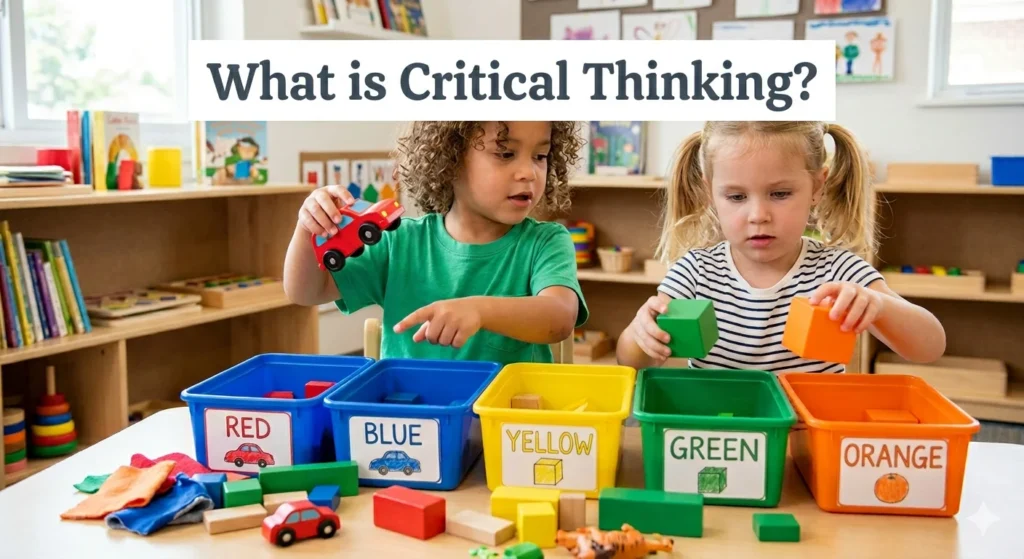
It means asking questions, examining evidence, noticing assumptions, and arriving at conclusions through reasoning not just repetition.
A simple definition for kids: Critical thinking is the habit of asking “why?” and “how do I know?” before accepting something as true.
It’s not about being skeptical of everything. It’s about being curious, careful, and open to revising your thinking when new information arrives.
In practice, a child using critical thinking might:
- Ask why a rule exists instead of just following it blindly
- Compare two explanations before deciding which makes more sense
- Notice when a story they’ve read doesn’t quite add up
- Weigh the pros and cons before making a choice
These aren’t extraordinary behaviors. With the right environment, they become habits.
Why Critical Thinking Matters More Than Ever
Children today are growing up in a world flooded with information, much of it unreliable.
Social media, AI-generated content, and algorithmic feeds all serve up ideas that feel convincing but may not hold up under scrutiny.
The child who can evaluate a claim who can pause and ask “does this actually make sense?” has a significant advantage. Not just academically, but in life.
Beyond that, critical thinking supports:
- Better decisions – at every stage of life, from small daily choices to major ones
- Stronger relationships – because understanding others’ perspectives requires reasoning, not just reaction
- Resilience – children who think critically are better at problem-solving when things go wrong
- Academic performance – across subjects, not just language arts or philosophy
- Independence – the ability to figure things out without always needing an adult’s answer
The research is clear: reasoning skills developed in childhood compounds over time. A child who practices them at age seven will be a sharper thinker at seventeen.
Critical Thinking vs. Memorization vs. Creativity
These three get confused often. Let’s separate them.
Memorization is storing information. Children need a foundation of facts. But knowing that the capital of France is Paris doesn’t mean a child can reason about why capital cities exist, or what makes a city important. Memorization is a tool. Critical thinking is what you do with it.
Creativity is generating new ideas. It’s about possibility and imagination. Critical thinking, by contrast, is about evaluating ideas asking which ones are sound, which are flawed, and why. The two work beautifully together: creativity produces ideas, critical thinking refines them.
Critical thinking is the process in the middle. It takes what memory provides and what creativity imagines, and asks: Is this true? Is this useful? Does this hold up?
A child who memorizes well without thinking critically might ace a test but struggle to apply the knowledge in a new context.
A creative child without critical thinking might generate exciting ideas that fall apart under examination.
The goal is to develop all three but critical thinking is the connector that makes the other two powerful.
How Critical Thinking Develops at Different Ages
Critical thinking isn’t a single skill that switches on at a certain age.
It develops gradually, with different capacities emerging at different stages.
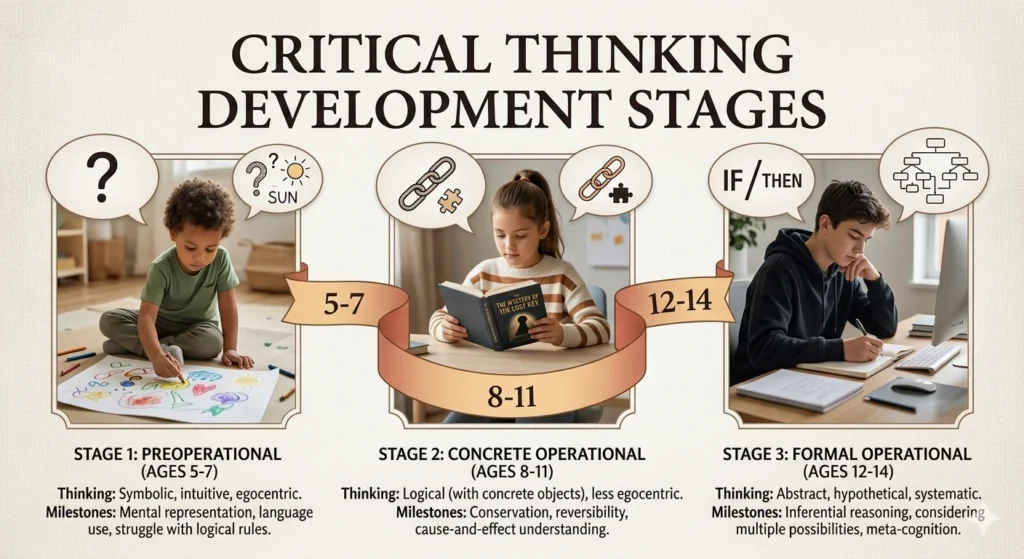
Here’s what to look for and nurture at each stage.
Ages 5–7: Wondering and Noticing
At this age, children are naturally curious. They ask “why” constantly and that’s exactly the right instinct.
The critical thinking work at this stage is about keeping that curiosity alive and helping children begin to notice the world carefully.
Children aged 5–7 are learning to:
- Observe and describe what they see
- Notice similarities and differences
- Follow simple logical sequences (“if this, then that”)
- Ask questions about causes and effects
Your role here isn’t to give answers. It’s to wonder alongside them. “That’s a good question what do you think?” is one of the most powerful things you can say.
Ages 8–10: Comparing and Questioning
Around this stage, children start to understand that there are multiple perspectives, and that what they’ve been told might not be the only way to see something.
They can begin to compare explanations, spot contradictions, and reason about fairness.
Children aged 8–10 are developing the ability to:
- Compare two viewpoints and explain which they find more convincing
- Identify reasons behind rules and decisions
- Recognize when something doesn’t add up
- Think through simple cause-and-effect chains
Activities that involve discussion, debate, and scenario-based thinking are especially effective at this age.
Ages 11–14: Analyzing and Evaluating
By early adolescence, children can engage with more complex reasoning.
They can analyze arguments, evaluate evidence, recognize bias, and start to develop their own informed opinions.
Children aged 11–14 can work on:
- Distinguishing facts from opinions
- Identifying assumptions in an argument
- Evaluating the reliability of a source
- Constructing their own evidence-based arguments
At this stage, real-world topics, news stories, ethical dilemmas, social issues become excellent thinking material.
Teens who practice reasoning on topics that actually matter to them develop much deeper habits than those doing abstract exercises.
Signs Your Child Is Developing Strong Critical Thinking Skills
Not sure if it’s working?
Here are genuine indicators not just “asks more questions,” but observable behaviors:
- They pause before answering, rather than blurting the first thing that comes to mind
- They say “I’m not sure let me think about that” rather than guessing for the sake of it
- They push back on your answers (respectfully) with reasons, not just stubbornness
- They notice inconsistencies in stories, in explanations, in rules
- They can explain why they believe something, not just what they believe
- They change their mind when presented with new evidence
- They can see a situation from someone else’s point of view
That last one is particularly significant. Perspective-taking and logical reasoning develop in tandem.
A child who can genuinely ask “how would this feel from their side?” is doing serious cognitive work.
Common Barriers to Critical Thinking in Children
Before you can build critical thinking, it helps to understand what gets in the way.
Rushed environments. Critical thinking requires time. When children are hurried through tasks or given immediate answers, the cognitive work gets skipped.
Fear of being wrong. A child who’s been criticized for giving incorrect answers will stop risking the thinking process. Safety to be wrong is non-negotiable.
Passive content consumption. Endless screen time with no discussion, no reflection, and no application actively competes with thinking development.
Over-correction by adults. When adults constantly correct, explain, or solve problems for children, kids learn to wait for the answer rather than find it.
Closed questions. A diet of “yes/no” and “recall” questions trains children to retrieve information, not to reason with it.
7 Mistakes Adults Make That Shut Down Thinking
These aren’t criticisms, they’re patterns that show up in even the most attentive parents and teachers.
Being aware of them is the first step.
1. Answering questions too quickly. When a child asks “why is the sky blue?” and you immediately explain, you’ve closed a thinking opportunity. Try: “What do you think?” before you give any answer.
2. Rewarding quick answers over careful thinking. When speed gets praised and reflection doesn’t, children learn to prioritize fast over thoughtfulness.
3. Giving the correct answer after a wrong guess. Instead, ask: “What made you think that?” You’ll learn a lot about their reasoning and so will they.
4. Treating debate as disrespect. A child who argues your position isn’t being difficult – they’re reasoning out loud. Engage with the argument, not the behavior.
5. Asking only recall questions. “What happened next?” tests memory. “Why do you think the character made that choice?” tests reasoning. Both matter, but the balance often skews too far toward recall.
6. Protecting children from ambiguity. Not every problem has a clean answer. Children who are always given resolution don’t develop comfort with uncertainty which is essential for real-world thinking.
7. Doing the thinking for them under time pressure. When you’re in a hurry, it’s tempting to just solve the problem yourself. But every time you do, it’s a missed rep in the gym of reasoning.
A Step-by-Step Framework for Building Critical Thinking
Here’s a practical sequence you can return to regardless of the context a homework problem, a conflict at school, a decision about what to do over the weekend.
Step 1: Pause and define the problem. What exactly is the question or challenge? Many thinking errors start because the child (or adult) hasn’t clearly defined what they’re actually working on.
Step 2: Gather relevant information. What do we already know? What do we need to find out? This step builds the habit of not rushing to conclusions.
Step 3: Identify assumptions. What are we taking for granted here? This is harder but powerful. “We’re assuming X – but is that definitely true?”
Step 4: Consider multiple perspectives. Who else is affected? How might someone with a different background or opinion see this?
Step 5: Evaluate the evidence. What’s strong evidence? What’s weak? What’s just an opinion dressed up as a fact?
Step 6: Draw a reasoned conclusion. Based on what we’ve gathered and examined, what does this lead us to? Note: a good thinker is willing to say “I’m not sure yet” if the evidence is mixed.
Step 7: Reflect on the process. What would we do differently next time? What did we miss? Reflection is where the real learning happens.
You don’t need to run through all seven steps for every situation. But keeping this structure in mind and returning to it explicitly with children builds a transferable thinking habit.
How Parents Can Encourage Critical Thinking at Home
You don’t need a curriculum, a whiteboard, or a PhD to develop your child’s thinking.
You need conversations, questions, and a willingness to slow down.
Open-Ended Questions That Spark Deeper Thinking
The questions you ask your child every day shape their thinking patterns over time. Here are ones worth building into regular conversation:
- “What do you think about that?” (after a news story, book, or experience)
- “How did you decide that?”
- “Is there another way to look at it?”
- “What would happen if…?”
- “What would you need to know to be sure?”
- “Do you agree with that? Why or why not?”
- “What’s the strongest argument against what you just said?”
- “What would change your mind?”
These aren’t interrogations. They’re invitations. Deliver them with genuine curiosity, not testing energy.
Real-Life Scenarios to Work Through Together
Everyday life is full of natural thinking opportunities:
At the supermarket: “This cereal says it’s healthy. What would we need to check to know if that’s actually true?” (Introduce reading nutrition labels as evidence evaluation.)
Watching the news: “They said X caused Y. Does that make sense? What else could explain it?”
A conflict with a friend: “You think they were being unfair. Could they see it differently? What would they say if we asked them?”
Planning a trip or activity: “We have two options. Let’s think through what could go wrong with each one before we decide.”
Handling money: “If you spend your allowance on this, what are you giving up? Is it worth it?”
None of these require expertise. They just require a few extra minutes and genuine engagement.
Critical Thinking Activities by Age Group
For Ages 5–7
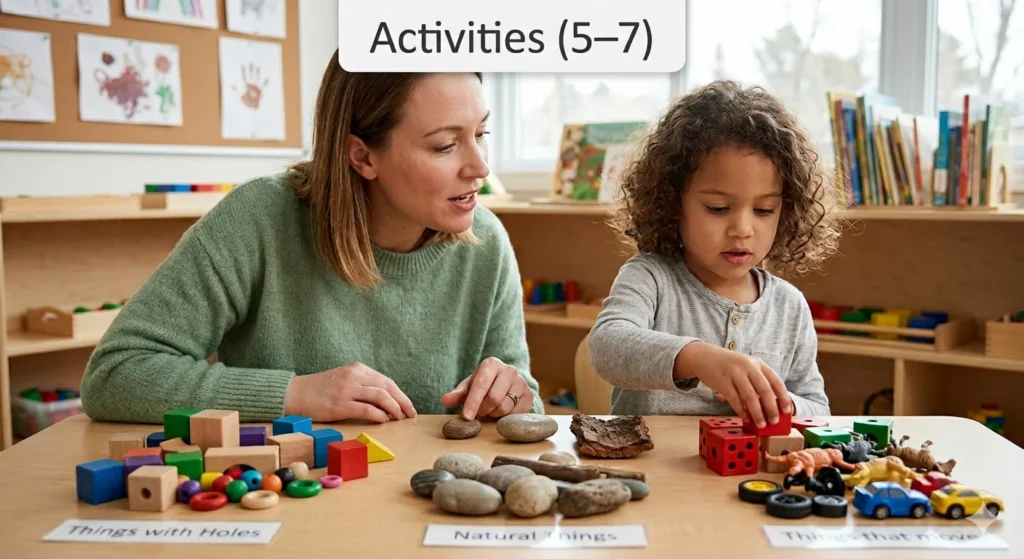
The best activities at this stage feel like play because they should. Children aged 5–7 don’t need structured exercises; they need low-stakes, curiosity-driven tasks that reward noticing and asking.
For a curated set of classroom-ready options, see our full list of critical thinking activities for Grade 1.
Sorting games with reasons. Give your child a collection of objects (buttons, toys, leaves) and ask them to sort them any way they like.
Then ask: “Why did you put those together?” The reasoning, not the sorting, is the exercise.
Odd one out. Present four objects or images and ask: “Which one doesn’t belong – and why?” There’s often more than one valid answer, which is exactly the point.
This simple exercise builds classification thinking and teaches children that reasoning matters more than a single “correct” answer. You can find age-specific odd one out activities for Class 1 to use directly.
“What’s wrong with this picture?” Use simple drawings or photos with deliberate oddities (a cat wearing a hat, a car with five wheels). Children practice noticing details and articulating inconsistencies.
Story retelling with a twist. After a familiar story, ask: “What if the character had made a different choice? What would have happened?” This builds cause-and-effect thinking.
“Is it alive?” classification. Walk through the house or garden and ask: “Is this alive? How do you know?” Simple but builds evidence-based reasoning about categories.
Spatial awareness questions work well here too try extending the conversation into spatial understanding for kids to develop how children perceive and reason about the world around them.
The “because” game. Ask your child to finish sentences: “I think we should have pasta for dinner because…” or “I want to go to the park because…” Training children to articulate reasons is a foundational thinking habit.
For Ages 8–10
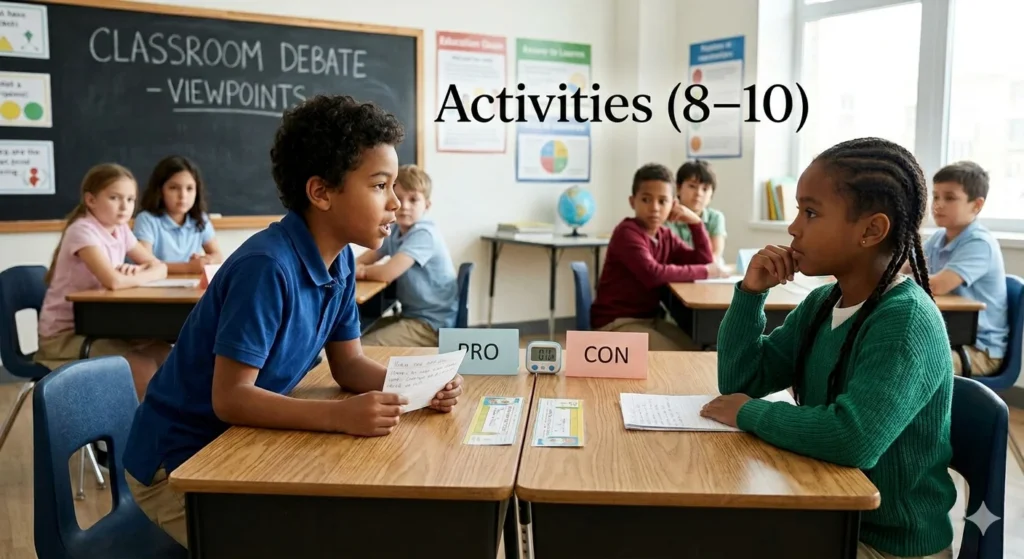
Children at this stage can handle more complexity. They’re ready to compare viewpoints, spot weak logic, and reason about real-world situations.
Math plays a bigger role here – structured problem-solving is one of the best thinking workouts available.
Practicing word problems for kids regularly builds exactly the kind of multi-step logical reasoning this age group needs.
Two-sided debates. Pick a low-stakes topic (“Should kids have homework?” or “Is it better to be fast or careful?”) and ask your child to argue both sides not just the one they believe. This is perspective-taking as a workout.
News story analysis. Find a simple news article. Ask: “What is this article saying? What evidence does it give? What questions does it raise? Is there anything it doesn’t tell us?”
Decision trees. When facing a real choice, draw it out. What are the options? What could happen with each? What’s the best outcome and worst case? Visualizing reasoning helps children internalize the process.
“Spot the logical error.” Present simple flawed arguments: “Everyone in my class has seen that movie, so it must be good.” Ask: “What’s wrong with that thinking?” (Great preparation for navigating peer pressure, too.)
Math analogies. Asking children to explain why two things are mathematically similar – not just that they sharpen analytical thinking fast.
Working through math analogies for kids is a surprisingly effective way to build this skill without it feeling like a formal exercise.
Product claim evaluation. Show your child an advertisement. “This says it will make you happier. How would we know if that’s true? What would we need to test?” Basic scientific reasoning in everyday form.
For Ages 11–14
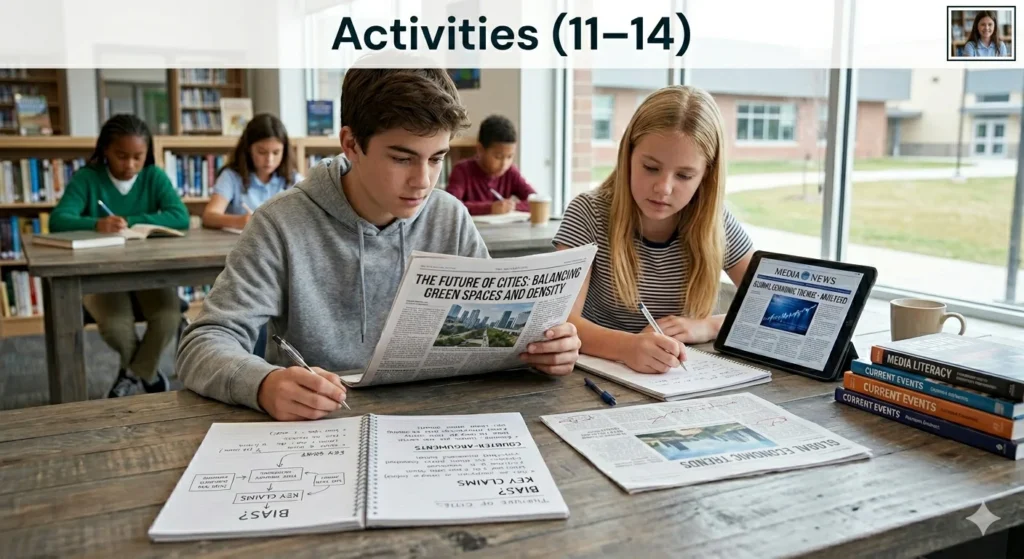
Older children can engage with genuine complexity ethical dilemmas, source evaluation, argument construction. This is also the stage where math reasoning becomes a serious thinking discipline in its own right.
Learning how to solve math word problems at this age isn’t just about maths, it’s about learning to break down a complex situation, identify what matters, and reason toward a conclusion. That skill transfers everywhere.
Ethical dilemma discussions. Classic thought experiments like the trolley problem, or more relatable scenarios (“Your friend is being bullied but asked you not to tell anyone – what do you do?”) develop moral reasoning alongside logical reasoning.
Source reliability assessment. Give your child two articles on the same topic from different sources. Ask them to evaluate: Who wrote this? When? What evidence do they cite? Which is more reliable, and why?
Constructing an argument. Ask your child to pick a position on a real issue (school lunch policy, a rule they disagree with, a local news topic) and write or present a three-point argument. Then challenge it: “What’s the strongest objection?”
Prediction and reflection. Before a book chapter, a sports match, or a news event unfolds: “What do you predict will happen, and why?” Afterward: “What did you get right? What did you miss? What does that tell you about your assumptions?”
Philosophy for beginners. Questions like “Is it ever okay to lie?” or “What makes something fair?” are perfect for this age. No answers needed – the discussion is the point.
Games and Puzzles That Build Reasoning Skills
You don’t have to manufacture activities from scratch.
Many well-known games are excellent critical thinking tools:
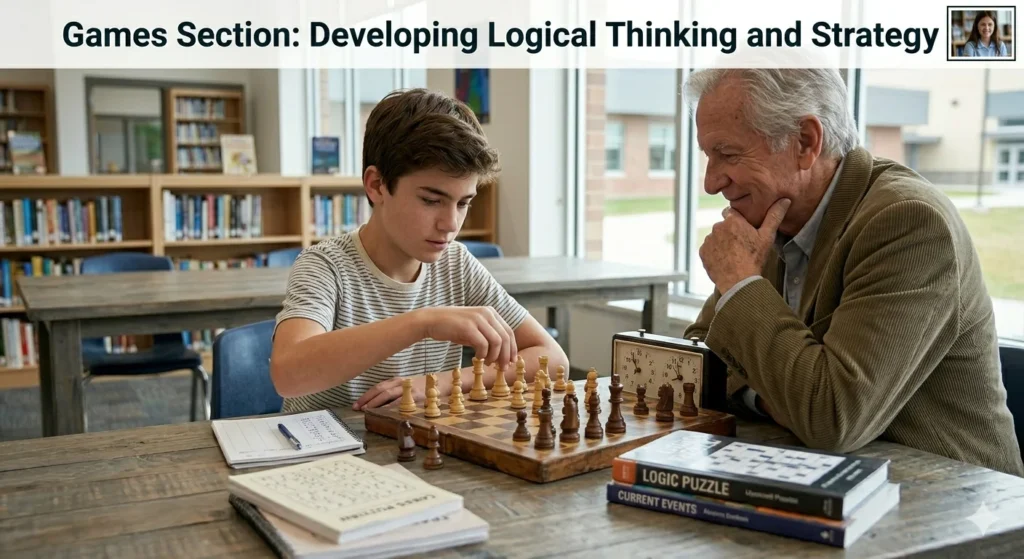
Chess – Planning multiple moves ahead, anticipating an opponent’s reasoning, and adapting strategy are all core critical thinking skills. Suitable from around age 7.
20 Questions – Builds classification thinking and hypothesis testing. “Is it alive? Is it bigger than a car?” teaches systematic narrowing through evidence.
Clue (Cluedo) – Elimination logic, note-taking, and deductive reasoning in a social, fun format. Great from ages 8–10.
Mastermind – Logical deduction from limited feedback. Underrated thinking game.
Strategy board games – Games like Ticket to Ride, Blokus, and Settlers of Catan build planning, resource management, and consequence thinking.
Logic puzzle books – Grid puzzles, lateral thinking problems, and “what comes next?” sequences. Widely available and inexpensive.
Escape rooms (physical or app-based) – Team-based reasoning under mild pressure. Excellent for ages 10+.
The key isn’t which game. It’s the thinking conversation around it: “Why did you make that move?” “What did you learn from that mistake?”
Classroom Strategies for Teachers
Teachers face a challenge parents don’t: 25+ children at once, a curriculum to cover, and limited time.
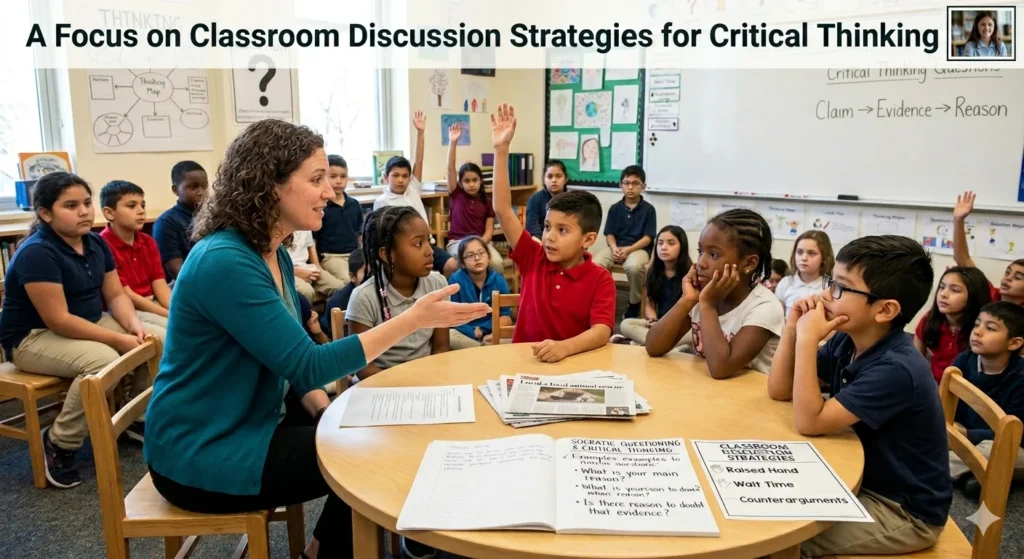
But many of the most effective critical thinking strategies actually save time in the long run because children who think independently need less hand-holding.
Socratic questioning. Instead of confirming a student’s answer, ask: “How do you know? Can you explain your reasoning? Does anyone see it differently?” This turns one answer into a class thinking exercise.
Think-pair-share. Before asking for responses, give students two minutes to think individually, then discuss with a partner. The quality of answers rises significantly – and every student has done the cognitive work, not just the fastest ones.
Exit tickets with reasoning. At the end of a lesson, ask students to write one thing they learned and one question they still have. The question is the critical thinking indicator.
Argument mapping. For older students, visually mapping an argument claim, evidence, objection, counter-response makes the structure of reasoning explicit and teachable.
Cross-subject application. Bring critical thinking into subjects where it’s unexpected. In math: “Why does this method work? Could there be a different approach?” In history: “Whose perspective is missing from this account?”
Deliberate ambiguity. Present problems without clean solutions. “Here’s a real situation what would you do, and why?” Discomfort with uncertainty is something to build, not protect students from.
Student-led questioning. Occasionally flip the dynamic: students generate the discussion questions, not the teacher. This builds questioning as a skill, not just answering.
How to Tell If Progress Is Happening
Critical thinking isn’t assessed on a report card, which makes parents and teachers nervous. But progress is observable if you know what to look for.
Look for process, not product. A child who thinks carefully and arrives at a wrong answer is doing better thinking work than a child who guesses correctly. Notice their reasoning, not just their results.
Track question quality. Are their questions getting more specific? More probing? Shifting from “what?” to “why?” and “how do we know?” is meaningful progress.
Note perspective-taking. Can they now articulate a view they don’t hold? Can they steelman an opposing argument? This is advanced reasoning.
Watch for self-correction. A child who revisits their own thinking – who says “wait, actually…” unprompted – is developing metacognition. That’s a significant milestone.
Observe patience with complexity. Does your child sit with a hard question longer than before? Tolerance for ambiguity grows with practice.
Progress in critical thinking is slow and nonlinear. Expect months and years, not weeks. But the habit, once established, is self-reinforcing.
How Critical Thinking Supports Academic Success
Critical thinking doesn’t just make children better thinkers it makes them better learners across every subject.
In reading comprehension, critical thinking enables children to infer meaning, question character motivations, and evaluate whether an argument holds up.
In mathematics, it shifts the experience from rule-following to understanding. A child who can reason about why a method works can transfer it to new problem types.
This is exactly why competitive math is such a powerful thinking discipline, solving math olympiad questions demands not just knowledge, but the ability to reason flexibly under pressure.
The students who do well aren’t necessarily the fastest calculators; they’re the ones who know how to think through a problem they’ve never seen before.
If your child is interested in building that deeper reasoning ability, understanding how to improve problem-solving skills for math competitions is a natural next step, one that directly develops the same analytical habits covered throughout this guide.
In science, critical thinking is the foundation of the scientific method: forming hypotheses, evaluating evidence, revising conclusions.
In history and social studies, it enables children to recognize bias, consider multiple perspectives, and avoid oversimplification.
In writing, it produces better arguments – because the child has actually thought through their position rather than stringing together vague claims.
The skills transfer. That’s the real advantage.
At what age should I start developing critical thinking skills in my child?
You can start from the moment children begin speaking. Even toddlers benefit from open-ended questions and being asked to give reasons for their choices. Formal activities become more effective around age 5–7, but the habit of curious questioning can begin much earlier.
How do I teach critical thinking without turning every conversation into a lesson?
The most effective approach is to embed questions into natural conversation. After a story, a news segment, a conflict with a sibling ask one genuine question about their reasoning. You don’t need to frame it as a lesson; you just need to be curious about how they think.
Is critical thinking the same as being argumentative or difficult?
No. Critical thinking is about reasoning clearly and evaluating ideas it’s a cognitive skill, not a personality trait. A well-developed critical thinker is actually better at listening and considering other perspectives, not just better at arguing their own position.
How long does it take to develop critical thinking skills?
It’s a long-term investment. You’re likely to see early signs – more questions, more “why?” within weeks of consistent encouragement. But deep reasoning habits develop over years. Think of it like physical fitness: the gains are real and cumulative, but they don’t happen overnight.
What if my child resists thinking independently and just wants to be told the answer?
This is very common, especially in children who’ve been heavily schooled in recall-based learning. Start with very low-stakes questions where being wrong carries no consequence. Make thinking feel safe and even enjoyable. Celebrate the process (“I loved how you thought that through”) rather than only the outcome.
Can critical thinking be taught at home without any formal curriculum?
Absolutely. In fact, the home environment has advantages over the classroom more time, more genuine conversation, more natural contexts for reasoning. The strategies in this guide require no materials, no curriculum, and no expertise – just the willingness to ask better questions.
Make Preparing for Math Olympiad Simple!



Final Thoughts
Critical thinking for kids isn’t something to memorize, it’s a skill built through curiosity, questions, and practice.
When children are encouraged to think through problems, explain their reasoning, and explore different viewpoints, they grow more confident, make better decisions, and learn to think independently.
Start this week with one simple activity: turn one answer into a question and focus on praising their thinking, not just the final result.