June 24, 2026
 15 min. read

Place value is the value of a digit based on its position in a number. For Grade 1 students, this means understanding that two-digit numbers are made up of tens and ones.
Many children can count and write numbers but may not understand what each digit represents.
Building a strong understanding of place value helps them make sense of larger numbers and prepares them for addition, subtraction, and future math concepts.
This guide explains place value for grade 1 with simple examples, hands-on activities, games, and practice questions designed for young learners.
What is Place Value? A Simple Definition for Grade 1
Place value is the idea that a digit’s value depends on where it sits in a number.
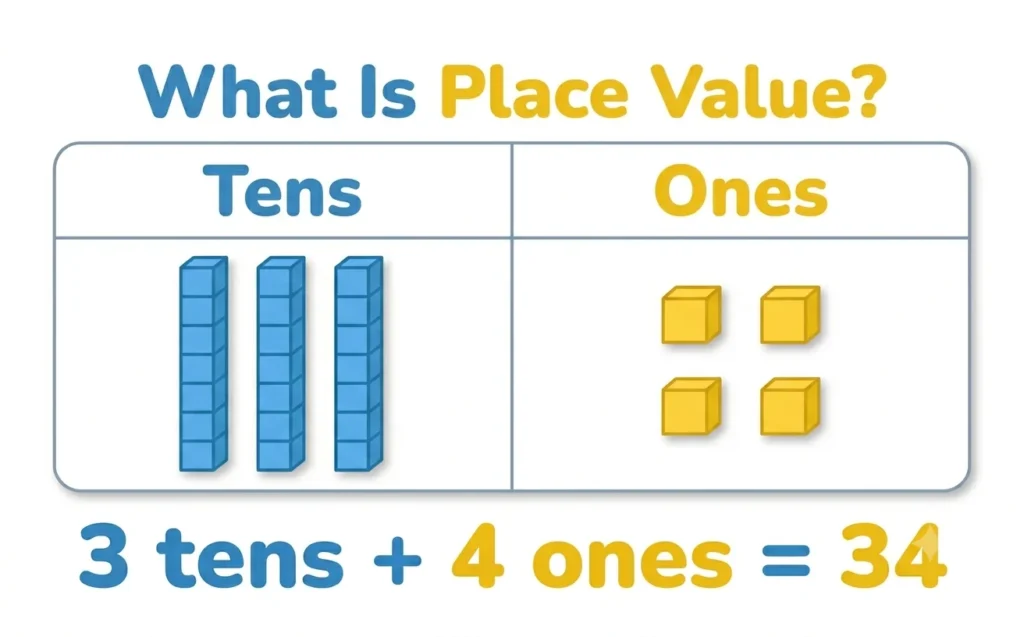
Here’s the simplest way to explain it to a Grade 1 child:
“The number 34 has two parts. The 3 tells us how many groups of ten we have (3 tens = 30). The 4 tells us how many single ones are left over (4 ones = 4). Together, 30 + 4 = 34.”
In Grade 1, children focus on just two places:
- Ones , the right-hand column, worth exactly the digit’s face value (5 ones = 5)
- Tens , the left-hand column, worth ten times the digit (5 tens = 50)
That’s it. No hundreds, no thousands , just tens and ones, understood deeply.
Why Place Value Matters: The Foundation of All Future Math
Place value isn’t one concept among many , it’s the engine behind almost everything in mathematics.
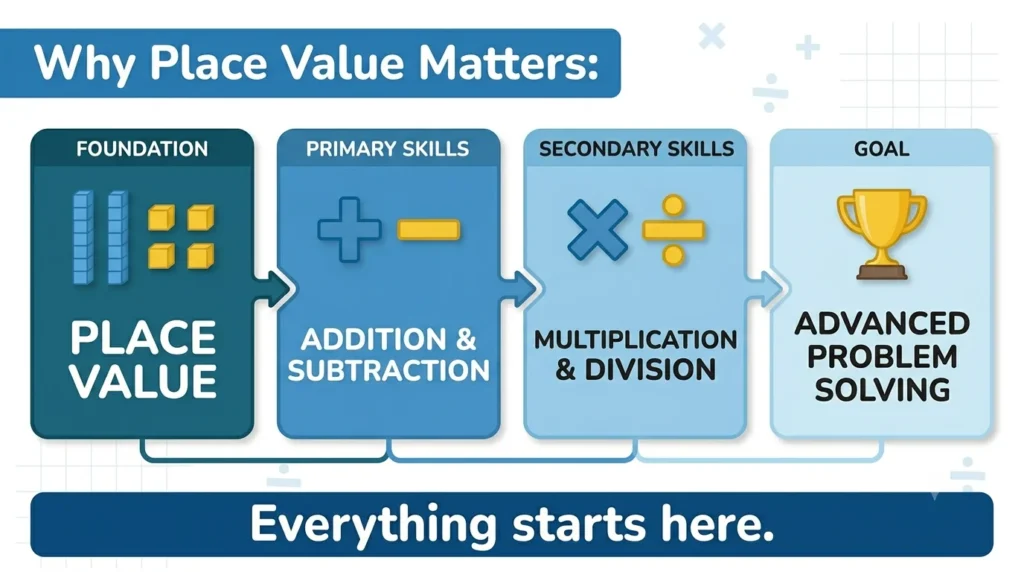
Without it, children follow addition and subtraction steps without understanding why they work, can’t judge whether an answer is reasonable, and struggle with regrouping in Grades 2 and 3.
With a solid foundation, children read and write numbers confidently, compare them with real understanding, and build mental math strategies that last.
Every arithmetic operation , addition, subtraction, multiplication, division , runs on the same idea: position determines value.
Children who understand this conceptually develop the flexible number sense that makes multi-digit arithmetic intuitive rather than procedural.
Understanding Ones and Tens
Ones are single, individual objects , any leftover items that haven’t been grouped into a ten. In 27, the 7 is in the ones place: 7 singles.
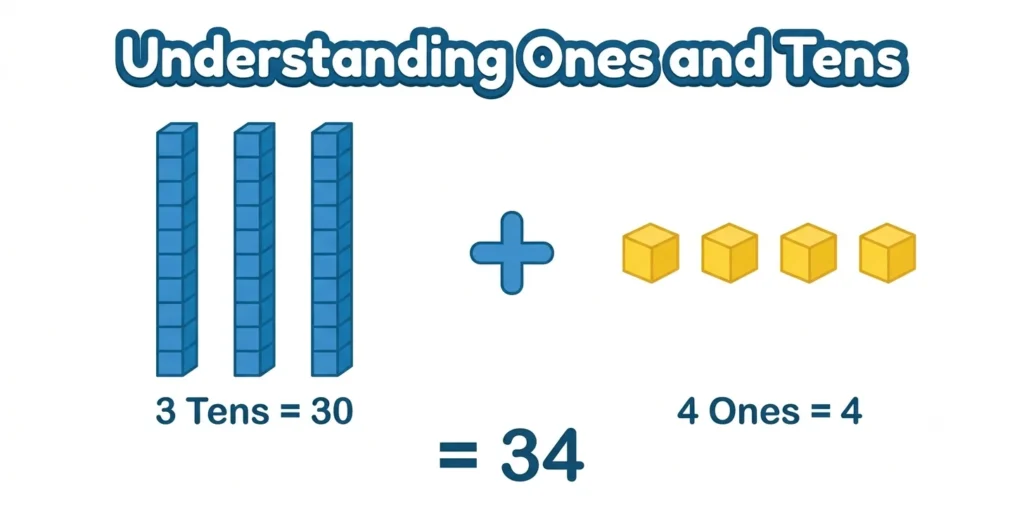
Tens are groups of exactly 10 ones bundled together. One ten isn’t just “the number 10” , it’s a group, a bundle, treated as a single unit. In 27, the 2 is in the tens place: 2 bundles of ten = 20. So 27 = 20 + 7 = 2 tens and 7 ones.
The classic tool for making this visible is base-ten blocks: a small unit cube = 1 one; a ten rod (10 cubes joined) = 1 ten.
To show 34: place 3 rods and 4 cubes on the table. Count the rods , “10, 20, 30” , then the cubes , “31, 32, 33, 34.” The child sees and touches exactly why 34 means three tens and four ones.
No blocks at home? Bundled straws, stacked pennies, or snapped Lego bricks work identically. The grouping is what matters, not the material.
Step-by-Step: How to Teach Place Value to Grade 1 Kids
A clear four-stage progression for teaching ones and tens from scratch. Complete each stage fully before moving on, rushing ahead is the most common teaching mistake.
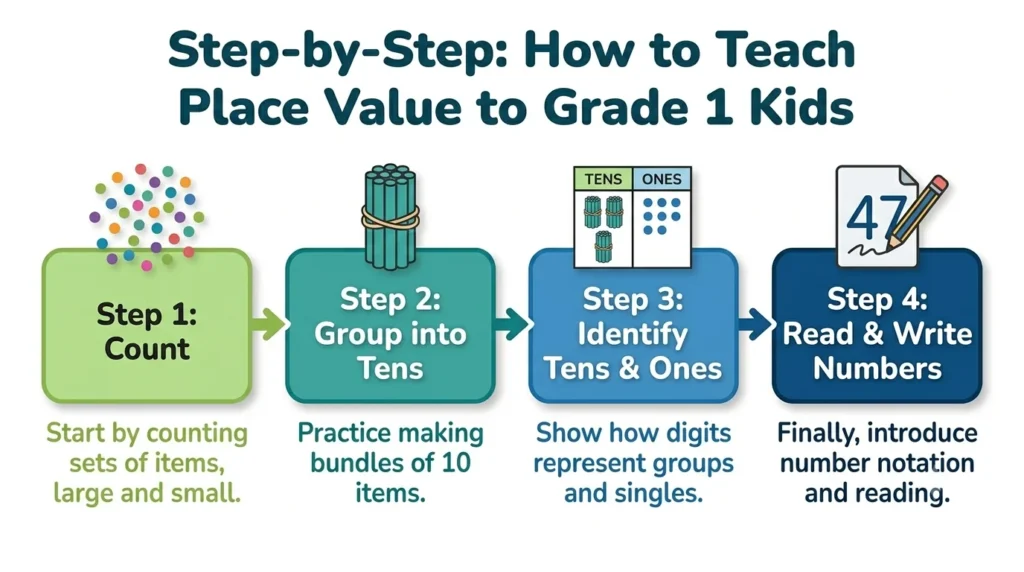
Step 1: Count and Collect
Gather small objects , coins, beans, or cereal pieces. Ask your child to count them one by one. Don’t mention place value yet. Just count.
When they can count 15–25 items confidently, move on. Preparation: practice skip-counting by 10s (“10, 20, 30…”) in the weeks before , it trains the mental scaffold for tens.
Step 2: Group into Tens
Take 13 beans. “Can we make a group of 10?” Your child picks out 10, rubber-bands them together. “What’s left? 3. So we have 1 ten and 3 ones.”
This physical trade , 10 loose items become 1 bundle , is the heart of place value. Say “one ten,” not just “ten,” so the bundle registers as a single unit.
Step 3: Identify Tens and Ones in a Number
Show “24” on a card. “How many groups of ten? How many ones?” Have your child verify by building it with bundles and loose items. T
hen reverse: give them 3 bundles and 6 loose straws. “What number is this?” (36.) Introduce a two-column chart , Tens | Ones , and write digits into it as you work.
Step 4: Read and Write Two-Digit Numbers
Practise both directions: show a physical model, write the number; show a written number, build the model. Say it aloud: “52 is 5 tens and 2 ones , fifty-two.”
Once a child moves between all three representations without hesitation, place value understanding is solid.
Hands-On Place Value Activities for Home and Classroom
These activities use only common household items. No expensive manipulatives needed.
Activity 1: Straw Bundles 🥤
Materials: 30–40 straws or pencils, rubber bands
How: Scatter the straws on a table. Your child makes as many groups of 10 as possible, securing each with a rubber band. Count the bundles (tens) and leftovers (ones), then write the number. Swap roles , you build, they read.
Why it works: The physical act of bundling makes “10 ones become 1 ten” tangible and unforgettable.
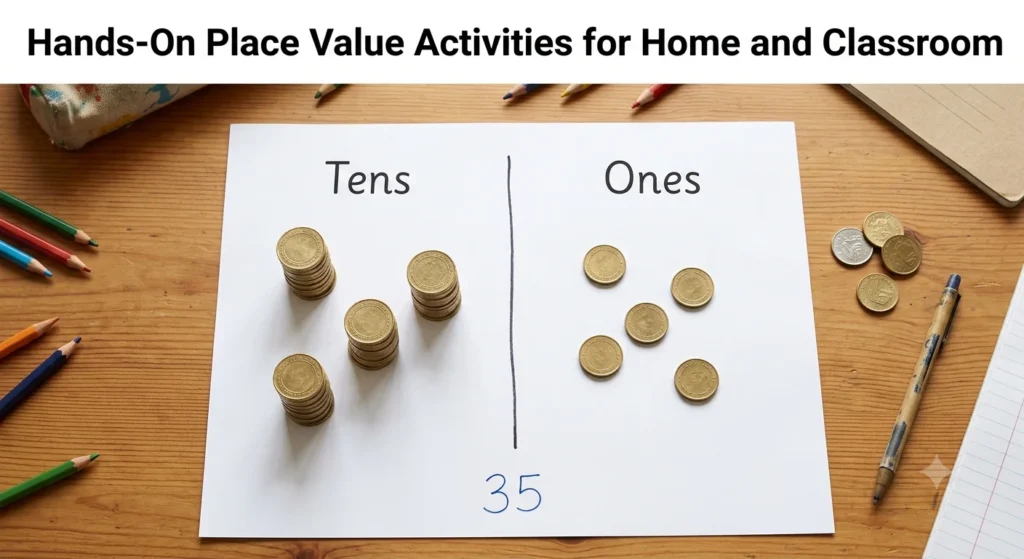
Activity 2: Place Value Mat + Counters
Materials: A sheet of paper divided into “Tens” and “Ones” columns, coins or buttons
How: Call out a two-digit number. Your child places the correct number of coins in each column. Reverse it , they arrange coins, you guess the number. Use numbers like 30 (3 tens, 0 ones) to build comfort with zero.
Why it works: Physical placement reinforces written structure , a homemade base-ten chart.
Activity 3: Tens and Ones Toss
Materials: Two labelled cups (“Tens” / “Ones”), small objects, one die rolled twice
How: First roll = tens digit, second = ones digit. Your child collects that many objects in the Ones cup, trades groups of 10 for a bundle into the Tens cup. First to reach 50 wins.
Why it works: Builds the exchange concept (10 ones → 1 ten) through play , direct preparation for regrouping.
Activity 4: Tens and Ones Scavenger Hunt
Materials: Paper and pencil
How: Give your child a number , say 23. Challenge: find 2 groups of 10 items and 3 individual items anywhere in the house (books, toys, shoes). Record each collection. Did you both make 23 the same way?
Why it works: Connects place value to the real environment and gets kids moving , perfect for active learners.
Fun Place Value Games for First Graders
Game 1: Race to 50
Players: 2 | Materials: A tens-and-ones mat per player, loose objects, one die
How to play: Players roll a die and collect that many loose objects (ones). When a player gets 10 ones, they trade them for 1 ten-bundle. First to reach 50 (5 tens) wins.
What it builds: The exchange concept , 10 ones become 1 ten , which is exactly how carrying in addition works.
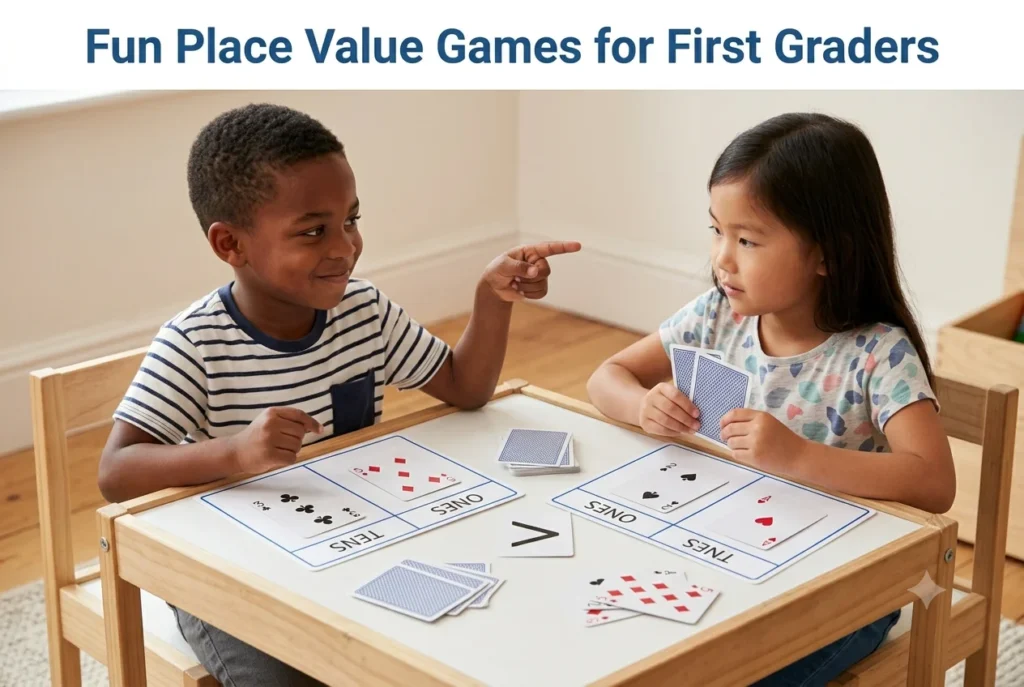
Game 2: Greater Than, Less Than Flip
Players: 2 | Materials: A deck of cards, digits 0–9 only
How to play: Each player flips two cards and arranges them into the biggest two-digit number possible. Compare. Who wins? Explain using place value: “My 73 has 7 tens, yours has 5 tens , mine is bigger.”
What it builds: Number comparison and strategic thinking about digit placement.
Game 3: Mystery Number
Players: 2 | Materials: Paper and pencil
How to play: One player thinks of a two-digit number and gives clues: “I have 4 tens and 6 ones. What am I?” Swap roles. Add challenge: “More than 3 tens but fewer than 5. My ones digit is one less than my tens digit.”
What it builds: Decomposition thinking and mathematical reasoning, excellent preparation for Olympiad-style problem-solving.
Common Misconceptions and How to Fix Them
These are the mistakes that appear most often, and the practical ways to address each one. Correcting them early is essential for building solid number sense in Grade 1.
Misconception 1: “The 2 in 24 is just 2, not 20”
What it looks like: A child reads 24 as “two-four” and thinks the 2 is worth 2.
Why it happens: Every digit they’ve seen so far has meant exactly its face value. Position changing worth is a new mental model, not just new knowledge.
Fix: Build the number immediately. “Here are 2 bundles of ten , count them: 10, 20. And 4 loose ones: 21, 22, 23, 24. That 2 stands for both whole bundles , it’s worth 20.”
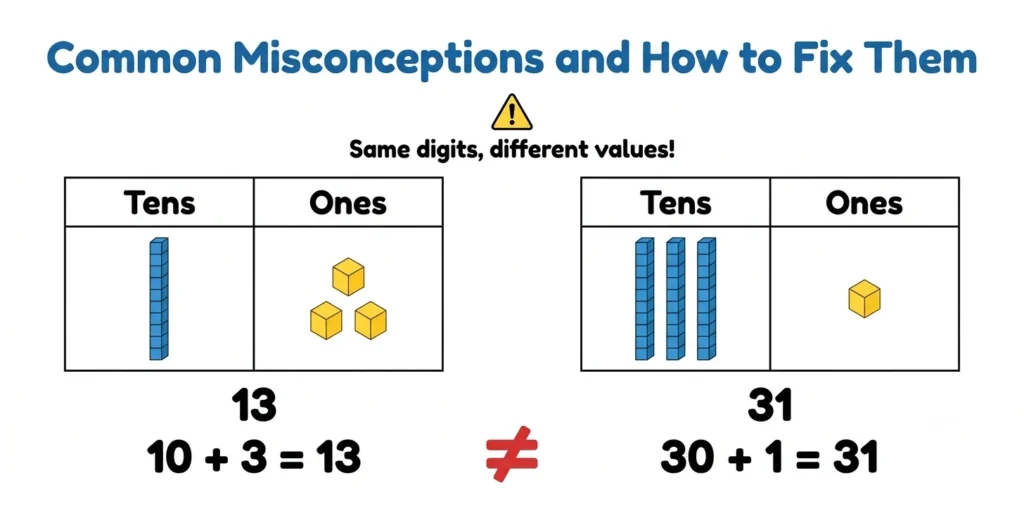
Misconception 2: “13 is the same as 31”
What it looks like: A child reverses digits or doesn’t see 13 and 31 as meaningfully different.
Why it happens: They haven’t internalised that tens go left, ones go right , and that order is fixed.
Fix: Build both numbers with blocks side by side and count each aloud. “13: ten, eleven, twelve, thirteen. 31: ten, twenty, thirty, thirty-one. Same digits, very different amounts.” Ask them to point to the bigger pile.
Misconception 3: “Zero means nothing, so I don’t need to write it”
What it looks like: A child writes 30 as “3” or 50 as “5.”
Why it happens: Zero means “nothing” in everyday language, so a zero in the ones column feels redundant.
Fix: Show the collision. “If you write just 3, which number is it? Three. But we have 3 tens , that’s thirty. The zero holds the one’s spot open. Without it, the 3 slides into the wrong column.”
Place Value in Real Life
Abstract concepts stick when children see them in the world around them. Point these out naturally , they take seconds and require no preparation.
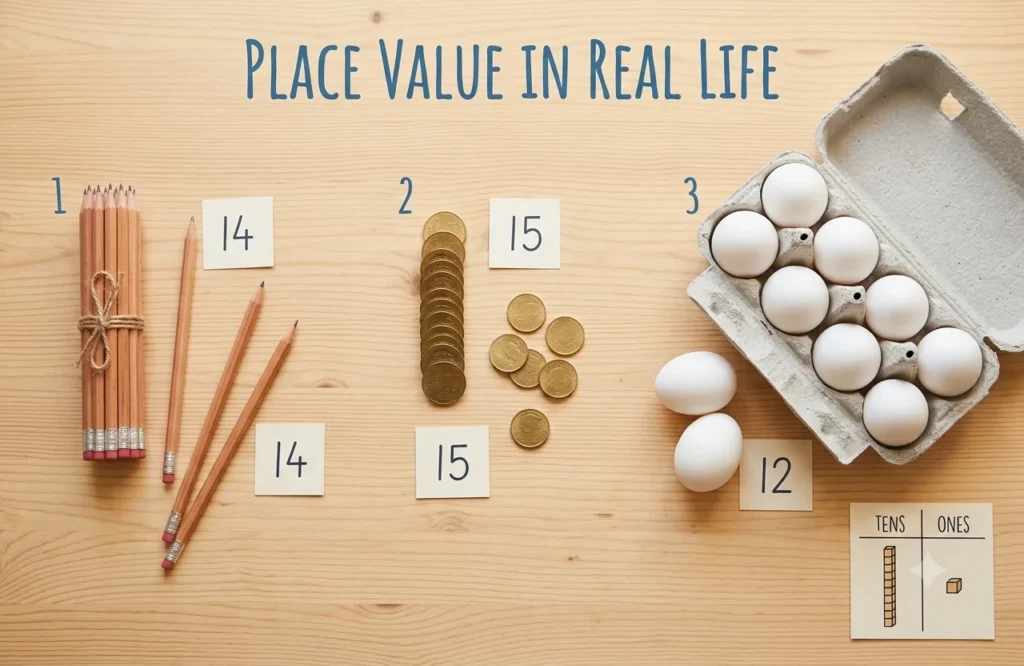
Pencil boxes: A full box of 10 pencils is one ten. Two boxes and 4 loose pencils = 24 (2 tens, 4 ones).
Coins: Ten 1-rupee coins can be exchanged for one 10-rupee coin , a real-world trade of 10 ones for 1 ten, the same exchange at the heart of place value.
Page numbers: “We’re on page 35. How many tens? How many extra ones?” Ten seconds, repeated daily, builds number sense faster than worksheets.
House numbers: On a walk, read numbers together. “47, four tens is forty, plus 7 ones, forty-seven.” These informal micro-conversations are some of the most powerful teaching moments you’ll have.
When your child is ready to compare and order numbers, this real-world habit will give them a head start.
How Place Value Connects to Addition and Subtraction
Place value is the engine that makes addition and subtraction make sense, not a standalone topic.
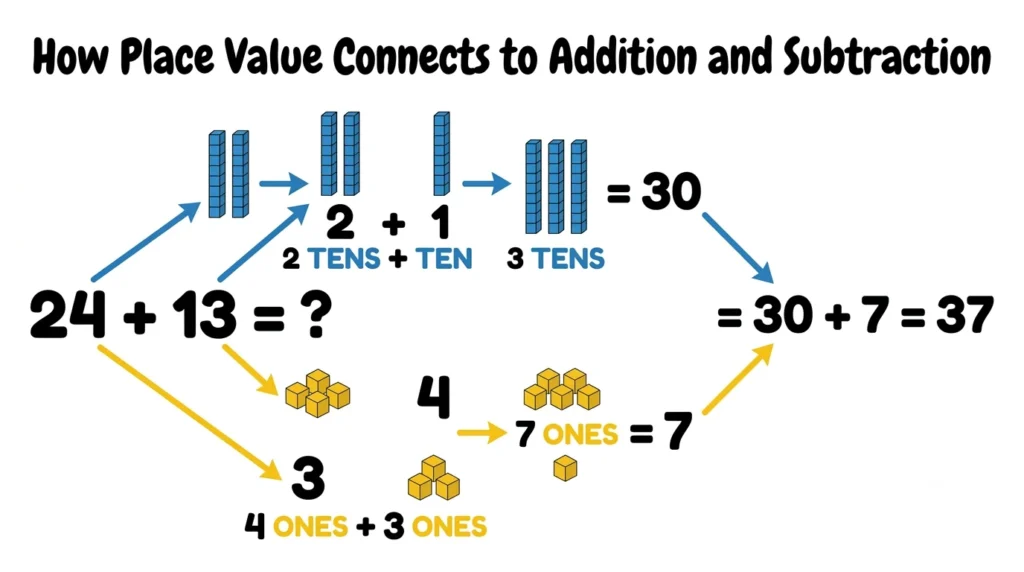
When children understand that 24 = 2 tens + 4 ones, they can add 24 + 13 in parts: 2 tens + 1 ten = 30, 4 ones + 3 ones = 7, total = 37.
Subtraction works identically: 36 − 14 = 2 tens + 2 ones = 22. No memorised procedure , just decomposition and recombination.
The “Race to 50” game , where 10 ones become 1 ten-bundle , is direct preparation for carrying in addition. Children who have made that physical exchange dozens of times understand regrouping intuitively when they meet it formally in Grade 2.
Teaching Tips for Parents and Teachers
Build first, write second. Always have your child build a number with physical objects before writing it. The symbol should confirm the physical reality, not replace it.
Use precise language consistently. Say “3 tens and 4 ones” rather than just “thirty-four” when working through examples. That expanded language reinforces the structure every time.
Short and frequent beats long and occasional. Five minutes of practice three times a week outperforms a 30-minute worksheet session once a week. Number sense needs repeated exposure, not marathon sessions.
Don’t rush to hundreds. Grade 1 is tens and ones , done thoroughly. Moving to three-digit numbers before two-digit numbers are solid creates confusion that’s hard to undo.
Use exchanges regularly (for teachers). Have students trade 10 ones for 1 ten and back again, often. This exchange is the cognitive core of place value and the direct foundation for regrouping in later grades.
Practice Questions with Answers
Q1: How many tens and ones are in 46? A: 4 tens and 6 ones.
Q2: Build the number with 5 tens and 3 ones. What number is it? A: 53.
Q3: Which is bigger: 38 or 83? How do you know? A: 83. It has 8 tens (80); 38 only has 3 tens (30). More tens = bigger number.
Q4: A child has 2 bundles of 10 straws and 7 loose straws. How many in total? A: 27 (2 tens + 7 ones).
Q5: Is 45 the same as 54? Explain. A: No. 45 = 4 tens + 5 ones. 54 = 5 tens + 4 ones. Same digits, different positions, different values.
Place Value for Grade 2: How to Explain Hundreds, Tens, and Ones
Grade 2 adds one powerful new layer to what children learned in Grade 1: hundreds.
The logic is exactly the same , just as 10 ones make 1 ten, 10 tens make 1 hundred.
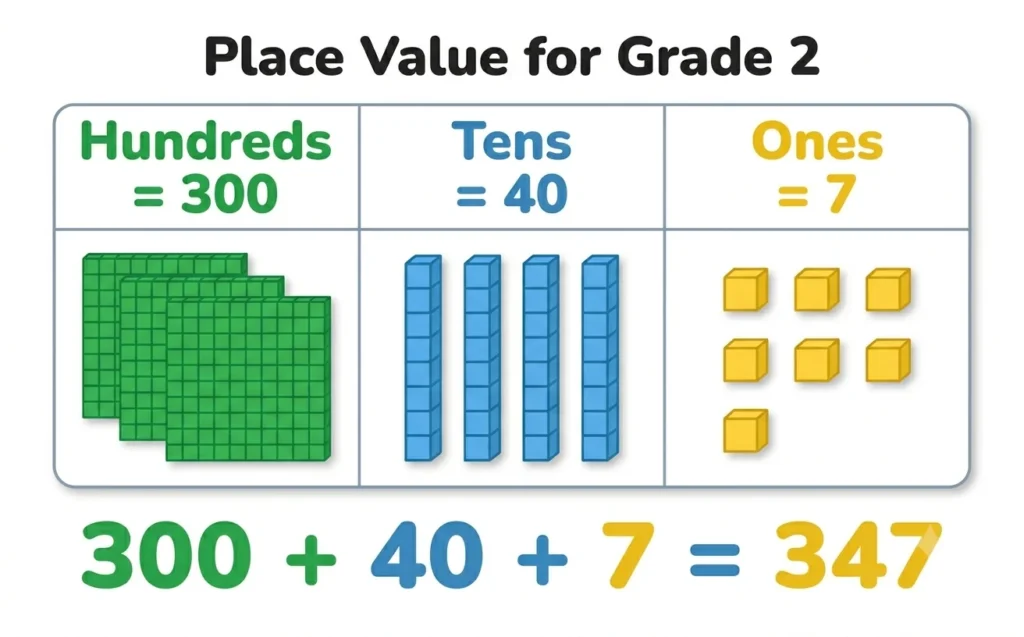
A child who physically stacks 10 ten-bundles and trades them for a single “hundred flat” has understood the deepest idea in Grade 2 place value.
By the end of Grade 2, children should read, write, and build any three-digit number up to 999; identify each digit’s place; write numbers in expanded form (347 = 300 + 40 + 7); and understand zero as a placeholder (305 has 0 tens , not no tens).
How to explain it: Start from what they know. “How many ones make a ten? How many tens make a hundred?” Let them bundle 10 ten-sticks to find out. Then introduce a three-digit number: “347 has 3 hundreds (300), 4 tens (40), and 7 ones. 300 + 40 + 7 = 347.”
The zero problem: Numbers like 305 are the trickiest , children often drop the zero and write “35.” Build it physically: 3 hundred-flats, nothing in the tens column, 5 unit cubes. “The zero holds that tens column open. Without it, 305 becomes 35 , a completely different number.”
Quick activity , Digit Value Flip: Write any three-digit number. Ask: “What digit is in the hundreds place? What is its value?” (e.g. digit = 3, value = 300.) Then ask for expanded form. Practise daily , the digit-versus-value distinction is the most common Grade 2 confusion.
Place Value for Grade 3: How to Explain Thousands and Rounding
Grade 3 stretches place value into four digits and introduces two critical new skills: thousands and rounding.
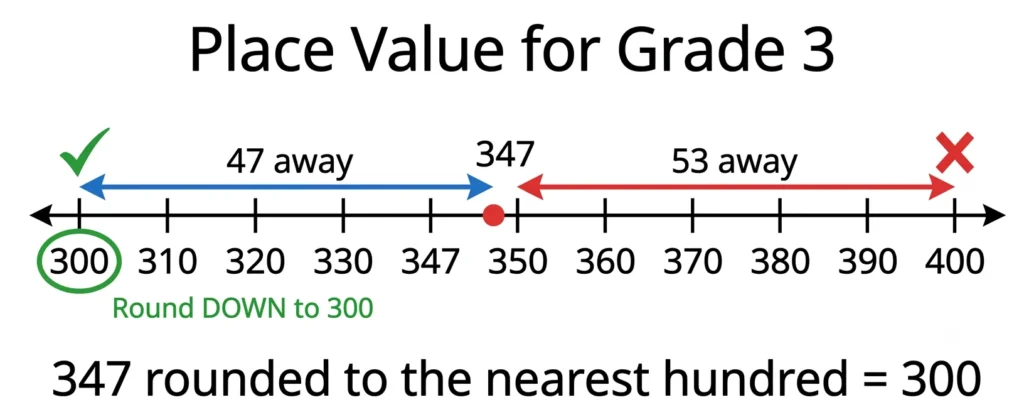
The grouping logic stays the same , 10 hundreds make 1 thousand , but children can no longer visualise 1,000 individual objects.
Teaching must shift from purely physical toward pictorial and abstract representations.
By the end of Grade 3, children should work fluently with all three forms of a four-digit number:
| Form | Example |
| Standard form | 4,362 |
| Expanded form | 4,000 + 300 + 60 + 2 |
| Word form | Four thousand, three hundred sixty-two |
How to explain thousands: Build on the chain they know. “10 ones make 1 ten. 10 tens make 1 hundred. What do 10 hundreds make?” Let them predict, then confirm: 1 thousand.
Ask them to write 4,362 in expanded form , and then build it piece by piece, adding thousands first, then hundreds, then tens, then ones. The physical layering makes each term in the expanded form feel real rather than mechanical.
Teaching rounding with a number line: Rounding taught as a rule (“if it’s 5 or more, round up”) produces errors the moment a question is phrased differently. Teach it as distance instead. To round 347 to the nearest hundred: draw a number line from 300 to 400, mark 347, and ask “Which hundred is closer?” 300 is only 47 away; 400 is 53 away. Round down to 300. Children who understand rounding as proximity never confuse direction.
Quick activity , Number of the Day: Each morning, write a four-digit number. Your child writes all three forms, identifies each digit’s value, and rounds to the nearest 10 and 100. Five minutes daily builds remarkable number flexibility.
Place Value for Grade 4: How to Explain Large Numbers and the 10× Relationship
Grade 4 is where place value becomes structural.
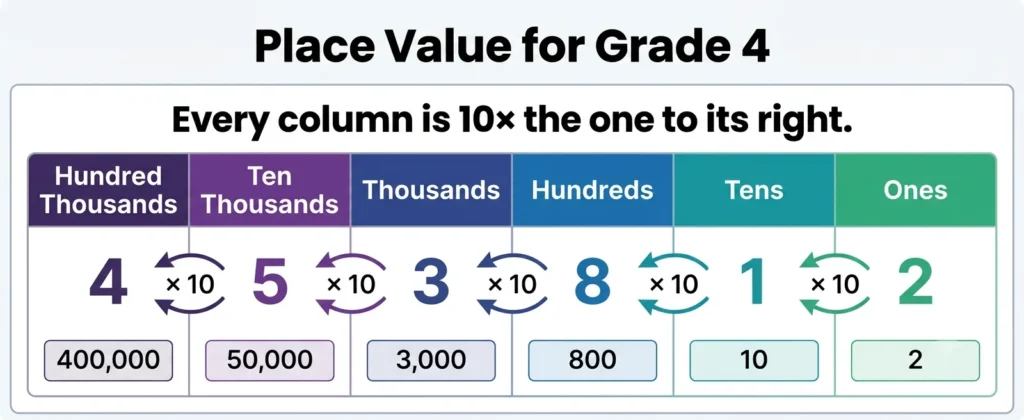
Children move into ten thousands and hundred thousands and must understand not just what each column is called but how every column relates to the one beside it: every place is 10 times the value of the one to its right.
The digit 3 in 3,000 is worth 3,000. In 30,000, it’s worth 30,000. In 300,000, ten times that again. Children who internalise this rule can reason about any column without memorising each name individually.
How to explain large numbers: Six-digit numbers look overwhelming as a single string. The key is reading in groups of three, separated by commas. 453,812 = “four hundred fifty-three thousand, eight hundred twelve.” Cover the ones group, read the thousands group, combine with “thousand” in the middle.
Rounding at scale: Same logic as Grade 3 , find the two nearest landmarks, determine which is closer , applied to larger place values. To round 347,582 to the nearest ten thousand: landmarks are 340,000 and 350,000.
Thousands digit is 7 (≥5), round up to 350,000. Anchor rule: underline the rounding place, circle the digit to its right; 5 or more rounds up.
Quick activity , The 10× Proof Game: Write a single digit , say, 6. Ask its value column by column: “6 → 60 → 600 → 6,000 → 60,000 → 600,000. What’s the pattern?” Watch them discover the rule themselves.
What is place value for Grade 1?
Place value is the idea that a digit’s worth depends on its position in a number. In Grade 1, children learn that two-digit numbers are made of tens (groups of 10) and ones (leftover singles). In 34, the 3 means 3 tens (30) and the 4 means 4 ones.
How do you teach ones and tens to kids?
Start with physical grouping , bundle straws, stack coins, fill egg cartons into tens. Once children can make and count bundles, connect those groups to written digits on a place value chart. Always build before you write.
Why is place value important for kids?
It’s the foundation of our entire number system. Without it, children can’t add, subtract, or understand how numbers grow. Strong place value in Grade 1 directly underpins every math concept through primary school.
What activities help children understand place value?
Bundling straws into tens, a homemade tens-and-ones mat with coins, and Race to 50 with physical counters are highly effective. Any activity that involves physically making and trading groups of 10 builds genuine understanding.
What are the best place value games for kids?
Race to 50 (trading 10 ones for 1 ten), Greater Than/Less Than card flip, and Mystery Number clue games are easy to set up at home with no materials beyond cards and small objects.
Make Preparing for Math Olympiad Simple!



Conclusion
Place value is a key math concept that helps children understand how numbers work.
By learning that digits represent different values based on their position, students build the foundation for addition, subtraction, and more advanced math skills.
Start with simple hands-on activities using everyday objects to show groups of tens and ones. With regular practice, children develop stronger number sense and greater confidence in math.
To continue building these skills, explore Gonit’s structured learning resources, including guides on the IMO syllabus for Class 1 and problem-solving activities for Grades 1–12.