


Most Grade 1 students can name a penny, but freeze the moment you mix a dime and a nickel in the same pile.
- The Learning Progression: How Grade 1 Students Build Money Skills
- Meet the Coins: A Grade 1 Introduction to Pennies, Nickels, Dimes, and Quarters
- Coin Recognition Activities for Grade 1
- Hands-On Counting Money Activities for Grade 1
- Skip Counting and Money: The Connection Grade 1 Students Need
- Classroom Money Center Ideas for Teachers
- Common Mistakes Children Make When Counting Money And How to Fix Them
- Counting Money Across the World's Top 10 Currencies
- Financial Literacy for Grade 1: Saving, Spending, and Sharing
- Practice Questions with Answers
- Fun Challenges and Extension Activities
- Parent and Teacher Tips at a Glance
- Final Thought
Counting money for Grade 1 means building real number sense through hands-on practice, not just memorizing coin values from a chart.
Children who sort real coins, run pretend stores, and count change in everyday moments learn faster and retain far more.
Not sure where to start? Our guide on counting pennies, nickels, and dimes walks through each coin step by step.
This guide fixes that. Inside, you’ll find 13+ hands-on counting money activities for Grade 1, a clear learning progression, and common mistakes to correct early, all ready to use today.
The Learning Progression: How Grade 1 Students Build Money Skills
Before diving into activities, it helps to understand how young learners develop money skills. Trying to teach counting before recognition is a recipe for frustration.
Here’s the progression that works. For more on how number sense develops at this age, see our guide on number sense teaching strategies for Grade 1.
Step 1 – Recognize
Children learn to identify each coin by name, appearance, and value. They can name a dime, describe what it looks like, and tell you it’s worth 10 cents.
Step 2 – Sort
Children can group coins by type: all pennies together, all nickels together, without being confused by size or color. This is where the “big coin = more money” misconception gets corrected.
Step 3 – Count
Children count sets of the same coins first (five pennies = 5 cents), then same coins in larger amounts, then mixed coins using skip counting strategies.
Step 4 – Spend
Children apply counting in context: comparing coin totals to prices, selecting the right coins to “purchase” something, and checking if they have enough.
Step 5 – Solve
Children solve simple word problems involving money, decide between options (“Do I have enough for the 15-cent eraser?”), and begin to grasp saving vs. spending.
Each step in this progression builds on the last. Rushing through Step 1 to get to Step 3 is the most common teaching mistake and the easiest to avoid.
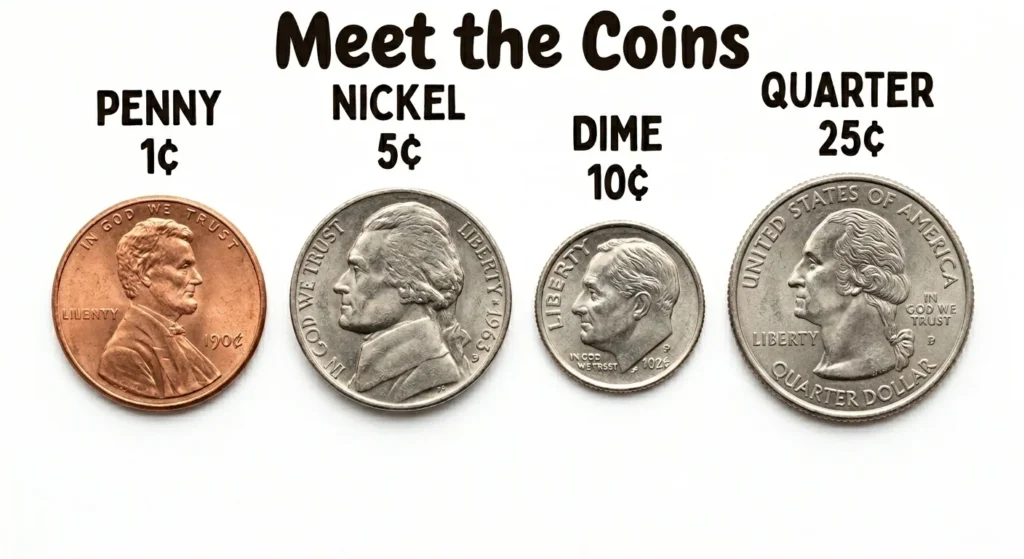
Meet the Coins: A Grade 1 Introduction to Pennies, Nickels, Dimes, and Quarters
Before any counting activity, Grade 1 students need to know their coins are cold.
Here’s a clear, memorable introduction to each one.
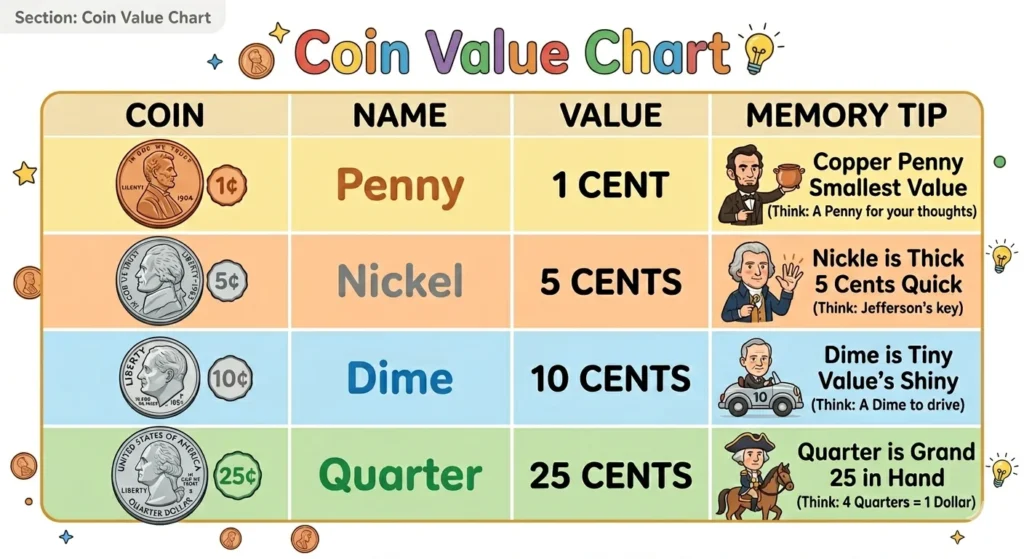
Coin Value Chart
| Coin | Appearance | Value | Memory Trick |
| Penny | Copper/brown, Abraham Lincoln on front | 1¢ | “P is for Penny, P is for 1 Penny: the smallest value” |
| Nickel | Silver, large and thick, Thomas Jefferson on front | 5¢ | “Nickel is big and tough: it’s worth 5 cents!” |
| Dime | Silver, smallest and thinnest coin, Franklin D. Roosevelt on front | 10¢ | “The dime is tiny but MIGHTY: worth 10 cents!” |
| Quarter | Silver, largest coin, George Washington on front | 25¢ | “A quarter of a dollar: 25 cents, the biggest coin value!” |
The #1 Thing to Teach First: Size Does Not Equal Value
This is the most important lesson in any Grade 1 money unit: the size of a coin does not tell you its value.
The dime is the smallest coin but worth more than the nickel, which is larger. This trips up almost every first grader at least once.
Make it a big deal! Show the coins side by side, compare them, and talk about why: because someone decided the value, not nature.
A great way to make this stick: hold up a dime and a nickel and say, “Which one looks bigger?” After the kids answer, say, “Now which one is worth more?”
Watch the surprise on their faces, then explain it. That moment of surprise is a powerful memory anchor.
Coin Recognition Activities for Grade 1
These first three activities focus purely on recognition: getting children to know each coin before they ever count them.
Activity 1 – Coin Detectives
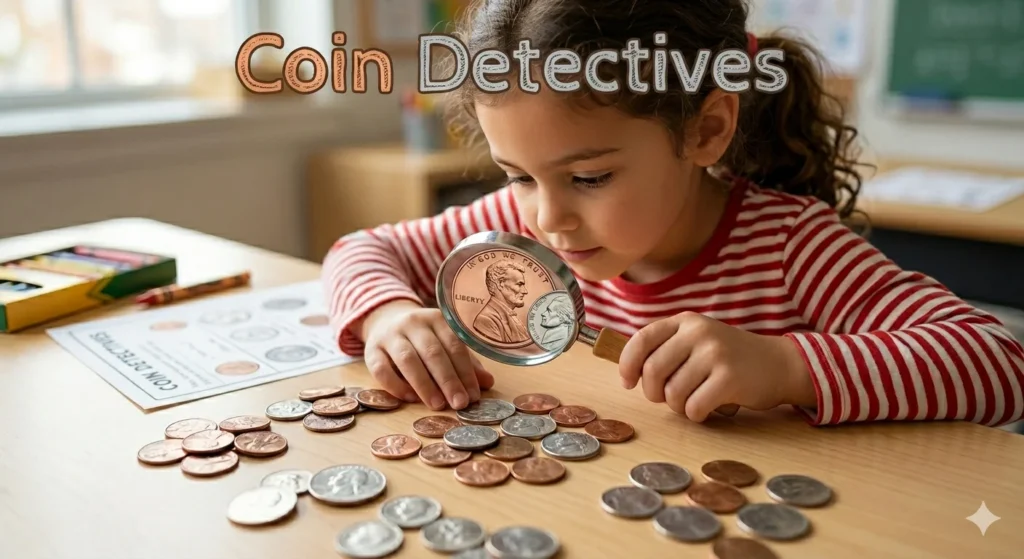
What you need: A small pile of coins (real or plastic), a magnifying glass (optional but exciting)
How it works: Give each child a small set of mixed coins. Tell them they’re detectives investigating these mysterious circles of metal. Ask them to describe each coin: What color is it? How big? What do they see on the front? What about the back?
After exploring, they sort the coins into groups and label each group with the coin’s name and value. This sensory-first approach builds the kind of visual memory that makes coin recognition automatic.
Why it works: Children who explore coins with their hands before memorizing facts develop stronger, longer-lasting recognition. The physical exploration creates a multisensory memory.
Activity 2 – Coin Sorting Mats
What you need: A printed or drawn sorting mat with four sections labeled Penny, Nickel, Dime, Quarter; a mixed set of coins
How it works: Children place each coin in the correct section of the sorting mat. For a challenge, add a timer. For support, add a reference card showing what each coin looks like.
This activity works beautifully as a math center warm-up or morning routine.
Activity 3 – Coin Rubbings
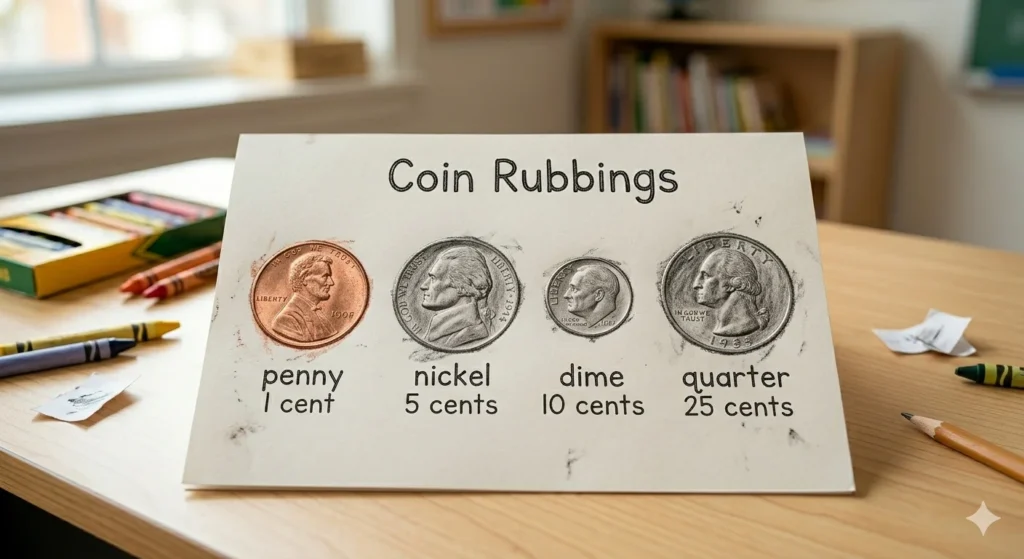
What you need: Real coins, white paper, crayons (peel the paper off for side-rubbing)
How it works: Children place a coin under paper and rub the side of a crayon over it. The coin’s image and text magically appear! Children label each rubbing with the coin’s name and value.
This is one of those activities children want to do again and again, and every repetition deepens recognition.
Hands-On Counting Money Activities for Grade 1
Once children can recognize coins reliably, it’s time to count.
Here are ten hands-on counting money activities that go well beyond worksheets.
Activity 4 – The Pretend Store
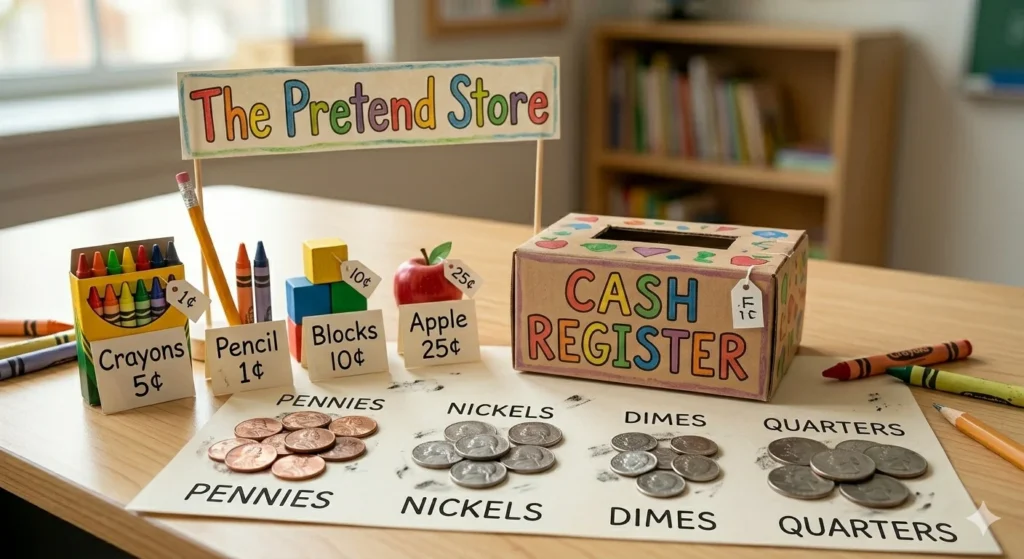
What you need: Small classroom items or paper “products,” price tags (1¢–30¢), a coin set per student, a “cashier” station
How it works: Set up a mini store in your classroom or living room. Label items with simple prices: a pencil costs 5¢, a sticker costs 10¢, a small toy costs 25¢. Children receive a set amount of coins and must select the right coins to “purchase” each item.
Start with exact-change only (no making change needed). As children get confident, add items that require combining two different coins.
Parent tip: Do this at home using pantry items! Set up cans and boxes with sticky-note price tags. Children love playing shopkeeper and customer with a grown-up.
Activity 5 – Coin Toss and Count
What you need: A penny, nickel, dime, and quarter; a flat surface; a recording sheet
How it works: Children take turns tossing a coin and calling heads or tails. They collect coins based on outcomes (e.g., heads = keep the coin, tails = return it). After five tosses, they count their total collection. The player with the most cents wins the round.
This adds a joyful random element that keeps engagement high while building counting practice naturally.
Activity 6 – Skip Count Jump
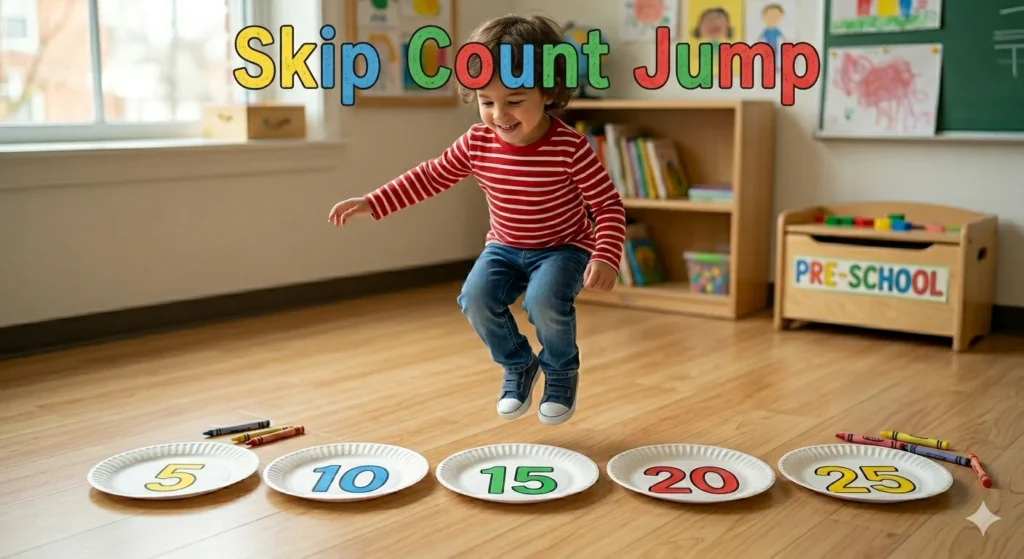
What you need: Number cards or sidewalk chalk (outdoors); a set of nickels or dimes
How it works: Write numbers 5, 10, 15, 20, 25 (for nickels) or 10, 20, 30, 40, 50 (for dimes) on paper plates or on the ground with chalk. Children place one coin on each number as they count along, jumping from plate to plate.
This connects skip counting with money counting in a physical, memorable way. Children who struggle with abstract skip counting often crack it the moment they can move through it.
For more structured skip counting practice, see our easy skip counting activities for Class 1.
Activity 7 – Coin Bingo
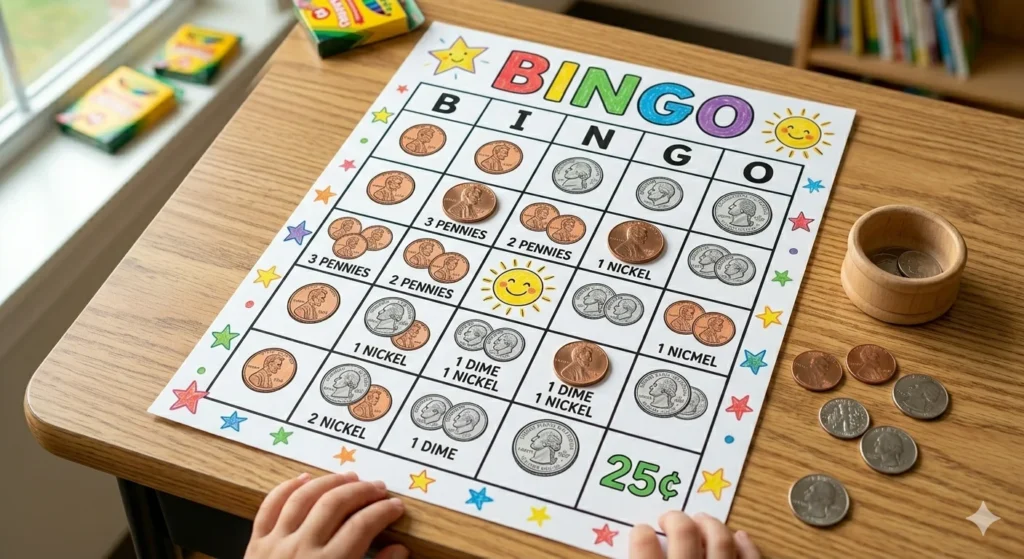
What you need: Bingo cards showing coin amounts (not coins themselves), a set of coin picture cards to draw from, small coins or counters as markers
How it works: Draw a coin picture card and call out what it shows (e.g., “Two nickels!”). Children must figure out the value (10¢) and find it on their card. First to get five in a row wins.
This is a brilliant assessment tool disguised as a game. You’ll quickly spot who can compute coin values fluently and who needs more support.
Activity 8 – The Piggy Bank Challenge
What you need: A jar or piggy bank, a bag of mixed coins, challenge cards
How it works: Write target amounts on challenge cards (e.g., “Make 15 cents using exactly 3 coins”). Children must find the right combination from the coin bag to reach the target and drop their coins into the piggy bank.
Adjust difficulty easily: start with pennies only, then same-coin combinations, then mixed.
Activity 9 – Coin War Card Game
What you need: A deck of money cards (showing coin images), two players
How it works: Shuffle the deck and deal it equally. Both players flip a card simultaneously. Whoever’s card shows a higher value keeps both cards. At the end, the player with the most cards (not most value) wins.
This is low-prep and high-engagement. Children practice instant coin recognition and value comparison without realizing they’re doing math.
Activity 10 – Money Scavenger Hunt
What you need: Coins hidden around the room or yard, a bag per child, a recording sheet
How it works: Hide coins around the space before class or playtime. Children search, collect, and then add up their haul. Bonus: add a “prize” for the child who counts most accurately (not most coins).
Hiding coins around the room turns what might be a dry counting exercise into an adventure. 🗺️
Activity 11 – Plastic Cup Prices
What you need: 5–8 plastic cups with prices written on them (5¢, 10¢, 15¢, 20¢, 25¢), a bag of coins
How it works: Children must place the exact correct coins into each cup to match its price. This is great independent center work because it’s self-checking. If you used the right coins, the cup should be “full.”
Activity 12 – The Snack Shop
What you need: Small snacks or food items (crackers, raisins, fruit pieces), paper plates, price labels
How it works: This one comes straight from classroom experience and it’s a fan favorite. Each snack item costs exactly one coin (1¢, 5¢, 10¢, 25¢). Give each child four coins (one of each). They “shop” for snacks by giving you the correct coin for each item.
No change-making needed. This is purely about matching coin to value in a real context. The food makes it instantly meaningful.
Activity 13 – Coin Memory Match
What you need: Index cards with coin images on half and values (e.g., “10 cents”) on the other half
How it works: Lay all cards face down. Children take turns flipping two cards, trying to match a coin image with its value. Classic memory rules apply.
This builds both coin recognition and value association, and it’s completely reusable across a whole unit.
Skip Counting and Money: The Connection Grade 1 Students Need
Here’s the insight that unlocks money counting for most Grade 1 students: counting coins is really just skip counting with physical objects.
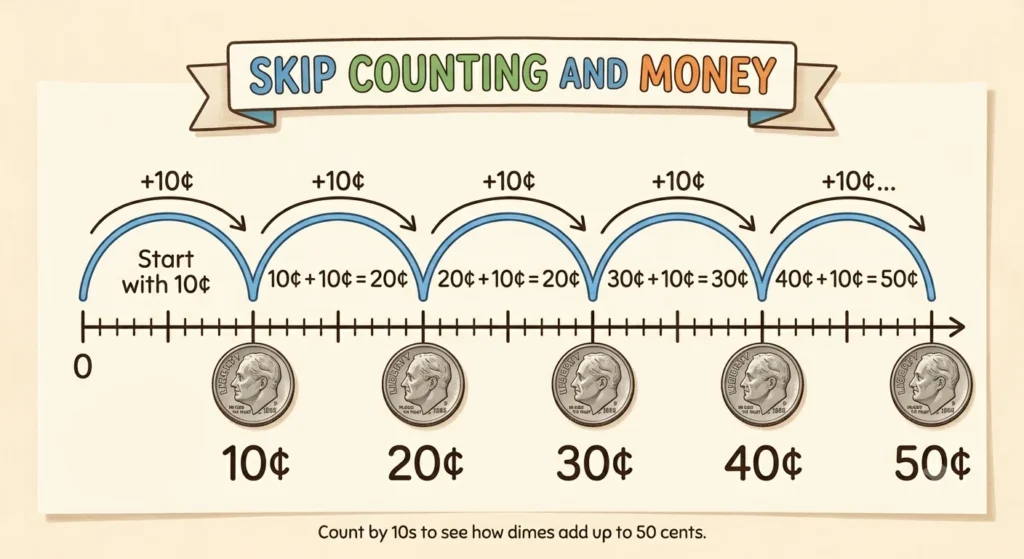
If a child can count by 5s, they can count a pile of nickels. If they can count by 10s, dimes are easy.
The trick is building skip counting fluency before the coin counting pressure hits, and then connecting the two explicitly.
Our guide on how to teach skip counting to Class 1 kids covers the foundational strategies in depth.
Counting by 5s with Nickels
Line up five nickels in a row. As you touch each one, count aloud: 5, 10, 15, 20, 25. Then replace the nickels with a picture and do the same.
The tactile experience of touching each coin while counting helps children internalize the pattern.
A simple song works wonders here. Chanting “5, 10, 15, 20, 25: that’s five nickels, I’m alive!” (or any silly rhyme your class invents) creates a memory hook.
Counting by 10s with Dimes
Same process with dimes: line them up, touch each one, count by 10s. Emphasize how fast the total grows: ten cents with every tiny coin!
Mixing It Up: Same-Coin Groups First
When children are ready to count mixed coins, teach this strategy: always start with the highest-value coin, count those, then move down.
So a pile of 1 quarter, 2 dimes, and 1 nickel would be counted: 25… 35, 45… 50.
This “count-on” strategy is more efficient than starting from pennies, and it mirrors how adults actually count change. Teach it explicitly and practice it with physical coins before moving to paper problems.
Note that skip counting also directly supports multiplication for Class 1 later on, making this practice doubly valuable.
Classroom Money Center Ideas for Teachers
A dedicated money learning center lets children practice independently while you work with small groups.
Here’s how to set one up without spending much time or money.
Setting Up Your Money Learning Station
Pick a corner of the classroom with a flat surface. A small table or two pushed-together desks work perfectly. The center should feel inviting, slightly playful, and clearly organized.
What to Include in a Grade 1 Money Center
- A coin reference poster (laminated, shows each coin’s image, name, and value)
- A bag of plastic coins (enough for 3–4 children to work simultaneously)
- Coin sorting mats (laminated so you can reuse them)
- Task cards with progressively harder counting challenges
- A “piggy bank” jar with challenge cards (see Activity 8)
- A pretend store mini-kit (small items with price tags, coin purses)
- A blank recording sheet where children write the total value of coin sets (tying neatly into data handling for Class 1 skills)
Rotate the challenge cards weekly so the center stays fresh. Children who “master” a center task can become the “coin expert” who helps classmates, which is a powerful confidence builder.
Home-Based Money Learning Activities for Parents
You don’t need classroom supplies to teach money at home. In fact, real-world moments are often the most powerful teachers.
Everyday Moments That Teach Money
- At the grocery store: Ask your child to hand over coins for small purchases. Let them count out the coins while you supervise.
- In a piggy bank: Let your child collect loose change and count it periodically. Keep a running chart of “how much we’ve saved.”
- During play: Set up a pretend café or toy store with homemade price tags. Children naturally practice both counting and spending logic during imaginative play.
- With board games: Games like Monopoly Junior or Pay Day use money concepts in a fun, low-stakes environment.
Parent Tip: The “Coin Jar” Ritual 🪙
Keep a clear jar where the family deposits loose change. Once a week, sit with your child and count the coins together. Sort by type, count each pile, then add the totals. This becomes a ritual children look forward to, and it builds money fluency through sheer repetition.
Common Mistakes Children Make When Counting Money And How to Fix Them
Knowing what trips kids up helps you get ahead of it.
Here are the three most common mistakes Grade 1 students make.
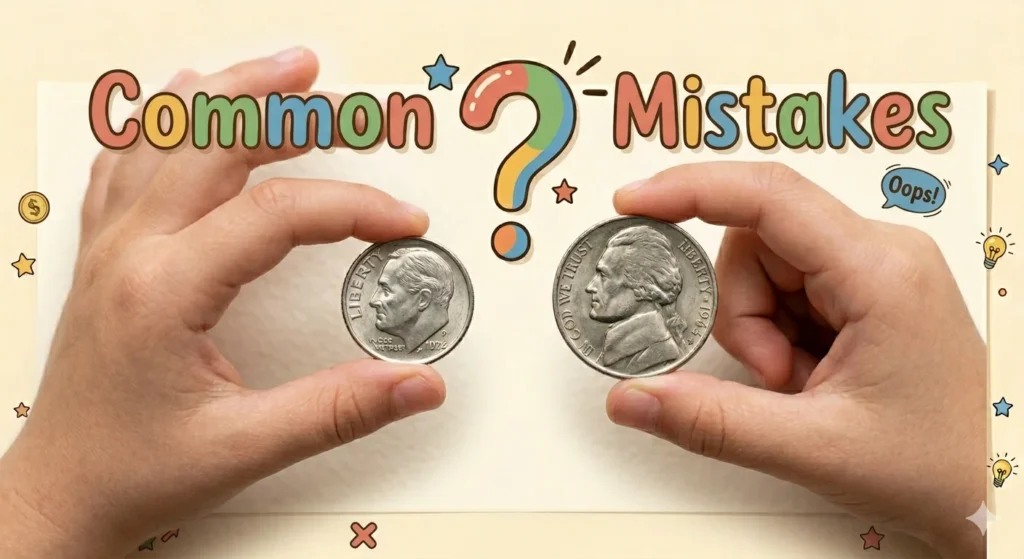
Mistake 1 – Bigger Coin = More Value
What it looks like: A child picks a nickel over a dime because it’s “bigger.”
How to fix it: Make this comparison explicit and dramatic early on. Hold up both coins and make it a puzzle: “This one is bigger, this one is smaller, but which is worth more? Let’s find out!” The element of surprise makes the correction stick.
Mistake 2 – Counting Coins by Number, Not Value
What it looks like: A child counts four coins and says “4 cents” regardless of what the coins are.
How to fix it: Before any counting activity, always have children name and sort their coins first. Build the habit: identify, sort, then count. Never let children skip the identification step.
Mistake 3 – Forgetting to Sort Before Counting Mixed Coins
What it looks like: A child starts with a penny, picks up a dime, tries to “count on” from 1 to 10, gets confused, and gives up.
How to fix it: Teach the “biggest first” strategy explicitly. Make sorting into a ritual: before counting any mixed pile, children physically move all quarters to one area, then dimes, then nickels, then pennies. Then count from largest to smallest. Practice this sequence until it’s automatic.
Counting Money Across the World’s Top 10 Currencies
Money isn’t just pennies and quarters! 🌍 Children around the world use different coins and bills.
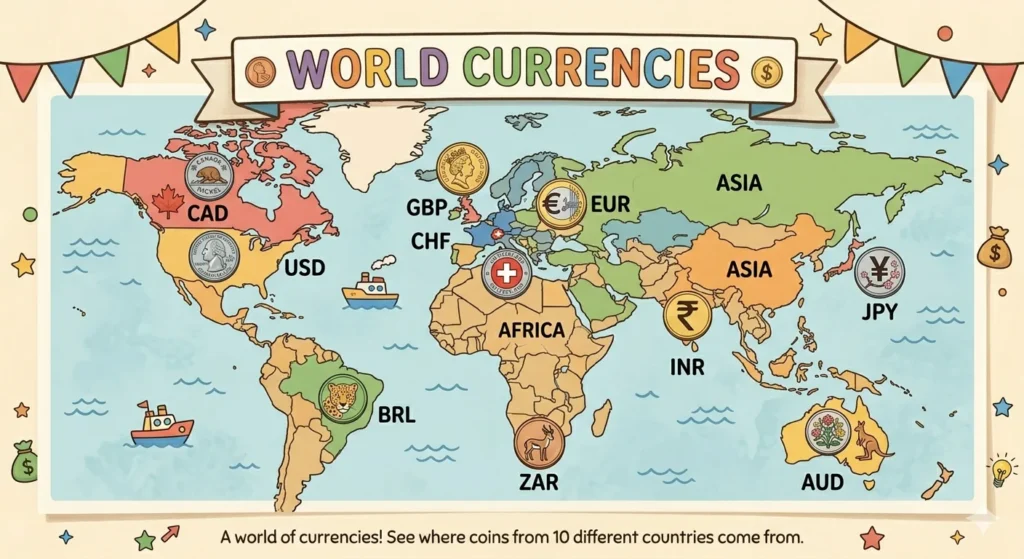
Here’s a Grade 1-friendly look at the coins used in 10 major world currencies.
| Country | Currency | Main Coins | Fun Fact for Kids |
| 🇺🇸 USA | US Dollar (USD) | Penny (1¢), Nickel (5¢), Dime (10¢), Quarter (25¢) | The penny is copper-colored because it’s made mostly from zinc with a thin copper coat! |
| 🇪🇺 Europe (EU) | Euro (EUR) | 1 cent, 2 cent, 5 cent, 10 cent, 20 cent, 50 cent, €1, €2 | Euro coins have different pictures on the back depending on which country made them! |
| 🇮🇳 India | Indian Rupee (INR) | 50 paise, ₹1, ₹2, ₹5, ₹10 | The Rupee sign (₹) was designed by a student in a national competition! |
| 🇬🇧 United Kingdom | British Pound (GBP) | 1p, 2p, 5p, 10p, 20p, 50p, £1, £2 | The 50p coin has 7 flat sides and is one of the only coins in the world shaped like a heptagon! |
| 🇦🇺 Australia | Australian Dollar (AUD) | 5c, 10c, 20c, 50c, $1, $2 | The Australian 50-cent coin is 12-sided! Australia’s coins show animals like kangaroos and platypuses. |
| 🇨🇦 Canada | Canadian Dollar (CAD) | 1¢ (penny, discontinued), 5¢, 10¢, 25¢, $1 (Loonie), $2 (Toonie) | Canada’s $1 coin is called a “Loonie” because it has a loon (a bird) on it! |
| 🇯🇵 Japan | Japanese Yen (JPY) | ¥1, ¥5, ¥10, ¥50, ¥100, ¥500 | Japan’s ¥5 and ¥50 coins have a hole in the middle! |
| 🇨🇳 China | Chinese Yuan (CNY) | 1 jiao, 5 jiao, ¥1 | China uses both coins and paper notes. The word “Yuan” means “round,” just like a coin! |
| 🇧🇷 Brazil | Brazilian Real (BRL) | 5 centavos, 10c, 25c, 50c, R$1 | Brazil’s coins show images of animals found in the Amazon, like the heron and the map! |
| 🇦🇪 UAE | UAE Dirham (AED) | 1 fils, 5 fils, 10 fils, 25 fils, 50 fils, Dh1 | The UAE Dirham has writing in both Arabic and English on its coins! |
Classroom idea: Print this table as a poster and ask children: “Which coin would you most like to collect? Why?” It sparks global curiosity while reinforcing the idea that money looks different everywhere but works the same way: it represents value.
Financial Literacy for Grade 1: Saving, Spending, and Sharing
Counting money is just the beginning. Even in Grade 1, children can start learning three big ideas that matter for their whole lives: saving, spending, and sharing.
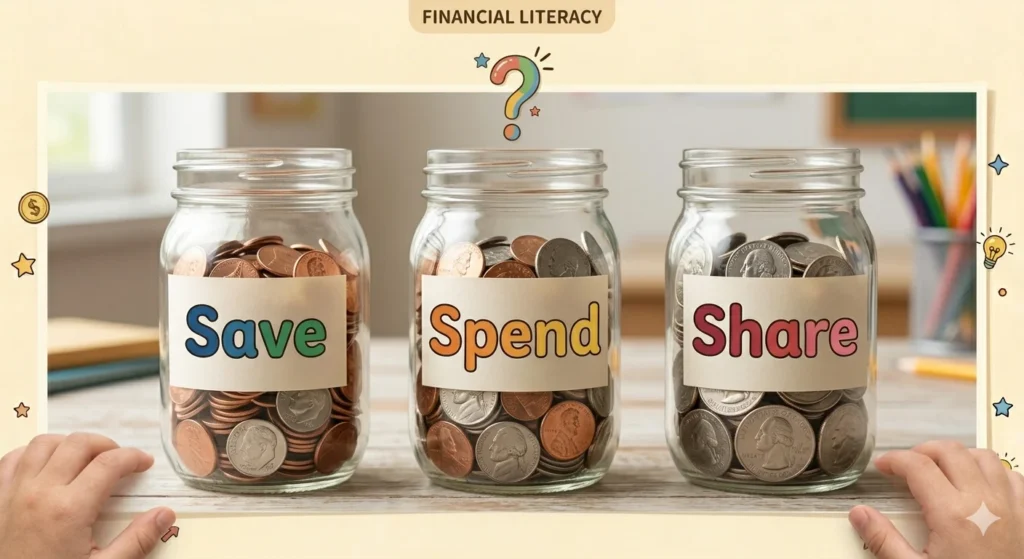
Simple Ways to Introduce Financial Concepts
Saving: Introduce the idea that not spending money means you can buy something bigger later. Use a simple visual: a jar with a goal drawn on the outside (e.g., a picture of a toy they want). Every time they add coins, they get closer to the goal.
Spending: Teach that spending is a choice. In a pretend store, ask: “You have 25 cents. The sticker costs 10 cents and the bookmark costs 20 cents. Which one can you afford? Which one do you like more?”
This also connects naturally to addition and subtraction for Class 1, where children practice the same “how much is left?” thinking.
Sharing: Introduce the concept of giving. Some families use a “three-jar system”: one jar for saving, one for spending, one for giving (to a charity or someone in need). These plants seeds of generosity alongside numeracy.
These concepts don’t need to be deep or heavy for Grade 1. Even a five-minute conversation about choices makes a difference. The goal is awareness, not full financial planning.
Practice Questions with Answers
Try these with your Grade 1 student or class. Start by reading the question aloud together.
For more practice with story-based problems, see our guide on word problems for kids.
Question 1: Amir has 2 pennies and 1 nickel. How many cents does he have? ✅ Answer: 2 + 5 = 7 cents
Question 2: Sofia has 3 dimes. How much money is that? ✅ Answer: 10 + 10 + 10 = 30 cents
Question 3: A pencil costs 15 cents. Which coins could you use to pay for it? ✅ Answer: 1 dime + 1 nickel = 10 + 5 = 15 cents ✓ (Or 15 pennies, or 3 nickels)
Question 4: Leo has 1 quarter and 2 pennies. How much money does he have? ✅ Answer: 25 + 1 + 1 = 27 cents
Question 5: Mia wants to buy a sticker for 10 cents. She has 2 nickels. Does she have enough? ✅ Answer: 5 + 5 = 10 cents. Yes! She has exactly enough! 🎉
Question 6: Which is worth more: 3 nickels or 1 dime? ✅ Answer: 3 nickels = 15 cents. 1 dime = 10 cents. 3 nickels are worth more.
Fun Challenges and Extension Activities
For students who are cruising through money basics, try these to keep them growing.
You can also pair these with our critical thinking activities for Grade 1 for an even richer extension experience.
- “Can You Make It Three Ways?” Give a target amount (e.g., 20 cents) and ask children to find three different coin combinations that equal that amount.
- “Coin Riddles” “I’m thinking of a coin that is worth 10 cents and is the smallest coin. What am I?” Children love creating their own riddles once they get the pattern.
- “More or Less?” Show two coin sets. Ask: “Which set has more money? How much more?”
- “Fill the Piggy Bank” Set a target (e.g., 50 cents). How few coins can you use to reach it? This introduces basic optimization thinking.
- “World Coin Explorer” Using the world currency table above, ask: “If Japan’s ¥10 coin is like our dime, what other coins might be similar across countries?”
Parent and Teacher Tips at a Glance
For Parents:
- Use real coins whenever possible. The weight and feel of actual money creates stronger memories than plastic.
- Involve children in real purchases (a small item at a shop) as soon as they’re ready.
- Keep it playful. If your child is frustrated, switch to a game instead of drilling facts.
- Revisit money skills regularly through everyday moments rather than formal “lessons.”
- Praise the process (“I love how you sorted first!”) not just the correct answer.
For Teachers:
- Introduce coins one at a time over several days before mixing them.
- Use the learning progression (Recognize, Sort, Count, Spend, Solve) as your unit map.
- Make the money center a rotating activity, not a one-time setup.
- Incorporate skip counting into non-money lessons. The fluency transfers directly.
- Watch for the “bigger = more” misconception early and address it head-on.
- Pair stronger and weaker students during coin games. Peer teaching is highly effective.
You’re right! Here’s the FAQ section based on the guidelines placed just before the conclusion, with 5 real “People Also Ask” questions, answers under 50 words each, and secondary keywords woven in naturally.
What coins should Grade 1 students learn first?
Start with the penny, then the nickel, dime, and quarter one at a time. Introduce each coin individually before mixing them. The most important early lesson is that bigger coins don’t always mean more value.
How do you teach counting money to Grade 1 students?
Follow this progression: recognize coins, sort by type, count same-coin groups, then mix coins using the “biggest first” strategy. Hands-on counting money activities for Grade 1, like pretend stores and coin sorting games, work far better than worksheets alone.
What are the best money activities for first graders?
The most effective money activities for Grade 1 are play-based: pretend stores, coin bingo, skip count jump, the piggy bank challenge, and coin war card games. Real coins beat plastic every time for building lasting recognition and counting fluency.
How does skip counting help with counting money?
Counting nickels requires skip counting by 5s; dimes by 10s. Children who build skip counting fluency before tackling coins find mixed-coin problems much easier. It’s the single most important foundation skill for money math in Grade 1.
How can parents help children practice counting money at home?
Use everyday moments: count loose change together weekly, set up a pretend store with pantry items, or hand your child coins during small purchases. Real-world money practice for kids builds far more confidence than any worksheet.
Make Preparing for Math Olympiad Simple!



Final Thought
Counting money for Grade 1 is about more than coins and cents.
When children learn to recognize, sort, and count money through play-based, real-world activities, they’re building the number sense, skip counting fluency, and math confidence that carry them far beyond a single unit.
At Gonit, we’ve built our Grade 1 math content around exactly this philosophy: concept-first learning that makes skills stick, not just get memorized.
We designed our money activities to match the same Recognize, Sort, Count, Spend, Solve progression you’ve seen throughout this guide.

Mikha Piregu is a Content Writer with experience spanning educational content, including math and math olympiad topics, as well as advocacy writing, research-based articles, and SEO-driven web content. He creates high-quality blog content, web copy, and feature articles that support brand visibility, audience engagement, and long-term organic growth through data-informed storytelling. Skilled in WordPress, WooCommerce, and modern digital tools, Mikha adapts content across various platforms, including blogs, websites, campaigns, and advocacy initiatives, with clarity and purpose.

There are no comments posted here yet.
Sign in to leave a comment