


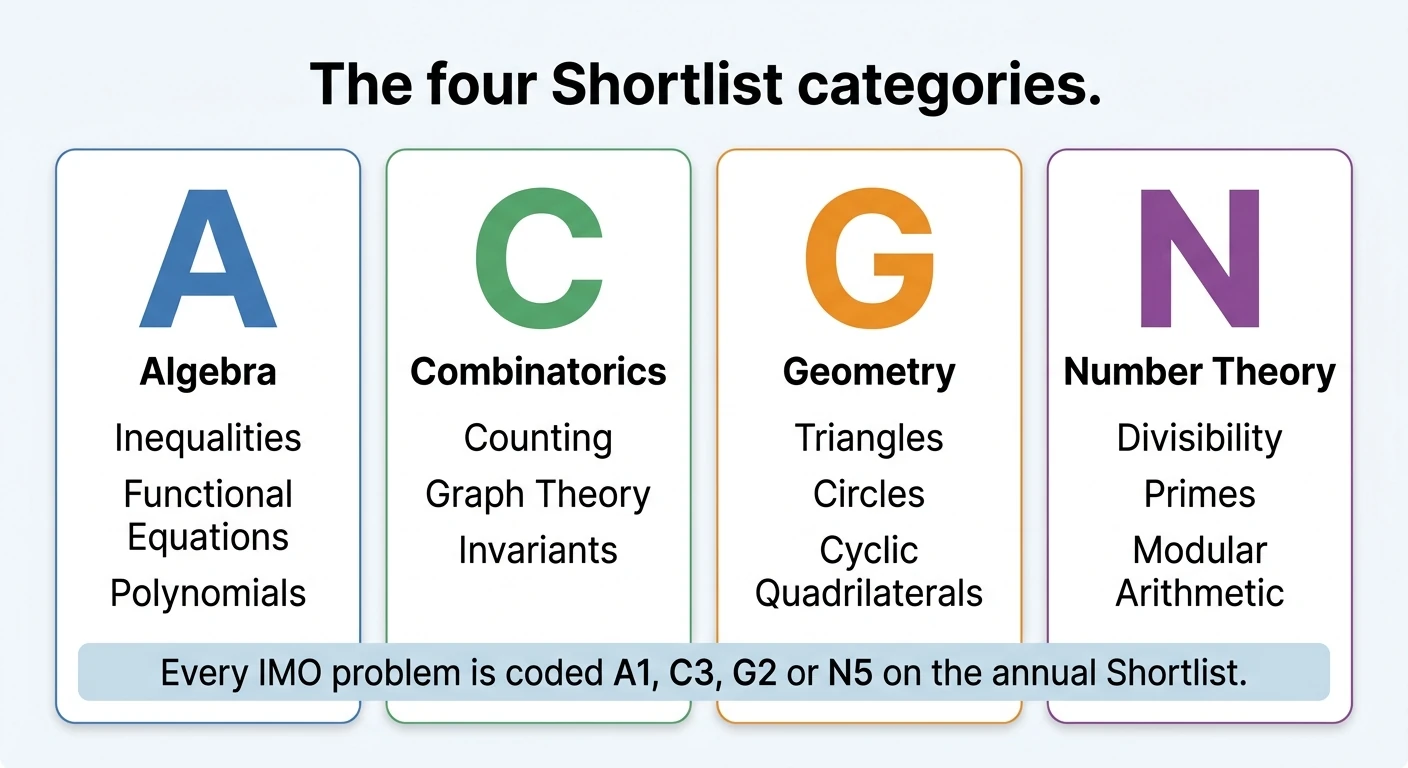
The International Mathematical Olympiad has no official syllabus. Problems test creative proof rather than curriculum recall, so no topic list is published. Every paper draws from the same four areas:
- Does the IMO Have an Official Syllabus?
- The Four Topic Areas
- IMO Exam Pattern and Marking
- Who Can Take the IMO? Eligibility and Age Limit
- IMO Syllabus by Class: What to Study at Each Stage
- Why "IMO Syllabus for Class 1" Searches Are Confusing
- How Students Actually Reach the IMO
- Frequently Asked Questions
- Key Takeaways
- Algebra: functional equations, inequalities (AM-GM, Cauchy-Schwarz, Jensen), polynomial equations, sequences and series, complex numbers.
- Number theory: modular arithmetic, divisibility, Diophantine equations, prime numbers, quadratic residues, Fermat’s Little Theorem.
- Geometry: Euclidean geometry, cyclic quadrilaterals, power of a point, homothety, inversion, collinearity and concurrency. No calculus or coordinate bashing needed.
- Combinatorics: counting methods, graph theory basics, colouring problems, invariants and monovariants, the pigeonhole principle.
This guide cover imo syllabus for all grades, the exam pattern and marking, who is eligible, and what to study in each class.
Does the IMO Have an Official Syllabus?
No. The IMO Board publishes General Regulations, Annual Regulations and every past paper since 1959, but no syllabus document for any year group or class.
The only scope definition appears in clause 4.2 of the General Regulations, which governs what countries may propose as problems:
The proposals should, as far as possible, cover various fields of pre-university mathematics and be of varying degrees of difficulty.
That vagueness is deliberate. The IMO tests whether a student can solve a problem they have never seen before, so a published topic list would undermine the point. Tellingly, the best-known topic guide in the community, written by a former IMO gold medallist, is titled an unofficial syllabus for exactly this reason.
What you can rely on instead is the structure of the Problem Shortlist, which has been consistent for decades.
The Four Topic Areas
Every year the host country’s Problem Selection Committee compiles a Shortlist from proposals submitted by participating nations. That Shortlist is sorted into four categories, and each problem is coded by letter: A for Algebra, C for Combinatorics, G for Geometry, N for Number Theory. A1 is the first algebra problem of that year, G3 the third geometry problem, and so on.
Those four letters are the closest thing to an IMO syllabus that exists.
| Area | Code | What it covers | Typical problem style |
|---|---|---|---|
| Algebra | A | Functional equations, inequalities (AM-GM, Cauchy-Schwarz, Jensen), polynomials, factorisation, sequences | Prove an inequality, or find all functions with a given property |
| Combinatorics | C | Counting methods, graph theory, colouring, invariants and monovariants, pigeonhole | Prove a configuration exists, or that a process must terminate |
| Geometry | G | Triangles, cyclic quadrilaterals, power of a point, homothety, inversion, symmetry | Prove three points are collinear, or two circles are tangent |
| Number Theory | N | Divisibility, primes, modular arithmetic, Diophantine equations, quadratic residues, Fermat’s Little Theorem | Prove something is impossible, or find all integers satisfying a condition |
Two boundaries are worth knowing.
- Calculus is not required. “Pre-university” rules it out, and no IMO problem has needed it.
- No formula sheet exists. Students are expected to know standard results and to prove anything non-standard they use.
Our collection of math olympiad questions shows how these look as real problems, how to solve math olympiad problems covers the approach, and free math olympiad training online collects practice material for each area.
IMO Exam Pattern and Marking
The format is fixed by the General Regulations and has not changed in years.
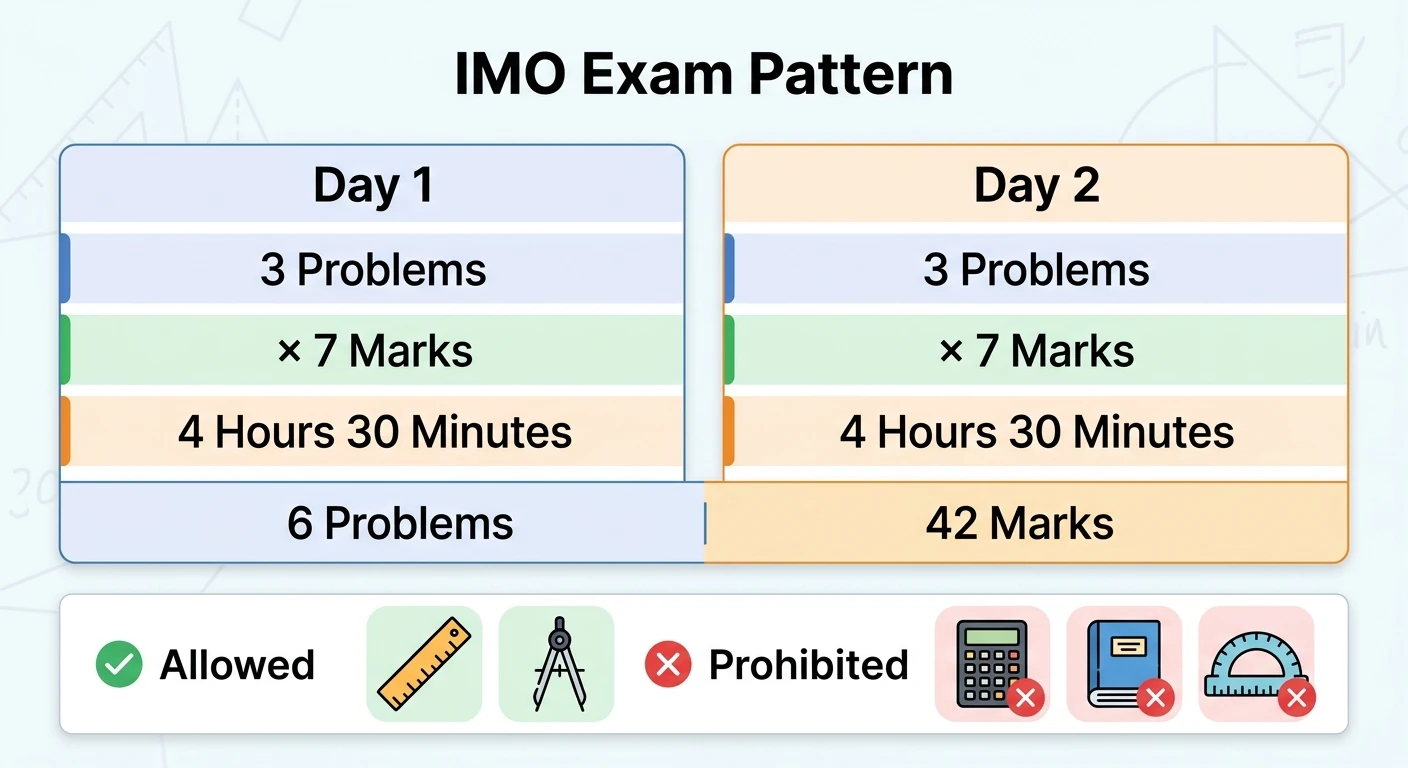
| Days | 2 consecutive days |
| Time per day | 4 hours 30 minutes |
| Problems per day | 3 |
| Total problems | 6 |
| Marks per problem | 7 |
| Total marks | 42 |
| Format | Full written proofs, no multiple choice |
| Team size | Up to 6 contestants per country |
Clause 5.4 lists what you may bring: writing and drawing instruments, including rulers and compasses. Books, papers, tables, calculators, protractors, computers and communication devices are all prohibited.
Scores are set through a process called coordination, where each team’s Leader and the host country’s Coordinators agree a mark out of seven for every problem. Partial credit is real, so a well-argued incomplete solution can still score. That is why writing the argument clearly matters as much as reaching the answer, a point covered in detail in how to get full marks in maths olympiad.
How Medals Are Awarded
Medals go to at most half the contestants, in a roughly 1:2:3 ratio of gold to silver to bronze. The cut-offs are not fixed. They are set each year by the Jury based on how the field performed, which means the same score can earn different medals in different years.
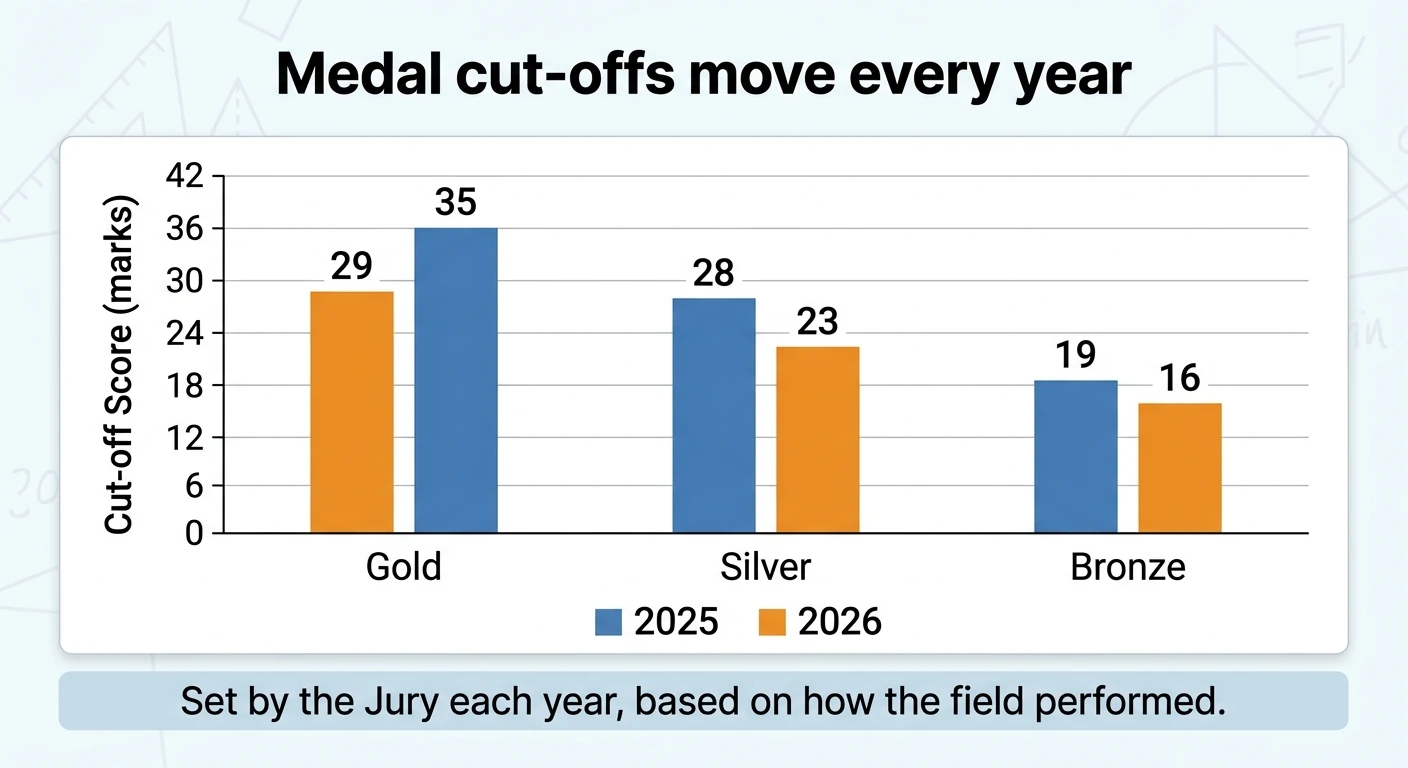
| Year | Gold | Silver | Bronze |
|---|---|---|---|
| IMO 2026, Shanghai | 29 | 23 | 16 |
| IMO 2025, Sunshine Coast | 35 | 28 | 19 |
The swing between those two years is large, and it reflects paper difficulty rather than a change in standards. At IMO 2026 the Jury awarded 55 golds, 105 silvers and 189 bronzes.
Under clause 5.8, any contestant who does not win a medal but scores a full seven on at least one problem receives a Certificate of Honourable Mention. At IMO 2026, 141 contestants received one.
Who Can Take the IMO? Eligibility and Age Limit
Clause 2.2 sets three conditions. A contestant must:
- Be under 20. Specifically, born on or after 1 July in the year 20 years before the competition.
- Be in full-time primary or secondary education, or be home-schooled without a high-school diploma and working toward one.
- Be selected through their country’s national Mathematical Olympiad or equivalent programme.
Note what condition 2 says: primary education counts. There is no lower age limit anywhere in the regulations, and the record books prove it is not merely theoretical.
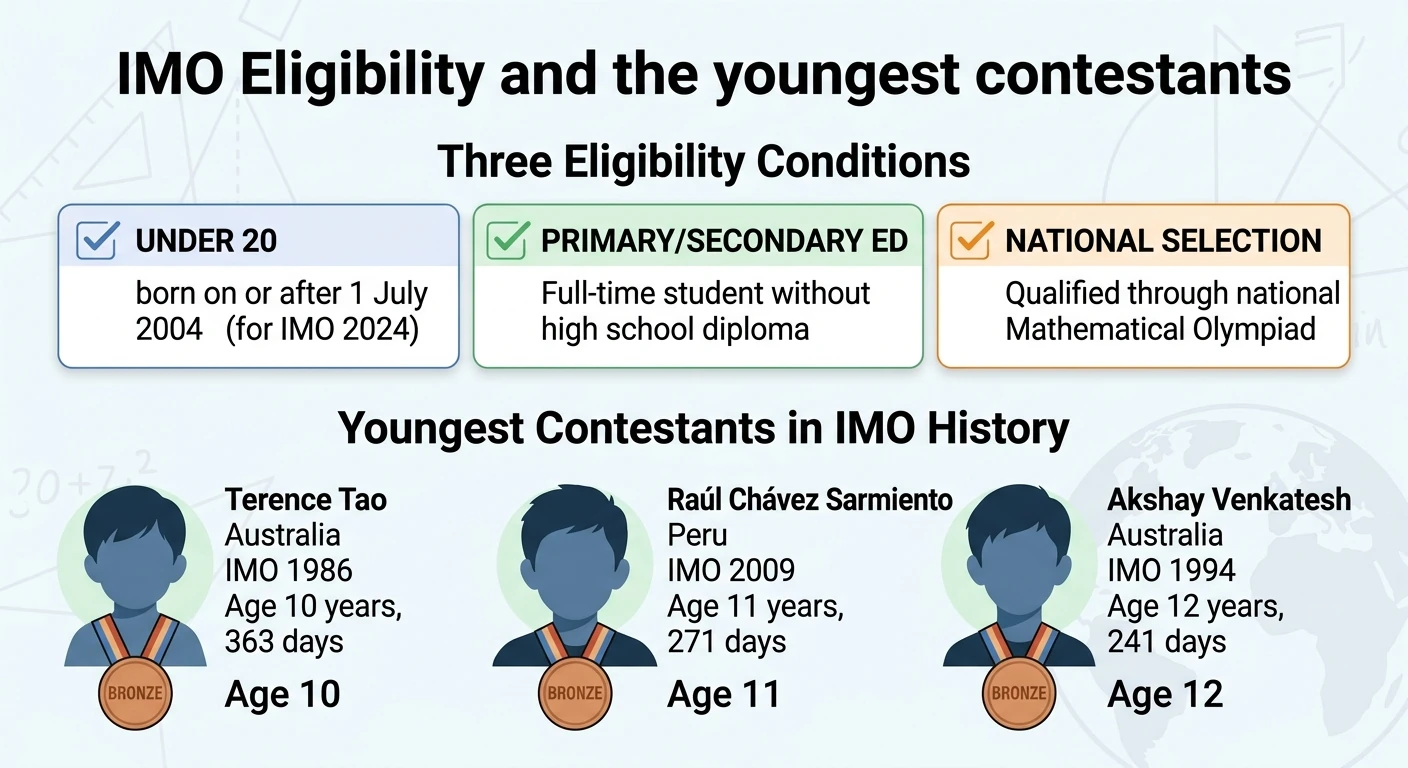
| Contestant | Country | Year | Age | Result |
|---|---|---|---|---|
| Terence Tao | Australia | 1986 | 10 years, 363 days | Bronze |
| Raúl Chávez Sarmiento | Peru | 2009 | 11 years, 271 days | Bronze |
| Akshay Venkatesh | Australia | 1994 | 12 years, 241 days | Bronze |
Tao went on to win gold at 13, still the youngest gold medallist in IMO history, and later a Fields Medal.
These are extreme outliers. Almost every contestant is between 15 and 19, not because of any rule but because the national selection rounds that feed the IMO are themselves pitched at senior secondary level.
One further rule: a student may not attempt the final selection examinations of more than one country in the same year. The regulations call this “IMO tourism” and prohibit it outright.
Eligibility for the school-level exams that share the IMO name works completely differently. Those rules are set out in IMO exam eligibility criteria for Classes 1 to 12, and for the American contests in AMC age limit.
IMO Syllabus by Class: What to Study at Each Stage
Since the IMO publishes no class-wise syllabus, the useful question is different. What should a student in each class actually be doing if the IMO is the goal?
In India there is one hard, class-based gate that answers this. IOQM, the first stage of the national selection chain, is open to students in Classes 8 to 12. For the 2026-27 cycle, candidates had to be born between 1 August 2007 and 31 July 2014. Before Class 8 there is no national-track exam to sit, so everything earlier is preparation.
| Class | Realistic target | What to work on | Gonit guide |
|---|---|---|---|
| 1 to 4 | School-level olympiads such as Math Kangaroo and MOEMS | Number sense, patterns, logical reasoning, word problems | Junior math olympiad guide |
| 5 to 7 | MATHCOUNTS and middle-school contests | Fractions, ratio, basic geometry, counting problems | Competition math for middle school |
| 8 to 9 | First IOQM attempt | Class 8 topics, number theory basics, inequalities, angle chasing, pigeonhole | IOQM syllabus |
| 10 | IOQM, then RMO | Modular arithmetic, functional equations, circle geometry, induction | RMO |
| 11 | RMO, then INMO | Full proof writing across all four areas | INMO |
| 12 | INMO, training camp, IMO | Past Shortlist problems, timed full papers | How to prepare for the IMO |
The pattern is that the four areas never change. What changes is depth, and the point at which a student switches from finding answers to writing proofs. In the Indian system that switch happens at RMO, which is the first proof-based round. Before it, correct answers are enough. After it, the argument carries the marks.
For the youngest students, how to prepare for the junior math olympiad covers where to begin. If the IMO is not the goal and you simply want a suitable competition for a younger child, the best math competitions in the world compares the realistic options by age.
Why “IMO Syllabus for Class 1” Searches Are Confusing
Two completely different exams share the acronym, and one of them does publish class-wise syllabi.
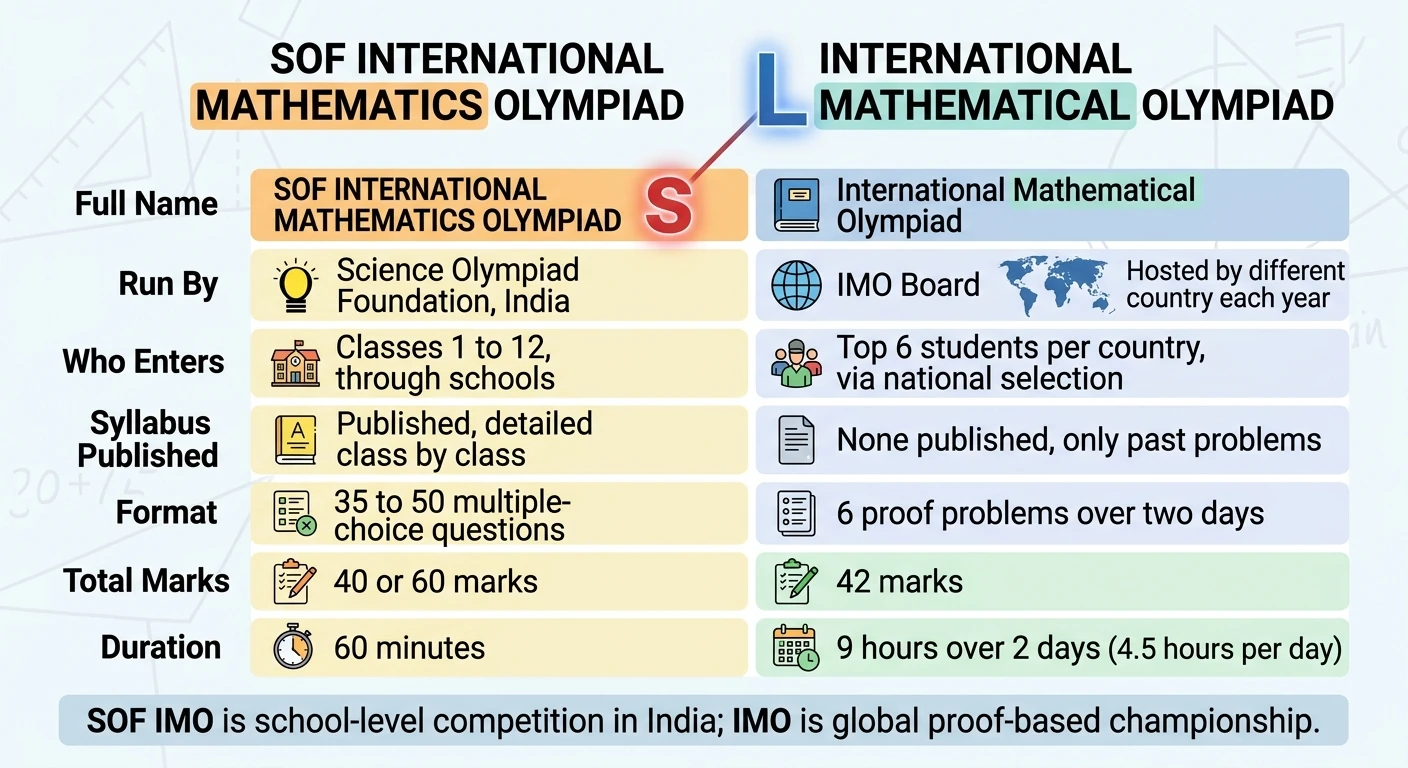
| SOF IMO | International Mathematical Olympiad | |
|---|---|---|
| Full name | International Mathematics Olympiad | International Mathematical Olympiad |
| Run by | Science Olympiad Foundation, India | IMO Board, hosted by a different country each year |
| Who enters | Classes 1 to 12, through their school | Six students per country, via national selection |
| Syllabus | Published, class by class | None published |
| Format | 35 to 50 multiple-choice questions | 6 proof problems over two days |
| Total marks | 40 or 60 | 42 |
| Duration | 60 minutes | 9 hours across two days |
If you are a parent searching for a Class 1, Class 5 or Class 8 syllabus, you almost certainly want SOF IMO, which publishes one for every class. Our SOF IMO syllabus page has the class-wise breakdown and SOF IMO exam pattern has the marks per section.
The two are not connected. A strong SOF IMO result does not qualify a student for the International Mathematical Olympiad, and the route to the latter runs entirely through IOQM, RMO and INMO. SOF IMO vs IOQM sets the two tracks side by side, and IOQM full form untangles the acronyms across the whole Indian system.
How Students Actually Reach the IMO
Every contestant arrives through their own country’s selection chain. The regulations require it, and there is no direct entry or individual registration.
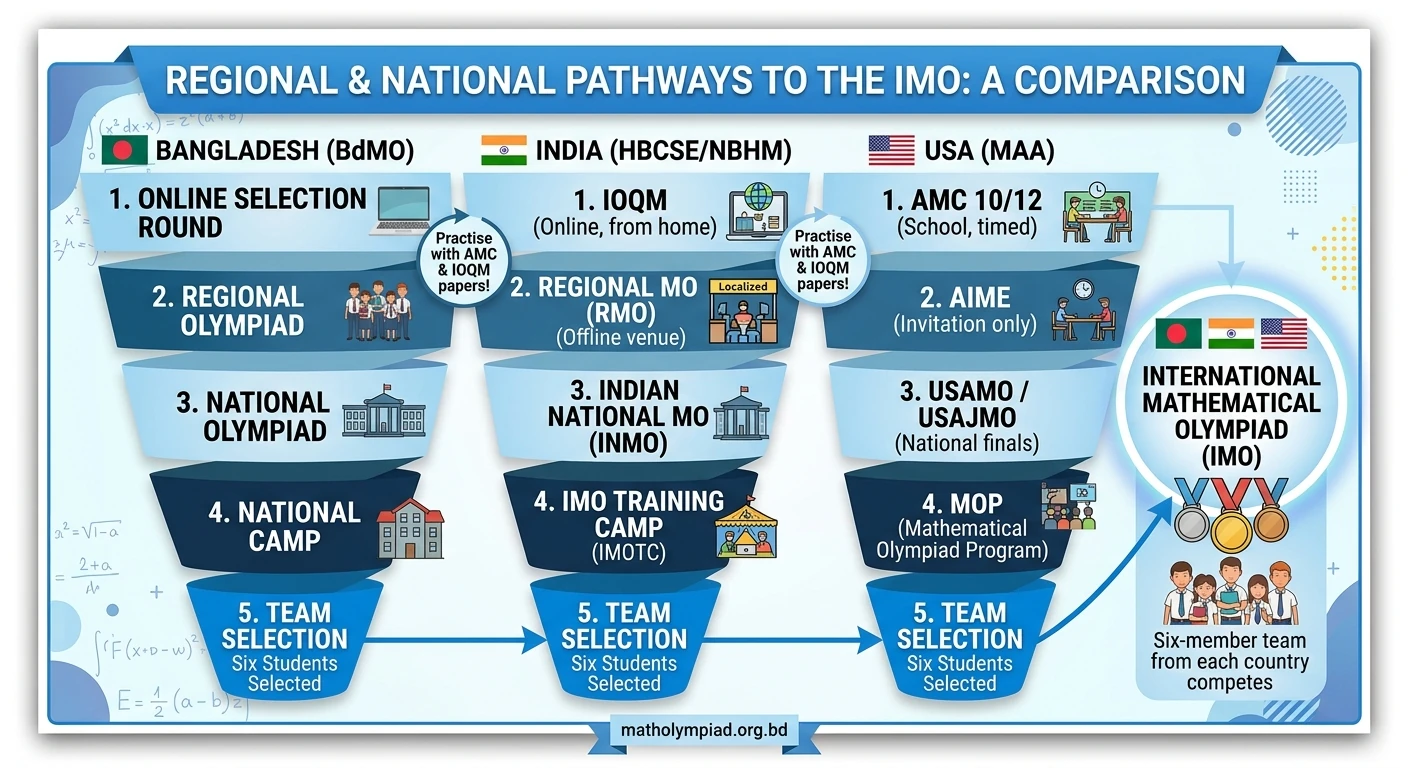
From India, the route is IOQM in September, then RMO in November, then INMO in January, then the training camp, then the six-member team. Dates shift each cycle, so confirm them against the official HBCSE announcement.
India’s 2026 team won two golds and four silvers at Shanghai, with golds for Aarav Gupta and Abel George Mathew.
From the USA, it runs through AMC 10 or 12, then AIME, then USAMO or USAJMO, then MOP, then Team Selection Tests. See how to qualify for the IMO in the USA, with topic coverage in the AMC syllabus. USAMTS is a free parallel route into the same proof rounds.
From Bangladesh, it runs through the BdMO online round, the regional olympiad, the national olympiad and the national camp. See how to qualify for the IMO from Bangladesh.
From Canada, selection runs through the CEMC contests.
The names differ, the shape does not: a broad entry round, a national round, a training camp, and a team of six.
The 67th IMO was held in Shanghai in July 2026. The 68th will be held in Budapest, Hungary, from 16 to 26 July 2027.
Frequently Asked Questions
What is the syllabus of the IMO?
There is no official syllabus. The IMO’s regulations state only that problems should cover “various fields of pre-university mathematics.” Every problem comes from algebra, combinatorics, geometry or number theory, the four categories used to organise the annual Problem Shortlist. Calculus is never required.
Is there an IMO syllabus for Class 1?
Not for the International Mathematical Olympiad, which has no class-wise structure. If you want a Class 1 syllabus you are looking for SOF IMO, a separate school-level exam that publishes one for every class from 1 to 12.
What is the IMO exam pattern?
Six problems across two consecutive days, three per day, four and a half hours each day. Each problem is worth seven marks, for a maximum of 42. All answers are full written proofs, and calculators are not permitted.
What is the age limit for the IMO?
Contestants must be under 20, specifically born on or after 1 July in the year 20 years before the competition. They must also be in full-time primary or secondary education and must not hold a high-school diploma.
Can a primary school student take the IMO?
Yes in principle. The regulations set no lower age limit and explicitly include primary education. Terence Tao competed for Australia in 1986 aged 10 years and 363 days and won a bronze medal, which remains the youngest participation on record. In practice it is vanishingly rare, because entry runs through national selection rounds aimed at senior students.
How many marks do you need for a gold medal?
It changes every year. The Jury sets cut-offs after seeing how the field performed. Gold required 29 marks at IMO 2026 but 35 at IMO 2025. Medals go to at most half the contestants, in roughly a 1:2:3 ratio of gold to silver to bronze.
Does calculus come in the IMO?
No. The regulations limit problems to pre-university mathematics, and no IMO problem has required calculus. The four areas are algebra, combinatorics, geometry and number theory.
What class can I start preparing for the IMO in?
You can build the skills at any age, but the first exam on the Indian national track is IOQM, which is open to Classes 8 to 12. Before Class 8 there is no national-track paper to sit, so earlier years are about building reasoning through school-level olympiads.
How do I qualify for the IMO?
Through your country’s national olympiad selection programme. There is no direct entry. In India that means IOQM, then RMO, then INMO, then the training camp.
Is SOF IMO the same as the International Mathematical Olympiad?
No. They share an acronym and nothing else. SOF IMO is a multiple-choice school exam for Classes 1 to 12 in India. The International Mathematical Olympiad is the global proof-based championship for six students per country.
Key Takeaways
- The IMO publishes no syllabus. Its regulations define scope only as “various fields of pre-university mathematics.”
- Every problem comes from algebra, combinatorics, geometry or number theory, the four Shortlist categories coded A, C, G and N.
- The format is six problems over two days, 4.5 hours per day, seven marks each, 42 in total.
- Medal cut-offs move every year. Gold was 29 in 2026 and 35 in 2025.
- Eligibility is under 20 and in primary or secondary education. There is no lower age limit, and Terence Tao competed at 10.
- There is no class-wise IMO syllabus. Searches for one almost always mean SOF IMO, a different exam.
- On the Indian track, Class 8 is the first year a student can sit IOQM and enter the national chain.
Starting out? Read how to prepare for the IMO for a full study plan, or how to improve problem solving skills for IMO if you are already practising but stuck.

Contributor at Gonit Worksheets, writing about math learning that works for real kids.


There are no comments posted here yet.
Sign in to leave a comment