


To practice for the AMC 8 the right way, focus on high-quality timed mock tests and structured error analysis.
- What the AMC 8 actually is
- AMC 8 Test Format at a Glance (2027)
- Where to find official AMC 8 past papers
- Free AMC 8 Practice Test: 5 Sample Questions With Answers
- How many practice tests should your student take?
- How to simulate real exam conditions
- The single most important habit: an error log
- A realistic 8 to 12 week practice plan
- Free past papers vs. structured practice
- What counts as a good AMC 8 score
- Common practice mistakes to avoid
- The bottom line
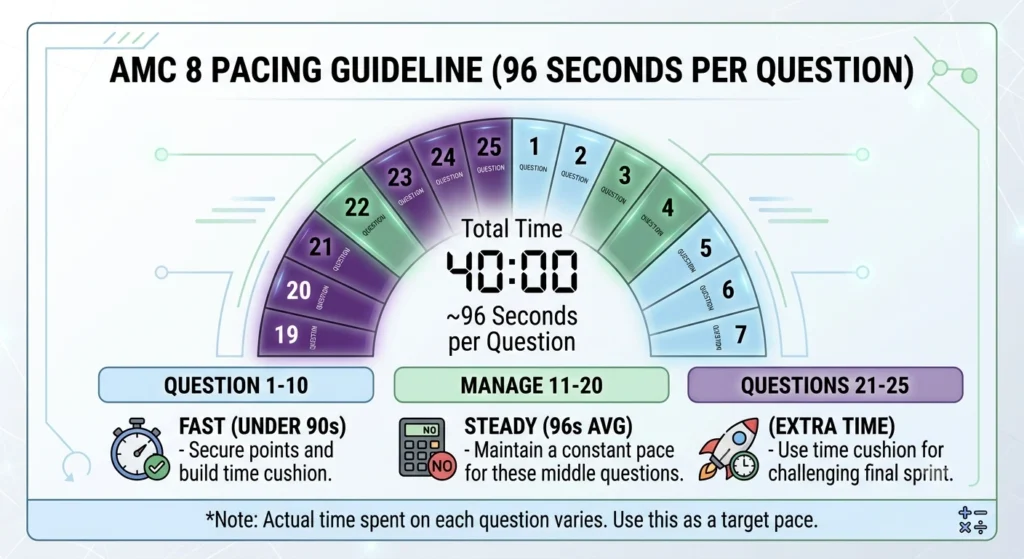
Because the exam consists of 25 multiple-choice questions in just 40 minutes, pacing and pattern recognition are critical.
To use AMC 8 practice tests well, take four to eight full-timed papers from the official AoPS and MAA archives, simulate real conditions (40 minutes, no calculator, phone away), and review every mistake in an error log.
This guide is for parents of grade 6 to 8 students (and motivated students themselves) who want to practice the way top scorers do.
What the AMC 8 actually is
Before picking a practice paper, know what you’re practicing for.
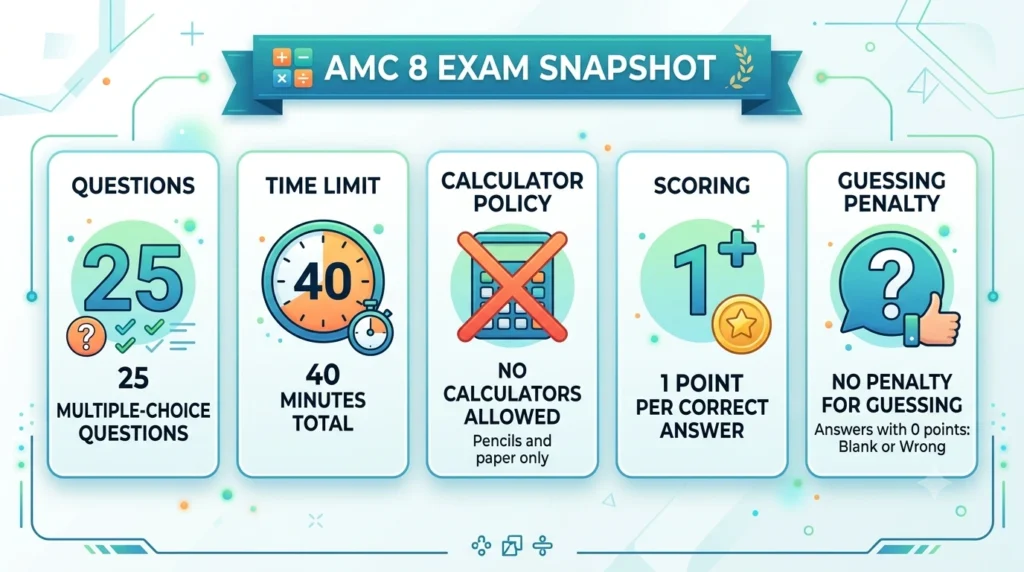
The AMC 8 is run by the Mathematical Association of America for students in grade 8 and below who are under 15.5 on test day (per current official MAA policy; some older sources still list 14.5).
- 25 multiple-choice questions, 40 minutes, no calculators.
- 1 point for correct, 0 for blank or wrong so there is no penalty for guessing.
- Topics: arithmetic, number theory, algebra basics, counting and probability, plane geometry, and simple logic.
- Given once a year in a one-week window in late January.
Three things follow:
- Pacing matters. Roughly 96 seconds per problem. Most students below honor roll (top 5%) lose points to the clock, not the math.
- Never leave a question blank. With no penalty, every blank is a free 20% shot.
- The exam is consistent. A 2014 problem looks almost identical in style to a 2024 one, which is why past papers are the highest-leverage practice material.
If you’re new to the exam itself, our AMC syllabus guide breaks down exactly which topics show up and in what proportion, and our AMC age limit guide covers eligibility rules in detail.
AMC 8 Test Format at a Glance (2027)
| Feature | AMC 8 |
|---|---|
| Questions | 25 multiple choice |
| Time | 40 minutes |
| Scoring | 1 point per correct answer, no penalty for wrong answers, maximum 25 |
| Calculator | Not allowed |
| 2027 dates | One day between January 21 and 27, 2027, chosen by your host |
| Who can take it | Grade 8 or below, under 15.5 years old on contest day |
Because there is no penalty, students should answer every question, even with a quick guess at the end.
Where to find official AMC 8 past papers
Three sources, in order of usefulness:
- AoPS AMC 8 Problems and Solutions wiki. Every official AMC 8 from 1999 onward with community-vetted solutions. The de facto archive.
- MAA’s official AMC page. Problems and solutions for past contests; the most recent year is released after the window closes.
- Po-Shen Loh’s LIVE past contests archive. Clean printable PDFs with solutions, curated by a former US IMO coach.
A few warnings:
- Don’t pay for “exclusive” past papers. Anyone selling them is repackaging public material.
- Avoid AI-generated practice tests. They look right but use the wrong difficulty curve and contain subtle errors. Stick to real papers for timed practice.
- Don’t republish problems. The MAA owns the copyright. Print for your own student; don’t share publicly.
Build one folder called “AMC 8 Past Papers” and drop a PDF for each year. You’ll use it many times over the next 8 to 12 weeks.
For a broader roundup of where to find quality practice material beyond past papers, see our guide to the best free AMC practice resources.
Free AMC 8 Practice Test: 5 Sample Questions With Answers
Try these warm-up questions in about 8 minutes, the same pace as the real test (40 minutes for 25 questions).
- What is the smallest positive whole number that is divisible by 2, 3, 4, 5 and 6?
- A rectangle has a perimeter of 30 cm and a length of 9 cm. What is its area?
- How many two-digit numbers have digits that add up to 5?
- The average of four numbers is 15. When a fifth number is added, the average becomes 16. What is the fifth number?
- Two fair coins are flipped. What is the probability of getting at least one head?
Answers: 1) 60, the least common multiple of 4, 5 and 6, which is also divisible by 2 and 3. 2) 54 square cm, because the width is (30 minus 18) divided by 2 = 6. 3) 5 numbers: 14, 23, 32, 41 and 50. 4) 20, because the total grows from 60 to 80. 5) 3/4, because only “tails, tails” has no head.
For full-length tests, use the official past papers below.
How many practice tests should your student take?
The right number for most students is four to eight full, timed practice tests over the prep cycle.
- Fewer than four and your student never gets used to the 40-minute pacing or seeing question 23 with eight minutes left.
- More than eight and you hit diminishing returns. Pre-2010 papers use a slightly different difficulty curve; recent years are more representative.
A reasonable cadence: one full timed mock every 7 to 10 days during the second half of prep, with the most recent three to four years saved for the final four weeks.
Between mocks, do short timed sets 10 to 12 questions in 16 to 20 minutes from older papers. These build pacing without burning your supply of recent papers.
How to simulate real exam conditions
The single biggest mistake we see: “practice tests” done at the kitchen table with a calculator, a phone nearby, and a parent occasionally answering questions.
That’s a tutoring session in disguise.
Set the conditions up properly:
- Phones and tablets in another room. No exceptions.
- Print the paper or use a non-interactive PDF. Paper feels different than screen, and most centers still use paper.
- 40 minutes, single timer. No pausing, no “5-minute think break.” Timer hits zero, pencils down.
- Mark as you go. Circle uncertain question numbers; asterisk the one to come back to.
- Always fill in an answer. Every blank is a free 20% shot.
- No review during the test. Save it for after.
Done right, a full timed practice test takes 70 to 80 minutes total: 40 for the test, 25 to 35 for an honest review.
The single most important habit: an error log
If you take one piece of advice from this guide, take this one. The students who improve most between practice tests keep an error log.
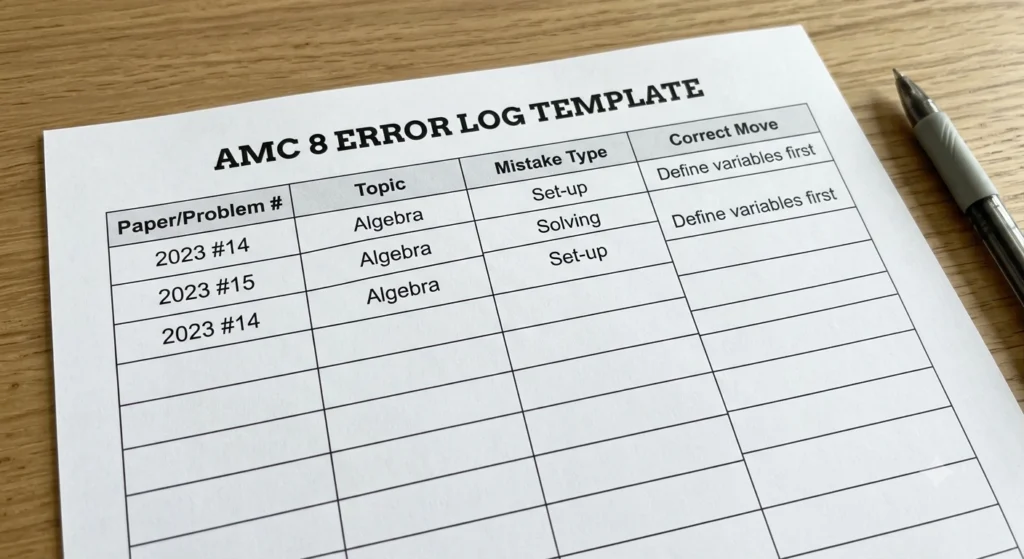
It’s a simple document a notebook page, Google Doc, or spreadsheet recording every problem your student got wrong (or guessed right by luck), and why. For each missed question, write four things:
- Paper and problem number (e.g., “2023 AMC 8, #14”).
- Topic (e.g., “counting, casework”).
- Mistake type. One of: Read (misread the question), Set-up (knew the topic but framed wrong), Execute (set up right, computed wrong), or Time (skipped or guessed because of the clock).
- Correct move in one sentence. “Use complementary counting.” “Recognize the 3-4-5 right triangle.” “Set up two equations in two variables.”
After three or four tests, patterns emerge. One student has ten “Read” errors and almost no “Set-up” errors; they need to slow the first read-through, not learn more math.
Another has eight “Time” errors clustered on questions 18 to 22 they need pacing practice and a stronger first 15 minutes, not more problem sets.
This is why most “we did 10 past papers and the score didn’t move” stories happen. The student did the tests but never extracted the lessons.
A realistic 8 to 12 week practice plan
Adjust the start date so week 12 ends the week before test day. For a January 2027 sitting, start in late October or early November 2026.
| Phase | Weeks | What to do | Time per week |
|---|---|---|---|
| Diagnose | 1 | One full timed paper (use a 2-year-old one). Start the error log. Identify top 2 weak topics. | ~90 min |
| Foundation | 2 to 4 | Topic-by-topic drilling on the two weakest areas. Short timed sets (10 to 12 problems) twice a week. No full mocks yet. | 60 to 90 min |
| Build | 5 to 7 | One mini-mock per week (12 questions in 20 min) plus continued topic drilling. Introduce pacing strategy. | 90 to 120 min |
| Simulate | 8 to 10 | One full timed past paper per week. 30 minutes of error-log review after each. Drill weak topics on off days. | 120 to 150 min |
| Taper | 11 | One last full mock early in the week. Light review of error log only. No new content. | ~75 min |
| Test week | 12 | Two or three problems a day from old papers. Sleep. Confidence over cram. | 30 to 45 min |
A few notes:
- Skip a week during school finals. Better to pause than burn out.
- The error log is the connective tissue. Without it, the plan is just a calendar.
- Topic order matters. Standard sequence: arithmetic and number theory → counting and probability → algebra basics → geometry.
- Most students find geometry hardest, so extra time there is normal. For the full topic map, see our AMC syllabus guide and the broader how to prepare for the AMC.
Free past papers vs. structured practice
The honest answer is “both, in the right proportion.”
Past papers are non-negotiable, the only authentic source. But papers alone don’t teach why a problem yielded to a trick, or which topic to drill next.
| Free past papers alone | Structured topic-by-topic practice | |
| Authenticity | Real AMC 8 problems, exact format | Curated problems, AMC 8 style and difficulty |
| Coverage | Mixed every test, no per-topic focus | One topic at a time, in the right order |
| Diagnoses weak topics? | Only with several tests + error log | Built in: per-topic mastery as you go |
| Worked solutions | Crowd-sourced (varies in quality) | One reviewed solution per problem |
| Pacing practice | Strong, full timed papers | Limited, focused on accuracy |
| Best for | Building exam stamina and pacing | Closing topic gaps between mocks |
| Use it for | One full mock every 7-10 days | The 4-5 short sessions in between |
This is the gap Gonit fills. It sequences AMC 8 topics in the right order, gives your student short daily problems, names the specific trick in every worked solution, and tracks per-topic mastery.
Combine it with one full past paper every 7 to 10 days and you have the structure most coaches recommend.
What counts as a good AMC 8 score
Once your student starts scoring practice tests, the next question is always the same: Is that score actually good?
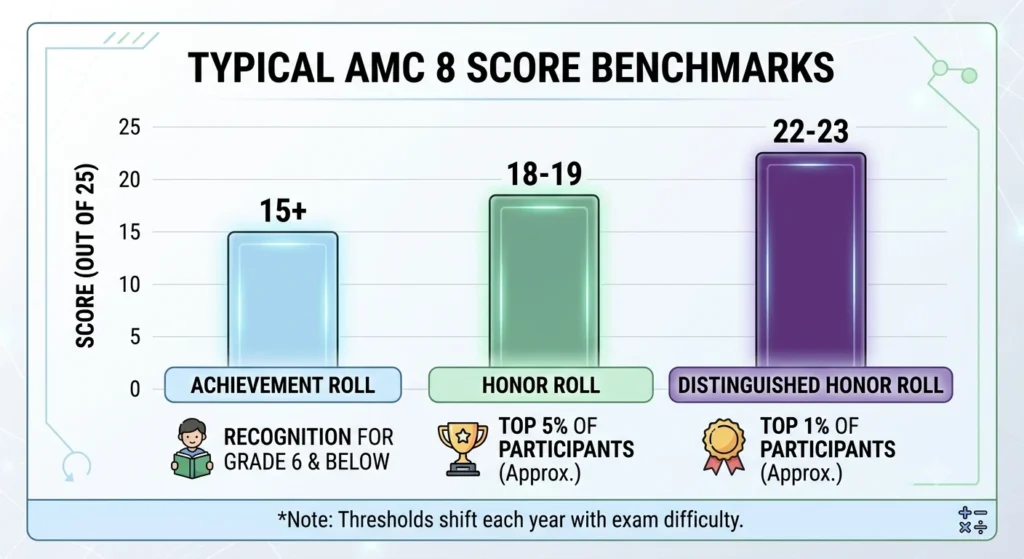
Honor roll (top 5%) needed 21 correct out of 25 in 2026; Distinguished Honor Roll (top 1%) needed 24.
There’s also an Achievement Roll, which recognizes students in grades 6 and below who score 15 or above. Exact cutoffs shift each year with exam difficulty, so use recent averages as a guide rather than a fixed target.
If you want a deeper breakdown of percentiles, honor roll thresholds, and how scores compare year to year, see our guides on what is a good AMC score and average AMC math scores.
For students who go on to place well, our AMC awards guide explains what recognition looks like beyond the honor roll cutoffs.
Common practice mistakes to avoid
A short checklist of habits that quietly cap your student’s score:
- Doing tests untimed. Without pacing pressure, your student is solving problems, not training for the AMC 8.
- Reviewing every problem equally. A 30-minute review where 25 minutes go to four hard problems beats one that touches all 25 evenly.
- Re-doing the same paper too soon. Within 90 days, they remember answers, not methods. Wait three months or use a different paper.
- Skipping the error log. “We talked through the mistakes” isn’t the same as writing them down.
- Cramming the last week. The day before should be light review, not a full mock. Sleep beats any extra problem set.
- Optimizing for the wrong score. Honor roll (top 5%) needed 21 correct in 2026; Distinguished Honor Roll (top 1%) needed 24. (There’s also an Achievement Roll, which recognizes students in grade 6 and below who score 15 or above.) Exact cutoffs shift each year with exam difficulty, so aim for honor roll first.
- Forgetting registration. AMC 8 runs through schools and authorized centers, not individuals. Confirm your school is registered before the late-October deadlines. See our AMC registration guide for the full timeline.
How many practice tests should my child take in total?
For a first-year AMC 8 student, four to six full timed papers is the sweet spot enough to build pacing and pattern recognition without burning out. Add two or three more for a returning student aiming for honor roll. More important than the raw number: real timed conditions and a serious error-log review after each.
Should my child start with the oldest or newest past papers?
Start with a paper two or three years old as a diagnostic recent enough to be representative, but not so recent you “use up” the latest material. Save the most recent two to three years for the final four weeks, when they double as practice and a realistic preview of test-day conditions.
My child knows the math but runs out of time. What now?
This is the most common AMC 8 problem, and it’s fixable. Two drills help. First-15 sprints: questions 1 to 15 of any past paper in 20 minutes (the front should be fast and high-accuracy). Back-half tactics: questions 16 to 25 in 20 minutes, focused on triage skip what you can’t start in 30 seconds and come back. Most kids waste time on the wrong problem, not on slow problems.
How is the AMC 8 different from Math Kangaroo?
Both are entry-level competitions, but they test different things and run on different timelines. Our Math Kangaroo vs AMC guide compares format, difficulty, and which one fits your student’s grade level.
Is the AMC 8 the same as the AMC 10?
No. The AMC 10 is for grade 10 and below, 25 questions in 75 minutes, harder algebra and geometry, and a different scoring rule (6/1.5/0, guessing penalty matters). The AMC 8 is for grade 8 and below, 25 questions in 40 minutes, no calculator, no guessing penalty. Many students progress from AMC 8 in middle school to AMC 10 in high school. If your student is close to that transition, our AMC 10 vs AMC 12 comparison and our AMC 10 practice test guide cover what changes next.
How long is the AMC 8 test?
The AMC 8 is 40 minutes long, with 25 multiple-choice questions and no calculator.
Where can I find a free AMC 8 practice test?
Every past AMC 8 paper is free on the AoPS Wiki with solutions. This page also has 5 sample AMC 8 questions with answers to start with.
Make Preparing for Math Olympiad Simple!



The bottom line
The students who get the most out of AMC 8 practice tests do four things:
- Use real past papers, sparingly enough that each one stays meaningful.
- Simulate real timed conditions, paper, phone away, no calculator, single 40-minute timer.
- Keep an error log that turns every mistake into a specific lesson for next week.
- Pair timed mocks with structured topic-by-topic practice in between, so each test reveals new gaps and the next two weeks close them.
A practice test is only as valuable as the review that follows it. Twelve thoughtful weeks will outperform six months of casual problem-solving.
Related guides on gonit.app
- AMC syllabus: a complete topic map for AMC 8, 10 and 12, the underlying curriculum your practice tests are sampling from.
- How to prepare for the AMC: a 12-week plan that works, the full study plan that the practice schedule above plugs into.
- How to register for the AMC 8, 10 and 12: deadlines, test centers, and the school-registration step most parents miss.
- Best free AMC practice resources: where to find quality practice material beyond past papers.
- What is a good AMC score: percentile benchmarks and honor roll cutoffs explained.

Mikha Piregu is a Content Writer with experience spanning educational content, including math and math olympiad topics, as well as advocacy writing, research-based articles, and SEO-driven web content. He creates high-quality blog content, web copy, and feature articles that support brand visibility, audience engagement, and long-term organic growth through data-informed storytelling. Skilled in WordPress, WooCommerce, and modern digital tools, Mikha adapts content across various platforms, including blogs, websites, campaigns, and advocacy initiatives, with clarity and purpose.




There are no comments posted here yet.
Sign in to leave a comment