


The AMC syllabus covers four areas at every level: algebra, geometry, number theory, and counting and probability.
- What Is the AMC? A Quick Overview
- AMC 8 Syllabus Breakdown
- AMC 10 Syllabus Breakdown
- AMC 12 Syllabus Breakdown
- AMC 8 vs AMC 10 vs AMC 12: Side-by-Side Comparison
- Topic Weight Distribution
- AIME Qualification and Score Benchmarks
- The Progression Ladder: AMC 8 to AMC 10 to AMC 12 to AIME
- What Is NOT on the AMC Syllabus
- Where to Start Based on Your Grade
- How to Turn This Syllabus Into a Study Plan
- Key Takeaways
AMC 8 tests them at middle school depth, AMC 10 adds quadratics, modular arithmetic and casework, and AMC 12 adds trigonometry, logarithms and complex numbers. No AMC level includes calculus, proofs, matrices or formal statistics. All three papers are 25 multiple-choice questions with no calculator.
If you have searched for the AMC maths competition syllabus and come back with a vague list, “algebra, geometry, number theory”, you are not alone.
Most articles online list topics without explaining what they mean at each level, how hard they are, or whether your child actually needs calculus.
This guide breaks down the American Mathematics Competitions curriculum level by level, AMC 8, AMC 10, and AMC 12, with specific subtopics, a side-by-side comparison, topic weightings, the difficulty curve across a paper, AIME score benchmarks, and a clear progression ladder.
What Is the AMC? A Quick Overview
The American Mathematics Competitions (AMC) is a national problem-solving competition run by the Mathematical Association of America (MAA).
Over 300,000 students across 50+ countries participate each year. There are three exam levels:
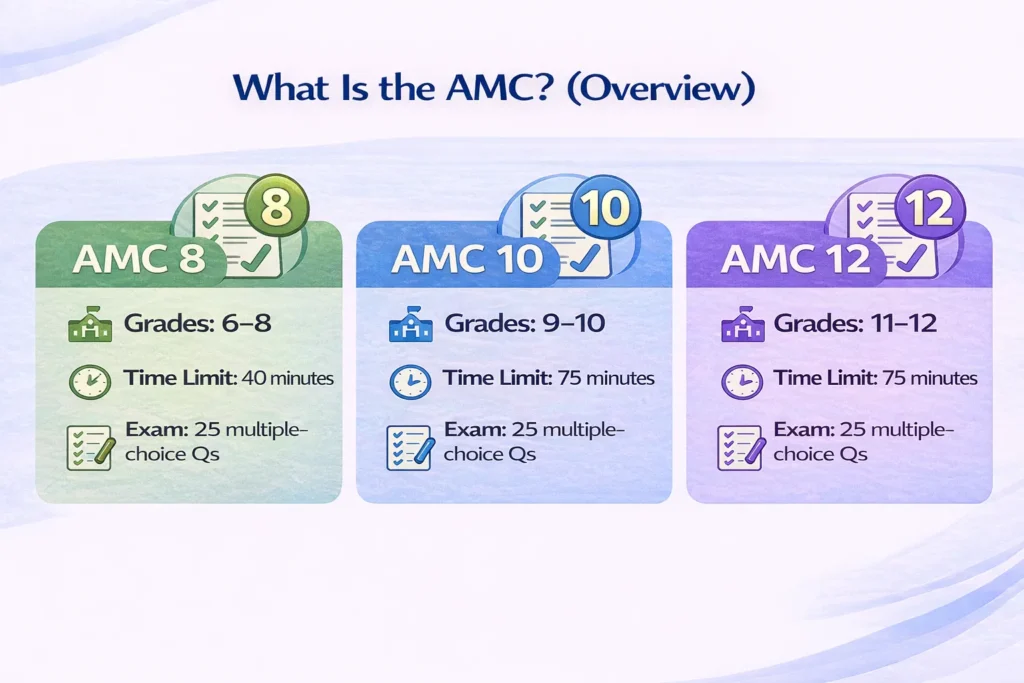
| Exam | Grade Level | Format | When |
|---|---|---|---|
| AMC 8 | Grade 8 and below (under 15.5 on contest day) | 25 questions / 40 min | January |
| AMC 10 | Grade 10 and below (under 17.5) | 25 questions / 75 min | November |
| AMC 12 | Grade 12 and below (under 19.5) | 25 questions / 75 min | November |
All three are multiple-choice with no calculators allowed. High scorers on AMC 10 and AMC 12 advance to the AIME, the next step toward the USA Mathematical Olympiad (USAMO).
Two sittings of AMC 10 and AMC 12 are offered each year, the A and the B, on different dates. You may take one A paper and one B paper, and your better result counts for qualification. For eligibility details see AMC age limits, and for this cycle’s dates see AMC test dates.
Is There an Official AMC Syllabus PDF?
No. The MAA does not publish a formal syllabus document for any AMC level. It states a content boundary (the AMC 10 covers the high school curriculum through grade 10, the AMC 12 the full curriculum excluding calculus) and leaves the rest to be inferred from past papers.
That is why every “AMC syllabus PDF” you find online is someone’s reconstruction rather than an official list, this page included. The reconstruction is reliable because the topic mix has been stable for years, but it is worth knowing that no official document exists to check it against. The closest thing to an authoritative source is the papers themselves, which is why working through AMC past papers tells you more than any topic list.
AMC 8 Syllabus Breakdown
The AMC 8 tests middle-school mathematics, but the problem-solving style is harder than school exams. Here is what is covered:
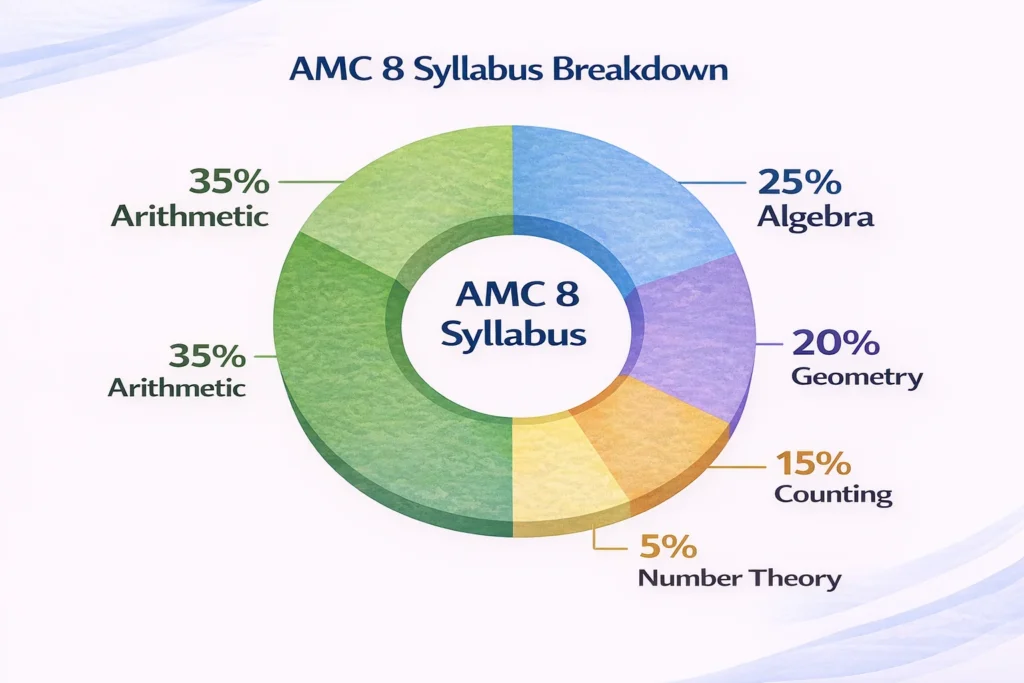
The Five Core Knowledge Areas on the AMC 8
Every AMC 8 question falls into one of five areas. There is nothing else on the paper.
Arithmetic and Number Sense, fractions, decimals, percentages, ratios, and proportional reasoning, applied through multi-step word problems rather than simple calculations.
Introductory Algebra, setting up and solving linear equations, basic coordinate geometry, and simple quadratic expressions in context.
Geometry Basics, area and perimeter of rectangles, triangles, and circles, the Pythagorean theorem, spatial reasoning, and composite figure problems.
Counting and Probability (Combinatorics), basic permutations (ordered arrangements) and combinations (unordered selections), and straightforward probability. For example: “How many ways can 4 students stand in a line?”
Number Theory Basics, prime numbers, prime factorization, divisibility rules, greatest common divisors (GCD), and least common multiples (LCM).
How Much of the AMC 8 Is Algebra Versus Number Theory Versus Combinatorics?
Roughly: geometry and arithmetic take five to seven questions each, counting and probability three to five, algebra three to five, and number theory two to four.
| Area | Questions per paper | Share of the paper |
|---|---|---|
| Geometry and spatial reasoning | 5 to 7 | About 25% |
| Arithmetic and word problems | 5 to 7 | About 25% |
| Counting and probability | 3 to 5 | About 16% |
| Algebra | 3 to 5 | About 16% |
| Number theory | 2 to 4 | About 12% |
The split moves a little each year, but no area has disappeared and none has taken over. If you are allocating study time, the honest answer is that geometry earns the most marks and combinatorics costs the most marks, because schools teach the first and skip the second.
How AMC 8 Difficulty Is Distributed Across the 25 Questions
The AMC 8 is deliberately laid out from easiest to hardest, and knowing the shape of the curve changes how you pace a paper.
| Questions | Difficulty | What they test |
|---|---|---|
| 1 to 10 | Accessible to most participants | Single-step arithmetic, reading a diagram, direct percentage or ratio work |
| 11 to 18 | Moderate | Two or three steps combined, often algebra set up from a word problem |
| 19 to 25 | Hard | Multiple ideas combined, casework, non-obvious geometry configurations |
Most students should be finishing 1 to 10 quickly and accurately, because those marks are worth exactly as much as question 25. A student who scores 15 is usually losing marks to careless errors in the first half rather than failing the last five questions.
Which Geometry Topics Appear Most Often on the AMC 8?
Area and perimeter lead, followed by the Pythagorean theorem and angle chasing.
- Area and perimeter of composite figures, the single most frequent geometry type. See area and perimeter for the foundations.
- The Pythagorean theorem, usually hidden inside a larger figure rather than asked directly.
- Angle relationships, parallel lines, triangle angle sums, exterior angles. See types of angles.
- Triangle properties, similarity and special triangles. See types of triangles.
- Circles, area, circumference, and sectors, less frequent than the above but reliably present.
- Spatial and 3D reasoning, nets, counting cubes, and folding problems.
Essential Number Theory Topics for the AMC 8
Number theory is only two to four questions, but they cluster in the hard half of the paper, so they decide whether a student reaches the Honor Roll.
- Prime numbers and prime factorization. Start with prime and composite numbers.
- Divisibility rules, which turn several questions a year into a ten-second check. See divisibility rules.
- Factors, multiples, GCD and LCM.
- Remainders and simple modular thinking, without the formal notation.
- Digit and place value problems.
What Algebra Skills Does AMC 8 Need Beyond School?
School algebra teaches you to solve an equation you are given. The AMC 8 mostly asks you to build the equation first, then solve it, which is a different skill.
Specifically, beyond the standard curriculum:
- Translating a word problem into variables quickly, including choosing which quantity to call x.
- Working with two unknowns through substitution, before formal systems are taught.
- Recognising when algebra is not the fastest route. Many AMC 8 questions that look algebraic are faster by testing the answer choices.
- Handling expressions rather than just equations, simplifying and comparing without solving.
How it compares to school: AMC 8 topics overlap with Grades 6 to 8 school math, but the problems demand more creative thinking. A school test asks you to find the area of a triangle. An AMC 8 question shows you a triangle inside a pentagon and asks you to find the shaded region, using the same formula, but in a less obvious way.
Did the AMC 8 Syllabus Change for 2026-27?
No. The AMC 8 syllabus has not changed, and no new topics were added. The five knowledge areas above have been stable for years.
What has changed is emphasis rather than content, covered in the trends section below, and the cutoff scores, which rise with the field rather than the syllabus. If you see a claim that new topics were added for a particular year, it is almost always describing a shift in how often an existing topic appears.
AMC 10 Syllabus Breakdown
The AMC 10 is a significant step up. It is designed for Grade 10 and below, but most students benefit from dedicated preparation starting in Grade 7 or 8. For a full strategy, see how to prepare for the AMC.
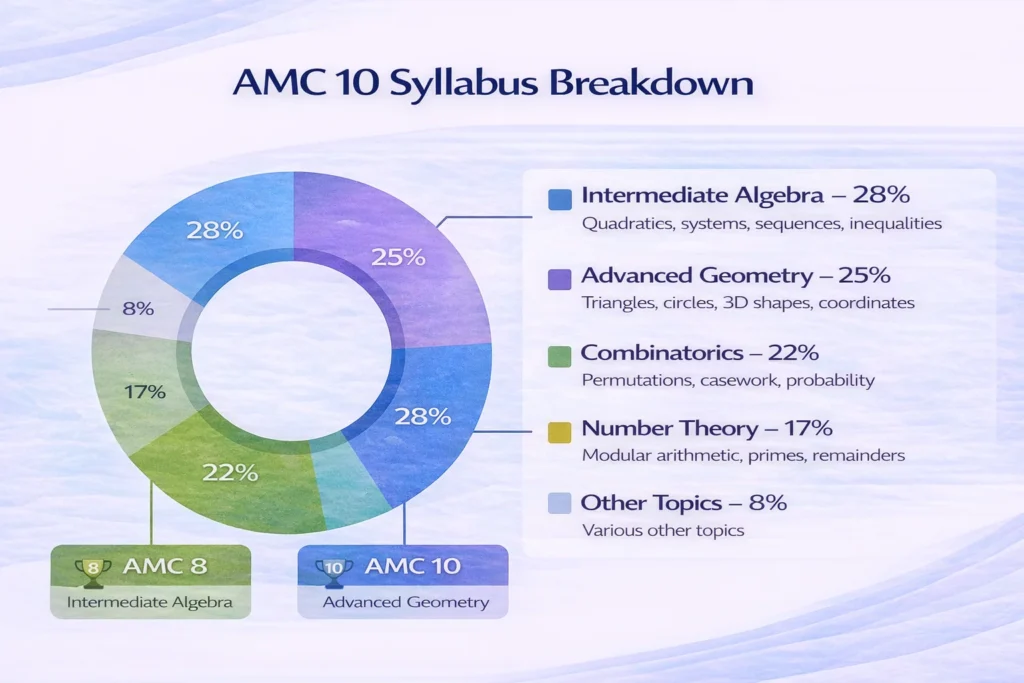
Intermediate Algebra, quadratic equations and functions, factoring techniques, systems of equations, arithmetic and geometric sequences, inequalities, and polynomial manipulation.
Advanced Geometry, triangle similarity and congruence, circle theorems (inscribed angles, tangent lines, arc lengths), coordinate geometry with complex configurations, and 3D shapes (prisms, pyramids, cylinders).
Combinatorics, this expands significantly from AMC 8. Expect permutations with restrictions, the multiplication principle, casework (splitting problems into cases), complementary counting, and probability with combinatorial reasoning. This is the area students most underestimate.
Number Theory, modular arithmetic (clock-like arithmetic with remainders), properties of primes, the Euclidean algorithm, and Diophantine equations (whole-number solutions to equations).
What Does the AMC 10 Cover That the AMC 8 Does Not?
Four things carry across from AMC 8, but every one of them gets deeper:
| Area | New on the AMC 10 |
|---|---|
| Algebra | Quadratics, systems, sequences, inequalities, polynomial manipulation |
| Geometry | Circle theorems, similarity proofs, coordinate geometry, 3D solids |
| Combinatorics | Casework, complementary counting, restricted permutations |
| Number theory | Modular arithmetic, the Euclidean algorithm, Diophantine equations |
Nothing is removed. A student moving up from the AMC 8 keeps everything they learned and adds a layer, which is why the transition is manageable within a year of focused work.
Does AMC 10 Include Calculus?
No. AMC 10 does not include calculus. The MAA officially excludes it. Derivatives, integrals, and limits do not appear anywhere on the AMC 10. This is the single most common misconception about the AMC maths competition syllabus.
How it compares to school: AMC 10 overlaps with parts of Algebra I, Geometry, and Algebra II, but combinatorics and number theory are rarely taught in school, making specific competition prep essential.
AMC 10A vs AMC 10B: What Is Actually Different?
Nothing in the syllabus. This is the most common misunderstanding about the two sittings.
| AMC 10A | AMC 10B | |
|---|---|---|
| Syllabus | Identical | Identical |
| Format | 25 questions, 75 minutes | 25 questions, 75 minutes |
| Date | Earlier November date | Later November date |
| Difficulty | Set to the same target | Set to the same target |
| Can you take both? | Yes, one A and one B | Yes, and your better score counts |
The MAA writes both papers to the same specification, so neither is officially the easier one. In practice the two papers do land slightly differently each year, which is why historical cutoffs for A and B differ, sometimes by 10 points or more. But that variation is unpredictable in advance, so there is no strategy in choosing one over the other.
The one genuine strategic point: sit both. Two attempts at the same syllabus, with the better score counting, is the cheapest score improvement available to any AMC student.
The same applies to AMC 12A and 12B.
AMC 12 Syllabus Breakdown
The AMC 12 covers the full high school mathematics curriculum. It is the hardest of the three levels and is open to students in Grade 12 and below.
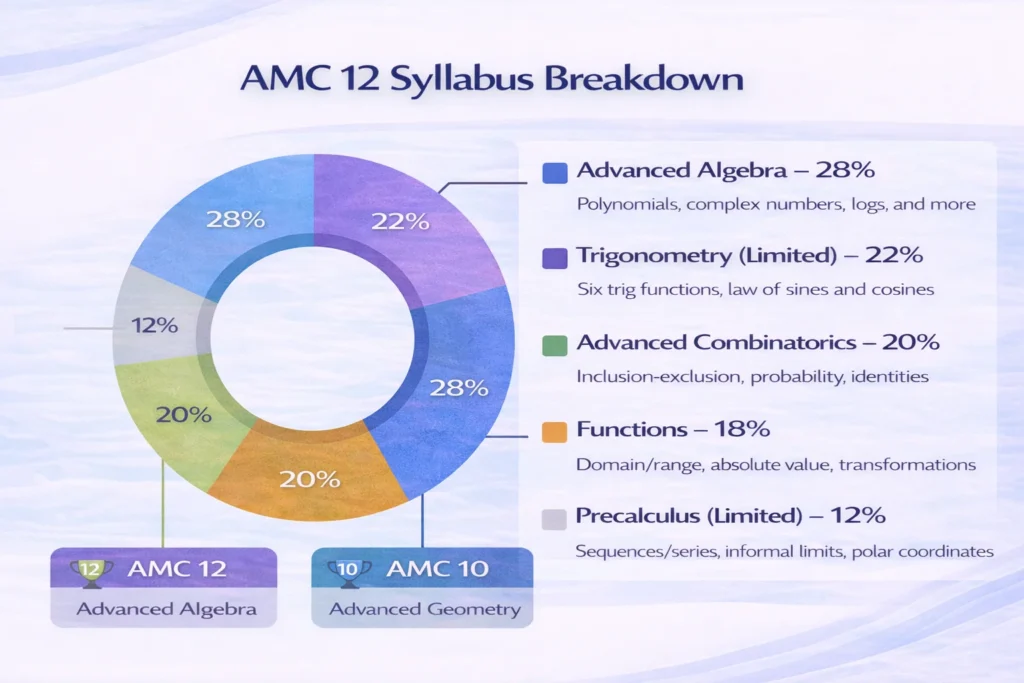
Advanced Algebra, everything in AMC 10, plus polynomial division, Vieta’s formulas, complex numbers, logarithms, exponential functions, and function composition and inverses.
Trigonometry (Limited), the six trig functions, the unit circle, law of sines, and law of cosines. This is not a full trigonometry course, it appears primarily in geometry-based problems.
Advanced Combinatorics, inclusion-exclusion, conditional probability, expected value, and combinatorial identities.
Functions, domain and range, piecewise functions, absolute value functions, and transformations.
Precalculus (Limited), deeper sequences and series, informal limits (conceptual, not computational), and isolated polar coordinate problems.
Does AMC 12 Include Calculus?
No. AMC 12 does not include calculus. The MAA is explicit: calculus is excluded from the AMC 12. Your child does not need it.
How it differs from AMC 10: AMC 12 adds trigonometry, complex numbers, logarithms, and deeper function theory. About 10 to 15 questions overlap with the AMC 10, but the remaining problems require a significantly broader mathematical toolkit. AMC 10 vs AMC 12 covers which to choose if you are eligible for both.
AMC 8 vs AMC 10 vs AMC 12: Side-by-Side Comparison
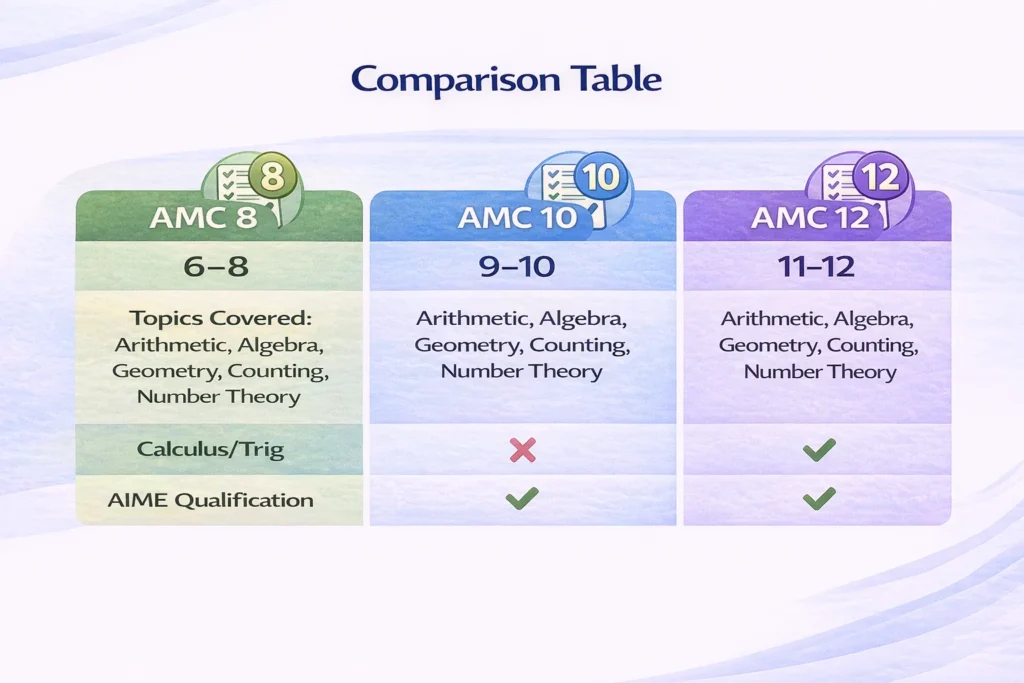
| Feature | AMC 8 | AMC 10 | AMC 12 |
|---|---|---|---|
| Algebra | Basic (linear, word problems) | Intermediate (quadratics, sequences) | Advanced (polynomials, logs, complex numbers) |
| Geometry | Basics (area, Pythagorean) | Intermediate (circles, 3D, similarity) | Advanced (trig, harder configurations) |
| Number Theory | Basic (primes, GCD, LCM) | Intermediate (modular arithmetic) | Advanced |
| Combinatorics | Basic (permutations, probability) | Intermediate (casework, complementary) | Advanced (inclusion-exclusion, expected value) |
| Trigonometry | No | No | Limited |
| Calculus | No | No | No |
| Questions and time | 25 in 40 min | 25 in 75 min | 25 in 75 min |
| Scoring | 1 point per correct answer | 6 correct, 1.5 blank, 0 wrong | 6 correct, 1.5 blank, 0 wrong |
| Typical average score | 12.42 in 2026, out of 25 | About 57 to 62 out of 150 | About 57 to 66 out of 150 |
| Leads to | AMC 10 preparation | AIME at 100 | AIME at 85 |
Note the scoring row, because it is widely misreported. On AMC 10 and 12 a blank is worth 1.5 points and a wrong answer is worth 0.
There is no negative marking. A blind guess across five options averages 1.2 points, slightly less than leaving it, so guessing only pays once you can eliminate two options.
Topic Weight Distribution
Knowing which topics appear most often helps you prepare smarter, not harder.
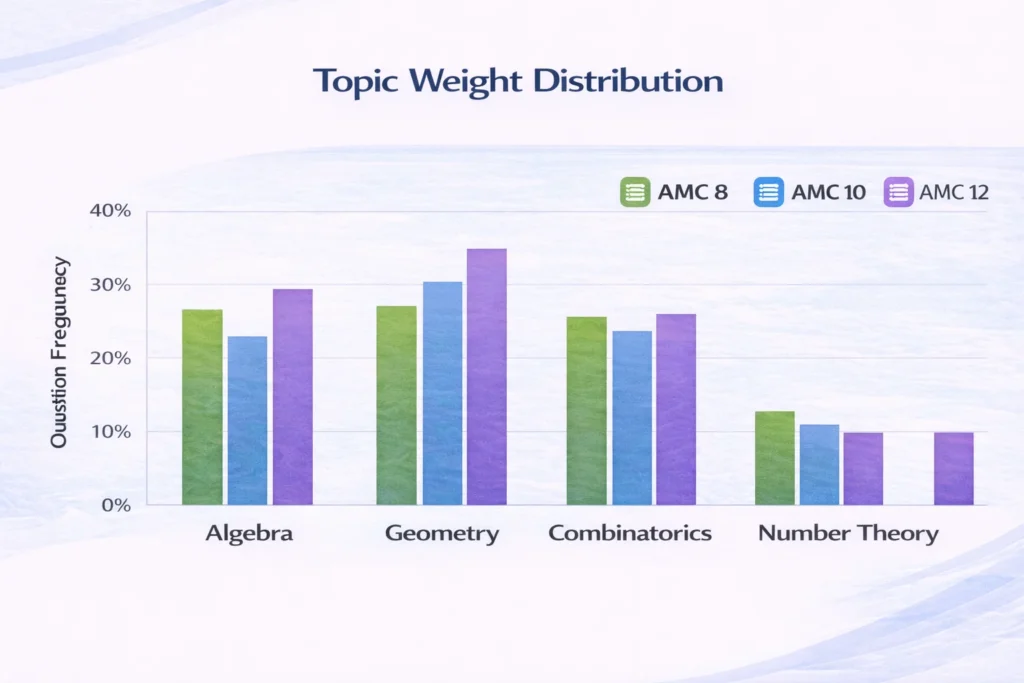
AMC 8 (25 questions)
- Geometry and spatial reasoning: 5 to 7 questions, consistently the largest category
- Arithmetic and word problems: 5 to 7 questions, appears at every difficulty level
- Counting and probability: 3 to 5 questions, growing in recent exams
- Algebra: 3 to 5 questions, increasingly word-problem driven
- Number theory: 2 to 4 questions, essential for harder questions
AMC 10 (25 questions)
- Algebra: 7 to 9 questions, the largest single category
- Geometry: 6 to 8 questions, consistent throughout
- Combinatorics and probability: 4 to 6 questions, the biggest differentiator for high scorers
- Number theory: 3 to 5 questions, common in mid-difficulty problems
AMC 12 (25 questions)
- Algebra (including functions and complex numbers): 8 to 10 questions, dominant
- Geometry (including trigonometry): 5 to 7 questions
- Combinatorics and probability: 4 to 6 questions, often the hardest problems
- Number theory: 3 to 4 questions
Key insight: combinatorics is the most underprepared topic for students coming from school math, and it is heavily represented across all three levels. Prioritize it.
How the Topic Mix Has Shifted Recently
The official syllabus has not changed in years. What has changed is emphasis, and three trends are worth knowing when you choose practice material.
Counting and probability is growing. Recent AMC 8 papers lean on it more than papers from a decade ago, and it now regularly appears in the first ten questions rather than only in the hard half.
Algebra is increasingly disguised as word problems. Fewer questions ask you to solve a stated equation. More ask you to build the equation from a described situation, then solve it. Practising bare algebraic manipulation prepares you for the second step but not the first.
Geometry has moved toward configuration over formula. The formulas tested are the same ones, but recent problems hide them inside composite or unfamiliar figures, so recognising which figure you are looking at matters more than recalling the formula.
None of this changes what to study. It changes how to practise, which is by working real past papers rather than topic drills alone.
AIME Qualification and Score Benchmarks
The AMC syllabus question most students really want answered is what score they need. Here are the benchmarks.
The AIME Floor Is Now a Fixed Number
This is the most important recent change to the AMC. Historically, AIME qualification was a percentage cut, roughly the top 2.5% of AMC 10 takers and the top 5% of AMC 12 takers, with the actual score published only after the exam.
From the 2026 to 2027 season the MAA has replaced that with fixed thresholds: 100 on the AMC 10 and 85 on the AMC 12.
That is a meaningful change for how you plan. Under the old system you could not know your target until results came out, and the number moved a lot year to year. Now it is published in advance, so AIME qualification becomes a concrete goal.
For context, here are the cutoffs from the final years of the percentage system. The year shown is the AIME year, so the 2026 row reflects the AMC sat in November 2025.
| AIME year | AMC 10A | AMC 10B | AMC 12A | AMC 12B |
|---|---|---|---|---|
| 2026 | 105 | 99 | 96 | 100.5 |
| 2025 | 94.5 | 105 | 76.5 | 88.5 |
| 2027 onward | 100 (fixed) | 100 (fixed) | 85 (fixed) | 85 (fixed) |
Look at the AMC 12A column. A 76.5 qualified for the 2025 AIME and a 96 was needed for 2026, a swing of nearly 20 points on the same paper in consecutive years. That volatility is exactly what the fixed floor removes.
Award Benchmarks at a Glance
| Award | AMC 8 | AMC 10 and AMC 12 |
|---|---|---|
| Top 5% | Honor Roll, 21 in 2026 | Distinction |
| Top 1% | Distinguished Honor Roll, 24 in 2026 | Honor Roll of Distinction |
| Achievement Roll | 15+ for grade 6 and below | 90+ for grade 8 and below on the AMC 10 |
| AIME invitation | Not applicable | 100 on AMC 10, 85 on AMC 12 from 2027 |
On the AMC 10 and AMC 12 the top-5% Distinction has recently landed between 105 and 127.5, and the top-1% Honor Roll of Distinction between 132 and 139.5. Both are percentile awards rather than fixed scores, so they move each year with the difficulty of the paper.
What is a good AMC score breaks these down in full, and average AMC math scores shows how the distribution actually looks. For the awards themselves, see AMC math competition awards.
The Progression Ladder: AMC 8 to AMC 10 to AMC 12 to AIME
Think of the AMC pathway as a ladder, with each step requiring stronger foundations and new mathematical tools:
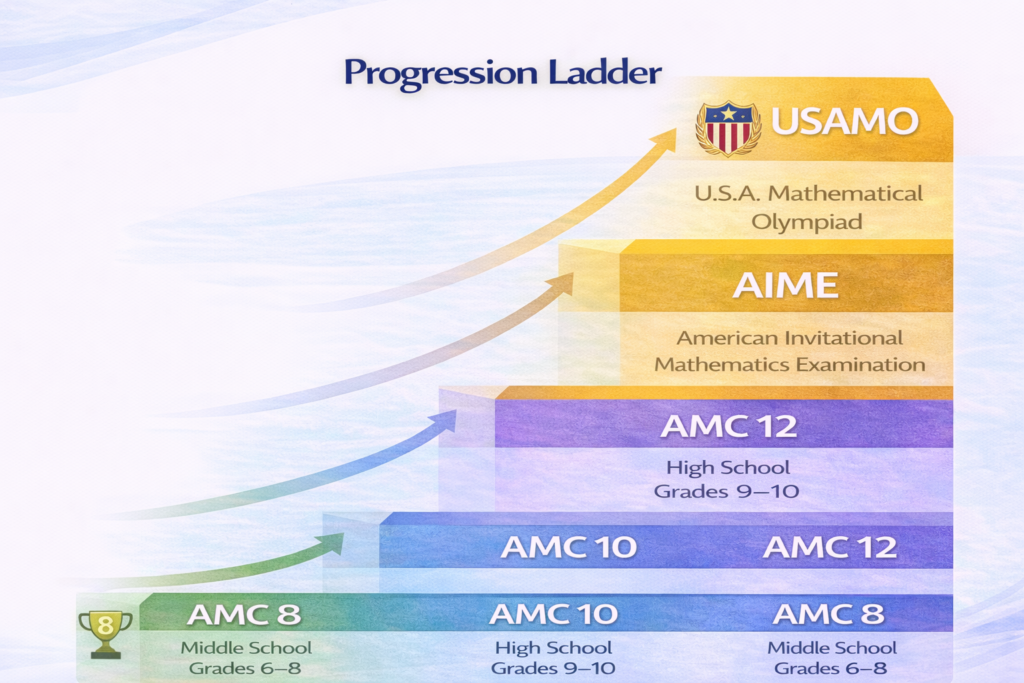
AMC 8 (Foundation), arithmetic, basic algebra, geometry basics, counting basics.
AMC 10 (Intermediate), adds quadratics, combinatorics, number theory, advanced geometry.
AMC 12 (Advanced), adds trigonometry, logarithms, complex numbers, advanced functions.
AIME (Elite), integer-answer format, 15 questions. From 2027 the paper is sat in two 90-minute parts rather than one three-hour block. No multiple choice.
How to Move From AMC 8 to AMC 10
The syllabus gap is smaller than it looks, and most of the work is in two areas rather than all four.
- Keep everything you have. Nothing from the AMC 8 is dropped. The arithmetic, basic geometry and counting all reappear, just inside harder problems.
- Learn quadratics properly. Factoring, the quadratic formula, Vieta’s formulas and the discriminant between them account for a large share of the new algebra.
- Learn casework and complementary counting. This is the biggest genuine gap, because school does not teach it at all.
- Add modular arithmetic. It converts a class of AMC 10 number theory problems from impossible to routine.
- Rebuild your pacing. You move from 1.6 minutes per question to 3, but the questions take far longer than twice as long, so the skip strategy matters more.
A reasonable timeline is one year: sit the AMC 8 in January, then work on the four points above through spring and summer for the following November’s AMC 10. AMC 8 vs AMC 10 covers when a student is ready.
What Is the AIME Syllabus?
There is no separate AIME syllabus. The AIME draws on the same four areas as the AMC 12, tested more deeply and with problems that combine two or three areas in a single question.
What changes is the format and the tolerance for error. Answers are integers from 000 to 999, there is no multiple choice to work backwards from, and there is no partial credit. A student who is comfortable across the full AMC 12 syllabus has the content they need for the AIME. What they usually lack is the stamina for problems that take fifteen minutes rather than three. AIME problems shows what that step up looks like.
What Is NOT on the AMC Syllabus
This is where most confusion lives. Here is a clear list of what the AMC does not test:
- Calculus, not on AMC 8, AMC 10, or AMC 12. No derivatives, integrals, or limits.
- Trigonometry, not on AMC 8 or AMC 10. Limited on AMC 12 only.
- Proof-based mathematics, the AMC is multiple choice. No written proofs are required, that is USAMO and IMO territory.
- Statistics, formal methods like standard deviation or regression are not tested.
- Matrices and linear algebra, not included at any AMC level.
- Calculators, not permitted at any level, which means no problem requires one.
Where to Start Based on Your Grade
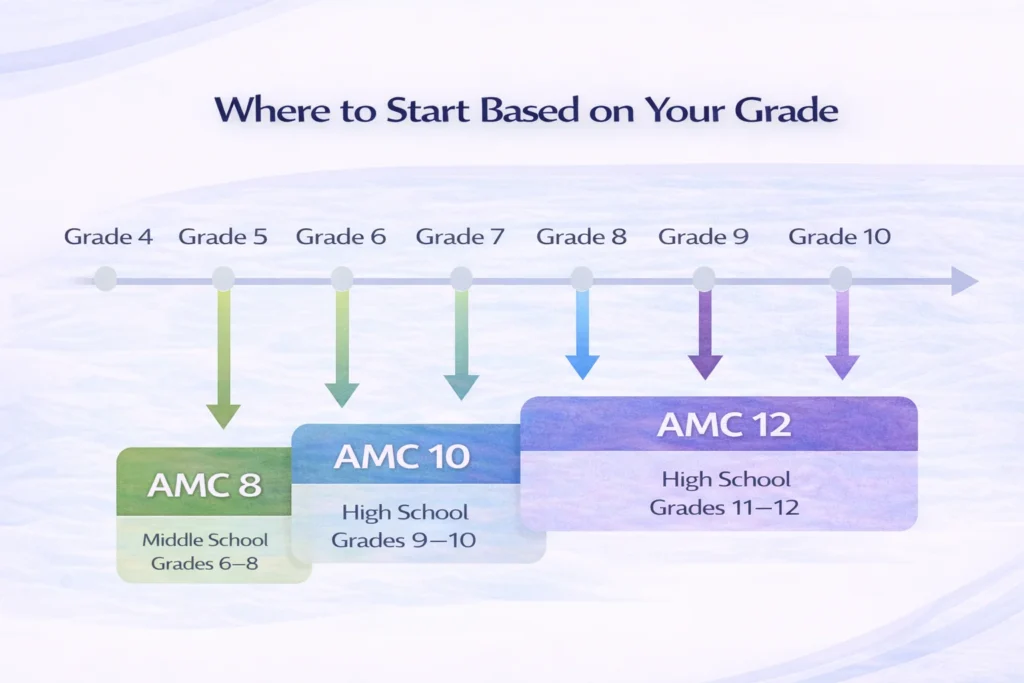
| Current Grade | Recommended Starting Point |
|---|---|
| Grade 4 to 5 | AMC 8 (exploration, low pressure) |
| Grade 6 | AMC 8 with focused preparation |
| Grade 7 | AMC 8 this year, then begin AMC 10 prep |
| Grade 8 | AMC 8 (if new) or AMC 10 (if AMC 8 experienced) |
| Grade 9 | AMC 10 with solid preparation |
| Grade 10 | AMC 10 or AMC 12 (based on math level) |
| Grade 11 to 12 | AMC 12 |
If your child has already taken the AMC 10, review their score against what is a good AMC score and identify which topic areas cost the most points.
That analysis should drive the next preparation phase. For younger students just starting, free math olympiad training online builds problem-solving foundations early, and AMC 8 vs AMC 10 covers when to make the jump.
How to Turn This Syllabus Into a Study Plan
A syllabus is a checklist, not a plan. Here is the order that works for most students.
- Confirm your level and the dates. Check AMC age limits and eligibility, then AMC test dates and how to register for the AMC.
- Audit yourself against the topic list above. Mark each subtopic as confident, shaky, or never seen. Most students find combinatorics and number theory in the third column.
- Fix the never-seen topics first. These cost the most marks per hour of study, because they are rarely taught in school.
- Work past papers by level, under time. Start with AMC past papers, then AMC 8 practice tests, AMC 10 practice tests or AMC 12 practice tests, and use free AMC practice resources for volume.
- Log every miss by topic, not by paper. After five papers the pattern in your error log tells you exactly where the next month should go.
A 24-Week AMC 8 Study Plan Across the Five Areas
If you want a concrete structure rather than a principle, this is the shape that covers all five knowledge areas with time left for timed practice.
| Weeks | Focus | What you should be doing |
|---|---|---|
| 1 to 4 | Number theory | Primes, divisibility, GCD and LCM. The smallest area, done first because it is the least familiar. |
| 5 to 9 | Counting and probability | Permutations, combinations, casework. The highest-value gap for most students. |
| 10 to 14 | Geometry | Area and perimeter of composite figures, Pythagoras, angle chasing, 3D reasoning. |
| 15 to 18 | Algebra and word problems | Translating situations into equations, then solving. |
| 19 to 22 | Full past papers, untimed | One paper a week, reviewing every miss in detail. |
| 23 to 24 | Full past papers, timed | 40 minutes, no calculator, exactly as on the day. Pacing only. |
The review is the part people skip and the part that works. A paper you have analysed properly is worth five you have simply completed. How to get better at solving math olympiad questions covers the review method, and math olympiad questions shows the question styles to expect.
For the full version with weekly structure across all levels, see how to prepare for the AMC.
What topics are on the AMC 8?
The AMC 8 covers five areas: arithmetic and proportional reasoning, introductory algebra, basic geometry (areas, perimeters, Pythagorean theorem), counting and probability, and number theory basics (primes, GCD, LCM). No calculators are allowed.
Does AMC include calculus?
No. Calculus is explicitly excluded from AMC 8, AMC 10, and AMC 12. Students do not need derivatives, integrals, or limits at any AMC level. This is the most common misconception about the AMC maths competition syllabus.
What is the difference between AMC 10 and AMC 12?
Both have 25 questions in 75 minutes and share 10 to 15 overlapping problems. AMC 12 adds trigonometry, logarithms, complex numbers, and advanced function theory, none of which appear on AMC 10. AMC 12 problems are also harder at the upper end. Students should choose based on their math preparation level, not their grade alone.
What math do I need to know for AMC 10?
Students need intermediate algebra (quadratics, sequences, systems), intermediate geometry (circle theorems, similarity, 3D shapes), combinatorics (permutations, combinations, casework), and number theory (modular arithmetic, prime properties). Trigonometry and calculus are not required.
How hard is AMC compared to school math?
Significantly harder in problem-solving style, even when the topics overlap. School math tests whether you can apply a known procedure. AMC problems require you to figure out which ideas to combine and how, often in unexpected ways. This is a learnable skill, but it takes dedicated competition-math practice to develop.
What topics should I study first for AMC?
AMC 8: start with geometry (most frequent) and combinatorics (least covered in school). AMC 10: prioritize algebra, then combinatorics and number theory. AMC 12: master all AMC 10 areas first, then add trigonometry, logarithms, and complex numbers. In all cases, practicing past AMC problems is your single most effective study tool.
What score do I need to qualify for the AIME?
From the 2026 to 2027 season, 100 on the AMC 10 or 85 on the AMC 12. Before that the cutoff was a percentage cut that changed every year, ranging roughly from 94.5 to 105 on the AMC 10 and 76.5 to 100.5 on the AMC 12 in recent seasons.
What number theory topics are essential for AMC 8?
The key AMC 8 number theory topics are prime numbers and prime factorization, divisibility rules, factors and multiples, GCD and LCM, remainders, and digit and place value problems.
What is the AMC 8 syllabus for 2027?
The 2027 AMC 8 covers arithmetic, pre-algebra, basic geometry (area, perimeter, angles, the Pythagorean theorem), counting and probability, number theory, and logical reasoning. There is no fixed official syllabus, but these areas appear every year.
Is the AMC 10 syllabus the same as the AMC 12 syllabus?
They overlap heavily, but the AMC 12 adds trigonometry, logarithms, complex numbers and harder sequences and series. Neither exam includes calculus.
Is there an official AMC syllabus PDF?
No. The MAA publishes a content boundary rather than a formal syllabus document, so every AMC syllabus PDF online is a reconstruction from past papers. The topic lists are reliable because the mix has been stable for years, but there is no official file to download.
Did the AMC 8 syllabus change for 2026-27?
No. No new topics were added. The five knowledge areas have been stable for years. What changes from year to year is the emphasis between them and the award cutoffs, not the content.
How many questions are on the AMC 8 and how long is the exam?
25 multiple-choice questions in 40 minutes, with no calculator. That is 1.6 minutes per question, tighter per question than the AMC 10 and AMC 12.
How is AMC 8 difficulty distributed across the 25 questions?
Questions 1 to 10 are accessible to most participants, 11 to 18 are moderate and usually need two or three steps, and 19 to 25 are hard and combine several ideas. Every question is worth one point, so the early questions matter as much as the late ones.
What geometry topics appear most often on the AMC 8?
Area and perimeter of composite figures lead, followed by the Pythagorean theorem, angle relationships, triangle properties, circles, and 3D or spatial reasoning.
Make Preparing for Math Olympiad Simple!


Key Takeaways
- The AMC syllabus is four areas at every level: algebra, geometry, number theory, and counting and probability.
- No AMC level includes calculus, proofs, matrices, formal statistics or calculators.
- The MAA publishes no official syllabus PDF, so every topic list online is reconstructed from past papers.
- On the AMC 8, geometry and arithmetic take about half the paper between them, and the questions run easiest to hardest across 1 to 25.
- The AMC 8 syllabus did not change for 2026-27. Emphasis shifts, content does not.
- Combinatorics is the biggest gap between school maths and the AMC at every level, so it earns the most marks per hour of study.
- AIME qualification is now a fixed 100 on the AMC 10 and 85 on the AMC 12, replacing a cutoff that swung nearly 20 points year to year.

Mikha Piregu is a Content Writer with experience spanning educational content, including math and math olympiad topics, as well as advocacy writing, research-based articles, and SEO-driven web content. He creates high-quality blog content, web copy, and feature articles that support brand visibility, audience engagement, and long-term organic growth through data-informed storytelling. Skilled in WordPress, WooCommerce, and modern digital tools, Mikha adapts content across various platforms, including blogs, websites, campaigns, and advocacy initiatives, with clarity and purpose.



There are no comments posted here yet.
Sign in to leave a comment