 December 9, 2025
 11 min. read

The characteristics of number sense Class 1 describe five interrelated abilities that together constitute genuine early mathematical understanding.
The five characteristics replace that vagueness with a precise diagnostic lens. You can see which abilities are developing well, which have gaps, and what to do about each one specifically.
This post explains every characteristic in plain terms, describes what strong and weak development looks like in practice, and gives you targeted activities for each area.
For the complete picture of early mathematical understanding, Number Sense for class 1 covers all six core components in full detail.
For the research-backed case for why this foundation matters so profoundly, why number sense is important for class 1 provides the evidence base.
Characteristic 1: Number Recognition
Number recognition is the ability to identify written numerals and connect them bidirectionally to the quantities they represent.
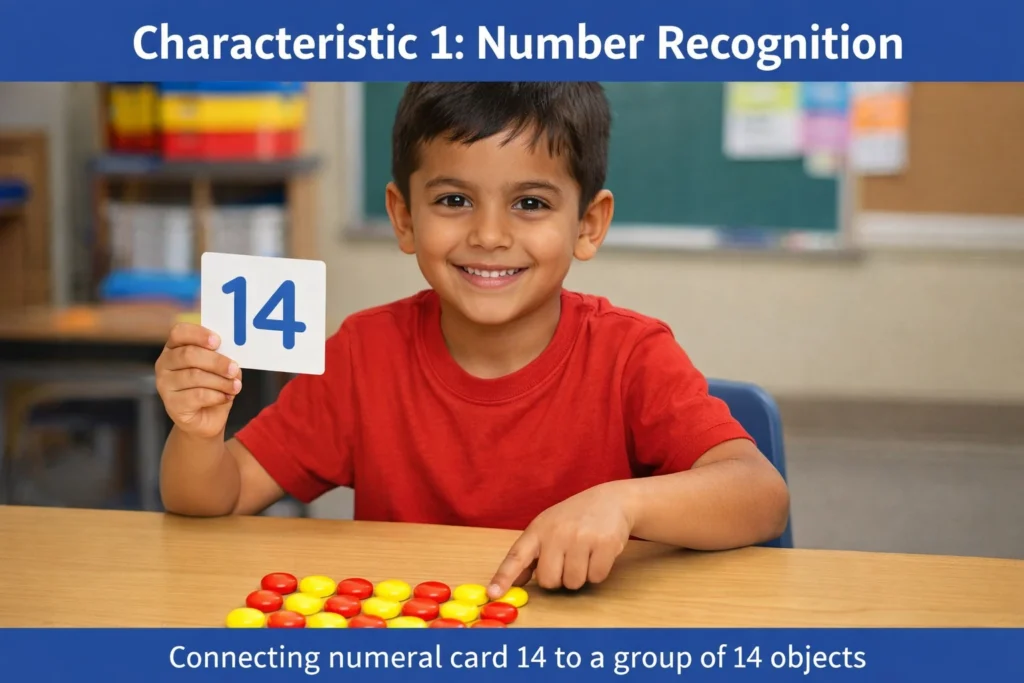
This goes in both directions: seeing “8” and knowing it means eight things, and seeing eight things and knowing the written symbol is “8.”
This might appear to be the simplest of the five characteristics, surely children just learn which squiggle means which number — but genuine number recognition is considerably deeper than visual memorization.
A child with strong number recognition understands that “8” represents the same quantity whether it is written on a card, displayed on a screen, spoken aloud, or represented as eight objects arranged in any spatial configuration.
Observable indicators of strong development:
- Identifies any numeral 1–20 (extending to 100 by end of Class 1) without hesitation
- Can say “that’s fourteen” when shown 14 objects without counting
- Recognizes numbers in different fonts, sizes, and contexts (price tags, page numbers, clocks)
Signs that development needs support:
- Confuses visually similar numerals (6 and 9, 2 and 5, 12 and 21)
- Can write or say a number but cannot show what quantity it represents
- Needs to count from 1 to confirm a number’s identity rather than recognizing it directly
Building activity: Number hunts around the home or classroom, finding numbers on clocks, packaging, calendars, door numbers — build recognition in authentic contexts.
The range of number tools explored in number sense resources for parents includes specific recognition-building resources at every level.
Characteristic 2: Counting Fluency
Counting fluency means counting accurately, flexibly, and with genuine understanding, not reciting numbers like a rhyme but using them purposefully from any starting point in any direction.
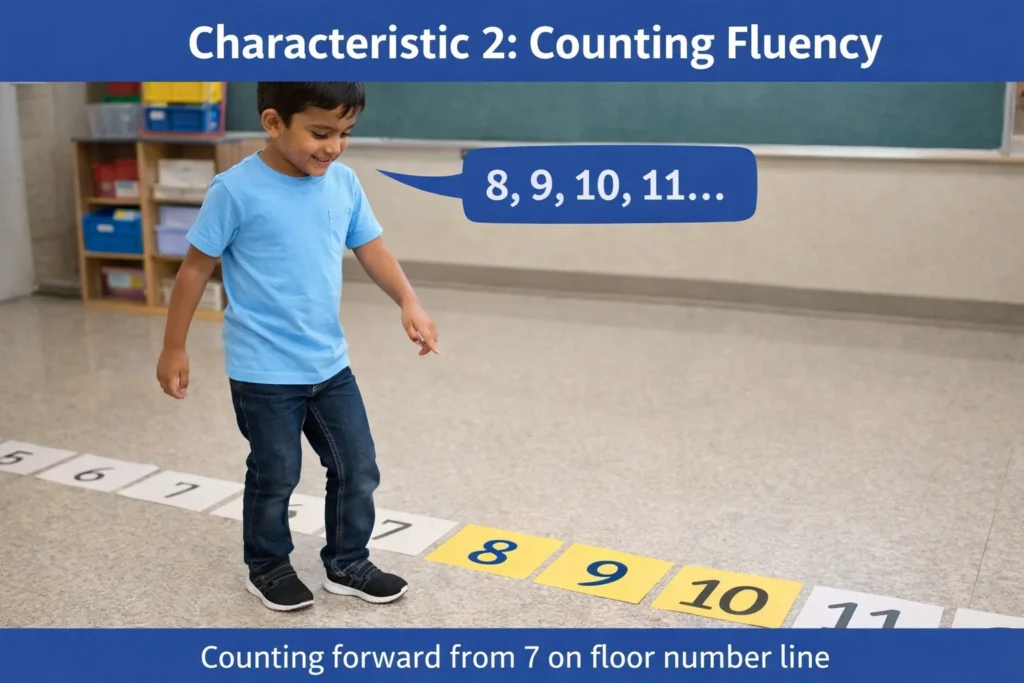
There are four distinct counting skills that constitute Class 1 counting fluency, and children need all four before counting can be considered genuinely fluent.
Forward counting from any starting point — not just from 1. A child who can count forward from 7 without restarting from 1 has counting-on ability; a child who must restart from 1 every time has sequence recall but not true fluency.
Backward counting from any starting point — essential for subtraction readiness. Most children need significantly more practice with backward counting than forward.
Daily countdown activities (from stairs, from clocks, from games) build this fluency most effectively.
Skip counting by 2s, 5s, and 10s — the bridge between counting and multiplication. Skip counting fluency is covered in full depth in skip counting for class 1 and the teaching methodology in how to teach skip counting to class 1 kids.
One-to-one correspondence — touching one object for each counting word, without double-counting or skipping. This is the foundational accuracy skill that underpins all subsequent counting.
Observable indicators of strong development:
- Counts forward and backward from any starting point within 20 without restarting
- Can count on from a given number to find a total (start at 6, count on 4 more — 7, 8, 9, 10)
- Skip counts by 2s to 20, by 5s to 50, by 10s to 100 without losing the pattern
Signs that development needs support:
- Always restarts from 1 regardless of the starting instruction
- Loses track during backward counting frequent errors and restarts
- Double-counts or skips objects during physical counting tasks
Building activity: The number line activities in how to teach number line maths class 1 directly build counting fluency forward and backward, jumping builds both counting directions simultaneously.
Characteristic 3: Understanding Quantities
Understanding quantities means knowing what numbers represent in terms of real amounts.
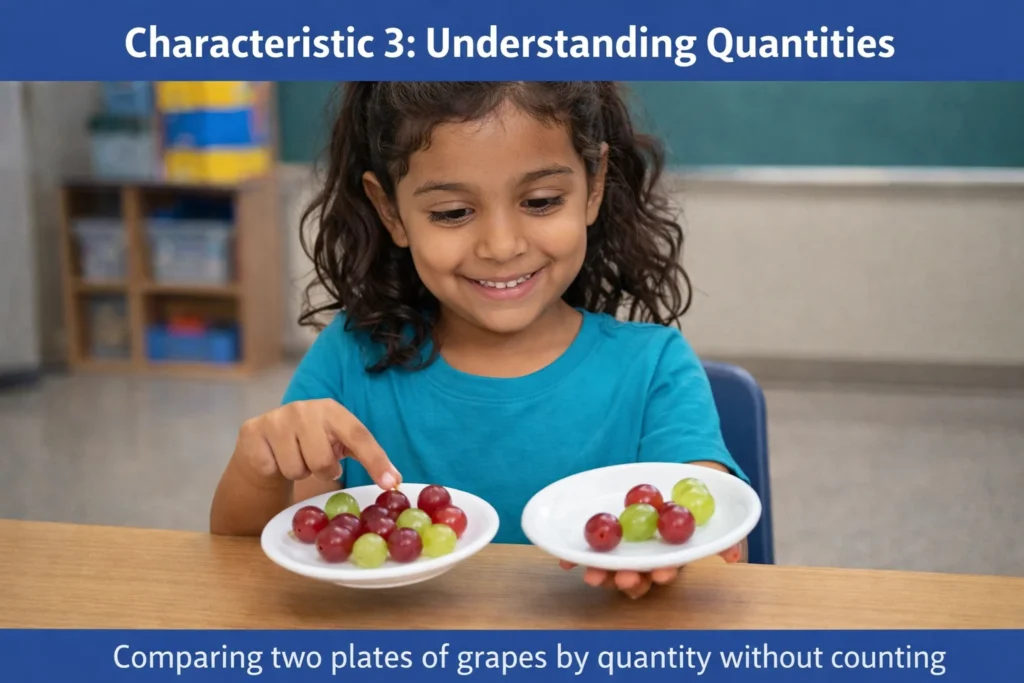
For example, 7 means a specific quantity of real objects, that seven is more than four, that the gap between 3 and 8 is greater than the gap between 6 and 8.
It is the bridge between the abstract symbol and the concrete reality it represents.
Three sub-skills constitute this characteristic at Class 1 level:
Subitizing — instantly recognizing a quantity of objects without counting. Perceptual subitizing (up to 4–5 objects) develops naturally; conceptual subitizing (recognizing larger quantities by grouping smaller ones) requires deliberate practice with dot cards and ten-frames.
Comparison — judging which of two quantities is greater, smaller, or equal. This is the foundation of the < and > symbol understanding and the comparing work in ascending and descending order in maths class 1.
Estimation — judging approximately how many without counting precisely. Strong estimators have developed an intuitive quantity scale; they know that 30 looks about three times as many as 10.
This scale develops through varied experiences with real quantities, not through instruction alone.
Observable indicators of strong development:
- Instantly recognizes groups of 3–5 objects without counting
- Immediately identifies which of two numbers is larger without counting up to both
- Estimates quantities within a reasonable range before counting to verify
Signs that development needs support:
- Counts every object even when subitizing is possible (a group of 3 should not require counting)
- Cannot compare two numbers without counting from 1 to both
- Estimates wildly (says 100 for a group of 8) — no quantity scale developed
Building activity: Ten-frame activities build subitizing and quantity understanding simultaneously, the most effective early quantity tool available.
The full range of quantity-building activities is in number sense teaching strategies for first graders.
Characteristic 4: Number Relationships
Number relationships is the understanding of how numbers connect to and depend on each other, not just what each number is individually, but how it relates to every other number in the system.
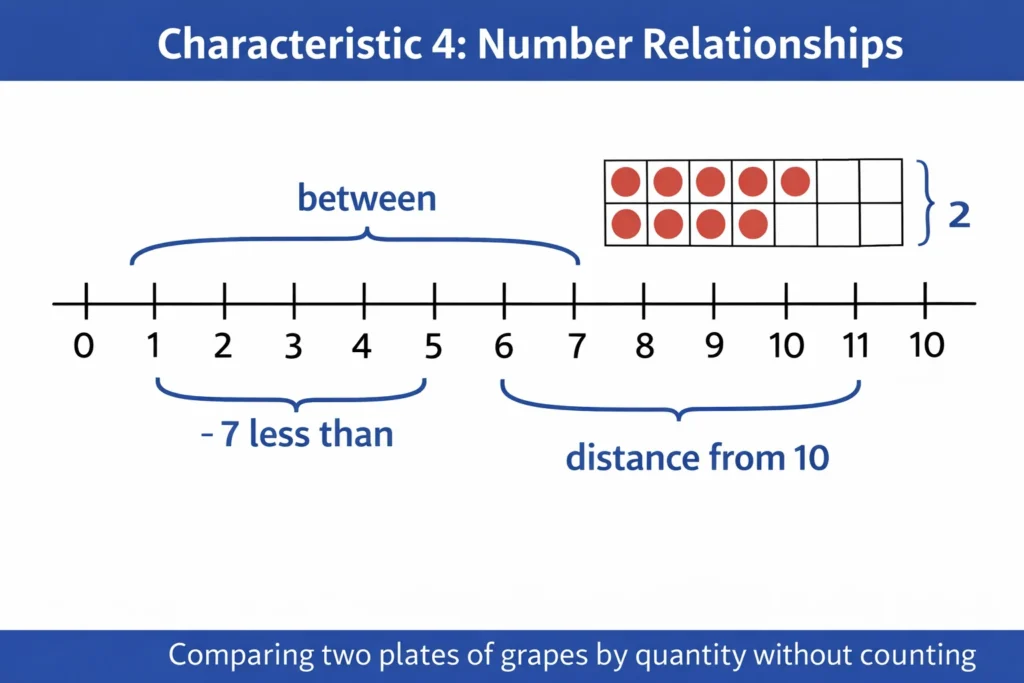
This characteristic is what distinguishes rote knowledge (memorized facts) from genuine mathematical understanding (flexible reasoning about connected quantities).
Part-whole understanding — a number can be decomposed into parts in multiple ways. 7 = 5 + 2 = 4 + 3 = 6 + 1 = 7 + 0. This understanding is the foundation of addition and subtraction flexibility.
The positional and sequential relationship understanding that supports this is covered in number positions on a number line class 1.
Before, after, and between — every number has a neighbour before it, a neighbour after it, and belongs between a range of other numbers.
This positional relationship understanding enables number line navigation without counting from zero every time.
Number patterns — recognizing and extending patterns in sequences. A child who sees 2, 4, 6, 8 and immediately says 10 is using number relationship understanding, not memorization.
Pattern recognition is the earliest form of algebraic reasoning. The sequence pattern work that develops this is in what is the number sequence for class 1 maths.
Place value relationships — understanding that 23 means 2 tens and 3 ones, not simply a “2” and a “3” placed side by side. This is one of the most important and most demanding number relationships for Class 1 children to develop.
Observable indicators of strong development:
- Can decompose 8 into at least three different pairs (7+1, 6+2, 5+3) without hesitation
- Immediately knows both neighbours of any number 0–20
- Recognizes and extends simple patterns (2, 4, 6, __ → 8; 5, 10, __ → 15)
Signs that development needs support:
- Only knows one way to make each number (7 is always “5 and 2”)
- Cannot identify what comes before or after a number without counting
- Does not notice patterns in number sequences — treats each number as unconnected
Characteristic 5: Flexible Thinking With Numbers
Flexible thinking with numbers is the most advanced of the five characteristics and the one that most clearly distinguishes genuine mathematical understanding from procedural compliance.
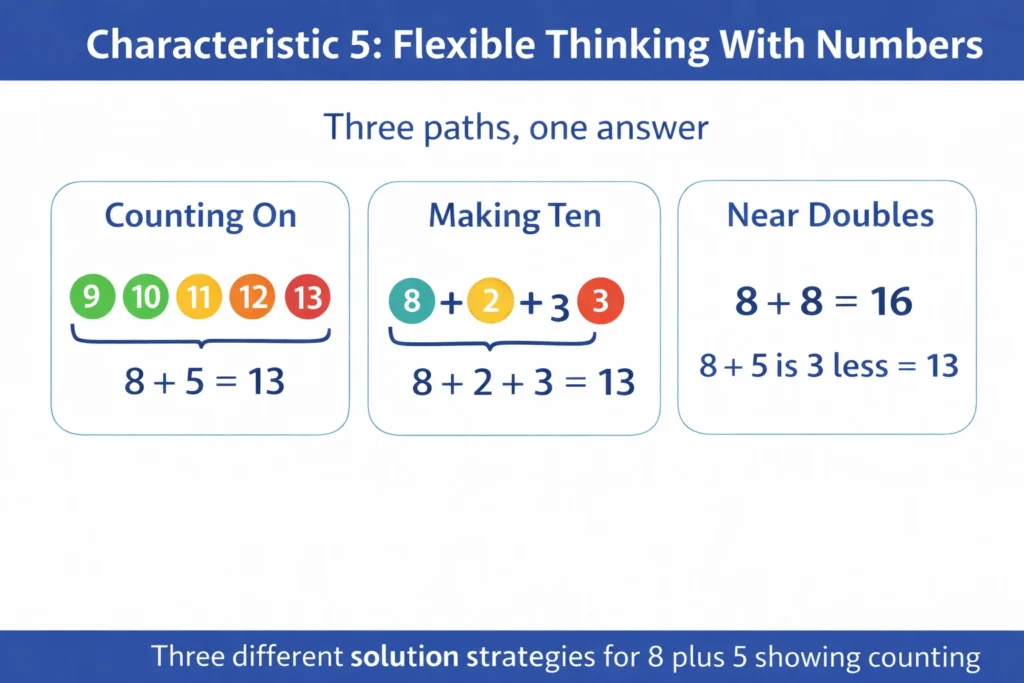
A child with flexible number thinking does not have one way to solve every problem they choose the most efficient strategy for the specific numbers involved.
This flexibility is built directly on the four characteristics above. A child cannot be flexible with numbers they cannot recognize, count fluently, understand as quantities, and see in relationship to other numbers.
Flexible thinking is the integration of the other four characteristics into dynamic mathematical reasoning.
Key flexible thinking strategies for Class 1:
Counting on — rather than counting both numbers from 1, start at the larger number and count on the smaller: for 7 + 4, start at 7 and count “8, 9, 10, 11.”
This strategy is only possible when the child has counting fluency from any starting point.
Making ten — breaking a number to create a sum of 10 first: for 8 + 5, take 2 from 5 to make 8 + 2 = 10, then add the remaining 3 = 13. This strategy requires both part-whole understanding and knowledge of ten as a landmark number.
Using known facts — leveraging memorized combinations to derive unknowns: if you know 5 + 5 = 10, then 5 + 6 must be 11. If you know 7 + 3 = 10, then 7 + 4 must be 11.
This strategy requires both number relationship understanding and flexibility to apply known facts to new situations.
Estimation and reasonableness checking — asking “does this answer make sense?” before accepting it.
A child who solves 3 + 8 = 14 and accepts this answer without question lacks the quantity understanding that would signal an unreasonable result.
Observable indicators of strong development:
- Uses different strategies for different problems rather than always counting from 1
- Can solve simple problems without physical objects or number lines
- Spontaneously checks whether answers are reasonable
Signs that development needs support:
- Always uses the same counting strategy regardless of which numbers are involved
- Cannot solve any problem without physical objects or finger counting
- Never questions an answer accepts obviously wrong results without noticing
Building activity: Number talks, structured 5-minute whole-class discussions where children share different solution strategies for the same problem, are the single most effective tool for developing flexible thinking.
The number talk methodology is covered fully in Number Sense Teaching Strategies for First Graders.
How the 5 Characteristics Work Together
The five characteristics of number sense are not a checklist to tick off in sequence they are interdependent and mutually reinforcing. Stronger development in any one characteristic supports development in all the others.
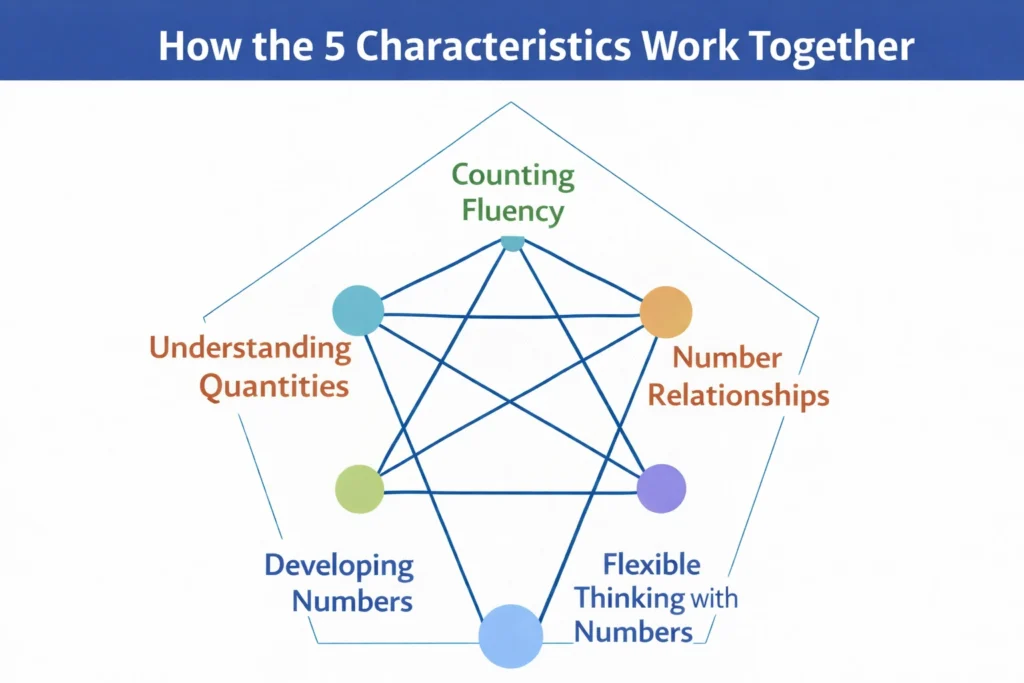
Number recognition enables counting fluency (you cannot count fluently without recognizing the numerals). Counting fluency builds quantity understanding (fluent counting from any starting point is how quantity comparison develops).
Quantity understanding enables number relationships (part-whole thinking requires understanding what each part quantity means).
Number relationships enable flexible thinking (you cannot use make-ten strategies without knowing that 8 + 2 = 10 and 3 + 7 = 10).
This interdependence means that when a child shows weakness in one area, the most effective response is rarely to drill that specific characteristic in isolation.
It is to look at which of the supporting characteristics underneath it may be underdeveloped, and strengthen the foundation.
Can a child have strong recognition but weak flexible thinking?
Yes — this is actually very common. Children who have been taught through worksheets and number cards often develop strong recognition and can count fluently, but have weak quantity understanding and almost no flexible thinking. They know what numbers look like but not what they mean or how they relate. This is why the five characteristics provide a more useful diagnostic than simply testing “can they count to 100?”
Which characteristic is most important to prioritize in Class 1?
All five develop together, but quantitative understanding (Characteristic 3) tends to be the most critical lever — and the most commonly underdeveloped. Children who genuinely understand what numbers represent as quantities find all four other characteristics easier to develop. Activities that build subitizing and comparison, such as ten-frames, dot cards, and comparison games tend to produce the fastest improvements across all five characteristics simultaneously.
How do these characteristics connect to competition mathematics?
All five characteristics are directly assessed in Class 1 mathematical competitions recognition in numeral identification problems, counting fluency in sequence problems, quantity understanding in comparison problems, number relationships in pattern problems, and flexible thinking in multi-step reasoning problems. The IMO syllabus for class 1 maps exactly which topics test which characteristics at the competition level.
Make Preparing for Math Olympiad Simple!



Conclusion
The characteristics of number sense, Class 1 number recognition, counting fluency, understanding quantities, number relationships, and flexible thinking, are not five separate skills.
They are five interwoven aspects of a single mathematical intelligence that grows through consistent, hands-on experience with numbers.
When a child struggles, these five characteristics tell you exactly where the gap is and what to do about it. That diagnostic precision is what makes this framework genuinely useful not just interesting.
For strategies that build all five simultaneously, see number sense teaching strategies for first graders.
For a curated resource guide by characteristic, see number sense resources for parents.
For the competition pathway, strong number sense opens up, see IMO syllabus for class 1.