

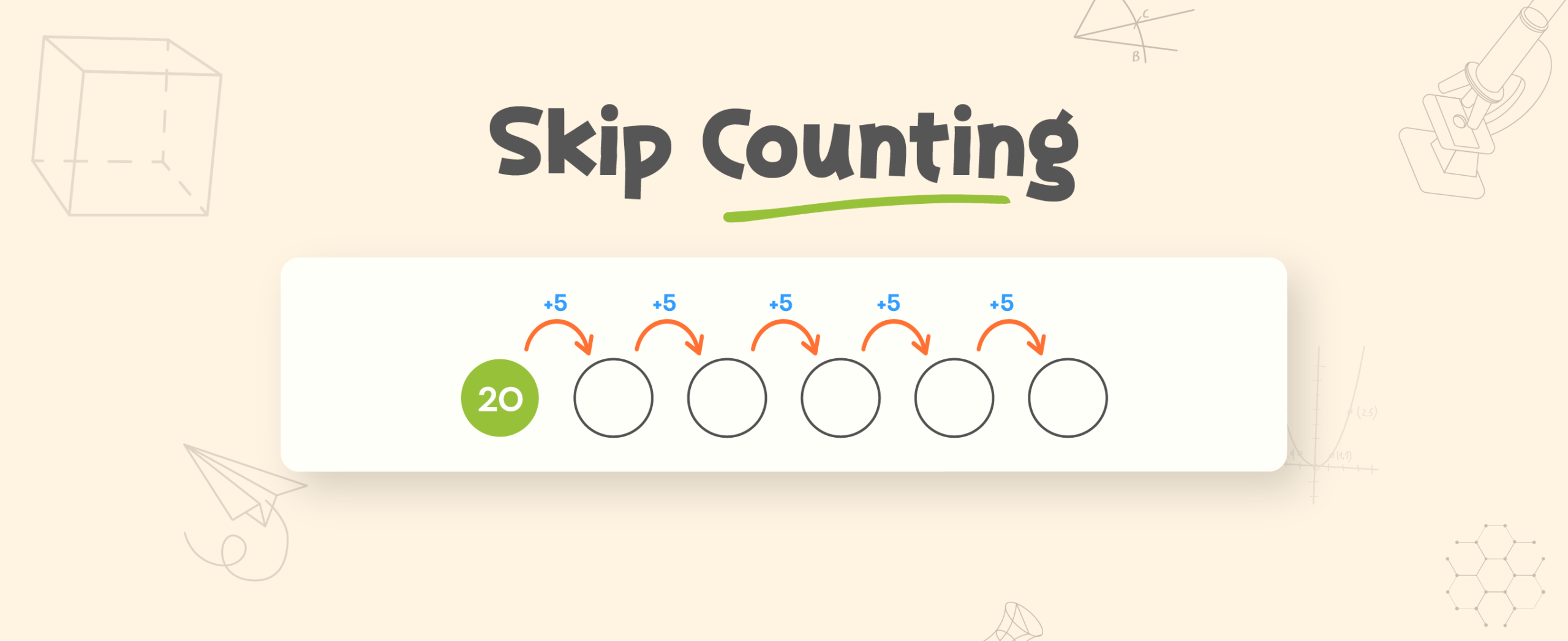
How to teach skip counting to Class 1 kids is a question every parent and teacher faces, and the answer matters more than most realise.
- The Core Teaching Principle: Equal Groups Before Equal Jumps
- Step 1: Confirm Forward Counting Fluency
- Step 2: Introduce Grouping With Physical Objects
- Step 3: Move to the Number Line
- Step 4: Build Oral Fluency Through Rhythm and Movement
- Step 5: Introduce Written Practice Last
- Activities That Reinforce Skip Counting
- Common Teaching Mistakes to Avoid
- Differentiation: Matching Teaching to the Child's Level
- Conclusion
Skip counting is not simply faster counting; it is the foundation for multiplication, division, and number pattern recognition.
Children who struggle with it were almost always taught too fast and too abstractly rote chanting with no real objects or movement. The fix is simple: concrete before abstract, always.
Before starting, build the right foundations with number sense for Class 1 and skip counting for Class 1. This guide focuses entirely on the delivery lesson sequence, activities, and mistakes to avoid.
The Core Teaching Principle: Equal Groups Before Equal Jumps
Before any number sequence is introduced, children need to understand what skip counting means conceptually: counting groups, not individual items.
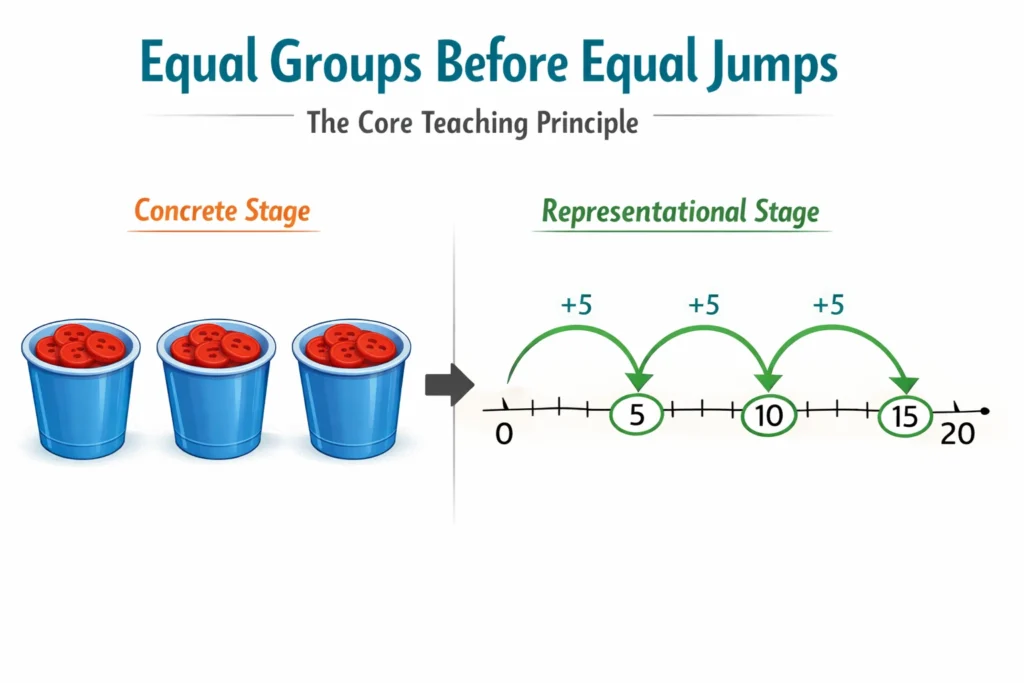
A child who understands this can figure out an unfamiliar skip-counting sequence by reasoning. A child who has only memorized “2, 4, 6, 8” as a chant cannot extend this understanding to new contexts.
The foundational understanding is this: when we skip count by 5, we are counting the total of equal groups of 5. Each time we say a number in the sequence, we have added one more group.
This is repeated addition the same operation as multiplication which is why skip counting fluency predicts multiplication readiness so reliably.
Build this understanding before fluency. Equal groups first, number sequences second.
The number sense foundation that makes this conceptual grounding possible is covered in Number Sense for class 1 and the teaching strategies in Number Sense Teaching Strategies for first graders.
Step 1: Confirm Forward Counting Fluency
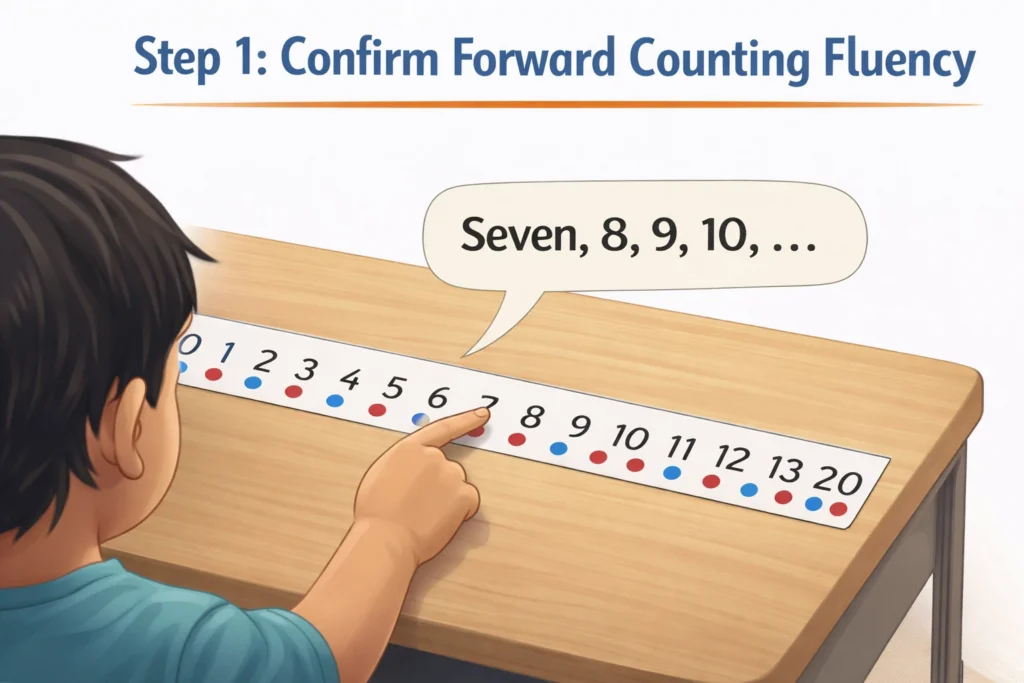
Before introducing any skip counting sequence, confirm that children can count forward fluently from any starting point not just from 1.
A child who must always start from 1 to count to any target has not yet developed the counting-on ability that skip counting requires.
Readiness check:
- “Start at 7 and count to 15.” (Can they do this without starting from 1?)
- “Start at 13 and count backward to 6.” (Backward counting fluency matters for later skip counting backward.)
If a child cannot count on from a mid-point, spend 3–5 minutes daily on counting-on games before introducing skip counting.
The number sequence fluency that supports this is developed through teaching number sequences to class 1 students and is detailed in the number sequence for class 1 maths.
Do not begin skip counting until: the child can count forward from any number within 20 without starting over from 1.
Step 2: Introduce Grouping With Physical Objects
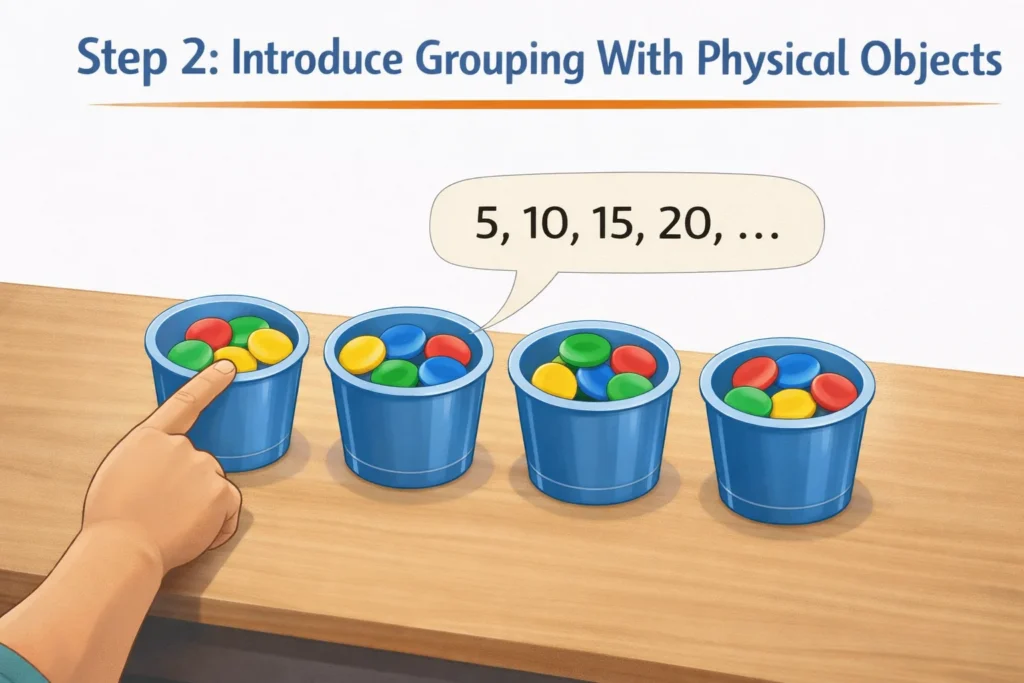
This is the most important step and the one most commonly skipped. Children must experience skip counting as counting groups before they count sequences.
Lesson script for skip counting by 2s:
Place 5 small cups on the table. Put exactly 2 buttons in each cup. Say: “Each cup has 2 buttons. Instead of counting every single button, let’s count the totals as we add cups.”
Touch the first cup: “2.” Touch the second cup: “4.” Touch the third: “6.” Touch the fourth: “8.” Touch the fifth: “10.”
Ask: “How many cups did we use?” (5.) “How many buttons total?” (10.) “What did we add each time?” (2.)
Now let the child do it. They touch each cup and say the running total. The physical touching and counting is what builds the conceptual link between groups and the skip counting sequence.
Extend to 5s and 10s using the same cup structure. 5 buttons per cup → 5, 10, 15, 20. 10 buttons per cup → 10, 20, 30, 40. The same cup activity, different group sizes, builds all three core sequences.
Step 3: Move to the Number Line
Once grouping with physical objects is fluent, move to the number line.
This is the representational stage children are now working with a visual model that represents the equal-jump structure of skip counting.
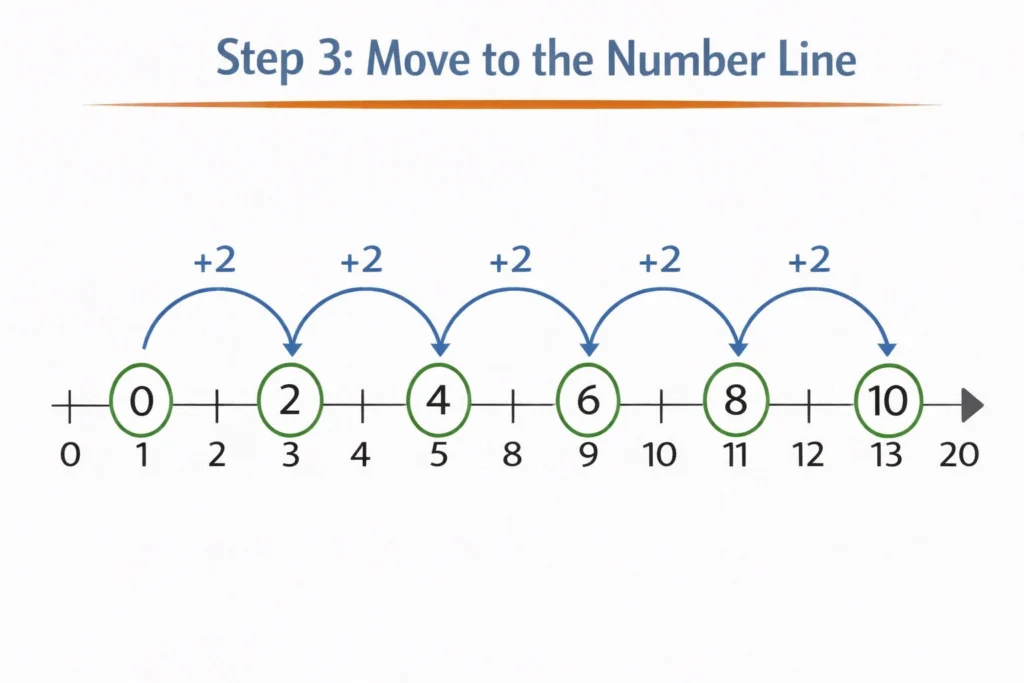
Lesson script for number line introduction:
Draw a 0–20 number line on the board. Say: “We counted 5 cups of 2 buttons each. Let’s show the same thing on the number line.”
Start at 0. Draw a curved arc to 2. Say: “+2 — that’s one cup.” Draw another arc to 4. “+2 — that’s two cups.” Continue to 10.
Ask: “What do you notice about the arcs?” (They are all the same size.) “What do you notice about the landing numbers?” (They are all even numbers. They all have a gap of 2 between them.)
The equal-arc visual is crucial, as it makes the equal-jump structure of skip counting physically visible in a way that a written number sequence alone cannot convey. Use this visual every time a new skip-counting sequence is introduced.
The number line teaching methodology that supports this step is in how to teach number line maths class 1 and the positional understanding in number positions on a number line class 1.
Step 4: Build Oral Fluency Through Rhythm and Movement
Once the conceptual foundation is in place through grouping and number line work, oral fluency practice through rhythm and movement builds the automatic recall that makes skip counting fast and reliable.
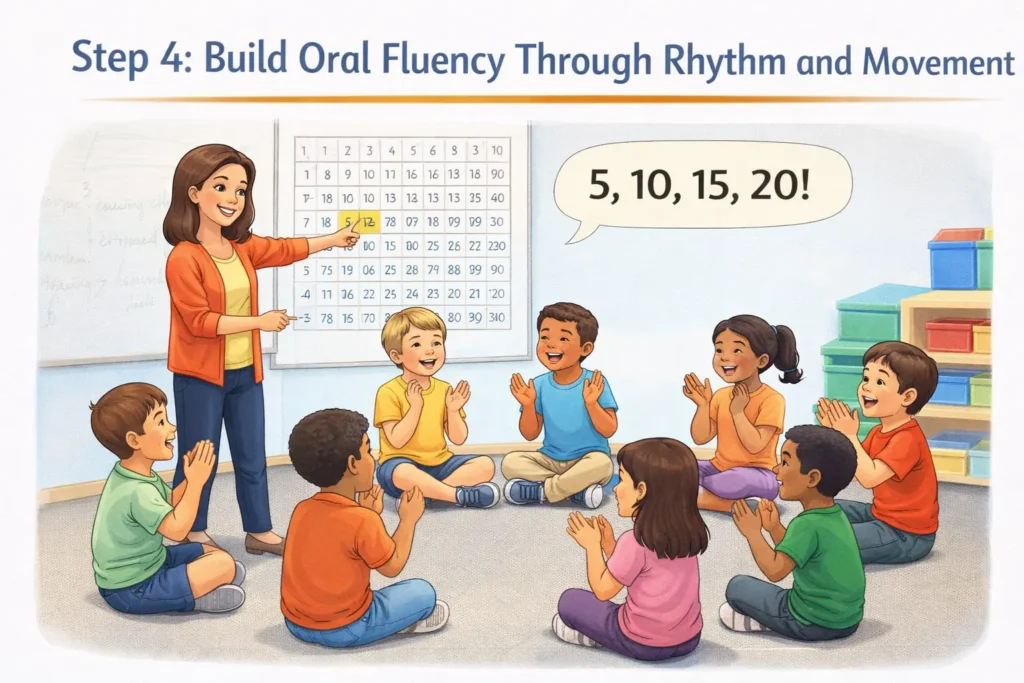
Clap-and-count: Stand in a circle. Chant the sequence together — 5, 10, 15, 20, 25 — clapping once per number.
The rhythm makes the sequence memorable in the way songs are memorable through repetition embedded in a predictable beat.
Whisper and shout: Count the sequence aloud but whisper the skipped numbers and shout the landing numbers.
For skip counting by 5 to 30: “one, two, three, four, FIVE, six, seven, eight, nine, TEN, eleven, twelve, thirteen, fourteen, FIFTEEN…”
This technique keeps the skipped numbers present in the child’s mind while making the landing numbers salient.
Call and response: Teacher says a number, class responds with the next: “5?” — “10!” “10?” — “15!” “15?” — “20!”
The pause and response format requires each child to actively produce the next number rather than passively chanting along.
This is the most diagnostic oral activity it reveals immediately which children are genuinely tracking the sequence and which are following along by ear.
Body movement sequences: Assign a physical action to each landing number, hop on 2, 4, 6, 8 while whispering the numbers in between. Stand on 5, 10, 15, 20. Jump on 10, 20, 30.
The movement creates a physical memory that persists even when the verbal memory fades.
Step 5: Introduce Written Practice Last
Written skip counting exercises are the final step in the consolidation of understanding, not the introduction of it.
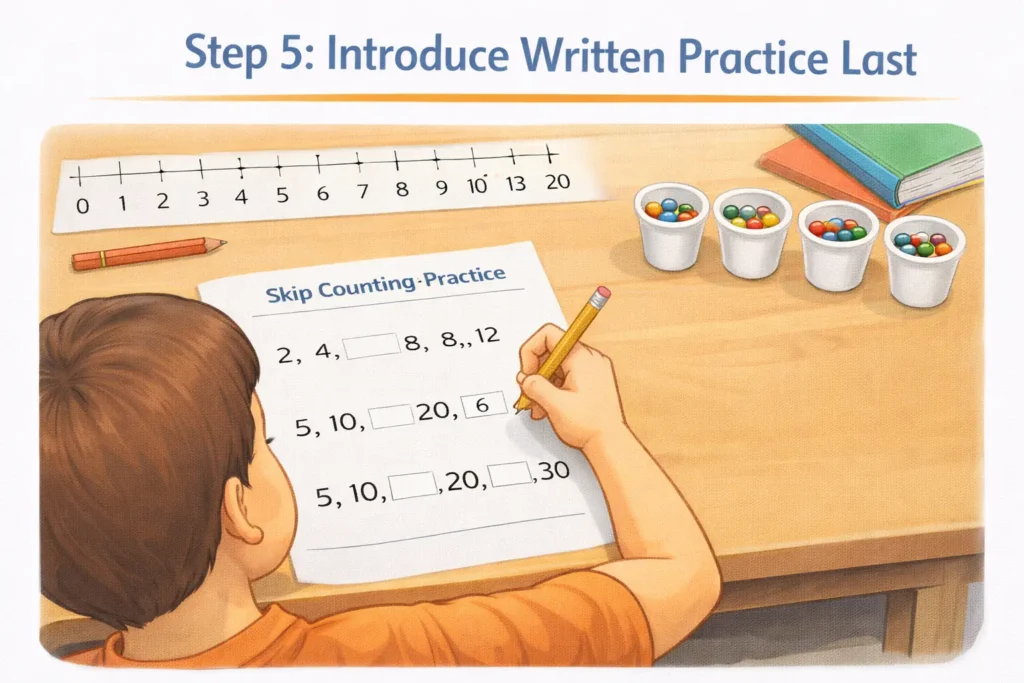
Children who reach written practice having completed Steps 1–4 find worksheets manageable and meaningful.
Children given worksheets before Steps 1–4 often complete them by guessing or copying, producing the appearance of understanding without the reality.
Effective written exercise types for skip counting:
- Fill in the missing number: “2, 4, __, 8, __, 12”
- Continue the sequence: “5, 10, 15, __, __, __”
- Identify the rule: “10, 20, 30, 40 — what is the jump?”
- Hundred chart colouring: colour every 5th number the pattern that emerges is the skip counting sequence made visible across the full number grid
Always keep the desk number line accessible during written practice.
The number line is a thinking tool, not a shortcut children who use it to check uncertain answers are developing exactly the self-monitoring habit that successful mathematical thinkers demonstrate.
The hundred chart work connects to the pattern recognition in ascending and descending order in maths class 1 — coloured skip counting patterns show clearly which direction sequences grow.
6 Activities That Reinforce Skip Counting
1. Floor Number Line Hops: Tape a 0–30 number line on the floor. Children hop on every 2nd, 5th, or 10th number, saying each landing number aloud.
The physical movement creates body memory for the sequence direction and equal-jump size simultaneously. Connects to the spatial learning in spatial understanding for class 1.
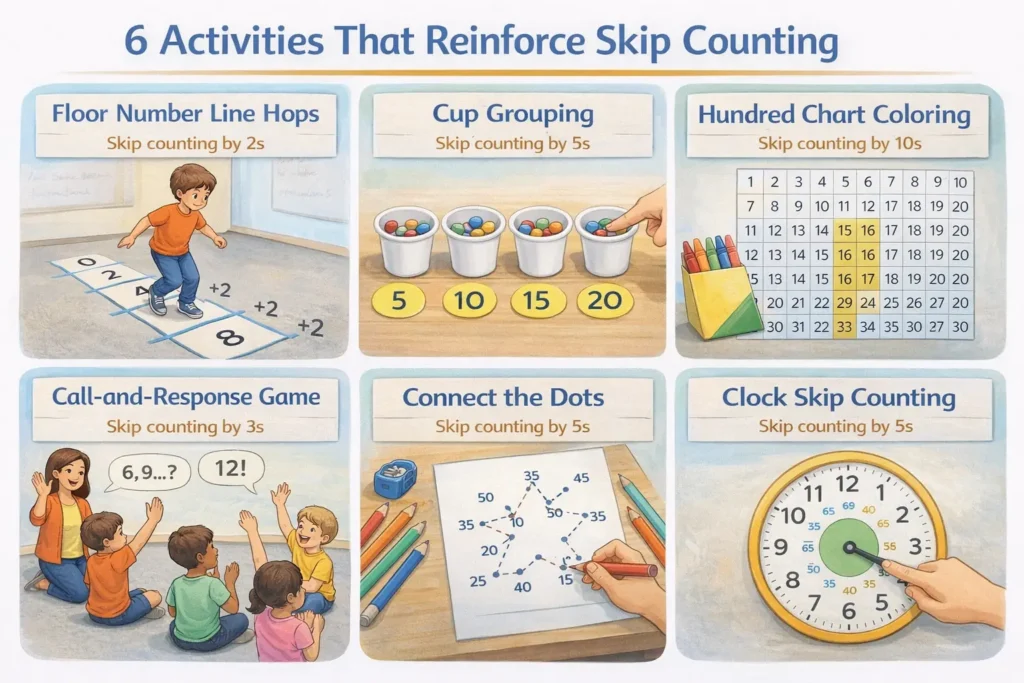
2. Cup Grouping: (Described fully in Step 2 above.) The most important conceptual activity — use it every time a new skip counting interval is introduced before any other activity.
3. Hundred Chart Colouring: Give children a printed 1–100 chart. Colour every 2nd number in one colour, every 5th in another, every 10th in a third.
The overlapping colour patterns reveal which numbers appear in multiple sequences and make the structure of the number system visually obvious.
This is one of the richest single activities for building skip counting and number pattern understanding simultaneously.
4. Call and Response: (Described in Step 4 above.) The highest-diagnostic oral activity. Use it at the start of every skip counting session as a warm-up and assessment in one.
5. Connect the Dots by Skip Count: Give children a connect-the-dots picture where the dots are labelled with skip counting sequences — connect dot 5 to dot 10 to dot 15.
The picture only appears when the correct sequence is followed, making the skip-counting sequence self-checking. Children are highly motivated to find the picture, producing more repetitions than any other written activity.
Connects to the number sequence activities in teaching number sequences to class 1 students.
6. Clock Face Skip Counting: Show children a clock face and explain that each number on the clock represents 5 minutes. Count around the clock by 5s: 5, 10, 15, 20… 60.
This real-life application of skip counting by 5s makes the sequence feel purposeful and connects mathematics to a daily-life tool children see constantly.
Common Teaching Mistakes to Avoid
| Mistake | Why It Causes Problems | Fix |
|---|---|---|
| Teaching the sequence before grouping | Children memorize chants without understanding equal groups | Always begin with physical cup grouping before any sequence work |
| Teaching all three sequences simultaneously | Direction and interval confusion: children mix up 2s, 5s, and 10s | Teach one sequence to fluency before introducing the next |
| Using worksheets as the introduction | Written work requires abstract thinking children guess without understanding | Worksheets are the final step, not the first |
| Accepting chanted answers without checking comprehension | Children follow along by ear rather than tracking the sequence independently | Use call-and-response exclusively it reveals which children are genuinely counting |
| Skipping the number line stage | Children cannot see the equal-jump structure | Draw arcs for every new sequence equal arcs must precede written sequences |
Differentiation: Matching Teaching to the Child’s Level
For children still developing basic counting fluency: Stay at Step 2 (cup grouping) for 2–3 weeks before introducing the number line.
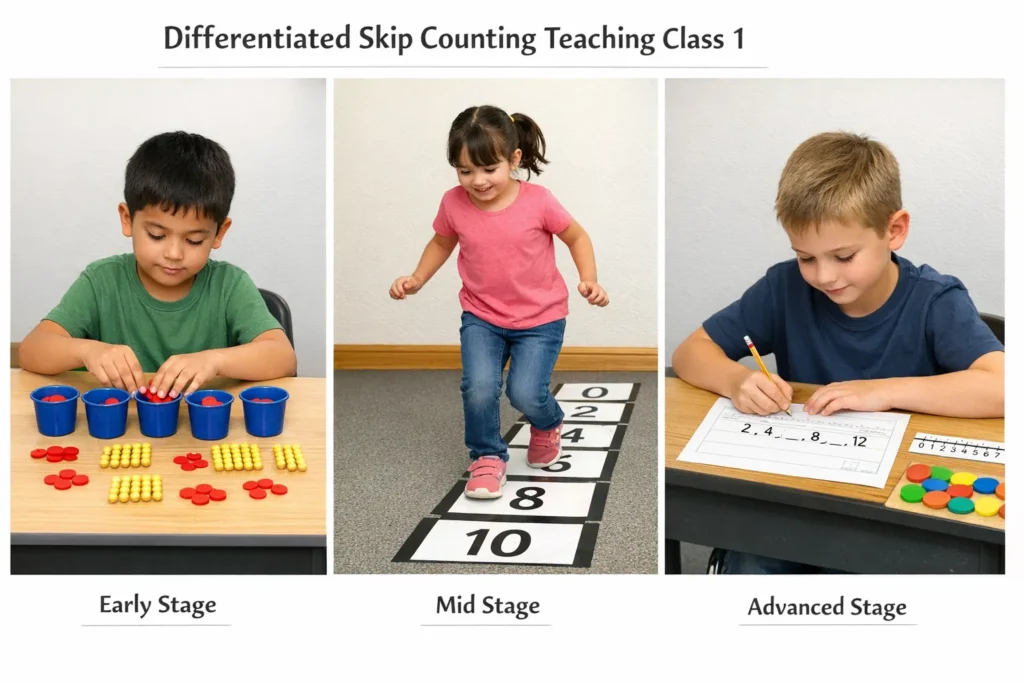
Focus exclusively on skip counting by 2s. Use very small numbers only to 10 initially. Do not introduce written exercises until the child can complete Steps 1–3 confidently.
For children at expected Class 1 level: Follow the full 5-step progression. Introduce 2s first, then 5s after 2s are fluent, then 10s. Use all six activities in rotation. Introduce written exercises at Step 5.
For children with strong number sense: Introduce backward skip counting alongside forward sequences once all three forward sequences are fluent.
Challenge with skip counting from non-zero starting points: “Count by 5s starting from 3.” Introduce skip counting by 3s as an extension. These children are ready for the early competition mathematics thinking described in IMO syllabus for class 1.
How long should each skip-counting session be?
5–10 minutes of focused, active practice is optimal for Class 1 children. Short sessions with high engagement produce faster learning than longer sessions where attention drifts. Daily 5-minute sessions across 3 weeks build deeper fluency than three longer weekly sessions.
How do I know when a child is ready to move from skip counting by 2s to skip counting by 5s?
When the child can complete the by-2s sequence to 20 without hesitation in a call-and-response format and can correctly fill in missing numbers in a written by-2s sequence, they are ready to begin skip counting by 5s. Do not move on based on performance in chanted group sequences alone — call-and-response individually is the reliable readiness test.
Should skip counting be introduced before or after ordering?
After number ordering fluency, understanding that 6 comes before 8, that 15 is between 10 and 20, is the prerequisite that makes skip-counting positions on a number line meaningful. The ordering foundations are in number ordering for class 1.
Make Preparing for Math Olympiad Simple!



Conclusion
Teaching skip counting follows one non-negotiable principle: conceptual understanding before fluency practice. Group real objects first, move to number line arcs, build oral rhythm through movement, and reach written exercises last.
Teach one sequence at a time 2s, then 5s, then 10s, and confirm fluency at each step before moving forward.
Use activities in rotation to keep practice varied, and fix mistakes by addressing the root cause rather than simply correcting the answer.
Done well, skip counting stops being a memorised chant and becomes a flexible, intuitive skill children carry confidently into multiplication and beyond.
For the complete conceptual picture of what skip counting is and why it matters, see skip counting for class 1.
For the number sense foundations, see number sense for class 1.
For the competition mathematics pathway, see the IMO syllabus for class 1.

Mikha Piregu is a Content Writer with experience spanning educational content, including math and math olympiad topics, as well as advocacy writing, research-based articles, and SEO-driven web content. He creates high-quality blog content, web copy, and feature articles that support brand visibility, audience engagement, and long-term organic growth through data-informed storytelling. Skilled in WordPress, WooCommerce, and modern digital tools, Mikha adapts content across various platforms, including blogs, websites, campaigns, and advocacy initiatives, with clarity and purpose. You can reach out to him at [email protected].

There are no comments posted here yet.
Sign in to leave a comment