 November 18, 2025
 17 min. read

The difference between Math Olympiad and Kangaroo Math competitions is one of the most commonly asked questions among students, parents, and educators.
Math Kangaroo is the world’s largest math contest, reaching about 6.5 million students in 90+ countries, with a single-round, multiple-choice format designed to make math fun and accessible for Grades 1–12.
Math Olympiad competitions, including the International Mathematical Olympiad (IMO) and national olympiads, are multi-round, proof-based, and highly selective, testing deep reasoning and rigorous mathematical arguments among a small group of advanced students.
This guide explains the key differences in format, difficulty, scoring, preparation, and goals, and shows how the two competitions complement each other at different stages of a student’s mathematical development.
Side-by-Side Overview: Math Kangaroo vs Math Olympiad
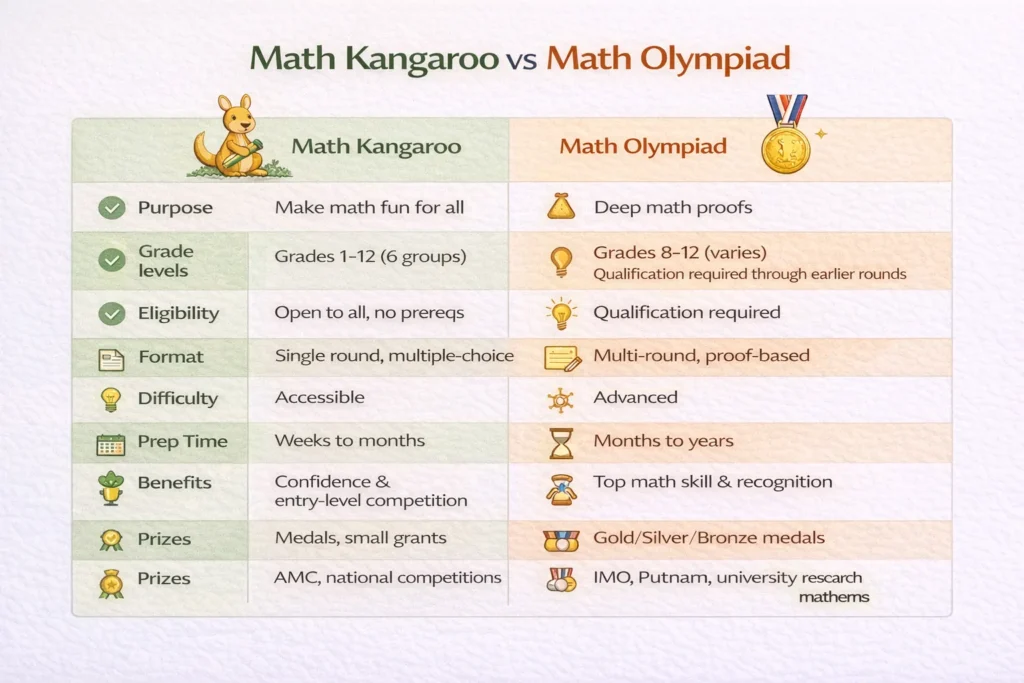
Before diving into each dimension in depth, here is the complete comparison at a glance:
| Feature | Math Kangaroo | Math Olympiad (IMO/USAMO/National) |
|---|---|---|
| Purpose | Make math fun and accessible for all | Test deep mathematical reasoning and proof ability |
| Grade levels | Grades 1–12 (6 age categories) | Typically Grades 8–12 (varies by competition) |
| Eligibility | Open to all — no prerequisites | Qualification required through earlier rounds |
| Format | Single-round, multiple-choice | Multi-round, written proof-based problems |
| Question style | Logic puzzles, reasoning, creative problems | Complex proofs requiring original mathematical arguments |
| Time limit | 75 minutes | 4.5 hours per day (IMO), 4–6 hours (national) |
| Rounds | One round only | 2–5 qualifying rounds depending on competition |
| Scoring | 3/4/5 points per tier, no penalty | 7 points per problem (IMO), partial credit available |
| Penalty scoring | No penalty for wrong answers | No penalty, but partial marks require complete logical steps |
| Difficulty | Accessible to challenging | Advanced to elite |
| Global reach | 90+ countries, 6.5M+ students | ~100 countries, ~600 students (IMO) |
| Proof writing required | No | Yes — essential for all marks |
| Preparation time | Weeks to months | Months to years |
| Primary benefit | Confidence, reasoning habits, entry-level competition | Advanced mathematical skills, elite academic recognition |
| Prizes | Medals, certificates, grants up to $1,000 | Gold/Silver/Bronze medals, scholarships, international recognition |
| Next step | AMC, national competitions | IMO, Putnam, university research mathematics |
What is Math Kangaroo: The Accessible Global Competition
Math Kangaroo was created in Australia in the 1980s by teacher Peter O’Halloran with a single guiding principle: mathematics should be enjoyable and accessible for every student, not just those who already excel at it.
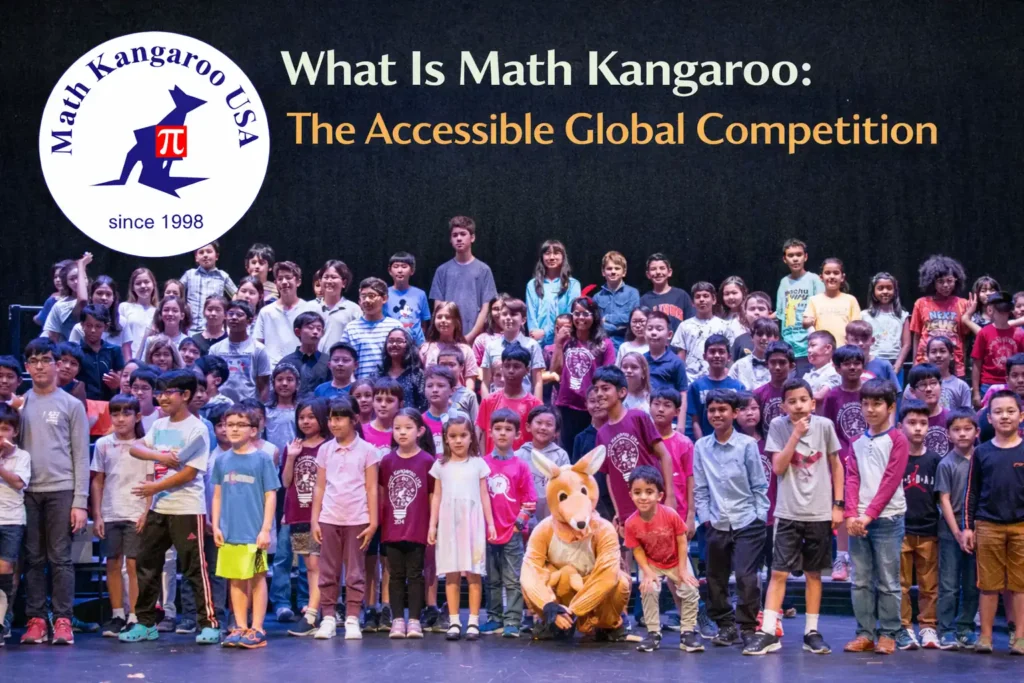
Two French educators brought the model to Europe in 1991, named it Kangourou in tribute to its Australian origins, and helped expand it through the formation of the Association Kangourou Sans Frontières (AKSF) in 1994.
Today, what is Kangaroo Math explains the full competition structure but the essential points for this comparison are these:
Math Kangaroo is structured across six grade-level categories (Pre-Ecolier through Student), uses 24–30 multiple-choice questions with five answer options each, runs for 75 minutes with no penalty for wrong answers, and is held simultaneously across all participating countries on the third Thursday of March each year.
The problems are specifically designed to be solvable through creative logical reasoning without requiring advanced mathematical curriculum knowledge.
A well-prepared Grade 5 student can engage meaningfully with Benjamin-level Kangaroo problems without having studied competition mathematics before.
This accessibility is intentional and is the primary reason math kangaroo participation has reached 6.5 million students annually.
The prizes reflect this inclusive philosophy. Every student receives a participation certificate. Top scorers earn medals and, in the U.S., college grants of up to $1,000. The complete structure is covered in math kangaroo prizes.
What is the Math Olympiad: The Advanced Proof-Based Competition
“Math Olympiad” refers to a family of competitions rather than a single event.
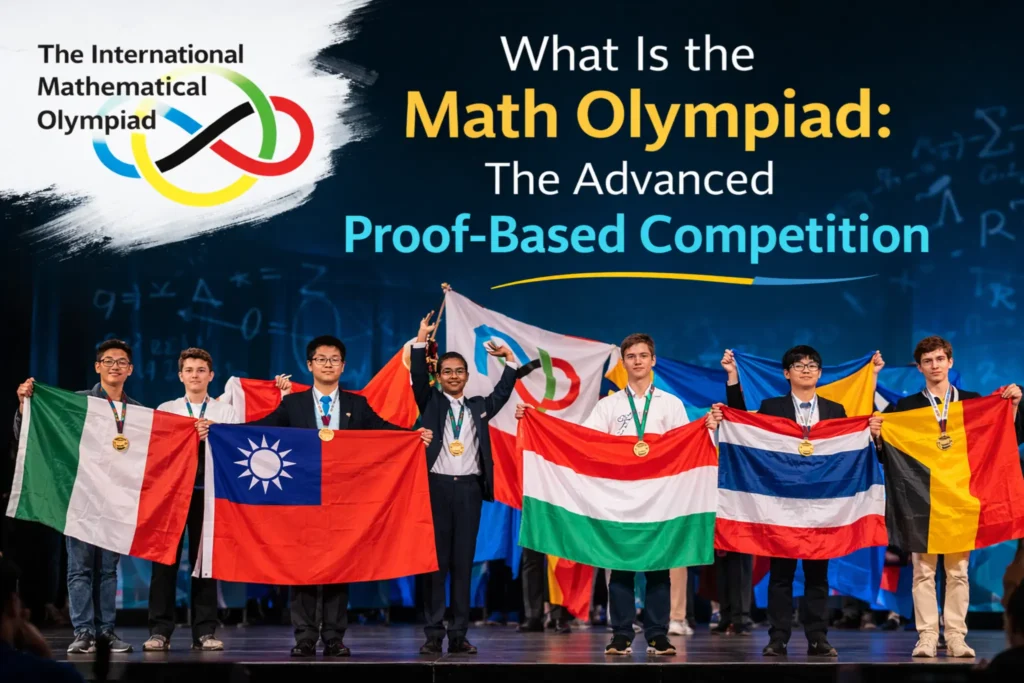
The most prominent members of this family are the International Mathematical Olympiad (IMO), the United States competitions (AMC → AIME → USAJMO/USAMO → IMO), and equivalent national pathways in other countries.
What unites all Math Olympiad competitions is their fundamental design: problems require students to construct complete, rigorous, original mathematical proofs.
There is no multiple-choice format, no procedure to apply, and no partial credit for finding the right answer without justifying it logically.
The score for each problem (0–7 at IMO level) reflects the completeness and logical rigor of the written proof, not the correctness of the final answer alone.
The U.S. competition pathway begins with the AMC series, the AMC 8 (Grades 8 and below), AMC 10, and AMC 12, which are multiple-choice competitions but considerably harder than Kangaroo at equivalent grade levels.
Strong AMC performers qualify for the AIME, then the top AIME performers qualify for USAJMO or USAMO, and the very best USAMO performers are selected for the six-person U.S. IMO team.
Understanding each step requires knowing what is a good AMC math competition score and AMC math competition awards to navigate the qualifying thresholds at each stage.
The IMO itself fields six students per country, selected through this multi-year qualifying process.
Problems span algebra, geometry, number theory, and combinatorics, and require sustained mathematical creativity over 4.5 hours per exam day across two consecutive days.
For the complete pathway from AMC through IMO for U.S. students, how to qualify for the IMO in the USA maps every qualification step in detail.
The 8 Key Differences Explained in Depth
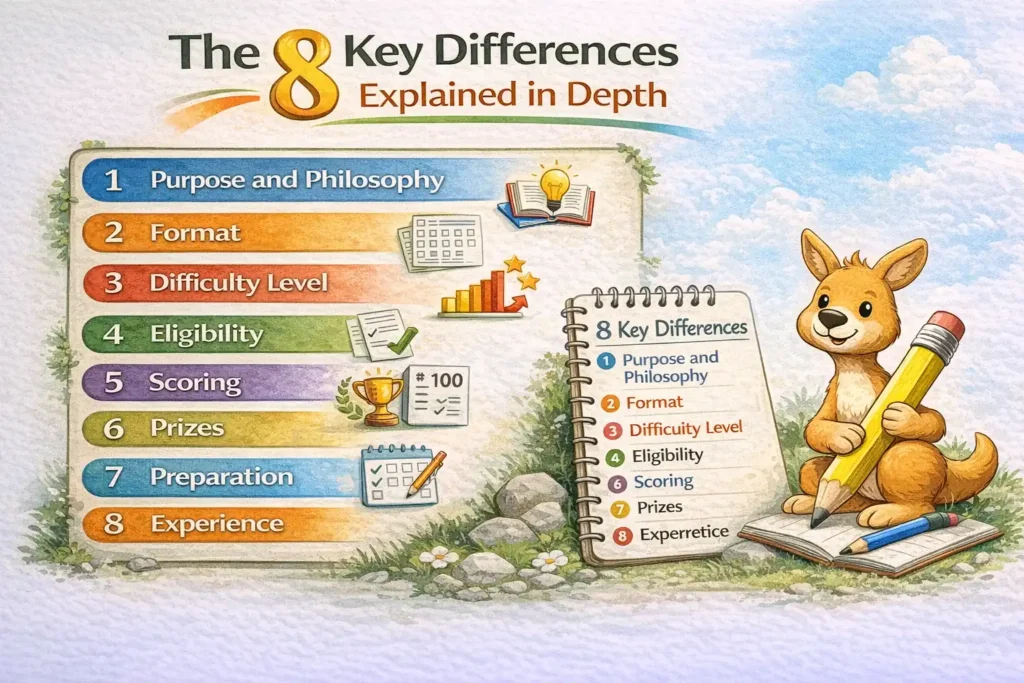
Difference 1: Purpose and Philosophy
This is the most fundamental difference and shapes everything else.
Math Kangaroo’s purpose is democratization making mathematics genuinely engaging for the broadest possible range of students.
Every design decision, from the multiple-choice format to the no-penalty scoring to the grade-calibrated levels, is oriented toward bringing more students into a positive relationship with mathematical thinking.
The competition succeeds when a student who has never thought of themselves as a “math person” finishes the paper feeling curious and capable.
Math Olympiad’s purpose is identification and development of exceptional mathematical talent.
The competition succeeds when the most mathematically gifted students are challenged to the limits of their current ability, revealing both their strengths and the specific areas of mathematical reasoning where they can grow further. By design, most olympiad participants find most problems extremely difficult. This is intentional, not a flaw.
Neither purpose is superior. They serve different needs at different stages of a student’s mathematical development.
Math Kangaroo often serves as the experience that builds the interest and confidence that eventually draws a student toward olympiad preparation.
Difference 2: Format — Multiple Choice vs Proof-Based
Math Kangaroo uses a multiple-choice format with five answer options per question. Students select the correct answer without needing to write any mathematical reasoning.
This format makes the competition fast-paced and accessible a student can attempt 30 questions in 75 minutes because they are selecting from given options rather than constructing arguments from scratch.
Math Olympiad uses an open-ended proof format. Students write complete mathematical arguments from a blank page.
At the IMO level, six problems are presented over two days (three per day, 4.5 hours per session).
Each solution can be pages long, requiring not just the correct mathematical idea but the full logical chain connecting the given information to the conclusion.
This format difference has profound implications for preparation. Math Kangaroo preparation focuses on pattern recognition, logical reasoning speed, and familiarity with the question style.
Olympiad preparation focuses on proof-writing technique, deep topic mastery, and the ability to construct novel arguments under time pressure.
How to get full marks in maths olympiad explains exactly what olympiad examiners reward in written solutions.
Difference 3: Difficulty Level and Question Types
Math Kangaroo problems range from accessible to genuinely challenging, but they are calibrated to be approachable by students at each grade level without advanced preparation.
The hardest Kangaroo problems in the 5-point tier at Senior level approach the difficulty of lower AMC 10/12 problems.
A strong student can work through them with creativity and careful reasoning even without specific olympiad training.
Math Olympiad problems at IMO and USAMO level are among the hardest mathematics problems ever posed to high school students. Many have stumped professional mathematicians when first encountered.
A single problem can require 45–90 minutes of sustained work from an expert solver.
The difficulty is not just conceptual, it is about the requirement to construct an original logical argument that connects disparate mathematical ideas in a non-obvious way.
Understanding what olympiad questions actually test is essential before choosing a preparation path.
What type of questions are asked in math olympiads covers the full taxonomy of olympiad problem types across algebra, geometry, number theory, and combinatorics.
Difference 4: Eligibility and Access
Math Kangaroo is open to every student from Grade 1 to Grade 12 with no prerequisites, no qualification requirements, and no prior competition experience needed.
Homeschooled students can participate through authorized test centers. Any student can register and compete.
Math Olympiad at the national and international level requires qualification through earlier rounds. In the U.S., the pathway is AMC → AIME → USAJMO/USAMO → IMO, with each stage requiring a threshold score to advance.
Students cannot enter USAMO directly; they must first demonstrate qualifying performance at the AMC and AIME levels. AMC age limit covers the specific grade and age requirements for each AMC competition.
This eligibility difference is deliberate. Olympiad competitions are designed for a self-selected group of advanced students the filtering process is part of what makes the IMO meaningful as a recognition of exceptional mathematical ability.
Difference 5: Scoring Systems
Math Kangaroo uses a tiered point system (3, 4, or 5 points per question depending on difficulty tier) with no penalty for wrong or blank answers.
The maximum score is 96 points (Grades 1–4) or 120 points (Grades 5–12). Students are ranked nationally and by state within their grade.
Math Olympiad scoring at IMO and USAMO level awards 0–7 points per problem. The score reflects the completeness and rigor of the written proof, not just whether the answer is correct. A student who has the right idea but cannot write a complete proof earns 1–3 points.
A student with a minor logical gap earns 5–6 points. Only a flawless, complete, clearly written proof earns 7/7.
This scoring philosophy means that proof-writing quality is as important as mathematical insight at olympiad level — a consideration with no parallel in Kangaroo Math.
Average AMC math scores helps contextualize what score benchmarks look like at the AMC level as a reference point between these two formats.
Difference 6: Prizes and Recognition
Math Kangaroo prizes operate across five tiers: national medals, state ribbons, ranking certificates, creative contest prizes, and universal participation certificates.
In the U.S., top high school performers are eligible for college grants of up to $1,000, and national winners receive Wolfram software licenses, STEM kits, and invitations to international math camps.
Full details are in math kangaroo prizes.
Math Olympiad prizes at USAMO level include medals and recognition from the Mathematical Association of America, with USAMO winners receiving the most prestigious high school mathematics recognition available in the United States.
IMO medals (Gold, Silver, Bronze) are internationally recognized as the highest honor in pre-university mathematics, carrying weight in university admissions at the world’s most selective institutions.
The full AMC and Olympiad recognition structure is explained in AMC Math Competition Awards.
Difference 7: Preparation Investment
Math Kangaroo preparation can begin meaningfully a few weeks before the competition. Solving past papers at your grade level, practicing logic puzzles, and building familiarity with the question style constitutes effective preparation.
Students with strong foundational skills in number sense, spatial reasoning, and logical thinking can perform well without years of dedicated competition preparation.
How to prepare for Math Kangaroo provides a complete preparation guide.
Math Olympiad preparation typically spans months to years.
Students aiming for USAMO qualification begin with AMC preparation, building the topic knowledge and problem-solving speed that AMC 10/12 demands before transitioning to AIME-level problem-solving and eventually the proof-writing and advanced technique development that national olympiad problems require.
The preparation framework for sustained Olympiad improvement is covered in how to get better at solving math olympiad questions.
The skills and resources for Olympiad preparation, systematic error logging, past paper analysis, proof-writing practice, and community engagement are also available for free online.
Free math olympiad training online covers every free platform available across all competition levels.
Difference 8: The Competition Experience
Math Kangaroo is designed to feel encouraging and positive. The single-round format, no-penalty scoring, and playful problem style mean that most students finish the paper having engaged with problems they found interesting regardless of how many they solved correctly.
First-time participants regularly report that the experience was more enjoyable than they expected.
The Math Olympiad is designed to be difficult enough that even the best participants find most problems challenging. Sitting for 4.5 hours on a single session of three problems where “completing” the paper means writing three full mathematical proofs, at least one of which may be beyond your current ability, is an inherently demanding experience.
This difficulty is what makes olympiad achievement meaningful, but it also means the emotional experience of competition is very different from Kangaroo.
How the Competitions Relate: A Shared Pathway, Not a Binary Choice
The most important thing to understand about Math Kangaroo and Math Olympiad is that they are not competing alternatives.
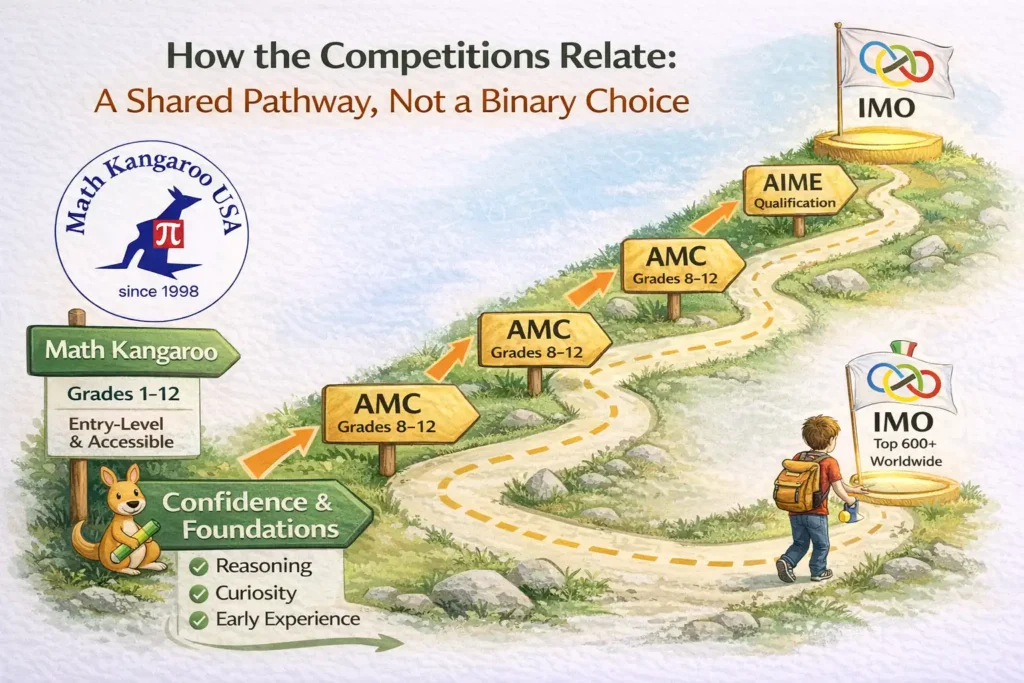
They occupy different positions in the same mathematical development arc, and many of the students who eventually compete at high olympiad levels began their competition mathematics journey through accessible competitions like Math Kangaroo.
The typical progression for a student who begins mathematical competition early and continues through high school looks something like this:
Grades 1–6: Math Kangaroo (Pre-Ecolier, Ecolier, Benjamin levels) — building logical reasoning habits, curiosity, and early competition experience in a low-pressure environment.
Grades 5–8: Math Kangaroo continues (Cadet level) alongside introduction to AMC 8 — the first multiple-choice competition that tests mathematical content rather than pure reasoning.
Grades 8–10: AMC 8 and AMC 10 — building topic knowledge in algebra, geometry, number theory, and combinatorics to the level required for serious AMC competition.
Math Kangaroo at Junior level as a confidence-building parallel track. The AMC maths competition syllabus shows exactly what content is required at each level.
Grades 10–12: AMC 10/12 → AIME qualification → USAJMO/USAMO preparation. Math Kangaroo at Student level remains accessible and valuable for maintaining reasoning flexibility alongside harder proof-based work.
This is not a ladder with rungs you must climb in order it is a landscape of competitions that serve different purposes simultaneously. A Grade 10 student preparing seriously for USAMO can still benefit from and enjoy Math Kangaroo.
A Grade 6 student who has only done Math Kangaroo is not “behind” — they are building exactly the foundations that AMC preparation will build on.
The benefits of AMC math explains how competition mathematics at all levels builds the academic profile and cognitive skills that support both advanced education and career performance in STEM fields.
Which Competition is Right for You in 2026
The right answer depends on where you are in your mathematical development, what you want from the competition experience, and how much time you can invest in preparation.
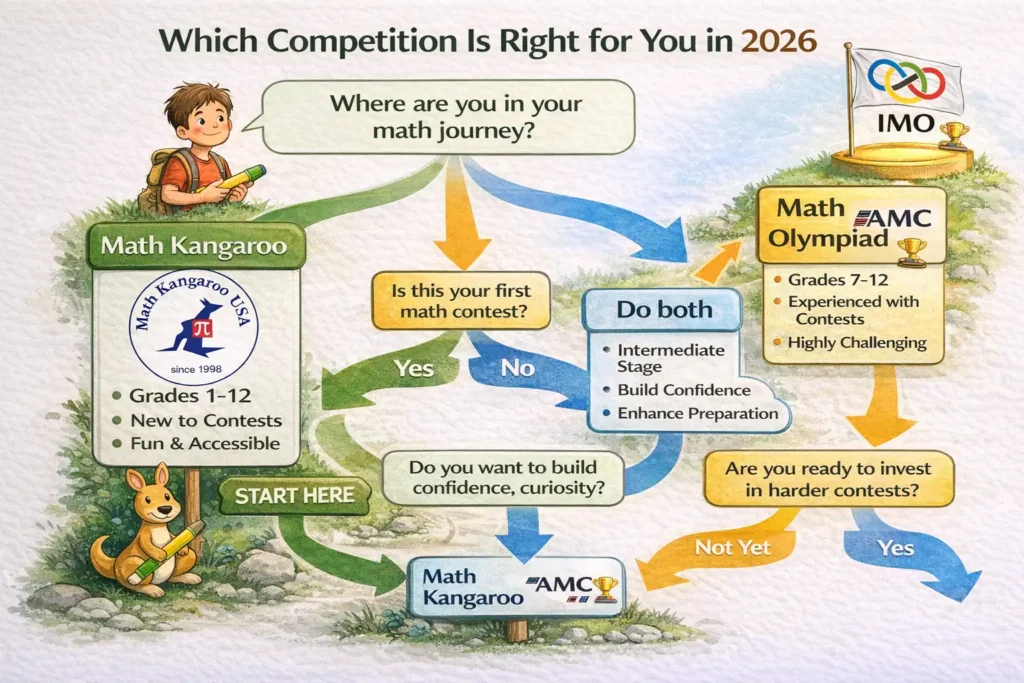
Choose Math Kangaroo if:
- You are in Grades 1–12 and have never participated in a math competition before it is the ideal entry point for exactly this situation
- You want a competition experience that feels enjoyable and encouraging rather than high-stakes and stressful
- You have 2–6 weeks to prepare rather than months or years
- You want to build mathematical confidence and discover whether competition mathematics is something you enjoy before committing to harder competitions
- You are a teacher or parent looking for an accessible, school-friendly competition to introduce to a broad group of students
Choose Math Olympiad (AMC pathway) if:
- You have already developed strong mathematical reasoning skills and want problems that genuinely challenge your current ability
- You are interested in studying mathematics, physics, computer science, or engineering at a selective university and want the academic credential that strong olympiad performance provides
- You are prepared to invest months to years of consistent, structured preparation
- You enjoy proof-based mathematical thinking constructing logical arguments from scratch rather than selecting from given options
- You want to compete with the most mathematically advanced students in your country and world
Do both if:
- You are at an intermediate stage strong enough to find Kangaroo problems engaging but not yet at the level where AMC 10/12 feels fully accessible
- You want the confidence and enjoyment of Kangaroo as a complement to the more demanding AMC preparation
- Your school runs both programs and participation in both is logistically easy
The most common pattern among students who eventually reach high olympiad levels is that they started with accessible competitions, built genuine enthusiasm for mathematical thinking, and then progressively took on harder challenges as their skills developed.
The foundational reasoning habits built through early Kangaroo participation directly support the problem-solving instincts that AMC and olympiad preparation refine.
For the specific skills that carry through from entry-level competitions to olympiad preparation, how to get better at solving math olympiad questions covers the full improvement framework that applies at every stage of the competition mathematics journey.
Is Math Kangaroo easier than the Math Olympiad?
Yes — significantly so. Math Kangaroo problems at every grade level are specifically designed to be approachable without advanced competition preparation. The hardest Kangaroo problems are at the lower end of AMC 10 difficulty. IMO and USAMO problems are among the hardest mathematics problems ever posed to high school students and require years of dedicated preparation to solve consistently.
Can you do both Math Kangaroo and Math Olympiad?
Absolutely, and many students do. The competitions are held at different times of year (Kangaroo in March, AMC in November, USAMO in the spring) and serve complementary purposes. Kangaroo builds accessible reasoning confidence; Olympiad competitions build great mathematical skill. Many Olympiad competitors participate in Kangaroo as a warm-up or for enjoyment alongside their Olympiad preparation.
Does Math Kangaroo help with Math Olympiad preparation?
Directly, yes — particularly in the early stages. The logical reasoning, pattern recognition, and creative problem-framing skills that Kangaroo develops are the same cognitive foundations that olympiad preparation builds on. Students who have done several years of Kangaroo Math typically find the transition to AMC preparation more natural than students with no competition math background.
Is the Math Olympiad only for gifted students?
At the IMO and USAMO level, yes — these competitions reach only the most mathematically exceptional high school students in their respective countries. But the AMC series, which is the entry point to the olympiad pathway in the U.S., is accessible to any motivated student willing to put in the preparation work. Many students who eventually qualify for USAMO did not show exceptional mathematical ability at an early age — they developed it through years of structured, consistent preparation.
What age should a student start Math Kangaroo?
Grade 1. The Pre-Ecolier level is specifically designed for Grades 1–2, with problems calibrated to be genuinely engaging for 6–8-year-old students. There is no minimum age or preparation requirement — you can register and participate from the very beginning of formal schooling.
What score do I need in AMC to qualify for the Math Olympiad?
The AMC to AIME qualification threshold varies by year. Typically, AMC 10 qualifiers need approximately 100–105 points (out of 150), and AMC 12 qualifiers need approximately 85–92 points. USAJMO/USAMO qualification from AIME requires a combined AMC + AIME index score that varies annually. What is a good AMC math competition score covers the current thresholds in detail.
How does winning Math Kangaroo compare to AMC achievement for college applications?
Both contribute positively to academic profiles. Math Kangaroo national winner status demonstrates strong logical reasoning in a competition with 6.5 million global participants. AMC Honor Roll and AIME qualification demonstrate advanced mathematical content mastery. For the most selective university admissions, USAMO qualification or IMO participation carries the greatest weight among competition mathematics credentials. The AMC math competition awards cover what each level of AMC achievement means for college applications.
Make Preparing for Math Olympiad Simple!



Conclusion
The difference between the Math Olympiad and Kangaroo Math comes down to eight dimensions: purpose, format, difficulty, eligibility, scoring, prizes, preparation investment, and the emotional experience of competition.
Math Kangaroo is built for breadth: reaching every student, at every grade, with mathematical thinking designed to feel enjoyable and achievable.
Math Olympiad is built for depth: testing the most advanced mathematical reasoning that high school students anywhere in the world can produce.
Wherever you are in that journey, start where you are. If you have not competed before, begin with Math Kangaroo how to prepare for Math Kangaroo will get you competition-ready.
If you are ready for the next level, the AMC maths competition syllabus maps the content you need to master. And if olympiad level is where you are aiming, how to qualify for the IMO in the USA shows you every step of the path.\