


Every week, thousands of parents and students search for the same thing: free math olympiad training online.
- What is Math Olympiad Training — And What Level Are You?
- The Honest Truth: How Hard Is Math Olympiad Preparation?
- The Free Math Olympiad Training Roadmap (Beginner → AIME)
- Free Resources for Number Theory in Math Olympiad Preparation
- Which Math Olympiad Should You Target First?
- Best Free Platforms for Math Olympiad Training — Strengths and Honest Gaps
- Top Online Math Olympiad Preparation Courses 2025-2026: What to Look For
- Free vs. Paid Olympiad Prep: An Honest Comparison
- How Much Does Olympiad Coaching Cost? Pricing Plans Explained
- How Many Problems Do You Actually Need to Solve?
- How to Prepare for Math Olympiad: A Weekly Study Framework
- Common Self-Study Mistakes And How to Avoid Them
- A Realistic Timeline — How Long Will This Take?
- For Parents: What You Actually Need to Know
- Can Students Effectively Prepare for Math Olympiad Through Online Training?
- Start Your Free Math Olympiad Training Today
- Final Thought
You can entirely train for the Math Olympiad online for free using comprehensive databases, structured applications, and community forums.
If you have felt that frustration, this guide is for you. Not another resource dump. A real roadmap.
By the end, you will know exactly what level your child is at, what to study, how many hours it takes, and whether free preparation is actually enough or when it is not.
Whether you are looking for the best online math olympiad preparation courses, a structured math olympiad program, or simply trying to figure out how to start math competition training from scratch, this guide covers it all.
What is Math Olympiad Training — And What Level Are You?
Before planning preparation, it helps to understand what is the purpose of the math olympiad and how competitions are structured.
“Math Olympiad” isn’t one thing. It’s a ladder. And you need to know which rung you’re standing on before you can climb.
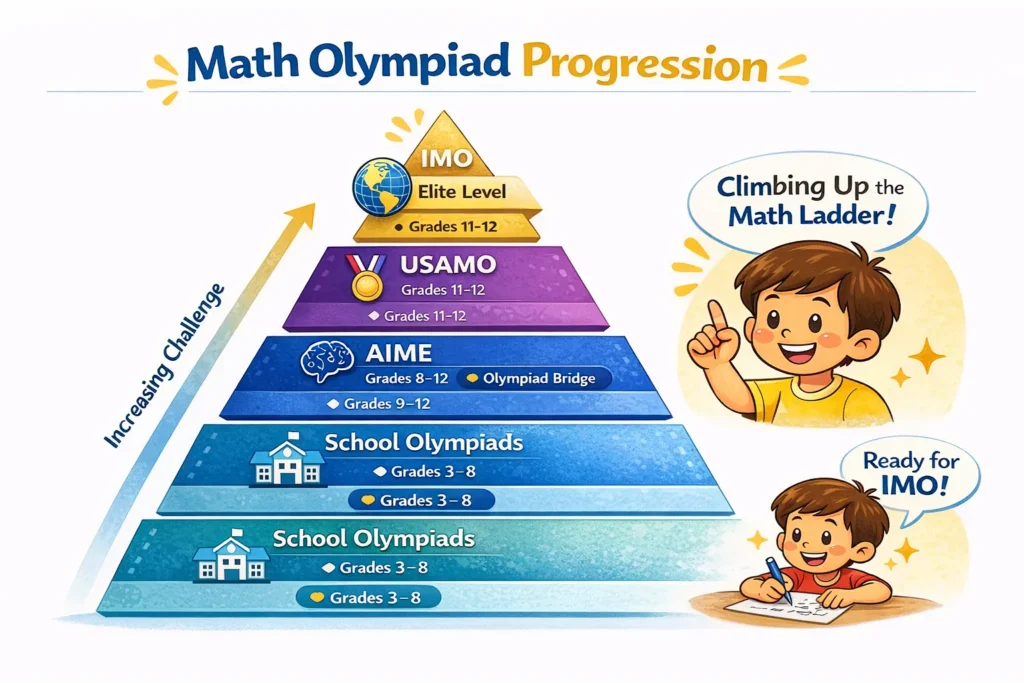
Here’s how the US competition math pathway works:
| Level | Competition | Who It’s For |
|---|---|---|
| Entry point | School-level olympiads, MOEMS | Grades 4–6 |
| Beginner | AMC 8 | Up to Grade 8 |
| Intermediate | AMC 10 / AMC 12 | Up to Grade 10 / 12 |
| Advanced | AIME | Top ~2.5–5% of AMC qualifiers |
| Elite | USAMO / USAJMO | Top ~250–500 students nationally |
| World stage | IMO | ~6 students represent the US |
If you’re unsure what type of problems to expect, see what type of questions are asked in math olympiads.
Most students reading this are somewhere between the AMC 8 and AMC 10 stage. That’s exactly where free preparation is most realistic and most powerful if structured correctly.
The Honest Truth: How Hard Is Math Olympiad Preparation?
If you are targeting AMC, it helps to review:
- Average AMC math scores — how most students actually perform
- What is a good AMC math competition score for your goal
- The full AMC syllabus broken down by topic
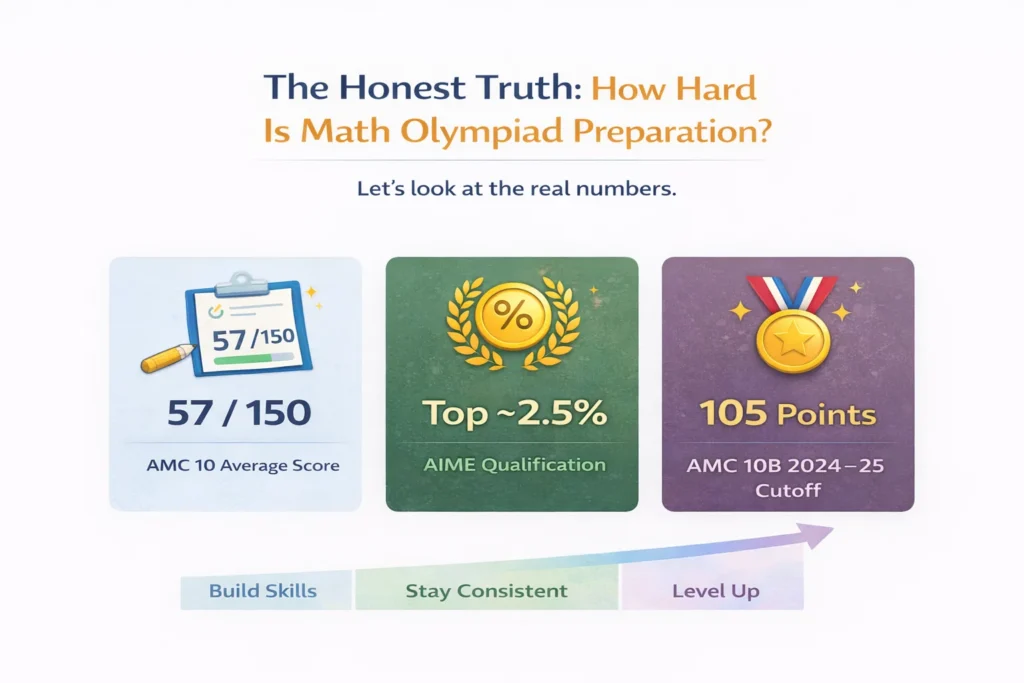
Let us look at the real numbers, because vague encouragement helps no one.
The AMC 8 is a 25-question multiple-choice exam for students up to Grade 8. It is the most accessible entry point and a great first goal for anyone beginning their math olympiad program.
The AMC 10 and AMC 12 are harder, with 30 problems and a 75-minute time limit. Average scores on the AMC 10 in 2025 dropped to around 57 out of 150, down from the low-to-mid 60s in previous years, indicating that competition is intensifying even at the entry level.
To qualify for the AIME, the next stage, you need to score in roughly the top 2.5% of AMC 10 participants or the top 5% of AMC 12 participants.
In practice, that means hitting around 94.5 to 105 points on the AMC 10, depending on the year. In 2024-2025, the AMC 10B cutoff sat at 105 points. These are not easy numbers.
But here is the reframe: most students do not need AIME as their first goal. A strong AMC 8 performance, a top-25% AMC 10 score, or simply building genuine mathematical thinking are meaningful, achievable targets that open real doors.
If your goal is deeper progression, read how to prepare for the AMC math competition for a full breakdown.
Math is hard. The path is clear. That is a good combination.
The Free Math Olympiad Training Roadmap (Beginner → AIME)
This is the section most articles skip. Here’s a structured progression system based on actual competition math requirements.
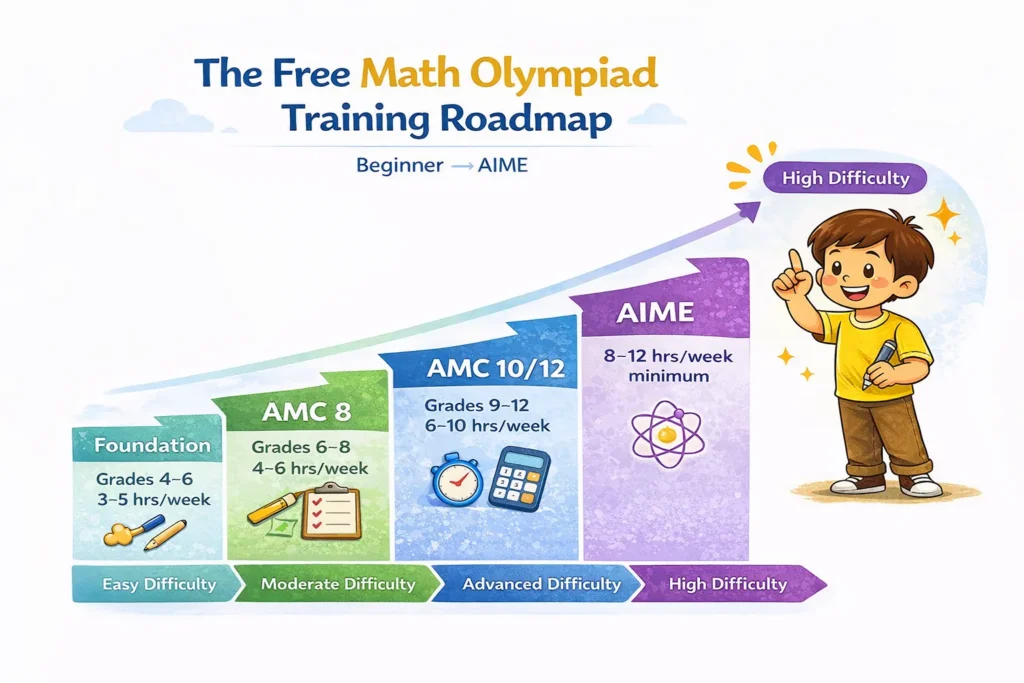
Stage 1 — Building the Foundation (Grades 4–6 / Pre-AMC 8)
Key topics: Arithmetic, fractions, basic algebra, logic puzzles, divisibility rules, basic geometry
Free resources:
- Khan Academy (Arithmetic through Pre-Algebra tracks)
- MOEMS past papers (free on moems.org)
- Gonit App — structured problem sets designed for this exact stage
Weekly time: 3–5 hours Problem volume target: 200–400 problems before attempting AMC 8 practice papers Realistic timeline: 4–6 months to be AMC 8-ready
This stage is about building speed, accuracy, and number sense. Don’t rush it. Students who skip this foundation consistently plateau at AMC 8.
Stage 2 — AMC 8 Preparation
Key topics: Number theory basics (primes, factors, GCD/LCM), introductory geometry (area, perimeter, angles), basic combinatorics (counting, simple probability), word problems
Free resources:
- AMC 8 past papers (all free on MAA’s website)
- AoPS AMC 8 problem sets (free wiki access)
- Art of Problem Solving “Introduction to Counting and Probability” library copy or free previews
Weekly time: 4–6 hours Problem volume target: 400–600 problems, with a focus on timed past papers in the final 6–8 weeks Realistic timeline: 6–12 months for a strong performance
The key at this stage is not just solving problems, it’s reviewing every wrong answer. One hour of review is worth three hours of forward practice.
Stage 3 — AMC 10 / AMC 12 Preparation
Key topics: Intermediate algebra (quadratics, sequences, functions), advanced geometry (circles, similar triangles, coordinate geometry), number theory, combinatorics and probability
Free resources:
- AoPS Wiki (free, comprehensive topic coverage)
- AMC 10 and AMC 12 past papers (free on MAA website)
- YouTube: channels like Art of Problem Solving, 3Blue1Brown (for conceptual depth)
Weekly time: 6–10 hours Problem volume target: 600–1,000 problems, organized by topic before switching to mixed practice Realistic timeline: 12–18 months for meaningful AMC 10 performance
This is where structure becomes critical. Students who practice randomly at this stage stall. Topic-by-topic drilling spending 2–3 weeks on geometry, then number theory, then combinatorics produces far better results than jumping between problem types.
Stage 4 — AIME Pathway
At this level, free preparation begins to show its limits not because free resources don’t exist, but because AIME requires a depth of problem-solving intuition that’s very hard to develop without structured feedback.
Free resources available: AoPS forums (detailed solutions), AIME past papers (free), MIT OpenCourseWare for proof-based math
Weekly time: 8–12 hours minimum Problem volume target: 1,000–1,500 problems at increasing difficulty Realistic assessment: Free prep can get you to the threshold. Crossing it reliably usually benefits from structured feedback on your problem-solving process.
Free Resources for Number Theory in Math Olympiad Preparation
Number theory is one of the most heavily tested topics across AMC 8, AMC 10, and AIME. It is also the area where many students have the fewest structured free resources. Here is what actually works.
For beginners at Stage 1-2, the goal is to master divisibility rules, prime factorization, GCD, and LCM. Khan Academy covers these well at no cost. MOEMS past papers include a reliable mix of number theory problems at an accessible level.
At Stage 3 (AMC 10 preparation), the AoPS Wiki’s number theory section is one of the best free online number theory resources available for high school olympiad preparation.
It covers modular arithmetic, number bases, Diophantine equations, and competition-specific techniques.
For AIME-level number theory, the following free resources are most useful:
- AoPS Number Theory forum detailed solution walkthroughs from past competition problems
- Past AIME exams with full solutions (available free from MAA)
- MIT OpenCourseWare 18.781 (Theory of Numbers) free lecture notes for proof-based foundations
- Art of Problem Solving’s “Introduction to Number Theory” book previews (partial free access)
The most common mistake students make with number theory is treating it as memorization. Competition problems test pattern recognition, not formula recall.
The only way to build that recognition is through volume: solve at least 100 number theory problems per month at your target difficulty level before any major competition.
If you are preparing for IMO-level number theory, structured resources become significantly more important. Free online number theory courses are a starting point, but expert feedback on proof-writing is hard to replace.
Which Math Olympiad Should You Target First?
One of the most common questions from students beginning olympiad training for individual study is: which competition should I enter first?
The answer depends on your grade level, but here is a practical guide:
- Grades 4-6: Start with school-level olympiads or MOEMS. These build problem-solving habits without the pressure of high-stakes competition.
- Grades 6-8: AMC 8 is your target. It is the official entry point into the US competition math pathway.
- Grades 8-10: AMC 10 is the next logical step. Students who scored above 18/25 on AMC 8 are typically ready to begin AMC 10 preparation.
- Grades 10-12: AMC 12 broadens the topic range and includes pre-calculus content.
For students outside the US, international options like Math Kangaroo or regional olympiads offer excellent structured entry points with their own preparation pathways.
See also: difference between Math Olympiad and Kangaroo Math and best math competitions in the world.
Best Free Platforms for Math Olympiad Training — Strengths and Honest Gaps
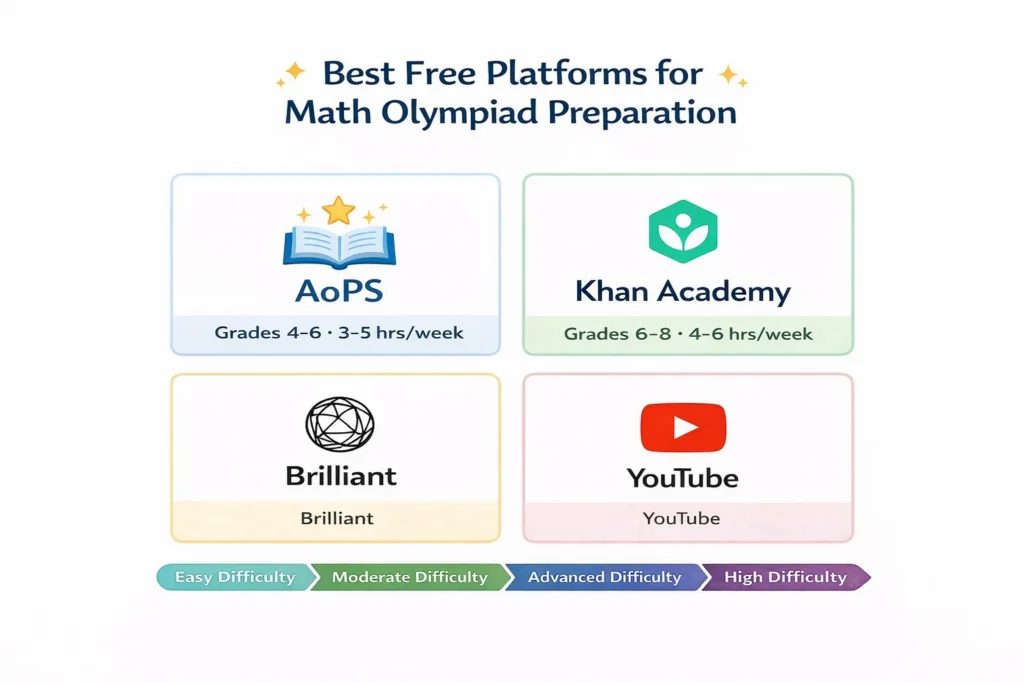
Gonit App — Best for Beginners Through AMC 10
What is free: Gonit App offers structured problem sets, topic-by-topic progression, and competition-style questions built specifically for olympiad preparation from foundational math through AMC 10 readiness. Unlike generic platforms, Gonit is designed around the exact competition math pathway described in this roadmap.
Best for: Students at Stage 1 through Stage 3 who want the structure of paid coaching without the price tag. Particularly strong for younger students (Grades 4-9) and parents who want a guided path rather than an overwhelming list of resources.
Why it stands out: Most free platforms give you access to content; Gonit gives you a sequence. That distinction matters enormously for students who do not know what to study next. The app’s problem sets are calibrated to competition difficulty, not school math, so students build the right mental models from the start.
Make Preparing for Math Olympiad Simple!



Art of Problem Solving (AoPS)
What is free: The AoPS Wiki is one of the best free mathematics resources in the world, with thousands of problem solutions, topic explanations, and past competition papers. The forums are free and genuinely helpful.
Best for: Students at AMC 10 level and above who are self-motivated and can read mathematical exposition independently.
Honest gap: The paid courses (Alcumus, textbooks, live classes) are significantly better structured than the free materials. The free wiki assumes you already know what you need to learn. If your child is a beginner, AoPS alone is overwhelming.
Khan Academy
What is free: Everything. Khan Academy’s entire curriculum from basic arithmetic through calculus is free.
Best for: Stage 1 and Stage 2 students building foundational skills. Excellent for parents who want to understand what their child is learning.
Honest gap: Khan Academy is not designed for competition math. It teaches school curriculum, not olympiad-style problem solving. You will outgrow it quickly after AMC 8 preparation begins.
Brilliant
What is free: A limited number of problems and course previews. Most content requires a paid subscription.
Best for: Students who learn better through interactive, visual problem-solving rather than reading solutions.
Honest gap: Despite the freemium model, free access is genuinely limited. It is better treated as a supplement than a primary preparation tool.
YouTube (AMC Solution Channels)
What is free: Full AMC 8, AMC 10, and AMC 12 solution walkthroughs, often problem by problem.
Best for: Understanding how to approach specific problems after you have attempted them yourself. Watching solutions before attempting problems is one of the most common self-study mistakes.
Honest gap: YouTube has no structure. Watching solution videos feels productive but builds passive understanding. Use it as a verification tool, not a primary study method.
Top Online Math Olympiad Preparation Courses 2025-2026: What to Look For
If you are comparing the best online math olympiad preparation courses for 2025-2026, the landscape has changed significantly.
Here is an honest assessment of what the top programs actually offer and where each one fits in your preparation journey.
When evaluating any online math olympiad course, ask these four questions:
- Does it follow a structured topic sequence, or is it just a problem library?
- Does it include solutions and explanations, or just answer keys?
- Is the difficulty calibrated to competition level, not school curriculum?
- Does it include progress tracking or feedback?
Most free platforms fail on the third and fourth criteria. A collection of hard problems without calibrated difficulty is not a course it is a library.
For actual mathematical olympiad training, the sequence in which you encounter problems matters as much as the problems themselves.
For AMC 8 through AMC 10 preparation, Gonit App and AoPS are the two most structured free-to-access options. For IMO preparation and USAMO-level training, Art of Problem Solving’s paid courses and dedicated coaching programs offer the depth that free platforms cannot match.
If you are specifically targeting the IMO pathway from the US, see: how to qualify for the IMO in the USA.
Free vs. Paid Olympiad Prep: An Honest Comparison
| Factor | Free Self-Study | Paid Coaching | Gonit App |
|---|---|---|---|
| Cost | $0 | $2,000-$8,000/year | Free to start |
| Structure | You create it | Provided | Provided |
| Feedback | Forums, self-review | Weekly from teacher | Built into practice |
| Accountability | Self-imposed | Class schedule | Progress tracking |
| Pacing | Your own | Fixed schedule | Adaptive |
| Best for | Self-directed, Stage 2+ | AIME+ aspirants | Stage 1 through AMC 10 |
Free prep works well when: Your child is self-motivated, you have time to guide their study schedule, and the goal is AMC 8 to AMC 10 performance.
Paid coaching helps when: Your child is targeting AIME qualification or above, needs external accountability, or has plateaued despite consistent self-study.
The middle path: Platforms like Gonit App offer the structure of paid coaching without the price tag — guided problem sets, topic progression, and practice designed specifically for olympiad-style thinking.
If you are evaluating long-term benefits of competition math, you may also want to read: What are the benefits of the math AMC
How Much Does Olympiad Coaching Cost? Pricing Plans Explained
One of the most searched questions in this space is about Olympiad coaching cost and pricing plans. The range is wide, and understanding it helps you make smarter decisions about where to invest.
Here is a realistic breakdown of what different math competition training programs actually cost:
| Program Type | Cost Range | Best For |
|---|---|---|
| Free self-study (AoPS Wiki, past papers) | $0 | Motivated self-learners, AMC 8-10 |
| Gonit App | Free to start | Grades 4-9, structured prep |
| AoPS online courses | $300-$600 per course | AMC 10 / AIME-level prep |
| Private tutoring (1-on-1) | $80-$200 per hour | AIME+ targeted prep |
| Intensive summer programs (PROMYS, Ross, MathPath) | $3,000-$8,000 per session | Top-tier USAMO/IMO pathway |
| Dedicated olympiad coaching programs | $2,000-$8,000 per year | Serious AIME/USAMO aspirants |
The honest truth: the cost difference between free prep and paid coaching is enormous, but the results difference for AMC 8 through AMC 10 preparation is not. Free structured platforms can fully replace paid coaching up to the AMC 10 level for self-motivated students.
The value of paid coaching increases significantly once you are targeting AIME qualification.
At that point, the marginal improvement from structured feedback, knowing not just that you got a problem wrong, but why your approach failed, is worth paying for.
For parents evaluating affordable olympiad coaching options, the practical recommendation is to start free (Gonit App, AoPS Wiki, past papers) and invest in paid support only if your child has plateaued at Stage 3 for 12 or more months.
How Many Problems Do You Actually Need to Solve?
This is the question nobody answers directly. Here are honest benchmarks:
| Goal | Total Problems | Weekly Target |
|---|---|---|
| AMC 8 familiarity | 200–400 | 20–30 problems |
| Competitive AMC 8 | 400–600 | 30–50 problems |
| AMC 10 readiness | 600–1,000 | 50–80 problems |
| AIME qualification | 1,000–1,500+ | 80–120 problems |
The volume isn’t the hard part. The discipline is. Students who solve 30 problems per week with full review of every mistake consistently outperform students who solve 100 problems and move on without reflection.
Random practice fails because it doesn’t build the pattern recognition that competition math demands.
Topic-focused drilling, solving 50 combinatorics problems in a row before moving to geometry, builds the mental categories you need to recognize problem types quickly.
How to Prepare for Math Olympiad: A Weekly Study Framework
Knowing how many problems to solve is only half the equation. Knowing how to structure your week is what separates students who improve steadily from those who plateau.
Here’s a proven weekly framework for students at Stage 2 (AMC 8) and above:
Day 1–2: Topic drill Pick one topic (e.g., number theory, geometry, combinatorics) and solve 15–20 problems from that topic exclusively. Don’t mix topics during drill days.
Day 3: Review + error analysis Go back through every problem you got wrong this week. Write out why you got it wrong and what the correct approach is. This is the highest-ROI activity in math olympiad prep.
Day 4–5: Mixed practice Solve 10–15 problems from a mix of topics. This trains the pattern recognition needed for actual competition conditions.
Day 6: Timed past paper (optional, once per month) Take a full timed AMC 8 or AMC 10 past paper under real conditions. Score it, then review every wrong answer in the following session.
Day 7: Rest or light reading Olympiad math is cognitively demanding. Rest is part of the training.
Common Self-Study Mistakes And How to Avoid Them
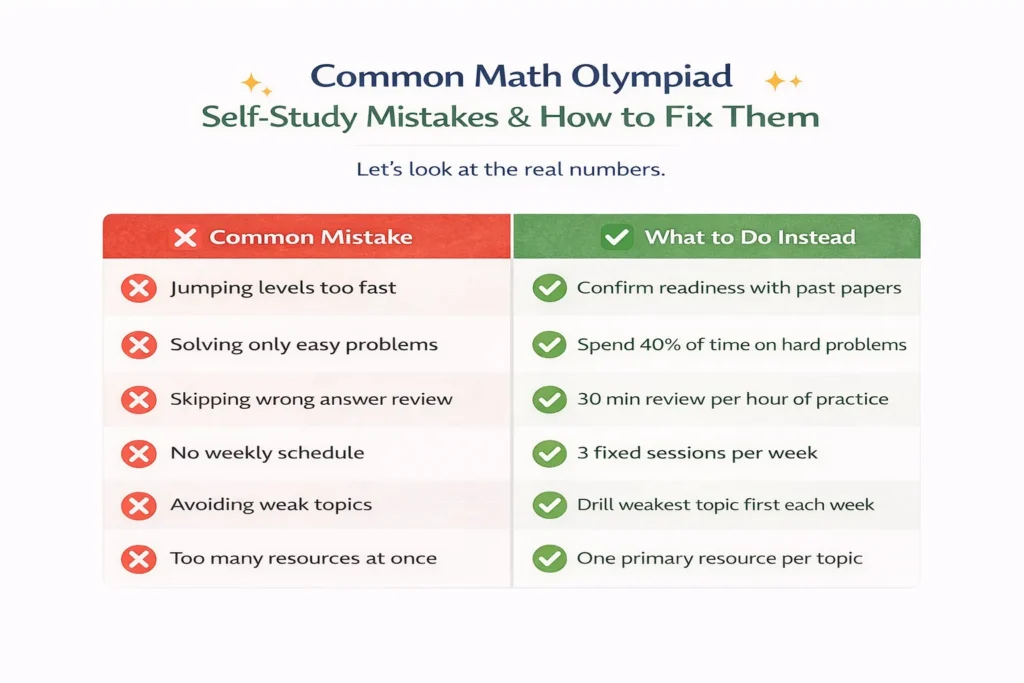
Jumping levels too fast. Attempting AMC 10 problems without solid AMC 8 foundations is demoralizing and inefficient. Confirm your Stage 2 readiness before moving to Stage 3.
Solving only easy problems. Comfort zone practice builds confidence but not skill. You need to spend significant time on problems you cannot immediately solve.
Skipping wrong answer review. Every wrong answer contains a lesson. If you are not spending at least 30 minutes reviewing mistakes for every hour of practice, you are leaving most of your learning on the table.
No weekly schedule. “I will study when I have time” reliably means you will not study enough. Three structured sessions per week beat seven unplanned ones.
Avoiding weak topics. Students naturally graovitate toward what they are good at. Your weak topic, combinatorics, geometry, or number theory, is exactly where your next improvement will come from.
Using too many resources at once. Pick one primary resource per topic and go deep. Switching between five platforms creates an illusion of variety without building depth. This applies to online math olympiad preparation just as much as offline study.
See also: how to get better at solving math olympiad questions and difference between math olympiad and kangaroo math
A Realistic Timeline — How Long Will This Take?
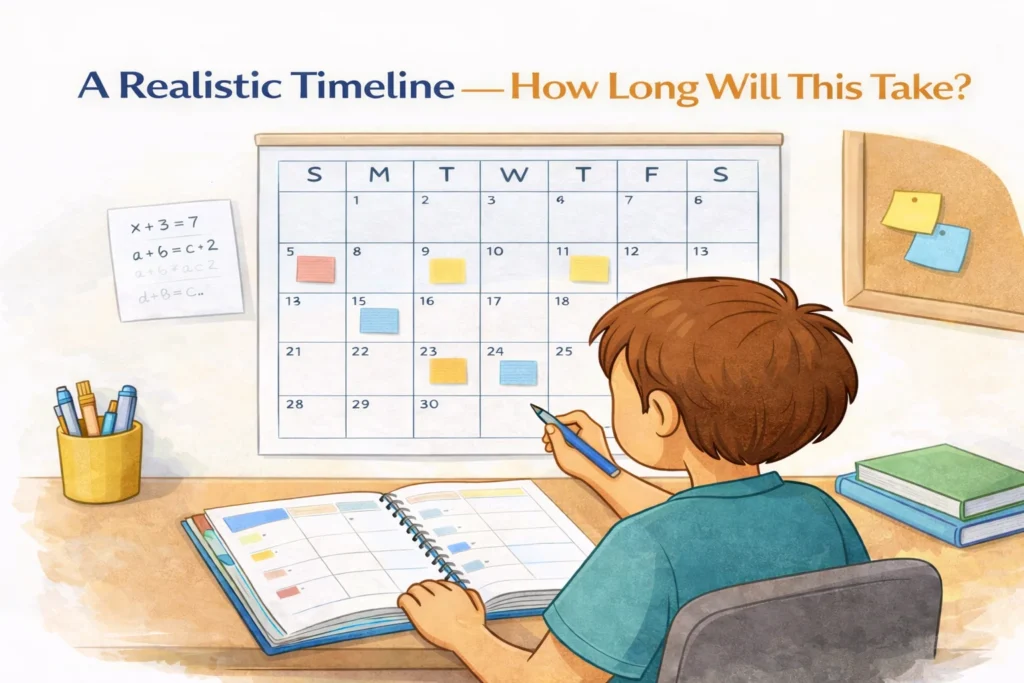
6-month plan (AMC 8 target): Achievable for a Grade 5-7 student who studies 4-6 hours per week consistently. Realistic goal: top 25% performance.
12-18 month plan (AMC 10 readiness): Appropriate for a Grade 7-9 student building from AMC 8 foundations. Realistic goal: above-average score, with top-10% performance requiring an additional 6-12 months.
2-3 year plan (AIME qualification): This is the realistic timeline for most students starting in middle school. AIME qualification places you in the top 2.5% of AMC 10 participants. It is a serious accomplishment that requires serious, consistent work over years not months.
Any article promising AIME qualification in 3 months is selling you something. The students who qualify for AIME and go on to USAMO typically begin structured preparation in Grades 5-7 and commit 8-12 hours per week for multiple years.
That is not discouraging. That is clarifying. Now you know what you are signing up for.
For Parents: What You Actually Need to Know
You do not need a mathematics degree to support your child’s olympiad preparation. What you do need is a realistic understanding of what this journey looks like.
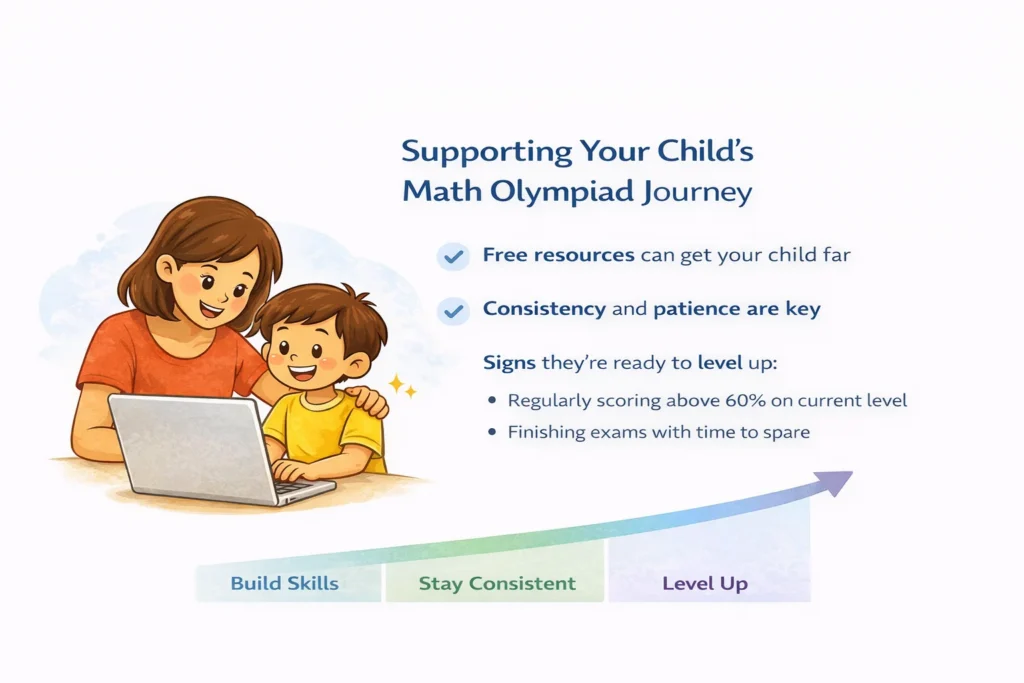
Cost is not the main barrier. Free resources combined with structured platforms like Gonit App can carry a student from beginner to competitive AMC 10 level. The real barriers are consistency, the right progression, and patience with a long-term goal.
Structure is what free prep usually lacks. The resources exist. The roadmap is what is missing. Your job as a parent is not to teach competition math it is to help maintain a schedule, celebrate small milestones, and resist the urge to push too far too fast.
Signs your child is ready to level up:
- Consistently scoring above 60% on past papers at their current level
- Finishing exams with time to spare
- Getting frustrated by problem difficulty (this is good — it means the current level is too easy)
When to consider a structured program: If your child has plateaued at the AMC 10 level after 12 or more months of consistent practice, or is targeting AIME qualification within a defined timeline, then structured coaching or a guided platform can accelerate progress significantly.
For Grade 1-3 students: If you are looking to start even earlier, how to apply for the maths olympiad for class 1 covers the entry-level pathway for young learners.
Can Students Effectively Prepare for Math Olympiad Through Online Training?
This question appears frequently in searches and the honest answer is: yes, for most goals, and with the right structure.
Online math olympiad preparation has significant advantages over in-person coaching for many students:
- Flexibility — students can study at their own pace and review materials repeatedly
- Access — high-quality resources (AoPS, Gonit, past papers) are available globally at no cost
- Progress tracking — digital platforms can measure improvement more granularly than a weekly class
The limitation is not the medium; it is the structure. Students who approach maths olympiad online coaching without a clear topic sequence and problem volume target typically plateau after 3-4 months. The roadmap in this guide is specifically designed to address that.
For students wondering about specific online olympiad programs with certificates, note that platforms offering online olympiads with free entry points like Math Kangaroo and some regional competitions can be valuable for motivation and benchmarking even outside formal training.
For a comparison of different competition formats, see: difference between math olympiad and kangaroo math.
Start Your Free Math Olympiad Training Today
Here is the short version of everything above:
- Identify your level — AMC 8, AMC 10, or foundation stage
- Follow the progression ladder — do not skip stages
- Commit to a weekly schedule — 4-6 hours minimum, with full review of mistakes
- Set a realistic timeline — 6 months for AMC 8 readiness, 12-18 months for AMC 10
Free math olympiad training online is real. It works. But it works because of structure — not just access to resources.
If you want that structure built in from the start, Gonit App is free to begin. We have designed our problem sets and topic progression specifically for students at Stage 1 through AMC 10 preparation — the exact range where structured practice makes the biggest difference.
No expensive coaching fees. No overwhelming resource lists. Just a clear path forward.
Make Preparing for Math Olympiad Simple!
Can I prepare for the math olympiad without coaching?
Yes — for AMC 8 through competitive AMC 10 performance, structured self-study with the right resources is genuinely sufficient. AIME qualification and above benefits significantly from expert feedback.
How many hours per week should I study for AMC 8?
4–6 hours per week over 6–12 months is a realistic and productive commitment for most students. Quality and review matter more than raw hours.
What’s the best free resource for competition math beginners?
Khan Academy for foundations (Grades 4–6), followed by AMC 8 past papers and Gonit App’s structured problem sets for competition-specific skills.
What score do I need on AMC 10 to qualify for AIME?
The cutoff varies each year. In 2024–2025, the AMC 10B cutoff was 105 out of 150. A reliable target is 100+ points, with a 10-point buffer recommended to account for year-to-year variation.
Is free Olympiad math preparation “good enough”?
It depends on your goal. For AMC 8 and AMC 10 preparation, free resources with good structure are completely viable. For AIME qualification, free prep can get you close — but structured feedback on your problem-solving process makes a meaningful difference.
Which online platform is best for math olympiad training?
For beginners through AMC 10, Gonit App offers the best combination of structure, accessibility, and competition-focused problem sets. For AMC 10 and above, AoPS wiki and past papers become essential supplements.
How do I start math olympiad preparation as a beginner?
Start at Stage 1 in this roadmap: build arithmetic and pre-algebra foundations with Khan Academy, then transition to competition-style problems with Gonit App’s structured sets. Aim for AMC 8 as your first competition goal.
Final Thought
You can prepare for the Math Olympiad online for free.
With dedication, curiosity, and the right mix of free study materials, problem archives, and supportive math communities, you already have everything you need to succeed.
Use free platforms like AoPS, Gonit App, Brilliant, and Khan Academy to build your problem-solving skills step by step.
Explore, practice, and enjoy the journey. With smart strategy and persistence, your free online math olympiad training can lead to extraordinary results.

Mikha Piregu is a Content Writer with experience spanning educational content, including math and math olympiad topics, as well as advocacy writing, research-based articles, and SEO-driven web content. He creates high-quality blog content, web copy, and feature articles that support brand visibility, audience engagement, and long-term organic growth through data-informed storytelling. Skilled in WordPress, WooCommerce, and modern digital tools, Mikha adapts content across various platforms, including blogs, websites, campaigns, and advocacy initiatives, with clarity and purpose.

There are no comments posted here yet.
Sign in to leave a comment