November 28, 2025
 5 min. read

The difference between number sense and arithmetic is often misunderstood, especially by parents and teachers.
Number sense is about understanding how numbers work, while arithmetic focuses on calculating using operations.
When you know these concepts differ, it becomes easier to guide your child toward deeper understanding instead of rote memorization, something also emphasized in addition and subtraction for Class 1.
Understanding Number Sense
Number sense is all about how your child thinks about numbers, not just how they calculate. It involves being flexible with numbers and understanding how they relate to each other.
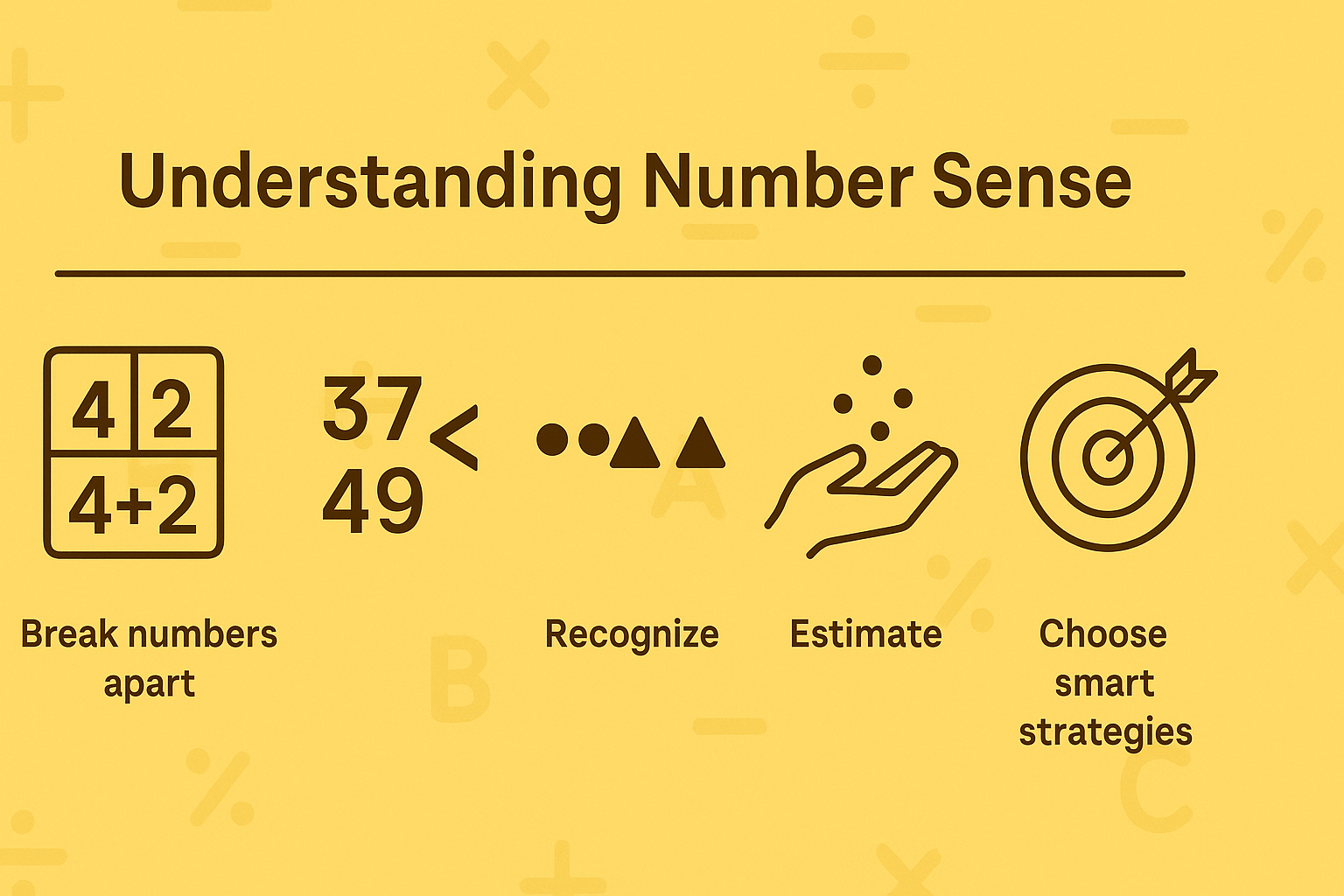
With strong number sense, your child can:
- break numbers apart and put them back together,
- Compare which number is bigger or smaller,
- recognize patterns,
- estimate quantities,
- and choose smart strategies when solving problems.
These skills support broader early-math areas like spatial understanding for Class 1, which helps children understand size, position, and relationships.
For example, if you ask your child, “What’s close to 50?” they might say 48 or 52—because they understand number relationships.
Understanding Basic Arithmetic
Basic arithmetic is what most people think of when they hear “math.”
This includes performing addition, subtraction, multiplication, and division using steps and procedures.
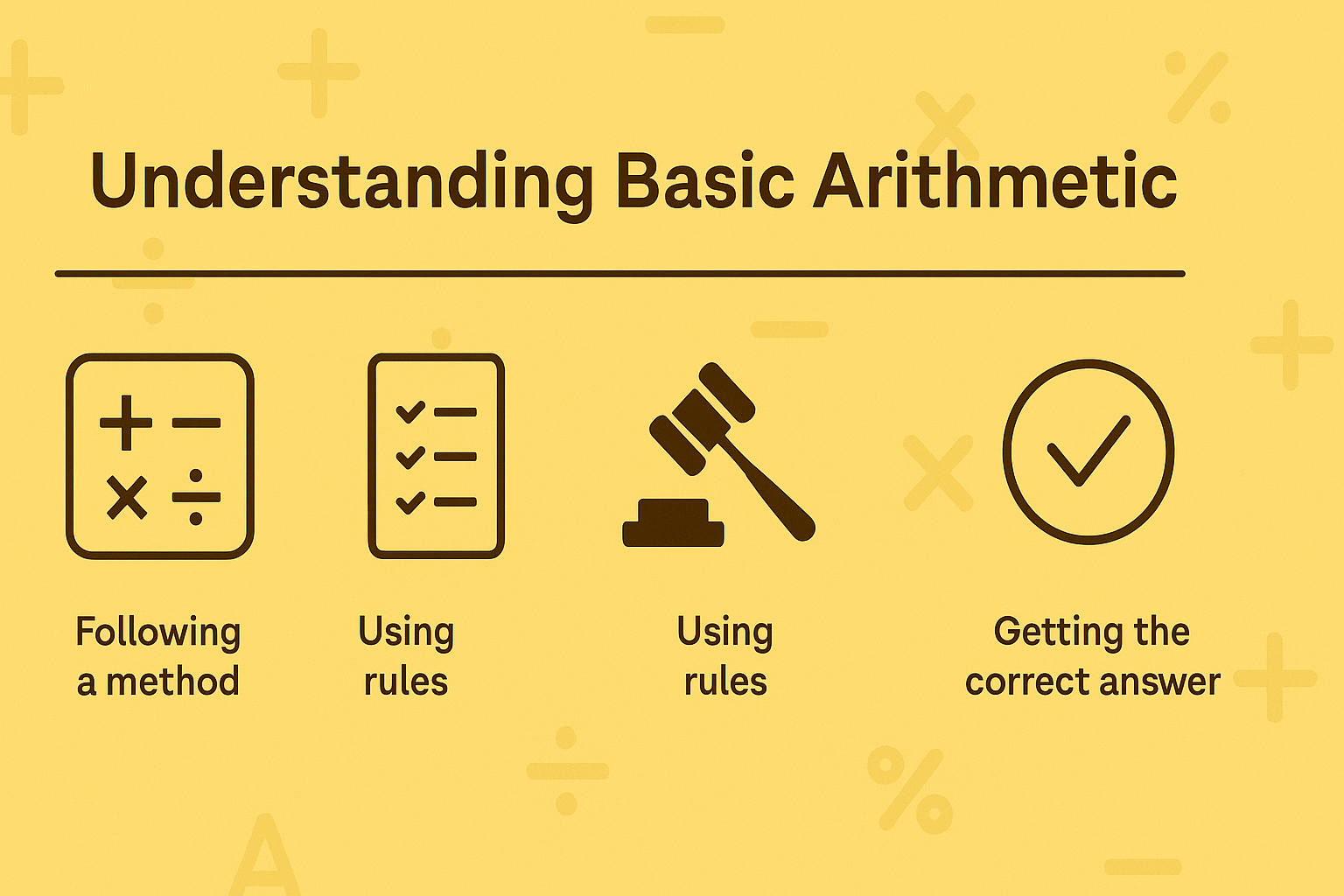
Arithmetic focuses on:
- following a method,
- using rules,
- and getting the correct answer.
For example, solving 7 + 5 by counting on or writing the digits in a column is arithmetic.
It’s about doing the calculation, even if the child doesn’t fully understand why the numbers work that way.
Foundational arithmetic skills connect directly to early concepts like multiplication for Class 1, which become easier once number sense is strong.
While number sense is about understanding, arithmetic is about performing.
Key Differences Between Number Sense and Basic Arithmetic
Understanding the difference between number sense and arithmetic helps children move from simply memorizing steps to truly thinking with numbers.
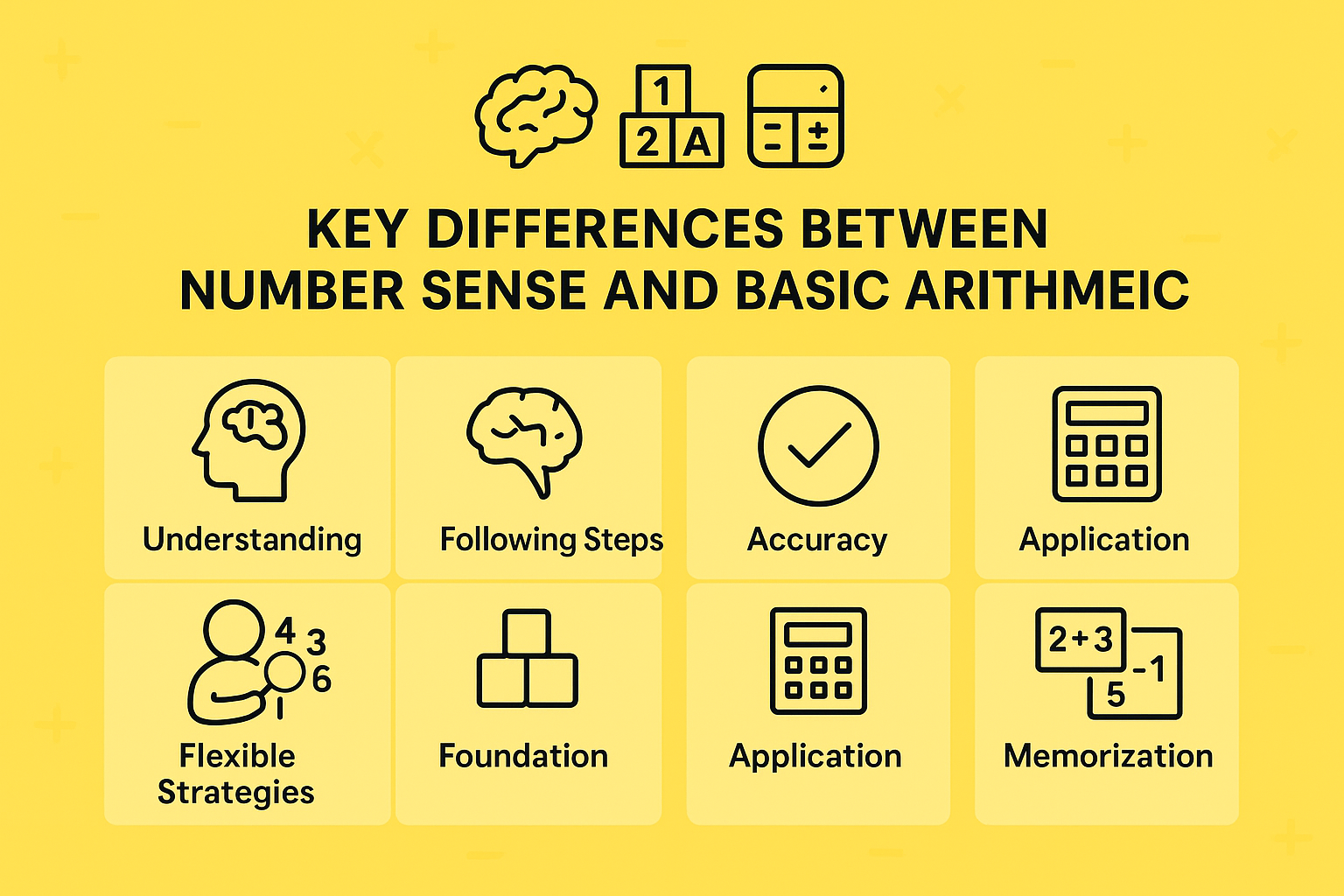
Each plays a unique role, but number sense always comes first.
1.1 Conceptual vs. Procedural
Number Sense = Understanding
Your child learns why numbers work the way they do—how they relate, grow, and break apart.
Arithmetic = Following Steps
Here, your child performs operations like addition or subtraction by applying rules or procedures.
Number sense builds the meaning; arithmetic uses the method.
1.2 Exploration vs. Accuracy
Number Sense = Thinking and Exploring
Your child experiments with numbers, tries different strategies, and reasons through problems. The goal is understanding, not perfection.
Arithmetic = Correct Answers
Arithmetic focuses on solving problems correctly, using the right steps to reach the exact answer.
Number sense encourages curiosity; arithmetic emphasizes precision.
Resources like math analogies for kids further improve reasoning and conceptual exploration, core components of number sense.
1.3 Foundation vs. Application
Number Sense = The Foundation
It prepares your child for all future math topics by giving them a strong sense of quantity, comparison, and patterns.
Arithmetic = The Application
Once the foundation is built, your child can apply number sense to perform real calculations and solve math problems.
Number sense comes first; arithmetic builds on top of it.
This foundational-to-application journey is also seen in skills like geometrical shapes for Grade 1, where understanding comes before calculation.
1.4 Adaptive Thinking vs. Memorization
Number Sense = Strategy and Flexible Thinking
Your child learns to choose efficient methods—like breaking numbers apart or counting on. It encourages smart, flexible thinking.
Arithmetic = Often Memorization
Arithmetic may involve memorizing facts, like addition tables or subtraction facts, especially for speed.
Number sense makes problem-solving flexible; arithmetic builds fluency through practice.
Why Both Are Important
Number sense and basic arithmetic are not opposites; they work together, and your child needs both to become a confident and successful math learner.
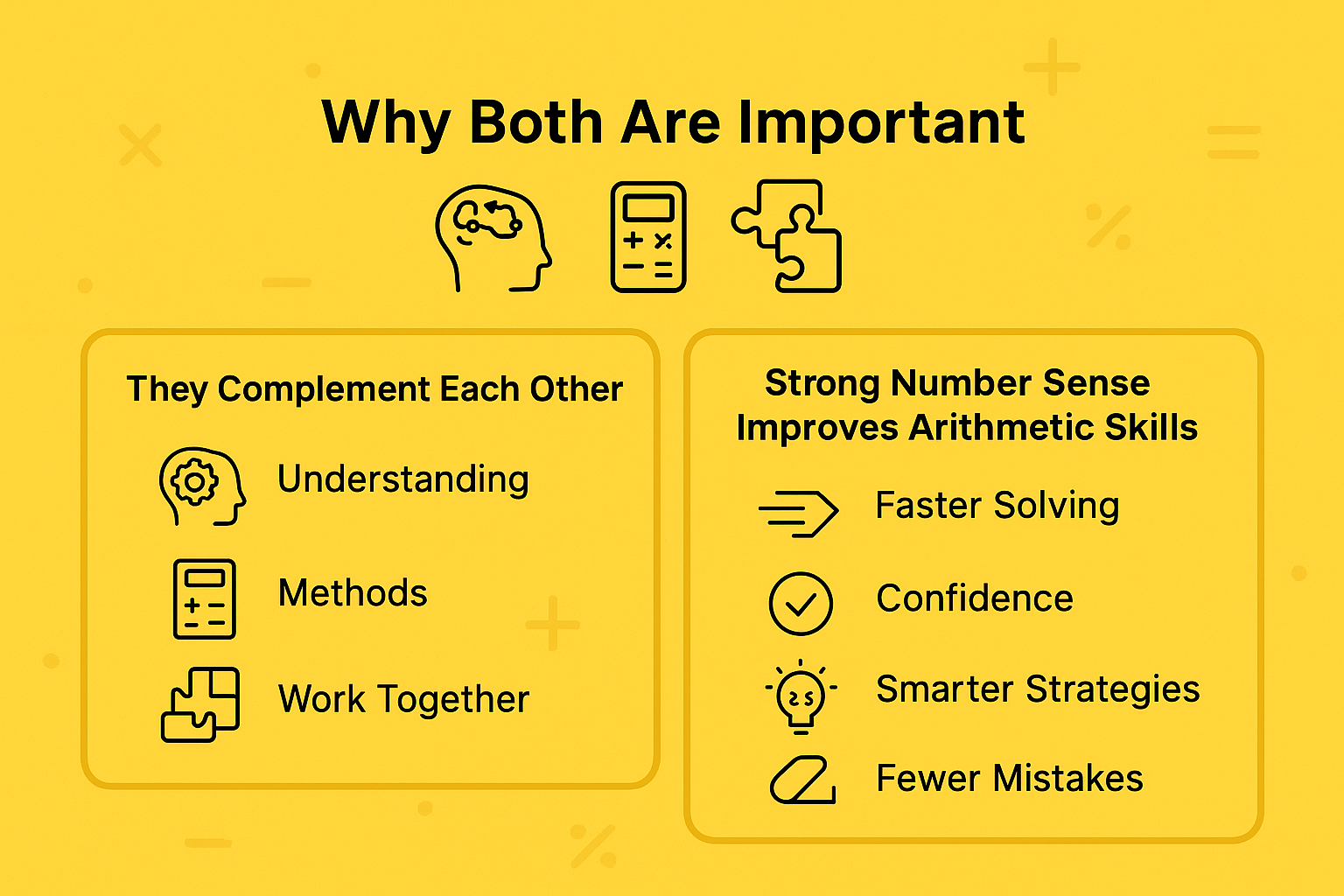
When you understand how they complement each other, you can better support your child’s growth.
They Complement Each Other
Number sense gives your child the understanding, while arithmetic provides the tools to use that understanding.
- Number sense helps your child see how numbers behave.
- Arithmetic helps your child solve problems using methods and procedures.
Together, they create a balanced approach where your child knows both what to do and why it works.
Parents aiming for long-term math confidence often explore challenges like the Maths Olympiad for Class 1, where number sense dramatically improves performance.
Strong Number Sense Improves Arithmetic Skills
When your child truly understands numbers, arithmetic becomes much easier.
A child with strong number sense can:
- solve addition and subtraction faster,
- check their answers with confidence,
- choose smarter strategies, and
- avoid common mistakes caused by memorization alone.
With a solid number-sense foundation, arithmetic stops feeling like a set of rules and starts becoming something your child can think through and enjoy.
Make Preparing for Math Olympiad Simple!



Final Word
Understanding the difference between number sense and basic arithmetic helps you better support your child’s math journey.
Number sense is about understanding, exploring, and thinking flexibly about numbers, while arithmetic focuses on performing operations and getting accurate answers.
Both skills are essential, but they serve different purposes:
- Number sense builds the foundation, helping your child understand how numbers work.
- Arithmetic applies that foundation, allowing your child to solve real math problems confidently.