


The difference between number sense and arithmetic is one of the most misunderstood distinctions in early mathematics education.
Most parents assume learning mathematics means learning to calculate, but calculation and understanding are two different things.
Number sense is the foundation: the flexible, intuitive grasp of what numbers mean and how they relate. Arithmetic is the application of that understanding through defined procedures.
Both are essential but the sequence matters enormously. Number sense must come first.
For the full case, see why number sense is important for Class 1. For the six components, see number sense for Class 1.
What is Number Sense?
Number sense is the ability to understand numbers deeply to know what they represent, how they compare, and how to reason about them flexibly.
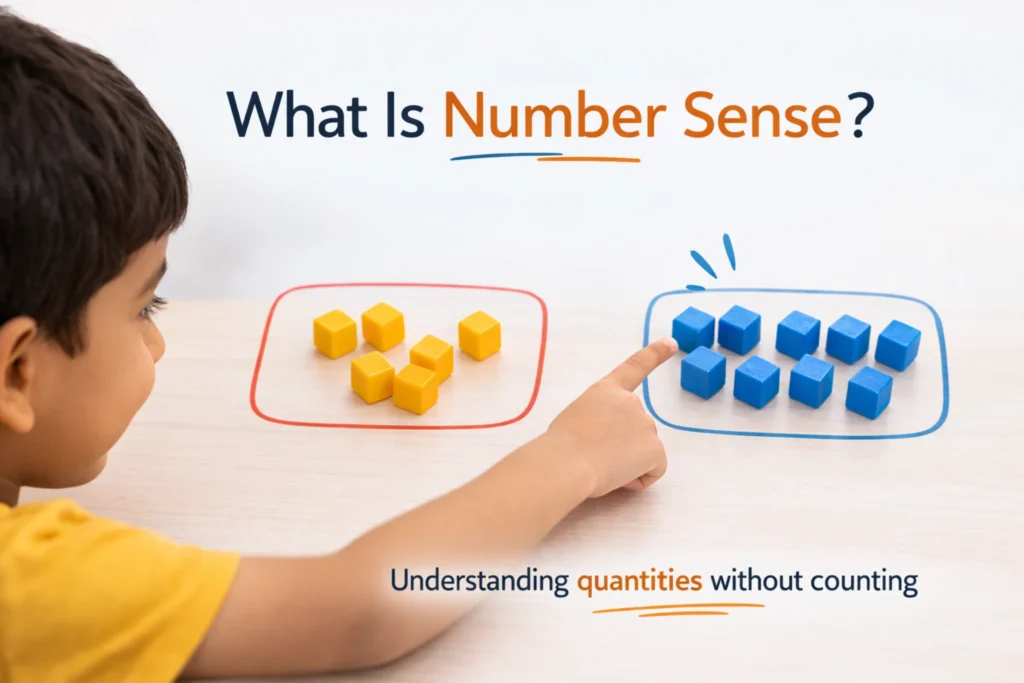
It is not a single skill but a cluster of interrelated understandings that develop together across the early years of schooling.
A child with strong number sense can break 9 into 5 and 4 or into 10 minus 1, depending on which is more useful. They know that adding 10 to any number changes only the tens digit.
They notice that 2, 4, 6, 8 follow a pattern and predict 10 without being told why. None of this requires a calculation procedure.
It comes from genuinely understanding how numbers work, the kind of understanding built through the hands-on, game-based, discussion-rich approaches in number sense teaching strategies for first graders.
The defining characteristic of number sense is flexibility. A child with strong number sense does not have one fixed strategy they adapt their approach based on what the specific numbers call for.
What Is Basic Arithmetic?
Basic arithmetic is the set of calculation procedures addition, subtraction, multiplication, division that operate on numbers to produce specific results.
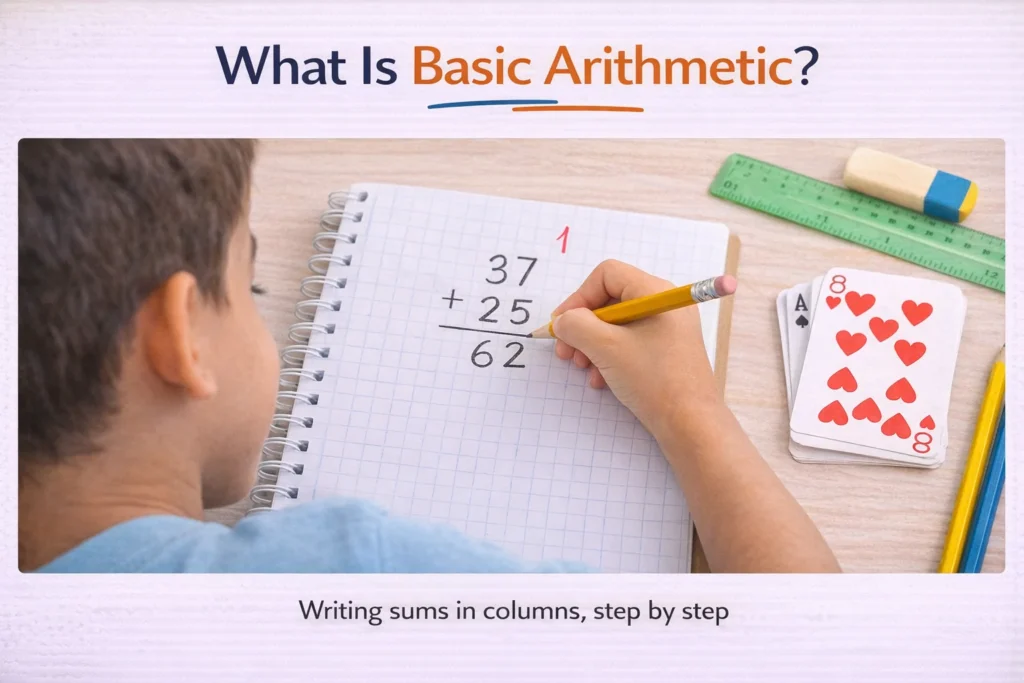
It is the domain of mathematical doing: applying a defined sequence of steps to reach a correct answer.
When a child adds 7 + 5 by counting up from 7, or carries a ten in column addition, they are performing arithmetic. The procedure is defined, the steps are clear, and the goal is accuracy.
This procedural reliability is arithmetic’s great strength: a child who correctly applies a procedure gets the right answer consistently.
Its limitation is rigidity. A child who only knows the procedure cannot check whether their answer is reasonable, cannot adapt when the problem format changes, and has no resources when the procedure does not fit.
At Class 1 level, arithmetic covers addition and subtraction within 100, and the equal-grouping foundations of multiplication for Class 1.
The 6 Key Differences
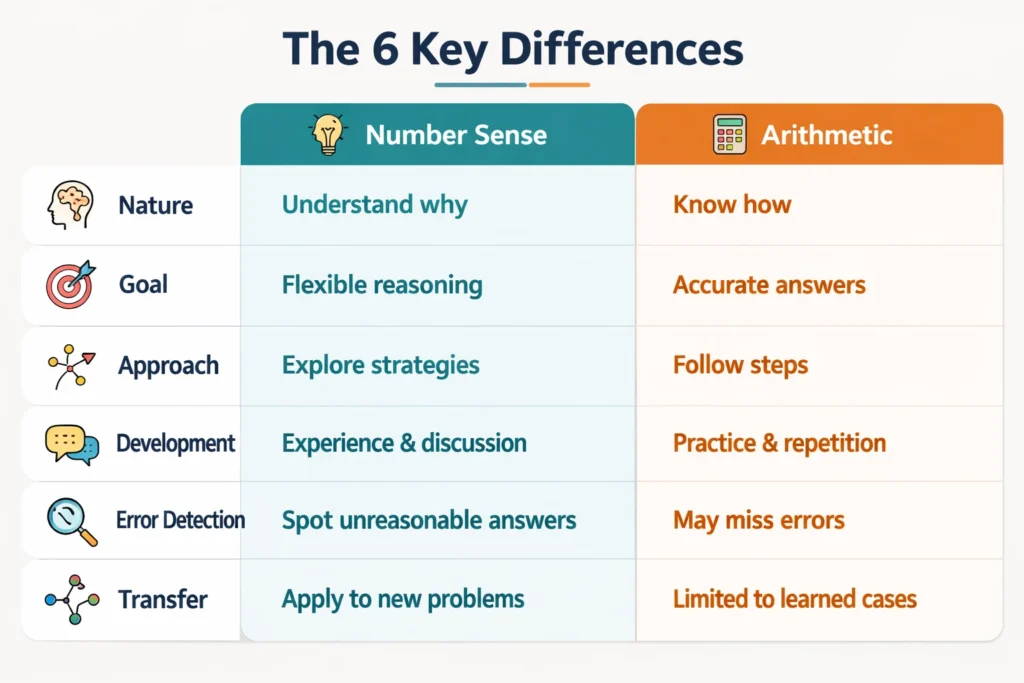
| Dimension | Number Sense | Basic Arithmetic |
|---|---|---|
| Nature | Conceptual — understanding why | Procedural — knowing how |
| Goal | Flexible reasoning about numbers | Accurate calculation of answers |
| Approach | Exploration, multiple strategies | Fixed steps, defined methods |
| Development | Built through experience and discussion | Built through practice and repetition |
| Error detection | Recognizes unreasonable answers | May not detect errors without checking |
| Transfer | Applies flexibly to new situations | May not transfer beyond learned procedure |
1. Conceptual vs Procedural
Number sense is about understanding why numbers work as they do. Arithmetic is about knowing how to execute a sequence of steps.
A child with a conceptual understanding of addition knows that combining quantities produces a larger one, that order does not change the sum, and that numbers can be decomposed to make calculations easier.
A child with only procedural knowledge lines up digits and adds columns correctly, but without the understanding that makes the skill durable and transferable.
2. Flexible Strategy vs Fixed Procedure
When a child with strong number sense sees 8 + 6, they might think: “8 needs 2 to make 10, take 2 from 6, so 10 + 4 = 14.” Or: “6 + 6 = 12, so 8 + 6 is 2 more = 14.”
They choose the strategy that fits those specific numbers. Arithmetic produces one fixed procedure applied the same way every time, reliable but less efficient when the numbers have exploitable relationships.
This strategic flexibility is grounded in the pattern awareness that what is the number sequence for class 1 maths develops.
3. Estimation vs Exact Answers
One of the clearest expressions of number sense is estimation, knowing roughly what an answer should be before calculating, and immediately recognizing when a result cannot be right.
A child who calculates 47 + 38 and gets 175 should instantly know something went wrong. A child with only arithmetic training has no such check.
This reasonableness-checking is one of the most practically valuable mathematical skills a child can develop, and it comes entirely from number sense, not arithmetic.
4. Foundation vs Application
The most important relationship between the two is the one that defines correct teaching sequence: number sense is the foundation, arithmetic is the application.
Arithmetic procedures are most meaningful, memorable, and durable when they are introduced after the conceptual understanding that makes them logical is already in place.
When procedures come first, they feel arbitrary and are vulnerable to forgetting.
This is why the ordering and comparison understanding in ascending and descending order in maths for class 1 matters before formal subtraction is introduced.
What Happens Without Number Sense
When arithmetic is drilled without number sense foundations in place, several predictable problems emerge typically visible between Class 3 and Class 5, when problem complexity exceeds what procedures alone can handle.
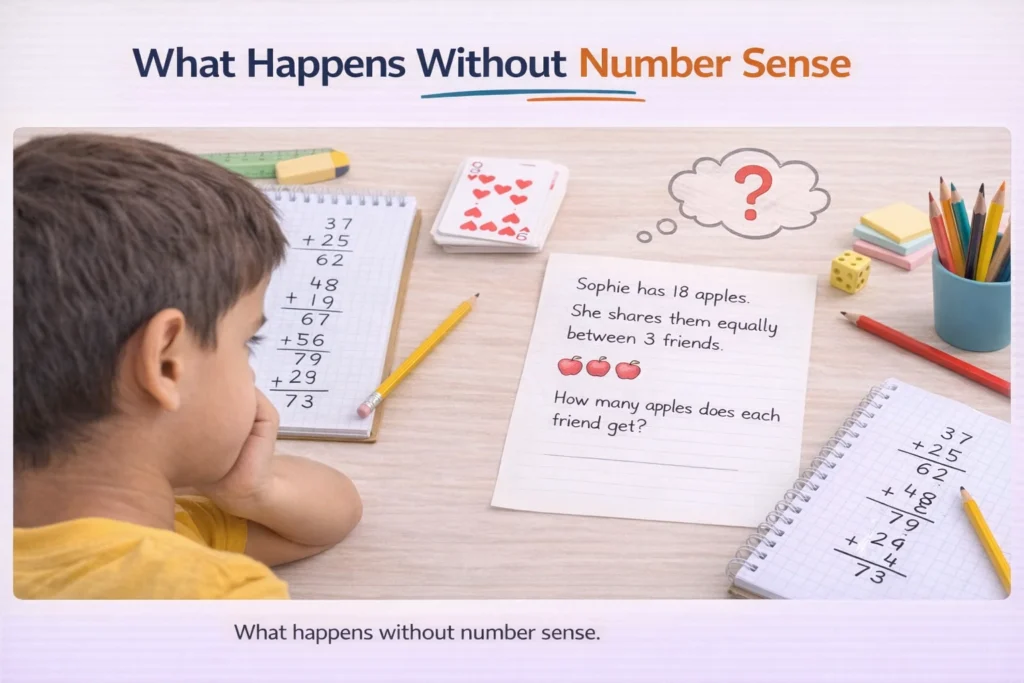
Fragile knowledge: Memorized procedures without understanding are forgotten faster and confused more easily.
A child who understands why column addition works can reconstruct it when memory slips. A child who only memorized it cannot.
Word problem difficulty: Word problems require identifying which operation to use before performing any calculation.
This identification requires understanding what each operation means, which is number sense.
Children with strong arithmetic but weak number sense routinely struggle with word problems, even when they could easily perform the calculation once told which one is needed.
Mathematics anxiety: When mathematics feels like a series of arbitrary rules to memorize rather than a logical system to reason through, anxiety follows.
Strong number sense makes mathematics feel rational and manageable the single most effective long-term protection against math anxiety.
The spatial and sequential reasoning in spatial understanding for class 1 and ordinal numbers for class 1 math both serve as early number sense anchors that reduce this arithmetic-only fragility.
How They Work Together
Number sense and arithmetic are not rivals they are partners that reinforce each other when developed in the right order. Number sense makes arithmetic procedures comprehensible and memorable.
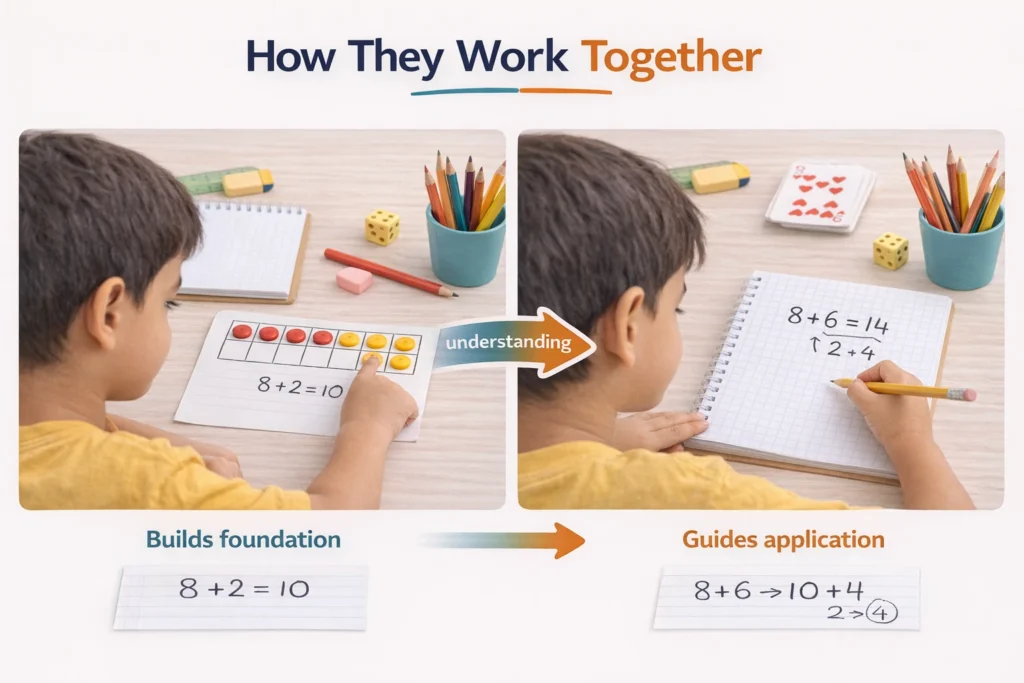
Arithmetic practice, in turn, deepens number sense by revealing new numerical relationships.
Consider the make-ten addition strategy. A child who has built number sense through ten-frame work already understands that 8 + 2 = 10 and that teen numbers are “ten and some more.”
When the strategy 8 + 6 → 8 + 2 + 4 → 10 + 4 → 14 is introduced, it clicks immediately because it expresses relationships the child already understands.
The arithmetic becomes an application of existing understanding rather than an arbitrary new rule.
This same pattern repeats across every arithmetic topic. Place value understanding (number sense) makes column addition logical. Number line intuition (number sense) makes subtraction meaningful.
Equal grouping (number sense) makes multiplication in multiplication for class 1 natural. And the equal-parts understanding that underlies fraction for class 1 depends entirely on number sense foundations being secure first.
For competition mathematics, this relationship is especially clear. The IMO syllabus for class 1 tests creative numerical reasoning the number sense dimension, rather than arithmetic speed.
Children who have both find competition problems far more approachable than those who have only procedures.
Can a child be strong in arithmetic but weak in number sense?
Yes, and it is more common than most parents realize. Children drilled heavily on procedures from an early age often show strong calculation accuracy but poor estimation and difficulty with unfamiliar problem formats. Strong arithmetic with weak number sense is a fragile combination that typically shows its limitations in Class 3–5.
Can a child have strong number sense but be slow at arithmetic?
Yes, and this is often misread as mathematical weakness when it is actually mathematical strength that simply needs arithmetic practice to complement it. Speed develops naturally with practice; understanding does not develop naturally through drilling alone. Starting from strong number sense is always the better position.
How do I know if my child needs more number sense or more arithmetic practice?
Ask your child to explain how they got their answer, or solve the same problem a different way. If they can only use one method and cannot explain why it works, number sense development is the priority. If they reason flexibly but calculate slowly, structured arithmetic practice is what they need. The warning signs of weak number sense are detailed in Why Number Sense Is Important for class 1.
Make Preparing for Math Olympiad Simple!



Conclusion
The difference between number sense and arithmetic is understanding versus procedure, foundation versus application, flexibility versus reliability.
Number sense comes first, providing the grounding that makes arithmetic meaningful and transferable. Arithmetic follows, building the calculation fluency that allows numerical reasoning to operate efficiently.
Together, in the right sequence, they produce the confident, flexible mathematical thinker every Class 1 child has the potential to become.
For the full picture, see Number Sense for Class 1.
For practical strategies, see number sense teaching strategies for first graders.
For home support, see number sense resources for parents.

Mikha Piregu is a Content Writer with experience spanning educational content, including math and math olympiad topics, as well as advocacy writing, research-based articles, and SEO-driven web content. He creates high-quality blog content, web copy, and feature articles that support brand visibility, audience engagement, and long-term organic growth through data-informed storytelling. Skilled in WordPress, WooCommerce, and modern digital tools, Mikha adapts content across various platforms, including blogs, websites, campaigns, and advocacy initiatives, with clarity and purpose. You can reach out to him at [email protected].



There are no comments posted here yet.
Sign in to leave a comment