


The absolute best free American Mathematics Competitions (AMC) resources include official past papers and comprehensive community-driven archives.
They offer complete problem statements, detailed text-based solutions, and step-by-step video explanations to boost your score.
The four best free AMC resources are the Art of Problem Solving (AoPS) Wiki (every past AMC problem with solutions), AoPS Alcumus (an adaptive free problem generator), the official MAA AMC site (registration, dates, official rules), and the AoPS video library (hundreds of free Richard Rusczyk walkthroughs of past problems).
Together these free AMC practice resources give you essentially unlimited AMC 8, AMC 10, and AMC 12 practice problems at no cost. The catch is they do not give you a structured path through them.
In this guide, we will cover what each of these free AMC resources is actually good for, where they fall short by contest level, and how to combine them into a daily practice routine that gets you to AIME.
The free AMC resources worth your time
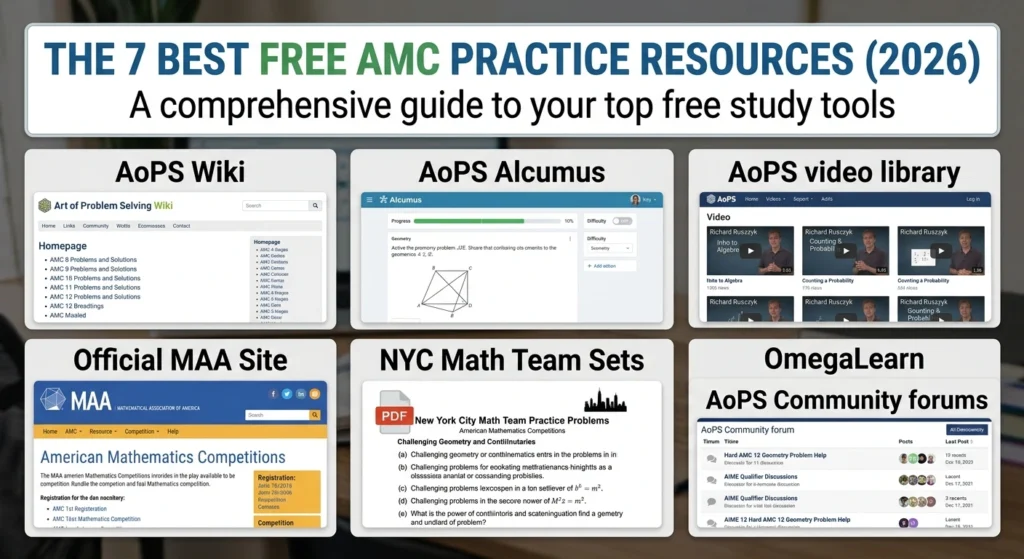
1. Art of Problem Solving (AoPS) Wiki
Link: artofproblemsolving.com/wiki
The single most valuable free AMC practice resource on the internet. AoPS hosts every AMC 8, AMC 10, AMC 12, and AIME problem ever administered, along with multiple community written solutions for each. Browse to the AMC 8 archive, the AMC 10 archive, or the AMC 12 archive, pick a year, and dive in. If you are still working out which contest fits your child, our guide on the AMC syllabus breaks down what each level actually tests.
What it is great for: unlimited timed past papers, comparing your approach to multiple expert solutions, learning elegant tricks from problem 23 to 25 write ups.
What it is not great for: beginners. The wiki throws you in the deep end with no curriculum. There is no “start here if you are new” path, you have to know what year and level you are capable of attempting, which most first timers do not.
2. AoPS Alcumus
Link: artofproblemsolving.com/alcumus
A free adaptive problem generator from AoPS. Pick a topic (algebra, counting, geometry, number theory), and Alcumus serves problems calibrated to your skill, adjusting up or down as you solve them. It is one of the best free tools ever built for math competition prep.
What it is great for: sustained topic by topic practice, especially for AMC 8 and early AMC 10 difficulty. The adaptive engine actually works.
What it is not great for: AMC 12 or AIME hard tier problems (Alcumus tops out around AMC 10 medium difficulty), and pacing practice, since it is untimed by design.
3. AoPS video library (Richard Rusczyk walkthroughs)
Link: artofproblemsolving.com/videos
AoPS hosts hundreds of free videos featuring founder Richard Rusczyk, including walkthroughs of past AMC 10, AMC 12, and AIME problems, plus videos aligned to the Prealgebra, Introduction to Algebra, and Introduction to Counting and Probability books. The step by step thinking out loud is hard to get from written solutions. Khan Academy also has a small AMC 10 playlist of a handful of videos, but the AoPS library is far deeper.
What it is great for: seeing how a strong problem solver approaches a hard problem, the inner monologue, the false starts, the reset to a different technique. Invaluable for students who learn better from watching than reading.
What it is not great for: breadth as a standalone curriculum. These are individual problem walkthroughs and topic videos, not a complete sequenced AMC course. You will need to combine them with past papers and structured practice.
4. Official MAA AMC site
Link: maa.org/student-programs/amc
The authoritative source for current rules, contest dates, AIME cutoffs, and official answer keys. Not a practice resource on its own, but you should check it at least monthly during prep season. For deadlines and how the registration process actually works, see our AMC registration guide, and for eligibility questions by grade, see the AMC age limit guide.
What it is great for: confirming dates, registration deadlines, and rule changes. The official AMC policies page is where current eligibility rules live, for example the AMC 8 age limit, which some third party sites still list incorrectly. Also publishes the official Teacher’s Manual each year with proctoring rules.
What it is not great for: practice problems. MAA does not host its own problem archive, the AoPS Wiki has effectively become the de facto archive.
5. NYC Math Team problem sets
Link: nycmathteam.org
The New York City Math Team publishes free PDF problem sets at AMC and above difficulty. Their handouts are dense, well organized by topic, and pitched at the level of strong AMC 10 and AMC 12 students aiming for AIME.
What it is great for: advanced students who have exhausted past papers and want curated topic drills.
What it is not great for: beginners or AMC 8 students, most of NYCMT’s material is too hard. Start here only after you are comfortable with AMC 10 problems 1 through 18.
6. OmegaLearn (free books plus video lectures)
Link: omegalearn.org
A collection of free books, Mastering AMC 8, Mastering AMC 10/12, The Book of Formulas, paired with video lectures for each chapter. Genuinely impressive output for a free resource, with clear topic coverage and worked examples.
What it is great for: students who like learning from a textbook plus video pairing. The AMC 8 book is one of the best free introductions in existence.
What it is not great for: active problem solving practice. The books are reference and instruction, you still need a separate problem source.
7. AoPS Community forums
Link: artofproblemsolving.com/community
The largest active community of US competition math students and coaches on the internet. Ask a hard problem, get five solutions in two hours.
What it is great for: getting unstuck on specific problems, learning from older students’ explanations, picking up culture and motivation.
What it is not great for: structured practice. The forums are reactive, you go there when you are stuck, not as a daily routine.
Comparison table
| Resource | Cost | Best for | Topic coverage | Adaptive | Tracks progress | Solutions provided |
|---|---|---|---|---|---|---|
| AoPS Wiki | Free | Past paper drilling | Every AMC year | No | No | Yes (community) |
| AoPS Alcumus | Free | Daily topic practice | AMC 8 to early AMC 10 | Yes | Yes (basic) | Yes |
| AoPS video library (Rusczyk) | Free | Watching problem solving | AMC 10/12, AIME plus intro topics | No | No | Yes (video) |
| MAA AMC site | Free | Rules, dates, registration | N/A | No | No | Official keys only |
| NYCMT problem sets | Free | Advanced topic drills | AMC 10/12 to AIME | No | No | Some PDFs |
| OmegaLearn | Free | Textbook plus video learning | AMC 8 / 10 / 12 | No | No | Yes |
| AoPS Community forums | Free | Getting unstuck | Everything | No | No | Crowdsourced |
Free AMC 8 vs AMC 10 vs AMC 12 resources: what changes by level
Not every free AMC resource fits every contest level, and this is where a lot of families waste time on the wrong tool.
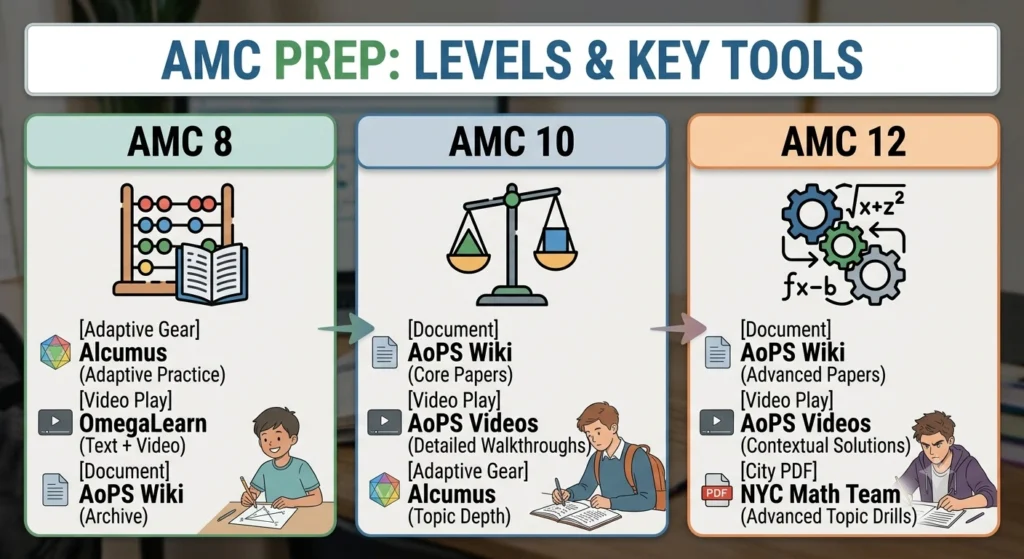
For AMC 8 practice, OmegaLearn’s Mastering AMC 8 book and Alcumus cover almost everything a middle schooler needs, since the difficulty ceiling on both matches AMC 8 well.
The AoPS Wiki’s AMC 8 archive is the natural next step once a student wants full-timed papers. For context on what the contest actually rewards, see our guide on the benefits of AMC math.
For AMC 10 practice, Alcumus is strong through the early and medium difficulty range, but strong AMC 10 students will outgrow it and need the AoPS Wiki’s AMC 10 archive plus the video library for problems 20 to 25.
For AMC 12 practice, free resources get thinner. Alcumus is not built for AMC 12 difficulty, so the AoPS Wiki archive, the video library, and NYC Math Team handouts carry most of the load.
Students at this level are usually also AIME qualifiers, so awards and scoring context matter. Our guides on AMC awards and what counts as a good AMC score are useful reference points here.
The honest argument: free resources give you problems, not a sequence
Here is what a stack of free AMC resources looks like in practice for a typical student:
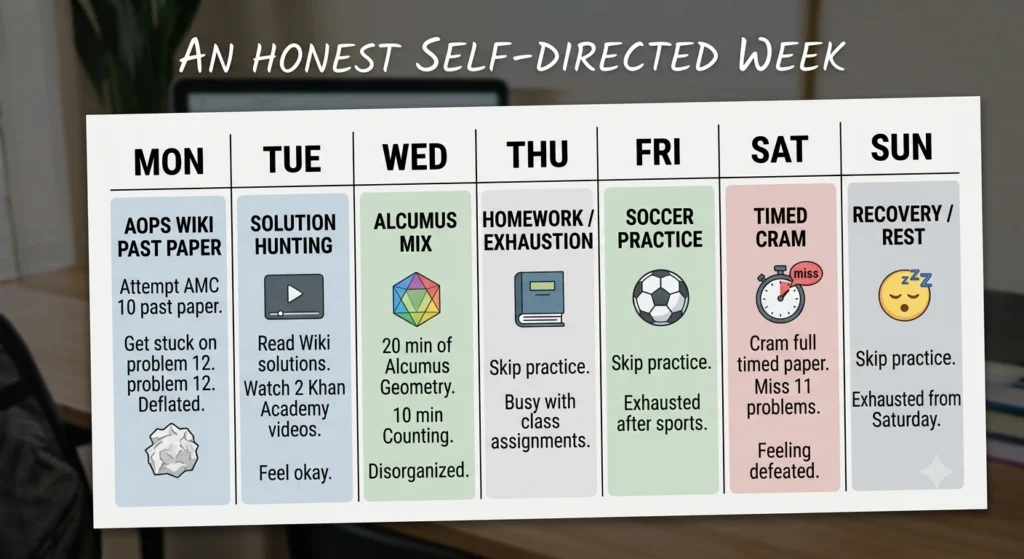
Monday: pull a past AMC 10 from the AoPS wiki, get to problem 12, get stuck.
Tuesday: read a few wiki solutions, watch a Khan Academy video on the problem, feel a bit better.
Wednesday: open Alcumus, do 20 minutes of geometry, switch to counting, do 10 more.
Thursday: skip practice, homework.
Friday: skip practice, soccer.
Saturday: cram a full timed paper, miss 11 problems, feel deflated.
Sunday: skip practice, exhausted from Saturday.
This is not a bad week; it is how a lot of self-directed AMC prep actually goes. The problem is not laziness. It is that free resources are a library, not a curriculum.
You are the one deciding every day what topic to work on, what difficulty to attempt, and when to switch from learning to timed practice. That is a lot of decisions for a 14-year-old, or a parent, to make correctly week after week.
What free resources do not give you:
- A daily plan: “today is 30 minutes of probability at AMC 10 medium difficulty”
- A weak topic tracker: “you have missed 4 number theory problems this week, here are 8 targeted reps”
- Pacing drills: “answer these 8 problems in 12 minutes total”
- Spaced repetition: “you got this one wrong 3 weeks ago, here it is again with a twist”
- A graded progression from intro examples to AIME floor problems on the same topic
Where a structured app fits in
This is the honest pitch for Gonit, and it is narrower than most app pitches: use free resources for breadth and depth.
Use a structured app for daily consistency.
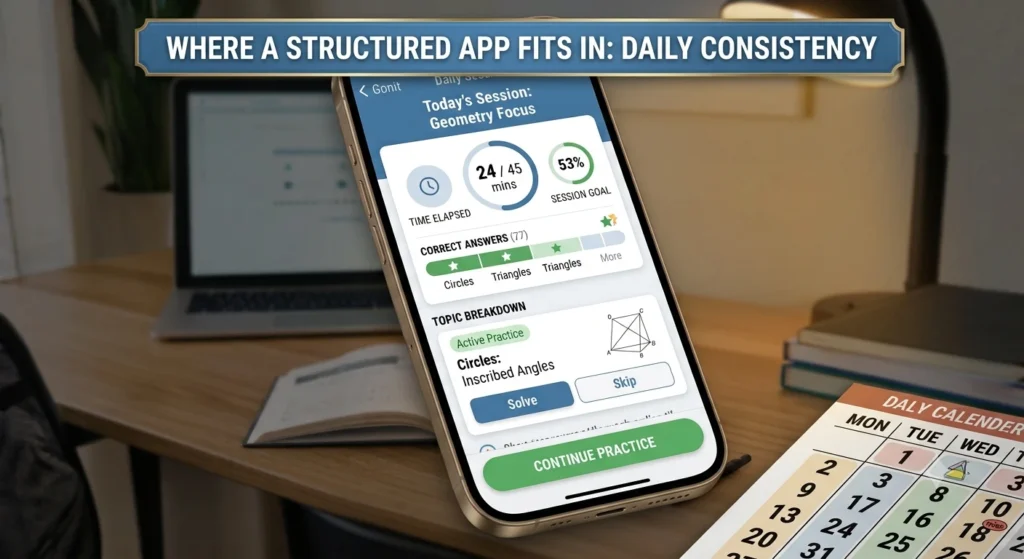
The pattern that works for most students:
- Daily reps: structured app (Gonit), 25 to 45 minutes
- Weekly full paper: AoPS Wiki past papers, timed under contest conditions
- Getting unstuck: AoPS forums, Khan Academy videos
- Topic reference: OmegaLearn books, NYCMT handouts
- Rules and dates: official MAA site
You do not need to pick one. The mix is what works.
A library is not a curriculum. Gonit gives your child a daily plan across every AMC topic, 25 to 45 minute sessions, pacing drills, weak topic targeting, and progress tracking.
Free to start, works alongside every other resource on this list. The problems are everywhere; the sequence is not. Start free on iOS and Android.
How to actually use these resources
A practical workflow if you are starting from scratch:
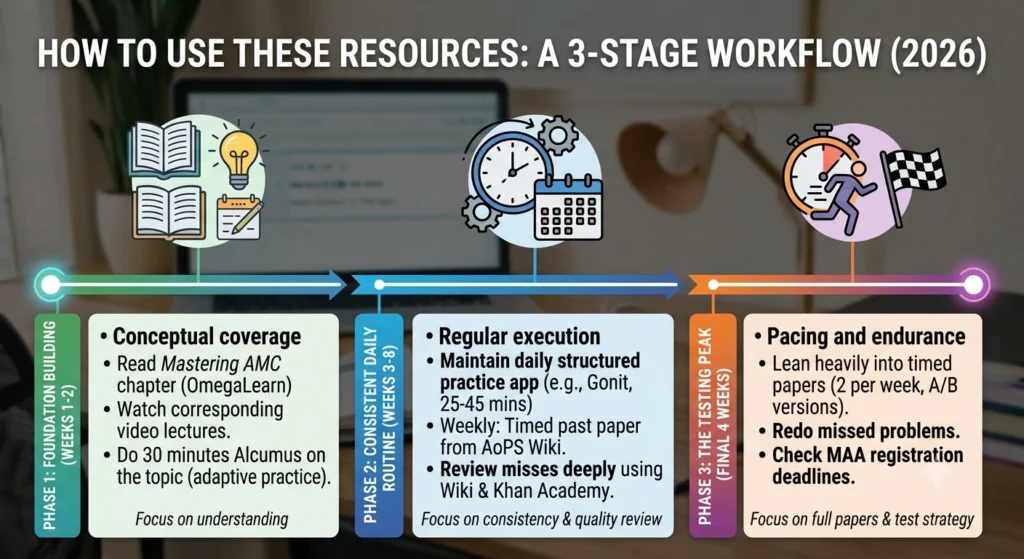
First two weeks: read OmegaLearn’s Mastering AMC 8 or Mastering AMC 10/12 chapter on whichever topic feels most intimidating. Watch the corresponding video lectures. Do 30 minutes of Alcumus on that topic.
Weeks 3 to 8: pick a daily 30 minute structured practice app. Gonit’s daily sequence is built for exactly this, but the principle stands even if you use something else, pick one and stick with it. Every weekend, take one full timed past paper from the AoPS wiki, then spend an hour reviewing your misses with help from the wiki solutions and Khan Academy videos.
Final 4 weeks: lean into timed past papers. Two per week, alternating A and B versions for the AMC 10/12. Redo problems you previously missed. If you have not registered yet, check deadlines on our AMC registration page well before this stage.
For more detailed prep timelines by contest, see our pillars on how to prepare for the AMC, the AMC 8 practice test, the AMC 10 practice test, and the AMC 12 practice test.
Can my child qualify for AIME using only free resources?
Yes, many do every year. The constraint isn’t material; it’s discipline. Free resources work if you can self-direct a daily 30–45-minute practice routine for 4+ months. If that’s a challenge, a structured app (paid or free-to-start) closes the gap.
Should we pay for AoPS courses?
AoPS’s paid courses (Intermediate Algebra, Intermediate Counting & Probability, etc.) are excellent and worth the cost if you can afford them, but they’re not essential. Their free Alcumus tool alone can take a student a long way. Save the paid courses for students aiming for AIME qualification into USAMO territory.
Are free videos enough for AMC 10 prep?
Not on their own. The AoPS video library (and Khan Academy’s smaller AMC playlist) is a useful supplement fantastic for seeing problem-solving in action, but it’s not a curriculum. Combine the videos with past papers from the AoPS wiki and a structured daily practice routine.
How many past papers should we actually do?
For a 4-month preparation window: aim for 6–10 full-time past papers in the final 6 weeks, with detailed review of every miss. Doing 20 past papers in a month with no review is worse than doing 8 with deep review. Quality of review beats quantity of papers.
What is considered a good AMC score?
It depends on the contest level and your goal (AIME qualification versus a strong personal score). Our guide on what a good AMC score is breaks this down by contest, alongside typical average AMC scores by grade level.
Do free resources cover the full AMC syllabus?
Mostly yes for AMC 8 and AMC 10, less completely for AMC 12 hard tier and AIME level content. See our AMC syllabus guide for the full topic breakdown so you can check coverage against whichever free resource you are using.
Make Preparing for Math Olympiad Simple!



Conclusion
Free AMC practice resources can absolutely get a student to AIME. The AoPS Wiki, Alcumus, the video library, and the official MAA site cover more ground than most families realize, and none of it costs a dollar. What they will not do is tell you what to work on today or track your weak topics for you.
Treat this list as a toolkit, not a checklist. Pull past papers from the AoPS Wiki, use Alcumus for daily reps, and lean on the video library when a solution does not click.
If you would rather not build that schedule yourself, Gonit fills that one gap with a daily sequence across every AMC topic.
Related guides
- How to prepare for the AMC: a complete roadmap
- AMC registration: deadlines and how to sign up
- AMC age limit: eligibility by grade
- AMC syllabus: what each contest level tests
- Benefits of AMC math for students
- AMC math competition awards explained
- What is a good AMC score

Mikha Piregu is a Content Writer with experience spanning educational content, including math and math olympiad topics, as well as advocacy writing, research-based articles, and SEO-driven web content. He creates high-quality blog content, web copy, and feature articles that support brand visibility, audience engagement, and long-term organic growth through data-informed storytelling. Skilled in WordPress, WooCommerce, and modern digital tools, Mikha adapts content across various platforms, including blogs, websites, campaigns, and advocacy initiatives, with clarity and purpose.



There are no comments posted here yet.
Sign in to leave a comment