 November 18, 2025
 14 min. read

Knowing how to prepare for AMC is the difference between walking into the exam uncertain and walking in with a clear plan, a practiced skill set, and a realistic score target.
The American Mathematics Competitions, AMC 8, AMC 10, and AMC 12 reward students who prepare strategically, not just students who are naturally strong at school math.
This guide covers everything: the exam structure, the core topics you need to master for each level, study plans for different timelines, the best resources, and the test-day strategies that experienced AMC students rely on.
Before diving into preparation, make sure your registration is in order see how to register for AMC for the step-by-step process.
And if you are still deciding whether AMC is worth your time, the benefits of AMC math post lay out what you stand to gain.
Understanding the AMC Series Before You Prepare
Preparing effectively starts with knowing exactly what each exam demands. The three AMC levels are meaningfully different in scope, difficulty, and scoring structure.
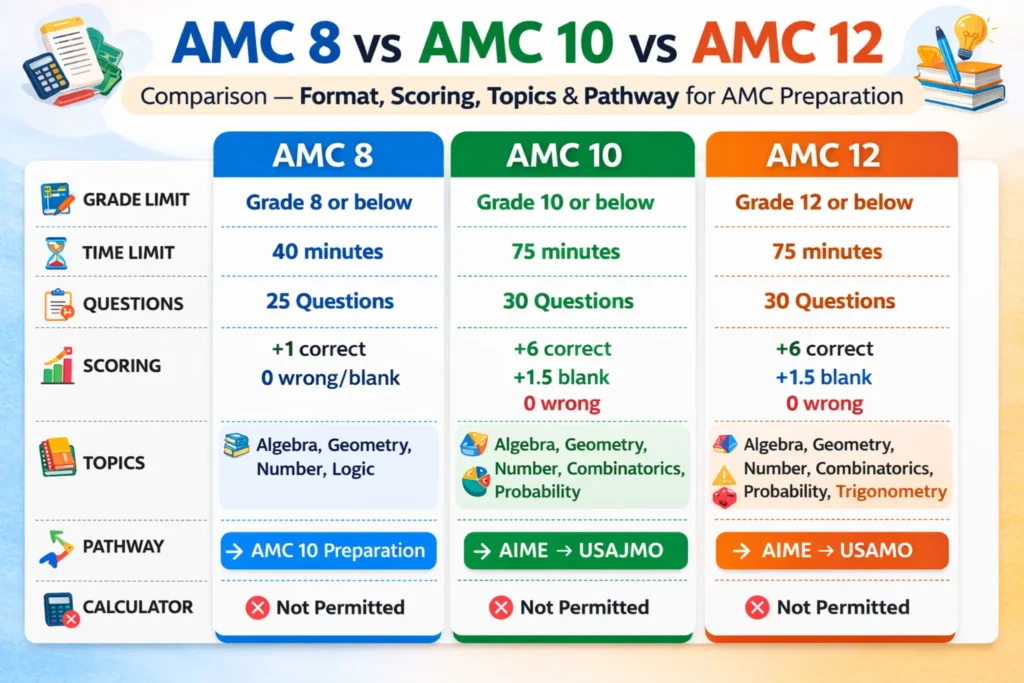
| Feature | AMC 8 | AMC 10 | AMC 12 |
|---|---|---|---|
| Grade limit | Grade 8 or below | Grade 10 or below | Grade 12 or below |
| Age limit | Under 14.5 | Under 17.5 | Under 19.5 |
| Questions | 25 | 30 | 30 |
| Time | 40 minutes | 75 minutes | 75 minutes |
| Scoring | 1 pt correct, 0 wrong/blank | 6 correct, 1.5 blank, 0 wrong | 6 correct, 1.5 blank, 0 wrong |
| Max score | 25 | 150 | 150 |
| Leads to | AMC 10 preparation | AIME → USAJMO | AIME → USAMO |
| Calculator | Not permitted | Not permitted | Not permitted |
The scoring difference between AMC 8 and AMC 10/12 is critical for preparation. On AMC 8, every question should be attempted there is no penalty for wrong answers.
On AMC 10 and AMC 12, a wrong answer scores 0 while a blank scores 1.5, which means random guessing hurts you. Strategic skipping is a skill that needs to be practiced, not just understood.
To confirm which exam you should register for, check the AMC age limit and eligibility guide.
How to Prepare for AMC 8
AMC 8 preparation is about building strong mathematical foundations and developing the habit of approaching unfamiliar problems without panic.
The exam tests middle school mathematics but in ways that go well beyond what most classrooms cover.
Core Topics for AMC 8
| Topic | What to Focus On |
|---|---|
| Arithmetic | Fractions, decimals, percentages, ratios, proportions |
| Pre-algebra | Basic equations, inequalities, word problems |
| Geometry | Perimeter, area, angles, basic coordinate geometry |
| Number theory | Divisibility, factors, multiples, primes |
| Combinatorics | Counting principles, basic probability |
| Logical reasoning | Pattern recognition, sequence problems |
AMC 8 Preparation Strategy
Start with past papers, not textbooks. The fastest way to understand what AMC 8 actually asks is to sit a full past paper from the MAA archives within the first week of preparation. Do not worry about the score use it to diagnose which topics need work.
Work problems, not topics. It is tempting to read through theory first, but AMC 8 rewards students who have seen many problem types. Spend the majority of your preparation time solving problems, not studying definitions.
Build an error log. After every practice session, write down every problem you got wrong or guessed on, record the topic it tested, and write out the correct solution in full. Reviewing your error log weekly is the single most efficient study habit for AMC 8.
Attempt every question. There is no penalty for wrong answers on AMC 8. Never leave a question blank — even an educated guess is better than 0.
Target score: Scoring 18+ earns Honor Roll. Scoring 22+ earns Distinguished Honor Roll (top 1% nationally). For full AMC 8 score benchmarks, see what is a good AMC math competition score.
How to Prepare for AMC 10
AMC 10 preparation requires a step up in both content depth and strategic thinking.
The exam goes beyond school algebra and geometry to test problem-solving flexibility, number theory, and combinatorics at a level most students have not encountered in class.
Core Topics for AMC 10
| Topic | Specific Areas |
|---|---|
| Algebra | Quadratics, systems of equations, sequences, functions, inequalities |
| Geometry | Triangles, circles, polygons, coordinate geometry, area and volume |
| Number theory | Divisibility, prime factorization, modular arithmetic, GCD/LCM |
| Combinatorics | Permutations, combinations, counting principles, inclusion-exclusion |
| Probability | Basic probability, conditional probability, expected value |
The AMC 10 stays within pre-calculus boundaries, no trigonometry and no calculus. For the complete topic-by-topic breakdown, see the AMC math competition syllabus.
AMC 10 Preparation Strategy
Master the 6/1.5/0 scoring system. The most important strategic skill for AMC 10 preparation is knowing when to skip. A blank scores 1.5. A wrong answer scores 0.
If you cannot eliminate at least two answer choices on a hard problem, leaving it blank is mathematically correct.
Practice problems 1–20, then build up. AMC 10 problems are roughly ordered by difficulty. Problems 1–10 are accessible to a prepared student. Problems 11–20 require solid technique.
Problems 21–30 are designed to challenge even strong students. Build your score by securing the first 15–20 questions reliably before pushing into the harder ones.
Timed practice is non-negotiable. 75 minutes for 30 questions is tight. Students who only practice untimed consistently underperform on test day because they have not built the pacing instincts needed.
Every full past paper should be done under strict timing.
Analyze every wrong answer deeply. On AMC 10, most errors fall into one of three categories: a topic gap (you did not know the technique), a careless mistake (you knew how but made an arithmetic error), or a strategy error (you guessed when you should have skipped).
Identifying which category each wrong answer falls into tells you exactly what to fix.
AIME qualification target: Score 100+ on AMC 10 to give yourself a solid buffer above the typical cutoff range of 94.5–105 points. See AMC score benchmarks for the full historical cutoff data.
How to Prepare for AMC 12
AMC 12 preparation builds on everything from AMC 10 and adds a layer of advanced content that most students encounter for the first time through competition preparation rather than in class.
Additional Topics for AMC 12 (Beyond AMC 10)
| Topic | Specific Areas |
|---|---|
| Trigonometry | Sine, cosine, tangent, identities, law of sines/cosines |
| Advanced algebra | Polynomials, logarithms, complex numbers, rational functions |
| Sequences and series | Arithmetic/geometric series, telescoping, sigma notation |
| Precalculus concepts | Polar coordinates, vectors, parametric equations |
AMC 12 Preparation Strategy
Use AMC 10 preparation as your base. Everything covered in AMC 10 preparation applies equally to AMC 12. Build those skills first, then layer in the additional AMC 12 topics.
Prioritize trigonometry and complex numbers early. These two topics consistently appear on AMC 12 and are the biggest differentiators between students who are stuck below 80 and students scoring 90+. Do not leave them until the final weeks of preparation.
Target problems 1–25 strategically. AMC 12 has the same 30-question structure as AMC 10, but the difficulty ramp is steeper. Problems 20–30 on AMC 12 are genuinely hard. Securing 90+ points from the first 20 problems is a stronger strategy than spreading effort evenly across all 30.
AIME qualification target: Score 88–95+ on AMC 12 to comfortably clear the typical cutoff range of 76.5–88.5 points. For more detail on what separates AMC 12 qualifiers, see how to get better at solving math olympiad questions.
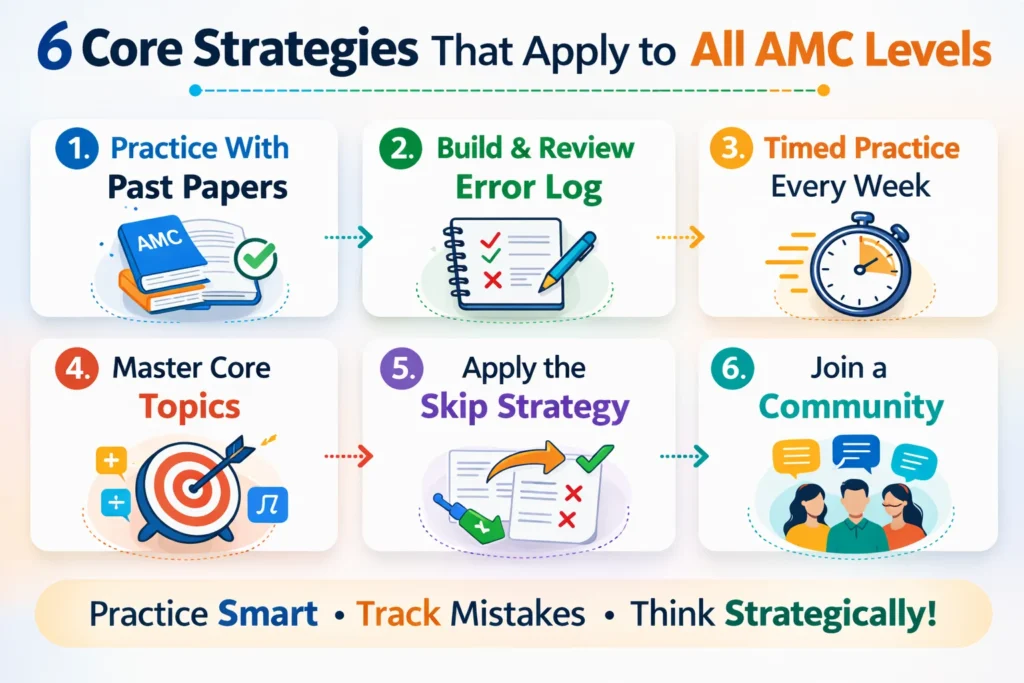
6 Core Strategies That Apply to All AMC Levels
Regardless of which AMC level you are preparing for, these six strategies consistently produce the strongest score improvements.
1. Practice With Authentic Past Papers
The MAA publishes official AMC past papers going back decades. These are the gold standard for preparation because they reflect the exact style, difficulty distribution, and question types of the real exam. No third-party resource replicates them perfectly.
Start your preparation by completing at least two past papers to establish a baseline score. Use this baseline to identify your weakest topic areas before committing to a study plan.
For structured access to past papers alongside guided practice, free math olympiad training online provides a useful starting framework.
2. Build and Review Your Error Log
An error log is a dedicated record of every question you get wrong during practice, organized by topic, type of error, and correct solution.
Reviewing your error log every week is more valuable than doing additional practice sessions it forces you to confront the same mistakes repeatedly until they no longer occur.
Categorize each error as:
- Topic gap — you did not know the technique
- Careless error — you knew how but made a small mistake
- Strategy error — you attempted a problem you should have skipped
Each category requires a different fix.
3. Simulate Real Exam Conditions Every Week
Timed, full-length practice under realistic conditions is the only way to build the pacing instincts AMC requires. This means: 40 minutes for AMC 8 and 75 minutes for AMC 10/12, no calculator, no interruptions, and every question attempted in order before reviewing.
Students who practice untimed consistently underperform on test day because their brain has not been trained to make fast, accurate decisions under pressure.
4. Master Core Topics Systematically
Random problem practice without a topic structure creates gaps that surface on test day in the worst possible way. Build fluency topic by topic: algebra first, then geometry, then number theory, then combinatorics, before mixing problem types in full-paper practice.
Use the AMC math syllabus as your checklist. When you can confidently solve problems in a topic area without hints or extended time, that topic is ready. Move to the next.
5. Apply the Skip Strategy Deliberately
On AMC 10 and AMC 12, the scoring rule rewards smart skipping. Develop a consistent decision process for each question:
- Within 30 seconds: Can I see a clear path to the answer? If yes, solve it. If no, mark it and move on.
- On the second pass: Can I eliminate at least two answer choices? If yes, attempt it. If no, leave it blank.
This two-pass approach consistently produces better scores than spending long periods on a single hard problem while easier questions go unanswered.
6. Join a Community of AMC Peers
Preparation in isolation is slower and less motivating than preparation alongside peers who are working toward the same goals.
Art of Problem Solving (AoPS) forums, school math clubs, and online AMC study groups all provide access to problem discussions, solution approaches you would not have found alone, and the accountability of shared preparation.
AMC Study Plans by Timeline
3-Month Study Plan (Short Timeline)
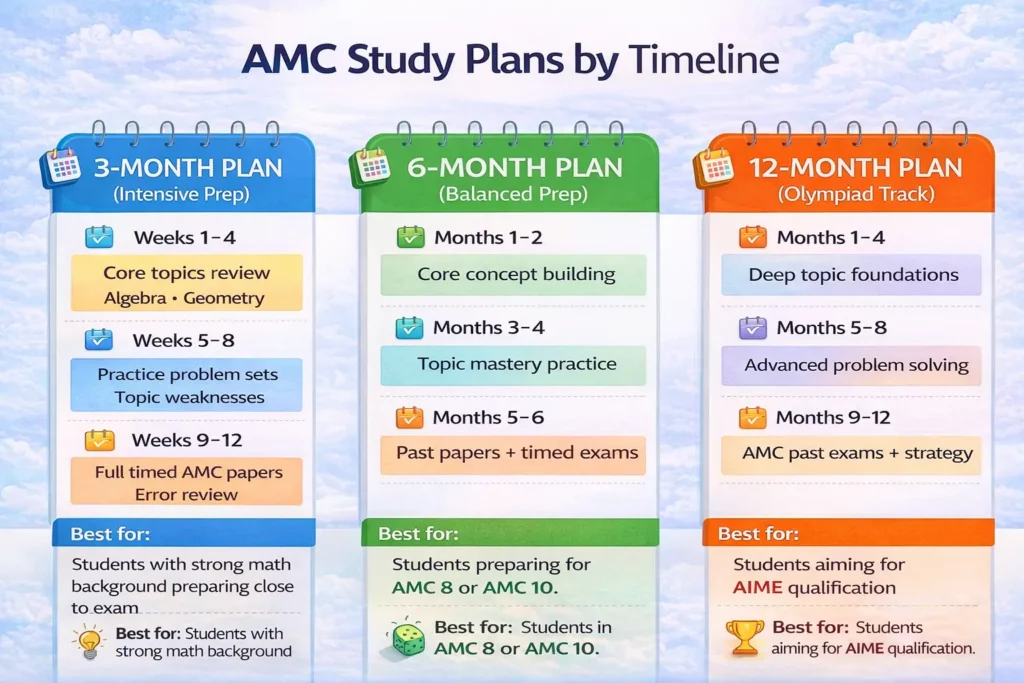
This plan suits students who have confirmed their registration and have approximately 12 weeks before the contest date.
| Weeks | Focus |
|---|---|
| 1–2 | Complete two full past papers to establish baseline. Identify your three weakest topic areas. |
| 3–5 | Intensive topic study on your weakest areas. 5–6 problems per topic per day, reviewing every error. |
| 6–8 | Mixed topic practice. One full past paper per week under timed conditions. Error log review every Sunday. |
| 9–10 | Two full past papers per week. Focus only on problems in your difficulty range — do not waste time on the hardest questions you cannot yet solve. |
| 11–12 | Light practice to maintain sharpness. Review your error log. No new topics. Final exam simulation one week before contest day. |
Daily commitment: 45–60 minutes on weekdays, 90 minutes on weekends.
6-Month Study Plan (Standard Timeline)
This plan is the most effective for most students enough time to build genuine topic fluency without burning out.
| Month | Focus |
|---|---|
| 1 | Complete two baseline past papers. Full topic inventory identify strong and weak areas. Begin systematic topic study starting with algebra. |
| 2 | Continue topic study geometry and number theory. 34 problem sets per week. Error log established. |
| 3 | Combinatorics and probability. Begin mixing topics in practice sessions. First timed full paper. |
| 4 | Full topic review. Two timed full papers per month. Error log review weekly. Begin problem difficulty progression push slightly above comfortable level. |
| 5 | High-intensity past paper practice. Two full papers per week. Focus on speed and the skip strategy. |
| 6 | Peak preparation. Three full papers per week for the first two weeks. Final two weeks: light maintenance, error log review, one final full simulation. |
Daily commitment: 30–45 minutes on weekdays, 60–90 minutes on weekends.
12-Month Study Plan (Long-Term Build)
This plan is ideal for students in grades 7–9 preparing seriously for future AMC 10 or AMC 12 attempts, or for anyone targeting AIME qualification.
| Quarter | Focus |
|---|---|
| Q1 (Months 1–3) | Foundation building — algebra and geometry from first principles using AoPS textbooks. No timed practice yet. |
| Q2 (Months 4–6) | Number theory and combinatorics. First past paper attempts (untimed) to explore problem types. Begin error log. |
| Q3 (Months 7–9) | Full topic integration. Weekly timed past papers. Difficulty push — attempt harder problems than feel comfortable. |
| Q4 (Months 10–12) | Peak preparation as per 3-month plan above. Timed simulations, error log mastery, AIME-level problems for the final month if targeting qualification. |
Daily commitment: 30 minutes on weekdays, 60 minutes on weekends sustainable over a full year.
Best Resources for AMC Preparation
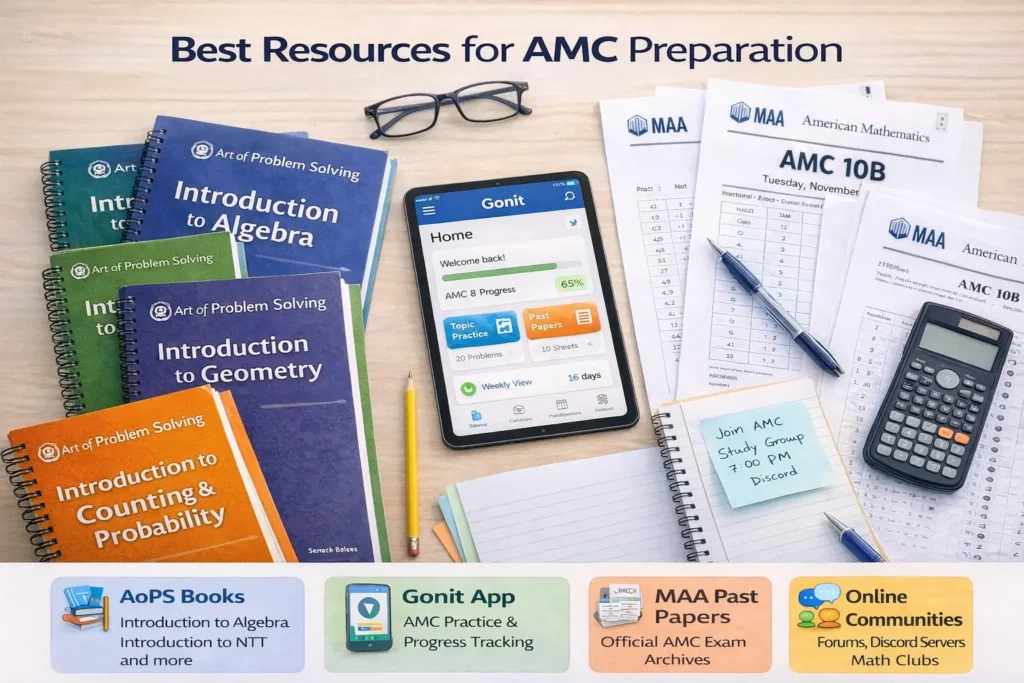
Art of Problem Solving (AoPS)
AoPS is the most widely used resource in the AMC preparation community, and for good reason. Their book series, Introduction to Algebra, Introduction to Geometry, Introduction to Number Theory, and Introduction to Counting & Probability, are written specifically for competition mathematics and cover AMC topics at exactly the right depth.
The AoPS online forum is equally valuable: thousands of past AMC problems have been discussed in detail, with multiple solution approaches and explanations from experienced students and coaches.
MAA Official Past Papers and Archives
The MAA publishes official AMC past papers and answer keys on their website, going back many years. These are the most important practice resource for any AMC level.
No other resource fully replicates the style and calibration of real AMC problems.
Gonit App
The Gonit app is built specifically for AMC and math olympiad preparation.
It offers structured practice sessions, personalized problem sets by topic and difficulty level, and progress tracking, making it particularly effective for students who want organized preparation rather than open-ended problem hunting.
Online Math Communities
The AoPS community forums, school math clubs, and AMC-focused Discord servers all provide access to peer discussion, shared strategies, and collaborative problem-solving.
These communities are especially valuable for students preparing without a coach or formal program.
Classic Problem-Solving Books
Beyond AoPS, books like The Art and Craft of Problem Solving by Paul Zeitz and Competition Math for Middle School by Jason Batterson provide excellent problem variety and strategy depth for students wanting broader mathematical development alongside AMC-specific preparation.
AMC Exam Day Strategy
All the preparation in the world is only valuable if you execute well on the day. Here is the strategy that translates practice into performance:
First pass — solve what you can solve quickly. Work through all 30 questions in order, spending no more than 2–3 minutes on each. Answer every problem you can solve confidently. For any problem that does not have a clear path within 60–90 seconds, mark it and move on.
Second pass — attempt problems you can narrow down. Return to marked problems and apply elimination. If you can narrow to two or three answer choices through logic or estimation, attempt them. If you cannot narrow down at all, leave the blank — it is worth more than a wrong answer.
Final pass — check your confident answers. Use any remaining time to review the answers you were confident about. Careless arithmetic errors on easy problems are the most costly mistakes on AMC — a wrong answer on problem 3 costs the same as a wrong answer on problem 28.
Never leave AMC 8 blanks. The no-penalty scoring means every question must be answered. Use any remaining time to guess intelligently on questions you skipped.
How long does it take to prepare for AMC?
A realistic minimum is 3 months of consistent daily practice for AMC 8. For AMC 10 and AMC 12 with AIME qualification as the goal, 6–12 months of structured preparation gives the strongest results.
Can I prepare for AMC without a tutor or coach?
Yes. The majority of AMC participants self-prepare using past papers, AoPS resources, and online communities. A coach accelerates progress, but the resources available for self-study are comprehensive enough to produce strong results with consistent effort.
How many past papers should I do before the exam?
A minimum of 8–10 full past papers under timed conditions for AMC 10 and AMC 12. For AMC 8, 5–6 full papers is a solid baseline. The quality of review after each paper matters more than the quantity of papers completed.
Should I start with AMC 8 or go straight to AMC 10?
If you are in grade 8 or below and under 14.5, AMC 8 is your only option. If you are eligible for AMC 10, starting with AMC 10 past papers is fine — do a few AMC 8 papers first if you find AMC 10 overwhelming initially.
What is the most common mistake students make when preparing for AMC?
Practicing without reviewing errors. Students who complete many past papers without deeply analyzing their wrong answers plateau quickly. The error log habit, recording, categorizing, and revisiting every mistake, is the highest-leverage habit in AMC preparation.
What comes after AMC?
Top scorers on AMC 10 and AMC 12 qualify for the AIME, which feeds into USAJMO and USAMO consideration. For the full pathway, see how to qualify for the IMO in the USA.
Make Preparing for Math Olympiad Simple!



Conclusion
Knowing how to prepare for AMC comes down to four things: understand the exam structure for your level, build topic fluency systematically, practice under real timed conditions with deep error review, and apply the skip strategy deliberately on AMC 10 and AMC 12.
Start by completing two past papers to establish your baseline. Build your weakest topics using AoPS or the Gonit app. Practice timed full papers weekly as the exam approaches. Review every error. Aim above the historical cutoff if AIME qualification is your goal.
For everything you need to know about scores, see what is a good AMC math competition score. For registration, see how to register for AMC. And for what the competition pathway looks like after AMC, see benefits of AMC math.
The preparation starts today.