July 13, 2026
 8 min. read

Math Kangaroo groups students into six competition levels paired by consecutive school grades: Grades 1–2 (Pre-Ecolier), 3–4 (Ecolier), 5–6 (Benjamin), 7–8 (Cadet), 9–10 (Junior), and 11–12 (Student).
Each level takes a 75-minute, multiple-choice test with no calculators allowed.
Levels 1–4 (Pre-Ecolier and Ecolier) feature 24 questions worth 96 max points, while Levels 5–12 (Benjamin through Student) feature 30 questions worth 120 max points.
Your child is ranked only against students in their exact grade, not the full grade pair, a different ranking structure than the AMC 10 vs AMC 12 system some families compare it to. Confirmed against the official Math Kangaroo USA FAQ.
This guide walks you through each level, what your child should expect, and how to pick the right practice difficulty.
The six Math Kangaroo levels
Math Kangaroo USA organizes students into six test levels by grade pair: Grades 1–2, 3–4, 5–6, 7–8, 9–10, and 11–12 (confirmed in its team competition FAQ and on its scoring page).
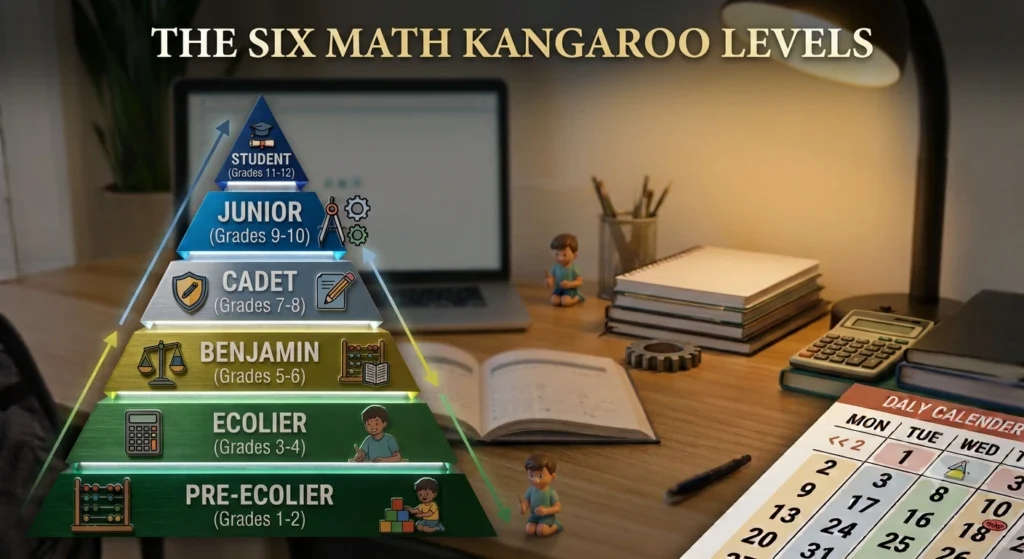
Each level has its own paper, and rankings are calculated per individual grade so a 3rd grader competes against other 3rd graders, not the 4th graders who took the same paper.
| Level name | US grades | Questions | Max score | Time | Typical age |
| Pre-Ecolier | 1–2 | 24 | 96 | 75 min | 6–8 |
| Ecolier | 3–4 | 24 | 96 | 75 min | 8–10 |
| Benjamin | 5–6 | 30 | 120 | 75 min | 10–12 |
| Cadet | 7–8 | 30 | 120 | 75 min | 12–14 |
| Junior | 9–10 | 30 | 120 | 75 min | 14–16 |
| Student | 11–12 | 30 | 120 | 75 min | 16–18 |
The naming pattern comes from the international Kangaroo organization, the Association Kangourou Sans Frontières (AKSF). US students sit the AKSF-developed papers each March alongside millions of students in 80+ countries.
A note on the scoring tiers: every paper, regardless of level, divides its questions into three difficulty bands easy (3 points each), medium (4 points each), and hard (5 points each). One-third of the questions sit in each tier. There is no penalty for incorrect answers in the US contest, so your child should answer every question, even if it’s a thoughtful guess.
Math Kangaroo Scoring System Explained
Every paper, regardless of level, divides its questions into three difficulty bands: easy (3 points each), medium (4 points each), and hard (5 points each).
One-third of the questions sit in each tier. There is no penalty for incorrect answers in the US contest, so your child should answer every question, even if it’s a thoughtful guess.
A common parent question is what counts as a good Math Kangaroo score. There’s no single published passing score or cutoff, since results are normed against that year’s grade cohort and top scorers earn recognition rather than a pass/fail mark.
For a broader sense of how competition math scoring works across contests, see our guide on average AMC math scores.
What each level actually looks like
The grade-pair groupings are designed so the paper feels age-appropriate.
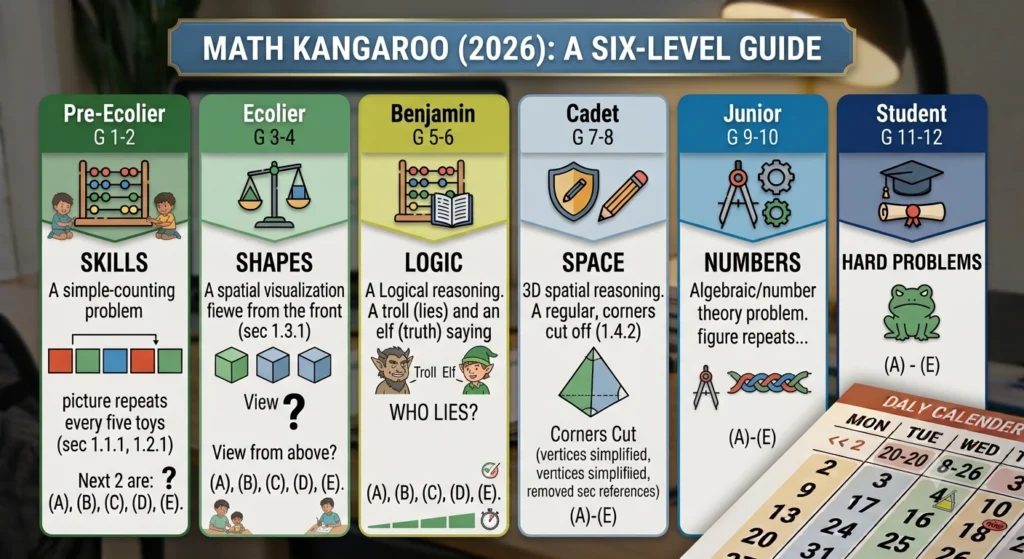
Here’s a level-by-level snapshot.
Pre-Ecolier (Grades 1–2)
The youngest level. Expect picture-heavy questions: count the dots, find the matching shape, complete the pattern, identify which clock shows the right time.
The reading load is low; many questions can be solved purely from the picture. For very young children, it’s helpful for an adult to read questions aloud during practice (and proctors will sometimes do this on contest day for grade 1).
What parents should know: there are no “wrong” outcomes here. The goal is exposure and confidence. Twenty minutes of practice twice a week is plenty.
Ecolier (Grades 3–4)
The first level where reading comprehension starts to matter.
Questions are still mostly visual and pattern-based, but multi-step thinking creeps in: simple geometry, basic arithmetic word problems, logic puzzles (“if all the kangaroos in the zoo are wearing hats, and Kara is a kangaroo, then…”).
Many 3rd and 4th graders find Ecolier a genuinely fun puzzle book.
What parents should know: this is the level where structured practice starts to make a difference. A few short sessions a week build the pattern recognition that makes the test feel friendly rather than confusing.
Benjamin (Grades 5–6)
The first level has 30 questions and a 120-point ceiling. The math itself reaches into fractions, decimals, area and perimeter, and early combinatorics (“in how many ways can you arrange these three coins?”). Multi-step word problems become the norm rather than the exception.
What parents should know: Benjamin is the level where many ambitious students first start enjoying competition math. If your child loves this, the AMC 8 is a natural next step in middle school.
Cadet (Grades 7–8)
Pre-algebra and Algebra 1 ideas show up explicitly: solve for an unknown, simplify expressions, work with negative numbers, find areas of compound figures.
Number theory and combinatorics deepen modular thinking, casework, simple probability. The 30 questions in 75 minutes start to feel like a genuine pacing challenge.
What parents should know: a strong Cadet performance often correlates with readiness for the AMC 8 and AMC 10. The skills transfer cleanly.
Junior (Grades 9–10)
Full algebra, more demanding geometry (similarity, area ratios, trigonometric ratios in disguise), substantial combinatorics, and number theory.
The “hard tier” 5-point questions on Junior papers can be genuinely tricky multi-step problems. By this point, most students sitting the Kangaroo are also sitting the AMC 10.
Student (Grades 11–12)
The highest level. Functions, sequences and series, advanced geometry, deeper number theory and combinatorics. Calculus is not required. Kangaroo deliberately stays below it. Many students at this level are also preparing for the AMC 12 and AIME.
Math Kangaroo Age Groups vs Grade Levels
Because Math Kangaroo level names sound age-based (Junior, Student) rather than grade-based, parents sometimes assume age determines placement.
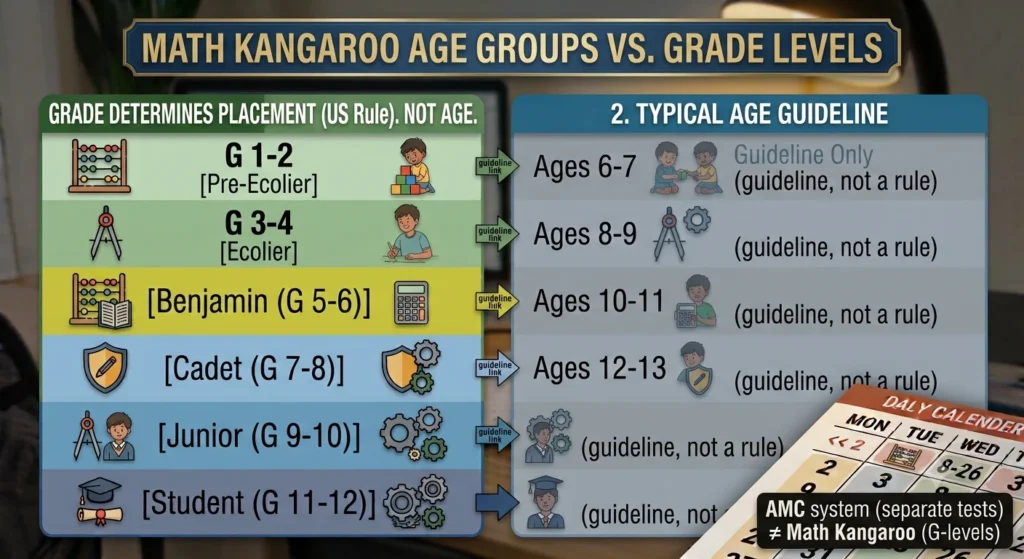
It doesn’t. Placement is grade-strict in the US, and the “typical age” column above is a guideline only, not a rule.
A student who is a year older or younger than the typical range for their grade still sits the paper matching their current grade, not their age.
This is a different structure from the AMC 10 vs AMC 12 system, where eligibility is also grade-based but the two contests are separate exams rather than a single shared paper split by ranking group.
How Math Kangaroo Compares to Other Competitions
Families often ask how Math Kangaroo stacks up against other options on the competition math calendar.
If you’re weighing which contest fits your child’s stage, our Math Kangaroo vs AMC comparison breaks down format, difficulty, and timing differences.
For those exploring the wider olympiad landscape beyond Kangaroo, the difference between the Math Olympiad and Kangaroo Math guide covers how the two tracks diverge in structure and purpose.
How to choose practice difficulty
Your child’s contest level is fixed by their grade but the practice difficulty isn’t.
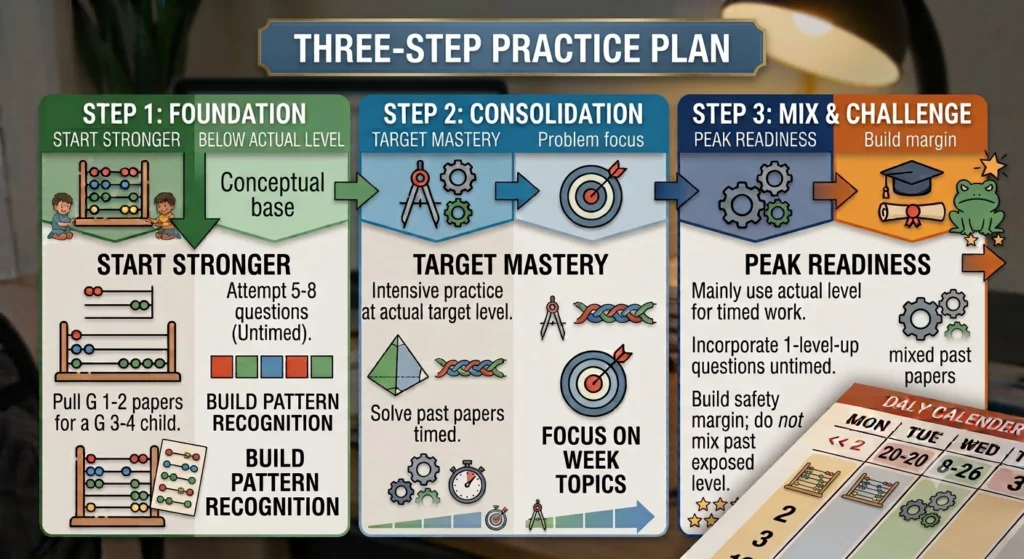
Here’s how to set it.
Step 1: Start one grade below their contest level. Pull a past paper from the free Math Kangaroo samples at the level below your child’s grade. Have them attempt 5–8 questions untimed. The goal is to build pattern recognition without intimidation.
Step 2: If they solve those comfortably, move to their actual level. Most kids land here within a week or two.
Step 3: For the final month before the contest, mix levels. Use their actual level for timed work, but throw in occasional one-level-up questions to build a comfortable safety margin. Never mix up to a level your child hasn’t been exposed to yet — it backfires into discouragement.
For the full practice-planning framework, see our Math Kangaroo past papers guide and how to prepare for Math Kangaroo.
My child is in 3rd grade. Can they choose to take the Ecolier or Pre-Ecolier paper?
No. In the US, Math Kangaroo assigns the paper based on grade, not student choice. A 3rd grader takes Ecolier. This differs from a few international organizations that allow grade-3 students to choose Pre-Ecolier the US rule is grade-strict.
My child is in kindergarten. What level do they take?
Per Math Kangaroo USA, kindergarten students are welcome to participate at the grade 1 level, which means they sit the Pre-Ecolier paper. It’s a stretch for most K students, so read questions aloud, sit nearby for support, and treat the day as a fun outing rather than a performance.
My 4th grader is mathematically advanced. Can they sit the Ecolier paper at the 3rd grade or skip to Benjamin?
They sit Ecolier with their grade. Their score will be ranked against other 4th graders, not the 3rd graders who took the same paper. If they’re ready for more challenge, the right move is structured practice at the Ecolier difficulty not skipping levels.
Why are the level names French?
The Math Kangaroo competition was founded in France in 1991. Its full name is Kangourou sans frontières (“Kangaroo without borders”). The level names Pre-Ecolier, Ecolier (schoolchild), Benjamin (youngest), Cadet, Junior, and Student are the original French categories preserved across all 80+ participating countries. They’re a nice reminder that your child is competing the same week as millions of children worldwide.
What is a good Math Kangaroo score for my child’s level?
There’s no universal passing score. Scores are evaluated against that year’s grade cohort, and top performers in each grade earn medals or certificates of merit. Focus on your child’s own progress across practice sessions rather than comparing raw scores across levels.
Make Preparing for Math Olympiad Simple!



Conclusion
Math Kangaroo’s level system looks complicated from the outside, but it comes down to one rule: grade determines the paper, and each child is scored only against their own grade.
Once you know which of the six levels, Pre-Ecolier, Ecolier, Benjamin, Cadet, Junior, or Student, your child falls into, the rest is just matching practice difficulty to that level and building comfort before test day.
Use the grade chart above as your reference point, start practice one level down if your child is new to competition math, and move up once they’re solving comfortably.